Korean J Gastroenterol Vol. 66 No. 1, 55-58 http://dx.doi.org/10.4166/kjg.2015.66.1.55 pISSN 1598-9992 eISSN 2233-6869
CASE REPORT
Korean J Gastroenterol, Vol. 66 No. 1, July 2015 www.kjg.or.kr
담도유두종 환자에서 광역학치료 후 간용적 보존 수술 1예
정진옥, 임진홍, 박준성, 박승우1, 김현기2, 김경식
연세대학교 의과대학 외과학교실, 내과학교실1, 병리학교실2
Volume-reserving Surgery after Photodynamic Therapy for Biliary Papillomatosis: A Case Report
Chin Ock Cheong, Jin Hong Lim, Joon Seung Park, Seung Woo Park1, Hyun Ki Kim2, and Kyung Sik Kim Departments of Surgery, Internal Medicine1, and Pathology2, Yonsei University College of Medicine, Seoul, Korea
Biliary papillomatosis is rare, and its pathogenic mechanisms are not yet clear. Because of its high risk for malignancy trans- formation, surgical resection is regarded as a standard treatment. Photodynamic therapy (PDT) has been used by the intravenous administration of hematoporphyrin derivative followed by laser exposure. A photochemical process causes disturbance of the microvascular structure and degradation of membrane. Cholangitis is a major complication after PDT. A healthy 56-year-old man was diagnosed with biliary papillomatosis involving the common hepatic duct, both proximal intrahepatic bile ducts (IHD), and the right posterior IHD. After biliary decompression by endoscopic nasobiliary drainage, PDT was performed to avoid extensive liver resection and recurrence using endoscopic retrograde cholangiographic guidance. After portal vein embolization, the patient underwent extended right hemihepatectomy. Following administration of chemoradiation therapy with tegafur-uracil and 45 Gy due to local recurrence at postoperative 13 months, there was no local recurrence or distant metastases. This is the first case report on PDT for biliary papillomatosis in Korea. Preoperative PDT is beneficial for reducing the lesion in diffuse or multifocal biliary papillomatosis and may lead to curative and volume reserving surgery. Thus, PDT could improve the quality of life and prolong life expectation for biliary papillomatosis patients. (Korean J Gastroenterol 2015;66:55-58)
Key Words: Papilloma, intraducal; Hepatectomy; Photochemotherapy
Received October 28, 2014. Revised February 10, 2015. Accepted February 23, 2015.
CC This is an open access article distributed under the terms of the Creative Commons Attribution Non-Commercial License (http://creativecommons.org/licenses/
by-nc/4.0) which permits unrestricted non-commercial use, distribution, and reproduction in any medium, provided the original work is properly cited.
Copyright © 2015. Korean Society of Gastroenterology.
교신저자: 김경식, 120-752, 서울시 서대문구 연세로 50-1, 세브란스병원 외과
Correspondence to: Kyung Sik Kim, Department of Surgery, Severance Hospital, 50-1 Yonsei-ro, Seodaemun-gu, Seoul 120-752, Korea. Tel: +82-2-2228-2100, Fax: +82-2-313-8289, E-mail: [email protected]
Financial support: None. Conflict of interest: None.
INTRODUCTION
Biliary papillomatosis, also known as benign papillary ad- enoma, is a rare disease characterized by multiple intra- ductal papillary tumors in the intrahepatic duct or extra- hepatic duct with proliferated columnar epithelial cells.1 However, it should be regarded as premalignancy disease with adenoma-carcinoma sequence.1 Pathogenic mecha- nisms are not yet clear, although biliary papillomatosis is known to be associated with recurrent pyogenic cholangitis
and chronic biliary ductal inflammation.2 Infection, clonorch- iasis or pancreatic juice reflux causes extensive proliferation of biliary epithelial cells, followed by the dysplasia-carcinoma sequence.2 Papillomatosis of the bile duct can cause bile duct obstruction and dilatation. Patients usually present with abdominal pain, jaundice, and acute cholangitis. Mechani- cal obstruction due to enlarging papilloma can cause septic cholangitis and hepatic failure.
Biliary papillomatosis is likely probably misdiagnosed of- ten as biliary stones and typically remains unrecognized for
56 정진옥 등. 담도유두종 환자에서 광역학치료 후 간용적 보존 수술
The Korean Journal of Gastroenterology
Fig. 1. (A) Two-dimensional thick-sec- tion rapid acquisition with relaxation enhancementimage shows an irre- gular intraluminal filling defect in the common bile duct and left intra- hepatic duct (arrows). Both intrahe- patic ducts are dilated. (B) Papillary atypical epithelial proliferation in the left intrahepatic duct 1st portion before photodynamic therapy (H&E stain, ×100).
a long time. Thus, patients typically experience aggravated papillomatosis before presenting, and have to undergo ex- tensive liver resection after diagnosis. Naturally, due to wor- sening prognoses and delayed diagnosis, resection may not be possible.
The mean survival period following resection was 28 months; patients without resection had a survival period of less than 11 months.2 Surgical resection has been consid- ered the only therapeutic option for biliary papillomatosis patients. However, it can often remain incomplete because of high risk of recurrence or multifocality. Liver transplanta- tion is also regarded as curative treatment.3 Patients could undergo percutaneous transhepatic biliary drainage (PTBD) to relieve their symptoms before surgery. Biliary papilloma- tosis is a disease of advanced age in the sixth-to-seventh dec- ade of life and is twice as common in males as females.4 Preoperative evaluation includes CT scan, MRI, and/or ERCP.
CASE REPORT
A healthy 56-year-old man was diagnosed with common bile duct (CBD) stenosis by MRI during a routine checkup in December 2011. ERCP revealed a suspicious papillomatosis involving the common hepatic duct (CHD), both proximal in- trahepatic bile ducts (IHD), and the right posterior IHD. Papil- lary dysplasia of CHD was confirmed by the biopsy. Tumor marker (CEA, 1.3 U/mL; CA 19-9, 8.0 U/mL) was normal.
Serum AST/ALT was 28/25, and the cholestatic enzymes (ALP, 276 IU/L; GGT, 103 IU/L) were mildly elevated. After bili- ary decompression by endoscopic nasobiliary drainage, the patient was transferred to our institution for surgery (Fig. 1).
Before surgery, PTBD was performed at S3 IHD, and biliary
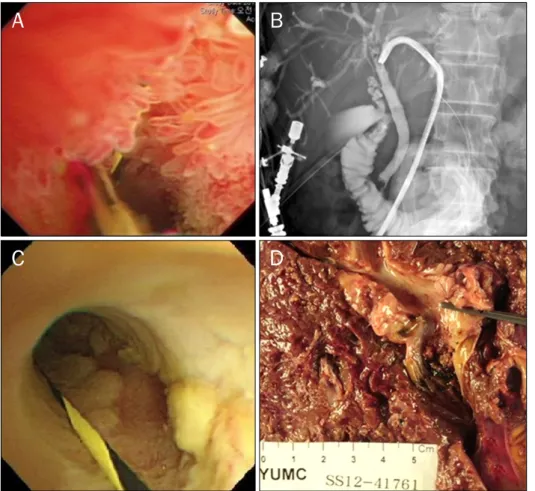
ductal dilatation was performed twice by 12 Fr and 18 Fr cath- eter at a two-day interval. Intraductal papillomatory change from distal CBD to right posterior IHD and left IHD 2nd portion was found on percutaneous transhepatic cholangioscopy (PTCS) (Fig. 2). Two weeks later, photodynamic therapy (PDT) was performed to avoid extensive liver resection and recur- rence. First, PDT was performed from the point of the hilum to mid-CBD and the left and right IHD with 180 J for 450 sec- onds, three times during one day. One day later, a second round of PDT was performed only from the hilum to the left IHD twice at the same dosage. The patient presented with acute cholangitis with fever and bilirubin elevation (highest total bilirubin 7.2) after procedures. Symptoms disappeared, and bilirubin was down by administration of intravenous antibiotics.
There was no evidence of obstruction, severe stricture, or remnant papillomatosis of the CBD and both IHD on PTCS one month after the second round of PDT, and all of the previously detected papillomatosis lesions were improved. After portal vein embolization, the patient underwent extended right hemihepatectomy in June 2012. There was no intraperi- toneal metastasis, and complete resection was performed (Fig. 2). Pathologic results showed total necrotic change of IHD with chronic cholangitis, hepatolithiasis, and foreign body reaction was observed, and there was no lymphatic metastasis.
After postoperative 13 months, PTCS was followed and granulomatous tissue and IHD stones were found on the left main duct. The biopsy result showed local recurrence with papillary atypical epithelial proliferation from anastomosis site to left IHD. After postoperative 13 months, chemo- radiation therapy with tegafur-uracil and 45 Gy was ad-
Cheong CO, et al. Volume-reserving Surgery after Photodynamic Therapy for Biliary Papillomatosis 57
Vol. 66 No. 1, July 2015
Fig. 2. (A, B) Percutaneous transhe- patic cholangioscopy before photo- dynamic therapy (PDT) shows diffuse biliary papillomatosis from the distal common bile duct to the left intrahe- patic duct 2nd portion. (C) Damaged epithelial cells and scars after PDT, and there is no evidence of remnant papillomatosis. (D) Pathologic speci- men from right extended hepatec- tomy.
ministered due to local recurrence. There were no local recur- rences or distant metastases afterwards.
DISCUSSION
This study is the first case report on PDT with volume re- serving surgery in Korea. The patient was still alive over 30 months despite local recurrence. Biliary papillomatosis had been regarded as benign or low malignant potential, but a re- cent review reported a high rate of malignant occurrence (41%),2,5,6 and a single center in Korea reported malignant occurrence in 83% of 58 patients.7 Resection is usually rec- ommended for treatment of biliary papillomatosis, and re- sectability depends on the location and extent of disease be- cause of the malignancy, high recurrence rates, and multi- focality.
PDT was established for treatment of Barrett’s esophagus, lung cancer, and bile duct cancer8 and was first reported in 1991 by McCaughan et al.9 for treatment of extrahepatic bile duct cancer. It may be a suitable therapeutic choice for pa- tients with recurrent biliary papillomatosis after resection or
who are not eligible for surgery. PDT has been used by means of intravenous administration of hematoporphyrin derivative and followed by laser exposure with proper wavelength. After local application, a photosensitizing agent concentrates in the lesion.
In general, the argon dye laser has been used with con- tinuous wave and penetrates with the thermal change in the biliary papillomatosis lesion.10 The pulsed excimer dye laser penetrates into deeper layers and activates the photosen- sitizer more effectively without thermal change.10 The sub- sequent destruction of neoplastic tissue is a photochemical process which contributes to disturbance of the microva- sculature and degradation of membrane by oxygen radicals.8 PDT was performed using ERCP guidance. Cholangitis is a major complication after PDT,10 thus biliary drainage is in- evitably required for prevention of cholangitis and biliary sepsis.
Diffuse biliary papillomatosis shows a high recurrence rate after surgical resection. Thus, radical hepatectomy or liv- er transplantation is the preferred therapeutic choice for bilo- bar or recurrent disease. Successful PDT can be ancillary for
58 정진옥 등. 담도유두종 환자에서 광역학치료 후 간용적 보존 수술
The Korean Journal of Gastroenterology
achievement of R0 resection, avoiding extensive resection or re-operation in advanced intrahepatic and extrahepatic papillomatosis. It can give good results for the patient in terms of better quality of life and prolonged lifespan.
The mean survival period following resection was 28 months; patients without resection had a survival period of less than 11 months.2 Surgical resection has been consid- ered the only therapeutic option for biliary papillomatosis patients. However, surgical resection can often remain in- complete, with a high risk of recurrence or multifocality. Thus, liver transplantation is also considered to be curative treat- ment.3 In this case, the patient had PDT, and extensive surgi- cal resection was avoided.
Some patients could not be treated surgically because of their comorbidities, such as cardiopulmonary disease, and the extent of the carcinoma. PDT could have been used as a local cancer therapy, especially for elderly patients. Suzuki et al.10 reported on the efficacy of PDT for bile duct carcinoma in four elderly patients for whom surgery was not possible.
Three of four patients survived over 20 months without surgi- cal resection, showing improvement in survival compared with 11 months survival without resection. In another case report of a successful PDT for biliary papillomatosis in the dis- tal CBD in Turkey, the patient survived for 10 years.8 This pa- tient underwent the Whipple procedure in 1996 and a 2nd operation, right hepatectomy and hepaticojejunostomy was performed in 2002 because of recurrence. Due to recur- rence again in 2004 and 2005, photodynamic therapy was administered, because repeated operations were no longer possible. After three applications of PDT, bile duct epithelium showed normal macroscopic and histological appearance.
He died in 2006 of multi organ failure because of pneumonia and decompensated liver cirrhosis.
Nevertheless, this case also shows that PDT could improve the quality of life and prolong life expectation when compared with median survival rate. In Korea, only a few biliary papil- lomatosis cases have been reported. However, most of them underwent surgical resection or palliative drainage for ob- struction.
In conclusion, biliary papillomatosis has malignant poten- cy. It is easily misdiagnosed, even in patients with typical symptoms or when proper preoperative evaluation has been performed. Once diagnosed, surgical resection is considered the only therapeutic option for biliary papillomatosis, and the survival rate is very low after resection. Furthermore, many patients require repeat or extensive surgery because of re- currence after resection. Therefore, PDT can be considered as a beneficial treatment for patients with bilobar or recur- rent biliary papillomatosis after resection. It can show good results in terms of quality of life and prolonged lifespan.
REFERENCES
1. Jeen YM, Jin SY. Papillary cholangiocarcinoma arising from bili- ary papillomatosis. Korean J Hepatol 2007;13:239-242.
2. Yeung YP, AhChong K, Chung CK, Chun AY. Biliary papillomatosis:
report of seven cases and review of English literature. J Hepato- biliary Pancreat Surg 2003;10:390-395.
3. Vibert E, Dokmak S, Belghiti J. Surgical strategy of biliary papil- lomatosis in Western countries. J Hepatobiliary Pancreat Sci 2010;17:241-245.
4. Cox H, Ma M, Bridges R, et al. Well differentiated intrahepatic cholangiocarcinoma in the setting of biliary papillomatosis: a case report and review of the literature. Can J Gastroenterol 2005;19:731-733.
5. Ma KF, Iu PP, Chau LF, Chong AK, Lam HS. Clinical and radio- logical features of biliary papillomatosis. Australas Radiol 2000;
44:169-173.
6. Vassiliou I, Kairi-Vassilatou E, Marinis A, Theodosopoulos T, Arkadopoulos N, Smyrniotis V. Malignant potential of intra- hepatic biliary papillomatosis: a case report and review of the literature. World J Surg Oncol 2006;4:71.
7. Lee SS, Kim MH, Lee SK, et al. Clinicopathologic review of 58 pa- tients with biliary papillomatosis. Cancer 2004;100:783-793.
8. Bechmann LP, Hilgard P, Frilling A, et al. Successful photo- dynamic therapy for biliary papillomatosis: a case report. World J Gastroenterol 2008;14:4234-4237.
9. McCaughan JS Jr, Mertens BF, Cho C, Barabash RD, Payton HW.
Photodynamic therapy to treat tumors of the extrahepatic biliary ducts. A case report. Arch Surg 1991;126:111-113.
10. Suzuki S, Inaba K, Yokoi Y, et al. Photodynamic therapy for malig- nant biliary obstruction: a case series. Endoscopy 2004;36:
83-87.