The effect of cavity configuration on the mechanical properties of resin composites
Gil-Joo Ryu, Sang-Jin Park, Kyoung-Kyu Choi
Department of Conservative Dentistry, College of Dentistry, Kyung Hee University
중합환경에 따른 복합레진의 물리적 성질에 관한 연구
류길주∙박상진∙최경규 경희대학교 치과대학 보존학교실
이 연구의 목적은 와동의 형태가 굴곡강도와 탄성계수 등 복합레진의 물리적 성질에 미치는 영향을 평가하는 것이다.
복합레진은 ClearfilTM AP-X(Kuraray, Japan)와 Esthet-XTM(Dentsply, USA)가 이용되었으며, 상아질 접착제는 ClearfilTM SE Bond(Kuraray, Japan)와 Prime & Bond NTTM(Dentsply, USA)를 사용하였다. 대조군의 시편은 split steel mold(25mm×2mm×2mm) 내에 상기 2종류의 복합레진을 충전하여 2개의 대조군 시편을 제작하였으며, 2.4 및 3.4의 C-factor를 부여하기 위한 유리 모형와동을 제작하고, 와동 내에 상기 2종류의 복합레진을 충전하기 전 유리와동의 내면은 sandblasting 처리하고 각각의 복합레진과 동일회사 제품의 상기 상아질 접착제로 처리한 후, 복합 레진을 각각 충전하여 4개의 실험군을 제작하였다. 제작된 실험군 시편은 저속 diamond saw로 충전된 복합레진 부위 의 중심부를 통과하도록 절단하여 레진기둥(25mm×2mm×2mm)이 되도록 제작하였다. 제작된 시편을 37℃의 증류 수에 24시간 동안 보관 후, 만능시험기(EZ Test, Shimadzu, Japan)를 이용하여 분당 1mm의 crosshead speed로 3 점 굴곡강도를 측정하였다. 또 Linometer(R&B, Korea)를 이용하여 복합레진의 중합수축량을 측정하였으며, 굴곡강 도측정 후 시편의 파단면은 주사전자현미경(S-2300, Hitachi, Japan)을 이용하여 관찰하였다. 실험결과의 통계분석 은 95% 수준의 one-way ANOVA/Tukey’s test를 이용하여 결과를 얻었다. 실험에 이용된 2종류 복합레진의 굴곡강 도와 탄성계수는 C-factor의 증가에 따라 감소하였으며, 파단면 또한 C-factor의 증가에 따라 더 불규칙해지는 양상을 나타내었다.
본 실험의 결과 hybrid형 복합레진이 micro-hybrid형 복합레진에 비해 C-factor의 영향을 더 많이 받는 것으로 나타 났으며, 와동의 C-factor 증가가 굴곡강도나 탄성계수와 같은 복합레진의 물리적 성질을 저하시킨다는 것을 의미하였 다.
Ⅰ. INTRODUCTION
Although dental composites has been improved and widely used, there are still some undesirable charac- teristics, which affect their performance.
One of them is the shrinkage that inevitably occurs during polymerization as monomer molecules are con- verted into a polymer network, exchanging Van der Waals spaces for shorter covalent bond spaces. This shrinkage produces contraction stress in confined structures such as a tooth cavity. The majority of the
contraction stress of composite occurs during the ini- tial polymerization period after gelation, and the stress development rate decreases gradually with time1). Before gelation, most of contraction stresses caused by polymerization shrinkage relieved by flow capacity of the resin composite. The contraction stress in dental composite plays an important role in marginal adaptation2). The internal stress generated in the restricted environment of a tooth cavity can exceed the adhesive bond strength and produce a delamination of the restoration interface3). In cases 국문초록
where higher bond strength is present, this stress may fracture the marginal tooth substrate and/or the composite restoration itself4). Either case results in the formation of a marginal gap, allowing for the pos- sible ingress of oral fluids and bacteria through leak- age. It is not easy for leakage around the cavity wall to be clinically detected immediately after placement.
However, the marginal leakage can be caused post- operative sensitivity, and may eventually produce discoloration of the margins and/or recurrent caries, and consequently may reduce the life of a restora- tion.
Due to the reasons mentioned above, throughout its lifetime, the interface between a dental resin and the restored tooth is subjected to the challenge of stresses, which can potentially cause de-bonding and lead to clinical failure of the restorative treatment.
Before the restored tooth is subjected to functional load and thermal strains, an early interfacial stress build-up occurs during the polymerization in situ of resins bonded to tooth tissues. The setting reaction is, in fact, accompanied by volumetric shrinkage of varying magnitude, depending on the resin formula- tion5). The magnitude of the polymerization contrac- tion stress has been found to be dependent on the ratio of the bonded to free, unbonded surface area of the sample6-8), on the material properties of the resin composite1,6,9,10)and on the amount of compliances of the substrate materials6,11,12).
Among the material properties, which are thought to reduce early interfacial stress build-up is the abili- ty to undergo plastic flow during the early phase of polymerization. Plastic flow allows part of the shrink- age to take place without stress build-up at the
interface and will determine the proportion of remaining shrinkage that manifests itself as determi- nation rigid contraction7). As a result of the rate- dependent character of visco-elastic behavior, slower rates of polymerization reaction have been shown to be associated with lower stress build-up and better interfacial integrity scores1,13-16).
The elastic modulus of the shrinking material has also been found to be a factor on which shrinkage stresses depend. In vitro studies have shown that the interfacial stress during the setting shrinkage of a resin composite is positively correlated with the rigid- ity of the setting material17). The elastic modulus also increases as the polymerization reaction proceeds18).
Polymerization shrinkage and elastic modulus are in close relationship with the survival of the interfa- cial bond. However, so far, little has been done to establish how close that relationship is, starting with task of a systemic characterization of the relevant properties of resin composites.
In this aspect, the present study was designed to evaluate the effect of cavity configuration on the mechanical properties of resin composites by measur- ing flexural strength, elastic modulus, polymerization shrinkage and examination of the fractured surfaces of resin composites cured in the cavities with differ- ent configuration.
Ⅱ. MATERIALS AND METHODS
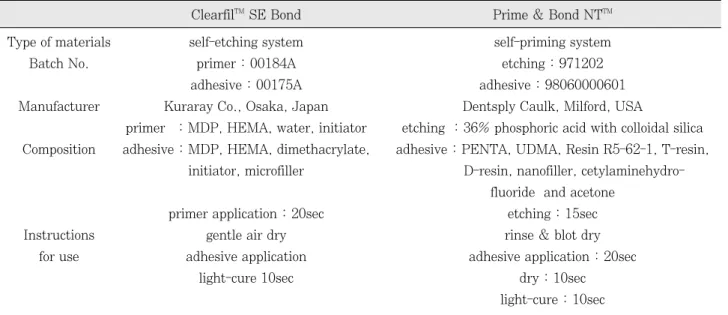
Two composite resins(Table 1) and their corre- sponding dentin bonding agents(Table 2) were used in this study. The 48 specimens of control group and two experimental groups of each resin composite Table 1.Resin composites used in this study.
Type of Materials hybrid composite micro-hybrid composite
Batch No. 0526A 530059
Manufacturer Kuraray Co., Osaka, Japan Dentsply Caulk, Milford, USA
Filler content 84.5 W% 77.0 W%
barium glass bariumalumino fluorosilicate glass
Mean particle size silicone dioxide : 0.6�0.8㎛ (0.02�2.5㎛)
: 3.0㎛ (0.1�15㎛) silicone dioxide nanofiller : 0.01�0.02㎛
ClearfilTMAP-X Esthet-XTM
were made according to the configuration factor (Table 3).
1. Specimen fabrication
The specimens of control group of each resin com- posites were made in a split steel mold (25×2×
2mm, Fig. 1) with top and bottom surfaces covered by a clear matrix. The specimens(n=8) were made with light irradiation(60s) in the curing unit(LABO- LIGHT LV Ⅰ, GC, Japan) on both the top and bot- tom surfaces. The specimens were stored in distilled water at 37℃ for 24hours prior to testing. In experi- mental groups, the specimens of each resin composite with 2.4 configuration factor(C-factor)(AC2 & EC2) were made in a simulated cavity(25×5×3mm) made of glass plates. Before filling the resin into the cavity, the inner surfaces of the glass cavities were sand- blasted and treated with silane and corresponding
dentin bonding systems. The specimens were made with light irradiation(60s) in the curing unit on both the top and bottom surfaces. Then the specimens were cut with slow speed diamond saw (ISOMET, Buehler, USA) under copious water to make resin bars(25×2×2mm). The storage and testing proce- dures of specimens were carried as same as control groups.
The specimens of each resin composite with C-fac- tor of 3.4(AC3 & EC3) were made as the same pro- cedures as the specimens with C-factor of 2.4, but the size of the simulated cavity(25×5×5mm) was different.
2. Flexural strength and elastic modulus de- termination
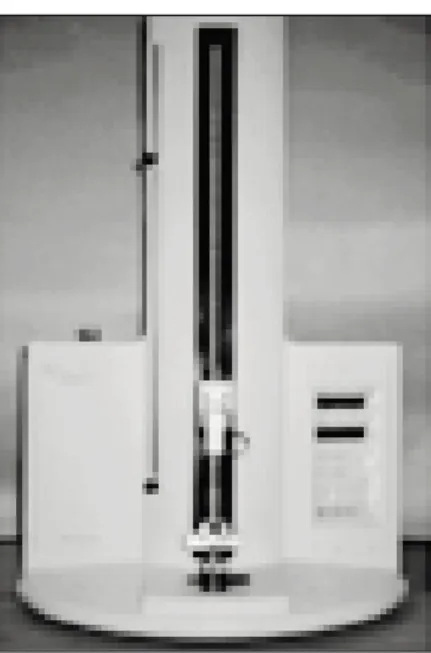
Flexural strength and elastic modulus were evalu- ated in three-point bending by International Standards Organization(ISO) 4049 for testing of resin-based filling materials reported previously19). The specimens were tested on a universal testing machine(EZ Test, Shimadzu, Japan, Fig. 2) in bend- ing on a span of 20mm at a crosshead speed of 1mm/min(Fig. 3). The crosshead travel of the uni- versal testing machine was synchronized with the motion of the strip chart. The slope of the linear por- tion of the load-versus-time curve was used in the Table 2.Dentin bonding agents used in this study.
Type of materials self-etching system self-priming system
Batch No. primer : 00184A etching : 971202
adhesive : 00175A adhesive : 98060000601
Manufacturer Kuraray Co., Osaka, Japan Dentsply Caulk, Milford, USA
primer : MDP, HEMA, water, initiator etching : 36% phosphoric acid with colloidal silica Composition adhesive : MDP, HEMA, dimethacrylate, adhesive : PENTA, UDMA, Resin R5-62-1, T-resin,
initiator, microfiller D-resin, nanofiller, cetylaminehydro- fluoride and acetone
primer application : 20sec etching : 15sec
Instructions gentle air dry rinse & blot dry
for use adhesive application adhesive application : 20sec
light-cure 10sec dry : 10sec
light-cure : 10sec
ClearfilTMSE Bond Prime & Bond NTTM
Table 3. Code of control and experimental group by C-factor. (n=8)
ClearfilTMAP-X ACO AC2 AC3
Esthet-XTM `ECO` EC2` EC3
Material Control C=2.4 C=3.4
(c<1.0)
calculation of the modulus, according to the followed equation ;
Flexural strength calculation : 3 P∙L / 2 b∙W2
P : Maximum load at fracture L : Length of the span(20mm) b : Thickness of the specimen w : Width of the specimen
Elastic modulus calculation : P∙L3/ 4 d∙b w3
P : Change of the load L : Length of the span d : Crosshead travel
b : Thickness of the specimen w : Width of the specimen
3. Polymerization shrinkage determination
The amount of the linear contraction of two resin composites were determined with Linometer(R & B, Korea). A small amount of resin composite(about 30mg) was placed on the thin stainless steel disk(25mm diameter, 0.5mm thickness) and covered with slide glass. The resin composite was cured for 60seconds. Since the disk was attached to the com- puterized sensor, if polymerization contraction occurs, the steel disk was raised and the sensor detected how long distance the disk moved.
The shrinkage data was obtained for 60 seconds with data interval of 0.5 second.
4. Examination of the fractured surface
After flexural strength testing, a fragment of the fractured specimens was selected randomly, sputter coated with gold and examined the fractured surfaces
with scanning electron microscope(S-2300, Hitachi, Japan). Then the characteristics of the specimens of control and experimental groups were compared.
5. Statistical analysis
The data obtained from above experiments was evaluated using one-way analysis of variance(ANO- VA) / Tukey’s test at α≤0.05 level.
Ⅲ. RESULTS
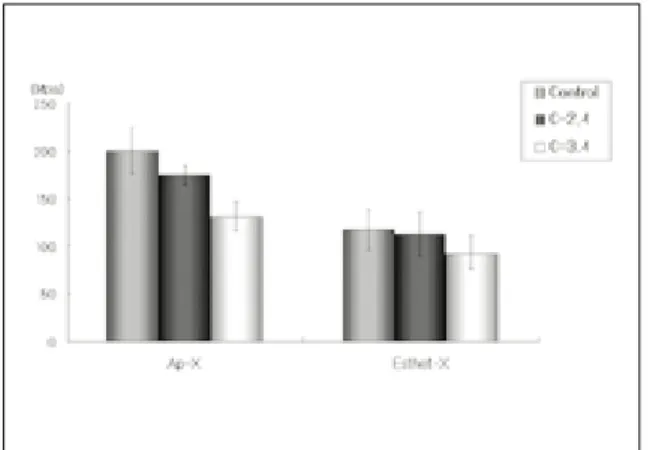
1. Flexural strengthThe flexural strength was decreased with increas- ing of configuration factor of the specimen. The flex- ural strength of ACO was much higher than that of AC2 and AC3, and there was significant difference among the test groups using ClearfilTMAP-X(p<0.05).
In the groups using Esthet-XTM, each flexural strength showed no significant difference(p>0.05).
2. Elastic modulus
The elastic modulus was decreased with increasing of configuration factor. The elastic modulus of control groups was significantly higher than that of experi- mental groups, though there was no significant dif- ference between experimental groups for each resin composite (p>0.05).
3. Polymerization shrinkage determination
The polymerization shrinkage of ClearfilTM AP-X is much less than that of Esthet-XTM. Probably, the fact is due to the difference of filler content between two resin composites (Table 1).
Table 4.Flexural strength (MPa±S.D.) of the experimental groups.
ClearfilTMAP-X 200.79±25.01a 174.77± 9.7b 131.07±15.7c
Esthet-XTM 117.48±20.72A 112.45±23.7A 93.44±17.71A
Resin composite Control C=2.4 C=3.4
4. SEM examination of fractured surface
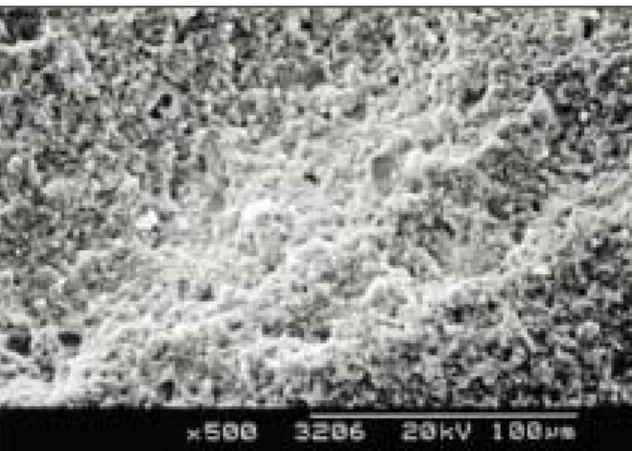
Fractured surface of the specimens of group ACO(Fig. 7, 8) showed smooth and homogenous appearance, but those of the specimens of the group AC2(Fig. 9) and AC3(Fig. 10) showed irregular and rough features. Especially, the specimen of group AC3 showed crack lines at the fractured surface. It means that there was stress concentration within the
resin mass during polymerization.The examination of the groups using micro-hybrid composite(Fig. 11, 14) was similar to that of hybrid composite, but general features of fractured surfaces were smoother than those of hybrid composite.
Ⅳ. DISCUSSION
The contraction stress of resin composite depends upon the type and level of filler included. Generally, an increased filler loading contribute to reduced poly- merization shrinkage, since the overall polymeriza- tion shrinkage depends on the amount of polymer matrix presented20,21). The higher stiffness leads to increased stress for a given contraction strain, according to Hooke’s law. (E=κσ/ε, E : Elastic mod- ulus, κ: Proportional constant, σ: Stress, ε:
Strain). Therefore, the composite stiffness and the amount of contraction both play important roles in the generation of stress in dental composite restora- tion. In this study, hybrid type resin composite showed higher mechanical properties(flexural strength and elastic modulus) than micro-hybrid Fig. 4.Flexural strength of the experimental groups.
Fig. 5.Elastic modulus of the experimental groups. Fig. 6. Polymerization shrinkage of two resin composites.
Table 5.Elastic modulus (GPa S.D.) of the experimental groups
ClearfilTMAP-X 10.96±0.94a 8.04±0.44b 7.60±1.26b
Esthet-XTM 7.49±0.81A 5.07±1.01B 4.47±0.54B
Resin composite Control C=2.4 C=3.4
composite for all configuration factor(p<0.05).
Generally, it is accepted that an increased filler level should contribute to increased mechanical properties and reduced polymerization shrinkage. From the polymerization shrinkage graph in this study, the gel-point of hybrid composite was found to be occurred earlier than micro-hybrid composite. During the period before occurring gel-point(pre-gel stage), the developing contraction stresses can be relieved due to the flow capacity of the material, but after gel-point(post-gel stage), the flow capacity of the material decreased and the developing contraction stress can cause microdefect or cracks in the materi- als. The specimen being stressed, the defect and/or cracks played a role as stress raiser and the mechan- ical properties decreased. The lower elastic modulus and higher shrinkage of the micro-hybrid composite is indirect evidence that flow capacity is achieved mainly by increasing the proportion of monomer in the formulation of the composite pastes. So despite of the less polymerization shrinkage, hybrid composite was affected more than micro-hybrid composite by increase of C-factor.
In SEM, the fractured specimens of the groups of ClearfilTM AP-X showed rougher surfaces than those of Esthet-XTM. The phenomenon was maybe due to the difference of filler particle size between the resin composites. The mean filler particle size of hybrid and micro-hybrid composite was 3.0
μ
m and 0.6 0.8μ
m, respectively. Indeed, the specimens with lower configuration factor showed smoother appearance than those with higher configuration factor.Generally the fact is accepted that the higher the configuration factor of the cavity, the more stresses develop. So resin composites filled in the cavity with higher configuration factor experience severe contrac- tion stresses during polymerization and the forces can cause crack in the resin mass. Flexural and/or tensile strength are significantly changed by the presence of defects due to generation of stress con- centrations. In brittle materials such as dental resin composites or porcelain, microcracks which exist on the surface or inside the material, decrease the material strength22).
It is supposed that as the configuration factor of the cavity increased, the flow capacity of the resin com-
posites decreased and more stresses occurred that cause detrimental effect on the mechanical properties of the resin composites in the restricted polymeriza- tion environment.
There have been many studies about the effect of polymerization shrinkage on dentin bonding23-29), and it is shown that polymerization shrinkage can cause contraction stress which has detrimental effect on the bond strength between resin composites and tooth structures. But, there are few studies about the effect of contraction stresses on the mechanical prop- erties of the resin composites. In this study, the flex- ural strength and the elastic modulus of resin com- posites had a tendency to decrease with increase of the C-factor. In case of hybrid type composite, the flexural strengths of test groups showed significant difference(p<0.05), but those of micro-hybrid compos- ite were not significantly different(p>0.05). It may be due to the filler content of the resin composite.
Hybrid type composite used in this study had higher filler content(84.5wt%) than micro-hybrid type resin composite(77.0wt%).
So, hybrid composite showed less polymerization shrinkage than micro-hybrid composite. But despite of the less shrinkage, the higher elastic modu- lus(10.96±0.94GPa) and earlier emergence of gel- point of hybrid composite makes it more influenced by increase of C-factor than micro-hybrid composite.
In clinical situation, many dentists have faced to problem related to the contraction stress of resin composite. Actually, the contraction stress of resin composites and bonding agents under clinical situa- tions is much more complex than what was previous- ly thought. The high values of contraction stress reported from some studies for specific configurations of restorations may overcome the bond strength of resin to dentin. This might explain a large number of bond failures and gap formation frequently observed in studies with bonding agents. However, an early interfacial stress build-up occurs during the polymer- ization in situ of resins bonded to tooth structures.
Moreover, under the rigid set-up situation(in case that bond strength is higher than contraction stress), the contraction stresses may affect the mechanical properties of resin composites.
There are several solutions to the competition
between the bond strength of resins to dentin and the forces of polymerization contraction.
One approach of these solutions is to develop dentin bonding agents that are able to develop imme- diate bond strengths that are greater than those developed by polymerization contraction and are equal to those obtained to acid-etched enamel. But, this can cause another problem, that is, the restrict polymerization environment decrease the mechanical properties of the resin composites.
A second solution is to cover the bonded surfaces with an elastic cavity liner. This acts as a “shock- absorber”and places a low modulus material between the relatively rigid dentin and resin compos- ite30). The resin interdiffusion zone generated as the main bonding mechanism of most of the current dentin bonding systems may also function as a stress relaxation layer, since it has a lower modulus than the underlying mineralized dentin31).
A third solution is to insert resin composites in increments to reduce the volume of the resin that is shrinking during polymerization. The use of reduced amounts of resin to be polymerized at each increment has been shown to reduce the stresses generated to the cavity walls15). Incremental filling techniques actually lower the C-factor to below 1, since there is usually almost as much free surfaces as bonded sur- face in any single increment.
A fourth solution is development of the new materi- als. Several researchers are attempting to develop new resin composites that do not shrink when they polymerize32). For example, Spiro- orthocarbonate monomers have been synthesized that expand during polymerization through a double ring-opening process33). Further improvements are being developed to cause sufficient double ring-opening to generate enough expansion to overcome the shrinkage gener- ated by conventional dimethacrylates.
In this study, hybrid type resin composite was more influenced than micro-hybrid composite by increase of C-factor. This fact is due to the difference of time, which gel-point appeared and filler content between the two resin composites. In case of hybrid compos- ite, high filler content makes it more stiff and the earlier emergence of gel-point decrease the flow capacity of the material. The polymerization shrink-
age was proved to have an effect on flexural strength and elastic modulus of composites. The results of this study shown that the higher the C-factor of cavity, the lower the mechanical properties of the resin com- posites.
Then the contraction stress of composites could be caused by polymerization shrinkage affect both bond strength of resin to tooth structures and mechanical properties of resin composites itself.
Ⅴ. CONCLUSION
To achieve successful resin composite restoration, many factors such as volumetric shrinkage of resin mass, configuration factor of the cavity and the type of the resin can be considered. This study was designed to evaluate the effect of configuration factor of cavity on the mechanical properties of resin com- posites such as flexural strength and elastic modulus.
From the results of this study, it can be concluded as follows :
1. The flexural strength of both resin composites was decreased as the C-factor increased. But there were no significant difference among the groups in micro- hybrid resin composite. (p>0.05).
2. The elastic modulus of both resin composites was decreased with increasing the configuration factor.
The elastic modulus of control groups(with C-fac- tor<1) was significantly higher than that of experi- mental groups (p<0.05).
3. The amount of polymerization shrinkage of hybrid composite was less than that of micro-hybrid com- posite. Although hybrid composite was less shrink than micro-hybrid composite, the flexural strength of the former was much affected by increase of the configuration factor.
4. In SEM, the higher the C-factor of the specimens, the rougher the fractured surfaces were. General- ly, the fractured surfaces of the ClearfilTM AP-X showed more irregular pattern than Esthet-XTM, probably due to the difference of the filler particle size and flow capacity between two resin compos- ites.
This study suggests that the mechanical properties of resin composites can be affected by the configura-
tion factor that plays an important role in the con- fined curing environment.
REFERENCES
1. Feilzer A. J., de Gee A. J., Davidson C. L. : Quantitative determination of stress reduction by flow in composite restorations. Dent. Mater., 6 : 167-171, 1990.
2. Uno S., Shimokobe H. : Contraction stress and mar- ginal adaptation of composite restorations in dentinal cavity. Dent. Mater., 13 : 19-24, 1994.
3. Davidson C. L., Van Zeghbroeck L., Feilzer A. J. : Destructive stresses in adhesive luting cements. J.
Dent. Res.,70 : 880-882, 1991.
4. Davidson C. L., de Gee A. J., Feilzer A. J. : The com- petition between the composite-dentin bond strength and the polymerization contraction stress. J. Dent.
Res.,63 : 1396-1399, 1984.
5. Feilzer A. J., de Gee A. J., Davidson C. L. : Curing contraction of composites and glass- ionomer cements.
J. Prosthet. Dent.,59 : 297-300, 1988.
6. Bowen R. L. : Adhesive bonding of various materials toward tooth tissues : VI. forces developing in direct filling materials during hardening. J. Am. Dent. Assoc., 74 : 439-445, 1967.
7. Davidson C. L., de Gee A. J. : Relaxation of polymer- ization contraction stresses by flow in dental compos- ites. J. Dent. Res.,63 : 146-148, 1984.
8. Feilzer A. J., de Gee A. J., Davidson C. L. : Setting stresses in composite resin in relation to configuration of the restoratives. J. Dent. Res., 66 : 1636-1639, 1987.
9. Hegdahl T., Gjerdet N. R. : Contraction stresses of composite resin filling materials. Acta Odontol.
Scand., 35 : 191-195, 1977.
10. Bowen R. L., Nemoto K., Rapson J. E. : Adhesive bonding of various materials to hard tooth tissues : forces developing in composite materials during hard- ening. J. Am. Dent. Assoc., 106 : 475-477, 1983.
11. Kemp-Scholte C. M., Davidson C. L. : Marginal seal- ing of curing contraction gaps in class Ⅴ composite resin restorations. J. Dent. Res.,67 : 841-845, 1988.
12. Alster D., Feilzer A. J., de Gee A. J., Davidson C. L. : Polymerization contraction stress in thin resin compos- ite layers as a function of layer thickness. Dent.
Mater.,13 : 146-150, 1988.
13. Feilzer A. J., de Gee A. J., Davidson C. L. : Setting stresses in composites for two different curing modes.
Dent. Mater., 9 : 2-5, 1993.
14. Feilzer A. J., Dooren L. H., de Gee A. J., Davidson C.
L. : Influence of light intensity on polymerization shrinkage and integrity of restoration - cavity inter- face. Eur. J. Oral Sci.,103 : 322-326, 1995.
15. Lutz F., Krejci I., Barbakow F. : Quality and durabili- ty of marginal adaptation in bonded composite restora- tions. Dent. Mater.,7 : 107-113, 1991.
16. Mehl A., Hickle R., Kunzelmann K. H. : Physical properties and gap formation of light cured composites with and without ‘soft start polymerization’. J. Dent., 25 : 321-330, 1997.
17. Feilzer A. J., de Gee A. J., Davidson C. L. :
Relaxation of polymerization contraction shear stress by hygroscopic expansion. J. Dent. Res., 69 : 36-39, 1990.
18. Braem M., Davidson C. L., Vanherle G., Van Doren V., Lambrechts P. : The relationship between testy methodology and elastic behavior of composites. J.
Dent. Mater.,66 : 1036-1039, 1987.
19. Choi K. K., Condon J. R., Ferracane J. L. : The effects of Adhesive Thickness on Polymerization contraction Stress of Composite. J. Dent. Res., 79(3) : 812-817, 2000.
20. Munksgaard E. C., Hansen E. K., Kato H. : Wall-to- wall polymerization contraction of composite resins versus filler content. Scand. J. Dent. Res., 95 : 526- 531, 1987.
21. Iga M., Takeshige F., Ui T., Torii M., Tsuchitani Y. : The relationship between polymerization shrinkage measured by a modified dilatometer and the inorganic filler content of light-cured composites. Dent. Mater., 10 : 38-45, 1991.
22. Kim K. H., Park J. H., Imai Y., Kishi T. : Microfracture Mechanisms of Dental Resin Composites Containing Spherically-shaped Filler Particles. J. Dent.
Res.,73(2) : 499-504, 1994.
23. Labella R., Lambrechts P., Van Meerbeek B., Vanherle G. : Polymerization shrinkage and elasticity of flowable composites and filled adhesives. Dent. Mater., 15 : 128-137, 1999.
24. Yoshikawa T., Sano H., Burrow M. F., Tagami J., Pashley D. H. : Effects of Dentin Depth and Cavity Configuration on Bond Strength. J. Dent. Res.,78(4) : 898-905, 1999.
25. Murray R. Bouschlicher, Marcos A. Vargas, Daniel B.
Boyer : Effect of composite type, light intensity, config- uration factor and laser polymerization on polymeriza- tion contraction forces.Am. J. Dent.,10 : 88-96, 1997.
26. Shigeru UNO, Toru TANAKA, Satoshi INOUE, Hidehiko SANO : The Influence of Configuration Factors on Cavity Adaptation in Compomer Restorations. Dent. Mater. J.,18(1) : 19-31, 1999.
27. Kinomoto Y., Torii M. : Photoelastic analysis of poly- merization contraction stresses in resin composite restorations. J. Dent.,26(2) : 165-171, 1998.
28. Carvalho R. M., Pereira J. C., Yoshiyama M., Pashley D. H. : A Review of Polymerization Contraction : The Influence of Stress Development versus Stress Relief.
Oper. Dent.,21 : 17-24, 1996.
29. Kinomoto Y., Torii M., Takeshige F., Ebisu S. : Comparision of polymerization contraction stresses between self-and light-curing composites. J. Dent., 27(5) : 383-389, 1999.
30. Kemp-Scholte C. M., Davidson C. L. : Complete mar- ginal seal of class Ⅴ resin composite restoration effect- ed by increased flexibility. J. Dent. Res., 69 : 1240- 1243, 1990.
31. Van Meerbeek B., Willems G., Celis J. P., Roos J., Braem M., Lambrechts P., Vanherle G. : Assessment by nano-indentation of the hardness and elasticity of the resin-dentin bonding area. J. Dent. Res., 72 : 1434-1442, 1993.
32. Eick J. D., Robinson S. J., Byerley T. J., Chappelow C. C. : Adhesives and nonshrinking dental resins of the future. Quint. Int.,24 : 632-640, 1993.
33. Stansbury J. W. : Synthesis and evaluation of new
Fig. 1. Split steel mold used in this study
사진부도 ①
Fig. 2. Universal testing machine Fig. 3. 3-point bending procedure
Fig. 7. The fractured surface of the ACO group(×500) Fig. 8. The fractured surface of the ACO group(×
2,000)
사진부도 ②
Fig. 9. The fractured surface of the AC2 group(×500) Fig. 10. The fractured surface of the AC3 group(×500)
Fig. 11. The fractured surface of the ECO group(×500) Fig. 12. The fractured surface of the ECO group(×
2,000)
Fig. 13. The fractured surface of the EC2 group(×500) Fig. 14. The fractured surface of the EC3 group(×500)