Analysis of the Result of Korean Medicine Treatment for Female Subfertility Using Herbal Medicine,
Acupuncture and Moxibustion Treatment
Jae-Cheol Jeong
1, Min-Sun Choi
1, Sang-Ho Yoon
2, Dong-Il Kim
11Department of Obstetrics & Gynecology, College of Korean Medicine, Dongguk University
2Department of Obstetrics & Gynecology, College of Medicine, Dongguk University Original Article
⋅Received:25 December 2014 ⋅Revised:17 June 2015 ⋅Accepted:17 June 2015
⋅Correspondence to:Dong-Il Kim
Department of Obstetrics & Gynecology, College of Korean Medicine, Dongguk University 814 Siksa-dong, Ilsandong-gu, Goyang-City, Gyeonggi-province, South Korea
Tel:+82-31-961-9062, Cell phone:+82-10-4518-7820, E-mail:[email protected] Objectives: To report on the result of infertility treatment with Korean medicine in clinical settings.
Methods: This study was single arm, retrospective observational study. Analysis of the medical records on thirty four infertile women who were treated by acupuncture, moxibustion, herbal medicine(Jokyungjongoktang-gagambang, Sutaehwan-gagambang). Pregnancy rate(PR) and Live birth rate(LBR) were analyzed as the primary outcomes.
Changes of AMH, FSH, LH, E2, P4, endometrial thickness, fat mass, and BMI were also analyzed as the secondary outcomes.
Results: A total of 34 patients were treated in the traditional Korean medical clinic. Nine patients were dropped, and 25 subjects completed the final examination at the end of this treatment schedule. Five of 25 subjects conceived during treatment, reaching 20% PR and LBR was also 20%. Except for FSH level, the results of the remaining outcome measures, including LFT, showed no significant changes. No serious adverse event has been reported.
Conclusion: Although no significant changes in bio-markers were observed, complex treatment using Korean medicine has shown effectiveness on women's infertility. In addition, the safety of the treatment has been verified.
Key Words : infertility, subfertility, pregnancy rate, acupuncture, herbal medicine, traditional Korean medicine
Introduction
South Korea is known as having one of the lowest birth rates in the world, and infertility has been thought to be an important factor causing the low birth rate. As this has been become a social issue, the government has implemented policies to resolve it. The government reinforced economic support for infertile couples in taking assistant reproductive technology(ART) as a main program. This program has helped many infertile couples become pregnant;
however, the clinical pregnancy rate(PR) by this project only increased the success rate to around 30% per cycle. In addition, the ART program was associated with significant stress for infertile couples [1].
Traditional Korean medicine has a long history in treatment of infertility. The effect of Korean medicine has been verified not only in the traditional medical books [2-4], but also in recent studies [5,6].
Based on this supporting evidence and the medical
environment, more than 70% of infertile couples
visited traditional Korean medicine clinics [1]. Thus, we conducted retrospective study from our clinic data in order to overcome the limits of ART to help people suffering from infertility.
Herbal medicine Jokyungjongoktang-gagambang (JKJOT-GGB) and Sutaehwan-gagambang(STH-GGB), acupuncture, and moxibustion treatment were used in our clinic. JKJOT has been widely used in improving female infertility, especially that induced by stress [7]. Some studies have reported on the effect of JKJOT associated with immunological mechanism on stress, hormone changes, and ovulation [8-11]. STH is an herbal medicine used for prevention of miscarriage and some studies have reported that STH was effective for treatment of recurrent miscarriage, threatened abortion. The decoction worked as a positive influence on the maternal immune system for carrying on pregnancy [12-15].
Various studies on the relations between acupuncture and treatment of infertility have been reported. According to in vivo and clinical studies, acupuncture may regulate the function of the hypothalamic-pituitary-ovarian axis and change the concentration of neuropeptides such as β-endorphin, and also affect uterine blood flow and uterine motility [14]. Results of a meta-analysis study showed that acupuncture improved clinical PR and LBR among women undergoing IVF [5].
These evidence-based treatments have been well utilized in traditional Korean clinics. We provided infertile patients with complex and effective treatments.
Materials and Methods
1. Study design and participants
This study was conducted from the medical records of the infertile female patients who had visited at Dongguk University Ilsan Korean medicine
hospital(DUIH) between July 2011 and June 2012.
The inclusion criteria were as follows: women unsuccessful at conceiving for more than one year, even after many attempts to become pregnant;
women diagnosed with unexplained infertility or ovulation related infertility from an infertility clinic;
women who had intercourse with reasonable frequency at least twice or more per week, except during the menstrual period; women who approved of sharing the results.
The exclusion criteria were as follows: women who did not maintain the treatment with acupuncture and herbs for the duration of six months; taking medication for infertility, like hormonal drugs;
diagnosed with polycystic ovarian syndrome(PCOS);
male infertility; taking psychiatric medications.
Patients’ visiting schedule was set by their own menstrual cycle day (MCD). Each patient visited the hospital four times per menstrual cycle, at MCD3, 8, 14, and 21. Assessments were performed and treatments were administered during six cycles, thus, each patient made a total of 24 hospital visits.
Each patient visited the hospital on MCD3 for the screening. Patients received acupuncture with moxibustion treatment and JKJOT-GGB was given on sight (MCD3). Blood chemistry test was performed for observation of changes of FSH, LH, estrogen, AMH, and LFT. BMI, fat mass, and endometrial thickness were also measured on the first visit.
Acupuncture and moxibustion treatments were administered on the first, second, and third visit (MCD 3, 8, and 14). On the third visit(MCD14), patients received STH-GGB and sonogram was performed for measurement of endometrial thickness (SA8000, SoNOAce PICO, Samsung medison, Korea). On the fourth visit(MCD21), blood chemistry test was performed for measurement of the progesterone level.
All the patients agreed with providing their
medical information for this study. And information
international number
(WHO) detail Additional stimulation GV20 unilateral
CV4 unilateral
SP6 bilateral electro acupuncture (SP6-SP9, bilateral)
SP9 bilateral
M-CA-18*(Extra point) bilateral electro acupuncture (Zigong-Tituo, bilateral) N-CA-4 † (Extra point) bilateral
(*JaGung: Its literal meaning is “uterus”. On the lower abdomen, 4cun(≒6-8cm) below the center of the umbilicus and 3cun(≒
4.5-6cm) lateral toCV3. †JeTak: Its literal meaning is “lift and support”. 4cun(≒6-8cm) lateral to the anterior midline and 2cun(≒
3-4cm) superior to the upper border of the pubic symphysis.) Table 1. Acupuncture Points of the Project
of patients was used solely for the purposes of this
study. This protocol was approved by DUIH IRB (2014-03)
2. Treatments 1) Herbal medicine
Both herbal medicines, JKJOT-GGB and STH -GGB, were purchased from Dongguk University Ilsan Korean medicine hospital. Participants took JKJOT-GGB for 10 days and STH-GGB for 15 days, twice per day. Each extract was prepared by decocting the dried prescription with water. The contents of the decoction are as follows.
JKJOT-GGB consists of 15 herbs; roots of Rehmannia glutinosa(GAERTNER) LIBOSCH (Scrophulariaceae) (12g), rhizomes of Cyperus rotundus L.(Cyperaceae) (12g), roots of Angelica gigas NAKAI(Umbelliferae) (8g), fruits of Evodia rutaecarpa BENTH(Rutaceae) (6g), rhizomes of Cnidium officinale MAKINO(Umbelliferae) (6g), roots of Paeonia lactiflora PALL.(Ranunculaceae) (8g), Sclerotia of Poriacocos(SCHW.) WOLF (Polyporaceae) (8g), fruit skins of Citrus unshiu MARKOVICH(Rutaceae) (6g), tubers of Corydalis turtschaninovii BESS(Papaveraceae) (6g), cortexes of Paeonia suffruticosa ANDREWS(Ranunculaceae) (4g), dried rhizomes of Zingiber officinale ROSC.
(Zingiberaceae) (4g), cortexes of Cinnamomum cassia PRESL(Lauraceae) (4g), leaves of Artemisia vulgaris L.(Compositae) (6g), velvet antler of Cervusnippon TEMMINCK.(Cervidae) (8g), rhizomes of Zingiber officinale ROSC.(Zingiberaceae) (3g).
STH-GGB consists of six herbs; fruits of Cuscuta chinensis LAM.(Convolvulaceae) (12g), rhizomes of Dioscorea japonica THUNB.(Dioscoreaceae) (24g), roots of Dipsacusasper WALL. (Dipsacaceae) (8g), roots of Astragalus membranaceus BUNGE (Leguminosae) (8g), roots of Angelica gigas NAKAI(Umbelliferae) (4g), roots of Panax ginseng C.A. MEY.(Araliaceae) (3g).
2) Acupuncture and moxibustion
Two doctors of Korean medicine administered all treatments. Both were qualified by the Korean ministry of health and welfare; one has had more than 20 years of clinical experience and the other has had more than two years of clinical experience.
All patients were treated in the supine position and received acupuncture and moxibustion treatments three times during each cycle.
For the acupuncture treatment, 10 points were used, based on the traditional and contemporary literature reviews and consensus of doctors of Korean medicine who are experts in women’s health(Table 1). Sterile disposable 0.25х40mm needles(Dongbang Acupuncture Inc., Korea) were used, and the retention time was 20±3min per treatment. Depths of needling varied from 5 to 30mm depending on the acupoints. The doctor manipulated the needles until the participant felt deqi sensation and electro-acupuncture stimulation was set to a continuous wave at 2Hz, which was applied on two sets, SP6 at one end and SP9 at the other as one set and M-CA-18 and N-CA-4 as another set. During acupuncture treatment, TDP(Teding diancibo Pu) was applied on the lower abdomen and participants were allowed to speak freely with doctors regarding their symptoms and conditions.
For the moxibustion treatment, Charcoal moxa
(Dongbang Acupuncture Inc., Korea) was applied on
Fig. 1. Flow chart of Patients Disposition
n M(SD)
General characteristics
Age, yr 25 33(2.18)
Height, cm 25 162.12(4.26)
Body weight, kg 25 56.44(13.37)
Body fat, % 25 30.2(6.6)
BMI, kg/m2 25 21.42(4.39)
Gynecological characteristics
Duration of trying pregnancy, number. 25 41.36(24.98) Duration of treatment, month 25 17.93(16.86) Age of menarche, year 25 13.28(1.14) Amount of menstruation, pad 25 17.88(6.48) Duration of menstruation, day 25 4.96(1.4) Menstrual cycle, day 25 29.36(2.38) Table 2. General and Gynecological Characteristics of
Participants
Pregnancy Time
(menstrual cycle) Number PR(%) LBR(%)
Cycle1 2
Cycle2 1
Cycle3 1
Cycle6 1
within 6 cycles 5/25 20 20
Table 3. PR and LBR
the CV4 acupoint for 15mins per treatment, immediately
after acupuncture treatment.
3. Outcomes
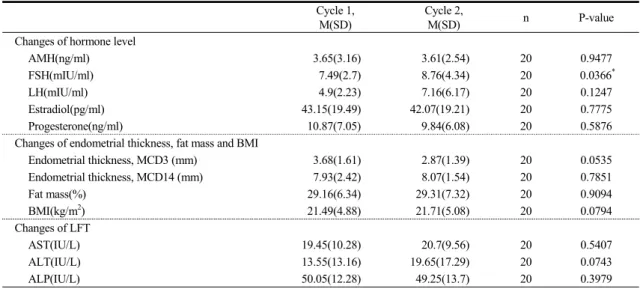
PR within the six menstrual cycle period and LBR were set as the primary outcome measures. The secondary outcome measure was the changes of hormone levels in FSH, LH, estrogen, and AMH.
Hormone levels were checked during the first and sixth menstrual cycle periods. BMI, fat mass, and endometrial thickness were also measured during the same menstrual cycle periods.
4. Statistical method
SAS statistical package version 9.1 was used.
Paired t-test was used for continuous variables.
Differences of P <0.05 were considered significant.
Results
1. Participant flow
Thirty four women were treated for infertility in our clinic. Nine women were excluded due to PCOS, spouse factor, drop out of the treatment schedule, resulting in 25 participants were analyzed. Data on blood chemistry test and LFT of five pregnant women were not acquired, thus, the analysis was performed using data from 20 women who failed to
conceive(Figure 1).
2. Baseline data
Baseline characteristics are shown in Table 2.
Most patients, except for one patient, had undergone other types of treatment for infertility.
3. Pregnancy rate
Five of 25 patients succeeded in conceiving and the PR per treatment of six cycles was 20%
(5/25*100).
Two women conceived during cycle 1 and another three women conceived during the following cycles:
2, 3, and 6 (Table 3).
4. Live birth rate
All of five pregnancies succeeded to result in
Cycle 1, M(SD)
Cycle 2,
M(SD) n P-value
Changes of hormone level
AMH(ng/ml) 3.65(3.16) 3.61(2.54) 20 0.9477
FSH(mIU/ml) 7.49(2.7) 8.76(4.34) 20 0.0366*
LH(mIU/ml) 4.9(2.23) 7.16(6.17) 20 0.1247
Estradiol(pg/ml) 43.15(19.49) 42.07(19.21) 20 0.7775
Progesterone(ng/ml) 10.87(7.05) 9.84(6.08) 20 0.5876
Changes of endometrial thickness, fat mass and BMI
Endometrial thickness, MCD3 (mm) 3.68(1.61) 2.87(1.39) 20 0.0535
Endometrial thickness, MCD14 (mm) 7.93(2.42) 8.07(1.54) 20 0.7851
Fat mass(%) 29.16(6.34) 29.31(7.32) 20 0.9094
BMI(kg/m2) 21.49(4.88) 21.71(5.08) 20 0.0794
Changes of LFT
AST(IU/L) 19.45(10.28) 20.7(9.56) 20 0.5407
ALT(IU/L) 13.55(13.16) 19.65(17.29) 20 0.0743
ALP(IU/L) 50.05(12.28) 49.25(13.7) 20 0.3979
Table 4. Changes of Secondary Outcomes