• 검색 결과가 없습니다.

Prevalence of Thyroid Nodules and Cancer Detected by Ultrasonography in Healthy Korean Adults: Clinical Features and the Risk for Malignancy

N/A
N/A
Protected

Academic year: 2021

Share "Prevalence of Thyroid Nodules and Cancer Detected by Ultrasonography in Healthy Korean Adults: Clinical Features and the Risk for Malignancy"

Copied!
7
0
0

로드 중.... (전체 텍스트 보기)

전체 글

(1)

ARTICLE Vol. 3, No. 2, November 2010

Received July 27, 2010 / Accepted September 7, 2010

Correspondence: Jae Hoon Chung, Division of Endocrinology and Metabolism, Department of Medicine, Samsung Medical Center, Sungkyunkwan University School of Medicine, 50 Irwon-dong, Gangnam-gu, Seoul 135-710, Korea Tel: 82-2-3410-3434, Fax: 82-2-3410-6956, E-mail: [email protected]

Prevalence of Thyroid Nodules and Cancer Detected by Ultrasonography in Healthy

Korean Adults: Clinical Features and the Risk for Malignancy

Eun Yeong Oh, MD 1 , Hye Won Jang, MD 2 , Ji In Lee, MD 2 , Hee Kyung Kim, MD 2 , Sun Wook Kim, MD, PhD 2 and Jae Hoon Chung, MD, PhD 2

1

Center for Health Promotion;

2

Division of Endocrinology and Metabolism, Department of Medicine, Samsung Medical Center, Sungkyunkwan University School of Medicine, Seoul, Korea

Background and Objectives: The prevalence of thyroid nodules has been reported to be high; however, it varies depending on the region and method of the study. We evaluated the prevalence of thyroid nodules detected by high-frequency ultrasonography (USG) in healthy Korean adults and analyzed its association with age, gender, size, multiplicity, and malignancy. Materials and Methods: We reviewed the medical records of 15,415 subjects (1,951 men and 13,464 women) that presented to our hospital for a health check-up from 2003 to 2005, and underwent a thyroid USG. Among them, USG-guided fine-needle aspiration cytology (FNAC) was performed in 1,659 subjects (10.7%) that had indeterminate or suspicious malignant nodules on USG. Results:

Among the 15,415 subjects, thyroid solid nodules were found in 6,023 (39.1%) by USG. The prevalence of thyroid nodules and multiplicity significantly increased with age (p<0.05), but did not differ by gender. Thyroid cancer was detected in 385 subjects (2.5%) by FNAC or by histological examination. The prevalence of thyroid cancer was 6.4% among the subjects with thyroid nodules. It did not differ by gender and nodule size. It tended to increase with age in total subjects, but was not significant. In the subjects with thyroid nodules, the risk of malignancy was highest in subjects aged under 40 and then decreased with age and higher in subjects with multiple nodules (p<0.05). Conclusion: The prevalence of thyroid nodules was 39.1% and the risk of malignancy in subjects with nodules was higher in subjects with younger age or multiple nodules.

Key Words: Prevalence, Thyroid nodule, Thyroid cancer

Introduction

Thyroid nodules are palpable in four to seven percent of adults. However, its prevalence can vary depending on the nodule size and location, neck thickness, and physician’s skill.

1-6)

In autopsy series, thyroid nodules were detected in 49 to 57% of clinically normal thyroids.

7-9)

The prevalence of thyroid nodules, identified by ultrasonography (USG), has

been reported to be from 13 to 67%.

3-5,10-19)

Most thyroid nodules are benign. However, thyroid cancer has been found in 5 to 10% of palpable thyroid nodules, and in 4 to 12% of nodules detected by USG.

20-23)

The risk for a malignancy developing from the thyroid nodules has been reported to be higher in children, males, adults less than 20 years or more than 60 years of age, and in patients with a history of head and neck irradiation.

24)

We performed this retrospective and descriptive

(2)

Table 1. Ultrasonographic findings of the thyroid gland in 15,415 healthy Korean subjects without previous history of thyroid diseases

Ultrasonographic findings

Number of subjects (%)

Total Men Women

Solid nodules±cysts 6,023 (39.1%) 740 (37.9%) 5,283 (39.2%)

Only cyst(s) 2,950 (19.1%) 306 (15.7%) 2,644 (19.6%)

Parenchymal changes 1,291 (8.4%) 116 (6.0%) 1,175 (8.7%)

Normal 5,151 (33.4%) 789 (40.4%) 4,362 (32.4%)

Table 2. Prevalence of thyroid nodule and cancer with age in 15,415 total subjects and 6,023 subjects with solitary thyroid nodules, respectively

Age

Prevalence ≤39 years 40∼49 years 50∼59 years ≥60 years p-value

Nodule/Total* 367/1,484 (24.7%) 2,031/6,148 (33.0%) 2,245/5,278 (42.5%) 1,380/2,505 (55.1%) <0.05 Cancer/Total

33/1,484 (2.22%) 141/6,148 (2.29%) 137/5,278 (2.60%) 74/2,505 (2.95%) NS Cancer/Nodule

33/367 (8.99%) 141/2,031 (6.94%) 137/2,245 (6.10%) 74/1,380 (5.36%) <0.05 NS: not significant, *The prevalence of thyroid nodule in total subjects significantly increased with age (p<0.05).

The prevalence of thyroid cancer in total subjects tended to increase with age,

but its prevalence in the subjects with thyroid nodule significantly decreased with age (p<0.05).

study to investigate the prevalence of thyroid nodules detected by USG in healthy Korean adults. We also analyzed associated clinical factors including age, gender, multiplicity, the size of the nodules, and malignancies.

Materials and Methods

We reviewed the medical records of 17,944 Korean adults that visited for their regular checkup from 2003 to 2005, and underwent USG of the thyroid. Thyroid USG was performed using a real-time ultrasound scanner with a 10∼12 MHz linear transducer. We excluded 2,529 with a previous history of thyroid nodules or thyroid surgery, and finally enrolled 15,415 for the investigation. There were 1,951 men (mean 51.7±7.1 years; range, 30∼86 years) and 13,464 women (mean 50.3±9.2 years; range, 18∼87 years).

USG-guided fine-needle aspiration & cytology (FNAC) were performed in 1,659 subjects (10.8%) with indeter- minate or suspicious malignant nodules on USG. The minimum size for aspirated nodules was 3 mm in diameter. In subjects with non-diagnostic cytology, repeat FNA was performed. This study was approved by the Institutional Review Board of the Samsung

Medical Center.

The chi-square test was used to evaluate the correlation between the risk of malignancy and age, gender, multiplicity, and nodule size. Age is shown as the mean±standard deviation (SD). p values less than 0.05 were considered significant.

Results

Prevalence of thyroid nodules in healthy subjects by ultrasonography

Among the 15,415 healthy Korean subjects, thyroid solid nodules were found in 6,023 (39.1%) subjects by USG. The ultrasonographic findings showed simple cysts of the thyroid in 2,950 (19.1%) subjects and diffuse parenchymal changes in 1,291 (8.4%) subjects.

The prevalence of thyroid nodules was 37.9% (740/

1,951) in men and 39.2% (5,283/13,464) in women

(Table 1); this difference was not significant. The

prevalence of thyroid nodule significantly increased

with age in total subjects and both genders, respec-

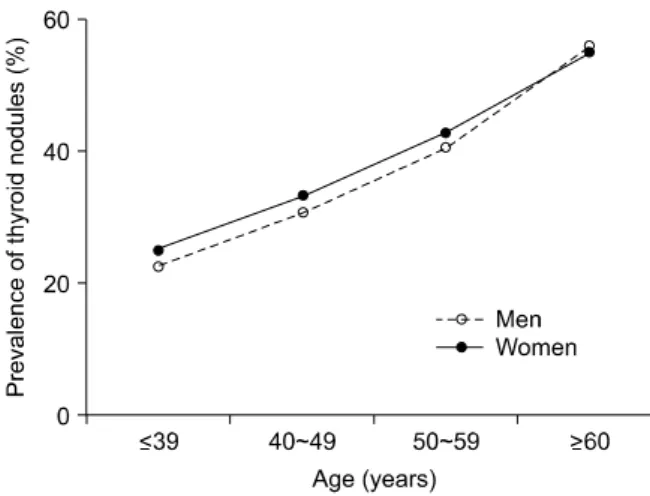
tively (p<0.05, Table 2, Fig. 1). The difference between

men and women at each age group was not signi-

ficant (Fig. 1). The prevalence of multiplicity increased

with age (Fig. 2).

(3)

Fig. 1. Prevalence of thyroid nodules according to age in men and women. The prevalence of thyroid nodule signi- ficantly increased with age in both genders, respectively (p

<0.05). The difference at each age between men and women was not significant. Its prevalence in men was 22.77% (5/22) in subjects ≤39 years, 30.5% (269/882) in subjects 40∼49 years, 40.5% (315/777) in subjects 50∼59 years, and 55.9% (151/270) in subjects ≥60 years. Simi- larly, its prevalence in women was 24.8% (362/1,462) in subjects ≤39 years, 33.5% (1,762/5,266) in subjects 40∼

49 years, 42.9% (1,930/4,501) in subjects 50∼59 years, and 55.0% (1,229/2,235) in subjects ≥60 years.

Fig. 2. Prevalence of multinodularity in thyroid nodules according to age. The prevalence of multiple thyroid nodules significantly increased with age (p<0.05). It was 35.7%

(131/367) in subjects ≤39 years, 40.7% (825/2,030) in subjects 40∼49 years, 49.9% (1,122/2,246) in subjects 50

∼59 years, and 56.9% (785/1,380) in subjects ≥60 years.

The size of the thyroid solid nodule on USG varied from 0.2 cm to 5.8 cm. Nodule size was based on the largest nodule in case of more than one nodule.

Thyroid nodules 1 cm or less in diameter were found in 4,152 subjects (68.9%), nodules from 1 to 2 cm in 1,481 subjects (24.6%), and nodules greater than 2 cm in 390 subjects (6.5%). Multiple nodules were found in 2,863 subjects (47.5%).

Prevalence of thyroid cancer in healthy subjects by ultrasonography-guided fine-needle aspiration and cytology

USG-guided FNAC was performed in 1,659 subjects, According to cytological results, 1,263 subjects (76%) had benign, 18 subjects (1%) had indeterminate, and 378 subjects (23%) had malignant cytology.

Twelve out of 18 subjects with indeterminate cyto- logy underwent thyroidectomy, and postoperative patho- logic results revealed seven papillary carcinomas, one follicular carcinoma, and four benign tumors. The other six subject with indeterminate cytology refused opera- tion. Two hundreds ninety-seven out of 378 subjects

with malignant cytology underwent thyroidectomy.

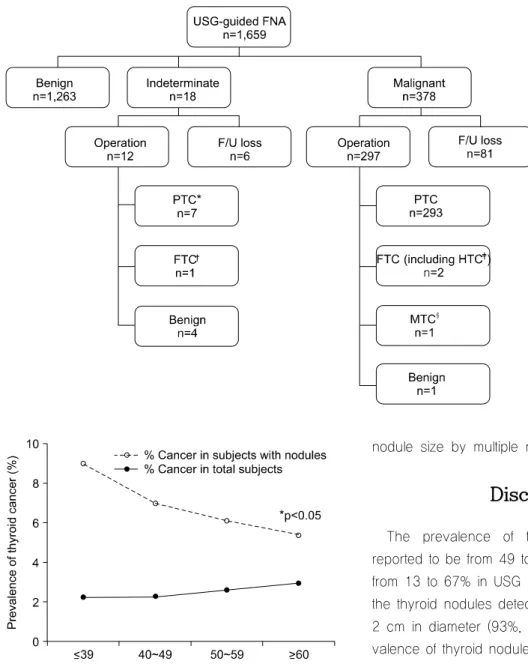
Postoperative pathologic results showed 293 papillary carcinomas, one follicular carcinoma, one Hurthle cell carcinoma, one medullary carcinoma, and one nodular hyperplasia. The other 81 subjects were diagnosed as thyroid carcinoma by cytologic results, but they were lost during follow-up. We considered that 304 sub- jects were confirmed as having thyroid carcinomas after thyroidectomy and 81 subjects were diagnosed as having thyroid carcinomas by cytologic examination without operation (Fig. 3). The overall prevalence of thyroid cancer was 2.5% among the 15,415 enrolled subjects, and 6.4% among the 6,023 subjects with thyroid nodules. The prevalence of thyroid cancer was not significantly different in men and women; 2.56%

(50/1,951) in men and 2.49% (335/13,464) in women among total subjects, and 6.75% (50/740) in men and 6.34% (335/5,283) in women among subjects with solid nodules.

The prevalence of thyroid cancer tended to

increase with age, but it was not significant. However,

its prevalence in the subjects with thyroid solid

nodules was highest in subjects younger than 40

years old, and significantly decreased with age (Table

2, Fig. 4). It was independent of sex, multiplicity, and

nodule size by multiple regression analysis. The

(4)

Fig. 4. Prevalence of thyroid cancer with age in 15,415 total subjects and 6,023 subjects with thyroid nodules. The prevalence of thyroid cancer in total subjects tended to increase with age, but its prevalence in the subjects with thyroid nodule significantly decreased with age (p<0.05).

Fig. 3. The cytological and histological results. *papillary thyroid cancer,

follicular thyroid cancer,

Hurthle cell carci- noma,

§

medullary thryroid can- cer.

prevalence of thyroid cancer did not differ according to the nodule size; 6.1% (254/4,152) in nodules less than 1 cm, 7.0% (131/1871) in nodues greater than 1 cm. Thyroid cancer was detected in 145 of 3,160 subjects (4.6%) with single thyroid nodule, and 240 of 2,863 subjects (8.4%) with multiple thyroid nodules.

Therefore, thyroid cancer was more common in the subjects with multiple nodules than in those with single nodules (p<0.05). It was independent of age, sex and

nodule size by multiple regression analysis.

Discussion

The prevalence of thyroid nodules has been reported to be from 49 to 57% in autopsy series and from 13 to 67% in USG investigations.

3-5,7-19)

Most of the thyroid nodules detected by USG were less than 2 cm in diameter (93%, 5,622/6,023). And the pre- valence of thyroid nodules and multiplicity significantly increased with age in both men and women (p<0.05, Table 2, Fig. 1, 2). It’s similar to the previous studies.

3,5,9,10,12,15,17-19,25)

Previous studies have reported that women are more likely to have thyroid nodules.

3,5,9,10,12,15,17-19)

However, in our series, there was no significant difference in the prevalence between men and women (men 37.9% vs. women 39.2%).

The prevalence of occult thyroid cancer has been

reported to be high, varying from 2.1% to 35.6% in

autopsy series,

9,14,26-32)

and 10.5% in a surgical series

on benign thyroid disease.

33)

The diagnosis depends

on the area, enrolled subjects, methods, and diagnostic

criteria used in the study. Harach et al. reported the

highest prevalence (35.6%) of occult thyroid cancer,

in lesions smaller than 2∼3 mm.

32)

The frequency of

(5)

malignancy, in subjects with thyroid nodules, has been reported to be from 3.4% to 7.7% in series reported from Western countries

14,24,34-36)

and from 10.4% to 13.9% in Korean series

37,38)

by FNAC or histological confirmation.

In this study, thyroid cancer was found in 385 subjects. The prevalence of thyroid cancer was 2.5%

among the 15,415 enrolled subjects, and 6.4% among the 6,023 subjects with thyroid nodules. FNAC was not performed in all patients with thyroid nodules;

therefore, the prevalence of thyroid cancer might be underestimated. Although thyroid cancer was diagnosed on the basis of cytological results, not the pathological findings in 81 patients in this study, there was no significant difference between the real and estimated prevalence of thyroid cancer. Three hundred and seventy-eight subjects with malignant cytology were recommended to have a thyroidectomy. Among them, the pathological reports after the thyroidectomy was available in 297 patients; 296 (99%) had thyroid cancer on the pathology reports. In this study, most cancer (99%) were papillary carcinomas, consistent with the findings of similar studies.

29,31,33)

These findings might in part be attributed to the high dietary intake of iodine in Korea, and to the ultrasonographic findings that suggested a malignancy with the characteristics of papillary carcinoma. The rare finding of occult follicular carcinoma was perhaps due to the difficulty in diagnosing latent follicular lesions

29)

; therefore, the frequency of follicular carcinoma might have been underestimated. The absence of occult anaplastic carcinomas was likely related to their rapid develop- ment.

29)

They might have been already detected on the clinical setting.

The correlation of the prevalence of thyroid cancer with age and gender has been controversial. Although its prevalence was not correlated with age and gender in some studies.

19,29,31,32,37)

Sobrinho-Simoes et al. and Iribarren et al. reported that the prevalence of latent thyroid cancer was significantly higher in females and the elderly.

30,39)

Belfiore et al. reported that the cancer risk in patients with thyroid nodules was higher in men, less than 30 years of age or more than 60.

24)

Similar results were observed in previous

Korean series.

37,38)

In the present study, the pre- valence of thyroid cancer did not differ significantly between men and women (2.56% vs. 2.49% in total subjects; 6.75% vs. 6.34% in subjects with nodules).

Compared to the rapid increase of the frequency of thyroid nodules with age, the prevalence of thyroid cancer did not increase significantly with age. In cases with thyroid nodules, the risk of malignancy was highest in the younger group (less than 40 years), and then decreased with age; it was lowest in older group (more than 60 years). These results differ from pre- vious studies

24,37)

and were associated with the decline of cancer frequency with age in subjects with thyroid nodules as shown in Table 2 and Fig. 3.

In previous studies, the prevalence of thyroid cancer was independent of the number of no- dules.

6,16,24)

In our study, the frequency of malig- nancies was higher in multiple nodules than in single nodule (8.4% vs. 4.6%, p<0.05). However, when simple thyroid cysts were included in the number of nodules, there was no significant difference in fre- quency of malignancies between single and multiple nodules. In patients with multiple nodules, the cancer rate per nodule might be similar to the patients with a solitary nodule; the overall cancer rate per patient might increase as the number of thyroid nodules increases.

The risk of malignancy has been inconsistent and might depend on the size of the nodule. Some inves- tigators have reported no difference in cancer fre- quency based on the nodule size; however, Hagag et al. reported that the cancer frequency in nodules greater than 1 cm was higher than for nodules smaller than 1 cm (7.4% vs. 4.2%).

23,37,40)

In the present study, there was no significant difference in cancer fre- quency between nodules greater than or smaller than 1 cm (6.1% vs. 7.0%).

Conclusion

The prevalence of thyroid nodules detected by USG

was 39.1%, and its prevalence as well as multiplicity

increased with age. When simple cysts were included,

its prevalence was 58.2%. The prevalence of thyroid

(6)

cancer by USG-guided FNAC was 2.5% among total subjects and 6.4% among the subjects with thyroid nodules. Although the risk of malignancy in total subjects tended to increase with age, it significantly decreased with age in the subjects with thyroid nodules. The risk of malignancy in subjects with thyroid nodules was higher in the subjects with younger age or multiple thyroid nodules. It was not different in gen- der and nodule size.

References

1) Vander JB, Gaston EA, Dawber TR. The significance of nontoxic thyroid nodules. Final report of a 15-year study of the incidence of thyroid malignancy. Ann Intern Med 1968;69(3):

537-40.

2) Rojeski MT, Gharib H. Nodular thyroid disease. Evaluation and management. N Engl J Med 1985;313(7):428-36.

3) Brander A, Viikinkoski P, Nickels J, Kivisaari L. Thyroid gland: US screening in a random adult population. Radiology 1991;181(3):683-7.

4) Brander A, Viikinkoski P, Tuuhea J, Voutilainen L, Kivisaari L. Clinical versus ultrasound examination of the thyroid gland in common clinical practice. J Clin Ultrasound 1992;20(1):

37-42.

5) Ezzat S, Sarti DA, Cain DR, Braunstein GD. Thyroid incidentalomas. Prevalence by palpation and ultrasonography.

Arch Intern Med 1994;154(16):1838-40.

6) Tan GH, Gharib H. Thyroid incidentalomas: Management approaches to nonpalpable nodules discovered incidentally on thyroid imaging. Ann Intern Med 1997;126(3):226-31.

7) Rice CO. Incidence of nodules in thyroid: Comparative study of symptomless thyroid gland removed at autopsy and hyperfunc- tioning goiters operatively removed. Arch Surg 1932;24:505-8.

8) Hellwig CA. Thyroid gland in Kansas. Am J Clin Path 1935;5:

103-11.

9) Mortensen JD, Woolner LB, Bennett WA. Gross and microscopic findings in clinically normal thyroid glands. J Clin Endocrinol Metab 1955;15(10):1270-80.

10) Carroll BA. Asymptomatic thyroid nodules: Incidental sonogra- phic detection. AJR Am J Roentgenol 1982;138(3):499-501.

11) Woestyn J, Afschrift M, Schelstraete K, Vermeulen A. Demon- stration of nodules in the normal thyroid by echography. Br J Radiol 1985;58(696):1179-82.

12) Mazzaferri EL. Management of a solitary thyroid nodule. N Engl J Med 1993;328(8):553-9.

13) Tomimori E, Pedrinola F, Cavaliere H, Knobel M, Medeiros-Neto G. Prevalence of incidental thyroid disease in a relatively low iodine intake area. Thyroid 1995;5(4):273-6.

14) Wang C, Crapo LM. The epidemiology of thyroid disease and implications for screening. Endocrinol Metab Clin North Am 1997;26(1):189-218.

15) Yim CH, Oh HJ, Chung HY, Han KO, Jang HC, Yoon HK, et al. Prevalence of thyroid nodules detected by ultrasonography

in womens attending health check-ups. J Korean Soc Endocrinol 2002;17(2):183-8.

16) Kang HW, No JH, Chung JH, Min YK, Lee MS, Lee MK, et al. Prevalence, clinical and ultrasonographic characteristics of thyroid incidentalomas. Thyroid 2004;14(1):29-33.

17) Suk JH, Kim TY, Kim MK, Kim WB, Kim HK, Jeon SH, et al. Prevalence of ultrasonographically-detected thyroid nodules in adults without previous history of thyroid disease. J Korean Endocr Soc 2006;21(5):389-93.

18) Kim JH, Park SJ, Kim SE, Lee KH, Cho IK, Jang SI, et al. Prevalence of thyroid nodules detected by ultrasonography in adult men attending health check-ups. J Korean Endocr Soc 2007;22(2):112-7.

19) Kim WJ, Kim JH, Park DW, Lee CB, Park YS, Kim DS, et al. Prevalence of thyroid nodules detected by ultrasonography in adults for health check-ups and analysis of fine needle aspiration cytology. J Korean Endocr Soc 2008;23(6):413-9.

20) Mazzaferri EL. Thyroid cancer in thyroid nodules: Finding a needle in the haystack. Am J Med 1992;93(4):359-62.

21) Lin JD, Huang BY, Chao TC, Hsueh C. Diagnosis of occult thyroid carcinoma by thyroid ultrasonography with fine needle aspiration cytology. Acta Cytol 1997;41(6):1751-6.

22) Khurana KK, Richards VI, Chopra PS, Izquierdo R, Rubens D, Mesonero C. The role of ultrasonography-guided fine-needle aspiration biopsy in the management of nonpalpable and palpa- ble thyroid nodules. Thyroid 1998;8(6):511-5.

23) Hagag P, Strauss S, Weiss M. Role of ultrasound-guided fine-needle aspiration biopsy in evaluation of nonpalpable thyroid nodules. Thyroid 1998;8(11):989-95.

24) Belfiore A, La Rosa GL, La Porta GA, Giuffrida D, Milazzo G, Lupo L, et al. Cancer risk in patients with cold thyroid nodules: Relevance of iodine intake, sex, age, and multinodularity.

Am J Med 1992;93(4):363-9.

25) Chung WY, Chang HS, Kim EK, Park CS. Ultrasonographic mass screening for thyroid carcinoma: A study in women sche- duled to undergo a breast examination. Surg Today 2001;31(9):

763-7.

26) Silverberg SG, Vidone RA. Carcinoma of the thyroid in surgical and postmortem material. Analysis of 300 cases at autopsy and literature review. Ann Surg 1966;164(2):291-9.

27) Fukunaga FH, Lockett LJ. Thyroid carcinoma in the Japanese in Hawaii. Arch Pathol 1971;92(1):6-13.

28) Sampson RJ, Woolner LB, Bahn RC, Kurland LT. Occult thyroid carcinoma in Olmsted County, Minnesota: Prevalence at autopsy compared with that in Hiroshima and Nagasaki, Japan.

Cancer 1974;34(6):2072-6.

29) Fukunaga FH, Yatani R. Geographic pathology of occult thyroid carcinomas. Cancer 1975;36(3):1095-9.

30) Sobrinho-Simôes MA, Sambade MC, Gonçalves V. Latent thyroid carcinoma at autopsy: A study from Oporto, Portugal.

Cancer 1979;43(5):1702-6.

31) Bondeson L, Ljungberg O. Occult thyroid carcinoma at autopsy in Malmö, Sweden. Cancer 1981;47(2):319-23.

32) Harach HR, Franssila KO, Wasenius VM. Occult papillary carcinoma of the thyroid. A "normal" finding in Finland. A syste- matic autopsy study. Cancer 1985;56(3):531-8.

33) Pelizzo MR, Piotto A, Rubello D, Casara D, Fassina A,

(7)

Busnardo B. High prevalence of occult papillary thyroid carcinoma in a surgical series for benign thyroid disease. Tumori 1990;76(3):255-7.

34) Werk EE Jr, Vernon BM, Gonzalez JJ, Ungaro PC, McCoy RC. Cancer in thyroid nodules. A community hospital survey.

Arch Intern Med 1984;144(3):474-6.

35) Hooft L, Hoekstra OS, Boers M, Van Tulder MW, Van Diest P, Lips P. Practice, efficacy, and costs of thyroid nodule evaluation: A retrospective study in a Dutch university hospital.

Thyroid 2004;14(4):287-93.

36) Caruso D, Mazzaferri EL. Fine-needle aspiration in the mana- gement of nodules. Endocrinologist 1991;1:194-202.

37) Kim WB, Chung HK, Yim CH, Park DJ, Kim SY, Cho BY, et al. Prevalence thyroid cancer in patients with cold thyroid

nodules in relation to sex, age, and multinodularity. J Korean Soc Endocrinol 1998;13:366-72.

38) Nam-Goong IS, Kim HY, Gong G, Lee HK, Hong SJ, Kim WB, et al. Ultrasonography-guided fine-needle aspiration of thyroid incidentaloma: Correlation with pathological findings.

Clin Endocrinol (Oxf) 2004;60(1):21-8.

39) Iribarren C, Haselkorn T, Tekawa IS, Friedman GD. Cohort study of thyroid cancer in a San Francisco Bay area population.

Int J Cancer 2001;93(5):745-50.

40) Papini E, Guglielmi R, Bianchini A, Crescenzi A, Taccogna

S, Nardi F, et al. Risk of malignancy in nonpalpable thyroid

nodules: Predictive value of ultrasound and color-Doppler

features. J Clin Endocrinol Metab 2002;87(5):1941-6.

수치

Table  1.  Ultrasonographic  findings  of  the  thyroid  gland  in  15,415  healthy  Korean  subjects  without  previous  history  of  thyroid diseases
Fig.  2.  Prevalence  of  multinodularity  in  thyroid  nodules  according to age. The prevalence of multiple thyroid nodules significantly  increased  with  age  (p<0.05)
Fig. 4. Prevalence of thyroid cancer with age in 15,415 total subjects  and  6,023  subjects  with  thyroid  nodules

참조

관련 문서