누룩으로부터 자일리톨 생산능이 있는 내열성 효모 Millerozyma farinosa 균주의 분리
정은혜, 배영우, 권세영, 박은희, 김명동*
강원대학교식품생명공학과
Received: February 8, 2019 / Revised: April 13, 2019 / Accepted: April 22, 2019
누룩은전통적인방법으로술을제조할때사용하는발 효제로서쌀, 밀등의곡류에다양한미생물을자연적으로 번식시킨 것이다[1]. Aspergillus oryzae [2], Rhizopus oryzae [3] 등의 곰팡이와 Leuconostoc mesenteroides, Lactobacillus casei, Pediococcus acidilactici 등의젖산균 [4, 5], Saccharomyces cerevisiae [6, 7], Saccharomycopsis fibuligera [8] 효모균주등다양한미생물이누룩으로부터분 리되었다. 쌀, 밀등의원료에포함된전분은곰팡이에의하
여포도당을비롯한발효가능한당분으로분해되고[9], 효
모에의해서에탄올로전환되어술이만들어진다[10]. 젖산 균은젖산을포함한유기산을생산하여전통주특유의맛과
향을생성하는것으로알려져있다[11].
누룩에존재하는미생물에대한연구는현재도활발하게 진행중이며[3, 10], 전분당화능이우수한 Saccharomycopsis fibuligera 균주[8], 알코올생산성이우수한 S. cerevisiae 균
주[6], 술의풍미에영향을미치는젖산균에대한연구결과
[4]가보고되었다.
자일리톨은오탄당당알콜로서감미도가설탕과유사하여 대체감미료로사용되고있으며, 과일과채소등의자연계에 널리존재한다[12]. 자일리톨은 Candida tropicalis [13] 등 의효모, Aspergillus [14] 등의곰팡이균주를이용하여생 산하는방법이보고되었다. 목질계바이오매스는밀짚이나 볏짚을비롯하여옥수수대나과채류의껍질과같은농업부 산물등이해당되며[15], 이들은셀룰로스, 헤미셀룰로스, 리 그닌으로구성된견고한구조로이루어져있다. 셀룰로스, 헤 미셀룰로스는당화를통해미생물이이용할수있는육탄당 인포도당과오탄당인자일로즈로전환되는데[16] 효소와미 생물을사용하는동시당화발효공정의경우, 주로 45−50℃ 에서진행되므로[17, 18] 내열성이우수한균주의확보가필 수적이다.
본연구에서는전통주제조를위한발효제로사용되는누 룩으로부터내열성이우수한자일로즈대사균주를분리하 고균체성장과자일리톨생산특성을조사하였다.
전국의재래시장에서전통방식으로제작한누룩 12점을 Isolation of Xylitol-Producing Thermotolerant Yeast Millerozyma farinosa from Nuruk
Eun-Hye Jung, Young-Woo Bae, Se-Young Kwun, Eun-Hee Park, and Myoung-Dong Kim*
Division of Food Biotechnology and Biosystems Engineering, Kangwon National University, Chuncheon 24341, Republic of Korea Diverse types of nuruks (traditional Korean fermentation initiators) were examined in order to isolate thermotolerant yeast strains capable of utilizing xylose as a carbon source. Among twenty yeast strains that grew at 46℃, MBY/L1597 showed a notably higher specific growth rate than other strains. This strain was identified as Millerozyma farinosa. While the control strain M. farinosa KCTC27412 (= CBS7064) did not show xylose reductase (XR) activity and apparent growth at 46℃, M. farinosa MBY/L1597 exhibited XR activity of 4.98 ± 0.49 U/mg protein when NADPH was used as a cofactor. M. farinosa MBY/L1597 cultured at 46℃ produced (9.87 ± 1.00 g/l) xylitol from 20 g/l xylose, corresponding to approximately 50% yield. M. fari- nosa MBY/L1597 was deposited at the Korean Collection for Type Cultures as KCTC27797.
Keywords: Tolerance, Nuruk, xylose reductase, xylitol, yeast, Millerozyma farinosa
*Corresponding author
Tel: +82-33-250-6458, Fax: +82-33-259-5565 E-mail: [email protected]
© 2019, The Korean Society for Microbiology and Biotechnology
구매하였다. 오탄당인자일로즈를탄소원으로이용할수있
는효모균주를분리하기위하여분쇄한누룩 1 g을 9 ml의
펩톤수에현탁하고단계적으로희석한후, chloramphenicol (100 mg/l, Sigma-Aldrich, USA)을 함유한 YEPX (yeast extract 10 g/l, peptone 20 g/l, xylose 20 g/l, pH 6.8, BD Diagnostic, USA) 평판배지에도말하였다[19]. 도말한배지 는 46℃로유지되는정체배양기에서 60시간동안배양하여 형성된단일집락을분리하였다.
분리한균주의단일집락을 50 ml의 YEPD (yeast extract 10 g/l, peptone 20 g/l, glucose 20 g/l, pH 6.8, BD Diagnostic) 배지에접종하고진탕배양기(JSR, Korea)를사용하여 30℃ 에서 12시간 동안 배양하였다. 배양된 균주는 원심분리 (4,000 × g, 10 min)하여회수한후멸균수로 2회세척하고 600 nm에서의세포흡광도(OD600)가 0.1이되도록 100 ml의
YEPX 배지에접종하고 46℃의진탕배양기에서배양하였다.
선별효모균주는단일집락을 YEPD 배지에접종하고 30℃에서 24시간 동안진탕 배양한후 GenExTM genomic Sx (GeneAll, Korea)를사용하여염색체 DNA를추출하였다. 염 색체의 Internal transcribed spacer 영역을증폭하기위하 여 ITS1 (5'-TCCGTAGGTGAACCTGCGC-3')와 ITS4 (5'- TCCTCCGCTTATTGATATGC-3') 프라이머[20]를사용하여 PCR 반응산물을확보한후㈜마크로젠(Korea)에의뢰하여 염기서열을 분석하였다. 염기서열은 National Center for Biotechnology Information (NCBI, USA)의 BLAST (Basic Local Alignment Search Tool, http://www.ncbi.nlm.nih.gov/
BLAST/) [21]를사용하여염기서열이보고된균주들과의상
동성을바탕으로동정하였다. 대조구로사용한 Millerozyma farinosa KCTC27412 균주는한국미생물자원센터(KCTC,
Korea)로부터분양받았다.
선별균주의내열성을확인하기위해단일집락을 5 ml의
YEPD 배지에접종하여 30℃에서 12시간배양한후균체를
회수하였다. 균체는멸균수로 5회세척하고적정농도로희 석한후 YEPD 및 YEPX 평판배지에 각각 10 µl씩점적한 후 60시간동안호기조건에서배양하였다.
자일로즈환원효소(XR)의활성은 Bengtsson 등[22]의방 법을사용하여측정하였다. YEPX 배지 5 ml에세포흡광도 가 0.1이되도록균주를접종하고 30℃에서 24시간배양한 뒤원심분리하여균체를회수하였다. 인산염완충액(50 mM, pH 6.0)에현탁한균체를 glass beads (Sigma-Aldrich)를사 용하여세포를파쇄한후원심분리(13,000 ×g, 10 min)하여 조효소액을확보하였다.
조효소액 100 µl에 2 mM의 NADPH 또는 NADH를첨가
하고 500 mM의자일로즈를기질로주입하여각반응온도
에서 15분간반응하였다. XR 효소활성은자일로즈가기질 로존재할때 1분동안 1 µmol의 NADH 또는 NADPH를산 화시키는효소의양으로정의하였고, 조효소액중의단백질 농도는 Bradford dye reagent (Bio-Rad, USA)를사용하여 측정하였다.
균체성장은흡광광도계(GE Healthcare, Sweden)를사용
하여 600 nm에서세포흡광도를측정하여결정하였다. 자일
로즈및자일리톨의농도는굴절률검출기가장착된고성능
액체크로마토그래프(Shimadzu, Japan)를사용하여측정
하였다. 컬럼은 65℃로 유지된 Rezex ROA-Organic Acid H+ (Phenomenex, USA)를사용하였으며, 이동상으로 0.005 N H2SO4용액을 0.6 ml/min의유속으로사용하였다.
모든측정은 3회반복하였으며평균값과표준오차는 IBM
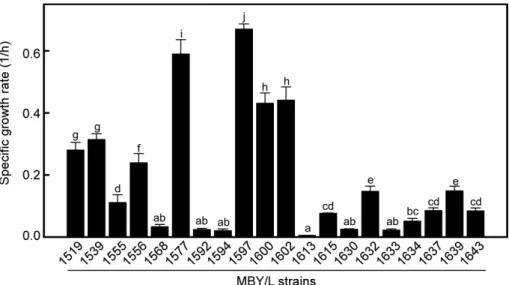
Fig. 1. Specific growth rates of the yeast isolates grown at 46℃ in YEPX medium containing 20 g/l xylose as carbon source. Aver- ages and standard errors determined from three independent measurements are shown. Different letters indicate significant difference between means (p < 0.05).
SPSS Statistics 24 (IBM, USA)를사용하여결정하였고, 유 의성검증은일원배치분산분석법[23]을사용하였다.
충청남도예산군을비롯한전국 5개지역에서구매한누 룩으로부터자일로즈를탄소원으로이용할수있는 944점의 효모균주를분리하였다. 내열성이우수한균주의선별을위 하여분리된균주를 46℃호기조건에서 60시간동안배양하 였고 20점의효모균주가자일로즈를이용하여성장하는것 을확인하였다(Fig. 1). 선발된균주중충남예산군에서확 보한 누룩으로부터 분리된 MBY/L1577, 1597, 1600 및 1602 균주의비성장속도가우수하였으며, 이들균주중 MBY/
L1597 균주의비성장속도가 0.67±0.10 1/h로서가장높은 값을나타내어추가연구를위한균주로선정하였다. MBY/
L1597 균주의 18S rRNA 유전자염기서열을분석하여다른
균주들과의상동성을비교한결과 Millerozyma farinosa와 100%의 상동성을 나타내었으며, 한국미생물자원센터에 KCTC27797 균주로기탁하였다.
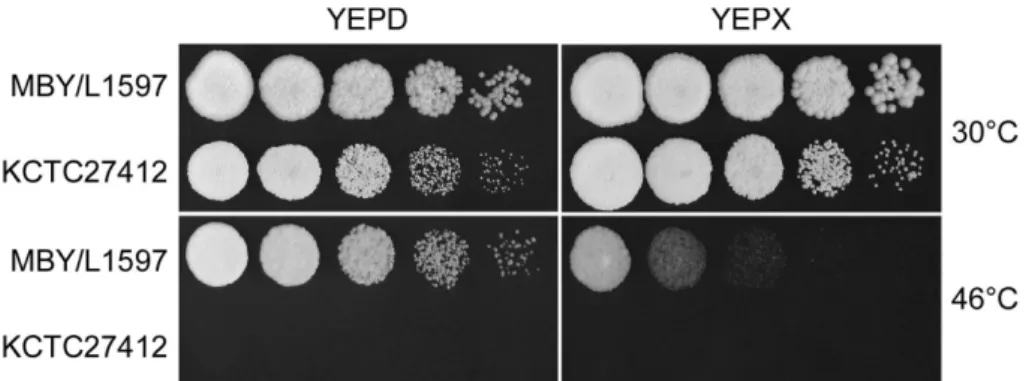
M. farinosa MBY/L1597 균주의내열성을조사하여대조
구인 KCTC27412 균주와비교한결과탄소원으로써포도당
과자일로즈를각각함유된배지에서유의적으로다른내열 성을나타냈다(Fig. 2).
내열성이우수한균주는기질의당화조건에서도상대적으 로안정적인성장을나타내어동시당화발효가가능하며, 세
균에의한오염가능성을낮출수있는장점도있다[24]. 따
라서다양한발효공정에서균주의내열성, 내산성, 에탄올내 성등은생산공정의비용절감및생산성과밀접한관련이 있다[25].
M. farinosa 균주의 XR 활성은보조효소로서 NADH보다
NADPH와관련성이높은것으로나타났으며, M. farinosa
MBY/L1597 균주및대조구균주의 XR 효소활성은반응온
도 30℃및 37℃에서유의적으로큰차이를나타내지않았 다(Fig. 3). 그러나대조구균주는 46℃에서 XR 효소활성을
나타내지않았으나 M. farinosa MBY/L1597 균주는 NADH 를 보조인자로 사용하였을 때 1.50±0.34 U/mg protein, NADPH를사용하였을 때 4.98±0.49 U/mg protein의 XR 효소활성을각각나타냈다. 이러한두균주의 XR 효소활성
Fig. 2. Influences of temperature and carbon sources on growths of M. farinosa KCTC27412 and MBE/L1597. Strains growing exponentially in YEPD were harvested, washed five times with sterile water, and diluted to an OD600 of 1.0 with sterile water. Then, ten-fold serial dilutions were spotted on agar plate. The plates were incubated at an indicated temperature, and cell growth was assessed after 36 h.
Fig. 3. Xylose reductase activities of M. farinosa KCTC27412 (■) and MBE/L1597 (□). For panel A, NADH was used as a cofactor and NADPH was used for panel B. Averages and stan- dard errors determined from three independent measurements are shown. Different letters in each panel indicate significant dif- ference between means (p < 0.05). ND: not detected.
의차이는 46℃에서 M. farinosa MBY/L1597 균주와대조구 균주의성장특성을일부뒷받침하는것으로사료된다.
자일로즈를 탄소원으로 이용할 수 있는 효모 균주 중 Pichia stipitis (Shefferosomyces stipitis)는 NADH보다
NADPH를보조인자로사용하였을때 XR 효소활성이상대
적으로높게나타났으며[26], C. tropicalis [27], C. parapsilosis [28]도유사한경향을나타냈다.
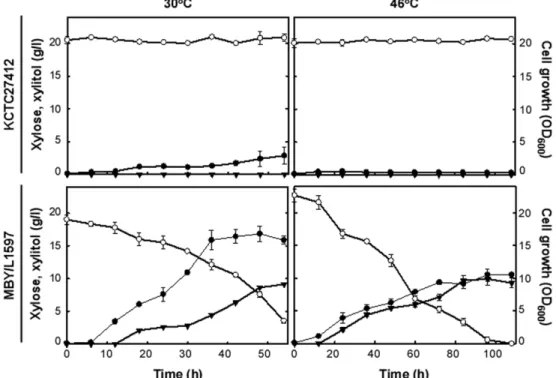
M. farinosa MBY/L1597 균주와대조구균주를 YEPX 배 지에서 30℃및 46℃에서배양하여자일로즈소모및자일 리톨 생산 특성을 조사하였다(Fig. 4). 대조구 균주인 KCTC27412 균주는 30℃에서 50시간동안초기에주입한 자일로즈를 거의 이용하지 못했으나 M. farinosa MBY/
L1597 균주는약 15 g/l의자일로즈를소모하였다. 대조구 균주인 KCTC27412 균주의최대 균체성장은 M. farinosa MBY/L1597의약 17% 수준이었다. 배양온도 30℃에서성장 한 대조구 균주는 자일리톨을 생산하지 못한 반면, M.
farinosa MBY/L1597 균주는 9.12±0.12 g/l의자일리톨을 생산하여대조구균주보다유의적으로높은자일리톨생산 량을나타냈다. 그러나두균주모두자일로즈를이용하여 에탄올은생산하지않았다(Date not shown). 또한대조구인
KCTC27412 균주는 46℃에서 성장하지 못하였으나, M.
farinosa MBY/L1597 균주는 46℃에서 108시간동안배양 초기에주입한자일로즈를모두소모하여 9.87±1.00 g/l의
자일리톨을생산하여소모한자일로즈대비약 50%의수율 을나타냈다.
하 등[29]은 40℃에서 성장이 우수한 Kluyveromyces marxianus ATCC36907 균주와 XR 효소활성이증대된돌연 변이균주의효소활성을비교하였다. 모균주는 NADH를보 조인자로사용하였을때 0.71±0.01 U/mg의 XR 효소활성
을 나타내어 NADPH를 보조인자로 사용한 효소활성
(0.37±0.01 U/mg)에비해약 1.9배우수한효소활성을나 타냈다. 돌연변이균주의경우모균주에비해보조인자에의 한효소활성의차이가감소하였으며자일리톨생산량이증 가하였다[12].
본연구에서사용한 M. farinosa MBY/L1597 균주의 XR 효소활성을 46℃에서측정하였을때, NADH보다 NADPH 를보조인자로사용하였을때약 3.32배높게나타났으며이
는 NADPH를보조효소로사용하는경우상대적으로활성
저해가크지않아균체성장및자일리톨생산에영향을미 친것으로판단된다.
본 연구를 통하여 누룩에서 분리한 M. farinosa MBY/
L1597 균주는대조구균주보다고온에서우수한균체성장
과자일리톨생산성을나타내어바이오매스를기질로사용 하는생물공정에적용이유망한균주로사료되며실험실적 진화[30]를포함한균주개량을통하여동시당화발효공정에 적용하기위한추가적인연구가필요할것으로판단된다.
Fig. 4. Profiles of cell growth (●), xylose consumption (○), and xylitol production (▼) in shake flasks cultivation of M. farinosa KCTC27412 and MBE/L1597. Averages and standard errors determined from three independent measurements are shown.
요 약
누룩으로부터자일로즈를탄소원으로이용할수있는내 열성이우수한효모균주를분리하고 46℃에서비성장속도
가우수한 MBY/L1597 균주를선발하였으며, 해당균주는
Millerozyma farinosa로동정되었다. 대조구인 M. farinosa KCTC27412(=CBS7064) 균주는 46℃에서자일로스환원효 소의활성이나타나지않았고균체도성장하지않았다. 그러 나 M. farinosa MBY/L1597 균주는 46℃에서 NADPH를 보조인자로사용한경우 4.98±0.49 U/mg protein의효소활 성을나타냈다. M. farinosa MBY/L1597 균주는 46℃에서 20 g/l의자일로즈를이용하여 9.87±1.00 g/l의자일리톨을 생산하여약 50%의수율을나타내었고한국미생물자원센터 에 KCTC27797 균주로기탁하였다.
Acknowledgments
This research was supported by Traditional Culture Convergence Research Program through the National Research Foundation of Korea(NRF) funded by the Ministry of Science, ICT & Future Plannig (No.2017M3C1B5019250).
Conflict of Interest
The authors have no financial conflicts of interest to declare.
References
1. Kim MJ. 2002. The study about traditional Nuruk. J. Natur. Sci. 9:
291-310.
2. Park HS, Jeong DY, Cho SH. 2014. Study on manufacturing method of Sunchang's Nuruk and Yakju and screening of Nuruk microorganism. J. Agric. Life Sci. 45: 6-11.
3. Choi YH, Choi DH, Park EH, Kim MD. 2016. Isolation of potent amylolytic fungus Rhizopus oryzae from Nuruk. Microbiol.
Biotechnol. Lett. 44: 376-382.
4. Park CD, Jung HK, Park HH, Hong JH. 2007. Identification and fermentation characteristics of lactic acid bacteria isolated from Hahyangju Nuruk. Korean J. Food Preserv. 14: 188-193.
5. Jo KY, Ha DM. 1995. Isolation and identification of the lactic acid bacteria from Nuruk. Agricul. Chem. Biotechnol. 38: 95-99.
6. Choi DH, Choi YH, Yeo SH, Kim MD. 2016. Isolation and char- acterization of Saccharomyces cerevisiae from Nuruk for pro- duction of ethanol from maltose. Microbiol. Biotechnol. Lett.
44: 34-39.
7. Jung HK, Park CD, Park HH, Lee GD, Lee IS, Hong JH. 2006. Man- ufacturing and characteristics of Korean traditional liquor, Hahyangju prepared by Saccharomyces cerevisiae HA3 isolated from traditional Nuruk. Korean J. Food Sci. Technol. 38: 659-667.
8. Choi DH, Park EH, Kim MD. 2014. Characterization of starch-uti- lizing yeast Saccharomycopsis fibuligera isolated from Nuruk.
Korean J. Microbiol. Biotechnol. 42: 407-412.
9. Baek SY, Yun HJ, Choi HS, Hong SB, Yeo SH. 2010. Screening and characteristics of useful fungi for brewing from commercial Nuruk in Chungcheong provinces. Korean J. Microbiol. Biotechnol.
38: 373-378.
10. Baek SY, Lee YJ, Kim JH, Yeo SH. 2015. Isolation and characteri- zation of wild yeasts for improving liquor flavor and quality.
Microbiol. Biotechnol. Lett. 43: 56-64.
11. Park JH, Chung CH. 2014. Characteristics of Takju prepared with Nuruk, and identification of lactic acid bacteria in Nuruk.
Korean J. Food Sci. Technol. 46: 153-164.
12. Kim JS, Park JB, Jang SW, Kwon DH, Hong EK, Shin WC, Ha SJ.
2017. Xylitol production by Kluyveromyces marxianus 36907- FMEL1 at high temperature was considerably increased through the optimization of agitation conditions. Microbiol.
Biotechnol. Lett. 45: 57-62.
13. Seo JH. 1999. Production of xylitol from Candida tropicalis. Ann.
Rep. Res. Agric. Life Sci. 3: 272-274.
14. Mahmud A, Hattori K, Hongwen C, Kitamoto N, Suzuki T, Nakamura K, et al. 2013. Xylitol production by NAD+-depen- dent xylitol dehydrogenase (xdhA) and L-arabitol-4-dehydro- genase (ladA)-disrupted mutants of Aspergillus oryzae. J. Biosci.
Bioeng. 115: 353-359.
15. Ko JJ, Yun SL, Kang SW, Kim SK. 2008. A review on thermo- chemical pretreatment in lignocellulosic bioethanol produc- tion. Korea Organic. Res. Recyc. Assoc. 16: 79-88.
16. Kim HG, Song HJ, Park DJ, Yang WH, Kim YD, Yang JK, et al.
2015. Bioethanol production by optimal enzymatic hydrolysis of pretreated Miscanthus sinensis var. purpurascens. J. Agric. Sci.
49: 135-145.
17. Kang HW, Kim Y, Park JY, Min J, Choi GW. 2010. Development of thermostable fusant, CHY1612 for lignocellulosic simultane- ous saccharification and fermentation. KSBB 25: 565-571.
18. Choi JM, Choi SS, Yeom SH. 2012. Bioethanol production from wasted corn stalk from Gangwon province: from enzymatic hydrolysis to fermentation. Appl. Chem. Eng. 23: 326-332.
19. Kwon HJ, Kim MD. 2016. Isolation of stress-tolerant Pichia farinosa from Nuruk. Microbiol. Biotechnol. Lett. 44: 349-354.
20. Guillamon JM, Sabate J, Barrio E, Cano J, Querol A. 1998. Rapid identification of wine yeast species based on RFLP analysis of the ribosomal internal transcribed spacer (ITS) region. Arch.
Microbiol. 169: 387-392.
21. Altschul SF, Gish W, Miller W, Myers EW, Lipman DJ. 1990. Basic local alignment search tool. J. Mol. Biol. 215: 403-410.
22. Bengtsson O, Hahn-Hägerdal B, Gorwa-Grauslund M. 2009.
Xylose reductase from Pichia stipitis with altered coenzyme preference improves ethanolic xylose fermentation by recom- binant Saccharomyces cerevisiae. Biotechnol. Biofuels. 5: 1-10.
23. Wu G, Nie L, Freeland SJ. 2007. The effects of differential gene expression on coding sequence features: analysis by one-way ANOVA. Biochem. Biophys. Res. Commun. 358: 1108-1113.
24. Ryu BH, Nam KD, Kim HS, Kim DS, Ji YA, Jung SJ. 1988. Screen- ing of thermotolerant yeast strain for ethanol fermentation.
Korean J. Appl. Microbiol. Bioeng. 16: 265-269.
25. Choudhary J, Singh S, Nain L. 2016. Thermotolerant ferment- ing yeasts for simultaneous saccharification fermentation of lignocellulosic biomass. Electron. J. Biotechnol. 21: 82-92.
26. Verduyn C, Van KR, Van DJ, Scheffers W. 1985. Properties of the NAD(P)H- dependent xylose reductase from the xylose-fer- menting yeast Pichia stipitis. Biochem. J. 226: 669-677.
27. Yokoyama S, Suzuki T, Kawai K, Horitsu H, Takamizawa K. 1995.
Purification, characterization and structure analysis of NADPH- dependent D-xylose reductases from Candida tropicalis. J. Ferment.
Bioeng. 79: 217-223.
28. Lee JK, Koo BS, Kim SY. 2003. Cloning and characterization of the xyl1 gene, encoding an NADH-preferring xylose reductase from Candida parapsilosis, and its functional expression in Candida tropicalis. Appl. Environ. Microbiol. 69: 6179-6188.
29. Kim JS, Park JB, Jang SW, Ha SJ. 2015. Enhanced xylitol produc- tion by mutant Kluyveromyces marxianus 36907-FMEL1 due to improved xylose reductase activity. Appl. Biochem. Biotechnol.
176: 1975-1984.
30. Yoo BH, Park EH, Kim MD. 2016. Enhanced resistance to lactic acid by laboratory adaptive evolution of Saccharomycopsis fibuligera. Microbiol. Biotechnol. Lett. 44: 488-492.