• 검색 결과가 없습니다.

Surgical Outcomes of Cox-maze IV Procedure Using Bipolar Irrigated Radiofrequency Ablation and Cryothermy in Valvular Heart Disease

N/A
N/A
Protected

Academic year: 2021

Share "Surgical Outcomes of Cox-maze IV Procedure Using Bipolar Irrigated Radiofrequency Ablation and Cryothermy in Valvular Heart Disease"

Copied!
7
0
0

로드 중.... (전체 텍스트 보기)

전체 글

(1)

DOI:10.5090/kjtcs.2011.44.1.18 ISSN: 2233-601X (Print) ISSN: 2093-6516 (Online)

*Department of Thoracic and Cardiovascular Surgery, Boramae Hospital, Seoul National University College of Medicine

**Department of Thoracic and Cardiovascular Surgery, Bundang Hospital, Seoul National University College of Medicine

***Department of Thoracic and Cardiovascular Surgery, Seoul National University Hospital, Seoul National University College of Medicine Received: September 24, 2010, Revised: November 12, 2010, Accepted: November 15, 2010

Corresponding author: Kyung-Hwan Kim, Department of Thoracic and Cardiovascular Surgery, Seoul National University Hospital, Seoul National University College of Medicine, 28, Yeongeon-dong, Jongno-gu, Seoul 110-744, Korea

(Tel) 82-2-2072-3971 (Fax) 82-2-765-7117 (E-mail) [email protected]

C

The Korean Society for Thoracic and Cardiovascular Surgery. 2011. All right reserved.

CC
This is an open access article distributed under the terms of the Creative Commons Attribution Non-Commercial License (http://creative- commons.org/licenses/by-nc/3.0) which permits unrestricted non-commercial use, distribution, and reproduction in any medium, provided the original work is properly cited.

Surgical Outcomes of Cox-maze IV Procedure Using Bipolar Irrigated Radiofrequency Ablation and

Cryothermy in Valvular Heart Disease

Jun Sung Kim, M.D.*, Jae Hang Lee, M.D.**, Hyoung Woo Chang, M.D.***, Kyung-Hwan Kim, M.D., Ph.D.***

Background: We evaluated the efficacy of Cox-maze IV procedure using bipolar irrigated radiofrequency ablation and cryothermy in chronic atrial fibrillation associated with valvular heart disease. Material and Methods: From November 2005 to June 2009, ninety four patients have undergone valvular heart surgery with Cox-maze IV procedure. Preoperative duration of atrial fibrillation was 7.6±6.5 years and follow-up duration was 22.7±12.3 months. Results: There were two (2.1%) postoperative deaths not related to maze procedure. Two cerebrovascular accidents, five low cardiac output syndromes and two permanent pacemaker implantations have occurred after surgery. Preoperative ejection fraction on echocardiography was 55.3±8.1% and ejection fraction of postoperative six month was 54.7±6.5%. Left atrial size of preoperative and postoperative were 61.5±11.6 mm and 53.1±8.4 mm at each. Freedom from atrial fibrillation rate at postoperative six-month was 80.7% and the cases of recurrence of at- rial fibrillation after six months were three (3.3%). Risk factors for failure or recurrence of maze procedure were old age (p=.010) and preoperative moderate or severe tricuspid regurgitation (p=.033). Conclusion: The Cox-maze IV procedure using RFBP2 and cryothermy is quite safe and freedom from atrial fibrillation at postoperative 6 month was 82.5%. Risk factors for failure or recurrence of atrial fibrillation after Cox-maze IV were old age and preoperative over moderate tricuspid regurgitation.

Key words: 1. Arrhythmia surgery 2. Valve disease 3. Arrhythmia 4. Ablation

INTRODUCTION

Atrial fibrillation (Afib) is the most frequent continuous cardiac arrhythmia and it could be present under abnormal or- ganic cardiac disease or not. When it occurs under any sit- uation, it causes the reduction of cardiac output and in-

tra-atrial thrombus formation which could be an origin of systemic embolism because there is no mechanical activity in both atrial chambers.

As provided in American College of Cardiology and

American Heart Association, the treatment of Afib is com-

posed of several anti-arrhythymic or rate control agents, elec-

(2)

Table 1. Patient demographics

Total (n=94) Age

Sex (M : F) AF duration Type of AF Persistent Permanent

Etiology of valvular disease Rheumatic

Degenerative Mixed Congenital Endocarditis Pericarditis

Preoperative CVA history

Preoperative anti-arrhythmic drug use Moderate or severe TR

56.0±10.2 years 34 : 60 7.6±6.5 years

2 (2.1%) 92 (97.9%)

62 (66.0%) 22 (23.4%) 5 (5.3%) 3 (3.2%) 1 (1.1%) 1 (1.1%) 11 (11.7%) 10 (10.6%) 34 (36.2%) AF=Atrial fibrillation; CVA=Cerebrovascular accident; TR=Tri- cuspid regurgitation.

Table 2. Combined operations

Procedures Total (n=94)

MV replacement MV plasty AV replacement AV plasty TV replacement TV plasty TAP DVR

Ascending aorta replacement CABG

LA thrombectomy

70 18 30 2 6 3 75 1 7 5 22

MV=Mitral valve; AV=Aortic valve; TAP=Tricuspid annulo- plasty; DVR=Double valve replacement; CABG=Coronary arte- rial bypass grafting; LA=Left atrium.

tric sinus conversion and anticoagulant agents [1,2]. Among these modalities, surgical Cox-maze procedure has been known as the best tool for confident sinus conversion. Since Cox-maze procedure was first performed at 1987, it has been modified twice to Cox-maze III procedure. After late 1990’s, by means of various energy sources such as cryoablation, unipolar or bipolar radiofrequncy ultrasound and microwave it has been modified to be Cox-maze IV procedure which is less invasive and costs lesser procedure time [3]. The lesion sets of Cox-maze IV procedure can be matched with that of Cox-maze III procedure. However, the durability of Cox-maze IV procedure is not guaranteed compared to original cut and sew technique in terms of transmurality formation in some papers [4,5].

In addition, because it could cause considerable aortic cross clamp time, frequent bleeding episodes from incision line and operative complexity, original cut and sew technique was abandoned in these days.

So, in this paper, we tried to provide appropriate treatment for Afib associated with valvular heart disease by analyzing the results of Cox-maze IV procedure using bipolar radio- frequency and cryoablation.

MATERIAL AND METHODS

A retrospective analysis was made of ninety four consec- utive patients who underwent Cox-maze IV procedure asso- ciated with valvular heart disease between November 2005 and June 2009 in our institution (Seoul National University Hospital). The operation was performed by single surgeon (K-H Kim).

Since the year 2000, we have performed Cox-maze III pro- cedure using cryoablation (Frigitronics

, cardiovascular cry- osurgical system-200, Atricure Inc, Chester, OH), and after early 2005, we adopted bipolar radiofrequency (RFBP2, bipo- lar irrigated radiofrequency, Cardioblate

BP2, Medtronic Inc, Minneapolis, MN) in Afib surgery. All patients had valvular heart disease which was candidate for open valvualr heart surgery and there was no patient who had lone Afib.

The causes of valvular heart disease were sixty-two rheu- matic diseases (66.0%), twenty-two degenerative diseases (23.4%) and ten cases (10.6%) of the other etiologies such as mixed form or congenital cause. Among them, six cases (6.4%) were redo-sternotomy.

All patients had chronic continuous Afib preoperatively and we excluded the patients who had paroxysmal Afib. The mean period of Afib was 7.6±6.5 years.

There were eleven patients (11.7%) who had an episode of

(3)

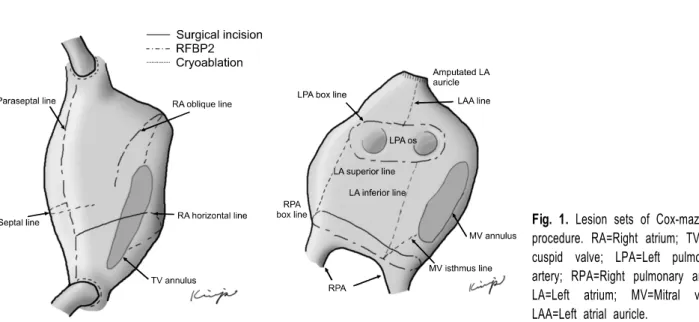
Fig. 1. Lesion sets of Cox-maze IV procedure. RA=Right atrium; TV=Tri- cuspid valve; LPA=Left pulmonary artery; RPA=Right pulmonary artery;

LA=Left atrium; MV=Mitral valve;

LAA=Left atrial auricle.

cerevrovascular accident and ten (10.6%) who had been pre- scribed anti-arrhythymic agent and no patient who had been performed direct current electric cadioversion preoperatively (Table 1).

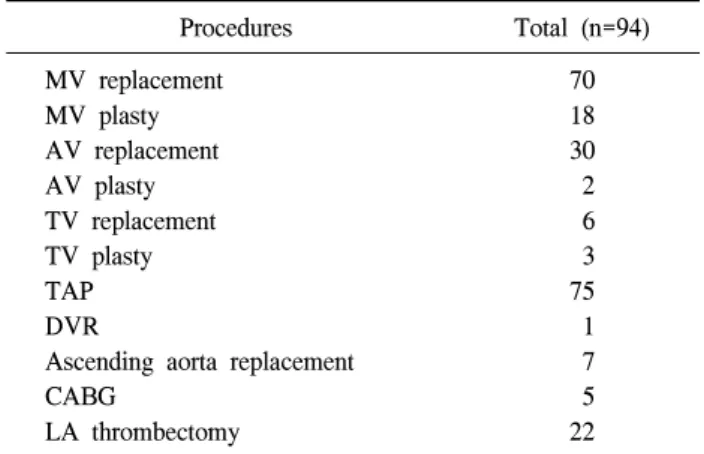
Table 2 shows combined valvular operations and associated cardiac diseases. Mitral procedures requiring repair or replace- ment were most frequent combined procedure (87 cases, 92.6%). Tricuspid interventions were next frequency (84 cas- es, 89.4%). Aortic valvuar operations were 32 cases (34.0%).

Coronary artery bypass grafting with valvular surgery were 5 cases (5.3%) and ascending aorta procedures requiring reduc- tion plasty or replacement were 7 cases (7.4%). We per- formed only three cases of left atrial reduction plasty. In tri- cuspid position, we performed annuloplasty using MC3 ring (Edwards LifeScience, Irvine, CA, USA) whenever there was annular dilatation more two-finger breadth on intraoperative finding in spite of preoperative mild tricuspid regurgitation.

Operative procedure was in progress as usual open heart surgery; Under general anesthesia, Swan-Ganz catheter was inserted via internal jugular vein to pulmonary artery. After median sternotomy, we put the arterial cannula on ascending aorta usually and dual venous cannula on separate vena cava.

According to combined surgery, we generally performed right atrial ablation on beating heart before aorta cross clamp- ing to minimize the myocardial ischemic time. Ablation pro- cedure for left atrium was performed during aorta cross clamp time with main combined procedure.

All ablation procedures obtained transmural lesion by in- strumental guidelines; we applied a cryothermy using N2O for more two minute under −60

o

C and bipolar radio- frequency twice using 25∼30 watt energy.

Fig. 1 shows our Cox-maze IV lesion sets. After right at- riotomy (horizontal line), a lesion set extended to tricuspid annulus via internal right atrial wall toward two o’clock by cryoablation. Then, small incision was made on right atrial auricle and bipolar radio frequency was applied to right atrial oblique line via free wall, and cryoablation was attempted to internal right atrial wall lesion to the annulus toward ten o’clock. With bipolar radio frequency, right atrial para-septal lines were made to both vena caval directions. In addition, septal line to foramen ovale was constructed by bipolar radio frequency, too.

Regarding left atrial lesion sets, separate both pulmonary

artery box lesions were made by bipolar radio frequency with

extended left atriotomy incision. Then, the lines between both

box lesions were constructed by cryoablation or radio-

frequency superiorly and inferiorly. Whenever there was

Marshall ligament around left pulmonary artery, we cut it

down. There were seventeen cases (18.1%) in which Marshall

ligament existed. Before mitral prosthesis insertion, cryoa-

blation was applied on mitral isthmus to mitral annulus. At

last, we ablated the lesion between left pulmonary artery box

line and left atrial auricle with cryothermy and obliterated the

left atrial auricle externally with simple double tie ligation or

(4)

excision.

We reviewed the preoperative risk factors and several echocardiographic parameters such as left atrial size and left ventricular ejection fraction at preoperative, before discharge, postoperative 6months and 12∼18 months. We also per- formed 12-lead electrocardiography (ECG) daily during peri- operative period and checked it bi-monthly for two years af- ter operation, and performed Holter monitoring in occasion as needed.

In this study, we defined “free from Afib” as ECG showed normal sinus rhythm, junctional rhythm, atrial pacing rhythm or other regular ventricular beat. We also defined a failure of maze procedure as case of Afib at postoperative 6months and regarded recurrence of Afib after 6months as a recurrence of Afib.

Data were analyzed with SPSS 12.0 software (SPSS, Inc., Chicago, IL). Ten preoperative and postoperative variables were evaluated in a univariate analysis to identify potential predictors of maze failure or Afib recurrence. Univariate anal- yses were performed for all parameters by means of χ

2

anal- ysis and Student’s t test for continuous variables. A multi- variable analysis (logistic regression model) was used to iden- tify factors for Afib recurrence or maze failure. A value of p less than 0.05 was considered statistically significant.

RESULTS

There were two operative mortalities (2.1%). One patient was expired because of sudden rupture of left ventricle after mitral valve replacement and the other was death from post- operative low cardiac output syndrome.

Postoperative morbidities were two cerebrovascular acci- dents (2.1%), two reoperations due to bleeding (2.1%), two superficial wound infections (2.1%), one case of permanent pacemaker insertion (1.1%) and thromboembolism (1.1%). In addition, low cardiac output syndrome which needed use of inotropics for over five days was 5 cases (5.3%) and brady- cardia which sustained for over three days was 25 cases (26.6%). And there was no postoperative renal failure.

The mean period for cardiopulmonary bypass time was 225±47.1 (136∼343) minutes and that of aortic cross clamp time was 152.2±40.8 (43∼249) minutes. Five patients (5.3%)

needed total circulatory arrest period which is mean 13.2±2.3 (10∼16) minutes.

Except two mortalities and two follow up loss, ninety pa- tients have been followed up in outpatient department and mean follow up period was 22.7±12.3 (0.7∼43.5) months.

1) Transthoracic echocardiographic (TTE) findings

Preoperative echocardiography revealed that left ventricular ejection fraction was mean 55.3±8.1 (32∼75)% and left at- rial size was mean 61.5±11.6 (26∼93) mm. More than mod- erate tricuspid regurgitation was present on 34 patients (36.2%). However, seventy five patients (79.8%) including them were revealed to have dilated annulus of tricuspid posi- tion and underwent tricuspid annuloplasty using MC3 ring.

At postoperative period, we compared preoperative TTE with postoperative 6 month and latest examination (postopera- tive mean 18.5±6.9 months). The left ventricular ejection fraction was slightly improved from preoperative 55.3±8.1%

to postoperative 6 month 54.7±6.5%, latest 56.5±7.0%. And left atrial size showed significant reduction after operation (preoperative 61.5±11.6 mm, postoperative 6 month 53.1±8.4 mm) then increasing tendency on latest examination (54.7±9.8 mm). Numbers of postoperative more than moderate tricuspid regurgitation were significantly reduced to only four (preope- rative 34 patients) after aggressive correction.

2) Electrocardiographic (ECG) findings

Just after operation, sixty seven patients (out of 94, 71.3%)

showed normal sinus rhythm and sixteen (17.0%) showed

consistent Afib. The others (eleven, 11.7%) showed junctional

rhythm or pacing rhythm or undetermined rhythm. However,

before discharge, proportion of Afib was increased to twenty

seven (out of 92, 29.3%) and normal sinus rhythm was 49

(53.3%), the others 16 (17.4%). At postoperative 1 month,

number of Afib was 27 (out of 92, 29.3%), normal sinus

rhythm 57 (62.0%) and the others 8 (8.7%) as like as predis-

charge findings. However, at postoperative 6 months, Afib

was decreased to 17 (out of 88, 19.3%), normal sinus rhythm

58 (65.9%), and the others 13 (14.8%). Then, this findings

has been maintained to postoperative 12 months; Afib 18 (out

of 90, 20.0%), normal sinus rhythm 58 (64.4%), the others

14 (15.6%).

(5)

Table 3. Risk factors analysis for maze failure or recurrence of atrial fibrillation

Variables No Afib (n=72) Afib (n=20) Univariate Multivariate

p-value p-value OR

Age (yrs) Female sex Rheumatic etiology

Preop moderate or severe TR Afib durarion (yrs)

Preop LA size (mm) LA reduction plasty CPB time (min) ACC time (min)

Immediate postop LA size (mm)

54.2±10.4 45 (62.5%) 50 (69.4%) 21 (29.2%) 6.5±6.0 60.7±10.8

2 (2.8%) 225.6±49.3 153.8±41.8 52.1±7.8

62.2±7.1 14 (70.0%) 10 (50.0%) 12 (60.0%) 10.6±6.6 63.9±14.6

1 (5.0%) 219.1±32.7 142.6±35.3 56.9±7.7

.000 .536 .106 .011 .010 .286 .525 .493 .277 .017

.010

.033 .207 .440

.217

1.093 (1.021∼1.169)

3.597 (1.111∼11.646) 1.059 (.969∼1.157) .977 (.920∼1.037)

1.064 (.964∼1.175) OR=Odds ratio; Afib=Atrial fibrillation; TR=Tricuspid regurgitation; LA=Left atrium; CPB=Cardiopulmonary bypass; ACC=Aorta cross clamp; Postop=Postoperative.

Generally, in our definition of free from Afib, success rate of our Cox-maze IV procedure in valvular heart disease at postoperative 6 months was 80.7% (71 out of 88). After 6month, we could find three recurred Afib patients in our co- hort which meant 3.3% (3 out of 90) of recurrence rate.

During follow up period after discharge, there was no new- ly developed cerebrovascular accident and no other morbidity associated with open heart surgery except one patient who underwent permanent pacemaker insertion due to sick sinus syndrome. All patients but four (two were early mortalities and two were follow up loss due to other hospital transfer) were regularly followed up in outpatient department. Among them, 53 patients (58.9%) have taken anti-arrhythmic agent such as amiodarone at postoperative 6 month.

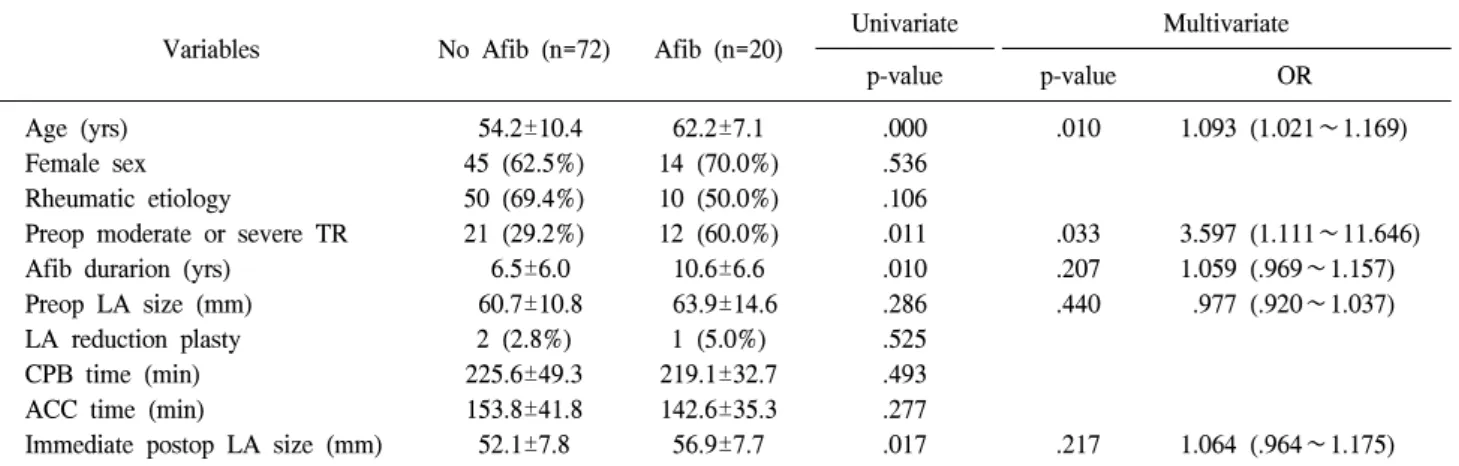
3) Risk factors analysis for failure of maze procedure (Table 3)

We elucidated risk factors for failure of our Cox-maze IV procedure about seventeen patients of failure and three of recurrence. In univariate analysis, old age (p=.000), pre- operative longer duration of Afib (p=.010), preoperative more than moderate tricuspid regurgitation (p=.011) and pre- operative larger left atrial size (p=.017) were significant risk factors. However, in multivariate analysis, only old age (p=.010, odds ratio=1.093) and preoperative more than mod- erate tricuspid regurgitation (p=.033, odds ratio=3.597) were significant risk factors.

DISCUSSION

Maze procedure was introduced by L. Cox for the first time at 1980 and has been modified and developed to be a current procedure [6-8]. Although lesion sets of Cox-maze IV procedure are similar to those of Cox-maze III procedure, it is different that separate both pulmonary box lesion sets are made and connected each other, and other several energy sources such as cryoablation, radiofrequency or microwave are used [3]. This modification has been started with use of cryoablation instead of cut and sew technique since late 1990’s, and Haissaguerre et al suggested modification of sep- arate pulmonary box lesion and connection [9]. So, we have performed Cox-maze IV procedure with established atriotomy lesion set, cryoablation and radio frequency as mentioned above column and made an addition of division of Marshall ligament [10,11].

Concerning bipolar radio frequency, it is inferior to con- struct transmural lesion than cut and sew technique but supe- rior to avoid catastrophic bleeding from incision line and in- evitable time of considerable myocardial ischemic period. So, it is very effective to apply both cryoablation and bipolar ra- dio frequency to make the lesion sets with less time and less complication.

In this study population, although there were two early

deaths, all mortalities were related to underlying cardiac dis-

ease and combined procedure not to maze procedure itself. In

(6)

addition, there were five patients complicated with low car- diac output syndrome who were taken longer operation time because of complexity of combined valve procedure. It goes without saying that such complications cannot be related to maze procedure completely, but minimal additional time to perform Cox-maze IV procedure causes little adverse effect to outcomes of the patients. The other complications were thought to be tolerable.

We reportthat results of Cox-maze IV procedure for treat- ment of chronic Afib associated with valvular heart disease is 80.7% of success rate at 6months and 3.3% recurrence rate afterwards. Melby et al. reported that freedom from Afib rate (86%) of Cox-maze IV procedure using bipolar radio fre- quency was not inferior to that of original Cox-maze III with cut and sew technique even in small study population (8 pptients) [12], And Lee et al. also reported that there was no difference in conversion rate to sinus rhythm at 6months in comparison with Cox-maze IV using bipolar radio frequency (40 patients) and classic cut and sew technique (35 patients);

95.0% vs. 97.1%, p=1.0 [13]. In addition, Khargi et al com- mented that there was no difference (p=.260) between classic cut and sew technique and other energy source use in 3832 patients of 45 studies after systematic review in Pubmed on- line research [4].

Decisive points for success of maze procedure are not only surgical technique such as exact lesion set formation and guarantee for transmurality but also factors of patient itself such as etiology of Afib (rheumatic or non-rheumatic), Afib duration and atiral size. Because this study is not a com- parative design, we cannot suggest that Cox-maze IV proce- dure using cryoablation and bipolar radio frequency is superi- or to other type of maze procedure. However, considering rel- ative high proportion of rheumatic valvular disease and lack of lone Afib in this study population, the success rate of 80.7% is comparable to other papers [4,12]. In addition, Cox-maze IV using cryoablation and bipolar radio frequency is very efficacious and valuable as there has been no newly developed cerebrovascular accident during follow up period.

With respect to prescription of anti-arrhythmic agent in this study, 58.9% at postoperative 6 months is relatively higher than other reports. The reason is suggested that incidence of junctional rthythm and sinus tachycardia is relatively high.

However, most patients could be discontinued to take anti-ar- rhythmic agent afterwards. And we think that direct compar- ison for anti-arrhythmic agent medication is not reasonable because each surgeon has different preference and indication for anti-arrhythmic agent.

It is widely known from lots of literatures that risk factors for failure of maze procedure were longer duration of Afib, larger left atrial size, and older age including rheumatic valv- ular heart disease and certain type of Afib [3]. This analysis also found that older age and preoperative more than moder- ate tricuspid regurgitation were statistically significant risk factors for failure of Cox-maze IV procedure. Old age means that the patient was supposed to have longer period of ex- posure to organic stress causing Afib and old age itself can be a cause of failure or recurrence for maze procedure be- cause aging process lead a change of fibrosis and less elas- ticity in atrial wall. Longer duration of Afib was analyzed in- to significant risk factor in univariate analysis although not in multivariate. Like old age, it can be a cause of failure or re- currence for maze procedure in terms of organic change of atrial wall. However, because additional myocardial ischemic time is minimal in Cox-maze IV procedure ; right side maze during pre-clamping period or cardioplegic infusion period and only about ten to fifteen minute to perform on left side maze, and maze procedure conduct rare complication, it is not reasonable that Cox-maze IV procedure should be avoid- ed in old patients or complex cases.

Generally, preoperative more than moderate tricuspid regur- gitation is related to left sided cardiac problem leading to right ventricular dilatation. In our cases, most patients who showed more than moderate tricuspid regurgitation were due to functional regurgitation except six patients who showed or- ganic change causing replacement of tricuspid valve. In addi- tion, it is well known that longer duration of Afib or pulmo- nary hypertension can lead considerable regurgitation in tri- cuspid valve.

It is debatable that correction of tricuspid regurgitation

should be performed in left sided valvular operation. Especi-

ally in case of mild regurgitation, most surgeons recom-

mended not to correct it, however, it would occur not in-

frequently during long term follow up period. And Dreyfus et

al commented that tricuspid annuloplasty should be consid-

(7)

ered according to presence of annular dilatation not degree of regurgitation in functional tricuspid regurgitation [14]. There- fore, we performed constantly tricuspid annuloplasty using MC3 ring if there was evidence of annular dilatation on right atriotomy finding which showed over three finger breadth or over the size of Carpentier-Edwards ring 34 mm sizer and re- ported good results which showed low residual tricuspid re- gurgitation and no morbidity related to annuloplasty proce- dure [15].

Limitations of this study are; first, there is no comparative control group. Period of classic cut and sew technique in our institution was too long ago to compare current technique be- cause of so many other variables. Besides, to strictly compare two techniques, only lone Afib patients should be studied for exclusion of operative bios. But, we had no such subject.

Second, there was no data of both atrial mechanical activities.

It is well known that no mechanical activity of atrium can lead evolution of thromboembolism even in normal sinus rhythm. We could not survey that of each patient in TTE da- ta because this study was designed retrospectively. This should be mandatory to following research. Third, we should have surveyed more detail and in-depth manner such as Holter monitoring on analysis of ECG. However, many re- searchers would set up 12-lead ECG as a standard evaluation tools for Afib. Last, because this study includes many type of combined surgery, it is unreasonable to accept as results of maze procedure. Therefore, it is mandatory to survey on lone Afib.

CONCLUSION

The Cox-maze IV procedure using cryoablation and bipolar radio frequency is safe and comparable to other maze proce- dure with 80.7% of success rate at postoperative 6 months.

And risk factors for failure or recurrence are old age and pre- operative more than moderate tricuspid regurgitation.

REFERENCES

1. Fuster V, Ryden LE, Cannom DS, et al. ACC/AHA/ESC 2006 guidelines for the management of patients with atrial

fibrillation--excutive summary. Rev Port Cardiol 2007;26:

383-446.

2. Van Gelder IC, Hagens VE, Bosker HA, et al. A comparison of rate control and rhythm control in patients with recurrent persistent atrial fibrillation. N Engl J Med 2002;347:1834-40.

3. Ad N. The Cox-Maze procedure: history, results, and pre- dictors for failure. J Interv Card Electrophysiol 2007;20:

65-71.

4. Khargi K, Hutten BA, Lemke B, Deneke T. Surgical treat- ment of atrial fibrillation; a systematic review. Eur J Cardiothorac Surg 2005;27:258-65.

5. Stulak JM, Dearani JA, Sundt TM 3rd, et al. Superiority of cut-and-sew technique for the Cox maze procedure: compar- ison with radiofrequency ablation. J Thorac Cardiovasc Surg 2007;133:1022-7.

6. Cox JL, Boineau JP, Schuessler RB, et al. Electrophysiologic basis, surgical development, and clinical results of the maze procedure for atrial flutter and atrial fibrillation. Adv Card Surg 1995;6:1-67.

7. Cox JL. The surgical treatment of atrial fibrillation. IV. Sur- gical technique. J Thorac Cardiovasc Surg 1991;101:584-92.

8. Cox JL, Schuessler RB, D'Agostino HJ Jr, et al. The surgi- cal treatment of atrial fibrillation. III. Development of a de- finitive surgical procedure. J Thorac Cardiovasc Surg 1991;

101:569-83.

9. Haissaguerre M, Jais P, Shah DC, et al. Spontaneous ini- tiation of atrial fibrillation by ectopic beats originating in the pulmonary veins. N Engl J Med 1998;339:659-66.

10. Wu TJ, Ong JJ, Chang CM, et al. Pulmonary veins and lig- ament of Marshall as sources of rapid activations in a ca- nine model of sustained atrial fibrillation. Circulation 2001;

103:1157-63.

11. Kim DT, Lai AC, Hwang C, et al. The ligament of Marshall:

a structural analysis in human hearts with implications for atrial arrhythmias. J Am Coll Cardiol 2000;36:1324-7.

12. Melby SJ, Zierer A, Bailey MS, et al. A new era in the sur- gical treatment of atrial fibrillation: the impact of ablation technology and lesion set on procedural efficacy. Ann Surg 2006;244:583-92.

13. Lee MK, Choi JB, Lee JM, Kim KH, Kim MH. Result of cox maze procedure with bipolar radiofrequency electrode and cryoablator for persistent atrial fibrillation - compared with cut-sew technique -. Korean J Thorac Cardiovasc Surg 2009;42:710-8.

14. Dreyfus GD, Corbi PJ, Chan J, Bahrami T. Secondary tri- cuspid regurgitation or dilatation: Which should be the cri- teria for surgical repair? Ann Thorac Surg 2005;79:127-32.

15. Jeong DS, Kim KH. Tricuspid annuloplasty using the MC3 ring for functional tricuspid regurgitation. Circ J 2010;74:

278-83.

수치

Table 1. Patient demographics Total  (n=94) Age  Sex  (M : F) AF  duration Type  of  AF Persistent Permanent
Fig. 1. Lesion sets of Cox-maze IV  procedure. RA=Right atrium;  TV=Tri-cuspid valve; LPA=Left pulmonary  artery; RPA=Right pulmonary artery;
Table 3. Risk factors analysis for maze failure or recurrence of atrial fibrillation

참조

관련 문서

The aim of this study was to provide a optimal drug therapy which secures effectiveness and safeness in elderly patients by analyzing polypharmacy and the

Results: In this research, there were positive changes in sub-factors of body composition, cardiopulmonary endurance, and heart rate variability in obese

In other words, pomegranate extract has an effect of inhibiting the progression of alveolar bone loss due to periodontal inflammation by reducing the expression of COX-1 and

:Acidulated phosphate fluoride treatment and formation of caries-like lesions in enamel: effect of application time.. Schmidt HF : The fluoride varnish

Objective: The purpose of this study is to use it as a basis for the health care guidelines for the muscle mass and cardiovascular disease of Korean population by

In this study, The author reviewed the developing procedure for the technique of the naval ships structures considering survivability and described the

This paper examines the various problems associated with passage of ships in coastal states maritime jurisdiction and analyze for the national and

Post-surgical use of radioiodine (131I) in patients with papillary and follicular thyroid cancer and the issue of remnant ablation: a consensus