⋅교신저자 : Sabina Lim, #1 Hoegi‐dong, Dongdaemoon‐gu, Postal code: 130-701, Seoul, Korea, Tel : 82-2-961-0324, Fax: 82-2-961-7831, E-mail : [email protected]
․ 투고 : 2009/10/23 심사 : 2009/11/05 채택 : 2009/11/18
The Effect of Sa-am acupuncture on Knee Osteoarthritis
Moo-Hong Min
1,2, Yeong-Gon Choi
1,2,3, Yun-Ju Kim
1,2, Hi-Joon Park
3, Sam-Chool Lee
1, Ho-No Joo
1, Seung-Moo Han
1, Sabina Lim
1,2,31
WHO Collaborating Center, East‐West Medical Research Institute, Kyung Hee University, Seoul, Korea
2
Dept. Applied Eastern Medicine, Graduate School, Kyung Hee University, Seoul, Korea
3
Dept. Meridian & Acupoint, Graduate School of Basic Eastern Medical Science, Kyung Hee University, Seoul, Korea
Running head : Effect of Sa‐am acupuncture on knee OA Abstract
Objective : Acupuncture has been widely used throughout the world for the treatment of knee osteoarthritis (knee OA). This study investigated whether acupuncture, particularly Sa‐am acupuncture, could be effective in relieving pain and improving the symptoms of knee OA.
Method : This study was conducted as a prospective, randomized, controlled, and patient‐ and investigator‐
blinded clinical trial. Forty volunteers with knee OA participated in the study. All participants were screened through an inclusion and exclusion criteria. Thirty four participants completed the clinical trial. In total, forty subjects were randomly selected to receive Sa‐am acupuncture. Eight sessions of acupuncture were given at the contralateral side of the problematic knee for 4 weeks. Korean translation of Western Ontario and McMaster Universities Osteoarthritis Index (KWOMAC) scores were measured twice: at the beginning and end of the clinical trial period. Both the Patient Global Assessment and physical health scores based on the 36‐Item Short‐Form Health Survey were also used to measure the results.
Results : Compared to the pre‐trial scores, the Sa‐am acupuncture group (n=34) showed a significant decrease in KWOMAC total scores according to a paired t ‐test. The Sa‐am acupuncture group also showed significant improvement in the Patient Global Assessment when compared to the pre‐trial.
Conclusions : Sa‐am acupuncture for knee OA resulted in an improved KWOMAC total score. This was mostly driven by the function component score that was greatly affected by acupuncture. However, further studies with expanded designs are needed to solidify this finding with scientific rigor.
Keywords : Acupuncture, Osteoarthritis, KWOMAC, SF‐36, Patient Global Assessment
Introduction
Acupuncture been used for centuries as a treatment for a wide range of human
diseases. The points on the human body
that acupuncture utilizes, called acupoints,
have been established over time. In
addition, new acupoints have been
developed with the progress of modern
oriental medicine. In recent years, Western
medical circles have become increasingly
interested in the scientifically proved therapeutic effect of acupuncture
1-3).
When acupoints are activated by needling, a series of responses arise from the stimulations that are known to affect the central and peripheral systems
4,5). To study the impact of acupuncture on the central nervous system (CNS), functional magnetic resonance imaging (fMRI) has
been used
1,2,4). Based on these
investigations, it has been reported that acupuncture might modulate the activity of the limbic system and subcortical gray structures
6). Furthermore, electro- acupuncture has been known to exert anti-inflammatory effects mediated by peripheral opioids in inflammation models
5)
. This implies that acupuncture could have a beneficial effect on both the central and peripheral systems.
Osteoarthritis (OA) is a chronic progressive disease that is difficult to manage and control, discouraging both patient and medical professional. Once OA appears in the knee, it results in a progressive deterioration of the pathological region of the knee, often accompanied by inflammation
7). Although there is no complete cure for OA until now, a variety of treatments, including acupuncture, are available for the relief of its symptom with few side effects
8).
Acupuncture methods are classified
according to the sites intended for needle insertion, the combination of acupoints used, and the manipulation of the needle
9). Sa‐am acupuncture, categorized as an acupuncture method that selects acupoints remote from pain regions based on meridian theory of acupuncture methods, has commonly been used in clinical treatment
10). It was developed by a monk Sa‐am about 400 years ago, and has been handed down as a unique Korean acupuncture method
10). Sa‐am acupuncture is thought to have originated from the theory of “I Ching” and “Yin Yang Five Element Theory”, and additionally to have been influenced by medical scholars
10). The method is one of several acupuncture methods to prescribe in the relation of “Five Phases” with the affected meridian
11). Because the method is applied to the patient by tracing the fundamental cause of disease, different acupoints can be appointed for even the most common illnesses
11). Sa-am acupuncture will be further explored in the discussion section.
The pathological regions and acupoints
located near pain regions in OA have
been selected in previous studies that
investigated the therapeutic effects of
Sa-am acupuncture in pain relief
12-14).
Therefore, the pain relief effect of Sa-am
acupuncture, which selects acupoints
remote from pain regions by the classification and the analysis of symptoms through the meridian, needs to be studied in OA. This study investigated whether acupuncture, particularly Sa-am acupuncture, could be effective in relieving pain and improving the symptoms of knee OA.
Methods 1. Target Population
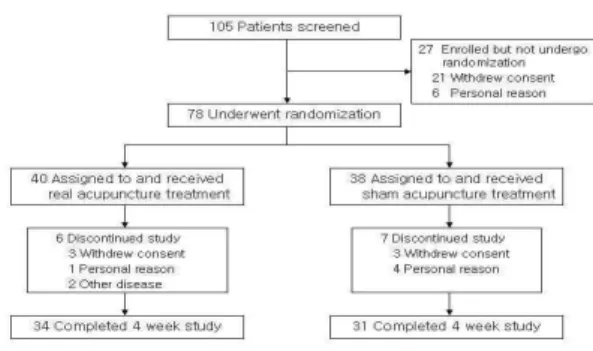
Male and female volunteers were recruited by advertisements to participate in this study (Fig. 1). All patients signed an informed consent. This study was carried out under the review of an ethics committee made up of oriental medical doctors and a religious scholar.
Fig. 1. Participant Flowchart.
Seventy-eight subjects were divided into each group using a random table, the Sa-am acupuncture group with 40 participants and the sham group with 38. During the trial, the number of dropouts was 6 in the Sa-am group and 7 in the sham group. The dropouts were classified as follows: in the Sa-am group, 3 by withdrawal of consent (denial of participation and treatment), 2 because of other diseases, and 1 for personal reasons; in the sham group, 3 by withdrawal of consent (denial of participation and treatment) and 4 for personal reasons.
Inclusion criteria:
- Female or male over the age of 50 (59.5 ± 5.3 years).
- Diagnosis of OA of the knee (American College of Rheumatology criteria applied).
- Duration of OA more than six months.
- Documented radiographic changes of osteoarthritis (Kellgren-Lawrence grade of 1 or more).
- Signed informed consent.
Exclusion criteria:
- Female or male over the age of 70.
- Intra‐articular corticosteroid injection in the knee within four weeks immediately preceding entry into the study.
- Severe chronic or uncontrolled concomitant illness.
- Diagnosis of rheumatoid arthritis of the knee.
- History or clinical indications of bleeding diathesis and cardiovascular disease, including current use of anticoagulants.
- Allergy to metal.
- Previous treatment with acupuncture within four weeks prior to entry into the study.
- Taking hormone medications.
2. Study design Randomization:
The subjects were divided into Sa-am acupuncture and sham acupuncture groups using a random table generated by SPSS 12.0. Two operators licensed in oriental medicine, having over seven years’
experience in clinical treatment, performed the acupuncture. The subjects of both groups were assigned to two operators, and each established operator throughout the trial administered both Sa‐am and sham acupunctures.
Blinding and materials:
Because it was impossible to blind the operators, both all subjects and the analyzers for the data were blinded.
Disposable stainless steel needles were used for the Sa-am acupuncture group (DongBang Acupuncture, Korea, 0.25 × 40
㎜). The patients of the sham group could not distinguish sham acupuncture from Sa-am acupuncture because Park sham needle had been used for the sham acupuncture
15).
3. Procedure
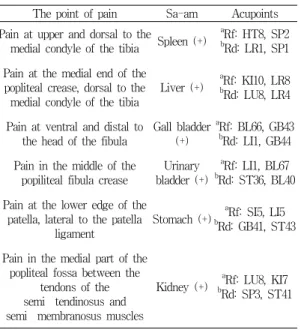
In the Sa-am acupuncture group, Sa-am acupuncture was performed at the selected acupoints as shown in Table 1.
Patients were acupunctured two times per week over a four-week period. The depth of Sa-am acupuncture was about 1 ㎜ - 5 ㎜, and the duration of the acupuncture was about 20 minutes. Twirling reinforcement‐reduction and nine‐six reinforcement‐reduction methods were used as a reinforcement‐reduction method, and the patients reported feeling deqi (needle sensation). Acupoint, frequency and duration of the operation on the sham group with Park sham needle were identical to the Sa-am group, and deqi was mimicked
15).
The acupoints in Sa-am acupuncture are determined from the method that has been passed down through generations by Sa-am practitioners, as shown in Table 2 and 3
11). The acupoints appointed by “Five Phases” in the Sa-am acupuncture method is shown in Table 2. For each treatment, Sa-am acupuncture uses a set of four acupoints (two acupoints for tonifying and two acupoints for purging) selected from
“Five Phases” (Table 3).
The point of pain Sa-am Acupoints Pain at upper and dorsal to the
medial condyle of the tibia Spleen (+)
aRf: HT8, SP2
b
Rd: LR1, SP1 Pain at the medial end of the
popliteal crease, dorsal to the
medial condyle of the tibia Liver (+)
aRf: KI10, LR8
b
Rd: LU8, LR4
Pain at ventral and distal to
the head of the fibula Gall bladder (+)
a
Rf: BL66, GB43
b
Rd: LI1, GB44 Pain in the middle of the
popiliteal fibula crease Urinary bladder (+)
a
Rf: LI1, BL67
b
Rd: ST36, BL40 Pain at the lower edge of the
patella, lateral to the patella
ligament Stomach (+)
aRf: SI5, LI5
b
Rd: GB41, ST43
Pain in the medial part of the popliteal fossa between the
tendons of the semi‐tendinosus and semi‐membranosus muscles
Kidney (+)
aRf: LU8, KI7
b
Rd: SP3, ST41
a
Rf: Reinforcement (+), needle turned right nine times.
b
Rd: Reduction (-), needle turned left six times.
Table 1. The acupoints of Sa-am determined according to the point of pain.
Phases Jeong Hyoung Su Gyoung Hap Meridian Yin Wood Fire Earth Metal Water
Yang Metal Water Wood Fire Earth
LU LU11 LU10 LU9 LU8 LU5
LI LI1 LI2 LI3 LI5 LI11
ST ST45 ST44 ST43 ST41 ST36
SP SP1 SP2 SP3 SP5 SP9
HT HT9 HT8 HT7 HT4 HT3
SI SI1 SI2 SI3 SI5 SI8
BL BL67 BL66 BL65 BL60 BL40
KI KI1 KI2 KI3 KI7 KI10
PC PC9 PC8 PC7 PC5 PC3
TE TE1 TE2 TE3 TE6 TE10
GB GB44 GB43 GB41 GB38 GB34
LR LR1 LR2 LR3 LR4 LR8
a
This method is based on traditional Korean medicine
11). The Five Phases, indicated as Jeong, Hyoung, Su, Gyoung and Hap, are all located in the extremities of the four limbs.
Each of them has a type of five elemental properties, which is distinguished from the type of attached meridian.
Table 2. The acupoints appointed by “Five Phases” in Sa-am acupuncture method
a.
Meridian
a
Jeong‐Gyeok
bSeung‐Gyeok
Reinforcement Reduction Reinforcement ReductionLU SP3 LU9 HT8 LU10 HT8 LU10 KI10 LU5
LI ST36 LI11 SI5 LI5 SI5 LI5 BL66 LI2 ST SI5 ST41 GB41 ST43 GB41 ST43 LI1 ST45 SP HT8 SP2 LR1 SP1 LR1 SP1 LU8 SP5 HT LR1 HT9 KI10 HT3 KI10 HT3 SP3 HT7 SI GB41 SI3 BL66 SI2 BL66 SI2 ST36 SI8 BL LI1 BL67 ST36 BL40 ST36 BL40 GB41 BL65 KI LU8 KI7 SP3 KI3 SP3 KI3 LR1 KI1 PC LR1 PC9 KI10 PC3 KI10 PC3 SP3 PC7 TE GB41 TE3 BL66 TE2 BL66 TE2 ST36 TE10 GB BL66 GB43 LI1 GB44 LI1 GB44 SI5 GB38 LR KI10 LR8 LU8 LR4 LU8 LR4 HT8 LR2
a
Jeong-Gyeok tonifies the mother organ of the deficient organ.
bSeung-Gyeok purges the son organ of the excessive organ. There are two acupoints that use reinforcement manipulation for tonifying and two acupoints that use reduction manipulation for purging. Therefore, Sa-am acupuncture uses a set of four acupoints selected from
“Five Phases”. In each of these, two tonifying and two purging, one is in its own meridian and the other is in the meridian of the mother or son.
Table 3. The acupoints distributed by
a
Jeong-Gyeok and
bSeung-Gyeok in Sa-am acupuncture method.
4. Measurement of the pain relief effects of Sa-am acupuncture
To estimate the pain relief effects of
Sa-am acupuncture on OA of the knee,
Western Ontario and McMaster
Universities Osteoarthritis Index
(WOMAC) translated into Korean (Korean
WOMAC, KWOMAC) was used as a
measurement of primary outcomes
following four weeks of treatment
16). As a
measurement of secondary outcomes, the
36-Items Short‐Form Health Survey
(SF-36) was used, estimating the quality
of life at pre‐trial and post‐trial. In addition, the Patient Global Assessment was used to assess the improvement of the symptoms after four weeks of treatment. The measurements were carried out with the evaluator of the subject groups blinded.
5. Statistical analysis
The number of subjects was calculated on the basis of Berman’s data which showed a mean difference of -14.0 ± 20.5 (mean ± SD) in the WOMAC score between both acupuncture groups
17). We estimated that 33.62 subjects would be needed in each group to give 80% power to demonstrate a statistically significant improvement in total KWOMAC score between the Sa-am and sham acupuncture groups. This statistical value was calculated by applying an intention‐to‐
treat analysis. An independent t -test and a Mann‐Whiney U-test were performed for both groups to confirm the possibility of success of randomized allocation and to compare the characteristics of the participants. Both an independent t -test and ANCOVA analysis were applied for the KWOMAC score, whereas only independent t -test for the SF-36 score. A Mann-Whiney U-test using a non-parametric system was used for the Patient Global Assessment. As the
KWOMAC total score had been repeatedly measured, the therapeutic effect by the frequency of acupuncture trial needed to be considered. Accordingly, the KWOMAC total score was analyzed by mixed effect model using an SAS mixed procedure.
SPSS 12.0 was used for the Mann-Whiney U-test, and an SAS 8.2 statistical package was used for all other statistical analyses.
Results
The study’s aims were to evaluate the
pain relief effect of Sa-am acupuncture
for degenerative OA. The subjects who
had been suitable for both inclusion
criteria and exclusion criteria from the
recruited participants were selected. (The
participant flowchart is shown in Figure
1.) With their consent, this study was
initiated as double blinding for both all
subjects and analyzer as a randomized
controlled trial. Seventy‐eight subjects
were divided into each group using a
random table, the Sa-am acupuncture
group with 40 participants and the sham
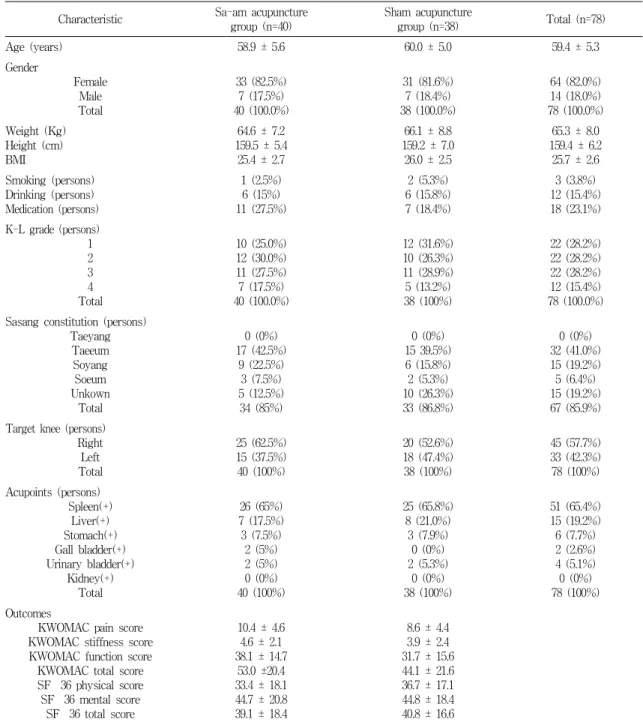
group with 38. The demographic and
baseline characteristics for both groups
are shown in Table 4. Both groups have
shown similar characteristics, with their
independence verified using both general
features and baseline outcomes. This
Characteristic Sa-am acupuncture
group (n=40) Sham acupuncture
group (n=38) Total (n=78)
Age (years) 58.9 ± 5.6 60.0 ± 5.0 59.4 ± 5.3
Gender
Female Total Male
33 (82.5%)
7 (17.5%) 40 (100.0%)
31 (81.6%)
7 (18.4%) 38 (100.0%)
64 (82.0%) 14 (18.0%) 78 (100.0%) Weight (Kg)
Height (cm) BMI
64.6 ± 7.2 159.5 ± 5.4 25.4 ± 2.7
66.1 ± 8.8 159.2 ± 7.0 26.0 ± 2.5
65.3 ± 8.0 159.4 ± 6.2
25.7 ± 2.6 Smoking (persons)
Drinking (persons) Medication (persons)
1 (2.5%) 6 (15%) 11 (27.5%)
2 (5.3%) 6 (15.8%) 7 (18.4%)
3 (3.8%) 12 (15.4%) 18 (23.1%) K-L grade (persons)
1 2 3 4 Total
10 (25.0%) 12 (30.0%) 11 (27.5%) 7 (17.5%) 40 (100.0%)
12 (31.6%) 10 (26.3%) 11 (28.9%) 5 (13.2%) 38 (100%)
22 (28.2%) 22 (28.2%) 22 (28.2%) 12 (15.4%) 78 (100.0%) Sasang constitution (persons)
Taeyang Taeeum Soyang Soeum Unkown
Total
0 (0%) 17 (42.5%)
9 (22.5%) 3 (7.5%) 5 (12.5%) 34 (85%)
0 (0%) 15 39.5%) 6 (15.8%) 2 (5.3%) 10 (26.3%) 33 (86.8%)
0 (0%) 32 (41.0%) 15 (19.2%) 5 (6.4%) 15 (19.2%) 67 (85.9%) Target knee (persons)
Right Total Left
25 (62.5%) 15 (37.5%) 40 (100%)
20 (52.6%) 18 (47.4%) 38 (100%)
45 (57.7%) 33 (42.3%) 78 (100%) Acupoints (persons)
Spleen(+) Liver(+) Stomach(+) Gall bladder(+) Urinary bladder(+)
Kidney(+) Total
26 (65%) 7 (17.5%) 3 (7.5%)
2 (5%) 2 (5%) 0 (0%) 40 (100%)
25 (65.8%) 8 (21.0%) 3 (7.9%)
0 (0%) 2 (5.3%)
0 (0%) 38 (100%)
51 (65.4%) 15 (19.2%) 6 (7.7%) 2 (2.6%) 4 (5.1%) 0 (0%) 78 (100%) Outcomes
KWOMAC pain score KWOMAC stiffness score KWOMAC function score KWOMAC total score SF‐36 physical score SF‐36 mental score
SF‐36 total score
10.4 ± 4.6 4.6 ± 2.1 38.1 ± 14.7
53.0 ±20.4 33.4 ± 18.1 44.7 ± 20.8 39.1 ± 18.4
8.6 ± 4.4 3.9 ± 2.4 31.7 ± 15.6 44.1 ± 21.6 36.7 ± 17.1 44.8 ± 18.4 40.8 ± 16.6
a
There were no statistical differences between the Sa-am acupuncture group and the sham group at the baseline.
The values expressed with a plus/minus sign are means ± SD. KWOMAC=Western and McMaster Universities Osteoarthritis Index translated into Korean. SF-36=36-Item Short‐Form Health Survey.
Table 4. The demographic and baseline characteristics of the participants
a.
implies that the randomized assignment of the subjects was suitable for this clinical study. During the trial, the number of dropouts was 6 in the Sa-am group and 7 in the sham group, as shown in Figure 1.
The dropouts were classified as follows:
in the Sa-am group, 3 by withdrawal of consent (denial of participation and treatment), 2 because of other diseases, and 1 for personal reasons; in the sham group, 3 by withdrawal of consent (denial of participation and treatment) and 4 for personal reasons.
1. 4‐weeks’ Sa-am acupuncture has no effect on OA through KWOMAC index scores by ANCOVA analysis.
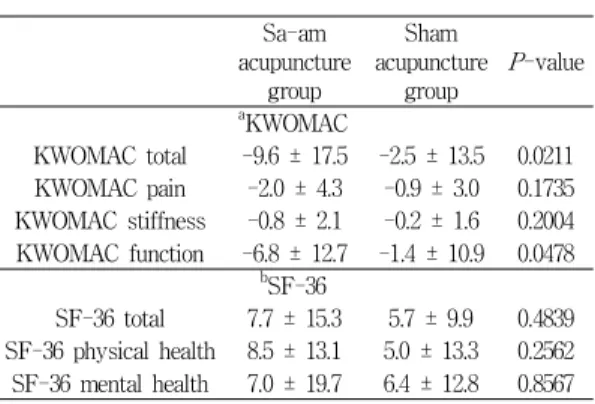
The pre-trial KWOMAC total score was 53.0 ± 20.4 in the Sa-am acupuncture group, and its total score after the four weeks’trial was 43.4 ± 22.0. Thus, the change in the KWOMAC total score within the Sa-am group was -9.6 ± 17.5.
The change of the KWOMAC total score in the sham group was -2.5 ± 13.5 (Table 5). The change of the KWOMAC function score was -6.8 ± 12.7 in the Sa-am group and -1.4 ± 10.9 in the sham group, showing significance (p=0.0478). These results reveal that the changes in the Sa
‐am group show a significant amelioration compared to the sham group
(statistical significance p=0.0211).
However, there was no significance in KWOMAC total and KWOMAC function scores by ANCOVA analysis. There was no significant change in either group in the cases that the changes of the KWOMAC pain and stiffness scores had been calculated, as shown in Table 5.
These results on KWOMAC scores indicate that Sa-am acupuncture has a no therapeutic effect on OA of the knee.
2. 4-weeks’ Sa-am acupuncture has no effect on OA through SF‐36 score.
The pre-trial SF-36 total score was 39.1 ± 18.4 in the Sa‐am acupuncture group, and its total score after the four weeks’trial was 46.8 ± 18.6. In the sham group, the pre‐trial SF-36 total score was 40.8 ± 16.6, and its total score after the four weeks’trial was 46.5 ± 18.6. The change of the SF-36 total score was 7.7
± 15.3 in the Sa-am group and 5.7 ± 9.9
in the sham group, showing no
significance as shown in Table 5
(p=0.4839). In addition, the SF-36 physical
and mental health scores also did not
show statistical significance between both
groups (Table 5).
Sa-am acupuncture
group
acupuncture Sham group P-value
a
KWOMAC
KWOMAC total -9.6 ± 17.5 -2.5 ± 13.5 0.0211 KWOMAC pain -2.0 ± 4.3 -0.9 ± 3.0 0.1735 KWOMAC stiffness -0.8 ± 2.1 -0.2 ± 1.6 0.2004 KWOMAC function -6.8 ± 12.7 -1.4 ± 10.9 0.0478
b
SF-36
SF-36 total 7.7 ± 15.3 5.7 ± 9.9 0.4839 SF-36 physical health 8.5 ± 13.1 5.0 ± 13.3 0.2562 SF-36 mental health 7.0 ± 19.7 6.4 ± 12.8 0.8567 The result and P -value from independent t -tests of change from baselines. The values presented with a plus/minus sign are means ± SD.
aKWOMAC = Western Ontario and McMaster Universities Osteoarthritis Index translated into Korean language.
b
SF-36=36-Items Short‐Form Health Survey.
Table 5. The changes of the mean score between pre-trial baselines and post-trial outcomes.
3. 4-weeks’ Sa-am acupuncture has an effect on OA through Patient Global Assessment
A Patient Global Assessment was made out by the subjects themselves at the end of the four weeks’trial in order to evaluate the condition of OA in their knee. Among the 35 subjects in the Sa-am acupuncture group, the distribution of the Patient Global Assessment was 17.1% in
“Excellent”, 20% in “Good”, 42.9% in
“Fair”, and 20% in “Poor”. The distribution among the 33 subjects in the sham group was 9.1% in “Excellent”, 9.1% in “Good”, 39.4% in “Fair”, and 42.4% in “Poor”. This result reveals that there is a significance between both
groups relative to KWOMAC scores and SF‐36 scores as shown in Table 6 (p=0.030).
Poor Fair Good Excellent P-value Sa-am acupuncture group 7 15 7 6
0.030 Sham acupuncture group 14 13 3 3
The result and P -value from Mann‐Whitney U-test at 4 weeks. Numbers indicate the number of subjects that rated each level of improvement of the disease.
Table 6. Patient Global Assessment at 4 weeks in participant outcomes.
4. Test by mixed effect via SAS mixed procedure
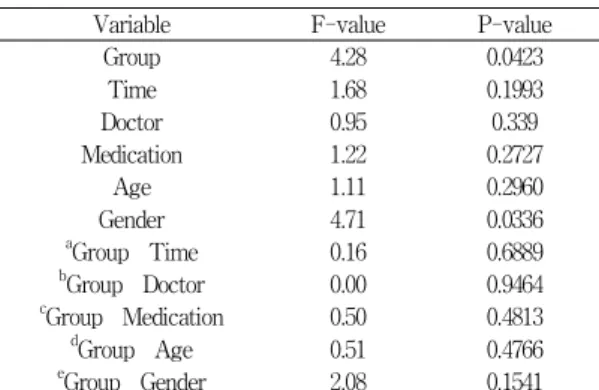
We analyzed repeatedly measured KWOMAC total scores using a mixed-model procedure of SAS. Although pre-trial measurements of the KWOMAC total scores were changed, we analyzed whether Sa-am acupuncture on OA of the knee was effective by using them as a variable. A heterogeneous general linear model was selected because it included the largest BIC (Bayesian Information Criteria) among the eight‐mixed model.
The results show that “Group (p=0.0423)”
and “Gender (0.0336)” can be a possible
variable for the change of the KWOMAC
total score by showing statistical
significance. However, other variables did
not have a significant effect on the
change of the KWOMAC total score. In
addition, there was no interaction among
the variables, which included time, age,
and the oriental medical doctor (Table 7).
This result shows that Sa-am acupuncture can have a significant effect on OA of the knee in spite of the change of variables just as estimated in independent t -test. However, as these results are based on KWOMAC scores, no significance of KWOMAC scores by ANCOVA analysis may have an influence on these results. The difference of change of the KWOMAC total score between both groups was estimated as low as 5.3 in the Sa-am group compared to the sham group.
Variable F-value P-value
Group 4.28 0.0423
Time 1.68 0.1993
Doctor 0.95 0.339
Medication 1.22 0.2727
Age 1.11 0.2960
Gender 4.71 0.0336
a
Group‐Time 0.16 0.6889
b
Group‐Doctor 0.00 0.9464
c
Group‐Medication 0.50 0.4813
d
Group‐Age 0.51 0.4766
e
Group‐Gender 2.08 0.1541
a
Group‐Time: the application of both group and time as variables,
bGroup‐Doctor: the application of both group and doctor as variables,
cGroup‐Medication: the application of both group and medication as variables,
d
Group‐Age: the application of both group and age as variables,
eGroup‐Gender: the application of both group and gender as variables.
Table 7. Test by Mixed Effects.
Discussion
Sa-am acupuncture follows the principle of Yin and Yang
11). Any deficiency needs to be tonified and any excess purged for
balance between Yin and Yang to be achieved, resulting in balance of the organ. This is the most important objective for treatment in the field of Korean medicine. Sa-am acupuncture is based on the theory of the “mother-son relationship”, which means that a mutual affecting relationship exists among the five elements
11). Sa-am acupuncture puts these basic rules into practice through the reinforcement or reduction manipulation of the target organ for tonifying or purging
11)