Neurocognitive Outcome in Survivors of Childhood Acute
Lymphoblastic Leukemia: Experience at a Tertiary Care Hospital in Korea
This study was conducted to investigate long-term neurocognitive outcomes and to determine associated risk factors in a cohort of Korean survivors of childhood acute lymphoblastic leukemia (ALL). Forty-two survivors of ALL were compared with 42 healthy controls on measures of a neurocognitive test battery. We analysed potential risk factors (cranial irradiation, sex, age at diagnosis, elapsed time from diagnosis, and ALL risk group) on neurocognitive outcomes. ALL patients had lower, but non-significant full-scale intelligence quotient (FSIQ, 107.2 ± 12.2 vs. 111.7 ± 10.2), verbal intelligence quotient (VIQ, 107.7 ± 13.6 vs. 112.2 ± 11.4), and performance intelligence quotient (PIQ, 106.3 ± 14.2 vs. 110.1 ± 10.7) scores than healthy controls. However, patients treated with cranial irradiation performed significantly lower on FSIQ (102.2 ± 8.1), VIQ (103.3 ± 11.7), and PIQ (101.4 ± 13.2) compared to non-irradiated patients and healthy controls. ALL patients also had poor attention, concentration, and executive functions.
Among ALL survivors, cranial irradiation was a risk factor for poor FSIQ, being male was a risk factor for poor PIQ, and younger age was a risk factor for poor attention. Therefore, the delayed cognitive effects of ALL treatment and its impact on quality of life require continuing monitoring and management.
Keywords: Acute Lymphoblastic Leukemia; Attention; Child; Cranial Irradiation; Cognition Seong Joon Kim,1 Min Hyun Park,2
Jae Wook Lee,3 Nak Gyun Chung,3 Bin Cho,3 In Goo Lee,3
and Seung Yun Chung4
1Department of Pediatrics, College of Medicine, The Catholic University of Korea, St. Vincent Hospital, Suwon; 2Department of Psychiatry, College of Medicine, The Catholic University of Korea, St.
Vincent Hospital, Suwon; 3Department of Pediatrics, College of Medicine, The Catholic University of Korea, Seoul St. Mary’s Hospital, Seoul; 4Department of Pediatrics, College of Medicine, The Catholic University of Korea, Incheon St. Mary’s Hospital, Incheon, Korea
Received: 17 August 2014 Accepted: 27 November 2014 Address for Correspondence:
Seung Yun Chung, MD
Department of Pediatrics, Incheon St. Mary’s Hospital, College of Medicine, The Catholic University of Korea, 56 Dongsu-ro, Bupyung-gu, Incheon 403-720, Korea
Tel: +82.32-510-5687, Fax: +82.32-503-9724 E-mail: [email protected]
http://dx.doi.org/10.3346/jkms.2015.30.4.463 • J Korean Med Sci 2015; 30: 463-469
INTRODUCTION
Acute lymphoblastic leukemia (ALL) is the most common child- hood malignancy, and its cases show favourable outcomes with a 5-yr event-free survival of about 80% (1). To attain a good prog- nosis, central nervous system (CNS)-directed therapy is an es- sential component (2). CNS-directed therapies mainly comprise of cranial irradiation, intravenous methotrexate, intrathecal chemotherapy, or a combination of these modalities. Among these CNS-directed therapies, it is reported that cranial irradia- tion has detrimental effects on neurocognitive outcome (3, 4).
However, neurocognitive outcomes after chemotherapy without cranial irradiation are inconsistent. Although some investigators have shown similar declines in intelligence after treatment with- out cranial irradiation (5, 6), most studies suggested that chil- dren treated without cranial irradiation fare better than children treated with cranial irradiation (7, 8). A young age at diagnosis (9) and being female (10) appear to be risk factors for poor intel- ligence after cranial irradiation. Detrimental effects on intelli- gence quotient often progress as survival time increases (11).
Specific neurocognitive domains like academic performance (12), memory and learning (13), attention and concentration (14), information processing speed (15), visuospatial skills (16), psychomotor functioning (17), and executive functioning (18) were reported to be impaired.
Long-term neurocognitive outcomes of ALL survivors have been conducted mainly in Western population. There have been few studies in Asian populations (19, 20), and only one study on a Korean population performed at 1995 until now (21). There- fore, we investigated long-term neurocognitive outcomes to dis- cover risk factors associated with poor neurocognitive function in a cohort of Korean childhood ALL survivors.
MATERIALS AND METHODS Enrolment of ALL survivors
Children who had been treated for ALL between January 2003 and December 2006 were recruited from the Department of Pe- diatrics, Seoul St. Mary’s hospital, College of Medicine, the Cath- olic University of Korea. Criteria for inclusion in this study were:
Pediatrics
1) patients whose primary language was Korean; 2) continuous complete remission since the initial diagnosis; 3) no CNS leuke- mia at diagnosis; and 4) age at time of testing between 5 and 15 yr. Criteria for exclusion were: 1) pre-existing neurologic condi- tions affecting behavioural development (cerebral palsy, devel- opmental delay or mental retardation, and Down syndrome); 2) acute and chronic neurologic sequelae during treatment (sei- zures and leukoencephalopathies); 3) ALL relapse; and 4) he- matopoietic stem cell transplantation.
Among 200 patients diagnosed with ALL between January 2003 and December 2006, 84 children met these criteria after medical record review. They were invited to this study between July 2011 and February 2012. Of the 84, 42 (50%) consented to enrol (ALL group). Reasons for failure to enrol included the fol- lowing: 1) Thirty four families declined participation, and 2) eight families withdrew consent during assessment. The study participants did not differ from the 42 non-participants in gen- der, age at diagnosis, or treatment.
As a control group, 42 age- and sex-matched healthy children were selected. They were selected at random from the local pop- ulation registry. The demographic and clinical characteristics of each participant are shown in Table 1.
Treatment of ALL
The patients diagnosed with ALL between 2003 and 2004 had been enrolled into CMCPL2001 (Catholic Medical Centre Proto- col ALL 2001) protocol (n = 21), and between 2003 and 2004 into CMCPL2005 protocol (n = 21). Patients were stratified into 4 risk groups based on age at diagnosis, initial peripheral white blood cell counts, initial steroid response, leukemic cell type, CNS involvement, and specific chromosomal translocation. The patients were assigned to different prophylactic CNS regimens, according to protocol and a defined risk factor. In CMCPL2001 protocol, CNS-directed treatment consisted of cranial irradia- tion, intrathecal chemotherapy and systemic methotrexate. If patients were older than 2 yr at diagnosis, cranial irradiation was administered (1,800 cGy). Patients younger than 2 yr were treat- ed with high dose methotrexate (5.0 g/m2) with triple intrathecal chemotherapy instead of cranial irradiation. Age-adjusted intra- thecal chemotherapy was administered 6 or 8 times according
to risk group. A total cumulative dose of intravenous methotrex- ate of 19 g/m2 to 24 g/m2 was also administered according to risk group. In CMCPL2005 protocol, CNS-directed treatment con- sisted of only intrathecal chemotherapy and systemic metho- trexate. Age-adjusted intrathecal chemotherapy was adminis- tered 13 to 22 times according to risk group. A total cumulative dose of intravenous methotrexate of 37 g/m2 to 47 g/m2 was ad- ministered according to risk group.
Battery of neurocognitive tests
Neurocognitive function assessments were performed in a qui- et room by a single trained examiner between July 2011 and February 2012. The test battery consisted of the Korean Educa- tional Development Institute-Wechsler Intelligence Scale (KE- DI-WISC), Children’s Colour Trails TestTM (CCTT), Stroop Co- lour and Word Test: Children’s Version (STROOP), and Atten- tion Deficit Hyperactivity Disorder Diagnostic System (ADS).
The examiners were unaware of a given child’s primary diagno- sis and treatment status at all times. Total time for assessment was about 2.5 hr. All tests were performed without cost to pa- tient families.
Assessment of intelligence: KEDI-WISC
KEDI-WISC is the Korean version of the Wechsler Intelligence test based on the Wechsler Intelligence Scale for Children-Re- vised 1974 edition. The test is comprised of two subscales, the Verbal IQ (VIQ) and the Performance IQ (PIQ), which com- bined to yield the Full Scale IQ (FSIQ) that has a mean of 100 and a standard deviation (SD) of 15 points.
Assessment of executive function: CCTT and STROOP The CCTT is the Korean version of the Colour Trails Test. CCTT is an individually administered, orthographic (paper and pen- cil), neuropsychological instrument designed to provide an ob- jectively scored measure of sustained visual attention, sequenc- ing, psychomotor speed, and cognitive flexibility (22). All data are presented as T-scores adjusted for age and gender. Higher T-scores indicate better function.
The STROOP is the Korean version of the Stroop Colour- Word Test. This test measures selective attention and cognitive Table 1. Baseline characteristics of the study population
Parameters ALL group
(n = 42)
ALL group (n = 42)
Control group (n = 42)
P (ALL vs. Control)
P (Irradiation vs.
non-irradiation) Irradiation group
(n = 18)
Non-irradiation group (n = 24)
Male:Female 25:17 13:5 12:12 25:17 1 0.147
Age at study in years (mean ± SD) 10.5 ± 2.4 11.7 ± 1.8 9.6 ± 2.5 10.5 ± 2.2 1 0.005
Age at diagnosis in years (mean ± SD) 3.8 ± 2.3 4.0 ± 1.7 3.7 ± 2.7 - - 0.691
Elapsed time from diagnosis in years (mean ± SD) 6.6 ± 1.3 7.7 ± 0.7 5.9 ± 1.0 - - 0.000
ALL risk group (Standard:intermediate:high) 18:4:20 6:4:8 12:0:12 - - 0.017
Treatment protocol (CMCPL2001:CMCPL2005) 21:21 18:0 3:21 - - 0.000
ALL, acute lymphoblastic leukemia; CMCPL2001, Catholic Medical Center Protocol ALL 2001; CMCPL2005, Catholic Medical Center Protocol ALL 2005.
flexibility (23). All data are presented as T-scores adjusted for age and gender. Higher T-scores indicate better function.
Assessment of attention: ADS
The ADS is a Korean version of the Test of Variables of Attention standardized to Korean cultural background. The ADS is a computerized test to diagnose and evaluate treatment effect of attention deficit hyperactivity disorder (24). Lower T-scores in- dicate better attention and response inhibition ability.
Statistical analysis
Demographic variables were compared with either chi-square tests or Student t-tests depending on whether the variables were categorical or continuous. Statistical analyses of long-term neu- rocognitive outcomes were conducted to answer 2 questions:
1) How does the ALL group perform relative to the control group?
2) How do the scores for the cranial irradiation, sex, age at di- agnosis of ALL, elapsed time from diagnosis to assessment, and ALL risk group effect long-term neurocognitive out- comes?
For the first step, the ALL group was compared with the con- trol group using independent t-tests. Additionally, the ALL group was separated into 2 groups according to patients whose treat- ment protocol included cranial irradiation (irradiation group) or did not (non-irradiation group). Each group was also compared using independent t-tests. The ratio of children who performed poorly on neurocognitive tests (lower than -1 SD from mean score) was compared between ALL and control groups using a chi-square test.
For the second step, to assess possible effects of the 5 poten-
tially relevant variables (cranial irradiation, sex, age at diagnosis of ALL, elapsed time from diagnosis to assessment, and ALL risk group) on each neurocognitive test score, a linear multiple re- gression analysis was calculated.
All statistical analyses were two-tailed, and P < 0.05 was taken to indicate statistical significant. All analyses were performed using SPSS (version 19.0, SPSS Inc., Chicago, IL, USA).
Ethics statement
The study protocol was reviewed and approved by the institu- tional review board of The Catholic Medical Centre of The Cath- olic University of Korea (Approval No. KC11OISI0436). Written informed consent was provided by all parents (and children if possible).
RESULTS
Comparison between groups
Forty-two children with ALL, 25 males and 17 females, were en- tered in this study. Mean age ± SD at diagnosis was 3.8 ± 2.3 yr, at assessment was 10.5 ± 2.4 yr, and elapsed time from diagnosis to assessment was 6.6 ± 1.3 yr. Forty-two healthy controls with the same male-to-female ratio and 10.5 ± 2.2 yr of age were as- sessed (Table 1).
Patients with ALL had lower FSIQ, VIQ, and PIQ than healthy controls; nevertheless, none of these comparisons were statisti- cally significant. However, the irradiation group showed a sta- tistically significantly lower score in FSIQ (irradiation, 102.2 ± 8.1 vs. non-irradiation, 111.0 ± 13.6, P = 0.019; vs. control, 111.7
± 10.2, P = 0.001), VIQ (irradiation, 103.3 ± 11.7 vs. non-irradia- tion, 111.0 ± 14.1, P = 0.068; vs. control, 107.7 ± 13.6, P = 0.008), Table 2. KEDI-WISC score of each group
Tests ALL
group (n = 42)
ALL group (n = 42) Control group (n = 42)
P*
(ALL vs.
Control)
P*
(Irradiation vs.
Control)
P*
(Non-irradiation vs.
Control)
P*
(Irradiation vs.
non-irradiation) Irradiation
group (n = 18)
Non-irradiation group (n = 24) KEDI-WISC (mean ± SD)
FSIQ VIQ PIQ
107.2 ± 12.2 107.7 ± 13.6 106.3 ± 14.2
102.2 ± 8.1 103.3 ± 11.7 101.4 ± 13.2
111.0 ± 13.6 111.0 ± 14.1 110.0 ± 14.0
111.7 ± 10.2 112.2 ± 11.4 110.1 ± 10.7
0.070 0.105 0.173
0.001 0.008 0.009
0.804 0.713 0.986
0.019 0.068 0.049 Verbal subtests (mean ± SD)
Information Similarities Arithmetic Vocabulary Digital span Comprehension
10.7 ± 3.1 11.8 ± 2.4 11.8 ± 2.5 11.2 ± 2.1 9.9 ± 2.2 10.3 ± 2.8
9.6 ± 2.7 11.3 ± 2.2 11.5 ± 2.6 10.6 ± 1.8 9.6 ± 2.1 9.3 ± 2.6
11.6 ± 3.1 12.2 ± 2.5 12.1 ± 2.4 11.7 ± 2.2 10.1 ± 2.2 11.1 ± 2.8
13.1 ± 2.7 13.0 ± 2.5 11.8 ± 2.8 12.5 ± 2.6 11.0 ± 2.4 9.5 ± 2.2
0.000 0.027 1.000 0.016 0.025 0.135
0.000 0.017 0.669 0.006 0.030 0.735
0.044 0.193 0.714 0.212 0.139 0.011
0.037 0.265 0.455 0.093 0.408 0.034 Performance subtests (mean ± SD)
Picture completion Picture arrangement Block design Object assembly Coding
8.3 ± 2.5 8.6 ± 3.3 12.5 ± 3.1 10.8 ± 1.9 13.6 ± 3.2
7.3 ± 2.4 8.2 ± 3.1 11.6 ± 3.0 10.3 ± 1.8 13.5 ± 3.3
9.0 ± 2.3 8.9 ± 3.4 13.1 ± 3.0 11.3 ± 1.8 13.7 ± 3.3
10.4 ± 2.4 10.0 ± 2.1 13.5 ± 3.0 11.6 ± 2.8 10.9 ± 1.8
0.000 0.026 0.118 0.145 0.000
0.000 0.014 0.028 0.071 0.000
0.034 0.124 0.607 0.591 0.000
0.020 0.500 0.116 0.094 0.839
*Independent t-test. ALL, acute lymphoblastic leukemia; FSIQ, full scale intelligent quotient; KEDI-WISC, Korean Educational Development Institute-Wechsler Intelligence Scales for Children; PIQ, performance intelligent quotient; VIQ, verbal intelligent quotient.
and PIQ (irradiation, 101.4 ± 13.2 vs. non-irradiation, 111.0 ± 14.0, P = 0.049; vs. control, 110.1 ± 10.7, P = 0.009) than non-ir- radiation and control groups. The irradiation group also per- formed significantly worse on several KEDI-WISC subtests (in- formation, comprehension, and picture completion) than the non-irradiation group (Table 2).
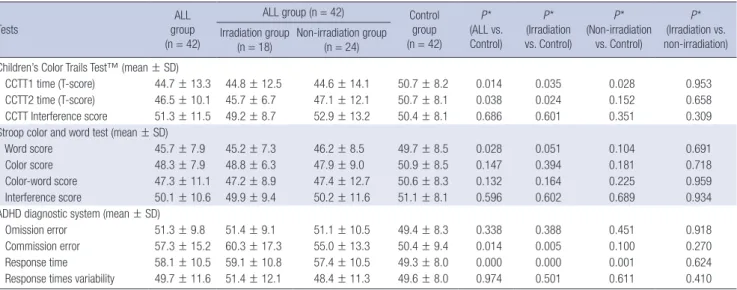
The ALL group showed worse CCTT1 time, CCTT2 time, STROOP word score, ADS commission error, and response time compared to the control group. There was no statistical difference in CCTT, STROOP, and ADS test scores between irra- diation and non-irradiation groups. However, the irradiation group showed worse CCTT1, CCTT2, ADS commission error, and response time compared to the control group. In contrast, the non-irradiation group showed worse scores only in CCTT1 and response time compared to the control group (Table 3).
Compared to the control group, more children from the ALL group performed poorly on neurocognitive tests (lower than -1 SD from mean score) such as FSIQ, VIQ, PIQ, CCTT1, ADS commission error, and response time (Table 4).
Risk factors analysis of long-term neurocognitive outcomes
In multiple linear regression analysis, there was a statistically significant effect of irradiation on FSIQ (beta = 0.360, P = 0.019);
irradiation correlated with a lower FSIQ. There was a statistically significant effect of sex on PIQ (beta = 0.430, P = 0.009); being male was correlated with a significantly lower PIQ. There also was a statistically significant effect of age at diagnosis on omis- sion error (beta = -0.386, P = 0.028), and response time variabil- ity (beta = -0.353, P = 0.045); a younger age at diagnosis with ALL correlated with a high score in omission error and response time variability (Table 5).
DISCUSSION
In this study, we found that although survivors of ALL were simi- lar to controls on all neurocognitive tests, we found that irradia- tion made the key difference; patients who had undergone irra- diation treatment had lower FSIQ, VIQ, and PIQ than the non- irradiation group and controls. These results are consistent with most other reports that demonstrate the deleterious effects of cranial irradiation on the developing brain in ALL survivors (3, 4, 7-9, 25-27). Decline in overall IQ scores in ALL patients treated Table 3. CCTT, Stroop Color, Word Test, and ADHD Diagnostic System score of each group
Tests ALL
group (n = 42)
ALL group (n = 42) Control group (n = 42)
P*
(ALL vs.
Control)
P*
(Irradiation vs. Control)
P*
(Non-irradiation vs. Control)
P*
(Irradiation vs.
non-irradiation) Irradiation group
(n = 18) Non-irradiation group (n = 24)
Children’s Color Trails Test™ (mean ± SD)
CCTT1 time (T-score) 44.7 ± 13.3 44.8 ± 12.5 44.6 ± 14.1 50.7 ± 8.2 0.014 0.035 0.028 0.953
CCTT2 time (T-score) 46.5 ± 10.1 45.7 ± 6.7 47.1 ± 12.1 50.7 ± 8.1 0.038 0.024 0.152 0.658
CCTT Interference score 51.3 ± 11.5 49.2 ± 8.7 52.9 ± 13.2 50.4 ± 8.1 0.686 0.601 0.351 0.309
Stroop color and word test (mean ± SD)
Word score 45.7 ± 7.9 45.2 ± 7.3 46.2 ± 8.5 49.7 ± 8.5 0.028 0.051 0.104 0.691
Color score 48.3 ± 7.9 48.8 ± 6.3 47.9 ± 9.0 50.9 ± 8.5 0.147 0.394 0.181 0.718
Color-word score 47.3 ± 11.1 47.2 ± 8.9 47.4 ± 12.7 50.6 ± 8.3 0.132 0.164 0.225 0.959
Interference score 50.1 ± 10.6 49.9 ± 9.4 50.2 ± 11.6 51.1 ± 8.1 0.596 0.602 0.689 0.934
ADHD diagnostic system (mean ± SD)
Omission error 51.3 ± 9.8 51.4 ± 9.1 51.1 ± 10.5 49.4 ± 8.3 0.338 0.388 0.451 0.918
Commission error 57.3 ± 15.2 60.3 ± 17.3 55.0 ± 13.3 50.4 ± 9.4 0.014 0.005 0.100 0.270
Response time 58.1 ± 10.5 59.1 ± 10.8 57.4 ± 10.5 49.3 ± 8.0 0.000 0.000 0.001 0.624
Response times variability 49.7 ± 11.6 51.4 ± 12.1 48.4 ± 11.3 49.6 ± 8.0 0.974 0.501 0.611 0.410
*By independent t-test. ADHD, attention-deficit/hyperactivity disorder; ALL, acute lymphoblastic leukemia; CCTT, Children’s Color Trails Test.
Table 4. Number of children who performed poorly on neurocognitive tests (less than -1 standard deviation from mean score)
Tests ALL group
(n = 42)
Control group
(n = 42) P*
KEDI-WISC (Number)
FSIQ < 95 8 (19.0%) 2 (4.8%) 0.043
VIQ < 95 7 (16.7%) 0 0.006
PIQ < 95 10 (23.8%) 2 (4.8%) 0.013
Children’s color trails testTM (Number)
CCTT1 (T-score) < 40 12 (28.6%) 4 (9.5%) 0.026 CCTT2 (T-score) < 40 9 (21.4%) 4 (9.5%) 0.131 Interference score < 40 3 (7.1%) 3 (7.1%) 1.000 Stroop color and word test (Number)
Word score < 40 8 (19.0%) 5 (11.9%) 0.365
Color score < 40 6 (14.3%) 4 (9.5%) 0.500
Color-word score < 40 9 (21.4%) 3 (7.1%) 0.061 Interference score < 40 7 (16.7%) 2 (4.8%) 0.078 ADHD diagnostic system (Number)
Omission error > 60 6 (14.3%) 2 (4.8%) 0.137 Commission error > 60 13 (31.0%) 3 (7.1%) 0.005 Response time > 60 15 (35.7%) 2 (4.8%) 0.000 Response time variability > 60 9 (21.4%) 2 (4.8%) 0.024
*By chi-square test. ADHD, attention-deficit/hyperactivity disorder; ALL, acute lympho- blastic leukemia; CCTT, Children’s Color Trails Test; FSIQ, full scale intelligent quotient;
KEDI-WISC, Korean Educational Development Institute-Wechsler Intelligence Scales for Children; PIQ, Performance intelligent quotient; VIQ, Verbal intelligent quotient.
with cranial irradiation is clinically significant because these pa- tients often require special accommodations to their academic programming. Because of the negative association between cra- nial irradiation and cognition, many ALL treatment protocols now exclude cranial irradiation. If cranial irradiation is used for the worst cases, close monitoring of neurocognitive function and efforts toward early remediation should be offered.
Although one report showed that irradiated male survivors with ALL have lower FSIQ (26), most other investigations report- ed greater risk for females than males in relation to cognitive outcome (20, 25, 28). Therefore, it was assumed that females are more vulnerable to cranial irradiation and CNS-directed chemo- therapy. Gender differences in brain maturation, such as the smaller white matter increase in girls during childhood (29), may explain divergent vulnerabilities between males and fe- males. As the rates of myelination of various brain regions during childhood development differ between sexes, cranial irradiation and CNS-directed chemotherapy interference with myelination may have different results (30). In our study, male survivors had lower PIQ that may result from a larger proportion of males (52.0%) than females (29.5%) exposed to cranial irradiation.
Patients diagnosed with ALL at a younger age suffer greater cognitive deficits than patient diagnosed at an older age, espe- cially patients treated with cranial irradiation (9, 20, 30, 31).
Nevertheless, in our study, we could not establish any relation- ship between age at ALL diagnosis and degree of deficit. Our treatment protocol excluded cranial irradiation if patient age at ALL diagnosis was under 24 months. As a result, all 5 patients who were under 24 months showed fairly good full-scale IQ (107.2 ± 12.5), potentially accounting for the lack of age affect.
As patients with ALL treated with cranial irradiation age, they show progressively worsening neuropsychological test results
(11, 32, 33). In our study, elapsed time from diagnosis to assess- ment did not show any effects on neurocognitive outcomes, likely because our study employed a cross-sectional design and a relatively short elapsed time from diagnosis to assessment (4-9 yr). Therefore, to clarify cumulative age-dependent effects of ALL treatment on neurocognitive function, longitudinal studies in a Korean population are needed.
In our study, there was no statistically significant difference in executive function and attention between irradiation and non- irradiation groups. However, the ALL group also showed poor executive function (measured by CCTT and STROOP test) and attention (measured by ADS) than the control group. Specifical- ly, ALL patients showed poor simple attention (measured by STROOP word), sequential information processing (measured by CCTT1), active selective attention (measured by CCTT2), im- pulsiveness (measured by ADS commission error), and sus- tained attention and concentration (measured by ADS response time). Our findings are consistent with the reports that many ALL survivors experience post-treatment deficiencies in atten- tion, concentration, and executive functioning (25, 34, 35). The survivors of pediatric cancer demonstrate improvement on measures of attentional functioning with pharmacological in- terventions used traditionally for the treatment of attention def- icit hyperactivity disorder (36-38). However, childhood cancer survivors may experience more adverse side effects to stimu- lant medications relative to their healthy peers (39, 40). There- fore, it might be beneficial to ALL survivors that; 1) appropriate screening for executive function, attention, and concentration;
2) judicious selection for potentially remediable ALL survivors with stimulant medication; and 3) careful monitoring of stimu- lant side effects.
We conclude that ALL survivors have subtle long-term neuro- Table 5. Multiple linear regression analysis for risk factors of poor neurocognitive outcomes
Tests or scales Irradiation Sex Age at diagnosis Time since diagnosis ALL risk group
KEDI-WISC (mean ± SD)
FSIQ 0.360† 0.248 -0.113 0.091 0.144
VIQ 0.352 -0.053 -0.035 0.089 0.089
PIQ 0.335 0.430* 0.02 0.175 -0.004
Children’s color trails testTM (beta)
CCTT1 (T-score) 0.165 0.292 -0.057 0.359 0.128
CCTT2 (T-score) 0.169 0.206 0.223 0.195 0.105
Interference score 0.246 0.045 0.246 0.106 -0.114
Stroop color and word test (beta)
Word score 0.004 -0.088 -0.13 -0.095 0.075
Color score -0.06 0.069 0.111 0.001 -0.086
Color-word score -0.015 0.093 0.241 -0.016 0.122
Interference score 0.032 -0.015 0.135 0.025 0.208
ADHD diagnostic system (beta)
Omission error -0.001 -0.193 -0.386† -0.004 0.022
Commission error -0.197 -0.128 -0.171 -0.051 0.088
Response time 0.028 -0.056 0.057 0.135 0.086
Response time variability -0.228 -0.135 -0.353† -0.142 0.114
*Correlation is significant at the 0.01 level (2-tailed); †Correlation is significant at the 0.05 level (2-tailed).
cognitive issues. In particular, cranial irradiation has significant deleterious effects on global intellectual function. Although ALL survivors treated without cranial irradiation did not show global intellectual functional deficits, they (together with ALL survivors with cranial irradiation) had specific neurocognitive deficits im- pacting attention, concentration, and executive function. Irradi- ation and being male and younger are weakly associated with poor neurocognitive function. Thus, the possible delayed cogni- tive effects of ALL treatment and its impact on quality of life re- quires continuous monitoring and management.
DISCLOSURE
The authors have no conflicts of interest to disclose.
AUTHOR CONTRIBUTION
Conception and coordination of the study: Kim SJ, Park MH, Lee JW, Chung NG, Cho B, Lee IG, Chung SY. Design of ethical is- sues: Kim SJ, Cho B, Lee IG, Chung SY. Acquisition of data: Kim SJ. Data review: Kim SJ, Park MH, Chung SY. Statistical analysis:
Kim SJ, Park MH. Manuscript preparation: Kim SJ, Park MH, Chung SY. Manuscript approval: all authors.
ORCID
Seong Joon Kim http://orcid.org/0000-0002-3130-9495 Seung Yun Chung http://orcid.org/ 0000-0002-1643-5864
REFERENCES
1. Silverman LB, Gelber RD, Dalton VK, Asselin BL, Barr RD, Clavell LA, Hurwitz CA, Moghrabi A, Samson Y, Schorin MA, et al. Improved out- come for children with acute lymphoblastic leukemia: results of Dana- Farber Consortium Protocol 91-01. Blood 2001; 97: 1211-8.
2. Pui CH, Relling MV, Downing JR. Acute lymphoblastic leukemia. N Engl J Med 2004; 350: 1535-48.
3. Campbell LK, Scaduto M, Sharp W, Dufton L, Van Slyke D, Whitlock JA, Compas B. A meta-analysis of the neurocognitive sequelae of treat- ment for childhood acute lymphocytic leukemia. Pediatr Blood Cancer 2007; 49: 65-73.
4. Roman DD, Sperduto PW. Neuropsychological effects of cranial radia- tion: current knowledge and future directions. Int J Radiat Oncol Biol Phys 1995; 31: 983-98.
5. Ochs J, Mulhern R, Fairclough D, Parvey L, Whitaker J, Ch’ien L, Mauer A, Simone J. Comparison of neuropsychologic functioning and clinical indicators of neurotoxicity in long-term survivors of childhood leukemia given cranial radiation or parenteral methotrexate: a prospective study.
J Clin Oncol 1991; 9: 145-51.
6. Mulhern RK, Wasserman AL, Fairclough D, Ochs J. Memory function in disease-free survivors of childhood acute lymphocytic leukemia given CNS prophylaxis with or without 1,800 cGy cranial irradiation. J Clin
Oncol 1988; 6: 315-20.
7. Van Dongen-Melman JE, De Groot A, Van Dongen JJ, Verhulst FC, Häh len K. Cranial irradiation is the major cause of learning problems in children treated for leukemia and lymphoma: a comparative study.
Leukemia 1997; 11: 1197-200.
8. Butler RW, Hill JM, Steinherz PG, Meyers PA, Finlay JL. Neuropsycho- logic effects of cranial irradiation, intrathecal methotrexate, and syste- mic methotrexate in childhood cancer. J Clin Oncol 1994; 12: 2621-9.
9. Christie D, Leiper AD, Chessells JM, Vargha-Khadem F. Intellectual per- formance after presymptomatic cranial radiotherapy for leukaemia: ef- fects of age and sex. Arch Dis Child 1995; 73: 136-40.
10. Waber DP, Urion DK, Tarbell NJ, Niemeyer C, Gelber R, Sallan SE. Late effects of central nervous system treatment of acute lymphoblastic leuke- mia in childhood are sex-dependent. Dev Med Child Neurol 1990; 32:
238-48.
11. Harila MJ, Winqvist S, Lanning M, Bloigu R, Harila-Saari AH. Progres- sive neurocognitive impairment in young adult survivors of childhood acute lymphoblastic leukemia. Pediatr Blood Cancer 2009; 53: 156-61.
12. Anderson VA, Godber T, Smibert E, Weiskop S, Ekert H. Cognitive and academic outcome following cranial irradiation and chemotherapy in children: a longitudinal study. Br J Cancer 2000; 82: 255-62.
13. Hill DE, Ciesielski KT, Sethre-Hofstad L, Duncan MH, Lorenzi M. Visu- al and verbal short-term memory deficits in childhood leukemia survi- vors after intrathecal chemotherapy. J Pediatr Psychol 1997; 22: 861-70.
14. Moyer KH, Willard VW, Gross AM, Netson KL, Ashford JM, Kahalley LS, Wu S, Xiong X, Conklin HM. The impact of attention on social func- tioning in survivors of pediatric acute lymphoblastic leukemia and brain tumors. Pediatr Blood Cancer 2012; 59: 1290-5.
15. Cousens P, Ungerer JA, Crawford JA, Stevens MM. Cognitive effects of childhood leukemia therapy: a case for four specific deficits. J Pediatr Psy- chol 1991; 16: 475-88.
16. Espy KA, Moore IM, Kaufmann PM, Kramer JH, Matthay K, Hutter JJ.
Chemotherapeutic CNS prophylaxis and neuropsychologic change in children with acute lymphoblastic leukemia: a prospective study. J Pedi- atr Psychol 2001; 26: 1-9.
17. Kaleita TA, Reaman GH, MacLean WE, Sather HN, Whitt JK. Neurode- velopmental outcome of infants with acute lymphoblastic leukemia: a Children’s Cancer Group report. Cancer 1999; 85: 1859-65.
18. Anderson V, Godber T, Smibert E, Ekert H. Neurobehavioural sequelae following cranial irradiation and chemotherapy in children: an analysis of risk factors. Pediatr Rehabil 1997; 1: 63-76.
19. Watanabe S, Azami Y, Ozawa M, Kamiya T, Hasegawa D, Ogawa C, Ishi- da Y, Hosoya R, Kizu J, Manabe A. Intellectual development after treat- ment in children with acute leukemia and brain tumor. Pediatr Int 2011;
53: 694-700.
20. Kato M, Azuma E, Ido M, Ito M, Nii R, Higuchi K, Ihara T, Kamiya H, Sakurai M. Ten-year survey of the intellectual deficits in children with acute lymphoblastic leukemia receiving chemoimmunotherapy. Med Pediatr Oncol 1993; 21: 435-40.
21. Choi JE, Shin HY, Kim IO, Yeon KM, Chae IY, Cho SC, Hwang YS, Ahn HS. Effects of Central Nervous System Irradiation on Neuropsychologic Functioning in Long - term Survivors of Childhood Acute Lymphoblastic Leukemia. J Korean Cancer Assoc 1995; 27: 303-15.
22. Llorente AM, Williams J, Satz P, D’Elia L. Children’s Color Trails Test 1 &
2 manual. Lutz, FL: Psychological Assessment Resources, 2003.
23. Homack S, Riccio CA. A meta-analysis of the sensitivity and specificity of the Stroop Color and Word Test with children. Arch Clin Neuropsychol 2004; 19: 725-43.
24. Shin M, Cho S, Chun S, Hong K. A study of the development and stan- dardization of ADHD diagnostic system. J Child Adolesc Psychiatry 2000;
11: 91-9.
25. Waber DP, Tarbell NJ, Kahn CM, Gelber RD, Sallan SE. The relationship of sex and treatment modality to neuropsychologic outcome in childhood acute lymphoblastic leukemia. J Clin Oncol 1992; 10: 810-7.
26. Langer T, Martus P, Ottensmeier H, Hertzberg H, Beck JD, Meier W. CNS late-effects after ALL therapy in childhood. Part III: neuropsychological performance in long-term survivors of childhood ALL: impairments of con- centration, attention, and memory. Med Pediatr Oncol 2002; 38: 320-8.
27. Jankovic M, Brouwers P, Valsecchi MG, Van Veldhuizen A, Huisman J, Kamphuis R, Kingma A, Mor W, Van Dongen-Melman JE, Ferronato L, et al. Association of 1800 cGy cranial irradiation with intellectual func- tion in children with acute lymphoblastic leukaemia. ISPACC. Interna- tional Study Group on Psychosocial Aspects of Childhood Cancer. Lan- cet 1994; 344: 224-7.
28. Waber DP, Tarbell NJ, Fairclough D, Atmore K, Castro R, Isquith P, Lus- sier F, Romero I, Carpenter PJ, Schiller M, et al. Cognitive sequelae of treatment in childhood acute lymphoblastic leukemia: cranial radiation requires an accomplice. J Clin Oncol 1995; 13: 2490-6.
29. De Bellis MD, Keshavan MS, Beers SR, Hall J, Frustaci K, Masalehdan A, Noll J, Boring AM. Sex differences in brain maturation during childhood and adolescence. Cereb Cortex 2001; 11: 552-7.
30. Buizer AI, de Sonneville LM, van den Heuvel-Eibrink MM, Veerman AJ. Chemotherapy and attentional dysfunction in survivors of childhood acute lymphoblastic leukemia: effect of treatment intensity. Pediatr Blood Cancer 2005; 45: 281-90.
31. Smibert E, Anderson V, Godber T, Ekert H. Risk factors for intellectual and educational sequelae of cranial irradiation in childhood acute lym- phoblastic leukaemia. Br J Cancer 1996; 73: 825-30.
32. Rowland JH, Glidewell OJ, Sibley RF, Holland JC, Tull R, Berman A, Bre- cher ML, Harris M, Glicksman AS, Forman E, et al. Effects of different forms of central nervous system prophylaxis on neuropsychologic func- tion in childhood leukemia. J Clin Oncol 1984; 2: 1327-35.
33. Rubenstein CL, Varni JW, Katz ER. Cognitive functioning in long-term survivors of childhood leukemia: a prospective analysis. J Dev Behav Pe- diatr 1990; 11: 301-5.
34. Peterson CC, Johnson CE, Ramirez LY, Huestis S, Pai AL, Demaree HA, Drotar D. A meta-analysis of the neuropsychological sequelae of chemo- therapy-only treatment for pediatric acute lymphoblastic leukemia. Pe- diatr Blood Cancer 2008; 51: 99-104.
35. Rodgers J, Horrocks J, Britton PG, Kernahan J. Attentional ability among survivors of leukaemia. Arch Dis Child 1999; 80: 318-23.
36. Mulhern RK, Khan RB, Kaplan S, Helton S, Christensen R, Bonner M, Brown R, Xiong X, Wu S, Gururangan S, et al. Short-term efficacy of meth- ylphenidate: a randomized, double-blind, placebo-controlled trial among survivors of childhood cancer. J Clin Oncol 2004; 22: 4795-803.
37. Thompson SJ, Leigh L, Christensen R, Xiong X, Kun LE, Heideman RL, Reddick WE, Gajjar A, Merchant T, Pui CH, et al. Immediate neurocog- nitive effects of methylphenidate on learning-impaired survivors of child- hood cancer. J Clin Oncol 2001; 19: 1802-8.
38. Conklin HM, Khan RB, Reddick WE, Helton S, Brown R, Howard SC, Bonner M, Christensen R, Wu S, Xiong X, et al. Acute neurocognitive re- sponse to methylphenidate among survivors of childhood cancer: a ran- domized, double-blind, cross-over trial. J Pediatr Psychol 2007; 32: 1127- 39.
39. Conklin HM, Lawford J, Jasper BW, Morris EB, Howard SC, Ogg SW, Wu S, Xiong X, Khan RB. Side effects of methylphenidate in childhood can- cer survivors: a randomized placebo-controlled trial. Pediatrics 2009;
124: 226-33.
40. Weber P, Lütschg J. Methylphenidate treatment. Pediatr Neurol 2002; 26:
261-6.