Planning the New City Based on the Geomancy: A Case of the Design of the New Multi-functional Administrative City (NMAC)*
Han Suk Ock**, Tae Yeol Seo***
경관풍수에 입각한 신도시의 개념적 설계 : 행정중심복합 예정도시를 사례로*
옥한석**, 서태열***
Abstract:The Republic of Korea is planning to build the New Multi-functional Administrative City (NMAC). The purpose of this paper is to suggest the conceptual framework for this new city that relies on the Korean geomancy, oriental viewpoint on man and nature relationship, particularly in Korea. According to the Geomancy which could conceptualize the human-environment relationship in the site, the overall landscape image of the city could be symbolized by two flying crane with three Taegueks. In transforming the overall landscape image to urban form, two diamonds which means eternity and strength arises from the western spatial viewpoint, as means to protect and harmonize the human, land and mountain relationship in this site and the symbolic meaning of this site as generative and sacred place in Korean people’s mind. On the one hand, through juxtaposing of the two diamonds a geometric structure shows up, on the other hand the main axis of the city could be established from two crane and three Taegueks. On the North-South axis from the core of the symbolic green axis, symbolic things will be located, and the administrative offices will be placed on the East-West axis. Peripherals of the central axis also play a role in developing overall land use from image. The buildings and residents could be arranged and located according to undulations and this is based on the oriental theory of geomancy. We can build cultural amenities on the head part of the crane and on the core area.
Key Words : Geomancy, landscape image, geometric structure, land use, sustainable city
요약:경관풍수는 인간, 토지, 물, 산과의 관계를 잘 형상화할 수 있는 친환경적이고도 자연적인 토대에서 도시의 경관과 경관이미 지를 설계하는 데 이용될 수 있다. 이 글은 최근 건설예정인 행정중심 복합도시 예정지역을 대상으로 경관풍수와 전통적인 한국의 인간-자연관계를 바탕으로 도시의 개념적 틀을 제시하는 데 목적이 있다. 즉 도시의 구조와 형태, 도시 내 토지이용 등 다양한 방면 에 걸쳐서 도시관련 개념적 틀을 제시하는 것이다. 행정복합 중심도시 건설 예정지는 경관풍수지리적으로 보면, 평화, 조화를 의미 하는 쌍학(雙鶴)과 강인함과 상생, 생성, 그리고 성스러운 삼태극의 이미지를 보인다. 이러한 바탕 위에서 서구적인 공간관이라고도 볼 수 있는 중첩된 다이아몬드 구조를 도시구조에 부여함으로써 이러한 전통적 경관풍수적이고도 친자연적인 장소 이미지와 상징성 을 지속적으로 유지할 수 있도록 도시의 형태를 계획할 수 있다. 다이아몬드 각각의 두 중심점과 접점에 의하여 이루어지는 세 개의
* This paper is based on the proposal which was applied to the public conceptual subscription for the New Multi-functional Administrative City(NMAC)
** Professor, Department of Geography Education, Kangwon National University, [email protected]
*** Professor, Department of Geography Education, Korea University
1. Introduction
The Republic of Korea is planning to build the New Multi-functional Administrative City (NMAC). The New City will host main central government bodies which will serve as the city’s central focus and around which industrial, educational, and cultural facilities will be built creating a city with a population of 500,000 on 73.14 km of land in Gongju-Yongi County.
In this paper, we tried to construct the conceptual framework for the new city that relies upon the oriental theory of geomancy, oriental viewpoint of man and nature relationship, and to seek the harmony between the oriental spatial viewpoint and the western spatial viewpoint on the city as the habitat for human being and nature. We hope that our original and inspirational ideas will provide new ideas in urban design and planning of the new city.
Furthermore, we want to argue that the main point in constructing a new city is to create a peaceful environment for people to live in, pursuing the harmony between nature and human, and just recover people’s composure of the busy world today. In order to perform this task, the idea that human must allow one to get closer to the nature and work to conserve the nature itself should be considered.
Authors want to suggest what is conceptual ideal city for Korean people’s mind and what is the future “peaceful eco-polis” which will open a new peaceful coexisting world of nature and humans, through discussing main issues such as the value of city, theory of geomancy, landscape
image, the structure and urban form of the city, and through considering overall land use, population density, distribution of building mass, housing types, the major transportation modes and operation, the cultural amenities.
2. Planning the New City Based on the Korean Geomancy
1) The first step: deciding the value of city
The first step of planning the new city would be to decide and define the value of the city.
Because of the symbolic image and its function, the new multi-functional administrative city (NMAC) will play most important role in Korean peninsula. Therefore, the new city should be structured towards peace through pursuing ecological and democratic values. The main priority will be the establishment of peace. It could be oriented toward “the city in nature, the city for nature”. Thus the symbolization of city is peace as a completeness of prosperity, harmony, unity and living as one.
Here, the peace is the peace in nature through all conflicts and competition in this corrupted world, harmony means the harmony between nature and human, between different social classes, and between men and women. In this city, we can seek to minimize the tension among various members of the society and the nature itself. Problems arise of men and women, of 중심점에 도시의 남북, 동서의 중심축이 형성되고 광장, 행정기관, 시청사가 입지시킬 수 있다. 도시 내 교통망은 방사형 및 직교형 으로 건설하고, 중심점 부근에 문화시설을 설치하며 지속가능한 도시 발전을 위하여 자연보존 지구 등을 남겨놓을 수 있을 것이다.
주요어 : 경관풍수, 경관 이미지, 기하학적인 구조, 토지이용, 지속가능한 도시
generation gap, and of conflicts among people of different regions. Through the new city, nature, people can learn to embrace one another with compassion and in this sense, will be able to relieve all the conflicts going on in today’s society (KRSI, 2004). People do not seem to have any time to keep their composures; however, this can all be regained by getting in relations with the creation of nature.
The value of city also must include the meaning of unity and in this matter will lead people to see the city as uniting the North Korea and South Korea as a complete one nation.
Unification of Korea symbolizes eternity and through the city, people will remember this significance. Learning to live in peace is very important in this society and by establishing new city, “our new multi-functional administrative city” that includes culture, administrative, university, research institutions, and high technology industrial complex, it will fulfill the society with spirit to live as one, in harmony.
The location of the city is an implication of the mountain and the river. In relation, human will be located in the “nature”, in other words, it is not just a city in a wide plain, but a “utopia”
surrounded by the original Korea’s beauty of mountain and the river(Suh, 2000; Ock, 2003). By establishing this ideal city, we will not be far from the peaceful future in our hands. We hope to call the new city (NMAC), “Peaceful eco-polis”.
2) Searching the theoretical background of conceptual framework of the new city : Application of the geomancy and oriental human-nature relationship
First oriental theoretical background of the city come from and is related to Korea’s traditional
environmental theory called geomancy or Pungsu. The nature of the geomancy theory is divided into two parts, vitality condition (Senggi) and feeling vitality condition (Kamung). Feeling vitality condition is so called the Kamung and vitality condition that resulted from moderate moisture and temperature influenced people. We must be able to feel the vitality condition and this is all derived from the value of geomancy theory.
Vitality condition and feeling vitality condition are elements that gave influence to all humans and creatures. This defines the nature of the geomancy theory. Based upon the amount of feeling vitality condition, the power of life was determined. Expectations of life, being high or low, being high or low, strong or weak, rich or poor, and up or down, depended upon the amount of vitality one felt. This phenomenon was created by the power of cosmos.
Circulating the fresh mild wind (Jangpung method) and accepting the moisture under the temperature (Duksu method) are aimed to achieve vitality condition which literally means a good combination of the moisture, temperature and fresh mild wind. Koreans developed geomancy in housing and applied this knowledge in their living (Suh, 2000). The Koreans tried to prevent water and wind troubles in their homes, settlements, and cities by establishing themselves in the best places that showed a good combination of water and wind, related to the circulating of the fresh mild wind and accepting of the moisture under the temperature methods(Lee, 1993). The best places will be called by “Bright yard (Myungdang)” in number 7 of Figure 1. The bright yard is the place that people can feel vitality condition.
In choosing the location of best places in
different regions, we must consider mountains and waters of that region. The good harmony of mountain, water, and land is show up with the model. The various models cannot be explained easily, so it always is symbolized by animals including crane, plants, or things.
The geomancy fulfills many meanings that are in relation to today (Ock and Park, 2003). First of all, it is regarded as the most important traditional science based upon the systemic knowledge of physical environment. Secondly, Korea’s traditional architecture is an influential ideal system. Furthermore it is viewed as a traditional geography that provides ideal spaces and selective homes. As a whole, it provides a
new knowledge that a land is more than an object but a correlation between the nature and the human. This theory will be the ecological viewpoint. Its ideas can provide amenity, compassion, and fulfillment to our people so that they can have a peaceful future in harmony.
Furthermore, the city, for Koreans, is for vitality condition and the sense of stability. In this sense, the marks of locations in the figure will be expressed as the squares and circles, and the squares will measure up to the ratio of 1:2 of length and width. This symbolizes the spiritual gathering of the oriental vitality and stability.
The second oriental background could be found in Yin-Yang theory. The theory represents Figure 1. General model of geomancy concept (Source: Chung Myun Lee, p.597)
yin and yang. Generally, yin means the north mountain side which is against the sun and so darkness covers, and yang means the south of the mountain side which faces the sun. This theory represents the spatial duality theory that bases its origin on the universe and the earth that the world of darkness started a new world. Yin and yang also came from the theory of Taegeuk, including the meaning that the creation of the universe is the state of Taegeuk. Our nation’s flag called Tae-guk-ki derived from this theory. The form of the flag arises from the color red and blue, from yang and yin, which naturally is harmonized into one representing one nation.
Furthermore, the Sam-taegeuk (three Taegeuks) includes the three elements; the sky, land, and human. It represents an ever-lasting state and in the history of Korea, Sam-taegeuk was regarded as a sacred sign and people thought of this as more than just a sign, but as a way to life.
In relation to the natural phenomenal, yin and yang most of the time have meanings including variations of night and day, temperature, and the season. The theory is not in existence in the western society but the differentiation between the western and the oriental elements does not arise any conflicts. On the contrary, in harmonizing, and coexisting of the two elements, unity is formed so greatly between the two features.
The third oriental background could be the construction of traditional Korea city theory. The start of the construction of a traditional Korean city could be determined by the once Eastern Asia’s premodern capital city called Hansung Bu.
This city was made in the image of a natural atmosphere, and the elements of this city could be summarized as the powerful throne (Ock, 2003).
The main division of the city was artificially divided by the internal and external part of the capital city. Naturally, Hansung Bu was classified as the central world and its surrounding world.
Inside the capital city, the King’s ideology was adapted and followed the systematically principle of the ideology(Ock and Park, 2003). Outer world of the main city was influenced through exposure to natural environment and the facilities were arranged according to the connection to the inner world of the city. Furthermore, while the central world of the city was a sacred space in relation to the throne, the outer world was a sacrificing space and therefore different altars were located in different parts of the city.
However, in this modern world, the urban structure should be converted so that the central world of the city will be for all people, and the space in which people can feel the rise of the spirit should be returned to them. The sacred place and space which was only for the throne centuries ago, it should be for all the people and should be conserved in the modern world today.
Most of the altars outside of the city were in relation with the agricultures since the neighboring district was mainly an agriculture region. Hansung Bu’s structure of the city was formed in reflection to the social characteristics of that period and through main facilities’
locations and arrangements, Hansung Bu naturally became the standard of all cities.
The throne was the main symbol of the city, and including ruling of a nation; the relation to the throne was generally the basic principles of the city. The city could be classified into two different aspects, one, methodically, composition of ideal system and symbolic system, in unity with nature completes a city. Specifically, the function of the city is in relation to the people.
The elements of the city have characteristics of its specific city and naturally have characters of the kind.
3) Extracting overall landscape image
The overall landscape image should be for the people. It is to be oriental and in accordance to the theory of geomancy and yin-yang theory, the
mountain, water, and land should be harmonized.
It shows up the modified geomancy model conceptualizing the human-environment relationship in this site, which is symbolized by
“flying crane”(Figure 2). This city lies in the shape of twin divine cranes that makes a nest under the main mountain, Mt. Wonsu. The two mountains, in relation to the river, and the land, Figure 2. Modified geomancy model conceptualizing the human-environment relationship in this site.
(thick black lines are various kind of mountain streams).
Figure 3. Two mountains (Left : Mt. Wonsu, Right : Mt. Bihak).
are lies in the heart of the region, and they will provide stability to this region as the center of all areas. Mt. Bihak is formed in the shape of one of the cranes flying toward the nest. Bihak means
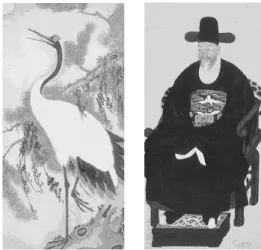
“flying crane” in Chinese character. (Figure 3) The mountains are related in accordance to geomancy and Kumkang River, the river of life, which flows between the two cranes. The male crane is placed on the north side, and the female crane is placed on the south. In Korean culture, the crane symbolizes sublimation and transcendence of an endless life (Figure 4). In order to understand the concept of geomancy, the objects, and natures are symbolized to provide better understanding of the Korean culture.
The black and white color of the cranes is the symbol of freshness and nobleness. For Koreans to live long lives like cranes do, they have to be very moral, peaceful, and kind. Administrators who will work for the city should have qualities like that of a crane. They should not be selfish or corrupt. In our history, traditional Korean
administrators had embroidered cranes on their uniforms.
According to our traditional geographic theories, mountains influence the citizens. Most Korean kings could read his subjects’ thoughts through the mountains that are in deep relation with water and wind. The key to form an overall image is the relationship between the land, water, river, and the mountain. In other words, natural environment condition is the highlight of forming an overall landscape.
Moreover, the strong affinity between men and nature is also important in forming the natural image of a landscape. Showing affection for the natural environment will restore the beauty and compassion for the corrupted environment today.
As the urban population increases, destructive features take over some of our most splendor features of the natural environment. However, if we put some effort into making a unified nature, the overall landscape by the harmony of men and nature, the peaceful future will not be far from it.
Figure 4. Two Korean art (left : crane picture, right : administrators dressed on an official uniform embroidered cranes
Figure 5. Symbolic meaning of this site, two cranes are flying.
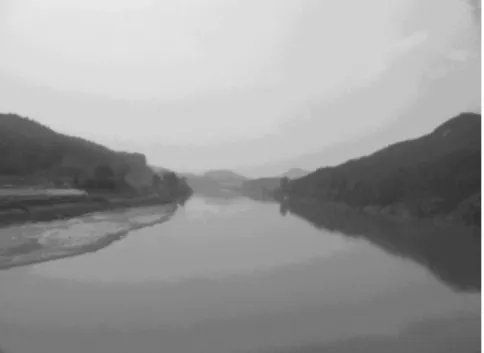
The head, heart, wings, feet, and tails of the cranes mark important areas in our “peaceful ecopolis.” The cranes’ food is spread out in front of the five features. The five features of the cranes are small five cities including three Taegeuks, which means three cities(figure 5). The water comes from the Sam-taegeuk(three Taegeuks) which forms all creations in heaven and earth. In this nation, the location is traditionally located on the heart of the land, and the two river confluence in flowing of the Sam- taegeuk(three Taegeuks) (Figure 6).
They will have various special functions in this city that have various urban zones. These are residential, business, commercial, and cultural zones.
Our modern society is democratic, so our city will differ from Korean cities from the past. The society will not be in accordance of only the King’s view, but in the view of all people.
However, the image that shows the love of rulers for people will also be applied so that our society will develop into a uniformed society.
3. Constructing the Structure and Urban Form of the City
In transforming the overall landscape image to urban form, the two ideal spots will be the heart of development. The two cranes that symbolize the city have the forms of one diamond structure.
Furthermore, the Sam-taegeuk is surrounded by another diamond. The form of diamond arises from the western spatial view and in unifying the two diamonds and the cranes and Sam-taegeuk, the oriental and western view is harmonized.
In selecting the cranes, the region of Sam- taegeuk can be strongly conserved and possibly, in order to preserve the untouched natural state of the conserved area, the core is created in the central part of where the right and left diamonds meet. The cores are also created in the outlet of where from the symbolic meaning of the oriental thory river flows from the sacred space(the three Taegueks)to secular space(two cranes).
Furthermore, the two cores lie in the center of the two cranes. In this sense, the three cores are created.
The image of nature is the fulfillment of the total land structure of the city. Moreover, characteristics of harmony, unification, and peace Figure 6. Waters from Sam-Taeguek
Figure 7. Two diamond structures for eternity in this site
are to be naturally blended in for the fulfillment of the city. In this sense, the nature formed by the harmonized mountain, water, and land should be conserved with strong determination.
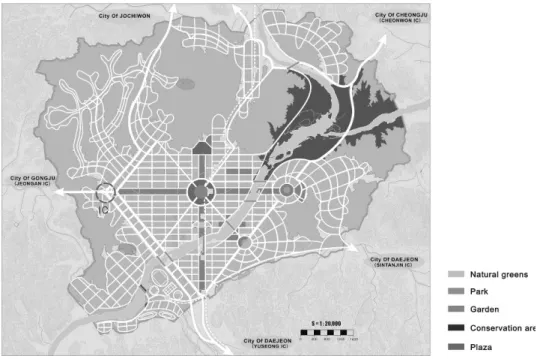
Juxtaposing of the two diamonds becomes a geometric structure(Figure 7). Among the intersecting places, the three places will be the core area. The form of the two diamonds is the desire for the spirit to spread out far across the city.
The three core areas will be in this structure of the city. The core areas will have a radial road system and the remaining areas will have a crossroad system. All highway networks will form an overlapped diamond shape and a crossroad system.
On the other hand, we can borrow the western spatial viewpoint in terms of the structure of city to make shape the global city and to harmonize the oriental and the western.
The earliest cities of the North America were usually modeled, grew without formal plan, in conformity to local topography or harbor frontages. However, in the mid-centuries of the western world, stylized North American city model first appeared with straight streets crossing at right angles. It was adapted from the European planners of the same period and as the city flourished, the habit of laying out squares or rectangles was strongly reinforced at the end of the eighteenth century. In the late 19th century, it became necessary to create a large number of towns almost overnight. The focus of a city was the location of the railroad station (Levy, 2003).
The placement of the railroad station signified both logical utilities.
As the cities grew larger the diagonal streets were introduced and western minds leaned toward economical dependence (Hall, 1996).
However, problems arose where the original city blocks were platted with short frontages. These hold up modern traffic flow every few yards, and people begin to look for new way to prepare for the increasing city. The search for space, which, a century ago, was creating the “streetcar suburbs” of older American cities, has, in the automobile era, caused an explosion of urban spread. It became the prime symbol of consumption, not only for individual homes, but for business and industry as well. As we could see from the past centuries of the western cities . Korean traditional cities and western cities were worlds apart from consistency. In this sense we must be able to blend both the western and the oriental culture into one.
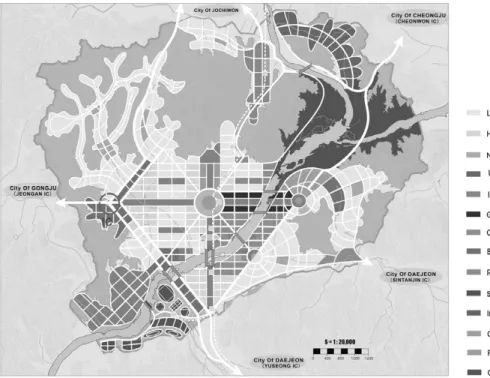
In this sense, we can put rectangular and circular shape into the inner part of the two diamonds. This symbolizes pleasures and a firm, desirable society. The three cores will be connected together and the left diamond’s inner part will be in the form of rectangle. It has been believed that the ratio 2:1 of width and length symbolizes the spiritual gathering of the oriental vitality condition and stability. The inner core Figure 8. Land use structure induced from land image.
area of the diamond is in the form of a circle and the other two cores are in the forms of circle as well. You can see overall land use concept induced from land image (Figure 8).
The oriental structure and the western structure of the diamonds must be in coexistence so that the city will be but dull. It is not easy for the two completely different forms to come into one, however, in completing the form, will the two cultures effuse and develop into a better and a peaceful city.
In looking at the overall land use, you can see that the three core areas connected to axis form three lines that are the bases of an important axis. The central axis represents the main connector of the two diamonds to the area symbolized as the upper crane that bear a broad
social welfare.
The symbol of the axis could be divided into three parts. First of all, it could be divided into axis of the North-South, which includes the attachment of the Mt. Wonsu. to the Mt. Bihak.
From the geomancy perspective, this region is spiritually the most lively region; the ideal spot of the axis. On the North-South axis from the core of the symbolic green axis, symbolic things will be located. On the North, the library, the museum, art center, the memorial tower of unification, the square plaza, the monument, and visual of crane symbolizing the origin of geomancy will be located (Figure 9).
These features should be arranged in a concentrated way so that it will signify the desire of our land of unification- oriented overflowed with energy and passion. In relation to the crane, the two main regions lie on each core of the two cranes. On the south of the main axis of the core, more environmental things will be located. Located are lakes that will be surround by gardens, and the river will flow through the gardens and head down from the northwest to the southeast. Furthermore, a great pavilion will be located in the lake.
The south of the main core will basically be filled with greens, just like the gardens in the European countries. The meadows are not just green land, it is a garden filled will beauty and splendor and people will be surprised at the way the gardens are made. It will be a place for people to stroll along and enjoy the nature just as the way it is. The axis deprived from the central core of the diamond will be in all greens which means that the axis are park, gardens, or just plain greens, leading to the four points of the diamond, furthermore, to the outer part of the Figure 9. Land use structure induced from land
image.
cores. The NMAC city hall will be located at another core, the heart of female crane.
Moreover, in the focus of the ideal spot as the main region, the administrative offices will be placed on the East-West axis. Included of the administrative offices are the Ministry of Finance and Economy, of Education and Human Resources Development, of Science and Technology, of Culture and Tourism, of Agriculture and Forestry, of Commerce, Industry and Energy, of Information and Communication, of Health and Welfare, of Environment, of Labor, of Construction and Transportation, of Maritime Affairs and Fisheries, the National Tax Service and the National Emergency Management Agency.
In relation to the axis of the central core, the core that lies in the line where the two diamonds meet, the presidential commission and prime minister’s commission are located. Included of the presidential commission is Civil Service commission, Presidential commission on small and medium enterprises, Korea Independent Commission against Corruption. Included of the Prime minister’s commission are The Office for Government Policy Coordination, Prime Minister’s Secretariat, Emergency Planning Commission, Fair Trade Commission, The Ombudsman of Korea, National Youth Commission, Ministry of Planning and Budget, Ministry of Government Legislation, Government Information Agency, and the Ministry of Patriots and Veterans Affairs.
The East-West axis is also the main connector of the city’s transportation axis and the binding of the inner structure. It is also a region for connecting the two cranes and Sam-taegeuk.
Especially in the case of Seoul, the Han River plays a major role in separating the two regions,
Kangnam(South Seoul) and Kangbuk(North Seoul). For this matter, overcoming the isolation of the two regions is in great need. In addition, the North and the South region have a great regional separation, so in the standard of the Kumkang River, there is a need for another axis to bind the two regions of Kangnam(South NMAC) and Kangbuk(North NMAc). In this way, the North-South axis and East-West axis may become the central space of unification in overcoming the isolation of the two regions by the river.
Together, the North-South axis and East-West axis become the central axis. Peripherals of the central axis also play a role in developing land use from its image. On the right side of the central axis, the sacred diamond region compromises the image of affinity of the nature.
On the left side of the axis, represents the reality state such as the industrial development, dwelling site. This field of merchant city is the actual world of people doing things with passion and spirit. It is a reality space where people move busily. The two ideal spots of the topography are connected and this in turn, forms the central axis.
Far apart from the central target, where the green plains are spread, there are research and development center, universities, and low-density residential houses located up in the north of the central axis. In looking at the overall land use, you can see that most of the low-density individual houses are far away from the diamond and in the center of each residential region, spaces for convenient living plaza is arranged.
Furthermore, the water reservoir should be set up in the space of where the two diamonds meet and where the left diamond ends.
4. Suggesting Overall Land Use, Distribution of Building Mass, Housing Types, Transportation Systems
1) Overall land use planning and housing types
In distributing and deciding the locations of the building mass, knowing the population density is a crucial factor. Populations have grown over the centuries in the cities as the development of the urban side of the nation grew. Rapidly growing cities are characterized by their specialized or diversified nature and are all inter-linked by integrating networks. For this matter, the selective growth of certain cities due to the development of industrial parks is evident.
The different regions, such as the residential district, the industrial district, the business and commercial district, and the culture district are divided and you can see the total basic form in the panel of the overall land use.
The buildings and residents are arranged and located according to undulations and this is based on the oriental theory of geomancy.
Looking at the panel of the overall land use, there are low-level individual houses in the middle of the left diamond block and outside of the diamond, and high floor apartments mostly close to the central core and inner parts of the right side of diamond. The left block of this city has a very low mountain. In this area, mountains cannot accommodate the moisture that comes from the lake in dry season.
Moisture is so important for establishing moderate conditions. The left block will not have
Figure 10. Overall land use
enough moisture. The moisture can only be provided to the low buildings. This is the reason we should build the low buildings on the left block. In relation to the correlation of the climate and the location, the ideal space, known as Bright yard (Myungdang), is located in the sides of the central core where the nature and conveniences is compromised, furthermore, the culture centers, parks, and the main commercial centers is located to the center of the core and this makes the ideal space more desirable (Figure 10).
In the middle block between the right and left of the diamond, a business district will be built.
Also, an artificial lake will be constructed in the middle block. Plazas, which represent a democratic society, will be built in the rotary of the core area. Each block must connect to another so that the connections will have a radial and rectangular road pattern.
On the other hand, there is a high mountain
on the right block. The condition of this block is beneficial to high buildings. High mountains can prevent the moisture from evaporating that it can provide abundant moisture. Unfortunately, the river flows on the backside of the block that it cannot provide moisture like that of the other block. The exact location of the lake may be in the center of this city. Therefore, both the lake and mountains can work together to capture a large amount of moisture. It can lead to the construction of tall buildings. You can see that the high-density residential districts are close to the river and the greens.
Living close to the nature will allow for the high-density living resident to have cool breeze and through mountain and the river, the residents could be provided of lots of cool moisture, so it would not be dense all seasons.
On the panel, you see that the low-density residential district is located apart from the main stream of the river. However, the low-density residential districts are provided of green plains
Figure 11. An example of residential area (low-density).
and they would not feel dense since the cool air will flow from the plains and the mountains surrounding them. If the district is too close to the river, than it would not be able to endure the rainy period which will last for at least 3 months.
Based on this condition, the population density will be decided. The right block will have very high population density. The apartments in the right block faces southwest and south, but townhouses, villas, and single-family houses are in the left block towards southeast and south.
You can see in the Figure 10 that the residential districts, mostly high-density residential sites are located in the outer side of the diamond. However, the low-density residential region is to the peripherals or far to the inner side of the diamond (Figure 11). This is mainly because the districts are distributed in accordance to the atmospheric condition of the districts.
To live a comforting and a pleasure life, house is one of the most important elements to consider. There are many different kinds of houses today, from apartments to single individual houses. For people to live in peaceful environment, several factors must be considered in constructing a city. First of all, location is an important factor for people in selecting their homes and housing types on certain area. In the middle of the plain, high-density houses such as apartments will be necessary for it should be high-storied considering the weather. On the mountainside of the area, single individual houses should be located. The closer to the mountain side, low-storied houses will be perfect for it as the atmosphere and peaceful homes blend together. Overall, whether the houses are high-storied or low-storied, the key to a
harmonious peaceful city is to construct a site of nature-loving site that everyone could find pleasures in and the site has to be in correlation to the mountain, water, and the land, harmonized with the humans.
Today, our life runs so fast that we have no time to overlook at the natures and see the beauties and splendors of it. Everyday, people get up and go through their daily routines without thinking about the value of the nature.
People are so used to the busy lives and the busy city that no one seems to care about the sound of the nature. It is important to keep one’s composures; however, it is not easy to have presence of mind since we have so much going on.
To this matter, by building nature-affinity homes, people can enjoy the pleasures in their very home instead of making time to go out and enjoying it. Creating the houses in the image of nature will affect greatly of people’s minds and naturally it will open up to pay attention to the presence of the natural surroundings.
2) Distributing building masses
Strolling around the building provides variety and pleasurable feelings. Through the windows you have a view into the atriums or over the fields and plains. There are a lot of reasons for stopping to take a look. In this sense, it is important for people to choose where they want to live and develop it into their own individual homes. Seeing the distribution of the building masses, one of the key issues is to considerably get close to the nature and its environment as close as you can. Busy daily lives have kept us apart from the nature and we have to make measures to get close to what we have left. In
constructing the houses, we must make amends that will be differentiated from the houses of the past.
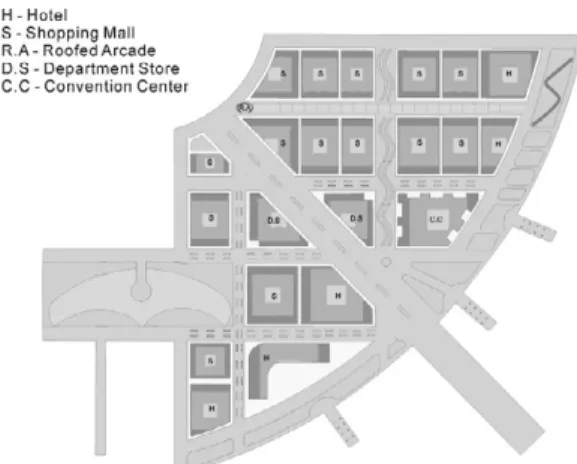
The CBD (Central Business District) should be located in the region where the significant two cranes’ abdomens meet (Figure 12). There should be a waterfront in the peripheral of the river that passes through the center of the city. The waterfront symbolizes divinity, and it should be located where the wild nature-free region end and where the secular world starts. It is to gather the Holy Spirit so that the water way will be ever lasting and through the oriental-nature view and the spirit will last forever in the water.
In today’s society, the natural stream’s conservation is needed so by establishing a waterfront, may the main business and commercial region be made into higher statures and the rest of the region, into lower statures as you can see on the panel of the total land usage.
The business and commercial district is to be located on the peripherals of the inner part of the diamond where it meets with the residential districts and the river, where it flows directly
across it. The streams that flow through the main district of business and commercials eventually flow and meet with the artificial lake and the river in which the waterfront is formed.
The industrial buildings must be placed at the end and the left side of the river (Figure 13).
We will build cultural amenities on the head part of the crane. Particularly, we will build a theater that reminds people of Greek’s Dionysos’
amphitheatre on the head of it. On the core area that three Taekuks form the exhibition, opera house, and performing place are located (Figure 14). People will be free to use the various complex facilities and enjoy different kinds of sports.
Figure 12. An example of commercial and business area.
Figure 13. An example of industrial area.
Figure 14. An example of culture area.
Memorial center will be located on the end side of the garden area by the Kumkang river.
King Sejong or other great people are to be remembered and special traces will be made in their fame. The scenery will be so beautiful that residents can enjoy peaceful moments of the total scene.
Looking at the figure of where the culture facilities lie, you will be able to see that the culture facilities are located in the region of the business district. Furthermore, the peripherals of the inner diamond show the major complex center and you can see that it is close to the river. The major facilities for culture and recreation will be located on the outer part of the diamond, but close to it, as the map shows its connection to the core and the axis of the diamond. People can take great pleasure as they harmonize with the nature and enjoy culture and different activities.
The plaza is important as well. By putting the plaza on the center of the core area in which juxtaposition of diamond composes, we want to make a Korean hall for sacrificial rite gate that represents a high quality odd culture and science in Korea. The plaza will be larger like the plaza in Paris where people of different societies gather and just enjoy different cultures. In locating the plaza in the center of the core, it can be a place for socializing and can be represented as the heart of passion and free spirit.
3) Administrative buildings and open space
The administrative buildings and open space is shown on the figure of the central axis. The public spaces will be positioned on the diamond pattern area. There are three public spaces. The
three different monuments will be built on each of these three public space areas. Public spaces can be accessed through the arterials. The gardens from North-South axis form a linear shape. People can enjoy a good sightseeing while walking along the gardens. The disposable landscape results from the fitness of the new city structure to the principle of geomancy.
The main core of the diamond will be the central plaza. Facing to the right of the main core, the west side of the green axis will be the center of culture, science and art. It will be filled with passion, spirit, and ambition. People will enjoy different culture activities and they will get a chance to have pleasure in the activities. To the east side of the green axis will be the center of social welfare. According to the theory of geomancy, relation to welfares is to the east and in following this theory will have hope of prosperity.
The inner part of the city will be in forms of rectangle, circle, and diagonal and the outer part;
the two diamonds will embrace the inner side of the diamonds. Not only the city be composed of realism, but there will also be central park, and an artificial lake for people to stroll and just enjoy the nature of it.
The value of forming a lake artificially is a vital sign of gathering the spirits and it is very important in relation to geomancy. The lake will be made in the form of nature itself and people will visualize it as a unification lake. The central park will be constructed in the place of the pavilions. The parks will be located on each part of the axis of the central core and people will be free to grow closer to the nature environment in this way.
On the panel showing the locations of the buildings, you can see the administrative offices
located on the right axis of the central core. It will be lined up next to the green plains in which all the axis of the diamond is covered with. The main government offices will be located on the core area of the spaces where the two cranes, the two diamonds meet. To the right side of the main core will the administrative buildings be located.
Listed are the 13 ministries; Ministry of Finance and Economy, of Education and Human Resources Development, of Science and Technology, of Culture and Tourism, of Agriculture and Forestry, of Commerce, Industry and Energy, of Information and Communication, of Health and Welfare, of Environment, of Labor, of Construction and Transportation, of Maritime Affairs and Fisheries, the National Tax Service and the National Emergency Management Agency.
In relation to the axis of the central core, the core that lies in the line where the two diamonds
meet, the presidential commission and prime minister’s commission are located. Included of the presidential commission is Civil Service commission, Presidential commission on small and medium enterprises, Korea Independent Commission against Corruption. Included of the Prime minister’s commission are The Office for Government Policy Coordination, Prime Minister’s Secretariat, Emergency Planning Commission, Fair Trade Commission, The Ombudsman of Korea, National Youth Commission, Ministry of Planning and Budget, Ministry of Government Legislation, Government Information Agency, and the Ministry of Patriots and Veterans Affairs.
The open space, which is the space outside of the diamond, will be left as a wilderness state. It could be a lake park, or garden squares; just itself will be the nature- free zone. The crucial point in developing spaces like this is that we must not be able to place any artificial materials
Figure 15. Open space and the greens.
or destroy the zone with trash. In order to conserve this area, people must be able to understand the nature and work to get close to it by just feeling the open space (Figure 15).
In order to maintain a sustainable city, the control for the water system is in great need. The control for rainwater, sewage should be located inner and outer parts of the city. It is important for the sewage disposal plant to be located along the river as the sewage must not be in contact with the nature itself, but has to be transported to the disposal plant. Moreover, the network system has to be constructed in advance to the culture amenities and the figure of the water control and network system shows clearly where it should be located. The various systems can be greatly advanced by the ubiquitors(Figure 16). The development of a sustainable city is not just the development of culture, but the development of the sustainable grounds and associated plants and systems.
4) Major transportation modes and operation
Once the structure of the ideal city is planned, transportation modes and operation must be considered. The transportation these days vary broadly and we have gotten closer to the modern technology as years move on. However, the development must not stop here but work further on in order to make our lives convenient.
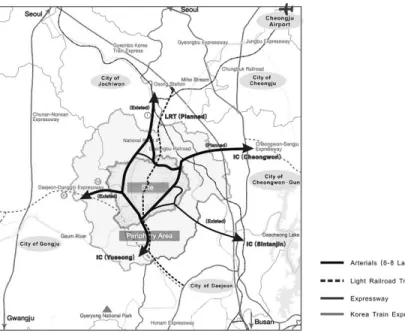
The transportation system consists of highway network of intra-city buses, cars, and inter-urban light rail transit.
The inter-urban transportation system has four main roots in which it leads to the outer part of the city. First of all, in order to get to the target site from Seoul, the major transportation will be KOREA TRAIN EXPRESS (KTX) which already exists, and from the Osong Station of KTX at about 16 km north, the light rail transit(LRT), will lead the way to the main target site, the central Figure 16. Water control and network system.
core of the diamond. People can get within 60 minutes to the New City (NMAC) from Seoul using KTX train and the LRT. The LRT runs through the south-north corridor to the south end of the City (Figure 17).
LRT is not in existence today, but in Japan it is one of the major transportations and if we could get it started, than it will grow to become one of the major transportations in our country as well.
Secondly, the four major cities, the city of Jochiwon, the city of Gongju, the city of Cheonwongun, and the city of Daejon(Yooseong District, Sintanjin District) will be connected to the target site by some arterials and it will each lead directly to the site. The transport to the main target site from Chunan interchange will be by taking the Gyeongbu expressway. The arterial will be from the south, Yooseong District and by taking the LRT; it will be easier to get to the target site.
There are five main communication root which is the arterials of 6~8 lanes in both directions, the
collectors of 4 lanes, the local roads such as country roads and other feeder roads. These main roots connect integrated highways;
however the inner road (Figure 18) system is in need for connecting the inner part of the city.
In planning a new transportation system, the recent transport development’s problems have to be overlooked and make changes in having to transport from city to city. Local roads are 2 lane vehicle roads in grid pattern in the blocks.
Collectors are for collecting and distributing traffics between arterials and local roads. Arterials are networked in radial pattern and make 3 major rotaries at the intersections in which they are crossed mutually or with collectors.
The road system must not be in discord with the natural environment and must be developed so that the nature will be conserved without harms. For example, within the conserved region, the road must be direct and streets for foreigners must be constructed in accord to the natural contour line and the nature itself
Figure 17. Inter-urban network.
Highways are to be lined and developed in accord of the natural environment as far as possible so that the nature should be preserved
well. For example, at the foot of mountains or hillside areas, it is usual the roads are not straight in accord to the natural contour line and the Figure 18. Highway and transit network.
Figure 19. Bicycle network and pedestrian mall.
nature itself. In preserved areas, highways or roads are developed to the minimum.
In addition to the highway networks, bicycle networks are developed. Bicycle networks consist of exclusive bicycle roads and bicycle lanes as a part of highway. Bicycle networks are distributed broadly around the City; in urban centers, residential areas, preserved districts and so on (Figure 19).
5. Conclusion
In this paper, authors tried to show how the Korean geomancy, and oriental viewpoint on man-nature relationship could be applied into planning the conceptual framework for new city, particularly in the case of the New Multi- functional Administrative City (NMAC) in Korea, through the process of deciding the value of city, searching the theoretical background, extracting overall landscape image, constructing the urban structure and form and suggesting overall land use.
We also focused on ideas how to preserve nature and establishing a city, how both the nature and the city have to be harmonized into one. The central point in establishing a new city is that we become one with the nature.
Furthermore, the theories of geomancy have shown us that water, mountain, and land have to coexist in order to develop into a better world.
From the land image, we have transformed the image to a complete form of a city, and have assembled the building mass and its transportation system through the map. The different districts that has been divided shows the basic idea of how the facilities should be located and adapting the ideal theory of both oriental
and western spatial viewpoint, the city will be a blending of both cultures, and will be developed into a polished, new city. The NMAC, the new multi-functional administrative city is also to be mutual dependent and self-reliant. In developing this form of the city, the cultural, industrial, and business region is to be complemented and people will rely upon this developing city, instead of their own home town. The enlargement and the fulfillment of the spaces in the formation of the city will provide a new urban formation for the people.
It will be a reborn of a peaceful and a natural
“eco-polis.” In developing a city, many measures have to be made and many risks have to be taken. Trying to construct a new advanced city is not to be quick, but firm and precise in every detail of what is made and located. In this matter, having to harmonize nature and people is the main priority in constructing the city, and developing it into a better town is the next best thing of what we have to do. The development of both mutual dependent and self - reliant city, the development of the future “peaceful eco- polis” will raise a new world and open a new peaceful coexisting world of nature and humans.
Acknowledgement
The authors are grateful to Mi Jin Kim (Ianrich Co.) and Ji Sun Kim (Ianrich Co.) for graphic design, Yun Young Kim (Hongik University) and Jin Young Oh (Seoul National University) for sketch and visual drsign, Ji Young Jang (Seoul Natinal University) for translation into English.
References
Hall, Peter, 1996, Cities of Tomorrow : An Intellectual History of Urban Planning and Design in the Twentieth Century, Blackwell.
KRIHS(Korea Research Institute for Human Settlements), 2004, Cities of World, Hanulbooks, Seoul.
Lee, Chung Myun, 1993, “Pungsu(Geomancy) in Korea:
Theory and Practice,” the 60thAnniversary Book of Professor Ki Ju Hyung, 565-619.
2003, Contemporary Urban Planning, Prentice Hall, New York.
Ock, Han Suk, 2003, “A Study on the Pungsu Landscape of the Myungdang Tomb Sites in Andong Area,”
Journal of the Korean Geographical Society, 38(1)1, 70-86.
Levy, John M., Woo Pyeong Park, 2003, “The Criteria and Selection of Pungsu site of Exurban Housing along the Han Riverside,” Journal of Photo-Geography, 13(1), 59-72.
SGHS(Study Group of Housing Science), 2004, Eco- Housing : Living together with Nature, Barun Publishing Co, Seoul.
Suh, Chan-Ki, 2000, Rural communities and agriculture, the Organizing Committee of the 29th Interantional Geographical Congress(ed.), Korea : The Land and People, Kyohaksa, 143-173.
Correspondence: Han Suk Ock, Professor, Dept. of Geography Education, College of Education, Kangwon National University 200-701 Korea (e-mail: [email protected], phone : 033-250- 6694)
교신:옥한석, 200-701 강원도 춘천시 효자동 192-1번지 강원대학교 사범대학 지리교육과 (이메일: ock@
kangwon.ac.kr, 전화:033-250-6694)
Received November 8, 2005 Accepted December 20, 2005