자가관리중재가 골관절염 대상자의 통증에 미치는 효과:
메타분석
이 춘 희
선린대학교 간호학과 조교수
Effects of Self-management on Pain in Patients with Osteoarthritis:
A Meta-analysis
Lee, Chun Hee
Assistant Professor, Department of Nursing, Sunlin University, Pohang, Korea
Purpose: This study was a meta-analysis of the effects of self-management on pain in patients with osteoarthritis.
Methods: Randomized controlled trials were identified by searching PubMed, EMBASE, CINAHL, Ovid-MEDLINE and Korean database using key words, ‘self-management’, ‘osteoarthritis’ and ‘pain’. Data were analyzed using the R version program. Results: Twenty nine studies met the inclusion criteria with a total of 5,998 participants. There were significant differences in overall effects of self-management (SMD -0.53, 95% CI -0.77~-0.29, p<.001). Conclusion: The results of the study show that self-management was effective in reducing pain in patients with osteoarthritis. As a result, it should be used as basic data when using self-management for patients with osteoarthritis.
Key Words: Osteoarthritis; Self-management; Meta-analysis
주요어: 골관절염, 자가관리, 메타분석 Corresponding author: Lee, Chun Hee
Department of Nursing, Sunlin University, 30 Chogok-gil, 36 Beon-gil, Heunghae-eup, Buk-gu, Pohang 37560, Korea.
Tel: +82-54-260-5292, Fax: +82-54-261-9455, E-mail: [email protected] Received: Sep 23, 2019 / Revised: Nov 6, 2019 / Accepted: Nov 6, 2019
서 론
1. 연구의 필요성
우리나라 65세 이상 노인인구는 2017년 13.8%로 2030년에 는 25%에 육박할 것으로 전망하며, 노인인구의 급격한 증가는 관절염의 유병률도 증가하여 33.1%의 노인이 관절염을 앓고 있 다(Jung et al., 2018). 그 중 골관절염은 주로 손, 무릎, 고관절, 척추 등에 통증을 동반하는 만성적인 관절질환으로 신체적 기 능장애의 원인이 된다. 이때 관절 통증은 과도한 움직임, 비만, 근력약화, 관절 손상 등의 원인으로 연골이 얇아지면서 관절 공 간이 좁아져 증상을 악화시킨다(Schlenk & Xiaojun, 2019).
골관절염 대상자의 통증 경감을 위한 중재로는 자가관리중 재, 심리 ․ 사회적 중재, 식이요법, 물리치료, 약물요법, 외과적 개입이 있다(Schlenk & Xiaojun, 2019). 골관절염 대상자의 통 증은 급성기를 제외하고는 약물요법을 병행하면서 자신의 관 절상태를 살피며 지속적인 자가관리가 필요하다(Kim & Park, 2017). 자기관리중재는 만성질환을 앓고 있는 대상자가 자신 의 상태를 관리하는데 적극적으로 참여하도록 장려하는 중재 로, 자기관리 기술을 익혀 골관절염으로 인한 신체적 기능을 향 상시키고 통증을 줄일 수 있다(Kroon et al., 2014). 골관절염 대상자에게 주로 사용되어 온 자가관리중재는 교육, 운동, 식 이, 목표설정 등이 포함되며, 골관절염과 같은 만성질환은 자 신이 관리하는 것이 효과적으로 보고되었다(Walsh, Salmon,
& Pearson, 2016).
골관절염 대상자에게 자가관리중재를 적용하여 통증에 대 한 효과를 보고한 연구는 부재하며, Kroon 등(2014)의 연구에 서는 골관절염 대상자에게 자가관리 교육중재의 효과를 메타 분석하여 결과변수로 통증, 기능, 삶의 질에 대해 분석하였으 나, 자가관리는 교육뿐 아니라 다양한 중재가 적용될 필요가 있음에도(Walsh, Salmon, & Pearson, 2016), 교육중재의 효 과만 분석한 제한점이 있었다. 또한 무릎 골관절염 대상자에게 자가관리중재의 효과를 메타분석한 Kim과 Park (2015)의 연 구에서는 결과변수로 통증, 관절가동범위, 신체기능, 일상생활 능력, 자기효능감, 삶의 질에 대해 분석하였다. 그러나 골관절 염의 부위를 무릎관절 부위만으로 한정하고 무작위 대조군 실 험연구가 아닌 문헌을 포함하였다. 골관절염은 무릎관절 뿐 아 니라 손, 고관절, 척추 등 다양한 부위에 발생 가능한 질환이므 로(Schlenk & Xiaojun, 2019), 골관절염 대상자의 자가관리중 재의 효과를 비교하기 위해 골관절염 부위에 따른 분석이 필요 할 것으로 사료된다.
이에 본 연구에서는 메타분석을 위해 일반적으로 사용되고 높 은 근거수준으로 평가되는 무작위 대조군 실험연구(Random- ized Controlled Trials, RCT)를 선정하여(Higgins & Green, 2011), 골관절염 대상자에게 통증을 감소시키기 위한 자가관 리중재의 전체 효과크기를 분석하였다. 또한 다양한 중재방법 의 효과와 골관절염 부위에 따른 통증의 효과를 분석하여 향후 골관절염 대상자를 위한 자가관리중재의 개발 및 적용의 근거 를 마련하고자 하였다.
2. 연구목적
본 연구의 목적은 골관절염 대상자의 통증을 감소하기 위해 적용된 자가관리중재의 효과를 검증하기 위해 메타분석을 수 행하여 효과크기를 제시하고 자가관리중재 적용을 위한 근거 를 마련하고자 하는 것이다.
연 구 방 법 1. 연구설계
본 연구는 골관절염 대상자에게 자가관리중재로 통증 감소를 위한 효과를 검증하기 위해 무작위 대조군 실험연구를 선정하 고 그 효과를 파악하기 위해 체계적으로 메타분석한 연구이다.
2. 분석대상 논문의 선정기준
본 연구는 체계적 문헌 고찰 보고지침(Preferred Reporting Items for Systematic Reviews and Meta-Analysis, PRISMA) 에 따라 PICO (Participants, Intervention, Comparison, Out- comes) 형식으로 논문을 검색하였다. 대상자(P)는 골관절염 을 진단받은 남녀 대상자이며 중재방법(I)은 자가관리중재를 실험한 중재이며, 비교집단(C)으로는 자가관리중재를 받지 않 고, 무처치, 일상적인 중재, 대체 중재를 포함하였다. 중재 결과 (O)는 골관절염으로 인한 통증을 결과변수로 보고한 연구를 선정하였다. 배제기준은 1) 무작위 대조군 실험연구가 아니며 2) 원문이 제시되지 않았고, 3) 결과 값을 보고하지 않았으며, 4) 단일군 연구, 질적연구, 리뷰연구로, 5) 한국어와 영어로 출 간되지 않은 연구이다.
3. 문헌검색전략
본 연구는 2019년 8월 1일부터 9월 10일까지 전자 데이터베이 스를 활용하여 국내 ․ 외에서 발표된 문헌을 검색하였다. 국외 문 헌으로는 PubMed, EMBASE, CINAHL과 Ovid-MEDLINE에 서 검색하였고, 국내 문헌은 KMbase, KoreaMed, Kiss, RISS와 DBpia에서 문헌을 검색하였다. 국외 주요 검색어로는 자가관리 중재(self-management [MeSH] OR self care [MeSH] OR self help OR self monitor)를 골관절염(osteoarthritis [MeSH] OR degenerative arthritis OR OA), 통증(pain [MeSH])과 AND 로 병합하였다. 국내 검색어로는(자가관리 OR 자기관리 OR 자조관리) AND (골관절염 OR 퇴행성 관절염)로 검색하였다.
그리고 출판일자는 제한하지 않았으나, 사람에게 사용된 실험 연구와 영어 또는 한국어로 제한하여 검색하였다.
문헌선택 과정은 문헌선택 흐름도(PRISMA flow diagram) 에 따라 문헌 선택기준을 단계별로 기록하였다. 문헌선택 과정 을 위해 연구자를 포함한 메타분석 연구자 2인은 독립적으로 전자 데이터베이스를 활용하여 자료를 추출한 후 EndNote를 이용하여 전체 논문을 1차 중복 배제하였다. 2차 배제는 제목 및 초록을 확인하였고, 원문 확인 후 선정기준에 따라 3차 배제 하여 최종 선정된 논문을 선택하였다. 문헌검색으로 최종논문 을 선정하기 위해 2인의 연구자는 독립적으로 평가, 분석하여 결과를 종합하였다.
4. 논문의 질평가
질평가는 무작위배정 비교 임상시험의 비뚤림 위험 평가를 위해 The Cochrane’s Risk of bias (RoB)를 적용하여 분석하 였다(Higgins & Green, 2011). 본 도구는 무작위 배정순서 생 성, 배정순서 은폐, 참여자와 연구자의 눈가림, 결과평가자의 눈가림, 불완전한 결과자료, 선택적 결과보고, 그 외 다른 잠재 적 비뚤림 위험을 포함한 7가지 영역으로 평가한다(Higgins &
Green, 2011). RoB 평가지침에 따라 선전된 논문의 원문을 확 인한 후 비뚤림 위험 가능성이 높은 경우 ‘높음’(high risk of bias), 비뚤림 위험 가능성이 낮은 경우 ‘낮음’(low risk of bias), 비뚤림 위험 정도를 파악하기 어려운 경우 ‘불확실’(uncertain risk of bias)로 평가하여(Higgins & Green, 2011) 응답 결과를 RevMan 5.3 프로그램에 기록하여 확인하였다.
5. 자료수집 및 자료분석
본 연구에서는 효과크기를 파악하기 위해 R version 3.5.1 프로그램을 이용하여 메타분석을 시행하였다. 골관절염 대상 자의 통증에 대한 자가관리중재 효과를 분석하기 위해 사전 사 후 의 평균, 표준편차, 실험군과 대조군의 대상자 수를 추출했 으며, 표준화된 평균차(Standard Mean Difference, SMD)를 효과크기 방법으로 선택하였다. 또한 연구들이 고유의 효과를 가진다고 가정하였을 때, 효과 크기의 동질성이 확보되지 않을 경우 각 연구 간의 이질성을 고려하여 가중치를 재설정하는 임 의효과모형(random effects model)을 통하여 산출 하였다 (Borenstein, Hedges, Higgins, & Rothstein, 2009).
효과크기의 통계적인 의미로는 전체 효과크기과 95% 신뢰 구간(CI)으로 판단하였고, 유의수준 5%를 기준으로 하였다.
이때 효과크기의 해석은 Cohen의 효과크기 해석에 따라서 ES=0.20 이상에서 0.50 미만은 작은 효과, ES=0.50 이상에서 0.80 미만은 중간효과 그리고 ES=0.80 이상은 큰 효과를 의미 한다(Cohen, 1998).
이질성 여부를 측정하기 위해 Forest plot을 통해 I2값을 검 토하였고, I2는 이질성이 없을 경우 0%이며, 낮은 이질성은 25%, 중등도의 이질성은 50%, 75% 이상인 경우는 이질성이 큰 것을 의미한다(Higgins & Green, 2011). 중등도 이상의 이 질성은 통계적으로 이질성을 설명하기 위해 meta-regression 과 meta-ANOVA를 적용하여 조절효과분석을 시행하였다.
Funnel plot을 이용하여 출판 편향을 확인하였으며, 시각적으 로 대칭일 경우 출판오류 가능성이 줄며, 객관적 검증을 위한 분석방법으로 Egger’s regression test를 사용하였다.
연 구 결 과 1. 문헌선정 결과
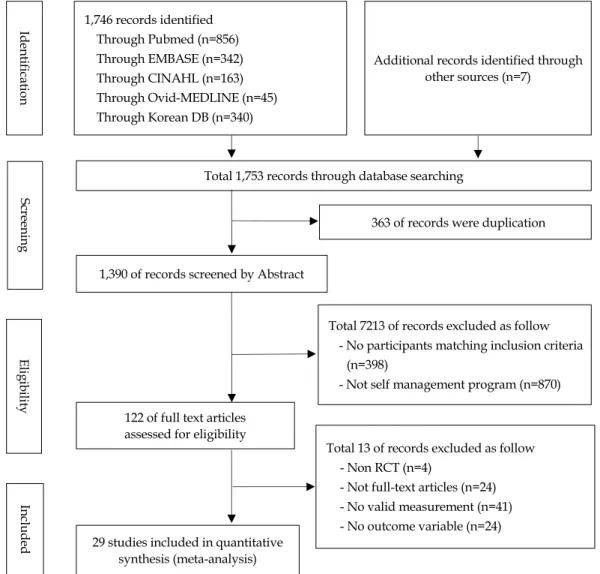
2019년 8월 1일부터 9월 10일까지 문헌 검색 결과 총 1,753 편의 문헌이 검색되었다. 국외 문헌의 경우 PubMed 856편, EMBASE 342편, CINAHL 163편, Ovid-MEDLINE 45편으 로 총 3,997편이 검색되었다. 국내 문헌의 경우 KMbase 39편, KoreaMed 16편, Kiss 30, RISS 45편, DBpia 210편으로 총 340편이 검색되었으며, 수기검색으로 7편의 문헌이 추가 검색 되었다. 1차적으로 검색된 1,753편 문헌 중 중복된 363편의 문 헌을 제외하고, 1,390편의 문헌에서 제목과 초록을 확인하여 골관절염 대상자가 아닌 398편, 자가관리중재가 아닌 870편의 문헌이 제외되어, 총 122편의 원문이 2차 선정되었다. 3차 선정 은 무작위 대조군 실험연구가 아닌 4편, 문헌의 전문이 없는 24 편, 유효한 측정값이 없는 41편, 결과변수인 통증을 포함하지 않은 24편을 제외하고, 29편이 메타분석을 위한 최종 논문으로 선정되었다(Figure 1). 2인의 연구자는 문헌 검색을 독립적으 로 수행하였으며, 의견이 상이한 경우 토의를 통해 결과를 도출 하였다.
2. 연구의 특성
분석에 포함된 29편의 논문의 특성은 주저자, 발표년도, 주 저자의 국가, 대상자 평균연령, 여성 비율, 대상자 수, 골관절염 부위, 중재 제공자, 중재 장소, 중재방법, 중재 시간, 횟수, 기간, 결과변수 측정도구를 포함하여 분석하였다(Table 1).
먼저, 최종 선정된 논문의 발표년도는 1985년부터 2019년 까지로, 2010년 이후 논문이 13편이었다. 연구의 출처는 29편 모두 국외로, 주저자의 소재 국가는 미국이 8편으로 가장 많았 다. 전체 대상자의 평균 연령은 67.8세이며 여성의 비율은 71.7%였다. 대상자 수는 최소 16명에서 최대 501명이며, 실험 군에서는 3,379명, 대조군에서는 2,619명으로 총 5,998명이었 다. 골관절염의 부위에 따른 대상자는 무릎관절 16편, 고관절 2 편, 무릎관절과 고관절 모두 포함한 연구 7편이었다. 중재 제공 자는 물리치료사가 포함된 연구 15편, 간호사가 포함된 연구 10편이었다. 중재 장소로는 병원이 10편, 지역사회나 가정이 19편이었다. 중재의 방법은 개별적 연구가 4편, 그룹이 12편, 개별과 그룹을 함께 적용한 연구가 13편이었다. 구체적인 중재 방법으로는 중복으로 시행된 연구를 포함하여 면대면 방법이 21편으로 가장 많았으며, 전화 중재 6편, 인터넷 중재 3편, 가정
1,746 records identified Through Pubmed (n=856) Through EMBASE (n=342) Through CINAHL (n=163) Through Ovid-MEDLINE (n=45) Through Korean DB (n=340)
Total 1,753 records through database searching
363 of records were duplication
Screening
1,390 of records screened by Abstract
Total 7213 of records excluded as follow - No participants matching inclusion criteria
(n=398)
- Not self management program (n=870)
Total 13 of records excluded as follow - Non RCT (n=4)
- Not full-text articles (n=24) - No valid measurement (n=41) - No outcome variable (n=24) 122 of full text articles
assessed for eligibility
29 studies included in quantitative synthesis (meta-analysis) EligibilityIncludedIdentification
Additional records identified through other sources (n=7)
Figure 1. Flow diagram of the study selection process.
방문 3편이었다. 또한 책자를 사용한 9편, DVD를 사용한 2편, 오디오를 사용한 연구가 1편이었다. 중재 내용으로는 27편이 교육 중재를 적용하였으며, 운동 17편, 목표설정 4편, 소그룹 토의 3편, 상담과 시범이 각 2편, 그 외 역할극, 식단조절, 침술 이 각 1편이었다. 그 중 교육 중재내용은 골관절염과 관련된 정 의, 위험요인, 치료법, 증상관리 등이 있었으며, 자가관리중재 와 관련된 중재의 이점, 문제해결법, 대처기술, 운동법, 체중 조 절, 식이, 약물요법, 의사소통법, 등이 있었다. 17편의 운동 중 재로는 운동 종류를 제시하지 않은 연구가 7편이며, 대퇴사두 근 운동, 저항운동, 스트레칭, 걷기, 타이치 운동, 수중운동이 실시되었다. 중재 시간은 3분에서 170분까지 다양하며, 횟수 는 4회에서 56회로 구성되었다. 중재 기간은 4주에서 32주이 며, 6주가 11편으로 가장 많았다. 통증변수의 측정도구로는 총 12종류의 도구가 사용되었으며, WOMAC이 15편으로 가장 많고 그 다음으로 VAS가 9편이었다.
3. 논문의 질평가 분석
본 연구에서 사용된 질평가 도구는 Cochrane의 RoB도구를 이용하여 29편의 RCT 연구를 질평가 하였다. 그 결과 무작위 배정순서 생성은 24편이 낮은 비뚤림이며, 4편은 무작위 배정 이라 기술되었으나 구체적인 배정순서에 대한 설명이 없어 불 확실한 비뚤림으로 평가되었다. 배정순서 은폐는 15편만이 낮 은 비뚤림으로 불투명한 봉투를 이용한 7편, 컴퓨터나 전화를 이용한 8편이 평가되었고, 무작위 배정이었으나 배정순서에 대한 기술이 없는 14편은 배정은폐의 적절성을 평가할 수 없었 다. 참가자와 연구자의 눈가림은 12편이 낮은 비뚤림, 결과평 가자의 눈가림은 11편이 낮은 비뚤림으로 평가되었고 나머지 논문에서 자세하게 기술되지 않아 불확실한 비뚤림으로 평가 되었다. 불완전한 결과자료는 13편에서 결측치가 없었으며, 8 편에서 Intent-to-treat 방법을 사용하여 21편이 낮은 비뚤림으
Table 1. Characteristics of Included Studies
No First author
(year) Location
Participants
Provider Setting
Intervention
Outcome measurement Age
(year)Female (%) Exp.
(n) Cont.
(n) OA
region Individual†
/Group‡
Min/Session /Duration
(wks)
1 Chen
(2019) China 68.9 84.4 71 70 Knee Physiotherapist Community Telephone
/Education, exercise 120/9/12 WOMAC 2 Bennell
(2018) Australia 61.3 57.0 73 71 Hip Physiotherapist Community Internet, email
/Education, exercise 35~45/56/8 NRS WOMAC 3 Isaramalai
(2018)
Thailand 65.9 84.0 30 45 Knee Physiotherapist &
nurse
Community Home visit /Education, exercise, goal setting
140/24/8 WOMAC
4 Li
(2018) USA 73.0 62.0 50 50 Knee Research assistant Community Acupressure,
demonstration, DVD 3/40/8 WOMAC 5 Bennell
(2017) Australia 62.3 63.0 84 84 Knee Physiotherapist, nurses, occupational therapist
Community Telephone, logbook
/Education, exercise 30/11/24 NRS WOMAC
6 Broderick
(2014) USA 67.2 76.7 128 128 Knee+
Hip Nurse Community Education, exercise 30~45/10/24 BPI 7 Bossen
(2013)
Netherlands 62.0 65.0 100 99 Knee+
Hip
Researcher Home Internet (education), email
N/N/9 Pain scale
8 Odole (2013)
Nigeria 55.5 49.0 25 25 Knee Physiotherapy Home Telephone (education), logbook
N/18/6 VAS
9 Ackerman (2012)
Australia 65.1 60.0 58 62 Knee+
Hip
Peer leader, professional leader
Hospital Education 150/6/6 WOMAC
10 Coleman
(2012) Australia 65.0 74.7 71 75 Knee Physiotherapist, nurses, occupational therapist
Community Education 150/12/6 WOMAC
11 Hurley (2012)
UK 67.0 77.3 278 140 Knee Physiotherapist Hospital Education, exercise 50~80/12/6 WOMAC
12 Kao
(2012) Taiwan 67.0 76.1 134 125 Knee Physiotherapist Community Education, exercise 80/4/4 Pain index
13 Wu
(2011)
Taiwan 67.0 70.0 114 91 Knee Physiotherapist Community DVD, booklet, counselling /Education, exercise
80/4/4 ASE-pain
14 Crotty
(2009) Australia 67.5 60.5 75 77 Knee+
Hip Nurse, peer Hospital Telephone, goal setting (individual) /Education
170/6/6 WOMAC
15 Jessep
(2009) UK 66.5 68.8 29 35 Knee Physiotherapist Hospital Education, exercise 55/10/5 WOMAC 16 Hurley
(2007) UK 67.0 57.8 278 140 Knee Physiotherapist Hospital Discussion, exercise N/12/6 WOMAC
17 Yip
(2007) Hong Kong 64.8 84.1 88 94 Knee Nurses Hospital Education, exercise 120/6/6 VAS
18 Yip
(2007-2)
Hong Kong 65.0 75.0 88 94 Knee Nurses Hospital Education, exercise 120/6/6 VAS ASE-pain 19 Hughes
(2006) USA 73.3 83.3 115 110 Knee+
Hip Physiotherapist Community Education, exercise 90/24/8 WOMAC ASE-pain AIMS-pain 20 Nunez
(2006)
Spain 71.0 71.0 51 49 Knee Trained health educator
Hospital Individual visit /Education, exercise
30~90/4/32 WOMAC
†Individual (telephone, internet, home visit); ‡Group (education, exercise, goal setting..); Exp.=Experimental group; Cont.=Control group; OA=Osteoarthritis;
WOMAC=Western Ontario and McMaster Universities osteoarthritis index; NRS=Numeric Rating Scale; BPI=Brief Pain Inventory; N=Not report;
ASE-pain=Arthritis Self Efficacy scale-pain; AIMS-pain=Arthritis Impact Measurement Scales-pain; HHS-pain=Harris Hip Score-pain; SF36-pain=Short Form health survey-pain; HAQ-pain=Health Assessment Questionnaire-pain.
Table 1. Characteristics of Included Studies (Continued)
No First author
(year) Location
Participants
Provider Setting
Intervention
Outcome measurement Age
(year)Female (%) Exp.
(n) Cont.
(n) OA
region Individual†
/Group‡
Min/Session /Duration
(wks) 21 Heuts
(2005)
Netherlands 51.6 81.5 132 141 Knee+
Hip
Physiotherapist Hospital Handbook /Education, goal setting
120/6/12 VAS
22 Tak
(2005) Netherlands 68.2 67.5 45 49 Hip Physiotherapist, occupational therapist, dietician
Community
+home Dietary advice
/Education, exercise 60/8/8 VAS HHS-pain
23 Victor (2005)
UK 63.5 72.0 120 73 Knee Nurse Community
+home
Handbook, home visit, diary, goal setting (individual) /Education
60/4/4 WOMAC
SF36-pain
24 Blixen (2004)
USA 70.8 37.5 16 16 N Nurse Home Telephone
(education), helpbook, audio-tape
45/6/6 ASE-pain AIMS-pain
25 Hughes
(2004) USA 73.6 84.1 80 70 Knee+
Hip Physiotherapist Community Education, exercise,
group discussion 90/24/8 WOMAC 26 Barlow
(2000) UK 58.2 84.0 311 233 N Peer Leader Community Education (helpbook), role play, group discussion
120/6/6 VAS
ASE-pain
27 Mazzuca (1997)
USA 62.4 85.0 105 106 Knee Nurse Hospital Telephone (education) /Education
30~60/N/4 VAS
HAQ-pain 28 Lorig
(1989)
USA 64.0 84.0 501 206 N Health professionals Community Helpbook /Education, exercise
120/6/6 VAS
29 Lorig (1985)
USA 67.4 83.0 129 61 N Physician Community Helpbook (education) /Group discussion, practice
N/6/16 VAS
ordinal scale
†Individual (telephone, internet, home visit); ‡Group (education, exercise, goal setting..); Exp.=Experimental group; Cont.=Control group; OA=Osteoarthritis;
WOMAC=Western Ontario and McMaster Universities osteoarthritis index; NRS=Numeric Rating Scale; BPI=Brief Pain Inventory; N=Not report;
ASE-pain=Arthritis Self Efficacy scale-pain; AIMS-pain=Arthritis Impact Measurement Scales-pain; HHS-pain=Harris Hip Score-pain; SF36-pain=Short Form health survey-pain; HAQ-pain=Health Assessment Questionnaire-pain.
로 평가되었다. 선택적 결과보고에서는 사전에 제시한 결과값 이 보고되지 않은 2편을 제외한 27편이 모든 결과를 보고하였 다. 그 외 다른 잠재적 비뚤림 위험 항목에서는 중재 전 가이드 라인, 매뉴얼 유무, 중재 제공자의 전문성을 파악할 수 있는지 를 평가하여 충분한 정보가 없는 논문이 24편으로 평가되었다.
논문의 질평가 분석결과 본 연구에 선정된 29편의 연구는 비교 적 비뚤림이 낮은 것으로 평가되었다.
4. 자기관리중재의 효과크기
자가관리중재가 골관절염 대상자의 통증에 미치는 효과를 확인하기 위해 선정된 29편의 논문을 확인하였다. 자가관리중 재의 통증에 대한 효과크기는 -0.53 (95% CI=-0.77~-0.29)으로 중간 정도의 효과크기를 나타내며 통계적으로 유의한 차이를 보였다(p<.001)(Figure 2). 이질성 검증을 위한 결과는 I2=95%
(Q=23.27, p<.001)로 통계적으로 유의하며 큰 이질성이 보인 다고 할 수 있다.
5. 효과크기의 이질성 검증: 조절효과 분석
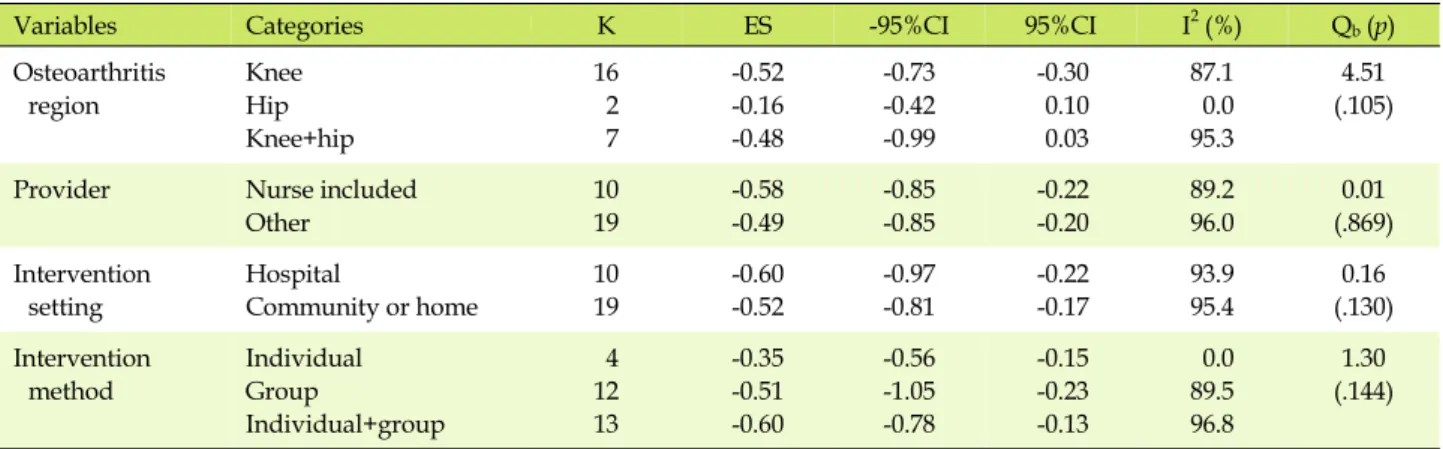
자가관리중재의 효과크기에 대한 이질성은 Higgins와 Green (2011)이 제시하는 상당한 정도의 이질성(75%≤I2≤100%)의 범위에 속하므로(I2=95%, Q=23.27, p<.001), 이질성을 설명 하기 위해 추가 분석이 필요하다. 먼저 조절효과 분석 중 조절 변 수로 연속형 변수는 중재 횟수, 중재 기간으로 meta-regression 실시하였고, 범주형 변수는 골관절염 부위, 중재 제공자, 중재 장소, 중재방법으로 meta-ANOVA 실시하였다(Table 2).
자가관리중재의 이질성을 설명하기 위해 연속형 변수인 중 재 횟수와 기간을 조절변수로 meta-regression을 실시한 결 과, 자가관리중재의 효과크기는 중재 횟수(Q=0.38, p=.534) 와 중재 기간(Q=0.01, p=.713)과의 관계가 없다고 할 수 없으 나 유의한 조절변수가 아닌 것으로 확인되었다.
범주형 변수로 골관절염 부위에 따른 효과크기를 살펴보면, 무릎관절이 -0.52, 고관절이 -0.16, 무릎관절과 고관절 부위가 -0.48로 무릎관절 부위의 효과크기가 더 크나, 두 집단 간의 차
Figure 2. Forest plots of the effects of self-management.
Table 2. Subgroup Analysis of Moderator Variables in Self-management
Variables Categories K ES -95%CI 95%CI I2(%) Qb(p)
Osteoarthritis region
Knee Hip Knee+hip
16 2 7
-0.52 -0.16 -0.48
-0.73 -0.42 -0.99
-0.30 0.10 0.03
87.1 0.0 95.3
4.51 (.105)
Provider Nurse included
Other
10 19
-0.58 -0.49
-0.85 -0.85
-0.22 -0.20
89.2 96.0
0.01 (.869) Intervention
setting
Hospital
Community or home
10 19
-0.60 -0.52
-0.97 -0.81
-0.22 -0.17
93.9 95.4
0.16 (.130) Intervention
method
Individual Group
Individual+group
4 12 13
-0.35 -0.51 -0.60
-0.56 -1.05 -0.78
-0.15 -0.23 -0.13
0.0 89.5 96.8
1.30 (.144) 이는 통계적으로 유의하지 않았다(Qb=4.51 p=.105). 중재 제
공자의 경우 간호사를 포함한 연구는 -0.58, 그 외 제공자의 연 구는-0.49로 간호사를 포함한 연구가 더 큰 효과크기를 나타냈 으나, 집단 간 유의한 차이가 없었다(Qb=0.01, p=.869). 중재 장소에 따른 효과크기는 병원이 -0.60, 지역사회와 가정기반이 -0.52으로, 병원에서 더 큰 효과를 나타났으나, 집단 간 차이는 통계적으로 유의하지 않았다(Qb=0.16, p=.130). 중재방법의 효과크기의 경우, 개별적 중재는 -0.35, 그룹 중재는 -0.51, 개별 과 그룹 중재를 병용한 연구는 -0.60으로 중재를 병용 적용한 경우 효과크기가 가장 큰 것으로 나타났으나, 두 집단 간 유의
한 차이는 없었다(Qb=1.30, p=.144).
6. 출판오류 분석
본 연구의 시각적 Funnel plot은 깔 대기 모양이 대칭적이 고 출판편향이 비교적 발생하지 않은 것으로 판단하였다. 비대 칭 정도를 판단하기 위해 Egger's regression test를 실시하였 고, bias=1.68 (t=-0.58, df=28, p=.568)로 효과크기가 비대칭 이 아님을 확인하였다.
논 의
자가관리는 스스로 건강 행위를 하는 것으로, 골관절염과 같 이 만성질환을 가진 대상자는 질병과 더불어 삶을 영위하기 위 해 건강관리에 적극적으로 참여하여 자신의 삶을 관리할 수 있 어야 한다(Kim, 2016). 그러나 골관절염 대상자의 자가관리중 재 효과를 분석한 연구는 부족하여 본 연구에서는 골관절염 대 상자에게 현재까지 진행된 자가관리중재의 통증에 대한 효과 와 그 유용성을 메타분석을 통해 제시하고자 한다.
본 연구에 최종 선정된 29편의 연구에서 자가관리중재가 골 관절염 대상자의 통증에 미치는 전체 효과크기는 -0.53으로 중 간정도 효과크기로 나타났다. 이는 무릎 골관절염 대상자에게 자가관리중재를 적용하여 통증, 신체기능, 일상생활능력, 자기 효능감의 효과를 검증한 Kim과 Park (2015)의 연구에서 통증 에 대한 효과크기가 -0.48로 중간 정도로 나타나, 무릎 골관절 염 대상자로 대상자를 한정하였으나 유사한 결과라 볼 수 있다.
반면, 만성 근골격계 통증 환자의 자가관리중재를 메타분석한 Du 등(2011)의 연구에서는 관절염을 가진 대상자에게 자가관 리중재를 적용하여 통증 감소가 -0.23으로 작은 효과크기를 나 타내 본 연구와 상의한 결과를 나타냈다. 이러한 결과는 효과 크기의 차이는 있으나 골관절염 대상자에게 자가관리중재를 적용하여 통증에 효과적인 것을 확인하였고, 골관절염 대상자 에게 자가관리중재 적용을 위한 근거로 사용될 수 있을 것으로 생각한다.
골관절염 대상자의 통증 감소를 위해 자가관리중재는 효과 적이나 문헌간의 이질성이 상당한 것으로 확인되어 조절효과 분석을 통하여 이질성을 설명할 필요가 있다. 조절변수로는 중 재 횟수, 중재 기간, 골관절염 부위, 중재 제공자, 중재 장소, 중 재방법에 따른 세부 분석을 실시하였다. 먼저 연속형 변수인 중 재 횟수와 기간의 효과는 자가관리중재의 유의한 조절변수가 아니었다. 이는 중재 횟수와 기간의 길고 짧음으로 자가관리중 재의 효과크기와의 관계를 설명할 수 없는 것이다. 골관절염 환자에게 심리적 중재 적용으로 통증에 미치는 효과를 메타분 석한 Lee (2019)의 연구에서는 중재기간이 길수록 통증이 유 의하게 감소하는 하는 것으로 나타나 본 연구와 상반된다. 관절 염으로 인한 통증은 자가관리중재 기간이 길어질수록 효과크 기가 큰 것으로 보고되었으나(Nolte & Osborne, 2013), 본 연 구결과를 근거로 통증에 대한 자가관리중재의 중재 횟수와 중 재 기간은 유의한 조절변수가 아니므로, 중재 제공자, 중재 장 소, 중재방법에 대한 추가적인 분석이 필요하겠다.
범주형 변수를 분석하기 위해 골관절염 부위에 따른 효과크
기부터 살펴보면, 타 부위에 비해 무릎 골관절염 부위를 적용한 연구에서 가장 큰 효과크기를 나타냈다. 무릎 골관절염은 골관 절염 부위 중 가장 호발되는 부위이며, 무릎 통증은 움직임의 제 한으로 걷기, 계단오르내리기 등의 일상생활 어려움이 발생하 여 지속적인 관리가 필요하다(Kao, Wu, Tsai, Chang, & Wu, 2012). 그러나 본 연구결과는 골관절염 대상자에게 적용한 자 가관리중재 중 무릎 골관절염 부위 연구가 다수여서 관절염 부 위로 인한 자가관리중재 효과크기로 단정하기에 무리가 있을 것으로 생각된다.
중재 제공자에 따른 분석을 살펴보면, 간호사가 포함된 연구 에서 효과크기가 더 큰 것으로 확인되었다. 자가관리중재 제공 자의 역할은 교육, 기술적인 지도, 문제 해결을 위한 상담이나 토의를 주도하며 개인의 목표를 달성해 가는 것을 돕는다 (Mann, LeFort, & Van Den Kerkhof, 2013). 간호사는 만성질 환 치료를 위해 자기관리와 더불어 환자 교육, 상담 등을 제공 하여 왔으며, 쉽게 훈련 받을 수 있어 그 효과가 입증되었다 (Broderick et al., 2014). 따라서 본 연구로 인해 간호사가 포함 된 자가관리중재의 효과를 확인하였으므로 중재 적용을 위해 간호사가 포함된 자가관리중재를 적용할 것을 제안한다.
중재 장소에 따른 자가관리중재의 효과는 병원에서 자가관 리중재를 제공 받았을 경우 더 큰 효과크기를 나타냈다. 중재 장 소에 따른 효과크기를 분석한 연구가 없어 비교하기 어려우나 본 연구에서 자가관리중재를 병원에서 제공받은 연구는 수술 전 환자이거나(Crotty et al., 2009; Jessep, Walsh, Ratcliffe, &
Hurley, 2009; Nuñez et al., 2006) 또는 병원 외래에서 중재를 적용 받은 연구로 지역사회에서 일상생활이 가능한 골관절염 대상자와 비교하여 평균 통증 점수가 높아 그 차이가 컸을 것으 로 생각된다. 따라서 본 연구를 근거로 중재를 적용할 경우, 중 재 장소에 따른 효과크기에 대하여 신중을 기해야 할 것이다.
중재방법으로는 개별중재와 그룹중재를 병용한 연구에서 더 큰 효과를 나타냈다. 골관절염 대상자에게 비약물적 중재 중 자가관리중재의 효과를 분석한 Fernandes 등(2013)의 연구에 서는 통증감소의 효과크기가 개별 중재와 비교해 교육, 운동, 체중감소를 포함한 종합적 중재가 더 큰 효과로 나타나 본 연구 결과와 유사하다. 또한 골관절염 대상자에게 자가관리중재 중 교육방법을 적용하여 통증에 작은 효과크기를 낸 Kroon 등 (2014)의 연구와 무릎 골관절염 대상자에게 인터넷을 이용한 가정기반 중재를 적용한 Meender Schäfer 등(2018)의 연구에 서 통증은 작은 효과를 가져와 본 연구결과를 뒷받침한다. 본 연구에서는 교육 중재가 주로 적용되었으며, 교육과 함께 운동 과 목표설정, 소그룹 토의, 상담과 시범 등의 다양한 방법으로
자가관리중재가 수행되어 개별중재와 그룹중재의 효과를 높 였을 것으로 사료된다. 또한 자가관리중재의 중재 전달방법은 면대면, 인터넷 기반인 모바일 기법, 인쇄물을 이용한 방법이 있으며(Mann et al., 2013), 본 연구에서는 주로 면대면 방법이 사용되었으나 전화와 인터넷을 사용한 중재가 9편, 책자, DVD, 오디오를 사용한 중재가 12편으로 비교적 다양한 방법 을 적용하였다. 자가관리중재는 같은 문제를 가진 그룹 안에서 문제를 해결하기 위해 그룹의 형태가 비용 효율적이며 가장 일 반적으로 사용되어 왔다(Mann et al., 2013). 그러나 골관절염 과 같은 만성질환은 완전한 회복이 어렵고 유병기간이 길어 포 괄적이고 다양한 방법을 통한 자가관리중재가 효과적이므로, 중재 적용을 위해 교육, 운동, 토의와 같은 그룹 방법뿐 아니라 개별적 전화나 인터넷을 이용한 방법을 포함하여 다양하게 적 용할 것을 제안한다.
이상에서 논의한 바와 같이 자가관리중재는 골관절염 대상 자의 통증에 효과적인 것으로 분석되었다. 또한 골관절염 부 위, 중재 제공자, 중재 장소, 중재방법에 따른 자가관리중재의 자료를 제시하였고 무작위 대조군 실험연구로 선정하였으므 로 자가관리중재의 적용 시 근거자료로 활용될 것이다. 반면 본 연구는 분석에 선정된 연구의 대조군이 무처치, 일반적인 치 료, 교육, 운동, 전화통화 등을 포함하여 대조군의 효과가 분명 하지 않아 효과 산출시 영향을 미쳤을 가능성을 배제할 수 없 다. 또한 상당한 정도의 이질성으로 분석되어 조절효과분석을 실시하였으나 중재 기간은 유의한 조절변수가 아닌 것으로 확 인되었고, 골관절염 부위, 중재 제공자, 중재 장소, 중재방법은 집단 간 차이가 통계적으로 유의하지 않았다. 그러나 본 연구에 서 선정된 무작위 대조군 실험연구의 질평가 분석 결과, 29편 의 연구는 비교적 비뚤림이 낮은 것으로 평가되어 개별 연구의 수준이 높은 것으로 분석되어 중재 적용의 기초로 활용할 수 있 을 것이다.
결 론
본 연구는 자가관리중재가 골관절염 대상자의 통증에 미치 는 효과를 분석하고, 근거기반을 위한 자료를 제시하기 위해 그 효과크기를 메타분석하였다. 본 연구의 분석 대상 논문은 2019 년 9월 10일까지 발표된 총 29편의 무작위 대조군 실험연구로 자가관리중재가 골관절염 대상자의 통증에 유의한 중간 정도 의 효과크기를 나타냈다. 그러나 대조군의 효과가 분명하지 않 은 제한점을 가지고 있으므로 연구결과 적용을 위해 신중을 기 해야 할 것이다.
REFERENCES
Borenstein, M., Hedges, L. V., Higgins, J. P. T., & Rothstein, H. R.
(2009). Introduction to meta-analysis. West Sussex: John Wiley
& Sons. https://doi.org/10.1002/9780470743386
Broderick, J. E., Keefe, F. J., Bruckenthal, P., Junghaenel, D. U., Schneider, S., Schwartz, J. E., et al. (2014). Nurse practition- ers can effectively deliver pain coping skills training to os- teoarthritis patients with chronic pain: A randomized, con- trolled trial. Pain, 155(9), 1743-1754.
https://doi.org/10.1016/j.pain.2014.05.024
Cohen, J. (1998). Statistical power analysis for the behavioral sci- ences (2nd ed). Hillsdale, NJ: Lawrence Erlbaum Associates.
Crotty, M., Prendergast, J., Battersby, M. W., Rowett, D., Graves, S.
E., Leach, G., et al. (2009). Self-management and peer support among people with arthritis on a hospital joint replacement waiting list: A randomised controlled trial. Osteoarthritis Cartilage, 17(11), 1428-1433.
https://doi.org/10.1016/j.joca.2009.05.010
Du, S., Yuan, C., Xiao, X., Chu, J., Qiu, Y., & Qian, H. (2011). Self- management programs for chronic musculoskeletal pain conditions: A systematic review and meta-analysis. Patient Education & Counseling, 85(3), e299-310.
https://doi.org/10.1016/j.pec.2011.02.021
Fernandes, L., Hagen, K. B., Bijlsma, J. W., Andreassen, O., Chris- tensen, P., Conaghan, P. G., et al. (2013). EULAR recom- mendations for the non-pharmacological core management of hip and knee osteoarthritis. Annals of the Rheumatic Dis- eases, 72(7), 1125-1135.
https://doi.org/10.1136/annrheumdis-2012-202745 Higgins, J. P., & Green, S. (2011). Cochrane handbook for system-
atic reviews of interventions, version 5.1.0. The Cochrane Collaboration, Retrieved March 2011, from
http://www.cochrane-handbook.org
Jessep, S. A., Walsh, N. E., Ratcliffe, J., & Hurley, M. V. (2009).
Long-term clinical benefits and costs of an integrated reha- bilitation programme compared with outpatient physi- otherapy for chronic knee pain. Physiotherapy, 95(2), 94-102.
https://doi.org/10.1016/j.physio.2009.01.005
Jung, K. H., Oh, Y. H., Lee, Y. K., Oh, M. A., Kang, E. N., Kim, K. R., et al. (2018). Elderly survey 2017. Seoul: Korea Institute for Health and Social Affairs.
Kao, M. J., Wu, M. P., Tsai, M. W., Chang, W. W., & Wu, S. F.
(2012). The effectiveness of a self-management program on quality of life for knee osteoarthritis (OA) patients. Archives of Gerontology & Geriatrics, 54(2), 317-324.
https://doi.org/10.1016/j.archger.2011.05.018
Kim, Y. I. (2016). Development and evaluation of a self-manage- ment program for home-living osteoarthritis patients. Un- published doctoral dissertation, Keimyung University, Daegu.
Kim, Y. I., & Park, J. S. (2015). A meta-analysis of intervention stud- ies on the effects of self-management in knee osteoarthritis.
Korea Academy Industrial cooperation Society, 16(3), 1946-1956.
https://doi.org/10.5762/KAIS.2015.16.3.1946
Kim, Y. I., & Park, J. S. (2017). Development and evaluation of a joint health self-management program for the elderly with knee osteoarthritis in communities: Applying the IMB model.
Journal of Korean Academy of Community Health Nursing, 28(1), 55-68.
https://doi.org.proxy.dsmc.or.kr/10.12799/jkachn.2017.28.
1.55
Kroon, F. P., van der Burg, L. R., Buchbinder, R., Osborne, R. H., Johnston, R. V., & Pitt, V. (2014). Self-management educa- tion programmes for osteoarthritis. Cochrane Database of Systematic Reviews(1), CD008963.
https://doi.org/10.1002/14651858.CD008963.pub2 Lee, C. H. (2019). The effect of psychological intervention for pain
reduction in osteoarthritis patients a meta-analysis. Journal of the Korea Academia Industrial cooperation Society, 20(5), 109-117.
https://doi.org/10.5762/KAIS.2019.20.5.109
Mann, E. G., LeFort, S., & Van Den Kerkhof, E. G. (2013). Self-man- agement interventions for chronic pain. Pain Management, 3(3), 211-222. https://doi.org/10.2217/pmt.13.9
Meender Schäfer, A. G., Zalpour, C., Piekartz, H., Hall, T. M.,
Paelke, V., Schäfer, A. G., et al. (2018). The efficacy of elec- tronic health-supported home exercise interventions for pa- tients with osteoarthritis of the knee: Systematic review.
Journal of Medical Internet Research, 20(4), 1-1.
https://doi.org/10.2196/jmir.9465
Nolte, S. O., & Osborne, R. H. (2013). A systematic review of out- comes of chronic disease self-management interventions.
Quality of Life Research, 22(7), 1805-1816.
https://doi.org/10.1007/s11136-012-0302-8
Nuñez, M., Nuñez, E., Segur, J. M., Macule, F., Quinto, L., Hernan- dez, M. V., et al. (2006). The effect of an educational program to improve health-related quality of life in patients with os- teoarthritis on waiting list for total knee replacement: A randomized study. Osteoarthritis and Cartilage, 14(3), 279-285.
https://doi.org/10.1016/j.joca.2005.10.002
Schlenk, E. A., & Xiaojun, S. (2019). Evidence-based practices for osteoarthritis management: Self-management education is the foundation of osteoarthritis care. American Nurse Today, 14(5), 22-28.
Walsh, N., Salmon, V., & Pearson, J. (2016). A systematic identi- fication and assessment of self-management apps for osteo- arthritis. Osteoarthritis & Cartilage, 24, S491-S491.
https://doi.org/10.1016/j.joca.2016.01.900
Appendix 1. List of Studies included in a Meta Analysis
Ackerman, I. N., Buchbinder, R., & Osborne, R. H. (2012). Chal- lenges in evaluating an arthritis self-management program for people with hip and knee osteoarthritis in real-world clin- ical settings. The Journal of Rheumatology, 39(5), 1047-1055.
https://doi.org/10.3899/jrheum. 111358
Barlow, J. H., Turner, A. P., & Wright, C. C. (2000). A randomized controlled study of the arthritis self-management program- me in the UK. Health Education Research, 15(6), 665-680.
https://doi.org/10.1093/her/15.6.665
Bennell, K. L., Nelligan, R. K., Rini, C., Keefe, F. J., Kasza, J., French, S., et al. (2018). Effects of internet-based pain coping skills training before home exercise for individuals with hip osteoarthritis (HOPE trial): A randomised controlled trial.
Pain, 159(9), 1833-1842.
https://doi.org/10.1097/j.pain.0000000000001281
Bennell, K. L., Nelligan, R., Dobson, F., Rini, C., Keefe, F., Kasza, J, et al. (2017). Effectiveness of an internet-delivered exercise and pain-coping skills training intervention for persons with chronic knee pain: A randomized trial. Annals of Inter- nal Medicine, 166(7), 453-462.
https://doi.org/10.7326/m16-1714
Blixen. (2004). A pilot study of health education via a nurse-run telephone self-management programme for elderly people with osteoarthritis. Journal of Telemedicine and Telecare, 10(1), 44-49. https://doi.org/10.1258/135763304322764194 Bossen, D., Veenhof, C., Van Beek, K. E., Spreeuwenberg, P. M.,
Dekker, J., & De Bakker, D. H. (2013). Effectiveness of a web-based physical activity intervention in patients with knee and/or hip osteoarthritis: Randomized controlled trial.
Journal of Medical Internet Research, 15(11), e257.
https://doi.org/10.2196/jmir.2662
Broderick, J. E., Keefe, F. J., Bruckenthal, P., Junghaenel, D. U., Schneider, S., Schwartz, J. E., et al . (2014). Nurse practi- tioners can effectively deliver pain coping skills training to osteoarthritis patients with chronic pain: A randomized, controlled trial. Pain, 155(9), 1743-1754.
https://doi.org/10.1016/j.pain.2014.05.024
Chen, H., Zheng, X., Huang, H., Liu, C., Wan, Q., & Shang, S.
(2019). The effects of a home-based exercise intervention on elderly patients with knee osteoarthritis: A quasi-experi- mental study. BMC Musculoskeletal Disorders, 20(1), 160.
https://doi.org/10.1186/s12891-019-2521-4
Coleman, S., Briffa, N. K., Carroll, G., Inderjeeth, C., Cook, N., &
McQuade, J. (2012). A randomized controlled trial of a self- management education program for osteoarthritis of the knee delivered by health care professionals. Arthritis Re- search & Therapy, 14(1), R21.
https://doi.org/10.1186/ar3703
Crotty, M., Prendergast, J., Battersby, M. W., Rowett, D., Graves, S.
E., Leach, G., et al. (2009). Self-management and peer support among people with arthritis on a hospital joint replacement waiting list: A randomized controlled trial. Osteoarthritis Cartilage, 17(11), 1428-1433.
https://doi.org/10.1016/j.joca.2009.05.010
Heuts, P. H., de Bie, R., Drietelaar, M., Aretz, K., Hopman-Rock, M., Bastiaenen, C. H. G., et al. (2005). Self-management in os- teoarthritis of hip or knee: A randomized clinical trial in a primary healthcare setting. The Journal of Rheumatology, 32 (3), 543-549.
Hughes, S. L., Seymour, R. B., Campbell, R. T., Huber, G., Pollak, N., Sharma, L., et al. (2006). Long-term impact of fit and strong on older adults with osteoarthritis. Gerontologist, 46(6), 801-814. https://doi.org/10.1093/geront/46.6.801 Hughes, S. L., Seymour, R. B., Campbell, R., Pollak, N., Huber, G.,
& Sharma, L. (2004). Impact of the fit and strong intervention on older adults with osteoarthritis. The Gerontologist, 44(2), 217-228. https://doi.org/10.1093/geront/44.2.217
Hurley, M. V., Walsh, N. E., Mitchell, H. L., Pimm, T. J., Patel, A., Williamson, E., et al. (2007). Clinical effectiveness of a re- habilitation program integrating exercise, self-management, and active coping strategies for chronic knee pain: A cluster randomized trial. Arthritis Rheumatism, 57(7), 1211-1219.
https://doi.org/10.1002/art.22995
Hurley, M. V., Walsh, N. E., Mitchell, H., Nicholas, J., & Patel, A.
(2012). Long-term outcomes and costs of an integrated re- habilitation program for chronic knee pain: A pragmatic, cluster randomized, controlled trial. Arthritis Care & Research, 64(2), 238-247. https://doi.org/10.1002/acr.20642
Isaramalai, S. A., Hounsri, K., Kongkamol, C., Wattanapisitkul, P., Tangadulrat, N., Kaewmanee, T., et al. (2018). Integrating participatory ergonomic management in non-weight bear- ing exercise and progressive resistance exercise on self-care and functional ability in aged farmers with knee osteo- arthritis: A clustered randomized controlled trial. Clinical Interventions in Aging, 13, 101-108.
https://doi.org/10.2147/cia.s144288
Jessep, S. A., Walsh, N. E., Ratcliffe, J., & Hurley, M. V. (2009).
Long-term clinical benefits and costs of an integrated re- habilitation programme compared with outpatient physi- otherapy for chronic knee pain. Physiotherapy, 95(2), 94-102.
https://doi.org/10.1016/j.physio.2009.01.005
Kao, M. J., Wu, M. P., Tsai, M. W., Chang, W. W., & Wu, S. F.
(2012). The effectiveness of a self-management program on quality of life for knee osteoarthritis (OA) patients. Archives of Gerontology & Geriatrics, 54(2), 317-324.
https://doi.org/10.1016/j.archger.2011.05.018
Li, L. W., Harris, R. E., Tsodikov, A., Struble, L., & Murphy, S. L.
(2018). Self-acupressure for older adults with symptomatic knee osteoarthritis: A randomized controlled trial. Arthritis Care & Research, 70(2), 221-229.
https://doi.org/10.1002/acr.23262
Lorig, K., Lubeck, D., Kraines, R. G., Seleznick, M., & Holman, H.
R. (1985). Outcomes of self-help education for patients with arthritis. Arthritis Rheumatism, 28(6), 680-685.
https://doi.org/10.1002/art.1780280612
Lorig, K., Seleznick, M., Lubeck, D., Ung, E., Chastain, R. L., &
Holman, H. R. (1989). The beneficial outcomes of the arthri- tis self-management course are not adequately explained by behavior change. Arthritis Rheumatism, 32(1), 91-95.
https://doi.org/10.1002/anr.1780320116
Mazzuca, S. A., Brandt, K. D., Katz, B. P., Chambers, M., Byrd, D.,
& Hanna, M. (1997). Effects of self-care education on the health status of inner-city patients with osteoarthritis of the knee. Arthritis Rheumatism, 40(8), 1466-1474.
https://doi.org/10.1002/art.1780400815
Nuñez, M., Nuñez, E., Segur, J. M., Macule, F., Quinto, L., Hernan- dez, M. V., et al. (2006). The effect of an educational program to improve health-related quality of life in patients with os- teoarthritis on waiting list for total knee replacement: A randomized study. Osteoarthritis Cartilage, 14(3), 279-285.
https://doi.org/10.1016/j.joca.2005.10.002
Odole, A. C., & Ojo, O. D. (2013). A telephone-based physiotherapy intervention for patients with osteoarthritis of the knee. Inter- national Journal of Telerehabilitation, 5(2), 11-20.
https://doi.org/10.5195/ijt.2013.6125doi:10.5195/ijt.2013.6 125
Tak, E., Staats, P., Van Hespen, A., & Hopman-Rock, M. (2005).
The effects of an exercise program for older adults with os- teoarthritis of the hip. Journal of Rheumatology, 32(6), 1106- 1113.
Victor, C. R., Triggs, E., Ross, F., Lord, J., & Axford, J. S. (2005).
Lack of benefit of a primary care-based nurse-led education programme for people with osteoarthritis of the knee. Clin- ical Rheumatology, 24(4), 358-364.
https://doi.org/10.1007/s10067-004-1001-9
Wu, S.-F. V., Mu-Jung, K., Meng-Ping, W., Mei-Wun, T., & Wan- Wen, C. (2011). Effects of an osteoarthritis self-management programme. Journal of Advanced Nursing, 67(7), 1491-1501.
https://doi.org/10.1111/j.1365-2648.2010.05603.x
Yip, Y. B., Sit, J. W., Fung, K. K., Wong, D. Y., Chong, S. Y., Chung, L. H., et al. (2007). Effects of a self-management arthritis pro- gramme with an added exercise component for osteoarthritic knee: Randomized controlled trial. Journal of Advanced Nurs- ing, 59(1), 20-28.
https://doi.org/10.1111/j.1365-2648.2007.04292.x
Yip, Y. B., Sit, J. W., Fung, K. K., Wong, D. Y., Chong, S. Y., Chung, L. H., et al. (2007-2). Impact of an arthritis self-management programme with an added exercise component for osteo- arthritic knee sufferers on improving pain, functional out- comes, and use of health care services: An experimental study. Patient Education and Counseling, 65(1), 113-121.
https://doi.org/10.1016/j.pec.2006.06.019