• 검색 결과가 없습니다.

Outpatient Treatment for Pneumothorax Using a Portable Small-Bore Chest Tube: A Clinical Report

N/A
N/A
Protected

Academic year: 2021

Share "Outpatient Treatment for Pneumothorax Using a Portable Small-Bore Chest Tube: A Clinical Report"

Copied!
5
0
0

로드 중.... (전체 텍스트 보기)

전체 글

(1)

ISSN: 2233-601X (Print) ISSN: 2093-6516 (Online)

Department of Thoracic and Cardiovascular Surgery, Gangnam Severance Hospital, Yonsei University School of Medicine Received: August 17, 2015, Revised: September 30, 2015, Accepted: October 1, 2015, Published online: June 5, 2016

Corresponding author: Sungsoo Lee, Department of Thoracic and Cardiovascular Surgery, Gangnam Severance Hospital, Yonsei University School of Medicine, 211 Eonju-ro, Gangnam-gu, Seoul 06273, Korea

(Tel) 82-2-2019-3381 (Fax) 82-2-3461-8282 (E-mail) [email protected]

C

The Korean Society for Thoracic and Cardiovascular Surgery. 2016. All right reserved.

CC
This is an open access article distributed under the terms of the Creative Commons Attribution Non-Commercial License (http://creative- commons.org/licenses/by-nc/4.0) which permits unrestricted non-commercial use, distribution, and reproduction in any medium, provided the original work is properly cited.

Outpatient Treatment for Pneumothorax Using a Portable Small-Bore Chest Tube: A Clinical Report

Won Gi Woo, M.D., Seok Joo, M.D., Geun Dong Lee, M.D., Seok Jin Haam, M.D., Sungsoo Lee, M.D., Ph.D.

Background: For treatment of pneumothorax in Korea, many institutions hospitalize the patient after chest tube insertion. In this study, a portable small-bore chest tube (Thoracic Egg; Sumitomo Bakelite Co. Ltd., Tokyo, Japan) was used for pneumothorax management in an outpatient clinic. Methods: Between August 2014 and March 2015, 56 pneumothorax patients were treated using the Thoracic Egg. Results: After Thoracic Egg insertion, 44 patients (78.6%) were discharged from the emergency room for follow-up in the outpatient clinic, and 12 patients (21.4%) were hospitalized. The mean duration of Thoracic Egg chest tube placement was 4.8 days, and the success rate was 73%; 20% of patients showed incomplete expansion and underwent video-assisted thoracoscopic surgery. For pri- mary spontaneous pneumothorax patients, the success rate of the Thoracic Egg was 76.6% and for iatrogenic pne- umothorax, it was 100%. There were 2 complications using the Thoracic Egg. Conclusion: Outpatient treatment of pneumothorax using the Thoracic Egg could be a good treatment option for primary spontaneous and iatrogenic pneumothorax.

Key words: 1. Pneumothorax 2. Chest tubes 3. Outpatients

INTRODUCTION

Pneumothorax is categorized as primary (without any pre- cipitating factor), secondary, iatrogenic, and traumatic.

Usually, primary spontaneous pneumothorax (PSP) is caused by subpleural bleb rupture without underlying lung disease [1]. Secondary pneumothorax has underlying lung disease, such as chronic obstructive pulmonary disease, emphysema, asthma, and others, and iatrogenic pneumothorax is usually caused by needle puncture of the lung parenchyma during acupuncture, central line catheterization, etc. [1].

For treatment of pneumothorax, there is some controversy over PSP, but for recurrent pneumothorax, many institutions

usually recommend video-assisted thoracoscopic surgery (VATS) [2]. For PSP, British guidelines recommend needle aspiration first, as this may minimize hospitalization and reduce the cost to the patient [2]. According to the guidelines of the Ameri- can College of Chest Physicians, clinically stable patients with a large pneumothorax should usually undergo drainage by a small-bore catheter (≤14 Fr) or a 16–22 Fr chest tube, and hospitalization is recommended [3]. The Japan Society for Pneumothorax and Cystic Lung Diseases Guidelines Com- mittee describe many options, but There is not definite con- sensus on the treatment for PSP [4]. In this study, we focus on outpatient treatment for pneumothorax. We used a portable small-bore chest tube (9 Fr) and evaluated its efficacy.

http://dx.doi.org/10.5090/kjtcs.2016.49.3.185

(2)

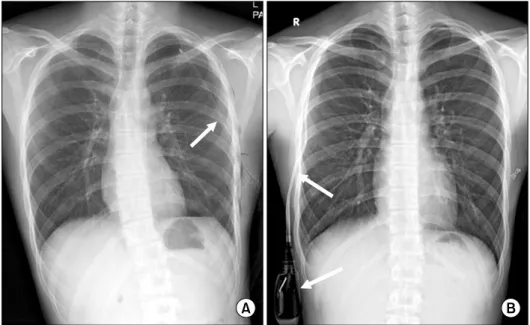
Fig. 2. Chest X-ray with (A) 12 Fr chest tube insertion (arrow) and (B) Thoracic Egg (arrows).

Fig. 1. Thoracic Egg catheter.

METHODS

We prospectively collected medical records of pneumo- thorax patients who underwent portable small-bore chest tube (9 Fr, Thoracic Egg; Sumitomo Bakelite Co. Ltd., Tokyo, Japan) insertion from August 2014 to March 2015 (Fig. 1).

Fifty-six patients were followed in the outpatient clinic or admitted. After pneumothorax was resolved, we did not rec- ommend regular outpatient division (OPD) visits. The in- dication for a portable small-bore chest tube (9 Fr) was a he- modynamically stable patient without a large pleural effusion or hemothorax on chest X-ray, showing costophrenic angle

blunting, regardless of the cause of pneumothorax (Fig. 2).

To audibly confirm air leakage, we squeezed a plastic chamber, and by dipping the chamber in sterile water, we could hear and also see air bubbles emerging. However, these methods are inconvenient, so if a lung did not expand at fol- low-up X-ray after 3 to 7 days, we interpreted this to repre- sent persistent air leakage. Therefore, discharged patients usu- ally visited the outpatient clinic after one week to evaluate improvement in the pneumothorax. If the lung did not show full expansion, we recommend surgery as a response to per- sistent air leakage.

In all patients with an indication for the insertion of a portable thoracic drainage device, we used a Thoracic Egg. A Thoracic Egg consists of a flexible 9 Fr silicone catheter with two one-way Heimlich valves and a small plastic chamber.

Under local anesthesia, a 5-mm skin incision was made.

After a test puncture, a catheter was inserted in the third to fifth intercostal space in the anterior axillary line. After pleu- ral puncture, the needle in the catheter was removed, and the catheter was inserted into the thoracic cavity. The catheter was fixed to the chest wall and connected to a plastic cham- ber with adhesive tape.

After insertion of the Thoracic Egg, we examined a chest

X-ray after 30 minutes to 1 hour. We discharged patients

when (1) the catheter position in the thoracic cavity was con-

firmed, (2) symptoms had resolved, and (3) expansion of the

(3)

Table 1. Demographic data of the patients

Demographic data Value

Sex (male:female) 47:9

Age (yr) 31 (15–80)

Pneumothorax classification

First spontaneous pneumothorax 37 (66.1)

Recurrent pneumothorax 10 (17.9)

Traumatic pneumothorax 1 (1.8)

Secondary pneumothorax 2 (3.6)

Iatrogenic pneumothorax 6 (10.6)

Site of pneumothorax

Left:right 24:32

Outpatient:inpatient 44 (78.6):12 (21.4) Duration of Thoracic Egg insertion (day) 4.8 (1 –9) Values are presented as number, mean (range), or number (%), unless otherwise stated.

Table 2. Treatment for primary spontaneous pneumothorax (n=37) Primary spontaneous pneumothorax Number No recurrence after Thoracic Egg removal 23 Recurrence after Thoracic Egg removal 5 Video-assisted thoracoscopic surgery due to

incomplete expansion

9

Table 3. Treatment for recurrent pneumothorax (n=10)

Recurrent pneumothorax Number

No recurrence after Thoracic Egg removal 4 Recurrence after Thoracic Egg removal 2 Video-assisted thoracoscopic surgery due to

incomplete expansion

2

Immediate operation for recurrent case 2

Fig. 3. Treatment results with Thoracic Egg.

lung was confirmed. Usually, we recommended that patients visit the outpatient clinic within one week, but we permitted admission if a patient preferred inpatient care.

RESULTS

A total of 56 patients were included in this study. Patient characteristics are documented in Table 1. The median age was 31 years, and 37 (66.0%) were under 30 years old. The majority were male (84.0%). By classification of pneumo- thorax, a first episode of PSP occurred in 37 patients (66.0%), recurrent PSP in 10 (17.8%), iatrogenic pneumothorax in 6 (10.7%), a secondary pneumothorax in 2 (3.6%), and a trau- matic pneumothorax in one (1.8%). Left side pneumothorax occurred in 42.9% (n=24) and right side in 57.1% (n=32).

Forty-four patients (78.6%) were discharged from the emer- gency room (ER) for follow-up in the outpatient clinic, and 12 patients (21.4%) were hospitalized because of individual needs. The mean duration of Thoracic Egg chest tube place- ment was 4.8 days. Treatment results with the Thoracic Egg are shown in Fig. 3, with a success rate of 73.0%, which was indicated by full expansion at the first OPD visit.

Among first episode PSP patients (n=37), 28 showed full expansion of the lung, and the chest tube was removed (Table 2). Nine patients did not show full expansion and pro- gressed to VATS surgery. We were able to identify ruptured bullae in every patient who underwent surgery [2].

In recurrent pneumothorax patients (n=10), 6 patients showed resolution after Thoracic Egg insertion, while 2 patients showed incomplete lung expansion and underwent surgery.

Two patients underwent immediate VATS, because we usu- ally recommend surgery for recurrences (Table 3).

Iatrogenic pneumothorax patients (n=6) all showed reso- lution at the OPD visit. The causes of iatrogenic pneumo- thorax were needle aspiration biopsy, acupuncture, and lung injury during central line insertion.

The traumatic pneumothorax patient visited the ER with chest pain after falling down from 1 m. Because there was not much pleural effusion and the amount of pneumothorax was less than <50%, we used a Thoracic Egg and admitted the patient because of the possibility of delayed hemothorax.

After 6 days, the patient was discharged without complication

(4)

following the removal of the Thoracic Egg.

In addition, two secondary pneumothorax patients, who had underlying chronic obstructive pulmonary disease, changed to a large chest tube 20 Fr or 24 Fr after 3–5 days following Thoracic Egg insertion. After 3 days, the patients were dis- charged without residual pneumothorax.

In summary, of 56 patients who underwent Thoracic Egg chest tube insertion, 73.2% (n=41) showed a resolved pneu- mothorax at the first OPD visit, and 23.2% (n=13) showed a residual pneumothorax and underwent surgery (n=11) or re- placement with a larger tube (n=2) (Fig. 3).

DISCUSSION

Many studies have evaluated the efficacy of small-bore chest tubes (7 Fr, 12 Fr, etc.). In a study comparing the efficacy of 24 Fr and 12 Fr chest tubes, there was no difference in hos- pital stay (5.6±1.9 days for the 24 Fr group and 5.2±1.5 days for the 12 Fr group) or rate of conversion to surgery (35.0%

for the 24 Fr group and 25.0% for the 12 Fr group) [5].

Other studies have reported excellent success rates ranging from 84.5% to 97.0% using small-bore catheters (5.5–9.4 Fr) for spontaneous pneumothorax [6,7]. In our study, we used a 9 Fr small bore chest tube, and the overall success rate was 73.0%.

Some studies have attempted outpatient treatment for pneu- mothorax. One small, randomized, controlled study compared a 12 Fr chest tube with needle aspiration for the treatment of PSP [8]. Among 48 patients, 23 underwent needle aspiration.

Of these, 11 were discharged, and 12 were admitted after OPD visits. Of 25 patients who received a 12 Fr chest tube insertion with Heimlich valves, 18 were discharged. In this study, 60.0% of PSP patient were treated in the OPD.

In our study, the admission rate was 21.4%. Because some iatrogenic pneumothorax patients were already inpatients, the admission rate was an overestimate. Patients discharged with the Thoracic Egg could continue school and social activities.

It will give patients social and economic benefits with re- duced costs due to hospitalization. With the small size of the catheter, patients also felt more comfortable.

Use of a small bore catheter may lead to kinking or block- age [9]. There were two complications in this study. One pa-

tient had worsening of the pneumothorax because of catheter kinking, and another experienced a tension pneumothorax be- cause of disconnection of the catheter from the plastic cha- mber. These two patients ultimately showed full expansion of the lung after management of the catheter and chamber. There were no other complications.

A similar study in Japan for treatment of PSP using the Thoracic Egg showed a success rate of 95.8%; 32.9% of the patients had a recurrent pneumothorax and received other treatments. In that study, the only indication for Thoracic Egg insertion was PSP [9].

In our study design, we used the Thoracic Egg regardless of pneumothorax type, except in patients with large effusions or a hemothorax. For first-episode PSP patients, the success rate was 75.6% (28/37); 37.8% (14/37) had recurrent pneu- mothorax and 24.0% (9/37) underwent VATS. In iatrogenic pneumothorax, the Thoracic Egg success rate was 100.0%.

For recurrent pneumothorax patients, it was 60.0%. In addi- tion, among patients with incomplete expansion of the lung after Thoracic Egg insertion, all had bullae on VATS ins- pection.

This study had several limitations. Because most patients were young, they were able to continue daily social activities with the Thoracic Egg. However, it was difficult to calculate the socioeconomic effect or cost savings. Moreover, some physicians did not favor use of the Thoracic Egg, resulting in some bias.

A portable small-bore chest tube, the Thoracic Egg, shows comparable results with other studies managing pneumothorax after hospitalization. In our institution, we provided initial treatment options to pneumothorax patients. The majority were young, and preferred to be discharged with the Thoracic Egg, enabling them to continue work and other activities.

Thus, Thoracic Egg insertion can provide social and econom- ic benefits for patients.

In conclusion, there are many treatment options for

pneumothorax. This study showed comparable results with

OPD treatment using the Thoracic Egg, with fewer com-

plications. And most patients could continue daily activity

with the Thoracic Egg. In this aspect, the treatment may have

social and economic benefits. Therefore, the Thoracic Egg

may be a good treatment option for pneumothorax.

(5)

CONFLICT OF INTEREST

No potential conflict of interest relevant to this article was reported.

ACKNOWLEDGMENTS

This study was supported by a Grant of the Samsung Vein Clinic Network (Daejeon, Anyang, Cheongju, Cheonan; Fund No.KTCS04-045).

REFERENCES

1. Sahn SA, Heffner JE. Spontaneous pneumothorax. N Engl J Med 2000;342:868-74.

2. MacDuff A, Arnold A, Harvey J; BTS Pleural Disease Guideline Group. Management of spontaneous pneumothorax:

British Thoracic Society Pleural Disease Guideline 2010.

Thorax 2010;65 Suppl 2:ii18-31.

3. Baumann MH, Strange C, Heffner JE, et al. Management of

spontaneous pneumothorax: an American College of Chest Physicians Delphi consensus statement. Chest 2001;119:590-602.

4. Kurihara M, Kataoka H, Ishikawa A, Endo R. Latest treat- ments for spontaneous pneumothorax. Gen Thorac Cardiovasc Surg 2010;58:113-9.

5. Park SH, Shin YC, Chee HK, Kim EJ, Kim KI, Park JU.

Efficacy of 12 Fr. closed thoracostomy drainage in manage- ment of primary spontaneous pneumothorax. Korean J Thorac Cardiovasc Surg 2004;37:983-6.

6. Conces DJ Jr, Tarver RD, Gray WC, Pearcy EA. Treatment of pneumothoraces utilizing small caliber chest tubes. Chest 1988;94:55-7.

7. Peters J, Kubitschek KR. Clinical evaluation of a percuta- neous pneumothorax catheter. Chest 1984;86:714-7.

8. Ho KK, Ong ME, Koh MS, Wong E, Raghuram J. A randomized controlled trial comparing minichest tube and needle aspiration in outpatient management of primary spon- taneous pneumothorax. Am J Emerg Med 2011;29:1152-7.

9. Karasaki T, Shintomi S, Nomura Y, Tanaka N, Saito H,

Yoshida Y. Outcomes of outpatient treatment for primary

spontaneous pneumothorax using a small-bore portable thora-

cic drainage device. Thorac Cardiovasc Surg 2014;62:516-20.

수치

Fig. 1. Thoracic Egg catheter.
Table 2. Treatment for primary spontaneous pneumothorax (n=37) Primary  spontaneous  pneumothorax Number No  recurrence  after  Thoracic  Egg  removal 23 Recurrence  after  Thoracic  Egg  removal 5 Video-assisted  thoracoscopic  surgery  due  to

참조

관련 문서

Seven patients underwent H. pyroli eradication therapy. Three patients showed complete response, but four patients failed... Conclusion

In this study, to investigate how applying a critical pathway to stomach cancer patients affects their recovery and treatment, the clinical effect of the critical

The Incomplete diffuse type PVD found primarily in patients with diabetic retinopathy and retinal detachment and complete diifuse type PVD found primarily in patients

This showed that the surgical outcome was successfulin 269 patients (98.89%),butthe revision surgery due to surgicalrelapse was performed in three patients.Of 152 patients

Evaluation of prevalance and clinical impact for unknown origin hypereosinophilia patients.. By

Note: N means patients number according to each 4 severity grades in 112 scrub typhus patients without antibiotics treatment

The associations of hepatic steatosis and fibrosis using fatty liver index and BARD score with cardiovascular outcomes and mortality in patients with new‑onset type 2

In the subgroup of patients who reached ASDAS-ID 1 year after TNFi treatment ( n = 327), ASDAS-ID was observed in 66.1% of the subsequent intervals, and only the