Menstruation is a physiological phenomenon experienced by women, many of whom report premenstrual symptoms such as breast tenderness, abdominal bloating, nausea, and headache. These symptoms are usually mild and do not require special treatment in most cases; however, 20-40% of women experience severe premenstrual symptoms that cause disability.1 These severe symptoms, known as premenstrual syndrome (PMS), include physical symptoms as well as a variety of emotional symptoms, including depression, anxiety, poor concentration, and irritability. The emotional symptoms of PMS, which cause severe daily disability in 4-14% of women, are categorized as premenstrual dysphoric disorder (PMDD).2 The symptoms of PMDD persist for
5-7 days before the start of menstruation and are usually relieved when menstruation begins, although the degree varies among individuals.3 The American Psychiatric Association (APA) has recommended diagnostic criteria and aggressive treatment for severe PMS. In 1987, the diagnostic and statistical manual of mental disorders, third edition (DSM-III) defined late luteal phase dysphoric disorder (LLPDD),4 followed in 1994 by newly proposed criteria for PMDD or severe PMS in the DSM-IV.5
The first report of premenstrual tension was published in 1931 by Frank. Subsequently, the United States Institute of Obstetrics and Gynecology (American College of Obstetrics and Gynecology, ACOG) identified PMS as ten physical and
Received: May 19, 2014 Revised: July 5, 2014 Accepted: July 5, 2014
Address for Correspondence: Tae-Hee Kim, Department of Obstetrics and Gynecology, Soonchunhyang University Bucheon Hospital, 170 Jomaru-ro, Bucheon 420-767, Korea
Tel: +82-32-621-5380, Fax: +82-2-6008-6874, E-mail: [email protected], [email protected]
Original Article
Journal of Menopausal Medicine 2014;20:69-74
Premenstrual Syndrome and Premenstrual Dysphoric Disorder in Perimenopausal Women
Soo-Ho Chung1, Tae-Hee Kim1, Hae-Hyeog Lee1, Arum Lee1, Dong-Su Jeon1, Junsik Park1, Yesol Kim2
1Department of Obstetrics and Gynecology, Soonchunhyang University College of Medicine, Bucheon, 2Departement of Biomedical Laboratory Science, Soonchunhyang University College of Medical Sciences, Asan, Korea
Objectives: To evaluate the prevalence of premenstrual syndrome (PMS) and premenstrual dysphoric disorder (PMDD) of perimenopausal women at a university hospital along with their menstrual characters.
Methods: A questionnaire survey regarding premenstrual symptoms was carried out in 100 perimenopausal women (43 to 53, years). The pattern of menstruation and, the intensity of dysmenorrhea were assessed; and further, the symptoms were classified according to their number, intensity, and persistence. The PMS criteria of American College of Obstetrics and Gynecology (ACOG) and PMDD criteria by American Psychiatric Association (APA) were evaluated.
Results: The approximate prevalence of PMS criteria was 95% and that of PMDD criteria was 23%. The most dominant symptoms were ‘breast tenderness’, ‘abdominal bloating’, ‘and headache’. PMDD was significantly associated with the severity of dysmenorrhea (P = 0.020). There was no significant relation with age, height, weight, body mass index and the cycle of menstruation.
Conclusion: Most women experience PMS and PMDD, which and have a significant impact on the activity of perimenopause women. However in most women that do not know well about PMS and PMDD. We should educate and inform women of PMS and PMDD, thus helping them increase their quality of life.(J Menopausal Med 2014;20:69-74)
Key Words: Perimenopause, Premenstrual syndrome, Prevalence, Severity of illness index
emotional premenstrual symptoms occurring on one or more of the five days before menstruation, appearing in the previous three menstrual cycles, and dissipating within four days after the start of menstruation or at least thirteen days before the next menstrual cycle.
Women of all ages are increasingly participating in society, leading to an increased stress burden and additional housework. In women with PMS, additional work and stress during menstruation can cause symptoms characteristic of the menopausal transition period. In this study, we analyzed the prevalence of PMS in women who were experiencing symptoms related to the menopausal transition period.
Materials and Methods
This study included 100 perimenopausal women who had visited a university hospital within 6 months from October 2013 to March 2014 and completed a questionnaire survey regarding premenstrual symptoms after providing informed consent. The questionnaire contained basic information about age, height, and weight, and multiple-choice questions regarding the ten ACOG diagnostic criteria for PMS. Additional questions included information pertaining to menstrual regularity (cycle regularity), the duration of menstruation (cycle duration), menstrual quantity (amount of flow), menstrual cycle, menstrual pain severity, analgesic use, and visits to an obstetrician/gynecologist. The questionnaires also included screening questions regarding PMDD and describing the presence of somatic premenstrual symptoms (breast tenderness, abdominal bloating, headache, and swelling of the extremities), emotional premenstrual symptoms (depression, angry outbursts, irritability, confusion, and anxiety), and quality of life. ACOG and APA guidelines recommend that patients be prospectively evaluated at least twice before PMS and PMDD can be diagnosed; however, due to practical limitations, an accurate diagnosis of these disorders was not possible at the time the survey was administered.
The results of this study were analyzed using SPSS software version 18.0 (SPSS Inc., Chicago, IL, USA).
Comparisons of the mean were performed using Student’s t-tests, while comparisons of fractions were made using χ2
te sts. A multiple response analysis was used for multiple responses. In all cases, P < 0.05 was considered to be statistically significant.
Results
1. General characteristics
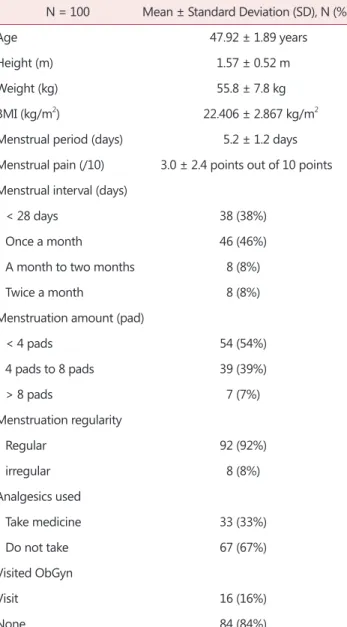
The average age of the respondents was 47.92 ± 1.89 years (range, 43-53 years), the average height was 1.57 ± 0.52 m, the average body weight was 55.8 ± 7.8 kg, and the
Table 1. Subject characteristics
N = 100 Mean ± Standard Deviation (SD), N (%)
Age 47.92 ± 1.89 years
Height (m) 1.57 ± 0.52 m
Weight (kg) 55.8 ± 7.8 kg
BMI (kg/m2) 22.406 ± 2.867 kg/m2
Menstrual period (days) 5.2 ± 1.2 days Menstrual pain (/10) 3.0 ± 2.4 points out of 10 points Menstrual interval (days)
< 28 days 38 (38%)
Once a month 46 (46%)
A month to two months 8 (8%)
Twice a month 8 (8%)
Menstruation amount (pad)
< 4 pads 54 (54%)
4 pads to 8 pads 39 (39%)
> 8 pads 7 (7%)
Menstruation regularity
Regular 92 (92%)
irregular 8 (8%)
Analgesics used
Take medicine 33 (33%)
Do not take 67 (67%)
Visited ObGyn
Visit 16 (16%)
None 84 (84%)
BMI: body mass index, ObGyn: obstetrics and gynecology
symptoms of PMS. In our study ‘breast tenderness’ was the most common (n = 56), followed by ‘abdominal bloating’
and ‘headache’ (n = 36). Reports of ‘depression’ (n = 28) and
‘hands and feet are swelling’ (n = 12) were low in the patient cohort. For the 100 women who were selected for this study, the average number of individual symptoms was 2.84 ± 2.02. The most common symptoms associated with PMDD were reported to be ‘angry outbursts’ (n = 33), and other symptoms of ‘anxiety’ (n = 22) (Table 2, 3).
3. Duration of the symptoms of PMS and the impact on social activities
Symptoms of PMS persisted for 3.1 ± 3.0 days in the patients in this study; 13 women reported that PMS affected their social activities and daily life (Table 2C).
4. Comparative analysis of PMS and PMDD Based on ACOG diagnostic criteria, 95 of the 100 women (95%) included in this study suffered from PMS. However, emotional and physical symptoms during the menstrual cycle that presented three times before the investigation could not be used to establish a reliable diagnosis. Based on APA diagnostic criteria for PMDD, PMDD was suspected in 23 mean body mass index (BMI) was 22.406 ± 2.867 kg/m2. A
regular menstrual cycle was reported for 92 patients, with an average duration of 5.2 ± 1.2 days. There were 16 women who did not report experiencing dysmenorrhea, and 84 women who reported dysmenorrhea on a visual analog scale of 3.0 ± 2.4 out of 10 points. Analgesics to relieve menstrual pain were taken by 33 out of the 100 women in the study (33%) and 16 women visited the obstetrician/
gynecologist for dysmenorrhea (Table 1).
2. Frequency and symptoms of PMS and PMDD The ACOG has identified ten of the most common
Table 2. Symptoms and frequency of premenstrual syndrome 2A. Positive symptoms based on the American College of Obstetrics and Gynecology (ACOG) criteria
Symptoms Responses Percent of
total
N Percent
Depression 28 28% 12%
Angry outbursts 33 33% 14%
Irritability 19 19% 8%
Anxiety 22 22% 9%
Breast tenderness 56 56% 23%
Abdominal bloating 36 36% 15%
Headache 36 36% 15%
Swelling of extremities 12 12% 5%
Total 242 100%
2B. Impact on social life
Frequency Percent
No 77 77
Yes 23 23
Total 100 100
2C. Number and duration of premenstrual syndrome occurrences N = 100 N (%), Mean ± Standard Deviation (SD) PMS Symptoms
Have a symptom 95 (95%)
None 5 (5%)
PMS duration 3.1 ± 3.0 days
PMS: premenstrual syndrome
Table 3. Frequency and number of premenstrual dysphoric disorder symptoms
Premenstrual Dysphoric Disorder Symptoms Frequencies Responses Percent of
total
N Percent
Depressed 28 28% 10%
Unstable 10 10% 3%
Irritable 19 19% 7%
Less interest 15 15% 5%
Hard to concentrate 20 20% 7%
Crave carbohydrates 44 44% 15%
Tired 50 50% 17%
Change in sleep 15 15% 5%
Out of control 4 4% 1%
Physical changes 87 48% 30%
Total 292
(23%) of the women in this study. There was a significant difference in the visual analog scale for dysmenorrhea between the PMDD and non-PMDD groups, but no differences in age, weight, BMI, cycle regularity, cycle duration, or amount of flow (Table 4).
Discussion
PMS symptoms are encountered repeatedly during the luteal phase of the menstrual cycle, causing adverse
effects on daily life and work productivity. More than 200 PMS symptoms have been reported in the literature, and most women of childbearing age experience at least one PMS symptom, although in the vast majority medical or psychiatric treatment is not required.6 A dual diagnosis that requires medical and psychiatric treatment of PMS accounts for a small percentage of PMS cases, although the definition and diagnostic criteria for PMS do not reflect the prevalence of PMS in the literature. Based on International Classification of Diseases, Tenth Revision (ICD-10) diagnostic criteria, the incidence of PMS is ~20-30%,7 Table 4. Independent factors associated with premenstrual dysphoric disorder
Women without PMDD (n) Women with PMDD (n) P value
Age (years) 48.0 ± 1.9 47.5 ± 1.9 0.217
Height (m) 1.5 ± 0.1 1.5 ± 0.1 0.111
Weight (kg) 55.7 ± 7.3 56.1 ± 9.4 0.837
BMI (kg/m2) 22.485 ± 2.830 22.140 ± 3.036 0.633
Menstrual pain (/10) 2.7 ± 2.5 3.9 ± 2.8 0.020
PMS duration (days) 3.1 ± 3.2 3.3 ± 2.3 0.481
Emotional symptoms (n) 0.7 ± 0.8 2.4 ± 1.2 0.091
Somatic symptoms (n) 1.2 ± 0.7 3.3 ± 1.3 0.085
Menstruation regularity 0.590
Regular 71 21
Irregular 6 2
Menstrual interval (days) 0.188
< 28 days 25 13
Once a month 39 7
A month to two months 7 1
Twice a month 6 2
Menstruation amount (pad) 0.413
< 4 pads 43 11
4 pads to 8 pads 30 9
> 8 pads 4 3
Premenstrual symptoms
Have a symptom 72 23 0.262
None 5 0
Mean ± Standard deviation
PMDD: premenstrual dysphoric disorder
whereas it is estimated that 3-8% of women have PMDD according to APA guidelines.8 In comparison, Park et al.9,10 reported that among 200 Korean women of childbearing age the prevalence of PMDD was ~8%.
The purpose of this study was to investigate the extent and severity of menopausal transition symptoms in women who visited our university hospital. The ACOG reported that most women suffer from PMS, while the APA estimated that 23% of women suffer from PMDD. A recent survey of working women by Kim et al.11 indicated that the prevalence of PMS in women of childbearing age was higher than previously reported.
The etiology of PMS includes hormone imbalances, Na+ retention, dietary factors such as vitamin deficiency, estrogen and progesterone imbalances, normal ovarian function, neurotransmitter imbalances, and other biological, psychological, and social psychological theories. This suggests that PMS is a multifactorial neuropsychological- endocrine disorder, although a definitive conclusion has not been reached.12,13 Further study regarding the causes of PMS, including eating habits and hormonal tests, are necessary and should include an analysis of multiple factors.
Approaches for PMS treatment have been developed in various fields. Symptom relief has been demonstrated with regular exercise, self-care, and a well-balanced healthy diet. In addition, the education of patients, families, and friends and application of methods for reducing stress and increasing social support are important. While this approach is not primarily for the specific treatment of PMS, it does aid in supporting the overall health of the patient.
Drug treatment with oral contraceptive pills, prostaglandin inhibitors, and spironolactone has also been used,2 although medication should not be a first-line treatment.
Women increasingly experience physical and mental stress as they enter the workplace and deal with social stressors.
Women who work have a higher prevalence of PMS com- pared to women who do not, and the incidence of PMS among middle-aged women compared to adolescents has not been determined. It is difficult to generalize to an entire population based on a small sample size. However, it is likely that symptoms of PMS in young women persist during the menopausal transition. Those women who experience PMS and PMDD often struggle with serious social and family
issues. Future studies will require a large sample size and generalized criteria for PMS and PMDD to verify the results of this study.
In this study, the prevalence of PMS was similar in pe- rimenopausal women compared to younger women, and PMS and PMDD were diagnosed in all of the subjects regardless of age. Continued education and outreach are required to provide an accurate perception of PMS, and the implementation of effective medical treatments to improve the quality of life for patients and maximize business efficiency will be helpful in the future.
References
1. Reid RL. Premenstrual syndrome. N Engl J Med 1991; 324:
1208-10.
2. Taylor D. Perimenstrual symptoms and syndromes:
guidelines for symptom management and self care. Johns Hopkins Adv Stud Med 2005; 5: 228-41.
3. Reid RL, Yen SS. The premenstrual syndrome. Clin Obstet Gynecol 1983; 26: 710-8.
4. American Psychiatric Association. DSM III: Diagnostic and statistical manual of mental disorders. 3rd ed. Washington, DC: American Psychiatric Association; 1987.
5. American Psychiatric Association. DSM IV: Diagnostic and statistical manual of mental disorders. 4th ed. Washington, DC: American Psychiatric Association; 1994.
6. Sveindóttir H, Bäckström T. Prevalence of menstrual cycle symptom cyclicity and premenstrual dysphoric disorder in a random sample of women using and not using oral contraceptives. Acta Obstet Gynecol Scand 2000; 79: 405- 13.
7. Janca A, Hiller W. ICD-10 checklists-a tool for clinicians’
use of the ICD-10 classification of mental and behavioral disorders. Compr Psychiatry 1996; 37: 180-7.
8. Yonkers KA, O’Brien PM, Eriksson E. Premenstrual syndrome. Lancet 2008; 371: 1200-10.
9. Park HE, Jee BC, Ku SY, Suh CS, Kim SH, Choi YM, et al. A survey on premenstrual syndrome. Korean J Obstet Gynecol 2005; 48: 401-10.
10. Park J, Kim TH, Lee HH, Lee W, Chung SH. Premenstrual syndrome in the nursing women working in a university hospital. J Reprod Endocrinol 2012; 4: 36-42.
11. Kim TH, Park HS, Lee HH, Chung SH. Premenstrual syndrome and dysmenorrhea in the career women at
Bucheon City. Korean J Obstet Gynecol 2011; 54: 523-8.
12. Halbreich U, Borenstein J, Pearlstein T, Kahn LS.
The prevalence, impairment, impact, and burden of premenstrual dysphoric disorder (PMS/PMDD).
Psychoneuroendocrinology 2003; 28 Suppl 3: 1-23.
13. Halbreich U, Backstrom T, Eriksson E, O’Brien S, Calil H, Ceskova E, et al. Clinical diagnostic criteria for premenstrual syndrome and guidelines for their quantification for research studies. Gynecol Endocrinol 2007; 23: 123-30.