Heterogeneous Spectrum of CFTR Gene Mutations in Korean Patients with Cystic Fibrosis
Haiyoung Jung, M.D.1, Chang-Seok Ki, M.D.1, Won-Jung Koh, M.D.2, Kang-Mo Ahn, M.D.3, Sang-Il Lee, M.D.3, Jeong-Ho Kim, M.D.4, Jae Sung Ko, M.D.5, Jeong Kee Seo, M.D.5, Seung-Ick Cha, M.D.6, Eun-Sil Lee, M.D.7,
and Jong-Won Kim, M.D.1
Department of Laboratory Medicine & Genetics1, Division of Pulmonary and Critical Care Medicine, Department of Medicine2, Department of Pediatrics3, Samsung Medical Center and Sungkyunkwan University School of Medicine, Seoul; Department of Laboratory Medicine4, Gangnam Severance Hospital and Yonsei University College of Medicine, Seoul; Department of Pediatrics5, Seoul National University College of Medicine, Seoul; Department of Internal Medicine6, Kyungpook National University School of Medicine, Daegu; Department of Pediatrics7, College of Medicine, Yeungnam University, Daegu, Korea
Background: Cystic fibrosis (CF) is one of the most common hereditary disorders among Caucasians. The most common muta- tions of the cystic fibrosis transmembrane conductance regulator (CFTR) gene have been well established among Caucasian popu- lations. In Koreans, however, there are very few cases of genetically confirmed CF thus far, and the spectrum of mutations seems quite different from that observed in Caucasians.
Methods: In the present study, we describe the cases of 2 Korean CF patients, present sequencing results identifying mutations in their CFTR gene, and summarize the results of CFTR mutational spectrum from previously reported Korean CF patients. The muta- tions described were identified by performing direct sequencing analysis of the complete coding regions and flanking intronic se- quences of the CFTR gene, followed by multiplex ligation-dependent probe amplification (MLPA) analysis in order to detect gene deletions or duplications that could not be identified by a direct sequencing method.
Results: Three CFTR mutations were identified in the 2 patients, including p.Q98R, c.2052delA, and c.579+5G>A. In an analysis of 9 Korean CF patients that included the 2 patients presented in this study, p.Q98R mutation was the only recurrently observed muta- tion with a frequency of 18.8% (3/16 alleles). Furthermore, only one of the mutations (c.3272-26A>G) was found among the 32 common mutations in the screening panel for Caucasians from the Cystic Fibrosis Mutation Database.
Conclusions: Sequencing of the entire CFTR gene followed by MLPA analysis, rather than using the targeted sequencing-based screening panel for mutations commonly found in Caucasian populations, is recommended for genetic analysis of Korean CF pa- tients.
Key Words: CFTR, Cystic fibrosis transmembrane conductance regulator, Cystic fibrosis, Mutations, Koreans, Sequencing, MLPA
Received: October 20, 2010 Manuscript No: KJLM-10-147 Revision received: February 7, 2011
Accepted: May 4, 2011
Corresponding author: Chang-Seok Ki, M.D.
Department of Laboratory Medicine & Genetics, Samsung Medical Center, 50 Irwon-dong, Gangnam-gu, Seoul 135-710, Korea
Tel: 82-2-3410-2709, fax: 82-2-3410-2719, e-mail: [email protected] Corresponding author: Won-Jung Koh, M.D.
Division of Pulmonary and Critical Care Medicine, Department of Medicine, Samsung Medical Center, 50 Irwon-dong, Gangnam-gu, Seoul 135-710, Korea Tel: 82-2-3410-3424, fax: 82-2-3410-3849, e-mail: [email protected] ISSN 1598-6535 © The Korean Society for Laboratory Medicine.
This is an Open Access article distributed under the terms of the Creative Commons Attribution Non-Commercial License (http://creativecommons.org/licenses/by-nc/3.0) which permits unrestricted non-commercial use, distribution, and reproduction in any medium, provided the original work is properly cited.
INTRODUCTION
Cystic Fibrosis (CF) is an autosomal recessive disease of exocrine tissues; the disease is characterized by the abnor- mal transport of ions and fluid across epithelial cell mem- branes. Mutations in the cystic fibrosis transmembrane con- ductance regulator (CFTR) gene are responsible for both classical and atypical presentations of the disease, including pulmonary disease, pancreatic insufficiency, malabsorption, meconium ileus, failure to thrive, infertility, and elevated concentrations of chloride in sweat [1]. A diagnosis of CF is based upon several findings, including the presence of typi- cal clinical features, history of CF in a sibling, positive sweat test, identification of CFTR mutations in both alleles, and an abnormal nasal potential difference measurement [2].
The CFTR gene spans an approximately 240-kb region on chromosome 7q31.3 and consists of 27 exons [3-5]. It en- codes a membrane protein of 1,480 amino acids that func- tions as a cAMP-regulated chloride channel in exocrine epi- thelia [6]. CF is a very common hereditary disease in Cauca- sian populations with incidences ranging from 1 in 2,500- 3,500 in the U.S. [7, 8] and approximately 1 in 1,000-3,000 newborns in Europe [9]. However, CF is quite rare in Asian populations, and an epidemiological study in a Japanese pop- ulation found the incidence of CF to be about 1 in 350,000 [10, 11]. CF is also extremely rare in the Korean population and only 10 patients with CF have been reported thus far, of which 7 cases were confirmed by genetic analysis [12-19].
There are currently over 1,700 mutations listed in the CFTR mutation database [20]. The most common mutation of the CFTR gene in Caucasian populations is a p.F508del, and this mutation is found in approximately 70% of Cauca- sian CF patients [1], whereas the incidence of other muta- tions remains about 2-3% per mutation [21]. Interestingly, the p.F508del is not a common mutation in Asian popula- tions and has frequencies of 19-44% in Indians [22-25], 17.3% in Pakistanis [26], and 18.1% in Iranians [27]. Fur- ther, of the few reports of genomic DNA analysis of Japa- nese patients with CF, there have been no cases where a p.F508del mutation was found [11].
Currently, not much data is available on the spectrum of mutations in Korean CF patients. Here, we describe the cases of 2 CF patients and have summarized the mutational spec- trum of the CFTR gene from Korean CF patients in order to further characterize the specific mutational pattern of the CFTR gene in the Korean population.
MATERIALS AND METHODS
1. Patients
Patient 1 was a 22-yr-old woman who was admitted for antibiotic therapy of infection with nontuberculous myco- bacteria (NTM). The patient had been treated for several episodes of chronic productive cough, sputum, and pneu- monia, which necessitated frequent visits to the outpatient clinic. At the age of 17, she was admitted to a civil hospital for the treatment of pulmonary tuberculosis and had receiv- ed antituberculosis drug therapy for 15 months. Her respira- tory symptoms progressively worsened, and she was diag- nosed with bronchiectasis and a NTM infection. She had an older brother with an unremarkable medical history. There was no evidence of exocrine pancreatic insufficiency or mal- absorption. The sweat chloride concentration was measured by a quantitative pilocarpine iontophoresis sweat test, in ac-
cordance with the guidelines of the Clinical and Laboratory Standards Institute. The average sweat chloride concentra- tion on both forearms was 81.2 mmol/L, which exceeded the upper limit of the reference range (<60 mmol/L).
Patient 2 was a 31-yr-old woman complaining of chronic productive cough, sputum, and recent hemoptysis without any gastrointestinal symptoms. The patient had been treated for these symptoms with antibiotics, but no improvement was noted. After a preliminary diagnosis of community-ac- quired pneumonia, she was admitted for further work-up and treatment. During her infancy, she had pertussis. She had recurrently received antituberculosis treatment from the age 15, with repeated events of remission and relapse of pulmonary tuberculosis. No evidence of exocrine pancre- atic insufficiency or malabsorption was found. The average sweat chloride concentration was elevated (112.4 mmol/L), which was highly suggestive of CF.
2. Mutation analysis
Informed consent was obtained from all parents and family members, and patient confidentiality was been maintained. Genomic DNA was isolated from peripheral blood leukocytes by using the Wizard Genomic DNA Puri- fication Kit, according to the manufacturer’s instructions (Promega, Madison, WI, USA). The presence of mutations in all 27 exons and exon-intron boundaries of the CFTR gene was assessed by polymerase chain reaction (PCR) and direct sequencing using primer pairs designed by the au- thors. PCR was performed using a thermal cycler (Model 9600; Applied Biosystems, Foster City, CA, USA), and cycle sequencing was performed using the ABI Prism 3100 Ge- netic Analyzer with the BigDye Terminator Cycle Sequenc- ing Ready Reaction Kit (Applied Biosystems). Sequence variations were analyzed with reference to the wild-type se- quence (GenBank Accession No. NM_00492.3) by using the Sequencher program (Gene Codes Corp., Ann Arbor, MI, USA).
When a large deletion mutation was thought to be present, multiplex ligation-dependent probe amplification (MLPA) analysis was performed using the SALSA P091-C1 CFTR test kit (MRC-Holland, Amsterdam, the Netherlands), ac- cording to the manufacturer’s protocol [28]. The P091-C1 CFTR probemix contains 5 control fragments and 43 differ- ent probes with amplification products. Briefly, 100 ng of ge- nomic DNA was denatured at 98˚C and hybridized with the CFTR-MLPA probe mix at 60˚C for 16 hr. Subsequently, the annealed probe was ligated to the Ligase-65 mix at 54˚C for 15 min. The appropriate PCR primers, dNTPs, SALSA PCR buffer, and SALSA polymerase were added, and the subse-
quent PCR reactions were performed. Each probe amplifica- tion product, 1 µL in volume, was then mixed with 0.5 µL GeneScanTM500 ROXTM Size Standard (Applied Biosystems, Warrington, UK) and 8.5 µL HiDi Formamide (Applied Bio- systems). Electrophoresis of the PCR products was per- formed using the ABI 3130 Genetic Analyzer (Applied Bio- systems, Foster, CA, USA), and the MLPA data were ana- lyzed using GeneMarker 1.6 software (SoftGenetics, LLC., State College, PA, USA). A normal copy number is expected to generate a normalized signal value of 1.
3. Clinical findings and spectrum of mutations in Korean CF patients
In order to study the spectrum of mutations in Korean CF patients, we reviewed the previously identified CF pa- tients at our institution (N=4) [14, 15, 17, 18] and in the lit- erature (N=3) [16, 19, 29] in addition to the cases analyzed in this report (N=2). Only genetically confirmed cases were included in this study.
RESULTS
1. Genetic analysis of the 2 Korean patients
Two mutations in the CFTR gene were found in Patient 1:
a heterozygous A to G transition in exon 4 [c.293A>G (p.
Q98R)] and a heterozygous deletion of an A in exon 13 [c.2052delA (p.L728NfsX38)]. A family study showed that her mother and older brother both also possessed the c.
2052delA mutation. No targeted genetic testing was done on her father. Our search of the Cystic Fibrosis Mutation Database [20] showed that the p.Q98R and c.2052delA mu- tations have also been reported in CF patients from France.
In Patient 2, a heterozygous splicing mutation in intron 4 (c.579+5G>A) was identified, but we were unable to detect
the mutation that must presumably have been present on the opposite allele. No further genetic study was done on her family members. The CFTR mutations from the families of the 2 patients are summarized in the pedigree (Fig. 1).
2. Clinical findings in 9 Korean CF patients
The average ages of 9 patients (7 female and 2 male pa- tients) at diagnosis and at presentation of symptoms were 13 and 2.8 yr, respectively. Five patients were diagnosed with CF under the age of 16 and the other 4 patients were clinically diagnosed with CF during adulthood (Table 1).
None of the patients had a history of sibling death due to respiratory or gastrointestinal problems or any symptoms related to CF in family members.
The respiratory symptoms were clinically documented in the CF patients as follows: chronic cough (N=7; 78%), spu- tum (N=4; 44%), sinusitis (N=4; 44%), recurrent or persis-
Table 1. Demographics and clinical findings of Korean CF patients CaseNo. Sex Age
at Dx Age at
1st Sx Clinical symptoms Sputum culture Sweat Cl- concentration
(mmol/L)
1 F 22 yr 1 yr Chronic cough, Sputum, Pneumonia M. abscessus 81.2
2 F 31 yr 15 yr Chronic cough, Sputum, Sinusitis, Pneumonia P. aeruginosa, Aspergillosis 112.4
3 M 21 yr 2 yr Chronic cough, Pansinusitis S. aureus 63.0
4 F 3 yr 2 days Meconium ileus ND ND
5 F 2 yr 2 mo Chronic cough, Steatorrhea, Failure to thrive, Pneumonia MRSA 102.0
6 F 18 yr 13 yr Chronic cough, Sinusitis, Pneumonia S. aureus, P. aeruginosa 102.5
7 F 15 yr 1 mo Chronic cough, Sputum, Sinusitis, Pneumonia, Clubbed fingers, Diarrhea, Abdominal pain MRSA, P. aeruginosa 102.4
8 M 4 mo 1 day Meconium ileus, Fatty liver S. aureus, S. maltophilia ND
9 F 5 yr 4 yr Chronic cough, Sputum, Pneumonia, Diarrhea, Fatty liver, Atrophy of pancreas P. aeruginosa 88.7 Abbreviations: Dx, Diagnosis; Sx, Symptom; ND, not done; S. aureus, Staphylococcus aureus; MRSA, Methicillin-resistant S. aureus; P. aeruginosa, Pseudomonas aeruginosa; M. absces- sus, Mycobacterium abscessus; S. maltophilia, Stenotrophomonas maltophilia.
Fig. 1. Pedigree of families of 2 Korean CF patients. The probands are indi- cated by black solid circles with an arrow, and the carriers are indicated by a central dot. (A) Family of Patient 1. (B) Family of Patient 2.
Abbreviation: ND, not done.
II:1 c.[579+5G>A]+[?]
II:1
c.[293A>G]+[2052delA] II:2
c.2052delA I:2 c.2052delA I:1
ND I:1
ND I:2
ND
tent pneumonia (N=7; 78%), and bronchiectasis (N=5;
56%). Infections related with CF were pulmonary tuberculo- sis (N=5; 56%), aspergillosis (N=1; 11%), and infections with NTM (N=1; 11%), Staphylococcus aureus (N=5; 56%), Pseudomonas aeruginosa (N =4; 44%), and Stenotroph- omonas maltophilia (N=1; 11%). Most of the patients had experienced infections of S. aureus and P. aeruginosa, which are well-known clinical infections of CF, during the course of their disease progression. Other symptoms observed in the CF patients were a history of failure to thrive (N=1;
11%), steatorrhea (N =3; 33%), clubbed fingers (N =1;
11%), fatty liver (N=2; 22%), pancreatic atrophy (N=1, 11%) and meconium ileus (N=2; 22%) (Table 1).
All patients were diagnosed with CF on the basis of clas- sical clinical phenotypes and high sweat chloride concen- tration (>60 mEq/L). The median sweat chloride concen- tration of 7 patients was 93.2 mmol/L, and all patients tested showed high sweat chloride concentration. In 2 neo- nates, the sweat test could not be done because of their young age.
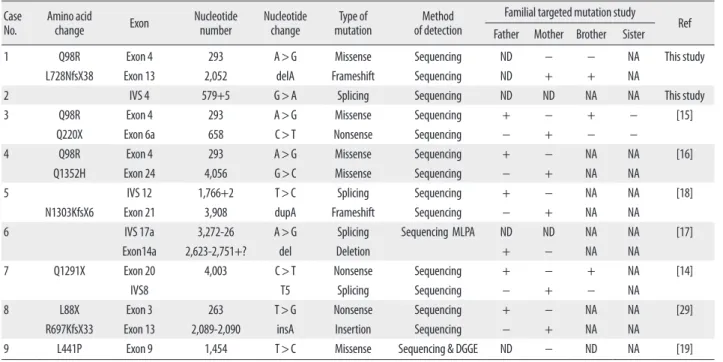
3. Spectrum of mutations in the 9 Korean CF patients A total of 16 disease-causing mutations of the CFTR gene were identified in the 9 Korean CF patients (Table 2). All identified mutations were detected by PCR and direct se- quencing with the exception of a large deletion in exon 14a, which was detected by MLPA. No p.F508del mutations,
known to be the most common mutation among Cauca- sians, were detected in the Korean patients of this study.
The identified mutations included 3 missense mutations (p.Q98R, p.Q1352H, and p.L441P), 3 nonsense mutations (p.Q220X, p.Q1291X, and p.L88X), 1 duplication with fra- meshift (c.3908dupA), 1 insertion with frameshift (c.2089- 2090insA), 4 splice site mutations (c.1766+2T>C, c.3272- 26A>G, c.579+5G>A, and IVS8-T5) and 2 deletion muta- tions (c.2052delA and c.2623-?_2751+?del).
The p.Q98R mutation was the only recurrently observed mutation, with a frequency of 18.8% (3/16 alleles). Muta- tions on both alleles were identified in 7 out of 9 patients.
All identified mutations of the CF patients examined were confirmed with targeted genetic tests in consenting family members. Eight out of 9 families were tested, and all parents of the patients, except in 1 family (case 9), were proven to be heterozygous carriers of the mutations with no pheno- typic abnormalities (Table 2).
DISCUSSION
Accurate knowledge of CF mutations in specific popula- tions provides information for CF prevention programs ap- plicable via heterozygote screening and prenatal diagnosis [25]. The identification of mutations and their frequencies is thus critically important for designing gene probes for ef- fective diagnosis of CF in a given population. Further, dif-
Table 2. Frequency of CFTR mutations in Korean CF patients CaseNo. Amino acid
change Exon Nucleotide
number Nucleotide
change Type of
mutation Method
of detection
Familial targeted mutation study Father Mother Brother Sister Ref
1 Q98R Exon 4 293 A>G Missense Sequencing ND − − NA This study
L728NfsX38 Exon 13 2,052 delA Frameshift Sequencing ND + + NA
2 IVS 4 579+5 G>A Splicing Sequencing ND ND NA NA This study
3 Q98R Exon 4 293 A>G Missense Sequencing + − + − [15]
Q220X Exon 6a 658 C>T Nonsense Sequencing − + − −
4 Q98R Exon 4 293 A>G Missense Sequencing + − NA NA [16]
Q1352H Exon 24 4,056 G>C Missense Sequencing − + NA NA
5 IVS 12 1,766+2 T>C Splicing Sequencing + − NA NA [18]
N1303KfsX6 Exon 21 3,908 dupA Frameshift Sequencing − + NA NA
6 IVS 17a 3,272-26 A>G Splicing Sequencing MLPA ND ND NA NA [17]
Exon14a 2,623-2,751+? del Deletion + − NA NA
7 Q1291X Exon 20 4,003 C>T Nonsense Sequencing + − + NA [14]
IVS8 T5 Splicing Sequencing − + − NA
8 L88X Exon 3 263 T>G Nonsense Sequencing + − NA NA [29]
R697KfsX33 Exon 13 2,089-2,090 insA Insertion Sequencing − + NA NA
9 L441P Exon 9 1,454 T>C Missense Sequencing & DGGE ND − ND NA [19]
Abbreviations: IVS, intervening sequence; MLPA, multiplex ligation-dependent probe amplification; ND, not done; NA, not applicable; DGGE, denaturing gradient gel electrophoresis.
ferent mutations are associated with varying severity of dis- ease with implications on management and prognosis [26].
However, limited data are available on the spectrum of mu- tations in Korean CF patients. Therefore, this study was planned to characterize the mutational spectrum of the CFTR gene in Korean CF patients.
Currently over 1,700 mutations are listed in the Cystic Fi- brosis Mutation Database [20]. However, only a few muta- tions have been reported in the Korean population. No mu- tation, except p.Q98R, has repeatedly been observed in Ko- rean CF patients in this study. Furthermore, only one of the 32 common mutations found in the screening panel for Caucasians was identified in this Korean population, name- ly, the c.3272-26A>G mutation [20].
A noteworthy characteristic of the mutational spectrum of the Korean CFTR gene is the absence of mutations that are common in the European and American populations.
This highly heterogeneous mutational spectrum suggests that a screening set of common CFTR mutations is of little use for the Korean population. Rather, sequencing of entire gene and complementary MLPA might be a more feasible way to accurately confirm a diagnosis of CF. Sequencing analysis detects more than 98% of CFTR mutations [30], and MLPA can detect deletions not identified by sequence analysis. However, the mutation detection rate of MLPA is not currently known.
Although CF tends to be detected early in life, diagnosis of CF is being made in adults with increased frequency [31, 32]. Patients who are diagnosed with CF when they are adults normally present with chronic respiratory problems.
As a group, they have a milder variant of lung disease, a lesser degree of Pseudomonas infection, and are more likely to be pancreatic-sufficient than patients in whom CF is di- agnosed at earlier ages [31, 32]. In the Korean CF patients in our study, half were diagnosed when they were adults and presented with chronic respiratory problems such as chronic productive cough, sputum, and recurrent pneumo- nia and presented with bronchiectasis in a more advanced disease. Pseudomonal and staphylococcal infections were observed in 4 (4/9, 44%) and 5 (5/9, 56%) patients, respec- tively. Further, the lower number of reported CF diagnoses in the Korean population may suggest that CF is under-di- agnosed in Korea.
In Patients 2 and 9, one of the causative mutations was not identified either by direct sequencing or by MLPA anal- ysis. The CFTR mutation detection rate varies depending on the test method and ethnic background. In some symp- tomatic individuals, only one or neither disease-causing mutation is detectable; in some carriers, the disease-causing
mutation is not detectable. This may indicate a molecular defect in a non-coding or promoter region or a deep intron- ic region of the gene, which may have led to a truncated or abnormal protein as a result of deregulated promoter sig- nals or abnormal splicing. Moreover, the splicing mutation observed in Patient 2 (c.579+5G>A) has also been reported in CF patients from Italy, according to the Cystic Fibrosis Mutation Database [20].
Physicians who are not familiar with the spectrum of CF’s phenotypic manifestations may not consider CF when per- forming their differential diagnoses, thus delaying accurate diagnosis [15]. As a result, CF patients are frequently misdi- agnosed and treated for tuberculosis and other diseases.
Five CF patients (56%) from our study had previously been diagnosed and treated for pulmonary tuberculosis. Althou- gh sweat chloride analysis is considered to be the gold stan- dard for screening CF, the test is difficult to perform be- cause of insufficient standardization of the procedure and issues with reimbursement in Korea.
Whilst the frequency of the p.F508del mutation is 87% in Northern Europe, it is only 28% in Asia and the Middle East, with a combined worldwide frequency of 66% (The Cystic Fibrosis Mutation Database 2010; The CF Genetic Analysis Consortium [1994]) [26]. No p.F508del mutations were detected in the Korean patients of this study. CF muta- tion frequencies vary widely among different populations, and haplotype heterogeneity has been found to be greater in populations with lower p.F508del frequencies [33]. The heterogeneous mutational spectrum observed in this study also confirms these previous findings of high haplotype heterogeneity with lower p.F508del frequencies. Therefore, screening for CF with p.F508del mutation analysis alone is not recommended in Korean patients.
In summary, we report the cases of 2 Korean CF patients with 3 known CFTR mutations (p.Q98R, c.2052delA, and c.579+5G>A), and these mutations have been submitted to the Cystic Fibrosis Mutation Database [20]. The heteroge- neous mutational spectrum of the CFTR gene in this Ko- rean population suggests that full sequencing, covering a broader range of the CFTR genome, is a better diagnostic method for Korean CF patients. In addition, MLPA analysis for the detection of large deletions or duplications can be used as a complementary tool to the direct sequencing method. Even though a large amount of research is required before all the CFTR mutations in the Korean population are characterized by whole gene sequencing, future genomics tools will allow us to develop more advanced diagnostic era for cystic fibrosis. This can be made possible by standard- ized molecular tests utilizing whole genome sequencing
and full gene sequencing accompanied by MLPA.
Authors’ Disclosures of Potential Conflicts of Interest No potential conflict of interest relevant to this article was reported.
REFERENCES
1. Welsh MJ. Gene transfer for cystic fibrosis. J Clin Invest 1999;104:
1165-6.
2. Behrman R, Kliegman R, et al. eds. Nelson textbook of pediatrics.
17th ed. Philadelphia: Saunders, 2004.
3. Kerem B, Rommens JM, Buchanan JA, Markiewicz D, Cox TK, Chakravarti A, et al. Identification of the cystic fibrosis gene: ge- netic analysis. Science 1989;245:1073-80.
4. Riordan JR, Rommens JM, Kerem B, Alon N, Rozmahel R, Grzelc- zak Z, et al. Identification of the cystic fibrosis gene: cloning and characterization of complementary DNA. Science 1989;245:1066- 73.
5. Zielenski J, Rozmahel R, Bozon D, Kerem B, Grzelczak Z, Riordan JR, et al. Genomic DNA sequence of the cystic fibrosis transmem- brane conductance regulator (CFTR) gene. Genomics 1991;10:
214-28.
6. Bear CE, Li CH, Kartner N, Bridges RJ, Jensen TJ, Ramjeesingh M, et al. Purification and functional reconstitution of the cystic fibro- sis transmembrane conductance regulator (CFTR). Cell 1992;68:
809-18.
7. FitzSimmons SC. The changing epidemiology of cystic fibrosis.
Curr Probl Pediatr 1994;24:171-9.
8. Collins FS. Cystic fibrosis: molecular biology and therapeutic im- plications. Science 1992;256:774-9.
9. World Health Organization. The molecular genetic epidemiology of cystic fibrosis. Report of a joint meeting of WHO/ECFTN/ICF (M)A/ECFS. World Health Organization, 2004:1-24.
10. Imaizumi Y. Incidence and mortality rates of cystic fibrosis in Ja- pan, 1969-1992. Am J Med Genet 1995;58:161-8.
11. Yamashiro Y, Shimizu T, Oguchi S, Shioya T, Nagata S, Ohtsuka Y.
The estimated incidence of cystic fibrosis in Japan. J Pediatr Gas- troenterol Nutr 1997;24:544-7.
12. Moon HR, Ko TS, Ko YY, Choi JH, Kim YC. Cystic fibrosis--a case presented with recurrent bronchiolitis in infancy in a Korean male infant. J Korean Med Sci 1988;3:157-62.
13. Park SH, Lee HJ, Kim JH, Park CH. Cystic fibrosis: case report. J Korean Radiol Soc 2002;47:693-6.
14. Ahn KM, Park HY, Lee JH, Lee MG, Kim JH, Kang IJ, et al. Cystic fibrosis in Korean children: a case report identified by a quantita- tive pilocarpine iontophoresis sweat test and genetic analysis. J Korean Med Sci 2005;20:153-7.
15. Koh WJ, Ki CS, Kim JW, Kim JH, Lim SY. Report of a Korean pa- tient with cystic fibrosis, carrying Q98R and Q220X mutations in the CFTR Gene. J Korean Med Sci 2006;21:563-6.
conium ileus in a female neonate. Korean J Pediatr 2007;50:1252-6.
17. Kim SJ, Lee M, Cha SI, Park HY, Ahn KM, Ki CS, et al. Standard- ized sweat chloride analysis for the diagnosis of cystic fibrosis in Korea. Korean J Lab Med 2008;28:274-81.
18. Choe YJ, Ko JS, Seo JK, Han JJ, Shim JO, Koh YY, et al. Novel CFTR mutations in a Korean infant with cystic fibrosis and pancreatic in- sufficiency. J Korean Med Sci 2010;25:163-5.
19. Gee HY, Kim CK, Kim SW, Lee JH, Kim JH, Kim KH, et al. The L441P mutation of cystic fibrosis transmembrane conductance regulator and its molecular pathogenic mechanisms in a Korean patient with cystic fibrosis. J Korean Med Sci 2010;25:166-71.
20. Cystic Fibrosis Centre at the Hospital for Sick Children in Toronto.
Cystic Fibrosis Mutation Database. http://www.genet.sickkids.on.
ca/cftr/Home.html (Updated on Apr 2010).
21. Tsui LC. The cystic fibrosis transmembrane conductance regulator gene. Am J Respir Crit Care Med 1995;151:S47-53.
22. Bowler IM, Estlin EJ, Littlewood JM. Cystic fibrosis in Asians. Arch Dis Child 1993;68:120-2.
23. Kabra M, Kabra SK, Ghosh M, Khanna A, Arora S, Menon PS, et al. Is the spectrum of mutations in Indian patients with cystic fi- brosis different? Am J Med Genet 2000;93:161-3.
24. Powers CA, Potter EM, Wessel HU, Lloyd-Still JD. Cystic fibrosis in Asian Indians. Arch Pediatr Adolesc Med 1996;150:554-5.
25. Sharma N, Singh M, Kaur G, Thapa BR, Prasad R. Identification and characterization of CFTR gene mutations in Indian CF pa- tients. Ann Hum Genet 2009;73:26-33.
26. Shah U, Frossard P, Moatter T. Cystic fibrosis: defining a disease under-diagnosed in Pakistan. Trop Med Int Health 2009;14:542-5.
27. Alibakhshi R, Kianishirazi R, Cassiman JJ, Zamani M, Cuppens H.
Analysis of the CFTR gene in Iranian cystic fibrosis patients: iden- tification of eight novel mutations. J Cyst Fibros 2008;7:102-9.
28. Schouten JP, McElgunn CJ, Waaijer R, Zwijnenburg D, Diepvens F, Pals G. Relative quantification of 40 nucleic acid sequences by mul- tiplex ligation-dependent probe amplification. Nucleic Acids Res 2002;30:e57.
29. Ko JM, Kim GH, Kim KM, Hong SJ, Yoo HW. Identification of a novel mutation of CFTR gene in a Korean patient with cystic fi- brosis. J Korean Med Sci 2008;23:912-5.
30. Strom CM, Huang D, Chen C, Buller A, Peng M, Quan F, et al. Ex- tensive sequencing of the cystic fibrosis transmembrane regulator gene: assay validation and unexpected benefits of developing a comprehensive test. Genet Med 2003;5:9-14.
31. Gilljam M, Ellis L, Corey M, Zielenski J, Durie P, Tullis DE. Clini- cal manifestations of cystic fibrosis among patients with diagnosis in adulthood. Chest 2004;126:1215-24.
32. Yankaskas JR, Marshall BC, Sufian B, Simon RH, Rodman D. Cys- tic fibrosis adult care: consensus conference report. Chest 2004;
125(S1):S1-39.
33. Kilinc MO, Ninis VN, Dagli E, Demirkol M, Ozkinay F, Arikan Z, et al. Highest heterogeneity for cystic fibrosis: 36 mutations ac- count for 75% of all CF chromosomes in Turkish patients. Am J Med Genet 2002;113:250-7.