Does Age at Onset of First Major Depressive Episode Indicate the Subtype of Major Depressive Disorder?: The Clinical
Research Center for Depression Study
Seon-Cheol Park,
1,2Sang-Woo Hahn,
3Tae-Yeon Hwang,
1,4Jae-Min Kim,
5Tae-Youn Jun,
6Min-Soo Lee,
7Jung-Bum Kim,
8Hyeon-Woo Yim,
9and Yong Chon Park
2,101Department of Psychiatry, Yong-In Mental Hospital, Yongin;
2Institute of Mental Health, Hanyang University, Seoul;
3Department of Psychiatry, College of Medicine, Soonchunhyang Univeristy, Seoul Hospital, Seoul;
4WHO Collaborating Center for PR and CMH, Yong-In Mental Hospital, Yongin;
5Department of Psychiatry, School of Medicine, Chonnam National University, Gwangju;
6Department of Psychiatry, College of Medicine, The Catholic University of Korea, Seoul;
7Department of Psychiatry, College of Medicine, Korea University, Seoul;
8Department of Psychiatry, Keimyung University School of Medicine, Daegu;
9Department of Preventive Medicine, College of Medicine, The Catholic University of Korea, Seoul;
10Department of Psychiatry, College of Medicine, Hanyang University, Guri Hospital, Guri, Korea.
Received: December 24, 2013 Revised: March 22, 2014 Accepted: March 26, 2014
Corresponding author: Dr. Yong Chon Park, Department of Psychiatry, College of Medicine, Hanyang University, Guri Hospital,
153 Gyeongchun-ro, Guri 471-701, Korea.
Tel: 82-31-560-2273, Fax: 82-31-554-2599 E-mail: [email protected]
∙ The authors have no financial conflicts of interest.
© Copyright:
Yonsei University College of Medicine 2014 This is an Open Access article distributed under the terms of the Creative Commons Attribution Non- Commercial License (http://creativecommons.org/
licenses/by-nc/3.0) which permits unrestricted non- commercial use, distribution, and reproduction in any medium, provided the original work is properly cited.
Purpose: The purpose of this study was to evaluate the effects of age at onset of the first major depressive episode on the clinical features of individuals with ma- jor depressive disorder (MDD) in a large cohort of Korean depressed patients.
Materials and Methods: We recruited 419 MDD patients of age over 18 years from the Clinical Research Center for Depression study in South Korea. At the start of the study, the onset age of the first major depressive episode was self-re- ported by the subjects. The subjects were divided into four age-at-onset sub- groups: childhood and adolescent onset (ages <18), early adult onset (ages 18‒44), middle adult onset (ages 45‒59), and late onset (ages 60+). Using analy- sis of covariance (ANCOVA) and ordinal logistic regression analysis with adjust- ing the effect of age, the relationships between clinical features and age at onset of MDD were evaluated. Results: There was an apparent, but inconsistent corre- lation between clinical features and age at onset. Earlier onset MDD was signifi- cantly associated with higher proportion of female gender [adjusted odds ratio (AOR)=0.570, p=0.022], more previous suicide attempts (AOR=0.635, p=0.038), greater number of previous depressive episodes (F=3.475, p=0.016) and higher scores on the brief psychiatric rating scale (F=3.254, p=0.022), its negative symp- tom subscale (F=6.082, p<0.0001), and the alcohol use disorder identification test (F=7.061, p<0.0001). Conclusion: Early age at onset may increase the likelihood of distinguishable MDD subtype, and age at onset of the first major depressive episode is a promising clinical indicator for the clinical presentation, course, and outcome of MDD.
Key Words: Major depressive disorder, age at onset, clinical indicator, subtype
specifically, the purpose of this study was to answer the fol- lowing questions:
• How does age at onset of the first major depressive epi- sode distribute?
• Can the clinical features of the MDD of the different age-at-onset subgroups be distinguished?
MATERIALS AND METHODS
Study overview
A detailed description of the CRESCEND study has been presented elsewhere.13 In that study, 1183 depressed patients were recruited at one or other of 18 study centers consisting of 16 university-affiliated hospitals and two general hospi- tals across South Korea, from January 2006 to August 2008.
The study protocols and consent forms were approved by all the relevant university and/or hospital Institutional Review Boards. The CRESEND study was performed over nine years. In phase I, the eligible subjects were assessed at base- line, followed by assessments in weeks 1, 2, 4, 8, 12, 24, and 52. In phase II, they were assessed annually over the course of eight years. The collection of data was managed and its quality monitored by the Department of Preventive Medi- cine of the Catholic University College of Medicine in Seoul.
All the demographic and clinical data were collected by trained and certified clinical research coordinators, who were supervised by clinical psychiatrists at the regional cen- ters. Using a preselected clinical report form, all data were recorded and stored on the website of the CRESCEND study (www.smileagain.or.kr).
Subjects
Broad inclusion and minimal exclusion criteria were adopt- ed by the CRESCEND study, in order to closely reflect the real clinical situation. Psychiatric inpatients and outpatients who were beginning treatment for first-onset or recurrent depression were recruited. The inclusion criteria were as fol- lows: 1) age over 7 years, and 2) current diagnosis of MDD without psychotic features, MDD with psychotic features, dysthymic disorder, and depressive disorders not otherwise specified, according to the fourth edition of the Diagnostic and Statistical Manual of Mental Disorders (DSM-IV) crite- ria.14 Diagnoses were confirmed within 2 weeks, using the Structured Clinical Interview for DSM-IV (SCID).15 The exclusion criteria were as follows: 1) current or lifetime di- agnosis of schizophrenia, other psychotic disorders, bipolar
INTRODUCTION
The clinical manifestations of major depressive disorder (MDD) are not limited to mood symptoms, but also include a wide range of cognitive and motor symptoms. Thus, MDD is considered a multifactorial and heterogeneous disorder which varies in terms of symptom severity, psychiatric co- morbidity, and clinical course, including recurrence and re- sponse to treatment.1,2 Hence, MDD has classified by its clinical manifestation and progress, and its subtyping has no clear demarcation because of complex phenomena.3,4 Age at onset of the first major depressive episode can influ- ence the symptoms and clinical course of depressive epi- sodes, and has been proposed as a clinical indicator able to classify heterogeneous individuals diagnosed with MDD into more homogenous subgroups, and be useful in the sub- typing or phenotyping of MDD.5,6 In previous studies, ear- ly-onset (or childhood and adolescent onset) MDD has been associated with a severe and chronic condition with a higher proportion of females, longer duration of illness, more epi- sodes, more tendency to suicide, higher symptom severity, more psychiatric comorbidity, and more psychiatric symp- toms,7,8 but fewer sleep, appetite and weight changes.9 Pa- tients with early-onset MDD coupled with alcohol depen- dence had a more unfavorable response to escitalopram than those with late-onset MDD and alcohol dependence.10 In terms of immunology, it has been suggested that early- onset MDD involves a suppression of natural killer cell numbers and natural killer cell activity coupled with proin- flammatory processes.11 Furthermore, based on the close re- lationship between early-onset mood disorder, high recur- rence rate, and bipolarity, it has been proposed that age at onset is a more favorable clinical and genetic indicator than polarity in characterizing unipolar MDD and bipolar II dis- order.12
There have been few studies in large cohorts of Korean MDD patients of the effect of age at onset of the first major depressive episode on the clinical features of MDD. The Clinical Research Center for Depression (CRESCEND) study of South Korea, which was the first large, prospective, observational, clinical study of a nationwide sample of Kore- an individuals diagnosed with depressive disorders, included epidemiological data using a number of psychometric scales to assess their clinical features.1 Hence, using the CRE- SCEND study, we aimed to evaluate the relationship be- tween age at onset and the clinical features of MDD. More
asked about the age at onset and this was also estimated by the trained and certified clinical research coordinator. In cases of MDD superimposed on dysthymic disorder, the age at on- set of MDD was regarded as the subject’s best estimate of when the first major depressive episode had developed ac- cording to the definition used in previous studies.
The subjects were divided into four distinct age-at-onset categories, based on the designs of previous studies.7,8,18 To obtain clinically meaningful findings, the age-at-onset sub- groups were defined in relation to the human life cycle. Thus, we divided the subjects into four age at onset subgroups as follows: child and adolescent onset (age <18), early adult onset (age 18‒44), middle adult onset (age 45‒59), and late adult onset (age 60+).
Assessments
Presence or absence of the symptoms corresponding to the specific diagnostic criteria for DSM-IV MDD was assessed.
Total numbers of depressive symptoms, as defined by the DSM-IV diagnostic construct, were also counted. The follow- ing clinician-administered assessment scales were applied: the 17-item Hamilton Depression Rating Scale (HAMD),19 the Hamilton Anxiety Rating Scale (HAMA),20 the Brief Psy- chiatric Rating Scale (BPRS),21 the Clinical Global Impres- sion item for severity (CGI-s),22 and the Social and Occupa- tional Functioning Assessment Scale (SOFAS).23 Scores on the following self-administered assessment scales were also obtained: the Scale for Suicide ideation (SSI-Beck),24 the WHO quality of life assessment instrument-abbreviated ver- sion (WHOQOL-BREF),25 and the Alcohol Use Disorders Identification Test (AUDIT).26 All scales had been formally translated into the Korean language. In addition, their valid- ity and reliability had been confirmed with acceptable lev- els in Korean setting.27-29 More severe symptoms or impacts were indicated by higher scores on the HAMD, the HAMA, disorder, psychotic disorders due to general medical condi-
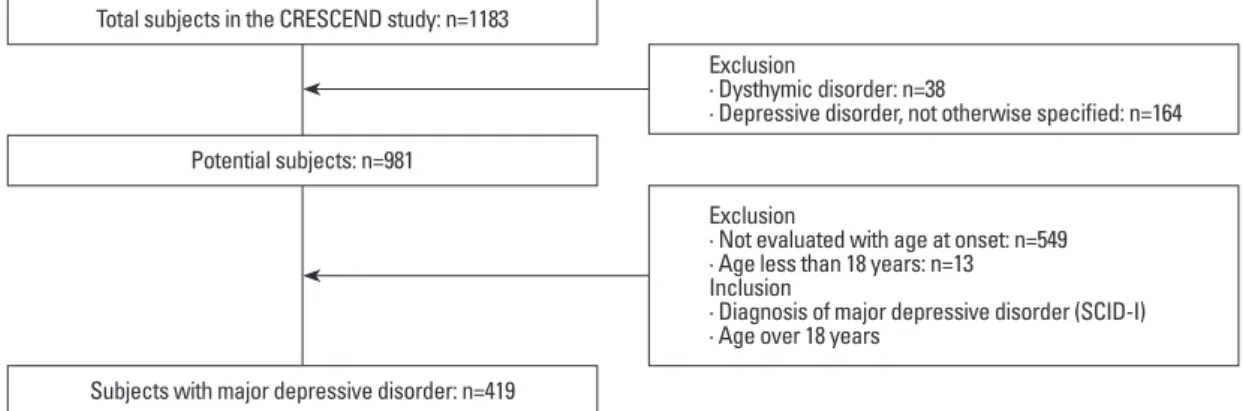
tion or dementia, according to DSM-IV criteria; 2) a co- morbid medical or neurological disease which interfered with the study evaluations and interviews; and/or 3) breast- feeding, pregnancy or intention to become pregnant within 9 months of enrollment. Written informed consent prior to participation was obtained from all the study participants or their authorized representatives. A psychiatric diagnosis confined to MDD without or with psychotic features was used as an inclusion criterion for the analysis described here, whereas it was not used to determine inclusion in the CRESCEND study. Hence, as shown in Fig. 1, 38 patients with dysthymic disorder and 164 patients with depressive disorder not otherwise specified were excluded from this study. Moreover, 549 depressed patients whose ages at on- set were not clear, and 13 patients of age less than 18 years were also excluded. As a result, 419 MDD patients over 18 years were included in our investigation. Demographic data including age, sex, marital status (married or unmarried), ed- ucational status (below or above a college education), occu- pational status (employed or unemployed), religious affilia- tion (religious observance or not) and monthly income (below or above 2000 USD) were collected.
Defining age at onset
The reliability of self-reported age at onset of first major de- pressive episode was generally good, as in previous stud- ies.16,17 It has been suggested that younger MDD patients tend to report lower ages at onset than older patients,17 but this has been contested.16 In accord with DSM-IV, the first major depressive episode was defined by the first experience of a cluster of symptoms and signs of a major depressive epi- sode, lasted at least 2 weeks, and was associated with clini- cally significant distress or functional impairment. Upon en- try into the CRESCEND study, each depressed patient was
Fig. 1. Process and criteria for selecting subjects. SCID, Structured Clinical Interview for DSM-IV.
Exclusion
· Dysthymic disorder: n=38
· Depressive disorder, not otherwise specified: n=164
Exclusion
· Not evaluated with age at onset: n=549
· Age less than 18 years: n=13 Inclusion
· Diagnosis of major depressive disorder (SCID-I)
· Age over 18 years Total subjects in the CRESCEND study: n=1183
Potential subjects: n=981
Subjects with major depressive disorder: n=419
14.24; t=16.03, p<0.0001). Because of this, comparisons among the age at onset groups were adjusted for the effect of age. Binary logistic regression models were fitted after adjusting for the effect of age to detect any gradation in dis- crete variables. ANCOVA were conducted after adjusting for the effect of age to analyze group differences in continu- ous variables, and Tukey’s post-hoc analyses were also used. Statistical significance was set at p<0.05 (two-tailed) in all tests. All statistical analyses were performed using SPSS 18.0 for Windows (SPSS Inc., Chicago, IL, USA).
RESULTS
General characteristics of the subjects
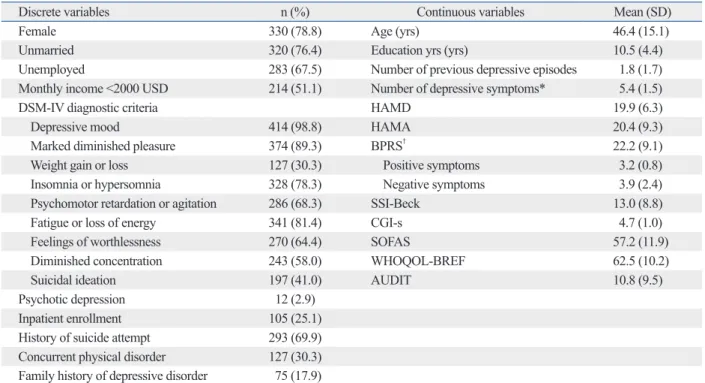
As shown in Table 1, a large proportion of the subjects were female (78.8%), unmarried (76.4%), and unemployed (67.5%), suffered from depressive mood (98.9%), markedly diminished pleasure (89.3%), insomnia or hypersomnia (78.3%), psychomotor retardation or agitation (68.3%), and fatigue or loss of energy (81.4%) according to the DSM-IV MDD diagnostic criteria, and reported histories of suicide attempts (69.9%). Mean age was 37.4 (SD=15.6), and mean the BPRS, the CGI-s, the SSI-Beck, and the AUDIT, and
by lower scores on the SOFAS and the WHOQOL-BREF.
In the HAMD and HAMA, each item is rated from 0 (not present) to 4 (severe). In the BPRS, each item is rated from 1 (absence of symptoms) to 7 (extremely severe). Positive symptoms were measured by the thinking disturbance sub- scale, namely the conceptual disorganization, hallucinatory behavior, and usual thought content items of the BPRS, and negative symptoms were measured by the emotional with- drawal, motor retardation, and blunted affect items.21 The score on the CGI-s is rated from 1 (not ill) to 7 (extremely severe),22 while the score on the SOFAS is rated from 1 to 10023 and the score on the AUDIT from 1 to 40.26 All the raters were trained twice a year, with a formal consensus meeting for applying the rater-administered assessment in- struments.
Statistical analysis
Logistic regression models and analyses of covariance (AN- COVA) were used with age at onset as an independent vari- able. Subjects in the childhood and adolescent onset group were younger than those in the early, middle, and late adult onset groups (27.2 years, SD=7.12 versus 48.5 years, SD=
Table 1. General Characteristics of Subjects (n=419)
Discrete variables n (%) Continuous variables Mean (SD)
Female 330 (78.8) Age (yrs) 46.4 (15.1)
Unmarried 320 (76.4) Education yrs (yrs) 10.5 (4.4)
Unemployed 283 (67.5) Number of previous depressive episodes 1.8 (1.7)
Monthly income <2000 USD 214 (51.1) Number of depressive symptoms* 5.4 (1.5)
DSM-IV diagnostic criteria HAMD 19.9 (6.3)
Depressive mood 414 (98.8) HAMA 20.4 (9.3)
Marked diminished pleasure 374 (89.3) BPRS† 22.2 (9.1)
Weight gain or loss 127 (30.3) Positive symptoms 3.2 (0.8)
Insomnia or hypersomnia 328 (78.3) Negative symptoms 3.9 (2.4)
Psychomotor retardation or agitation 286 (68.3) SSI-Beck 13.0 (8.8)
Fatigue or loss of energy 341 (81.4) CGI-s 4.7 (1.0)
Feelings of worthlessness 270 (64.4) SOFAS 57.2 (11.9)
Diminished concentration 243 (58.0) WHOQOL-BREF 62.5 (10.2)
Suicidal ideation 197 (41.0) AUDIT 10.8 (9.5)
Psychotic depression 12 (2.9)
Inpatient enrollment 105 (25.1)
History of suicide attempt 293 (69.9)
Concurrent physical disorder 127 (30.3) Family history of depressive disorder 75 (17.9)
AUDIT, Alcohol Use Disorders Identification Test; BPRS, Brief Psychiatric Rating Scale; CGI-s, Clinical Global Impression item for severity; HAMA, Hamilton Anxiety Rating Scale; HAMD, Hamilton Depression Rating Scale; SSI-Beck, Scale for Suicide Ideation; SOFAS, Social and Occupational Functional Assess- ment Scale; WHOQOL-BREF, WHO quality of life assessment instrument-abbreviated version.
*Depressive symptoms were defined according to the diagnostic criteria for DSM-IV major depressive episode.
†n=320.
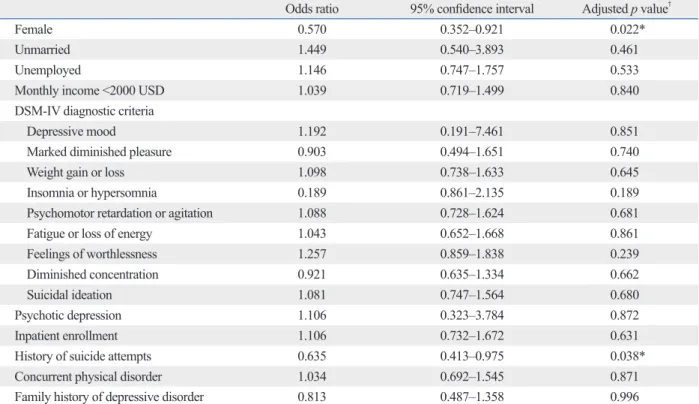
age at onset are presented in Table 2. After adjustment for current age, logistic regression models showed that earlier age at onset was associated with female gender [odds ratio (OR)=0.570; 95% confidence interval (CI)=0.352‒0.921;
p=0.022] and more frequent previous suicide attempts (OR=
0.635; 95% CI=0.413‒0.975; p=0.038). After adjustment for age, there were no significant differences between the four subgroups with respect to unmarried status (OR=1.449;
95% CI=0.540‒3.893; p=0.461), unemployed status (OR=
1.146; 95% CI=0.747‒1.757; p=0.533), monthly income
<2000 USD (OR=1.039; 95% CI=0.719‒1.499; p=0.840), current presence of depressed mood (OR=1.192; 95%
CI=0.191‒7.641; p=0.851), markedly diminished pleasure (OR=0.903; 95% CI=0.494‒1.651; p=0.740), weight gain or loss (OR=1.098; 95% CI=0.738‒1.633; p=0.645), in- somnia or hypersomnia (OR=0.189; 95% CI=0.861‒2.135;
p=0.189), psychomotor retardation or agitation (OR=1.088;
95% CI=0.728‒1.624; p=0.681), fatigue or loss of energy (OR=1.257; 95% CI=0.859‒1.838; p=0.239), feelings of worthlessness (OR=0.921; 95% CI=0.635‒1.334; p=0.662), or diminished concentration (OR=1.081; 95% CI=0.747‒
1.564; p=0.680), psychotic depression (OR=1.106; 95%
number of education years was 10.5 (SD=4.4). The mean score on the HAMD was 19.9 (SD=6.3), followed by 20.4 (SD=9.3) on the HAMA, 22.2 (SD=9.1) on the BPRS, 13.0 (SD=8.8) on the SSI-Beck, 4.7 (SD=1.0) on the CGI-s, 57.2 (SD=11.9) on the SOFAS, 62.5 (SD=10.2) on the WHO- QOL-BREF, and 10.8 (SD=9.5) on the AUDIT.
Subgroups in terms of age at onset of the first major depressive episode
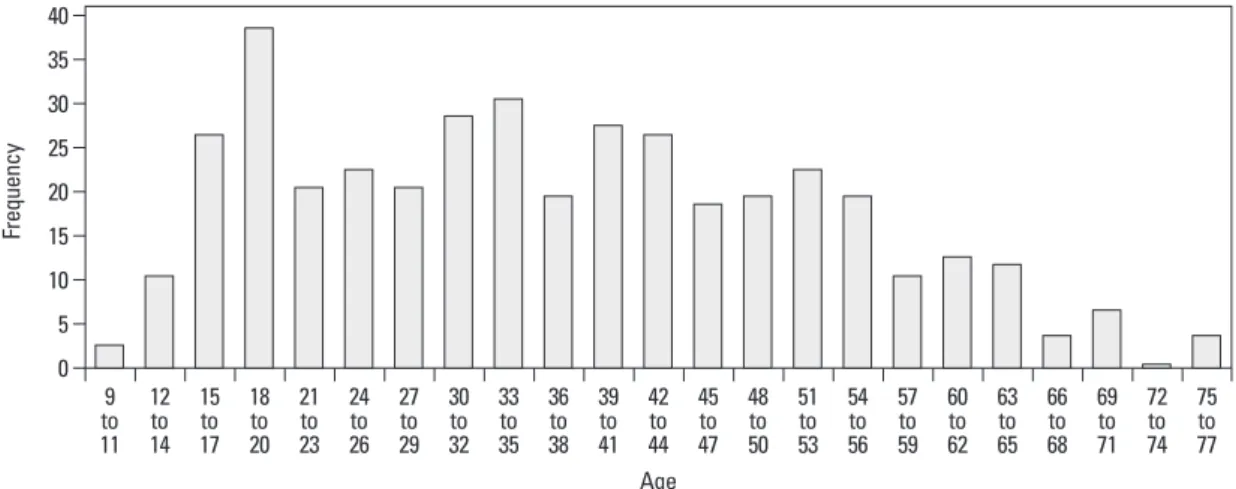
As shown in Fig. 2, the mean age at onset of the first de- pressive episode was 37.4 years (SD=15.6; range=10‒77).
The distribution of ages at onset was positively skewed (skewness=0.30), and its kurtosis was -0.80. The mean age at onset was higher than its median (36.0 years) and mode (30.0 years). As shown in Fig. 3, about half (57.0%) of the subjects were first affected by MDD as young adults, fol- lowed by 23.4% as middle adults, and 9.8% each as chil- dren and adolescents, and as late adults.
Clinical features associated with age at onset of the first major depressive episode
The clinical features (discrete variables) associated with
Fig. 2. Distribution of ages at onset of the first major depressive episode (n=419).
Fig. 3. Subgroups in terms of age at onset of the first major depressive episode.
Child and adolescent (age <18) Early adult (age 18–44) Middle adult (age 45–59) Late adult (age 60+) Present study (n=419) Zisook, et al. 2007 (n=3996)
9.8%
(n=41)
57.0%
(n=239)
23.4%
(n=98)
9.8%
(n=41) 37.2%
(n=1486)
50.2%
(n=2008)
10.2%
(n=406) 2.4%
(n=96) 0
5 10 15 20 25 30 35 40
to9 11
12to 14
15to 17
18to 20
21to 23
24to 26
27to 29
30to 32
33to 35
36to 38
39to 41
42to 44
45to 47
48to 50
51to 53
54to 56
57to 59
60to 62
63to 65
66to 68
69to 71
72to 74
75to 77
Frequency
Age
DISCUSSION
In terms of age at onset of first major depressive episode, the findings of this study were characterized by small pro- portion of child and adolescent subgroup and high propor- tions of adult subgroups (Fig. 3). The frequency distribution of onset groups is somewhat different from the distribution reported by Zisook, et al.18 The frequency of the childhood and adolescent onset MDD subgroup in this study is lower than that in the previous study, whereas the frequencies of the middle and late adult onset MDD subgroups in this study were higher. The mean age at onset of the first major depressive episode in this study (37.4 years) is markedly higher than in the previous study (26 years). Additionally, Yang, et al.9 reported that the mean age at onset of MDD in 1970 Han Chinese women was 35.9 years. Hence, there is a possibility that the difference in the mean age at onset of the recruited subjects between the two studies contributed to the different proportions of the subgroups in terms of first major depressive episode. However, comparison with the previous findings is difficult because of the variations between the studies, possibly due to differences between psychiatric inpatients and outpatients, ethnic effects on the CI=0.323‒3.784; p=0.874), inpatient enrollment (OR=
1.106; 95% CI=0.732‒1.672; p=0.631), and family history of depressive disorder (OR=0.813; 95% CI=0.487‒1.358;
p=0.996).
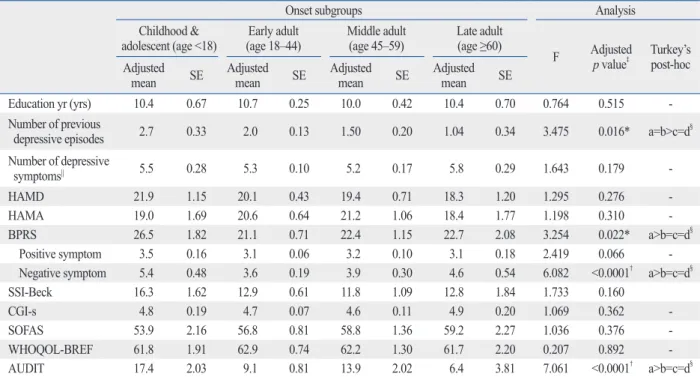
Table 3 presents the clinical features (continuous vari- ables) associated with age at onset. After adjustment for current age, ANCOVA showed that earlier age at onset was associated with greater number of previous depressive epi- sodes (F=3.475; p=0.016), higher scores on the BPRS (F=
3.254; p=0.022), on its negative symptom subscale (F=
6.082; p<0.0001), and on the AUDIT (F=7.061; p<0.001).
According to Tukey’s post-hoc analyses, subjects with childhood and adolescent onset MDD had significantly more previous depressive episodes, a higher score on the negative symptom subscale of the BPRS, and a higher total score on the AUDIT than those in the other subgroups. Af- ter adjustment for age, there were no significant differences between the four subgroups with respect to years of educa- tion (F=0.764; p=0.515), number of current depressive symptoms (F=1.643; p=0.179), scores on the HAMD (F=
1.295; p=0.276), the HAMA (F=1.198; p=0.310), the SSI- Beck (F=1.733; p=0.160), the CGI-s (F=1.069; p=0.362), the SOFAS (F=1.036; p=0.376) and WHOQOL-BREF (F=0.207; p=0.892).
Table 2. Clinical Features Associated with Age at Onset of the First Major Depressive Episode (I): Discrete Variables (n=419) Odds ratio 95% confidence interval Adjusted p value†
Female 0.570 0.352‒0.921 0.022*
Unmarried 1.449 0.540‒3.893 0.461
Unemployed 1.146 0.747‒1.757 0.533
Monthly income <2000 USD 1.039 0.719‒1.499 0.840
DSM-IV diagnostic criteria
Depressive mood 1.192 0.191‒7.461 0.851
Marked diminished pleasure 0.903 0.494‒1.651 0.740
Weight gain or loss 1.098 0.738‒1.633 0.645
Insomnia or hypersomnia 0.189 0.861‒2.135 0.189
Psychomotor retardation or agitation 1.088 0.728‒1.624 0.681
Fatigue or loss of energy 1.043 0.652‒1.668 0.861
Feelings of worthlessness 1.257 0.859‒1.838 0.239
Diminished concentration 0.921 0.635‒1.334 0.662
Suicidal ideation 1.081 0.747‒1.564 0.680
Psychotic depression 1.106 0.323‒3.784 0.872
Inpatient enrollment 1.106 0.732‒1.672 0.631
History of suicide attempts 0.635 0.413‒0.975 0.038*
Concurrent physical disorder 1.034 0.692‒1.545 0.871
Family history of depressive disorder 0.813 0.487‒1.358 0.996
*p<0.05.
†Adjusted for the effect of age.
episodes in this study. Although we did not investigate the relationship between duration of illness and age-at-onset, these findings are partly in accordance with the previous finding that earlier onset of MDD was associated with more frequent recurrence, including a higher number of episodes, longer duration of illness, and more frequent attempted sui- cides.7,8,18
Second, patients with earlier onset MDD tends to have more atypical symptoms or other manifestations than the mood symptoms evident in the current depressive episodes in this study. Patients with earlier onset MDD have higher total scores on the BPRS. In particular, on the BPRS nega- tive symptom subscale in this study, although there are no correlations among the subgroups with respect to the types and number of DSM-IV depressive symptoms, and scores on the CGI-s, HAMD, HAMA, and SSI-Beck. These find- ings are inconsistent with previous reports that earlier onset MDD is associated with greater severity of index depressive episode, more frequent current suicidal ideation9,18 and inter- personal rejection sensitivity.30 These contradictory findings age at onset of the first major depressive episode, and sam-
ple size.
Although there is no distinctively identifiable age-at-on- set MDD subgroup in this study, subjects who have report- ed earlier age at onset are independently associated with higher proportion of female gender, more frequent history of suicide attempts, greater number of previous depressive episodes, more severe negative symptoms, and higher alco- hol consumption. Moreover, those who reported later age at onset are associated with contradictory characteristics; thus, using the ordinal logistic regression and ANCOVA with Tukey’s post-hoc analyses after adjusting for the effects of current age, the childhood and adolescent onset subgroup is more distinctive in terms of clinical features than the other subgroups in this study.
We now discuss each of these features in turn, within the context of the relevant previous ones. First, the subjects with earlier onset MDD are more likely to have a more troubled clinical course. Earlier onset MDD is associated with more frequent suicide attempts and a greater number of previous
Table 3. Clinical Features Associated with Age at Onset of the First Major Depressive Episode (II): Continuous Variables (n=419)
Onset subgroups Analysis
Childhood &
adolescent (age <18) Early adult
(age 18‒44) Middle adult
(age 45‒59) Late adult (age ≥60)
F Adjusted
p value‡ Turkey’s post-hoc Adjusted
mean SE Adjusted
mean SE Adjusted
mean SE Adjusted
mean SE
Education yr (yrs) 10.4 0.67 10.7 0.25 10.0 0.42 10.4 0.70 0.764 0.515 -
Number of previous
depressive episodes 2.7 0.33 2.0 0.13 1.50 0.20 1.04 0.34 3.475 0.016* a=b>c=d§ Number of depressive
symptoms|| 5.5 0.28 5.3 0.10 5.2 0.17 5.8 0.29 1.643 0.179 -
HAMD 21.9 1.15 20.1 0.43 19.4 0.71 18.3 1.20 1.295 0.276 -
HAMA 19.0 1.69 20.6 0.64 21.2 1.06 18.4 1.77 1.198 0.310 -
BPRS 26.5 1.82 21.1 0.71 22.4 1.15 22.7 2.08 3.254 0.022* a>b=c=d§
Positive symptom 3.5 0.16 3.1 0.06 3.2 0.10 3.1 0.18 2.419 0.066 -
Negative symptom 5.4 0.48 3.6 0.19 3.9 0.30 4.6 0.54 6.082 <0.0001† a>b=c=d§
SSI-Beck 16.3 1.62 12.9 0.61 11.8 1.09 12.8 1.84 1.733 0.160
CGI-s 4.8 0.19 4.7 0.07 4.6 0.11 4.9 0.20 1.069 0.362 -
SOFAS 53.9 2.16 56.8 0.81 58.8 1.36 59.2 2.27 1.036 0.376 -
WHOQOL-BREF 61.8 1.91 62.9 0.74 62.2 1.30 61.7 2.20 0.207 0.892 -
AUDIT 17.4 2.03 9.1 0.81 13.9 2.02 6.4 3.81 7.061 <0.0001† a>b=c=d§
AUDIT, Alcohol Use Disorders Identification Test; BPRS, Brief Psychiatric Rating Scale; CGI-s, Clinical Global Impression item for severity; HAMA, Hamilton Anxiety Rating Scale; HAMD, Hamilton Depression Rating Scale; SSI-Beck, Scale for Suicide Ideation; SOFAS, Social and Occupational Functional Assess- ment Scale; WHOQOL-BREF, WHO quality of life assessment instrument-abbreviated version; SE, standard error; DSM-IV, fourth edition of the Diagnostic and Statistical Manual of Mental Disorders.
*p<0.05.
†p<0.01.
‡Adjusted for the effect of age.
§a, childhood and adolescent onset subgroup; b, early adult onset subgroup; c, middle adult onset subgroup; d, late adult onset subgroup.
||Depressive symptoms were defined by diagnostic criteria for the DSM-IV major depressive episode.
more precise estimates of the association between the vari- ous variables and the age-at-onset subgroups. Sixth and fi- nally, inter-rater reliability has not been examined in our study.
In spite of these limitations, this study has the virtue of ex- panding investigations of the relationship between clinical features and age at onset subgroups in a large Korean cohort with depressive disorders (the CRESCEND study). Based on the results of this study, the subjects with early onset MDD presented atypical manifestations with high alcohol intake, a greater tendency to recurrence, and poor clinical courses and/or outcomes. Thus, early age at onset may be a promising phenotyping indicator of MDD with a high clini- cal burden. Further studies refining the MDD clinical char- acteristics associated with age at onset in the Korean popula- tion are needed.
ACKNOWLEDGEMENTS
This study was supported by a grant of the Korea Health- care technology R&D Project, Ministry of Health and Wel- fare, Republic of Korea (HI10C2020). The Ministry of Health and Welfare had no further role in study design; in the collection, analysis, and interpretation of data; in the writing of the report; or in the decision to submit the paper for publication.
REFERENCES
1. Seok JH, Lee KU, Kim W, Lee SH, Kang EH, Ham BJ, et al. Im- pact of early-life stress and resilience on patients with major de- pressive disorder. Yonsei Med J 2012;53:1093-8.
2. Kendler KS, Kessler RC, Walters EE, MacLean C, Neale MC, Heath AC, et al. Stressful life events, genetic liability, and onset of an episode of major depression in women. Am J Psychiatry 1995;
152:833-42.
3. Paykel ES. Classification of depressed patients: a cluster analysis derived grouping. Br J Psychiatry 1971;118:275-88.
4. Lichtenberg P, Belmaker RH. Subtyping major depressive disor- der. Psychother Psychosom 2010;79:131-5.
5. Zhu T, De Luca V, Gallaugher LA, Woldeyohannes HO, Soczyns- ka JK, Szymkowicz S, et al. Admixture analysis of age at onset in major depressive disorder. Gen Hosp Psychiatry 2012;34:686-91.
6. Jaffee SR, Moffitt TE, Caspi A, Fombonne E, Poulton R, Martin J.
Differences in early childhood risk factors for juvenile-onset and adult-onset depression. Arch Gen Psychiatry 2002;59:215-22.
7. Zisook S, Rush AJ, Albala A, Alpert J, Balasubramani GK, Fava M, et al. Factors that differentiate early vs. later onset of major de- pression disorder. Psychiatry Res 2004;129:127-40.
may have been due to differences in sample size or compo- sition, and methods of statistical analysis. Despite these dif- ferences, the possibility that dominantly negative symptoms of MDD in the index episode contributes to the separated and distinctive properties, unfavorable treatment response, and great burden of illness cannot be excluded.31,32
Third, subjects with earlier onset MDD were more likely to acknowledge more severe alcohol intake in this study.
This finding is in accord with the trend towards a higher in- cidence of lifetime substance use disorders in earlier onset MDD patients, and an increasing body of evidence for an underpinning genetic linkage between MDD and addic- tion.33-35 Although higher numbers of lifetime comorbid psychiatric diagnoses (for example, panic disorder, post- traumatic stress disorder, obsessive-compulsive disorder, or hypochondriasis) in subjects with earlier onset MDD have been consistently observed in previous studies,9,18,30 the as- sociation between psychiatric comorbidity and age-at-onset subgroups has not been investigated in this study.
Fourth and finally, we have found no relationship between family history of depressive disorder and the age-at-onset subgroups. Although an association between earlier onset MDD and stronger genetic loading has been suggested in several previous studies,7,36,37 MDD can be the consequence of complex interactions between genetic and environmental variables.5 For example, Korten, et al.38 demonstrated that, based on the crude cutoff age of 40, there was a significant association between positive family history and early onset MDD. Differences in the cutoff age in terms of age-at-onset subgroups may contribute to the inconsistency between the findings of previous studies.
This study has several limitations. First, age at onset of first major depressive episode, which was estimated by self- report, is uncertain and arbitrary. Second, age at onset can- not directly allow conclusions concerning causal relation- ship between the clinical features of MDD. Third, we have not assessed duration of illness, duration of current episode, lifetime psychiatric comorbidity, cognitive symptom do- mains and other significant clinical characteristics. Findings concerning the association between clinical features and the age at onset subgroups are limited in this study. Fourth, the statistical differences between age at onset subgroups may be of limited clinical significance. Since these findings may be the result of the large sample size, or the broad inclusion criteria, their implications for clinical practice may be limit- ed. Fifth, use of a modification of the Bonferroni’s proce- dure for testing multiple hypotheses would have yielded
25. Development of the World Health Organization WHOQOL- BREF quality of life assessment. The WHOQOL Group. Psychol Med 1998;28:551-8.
26. Saunders JB, Aasland OG, Babor TF, de la Fuente JR, Grant M.
Development of the Alcohol Use Disorders Identification Test (AUDIT): WHO Collaborative Project on Early Detection of Per- sons with Harmful Alcohol Consumption--II. Addiction 1993;88:
791-804.
27. Yi JS, Bae SO, Ahn YM, Park DB, Noh KS, Shin HK, et al. Valid- ity and reliability of the Korean Version of the Hamilton Depres- sion Rating Scale(K-HDRS). J Korean Neuropsychiatr Assoc 2005;44:456-65.
28. Lee JY, Cho MJ, Kwon JS. Global Assessment of Functioning Scale and Social and Occupational Functioning Scale. Korean J Psychopharmacol 2006;17:122-7.
29. Joe KH, Chai SH, Park A, Lee HK, Shin IH, Min SH. Optimum cut-off score for screening of hazardous drinking using the Korean version of Alcohol Use Disorder Identification Test (AUDIT-K). J Korean Academy of Addiction Psychiatry 2009;13:34-40.
30. Wilkowska-Chmielewska J, Szelenberger W, Wojnar M. Age-de- pendent symptomatology of depression in hospitalized patients and its implications for DSM-5. J Affect Disord 2013;150:142-5.
31. Galynker II, Cai J, Ongseng F, Finestone H, Dutta E, Serseni D.
Hypofrontality and negative symptoms in major depressive disor- der. J Nucl Med 1998;39:608-12.
32. Galynker II, Cohen LJ, Cai J. Negative symptoms in patients with major depressive disorder: a preliminary report. Neuropsychiatry Neuropsychol Behav Neurol 2000;13:171-6.
33. Nurnberger JI Jr, Foroud T, Flury L, Su J, Meyer ET, Hu K, et al.
Evidence for a locus on chromosome 1 that influences vulnerabili- ty to alcoholism and affective disorder. Am J Psychiatry 2001;158:
718-24.
34. Lyons MJ, Schultz M, Neale M, Brady K, Eisen S, Toomey R, et al. Specificity of familial vulnerability for alcoholism versus major depression in men. J Nerv Ment Dis 2006;194:809-17.
35. Gokturk C, Schultze S, Nilsson KW, von Knorring L, Oreland L, Hallman J. Serotonin transporter (5-HTTLPR) and monoamine oxidase (MAOA) promoter polymorphisms in women with severe alcoholism. Arch Womens Ment Health 2008;11:347-55.
36. Alpert JE, Fava M, Uebelacker LA, Nierenberg AA, Pava JA, Worthington JJ 3rd, et al. Patterns of axis I comorbidity in early- onset versus late-onset major depressive disorder. Biol Psychiatry 1999;46:202-11.
37. Klein DN, Schatzberg AF, McCullough JP, Dowling F, Goodman D, Howland RH, et al. Age of onset in chronic major depression:
relation to demographic and clinical variables, family history, and treatment response. J Affect Disord 1999;55:149-57.
38. Korten NC, Comijs HC, Lamers F, Penninx BW. Early and late onset depression in young and middle aged adults: differential symptomatology, characteristics and risk factors? J Affect Disord 2012;138:259-67.
8. Zisook S, Rush AJ, Lesser I, Wisniewski SR, Trivedi M, Husain MM, et al. Preadult onset vs. adult onset of major depressive disor- der: a replication study. Acta Psychiatr Scand 2007;115:196-205.
9. Yang F, Li Y, Xie D, Shao C, Ren J, Wu W, et al. Age at onset of major depressive disorder in Han Chinese women: relationship with clinical features and family history. J Affect Disord 2011;135:
89-94.
10. Muhonen LH, Lönnqvist J, Lahti J, Alho H. Age at onset of first depressive episode as a predictor for escitalopram treatment of major depression comorbid with alcohol dependence. Psychiatry Res 2009;167:115-22.
11. Frank MG, Wieseler Frank JL, Hendricks SE, Burke WJ, Johnson DR. Age at onset of major depressive disorder predicts reductions in NK cell number and activity. J Affect Disord 2002;71:159-67.
12. Benazzi F. Classifying mood disorders by age-at-onset instead of polarity. Prog Neuropsychopharmacol Biol Psychiatry 2009;33:
86-93.
13. Park SC, Kim JM, Jun TY, Lee MS, Kim JB, Jeong SH, et al. Prev- alence and clinical correlates of insomnia in depressive disorders:
The CRESCEND Study. Psychiatry Investig 2013;10:373-81.
14. American Psychiatric Association. Diagnostic and Statistical Manual of Mental Disorders. 4th ed. Washington DC: American Psychiatric Press; 1994.
15. First MB, Spitzer RL, Gibbon M, Williams JBW. Structured Clini- cal Interview for DSM-IV Axis I Disorders-Patient Edition (SCID-I/P, Version 2.0). New York: Biometrics Research Depart- ment, New York State Psychiatric Institute; 1995.
16. Farrer LA, Florio LP, Bruce ML, Leaf PJ, Weissman MM. Reli- ability of self-reported age at onset of major depression. J Psychi- atr Res 1989;23:35-47.
17. Prusoff BA, Merikangas KR, Weissman MM. Lifetime prevalence and age of onset of psychiatric disorders: recall 4 years later. J Psychiatr Res 1988;22:107-17.
18. Zisook S, Lesser I, Stewart JW, Wisniewski SR, Balasubramani GK, Fava M, et al. Effect of age at onset on the course of major depressive disorder. Am J Psychiatry 2007;164:1539-46.
19. Hamilton M. A rating scale for depression. J Neurol Neurosurg Psychiatry 1960;23:56-62.
20. Hamilton M. The assessment of anxiety states by rating. Br J Med Psychol 1959;32:50-5.
21. Overall JE, Gorham DR. The brief psychiatric rating scale. Psy- chol Rep 1962;10:779-812.
22. Guy W. ECDEU Assessment Manual for Psychopharmacology.
U.S. Department of Health, Education, and Welfare Publication.
Washington DC: National Institute of Mental Health; 1976.
23. Goldman HH, Skodol AE, Lave TR. Revising axis V for DSM- IV: a review of measures of social functioning. Am J Psychiatry 1992;149:1148-56.
24. Beck AT, Kovacs M, Weissman A. Assessment of suicidal inten- tion: the Scale for Suicide Ideation. J Consult Clin Psychol 1979;47:343-52.