• 검색 결과가 없습니다.

Utility of Procalcitonin as an Early Diagnostic Marker of Bacteremia in Patients with Acute Fever

N/A
N/A
Protected

Academic year: 2022

Share "Utility of Procalcitonin as an Early Diagnostic Marker of Bacteremia in Patients with Acute Fever"

Copied!
6
0
0

로드 중.... (전체 텍스트 보기)

전체 글

(1)

Utility of Procalcitonin as an Early Diagnostic Marker of Bacteremia in Patients with Acute Fever

Myeong Hee Kim, 1 Gayoung Lim, 2 So Young Kang, 1 Woo-In Lee, 1 Jin-Tae Suh, 2 and Hee Joo Lee 2

Department of Laboratory Medicine,

1

Kyung Hee University Hospital at Gandong and

2

Kyung Hee University Medical Center, Kyung Hee University School of Medicine, Seoul, Korea.

Received: March 3, 2010 Revised: June 4, 2010 Acceptd: July 9, 2010

Corresponding author: Dr. Hee Joo Lee, Department of Laboratory Medicine, Kyung Hee University Medical Center, Kyung Hee University School of Medicine, 1 Heogi-dong, Dongdaemun-gu, Seoul 130-702, Korea.

Tel: 82-2-958-8672, Fax: 82-2-958-8609 E-mail: [email protected]

∙ The authors have no financial conflicts of interest.

© Copyright:

Yonsei University College of Medicine 2011 This is an Open Access article distributed under the terms of the Creative Commons Attribution Non- Commercial License (http://creativecommons.org/

licenses/by-nc/3.0) which permits unrestricted non- commercial use, distribution, and reproduction in any medium, provided the original work is properly cited.

Purpose: Procalcitonin (PCT) is a current, frequently used marker for severe bacte- rial infection. The aim of this study was to assess the ability of PCT levels to differ- entiate bacteremic from nonbacteremic patients with fever. We assessed whether PCT level could be used to accurately rule out a diagnosis of bacteremia. Materials and Methods: Serum samples and blood culture were obtained from patients with fever between August 2008 and April 2009. PCT was analyzed using a VIDAS

®

B.R.A.H.M.S PCT assay. We reviewed the final diagnosis and patient histories, in- cluding clinical presentation and antibiotic treatment. Results: A total of 300 patients with fevers were enrolled in this study: 58 with bacteremia (positive blood culture) (group I); 137 with local infection (group II); 90 with other diseases (group III); and 15 with fevers of unknown origin (group IV). PCT levels were significantly higher in patients with bacteremia than in those with non-bacteremia (11.9 ± 25.1 and 2.5 ± 14.7 ng/mL, respectively, p < 0.001). The sensitivity and specificity were 74.2% and 70.1%, respectively, at a cut-off value of 0.5 ng/mL. A serum PCT level of < 0.4 ng/

mL accurately rules out diagnosis of bacteremia. Conclusion: In febrile patients, ele- vated PCT may help predict bacteremia; furthermore, low PCT levels were helpful for ruling out bacteremia as a diagnosis. Therefore, PCT assessment could help phy- sicians limit the number of prescriptions for antibiotics.

Key Words: Bacteremia, procalcitonin, infection

INTRODUCTION

The prompt diagnosis and treatment with an appropriate antimicrobial agent is im-

portant in reducing morbidity and mortality associated with bacteremia.

1

Microbi-

ologic culturing requires at least 24-48 hours, and negative cultures do not exclude

the presence of infection.

2

Moreover, only 5-10% of blood cultures performed in

hospitals show microorganisms.

3

Thus, a rapid and reliable test to rule out bactere-

mia would be helpful in decision making. Procalcitonin (PCT), the precursor of

the hormone calcitonin, is produced by C-cells of the thyroid gland or neuroendo-

crine cells in the lung or intestine.

4,5

Although only very few PCT molecules are

released into circulation in a normal state, serum PCT concentrations increase in

patients with bacterial and viral infections; systemic bacterial infection, especially,

(2)

Anaerobic/F (prereduced enriched soybean-casein digest broth) or Peds Plus F (enriched soybean-casein digest broth), and bacterial growth was monitored. From the positive sam- ples a small volume was inoculated onto blood agar and MacConkey agar plates and incubated overnight at 37°C.

MicroScan WalkAway-96 System (Dade Behring, Sacra- mento, CA, USA) was used to identify the bacteria species.

If a single blood culture yielded coagulase-negative staphy- lococci (CNS), viridans streptococci, Bacillus spp., Coryne- bacterium spp. or Propionibacterium spp., the culture was considered to have been contaminated.

The comparison of group differences for continuous vari- ables was performed using one-way ANOVA. Receiver op- erating characteristic (ROC) curves were plotted for PCT and CRP, and diagnostic accuracy was assessed by calculat- ing the areas under the ROC curves (AUCs). Because we wanted to evaluate the capacity of PCT to rule out the diag- nosis of bacteremia, we sorted the values of PCT into ten deciles and calculated sensitivity, specificity, positive pre- dictive value (PPV) and negative predictive value (NPV) associated with the nine cut-off values separating the ten deciles. All statistical analyses were performed using SPSS ver. 13.0 (SPSS Inc., Chicago, IL, USA).

RESULTS

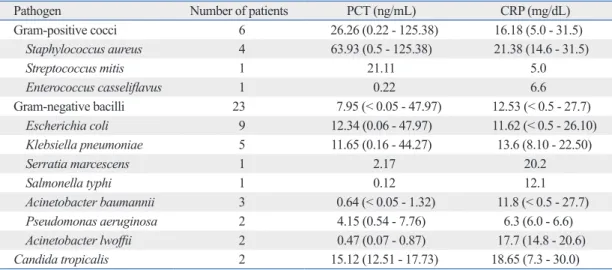
Of 300 patients enrolled in the study, 23 were excluded be- cause they were diagnosed as having disorders that were not suspected to be infection: trauma, hemorrhage, burns, or immunologic disease. Twenty-five positive blood cul- tures were excluded because they were considered to have been contaminated; 23 coagulase negative streptococci in single blood culture and 2 Bacillus spp.. None of the re- maining 252 patients were enrolled more than once, and all were classified as either bacteremia (group I, n = 31), local- ized infection (group II, n = 129), other disorders (group III, n = 83), or FUO (group IV, n = 9)(Table 1). Thirty-one pa- tients in the bacteremic group had 16 Gram-negative bacilli (Escherichia coli in nine cases; Klebsiella pneumoniae in five; Serratia marcescens in one; Salmonella Typhi in one), seven glucose non-fermenting gram-negative bacilli (Aci- netobacter baumannii in three cases; Pseudomonas aerugi- nosa in two, Acinetobacter lwoffii in two), six gram-positive cocci (Staphylococcus aureus in four cases; Streptococcus mitis in one; Enterococcus casseliflavus in one), and two cases of Candida tropicalis (Table 2). The PCT levels in can induce higher concentrations of serum PCT.

6

PCT con-

centration has been reported to be useful for the early diagno- sis of bacteremia and decisive initial antimicrobial therapy.

7-11

Furthermore, following administration of antimicrobial agents with serial measurements of PCT levels can help to protect against emerging antimicrobial-resistant strains by re- stricting unnecessary antibiotic use.

12

A new automated rapid quantitative assay, VIDAS

®

B.R.A.H.M.S PCT assay (bio- Mérieux, Marcy LʼEtoile, France), is based on an enzyme- linked fluorescent immunoassay (ELFA) and has a func- tional sensitivity of 0.09 ng/mL.

The aim of this study was to assess the ability of PCT level to differentiate bacteremia from non-bacteremia in pa- tients with fever using this new assay. We also assessed whether PCT level could be used to rule out the diagnosis of bacteremia.

MATERIALS AND METHODS

This study was carried out from August 2008 to April 2009 at a tertiary hospital in Korea. All 300 patients with acute fever (temperature ≥ 38°C) were enrolled in this study, and blood cultures were performed for all of them. These patients were not administered antimicrobial agents prior to blood culture. Their medical records were reviewed for clinical diagnosis, laboratory findings, and antimicrobial treatments.

The patients were classified as bacteremia (group I), local- ized infection (group II), other disorders (group III), and fe- ver of unknown origin (FUO, group IV) according to the fi- nal diagnosis.

Blood samples were obtained from each patient to deter- mine serum PCT level and C-reactive protein (CRP) level at the same time that the samples were obtained for culture.

PCT level was measured via an automatic analyzer, the VI-

DAS

®

B.R.A.H.M.S PCT assay (bioMérieux, Marcy

L’Etoile, France). The lower limit of detection of the assay

was 0.05 ng/mL. CRP level was measured using CRPα

Auto (Wako Pure Chemical Industries, Ltd., Osaka, Japan)

by TBA-200 FR NEO (Toshiba Medical Systems Corpora-

tion, Tochigi-ken, Japan). Blood cultures were processed in

more than two pairs of bottles and were incubated in aero-

bic and anaerobic conditions in an automatic analyzer,

BACTEC 9240 Blood Culture System (Becton Dickinson

Diagnostic Instrument Systems, Sparks, MD, USA). Blood

samples were secured in Bactec culture vial types Plus Aer-

obic/F (enriched soybean-casein digest broth), Bactec Plus

(3)

cant difference was found between PCT levels in the bacte- remic group (group I) and in the localized infection group (group II), which was 1.2 ± 3.5 ng/mL (p < 0.001). There were no significant differences between the bacteremic group and the non-bacteremic groups (group II, III, and IV) with respect to CRP levels (p = 0.298).

The PCT levels between the sites of localized infections were not significantly different, but the CRP levels showed significant differences (Table 3). The infection sites of pa- tients with localized infection were the upper respiratory gram-positive and gram-negative bacteremia were 26.26

ng/mL (0.22-125.38 ng/mL) and 7.95 ng/mL (< 0.05-47.97 ng/mL), respectively, with the levels significantly higher in gram-positive (p = 0.009). However, CRP levels were not significantly different between two types of bacteremia (p = 0.659).

The mean serum PCT level was 11.9 ± 25.1 ng/mL in the bacteremic group (group I), which was significantly higher, than in the non-bacteremic groups (groups II, III, and IV), which was 2.5 ± 14.7 ng/mL (p < 0.001). The most signifi-

Table 1. Patient Characteristics According to Group

Group I Group II Group III Group IV

Number 31 129 83 9

Sex (M : F) 16 : 15 66 : 63 57 : 26 5 : 4

Age 62.1 ± 19.3 20.9 ± 28.4 52.6 ± 22.3 19.9 ± 19.2

Procalcitonin 11.9 ± 25.2 1.2 ± 3.5 4.7 ± 23.5 0.2 ± 0.1

C-reactive protein 13.6 ± 9.1 6.6 ± 7.8 10.2 ± 8.5 5.1 ± 4.6

Table 2. PCT and CRP Concentrations According to Pathogen in Patients with Bacteremia

Pathogen Number of patients PCT (ng/mL) CRP (mg/dL)

Gram-positive cocci 6 26.26 (0.22 - 125.38) 16.18 (5.0 - 31.5)

Staphylococcus aureus 4 63.93 (0.5 - 125.38) 21.38 (14.6 - 31.5)

Streptococcus mitis 1 21.11 5.0

Enterococcus casseliflavus 1 0.22 6.6

Gram-negative bacilli 23 7.95 (< 0.05 - 47.97) 12.53 (< 0.5 - 27.7) Escherichia coli 9 12.34 (0.06 - 47.97) 11.62 (< 0.5 - 26.10) Klebsiella pneumoniae 5 11.65 (0.16 - 44.27) 13.6 (8.10 - 22.50)

Serratia marcescens 1 2.17 20.2

Salmonella typhi 1 0.12 12.1

Acinetobacter baumannii 3 0.64 (< 0.05 - 1.32) 11.8 (< 0.5 - 27.7)

Pseudomonas aeruginosa 2 4.15 (0.54 - 7.76) 6.3 (6.0 - 6.6)

Acinetobacter lwoffii 2 0.47 (0.07 - 0.87) 17.7 (14.8 - 20.6)

Candida tropicalis 2 15.12 (12.51 - 17.73) 18.65 (7.3 - 30.0)

PCT, procalcitonin; CRP, C-reactive protein.

Table 3. PCT and CRP Concentrations (Mean ± SD) on the Infected Site in Patients with Localized Infection

Number of patients PCT (ng/mL) CRP (mg/dL)

Upper respiratory infection 31 0.35 ± 0.53 3.45 ± 6.52

Lower respiratory infection 46 1.29 ± 4.43 5.70 ± 6.45

Urinary infection 27 2.04 ± 4.05 9.44 ± 9.33

Gastrointestinal infection 11 0.78 ± 1.79 4.18 ± 7.04

Skin infection 7 2.34 ± 5.19 14.16 ± 6.46

Osteoarticular infection 3 0.33 ± 0.25 20.5 ± 0.89

Otitis media 2 0.28 ± 0.28 4.95 ± 0.35

Infective endocarditis 1 0.05 0.70

Malaria 1 1.36 6.20

p value* 0.797 < 0.001

PCT, procalcitonin; CRP, C-reactive protein.

*Significance between sites of localized infections.

(4)

of 0.4 ng/mL. Sensitivity, specificity, PPV and NPV at the cut-off value 0.5 ng/mL, which was recommended by the manufacturer, were 74.2%, 70.1%, 26.1% and 95.1%, re- spectively.

DISCUSSION

Early diagnosis of bacteremia in patients with fever is im- portant for reducing the morbidity and mortality associated with bacteremia and its complications.

1

The gold standard for diagnosis of bacteremia is isolation and identification of organisms; however, blood cultures lack sensitivity, are time consuming, and can be problematic due to skin micro- organism contamination.

13

The diagnosis of bacteremia in tract in 31 cases; the lower respiratory tract in 46 cases; the

urinary tract in 27 cases; the gastrointestinal tract in 11 cas- es; the skin infectionin 7 cases; osteoarticular infection in 3 cases; otitis media in two cases; infective endocarditis in one case; and malaria in one case.

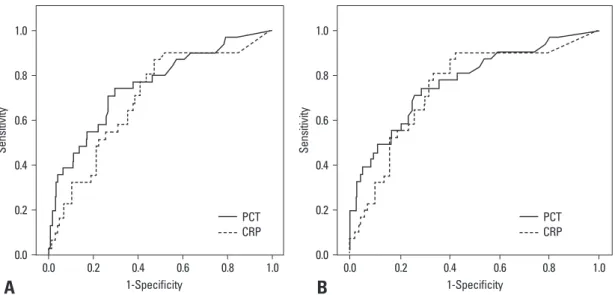
Fig. 1 presents the ROC curves of the PCT and CRP con- centrations for discrimination between patients in the bacte- remic group (group I) and patients in the non-bacteremic groups (groups II, III, and IV). The AUCs were 0.753 and 0.696, respectively. The AUCs for discrimination of bacte- remia from localized infection were 0.761 and 0.739, re- spectively (Fig. 1).

Sensitivity, specificity, PPV and NPV of PCT levels for the nine cut-off values are shown in Table 4. The highest NPV was 95.4%, which was associated with a cut-off value

Table 4. Diagnostic Performances of Serum PCT Assessment for the Nine Cut-Off Values That Separate the Ten Deciles of PCT Distribution

Cut-off value (ng/mL)

No. of cases under the

cut-off value (%) Sensitivity (%) Specificity (%) Positive predictive value (%)

Negative predictive value (%)

< 0.05 37 (14.7) 96.8 15.0 14.0 97.3

0.07 59 (23.4) 93.5 20.5 14.5 94.9

0.10 79 (31.3) 90.3 32.3 16.2 96.2

0.16 104 (41.3) 87.1 44.9 17.6 95.2

0.23 128 (50.8) 77.4 55.9 20.2 95.3

0.40 152 (60.3) 74.2 66.1 24.0 95.4

0.63 177 (70.2) 61.3 75.6 25.3 93.2

1.37 202 (80.2) 48.4 83.5 32.0 92.6

5.98 227 (90.1) 35.5 94.5 48.0 91.6

PCT, procalcitonin.

Fig. 1. (A) Receiver operator characteristic curve demonstrating sensitivity as a function of one-specificity for discriminating patients with blood culture positivity based on procalcitonin (PCT) and C-reactive protein (CRP) levels. PCT and CRP had areas under the receiver oper- ator characteristic curve of 0.753 and 0.696, respectively. (B) Receiver operator characteristic curve demonstrating sensitivity as a func- tion of one-specificity for discriminating patients with bacteremia from patients with localized infection based on PCT and CRP. PCT and CRP had areas under the receiver operator characteristic curve of 0.769 and 0.746, respectively.

Se ns iti vit y Se ns iti vit y

0.0 0.0

0.2 0.2

0.4 0.4

0.6 0.6

0.8 0.8

1.0 1.0

0.0 0.2 0.4 0.6 0.8 0.0 0.2 0.4 0.6 0.8

PCT PCT

CRP CRP

1.0 1.0

1-Specificity 1-Specificity

A B

(5)

study, there was no significant difference between mean CRP concentrations of patients with bacteremia and non- bacteremia. ROC analysis confirmed that the diagnostic utility of CRP was inferior to that of PCT in discriminating between these conditions.

We found that a PCT value of < 0.4 ng/mL could rule out bacteremia with a high degree of accuracy, because the NPV associated with this threshold was as high as 95.4%.

Similarly, a previous study reported that < 0.4 ng/mL was the best cut-off value for ruling out bacteremia.

12

Determi- nation of the PCT level seems to be a consistent tool for ruling out bacteremia in patients with acute fever.

In conclusion, PCT level could be a reliable marker to rule out or predict bacteremia in patients presenting with acute fever, and therefore, help in deciding the appropriate use of antimicrobial agents. More prospective and large- scale studies are needed to better define the usefulness of PCT levels in various clinical settings.

REFERENCES

1. Parrillo JE. Pathogenetic mechanisms of septic shock. N Engl J Med 1993;328:1471-7.

2. Mitaka C. Clinical laboratory differentiation of infectious versus non-infectious systemic inflammatory response syndrome. Clin Chim Acta 2005;351:17-29.

3. Reimer LG, Wilson ML, Weinstein MP. Update on detection of bacteremia and fungemia. Clin Microbiol Rev 1997;10:444-65.

4. Jacobs JW, Lund PK, Potts JT Jr, Bell NH, Habener JF. Procalci- tonin is a glycoprotein. J Biol Chem 1981;256:2803-7.

5. Reinhart K, Karzai W, Meisner M. Procalcitonin as a marker of the systemic inflammatory response to infection. Intensive Care Med 2000;26:1193-200.

6. Assicot M, Gendrel D, Carsin H, Raymond J, Guilbaud J, Bohuon C. High serum procalcitonin concentrations in patients with sepsis and infection. Lancet 1993;341:515-8.

7. Brunkhorst FM, Wegscheider K, Forycki ZF, Brunkhorst R. Pro- calcitonin for early diagnosis and differentiation of SIRS, sepsis, severe sepsis, and septic shock. Intensive Care Med 2000;26 Sup- pl 2:S148-52.

8. Endo S, Aikawa N, Fujishima S, Sekine I, Kogawa K, Yamamoto Y, et al. Usefulness of procalcitonin serum level for the discrimi- nation of severe sepsis from sepsis: a multicenter prospective study. J Infect Chemother 2008;14:244-9.

9. Harris KR, Digard NJ, Lee HA. Serum C-reactive protein. A use- ful and economical marker of immune activation in renal trans- plantation. Transplantation 1996;61:1593-600.

10. Jongwutiwes U, Suitharak K, Tiengrim S, Thamlikitkul V. Serum procalcitonin in diagnosis of bacteremia. J Med Assoc Thai 2009;92 Suppl 2:S79-87.

11. Luzzani A, Polati E, Dorizzi R, Rungatscher A, Pavan R, Merlini A. Comparison of procalcitonin and C-reactive protein as markers of sepsis. Crit Care Med 2003;31:1737-41.

patients presenting with fever has been reliant on a combi- nation of clinical examination and laboratory parameters, such as CRP level and erythrocyte sedimentation rate (ESR).

However, these parameters lack accuracy for early diagno- sis of bacteremia.

14

PCT has recently come to interest as a possible marker of the systemic inflammatory response to infection.

7-11

Although many studies have established that PCT level can be used to identify bacterial infections in pa- tients with sepsis,

7,8,11,15

only a few studies have evaluated the capacity of PCT findings to rule out bacteremia in out- patients with fever. A previous study evaluated PCT level as an early predictive marker of bacteremia, PCT had NPVs of 99% and 96% when the PCT cut-off values were 0.2 ng/

mL and 0.5 ng/mL, respectively.

16

Another study evaluated the performance indices of PCT in a prospective analysis of 300 hospitalized medical patients with fever.

17

The sensitiv- ity, NPV, and AUC of PCT for the diagnosis of bacteremia were 75%, 90%, and 0.7, respectively, when using 0.5 ng/

mL as the cut-off value. Similarly, we found in this study that the sensitivity, specificity, PPV, and NPV were 74.2%, 70.1%, 26.1% and 95.1%, respectively. Although PCT lev- els were shown to have a higher tendency, we believe that its power to discriminate bacteremia from localized infec- tion was sufficient. The ROC curve for differentiating pa- tients with bacteremia from patients with localized infec- tion based on the PCT level had an AUC of 0.769.

The present study showed that PCT levels in gram-posi- tive bacteremia could be significantly higher than those in gram-negative bacteremia, which is contradictory to the re- sults of a previous study.

18

However, the number of the pa- tients with gram-positive bacteremia was too small. It is therefore difficult to generalize for all patients with bactere- mia based on our results.

In a previous study, PCT levels were determined using an immunoluminometric assay (LUMItest, BRAHMS, Hen- ningsdorf, Germany), and the functional sensitivity of this method was 0.5 ng/mL. However, because 0.5 ng/mL ex- ceeds the average normal value by more than ten-fold, many mild changes in PCT values are missed.

19

More sensitive detection methods are needed for the accurate assessment of the clinical usefulness of PCT values.

20

We evaluated the diagnostic usefulness of PCT for bacteremia using a devel- oped method, the enzyme-linked fluorescent assay (ELFA).

The functional sensitivity of ELFA is 0.09 ng/mL, which is close to the upper normal value.

Although lacking diagnostic specificity, CRP is known as

a sensitive marker of infection or inflammation.

21

In this

(6)

17. Bossink AW, Groeneveld AB, Thijs LG. Prediction of microbial infection and mortality in medical patients with fever: plasma pro- calcitonin, neutrophilic elastase-alpha1-antitrypsin, and lactoferrin compared with clinical variables. Clin Infect Dis 1999;29:398- 18. Charles PE, Ladoire S, Aho S, Quenot JP, Doise JM, Prin S, et al. 407.

Serum procalcitonin elevation in critically ill patients at the onset of bacteremia caused by either Gram negative or Gram positive bacteria. BMC Infect Dis 2008;8:38.

19. Becker KL, Snider R, Nylen ES. Procalcitonin assay in systemic inflammation, infection, and sepsis: clinical utility and limitations.

Crit Care Med 2008;36:941-52.

20. Hur M, Moon HW, Yun YM, Kim KH, Kim HS, Lee KM. [Com- parison of diagnostic utility between procalcitonin and C-reactive protein for the patients with blood culture-positive sepsis]. Korean J Lab Med 2009;29:529-35.

21. Schuttrumpf S, Binder L, Hagemann T, Berkovic D, Trumper L, Binder C. Utility of procalcitonin concentration in the evaluation of patients with malignant diseases and elevated C-reactive pro- tein plasma concentrations. Clin Infect Dis 2006;43:468-73.

12. Chirouze C, Schuhmacher H, Rabaud C, Gil H, Khayat N, Esta- voyer JM, et al. Low serum procalcitonin level accurately predicts the absence of bacteremia in adult patients with acute fever. Clin Infect Dis 2002;35:156-61.

13. Rowther FB, Rodrigues CS, Deshmukh MS, Kapadia FN, Hegde A, Mehta AP, et al. Prospective comparison of eubacterial PCR and measurement of procalcitonin levels with blood culture for di- agnosing septicemia in intensive care unit patients. J Clin Micro- biol 2009;47:2964-9.

14. Bates DW, Sands K, Miller E, Lanken PN, Hibberd PL, Graman PS, et al. Predicting bacteremia in patients with sepsis syndrome.

Academic Medical Center Consortium Sepsis Project Working Group. J Infect Dis 1997;176:1538-51.

15. Müller B, Becker KL, Schachinger H, Rickenbacher PR, Huber PR, Zimmerli W, et al. Calcitonin precursors are reliable markers of sepsis in a medical intensive care unit. Crit Care Med 2000;28:

977-83.

16. Liaudat S, Dayer E, Praz G, Bille J, Troillet N. Usefulness of pro-

calcitonin serum level for the diagnosis of bacteremia. Eur J Clin

Microbiol Infect Dis 2001;20:524-7.

수치

Table 2. PCT and CRP Concentrations According to Pathogen in Patients with Bacteremia
Fig. 1 presents the ROC curves of the PCT and CRP con- con-centrations for discrimination between patients in the  bacte-remic group (group I) and patients in the non-bactebacte-remic  groups (groups II, III, and IV)

참조

관련 문서

This study was conducted under the hypothesis that a group art therapy program may increase emotional expression and decrease life event stress in patients with

마찬가지로 원자핵도 내부에 여러 에너지 준위를 가지는데, 에너지를 흡수하여 기저 상태에서 여기 상태로 전이될 수도 있고 반대로 에너지를 방출하여 여기 상태에서

Results: In this research, in the group with fibromyalgia patients group, systemic lupus erythematosus patients group and without systemic autoimmune

The feed is commonly a solution in a solvent like ethanol or t-butanol, and the nonsolvent is water..

(Background) Gallbladder wall thickening(GWT) and gallbladder contraction are often observed in patients with acute hepatitis.. The incidence of acute hepatitis A

 For a given type of charged particle at a given energy, the stopping power is given by the product of (1) the linear attenuation

 Although van der Waals equation is still less accurate at high

The risk of complicated acute appendicitis should be evaluated in terms of medical factors, including psychi- atric disease entity, psychotropic prescription, and