Efficacy of Epidural Analgesia in Patients with Cancer Pain:
A Retrospective Observational Study
Yeon Soo Jeon,
1Jung Ah Lee,
1Jin Woo Choi,
1Eu Gene Kang,
1Hong Soo Jung,
1Hoon Kyo Kim,
2Byoung Yong Shim,
2Jae Hee Park,
1and Jin Deok Joo
1Departments of 1Anesthesiology and Pain Medicine, 2Oncology, St. Vincent's Hospital, College of Medicine, The Catholic University of Korea, Suwon, Korea.
Received: April 6, 2011 Revised: May 18, 2011 Accepted: June 20, 2011
Corresponding author: Dr. Jin Deok Joo, Department of Anesthesiology and Pain Medicine, St. Vincent’s Hospital, College of Medicine,
The Catholic University of Korea, 93 Jungbu-daero, Paldal-gu, Suwon 442-723, Korea.
Tel: 82-31-249-7212, Fax: 82-31-258-4212 E-mail: [email protected]
∙ The authors have no financial conflicts of interest.
© Copyright:
Yonsei University College of Medicine 2012 This is an Open Access article distributed under the terms of the Creative Commons Attribution Non- Commercial License (http://creativecommons.org/
licenses/by-nc/3.0) which permits unrestricted non- commercial use, distribution, and reproduction in any medium, provided the original work is properly cited.
Purpose: Pain in terminal cancer patients may be refractory to systemic analge- sics or associated with adverse drug reactions to analgesics. Epidural analgesia has been effectively used in such patients for pain control. However, this method does not provide pain relief to all patients. The efficacy and complications of continu- ous epidural analgesia were evaluated for expanding efficacy in terminal cancer patients. Materials and Methods: The charts of patients who received epidural analgesia for over 5 years for the control of terminal cancer pain were reviewed retrospectively. Results: Ninety-six patients received 127 epidural catheters. The mean duration for epidural catheterization was 31.5±55.6 (5-509) days. The dose of epidural morphine increased by 3.5% per day. The efficacy of epidural analge- sia at 2 weeks follow up revealed improved pain control (n=56), as the morphine equivalent drug dose dropped from 213.4 mg/day to 94.1 mg/day (p<0.05) at 2 weeks follow up. Accordingly, after 2 weeks institution of epidural analgesia, there was a significant reduction in the proportion of patients with severe pain, from 78.1% to 19.6% (p<0.05). Conclusion: Epidural analgesia was an effective pain control method in patients with terminal cancer pain, however, a systematized al- gorithm for the control of cancer-related pain in needed.
Key Words: Bupivacaine, cancer pain, epidural analgesia, morphine
INTRODUCTION
Cancer has been the most common cause of death in Korea since 1983. The num- ber of cancer patients was 153237 in 2006 and 161920 in 2007, with an increased frequency of 5.1% and 11.0%, respectively, in comparison to 2005. Alarmingly, the incidence and prevalence of cancer continues to increase. Assuming a lifespan of 76 years in men and 83 years in women, one out of three men and one out of four women are predicted to develop cancer during their lifetime in Korea.1
Seventy-five to 80% of terminal cancer patients complain of cancer-related pain.2 The World Health Organization and National Cancer Care Network presented algo- rithms for cancer pain control.3,4 These guidelines have been validated in clinical practice and were shown to provide effective analgesia in 70-90% of patients.3,5
The mean daily doses of epidural morphine at the start and termination were also evaluated. The dose escalations of the epidural morphine, the ratio of the maximum dose to the minimum start dose, were evaluated for the daily in- crease percentage of epidural morphine.
As the survival period of more than 2 weeks had the high- est number of patients (n=56), the efficacy of pain control was indirectly evaluated according to changes in intrave- nous morphine equivalent drug dose (MEDD) and the de- gree of pain at pre-epidural and 2 weeks follow up. The de- gree of pain was defined as none to mild, moderate, and severe. Complications were also evaluated.
Statistical analysis
The results are presented as the mean±SD or incidence (percentage). Paired samples t-test was used to examine the change in MEDD, at pre-epidural and 2 weeks follow up.
Statistical analyses were performed using SPSS software version 13.0. p-value<0.05 was considered significantly significant.
This study was approved by the Institutional Review Board of - St. Vincent’s Hospital, College of Medicine, The Catholic University of Korea (IRB approval number: VC 10RIS10061).
RESULTS
Two hundred and twenty-eight hospitalized cancer patients with pain were referred to the pain clinic due to severe ad- verse drug reactions or ineffective pain control in spite of opioid administration. One hundred and thirty-two (58%) patients had at least one EA performed. Ninety-six (42%) patients underwent continuous EA.
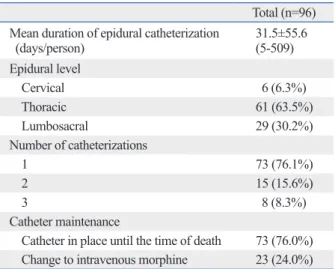
Patient characteristics including age, gender, primary cancer, pain location, type of pain, and pre-epidural failure are shown in Table 1. Ninety-six patients were treated using 127 catheters. The catheter characteristics are shown in Ta- ble 2. Positions of the catheter tips of 73 catheters were confirmed by plain radiographs. Forty-eight (65.7%) cathe- ters were located at the target site level or within 3 cm of the target site, while 25 (34.2%) catheters were inappropri- ately placed outside the target site.
The mean epidural doses of morphine at the start and ter- mination were 21.24±20.6 mg and 56.7±61.4 mg, respec- tively. The mean dose escalation of epidural morphine over time was 2.8±2.3. Mean duration of epidural catheterization However, it is very difficult to control cancer-related pain
refractory to medical management.3 For these patients, con- tinuous epidural analgesia (EA), intrathecal analgesia (ITA), and intracerebroventricular analgesia (ICVA) have been very effective.6-10 Therefore, EA or ITA is considered the fourth ladder of treatment.3
ITA and ICVA have many advantages. However, they ne- cessitate more aggressive surgical procedures and are very expensive. And the risk of spinal infection, confusion, and sedation are also high.10
EA is easy to perform and is effective for patients with a predicted survival less than three months.11 The cost is also covered for 95% of cancer patients by national health insur- ance in Korea. For these reasons, the EA is preferred and is used for control of cancer-related pain in Korea. Nonethe- less, the efficacy of EA varies among patients.
The purpose of this study was to evaluate the efficacy and complications of continuous epidural analgesia in order to improve its efficacy for control of cancer-related pain.
MATERIALS AND METHODS
Ninety-six terminal cancer patients were referred to the pain clinic for pain control and were administered EA from 2005 to 2009. A retrospective review of their medical re- cords was performed.
A coiled 18G epidural catheter (Arrow, Arrow Interna- tional Inc., Reading, PA, USA) was used for catheteriza- tion, which tunneled into the nearby trunk. Morphine, bupi- vacaine, and ketamine were used for most patients as the initial epidural drugs. After the daily total opioid dose was converted into an intravenous morphine equivalent dose, epidural morphine was injected at 1/4-1/6 of the intrave- nous morphine dose.
Bupivacaine 12.5-25 mg/day and ketamine 10-20 mg/
day were injected at 2 mL/h according to the patient’s pain severity, cancer progress, pain location, and type of pain.
Adjuvant analgesics were used including antiepileptic drugs, antidepressants, anti-inflammatory drugs, and, in some cas- es, steroids.
Patient characteristics including age, gender, primary can- cer, pain location, pain type, and causes of pre-epidural fail- ure were evaluated. In addition, the mean duration of epi- dural catheterization, the level of the EA, the position of the tip of the epidural catheter, the number of reinsertions, and the catheter course were also evaluated.
due to the draining of interstitial fluid through the puncture site caused by generalized edema. Presenting drug related complications included respiratory depression to a rate of 8 breath/min in 1 patient, motor block in 1 patient, hypoten- sion in 1 patient, and sensory deficits in 2 patients. All of these problems were resolved with dose reduction. Consti- pation occurred in most patients, and urinary retention was resolved by symptomatic treatment.
DISCUSSION
The results of this study showed that continuous epidural analgesia significantly decreased the MEDD of morphine in terminal cancer patients and reduced the proportion of patients with severe pain.
Prior studies previously reported that the continuous EA was effective in 50-90% of patients.7,9,12 Ballantyne and Car- wood10 reported EA showed excellent pain relief in 72% of patients with terminal cancer-related pain by performing a meta-analysis of 31 studies. Burton, et al.13 reported there was a significant reduction in the proportion of patients with severe pain from 86% to 17% after neuroaxial analgesia. In our study, EA was deemed effective in 80.4% of patients.
In our study, EA was effective immediately after institu- tion in the majority of patients however, approximately 30%
of patients showed decreased efficacy over time. Mer- cadante14 suggested that tumor progression, psychological factors, development of pseudotolerance caused by dural thickening, impedance of transdural diffusion, epidural me- tastasis with the invasion of nerve roots, and reactive fibrosis were some of the potential causes of reduced effectiveness was 31.5±55.6 days, and the dose of epidural morphine in-
creased by 5.3% per day.
The efficacy of EA at 2 weeks follow up revealed im- proved pain control (n=56), as MEDD dropped from 213.4±
221.7 (10-1480) mg/day to 94.1±145.0 (30-680) mg/day at 2 weeks follow up (p<0.05). After 2 weeks institution of EA, there was a significant reduction in the proportion of patients with severe pain, from 78.1% to 19.6% (p<0.05).
Catheter related complications were as follows: mild, such as spontaneous removal or removal by mistake in 15 patients (15.6%). And moderate complications, including infection, occlusion, oozing, and formation of fibrous sheath occurred in 14 patients (14.6%). Infection occurred at the entrance and tunnel sites, but all infections were con- trolled by antibiotics and/or catheter removal. Bloody dis- charge occurred in 2 patients with a long-term catheter. Se- vere complications such as epidural abscess or hematoma did not occur. Oozing occurred in three patients, perhaps Table 1. Patient Characteristics
Total (n=96) Age (yrs)
40< 9 (9.4%)
41-59 35 (36.5%)
60≤ 52 (54.2%)
Sex
Male 54 (56.2%)
Female 42 (43.8%)
Primary cancer
Lung cancer 18 (18.8%)
UGI cancer 23 (24.0%)
Hepatobiliary cancer 10 (10.4%)
Pancreatic cancer 15 (15.6%)
Rectosigmoidal cancer 13 (13.5%)
Urogenital cancer 7 (7.3%)
Etc. 10 (10.4%)
Pain location
Head, neck and upper extremity 8 (8.3%) Chest, abdomen and back, sacral and
lower extremity 88 (91.6%)
Pain type
Somatic 10 (10.4%)
Visceral 57 (59.4%)
Neuropathic 2 (2.1%)
Mixed 27 (28.1%)
Pre-epidural failure
Inappropriate pain control 75 (78.1%)
Intolerable side effect 21 (21.9%)
UGI, upper gastrointestinal.
Values are expressed as the incidence (percentages).
Table 2. Catheter Characteristics
Total (n=96) Mean duration of epidural catheterization
(days/person) 31.5±55.6
(5-509) Epidural level
Cervical 6 (6.3%)
Thoracic 61 (63.5%)
Lumbosacral 29 (30.2%)
Number of catheterizations
1 73 (76.1%)
2 15 (15.6%)
3 8 (8.3%)
Catheter maintenance
Catheter in place until the time of death 73 (76.0%) Change to intravenous morphine 23 (24.0%) Values are expressed as the incidence (percentages).
ever, it is not available in Korea. Urinary retention was also severe if the catheter tip was located in the lower lumbar epi- dural space. This was treated by symptomatic therapy.
The optimal time for commencing EA remains unclear.
Often, spinal opioid treatment was initiated before optimal systemic opioid administration was achieved.14 However, in- discriminate use of spinal opioids should be discouraged.23 In our study, seven patients could have been adequately con- trolled pain by appropriate systemic analgesics alone. Cur- rently, we consider EA in patients with intolerable side ef- fects despite systemic analgesics or in patients with refractory pain despite receiving morphine 100 mg/day intravenously.
The limitations of this study were as follows: first, this was a retrospective study. Second, we did not use an objec- tive pain score. This trend was shown in most papers con- cerning neuroaxial therapy for terminal cancer pain.10 Al- though it is possible to measure pain scores during the early period of disease, it becomes difficult to measure as the dis- ease progresses. Additionally, other limitations include the absence of a comparison group, bias with patient reporting of symptoms and analgesic intake, as well as inaccurate data in the medical records.
In conclusion, in terminal cancer patients with severe drug side effects or refractory pain, epidural analgesia was an effective pain control method, however, a systematized algorithm for improving the efficacy of epidural analgesia is needed.
ACKNOWLEDGEMENTS
We would like to thank to Professor Young Moon Park and Seung Hee Jung, (Department of Preventive Medicine, The Catholic University of Korea) for their help with the statis- tical analysis.
REFERENCES
1. Ministry of Health and Welfare, Department of Central Cancer Registry, 2006-2007 cancer statistics 2009. p.1-34.
2. Goudas LC, Bloch R, Gialeli-Goudas M, Lau J, Carr DB. The epi- demiology of cancer pain. Cancer Invest 2005;23:182-90.
3. Meuser T, Pietruck C, Radbruch L, Stute P, Lehmann KA, Grond S. Symptoms during cancer pain treatment following WHO- guidelines: a longitudinal follow-up study of symptom prevalence, severity and etiology. Pain 2001;93:247-57.
4. Benedetti C, Brock C, Cleeland C, Coyle N, Dubé JE, Ferrell B, et al. NCCN Practice Guidelines for Cancer Pain. Oncology (Wil-
over time. In addition, inappropriate evaluation, the lack of knowledge and time of physicians, and the fear of opioid use were the causes of inappropriate control of cancer-relat- ed pain in EA.15 Subsequently, despite disease progression, continuous dose adjustments were not administered. In con- trol of cancer-related pain using systemic analgesics, similar practice is demonstrated.16
Some adjuvants can be commonly used for improving ef- ficacy of epidural morphine. Bupivacaine-morphine combi- nation presents more effective analgesic effect than morphine alone, more effective relief of the neuropathic component of pain, and there is no neurotoxicity in long-term infusion.17 However, ketamine, a N-methyl-D-aspartic acid antagonist, is questionable because of preservative (chlorbutanol) relat- ed neurotoxic effects. Spinal myelopathy has also been re- ported with intrathecal injection of ketamine in large doses.
However, the combination of small amounts of ketamine is helpful in pain relief in patients.18
Infection is a major problem associated with catheter use.
Ruppen, et al.19 reported that catheter related infection were superficial 4.6% and deep 1.2% in a systemic review of 24 studies. Infection may more readily occur with long term of catheter insertion, without subcutaneous tunneling, and catheter type. In our study, infections occurred in 10% of the patients. Fortunately, there were no deep infections and all were controlled by the administration of antibiotics or by removing the catheter. Accordingly, patients and care- givers should be instructed on wound care as well as signs and symptoms indicative of infection.
There were 11 spontaneous catheter removals, which were reduced by fixing the entrance site and the catheter with DuoDERM® (Unomedical, Mona Vale, NSW, Austra- lia) and sterile strips. Infections in 4 patients and spontane- ous removal of the catheter in 4 of 11 patients occurred in those who did not undergo subcutaneous tunneling, demon- strating the importance of subcutaneous tunneling.20 The formation of a fibrous sheath at the catheter tip can occur after long-term administration of drugs.21 In such cases, pa- tients may complain of pain during epidural bolus injection.
In our study, a fibrous sheath appeared along with bloody discharge after long term catheterization in 2 patients, and catheters were removed.
Constipation is the most common side effect of opioids, occurring in most of the patients in our study. Although drugs were used to relieve the constipation, most of the patients were not well controlled. Recently methylnaltrexone has been introduced to treat opioid induced constipation.22 How-
15. Jeon YS, Kim HK, Cleeland CS, Wang XS. Clinicians’ practice and attitudes toward cancer pain management in Korea. Support Care Cancer 2007;15:463-9.
16. Hong SH, Roh SY, Kim SY, Shin SW, Kim CS, Choi JH, et al.
Change in cancer pain management in Korea between 2001 and 2006: results of two nationwide surveys. J Pain Symptom Manage 2011;41:93-103.
17. Sjöberg M, Karlsson PA, Nordborg C, Wallgren A, Nitescu P, Ap- pelgren L, et al. Neuropathologic findings after long-term intrathe- cal infusion of morphine and bupivacaine for pain treatment in cancer patients. Anesthesiology 1992;76:173-86.
18. Congedo E, Sgreccia M, De Cosmo G. New drugs for epidural analgesia. Curr Drug Targets 2009;10:696-706.
19. Ruppen W, Derry S, McQuay HJ, Moore RA. Infection rates as- sociated with epidural indwelling catheters for seven days or lon- ger: systematic review and meta-analysis. BMC Palliat Care 2007;
20. Hogan Q, Haddox JD, Abram S, Weissman D, Taylor ML, Janjan 6:3.
N. Epidural opiates and local anesthetics for the management of cancer pain. Pain 1991;46:271-9.
21. Hogan QH. Loculated? Encapsulated? Indented? Pain 1993;53:
241-2.
22. Chamberlain BH, Cross K, Winston JL, Thomas J, Wang W, Su C, et al. Methylnaltrexone treatment of opioid-induced constipation in patients with advanced illness. J Pain Symptom Manage 2009;
38:683-90.
23. Mercadante S, Agnello A, Armata MG, Pumo S. The inappropri- ate use of the epidural route in cancer pain. J Pain Symptom Man- age 1997;13:233-7.
liston Park) 2000;14:135-50.
5. Zech DF, Grond S, Lynch J, Hertel D, Lehmann KA. Validation of World Health Organization Guidelines for cancer pain relief: a 10- year prospective study. Pain 1995;63:65-76.
6. Samuelsson H, Malmberg F, Eriksson M, Hedner T. Outcomes of epidural morphine treatment in cancer pain: nine years of clinical experience. J Pain Symptom Manage 1995;10:105-12.
7. Smitt PS, Tsafka A, Teng-van de Zande F, van der Holt R, Elswi- jk-de Vries I, Elfrink E, et al. Outcome and complications of epi- dural analgesia in patients with chronic cancer pain. Cancer 1998;83:2015-22.
8. Samuelsson H, Hedner T. Pain characterization in cancer patients and the analgetic response to epidural morphine. Pain 1991;46:3-8.
9. Du Pen SL, Kharasch ED, Williams A, Peterson DG, Sloan DC, Hasche-Klunder H, et al. Chronic epidural bupivacaine-opioid in- fusion in intractable cancer pain. Pain 1992;49:293-300.
10. Ballantyne JC, Carwood CM. Comparative efficacy of epidural, subarachnoid, and intracerebroventricular opioids in patients with pain due to cancer. Cochrane Database Syst Rev 2005:CD005178.
11. Bedder MD, Burchiel K, Larson A. Cost analysis of two implant- able narcotic delivery systems. J Pain Symptom Manage 1991;6:
368-73.
12. Erdine S, Aldemir T. Long-term results of peridural morphine in 225 patients. Pain 1991;45:155-9.
13. Burton AW, Rajagopal A, Shah HN, Mendoza T, Cleeland C, Has- senbusch SJ 3rd, et al. Epidural and intrathecal analgesia is effec- tive in treating refractory cancer pain. Pain Med 2004;5:239-47.
14. Mercadante S. Controversies over spinal treatment in advanced cancer patients. Support Care Cancer 1998;6:495-502.