• 검색 결과가 없습니다.

Anti-inflammatory Potential of Artemisia capillaris and Its Constituents in LPS-induced RAW264.7 Cells

N/A
N/A
Protected

Academic year: 2022

Share "Anti-inflammatory Potential of Artemisia capillaris and Its Constituents in LPS-induced RAW264.7 Cells"

Copied!
10
0
0

로드 중.... (전체 텍스트 보기)

전체 글

(1)

https://doi.org/10.20307/nps.2018.24.3.171

171

Anti-inflammatory Potential of Artemisia capillaris and Its Constituents in LPS-induced RAW264.7 Cells

Qudeer Ahmed Abdul

1

, Su Hui Seong

1

, Bo Ra Ahn

1

, Md Nurul Islam

2

, Hyun Ah Jung

3,

*, and Jae Sue Choi

1,

*

1

Department of Food and Life Science, Pukyong National University, Busan 48513, Republic of Korea

2

Department of Pharmacy, Mawlana Bhashani Science and Technology University, Santosh, Tangail 1902, Bangladesh

3
Department of Food Science and Human Nutrition, Chonbuk National University, Jeonju 54896, Republic of Korea

Abstract − Artemisia capillaris has been widely used as an alternative therapy for treating obesity and atopic dermatitis. It has been used as a hepatoprotactant. It is also used for ameliorating inflammatory reactions.

Although there are several investigations on other Artemisia species, there is no systematic study describing the role of A. capillaris MeOH extract, its solvent soluble fractions, or derived anti-inflammatory principal components in regulating inflammatory conditions. Therefore, the objective of this study was to elucidate anti-inflammatory mechanisms of A. capillaris. Results revealed that MeOH extract of A. capillaris could decrease LPS-stimulated NO secretion. Of tested fractions, CH

2

Cl

2

, EtOAc, and n-BuOH strongly inhibited NO release from RAW264.7 cells. Bioactive mediators derived from CH

2

Cl

2

and n-BuOH fractions elicited potent anti-inflammatory actions and strikingly abrogated LPS-triggered NO accumulation in RAW264.7 cells. Of particular interest, capillin and isoscopoletin possessed the most potent NO suppressive effects. Western blot analysis validated the molecular mechanism of NO inhibition and showed that capillin and isoscopoletin significantly down-regulated iNOS and COX-2 protein expression. Taken together, our results provide the first evidence that MeOH extract, CH

2

Cl

2,

EtOAc, and n-BuOH fractions from A. capillaris and its derived lead candidates can potently suppress inflammatory responses in macrophages by hampering NO release and down-regulating iNOS and COX-2 signaling.

Keywords − Artemisia capillaris, Inflammation, iNOS, COX-2, Coumarin, Flavonoids

Introduction

Experimental studies have gathered growing evidence that inflammation is the cornerstone in the evolution of many multifaceted diseases and disorders, including metabolic syndromes, cancer, autoimmune, neurodegene- rative, and cardiovascular diseases.

1

Macrophage-derived nitric oxide (NO) is an essential intercellular messenger molecule that has been recognized as one of the most versatile player in the pathogenesis of inflammation. In the inflammatory state, activated macrophages secrete a variety of effector molecules including prionflammatory cytokines and NO. NO is believed to induce vasodilatation in cardiovascular system. Furthermore, cytokine-activated macrophages can release NO in high concentrations as

immune responses. In addition, NO is a potent neuro- transmitter at neuron synapses. It contributes to the regulation of apoptosis. NO is involved in the pathogenesis of inflammatory disorders of the joint, gut, and lungs.

2

Exposure to inflammatory stimuli such as lipopolysaccharide (LPS) causes activation of macrophages and the release of NO. Activated macrophages secrete various proinflammatory mediators, including cyclooxygenase-2 (COX-2) and inducible nitric oxide synthase (iNOS) which in turn will result in accumulation of cellular NO that contributes to inflammation.

3,4

With the onset of inflammation, signaling of iNOS and COX-2 is also activated. The emergence of iNOS and COX-2 appears to represent crucial effector of inflammatory responses. Numerous experimental models have been designed to mimick inflammatory reactions and provide opportunities for testing new pharmacological components. Research focus has been shifted toward the use of natural products as possible anti-inflammatory agents or the development of targeted hit leads from medicinal plants. Accordingly, this study focused on pharmaceutical and therapeutic use of Artemisia capillaris for treatment of inflammation.

*Author for correspondence

Jae Sue Choi, Department of Food and Life Science, Pukyong National University, Busan 48513, the Republic of Korea.

Tel: +82-51-629-5845; E-mail: [email protected]

Hyun Ah Jung, Department of Food Science and Human Nutrition, Chonbuk National University, Jeonju 54896, Republic of Korea.

Tel: +82-63-270-4882; E-mail: [email protected]

(2)

172 Natural Product Sciences

A. capillaris has been frequently used in the treatment of liver diseases, including hepatitis, jaundice, fatty liver, and bilious disorder. Infusions of buds, stems, and leaves of A. capillaris have been used in traditional Chinese medicine (TCM) primarily as a choleric, anti-inflammatory, antipyretic, and diuretic agent for treating epidemic hepatitis.

5

A wide variety of pharmacological and biological activities of A. capillaris have been reported, including antioxidant,

6,7

cytoprotective,

6

hepatoprotective,

8,9

antimi- crobial,

10

anticancer,

11

anti-obesity,

12

and choleretic effects.

13

Ethyl acetate fraction of A. capillaris has shown anti- oxidative and cytoprotective effects by scavenging ROS with protective effect against oxidative DNA damage.

6

In additions, ethyl acetate fraction of A. capillaris can induce cytoprotective effects against oxidative stress-induced apoptosis in V79 cells by enhancing antioxidative activity.

12

Phytochemical analysis of the genus Artemisia has revealed that it embraces diverse classes of novel compounds such as terpenoids, flavonoids, coumarins, caffeoylquinic acids, sterols, and acetylenes. Coumarins isolated from A.

capillaris has demonstrated inhibitory potential against advanced glycation end product formation.

14

Aerial parts of A. capillaryis and its constituents can suppress 5- lipoxygenase and skin inflammation in rat basophilic leukemia-1 (RBL-1) and male ICR mice.

15

A. capillaris and its derived constituents can strongly inhibit α- glucosidase and protein tyrosine phosphatase 1B (PTP1B) activities.

16

Therefore, multiple investigations have ascertained the therapeutic potential of A. capillaris. However, there is no systematic study that explores the anti-inflammatory therapeutic potential of A. capillaris extract, its fractions, or its constituents responsible for its anti-inflammatory effects. Therefore, the objective of the current study was to identify lead anti-inflammatory mediators from A.

capillaris through bioguided extraction and fractionation.

Experimental

Chemicals and Reagents − LPS from Escherichia coli, Griess reagent, 3-[4,5-dimethylthiazol-2-yl]-2,5-diphenyl tetrazolium bromide (MTT), ethylene diamine tetraacetic acid (EDTA), 2-amino-5,6-dihydro-6-methyl-4H-1,3-thiazine hydrochloride (AMT), 6-hydroxy-2,5,7,8-tetramethylchro- man-2-carboxylic acid (Trolox), fetal bovine serum (FBS), and antibiotics were purchased from Sigma-Aldrich Co.

(St. Louis, MO, USA), and Dulbecco's Modified Eagle's Medium (DMEM) from Hyclone (Logan, Utah, USA).

Various primary antibodies (iNOS, COX-2, and β-actin) were obtained from Cell Signaling Technology, Inc.

(Beverly, MA, USA). Polyvinylidene fluoride (PVDF)

membrane (Immobilon-P) was obtained from Millipore Co. (Billerica, MA, USA). Unless otherwise indicated, all chemicals were purchased from Sigma-Aldrich Co. (St Louis, MO).

Plant Materials − Whole plants of A. capillaris were collected from Cheongsong, Kyungpuk Province, Korea, in August 2009 and were authenticated by Prof. Je-Hyun Lee, College of Oriental Medicine, Dongguk University, Gyeongju, Korea. A voucher specimen (20093008) was deposited in the laboratory of one of the authors (J. S.

Choi) for future reference.

Extraction, Fractionation and Isolation of Com- pounds from A. capillaris − The extraction, fractionation and isolation of compounds from A. capillaris were carried out as previously described.

14,16

Isolated compounds were identified by spectroscopic methods, including

1

H- and

13

C-NMR, as well as by comparison with published spectral data and TLC analysis. The structures of com- pounds are shown in Fig. 1.

Cell Culture − RAW 264.7 macrophage cells (ATCC, Rockville, MD, USA) were cultured at 37

o

C in DMEM supplemented with 10% FBS in a humidified atmosphere with 5% CO

2

. Medium was changed every 24 h.

Cell Viability in RAW264.7 Cells − The macrophage RAW264.7 cell line was incubated in Dulbecco’s modified Eagle’s medium (DMEM) at 37

o

C under 5% CO

2

humidified air. The cells were seeded onto a 96-well plate at a density of 1.0 × 10

4

cells per well and incubated at 37

o

C for 24 h. The cells were then treated with various concentrations of test samples. After an additional 24 h of incubation at 37

o

C, 100 μL of MTT (0.5 mg/mL in PBS) was added to the wells and mixed well. The resulting color was assayed at 570 nm using a microplate reader (VERSA max Molecular Devices).

RAW264.7 Cell Culture and Measurement of NO Concentration − RAW264.7 cell culture and measurement of NO concentration RAW264.7 cells obtained from the American type culture collection (ATCC) were cultured with DMEM supplemented with 10% FBS and 1%

antibiotics in a 5% CO

2

atmosphere at 37

o

C. The cells were activated with LPS (1 μg/mL). Briefly, the cells were plated in 96-well plates (2 × 10

5

cells/well). After pre-incubation for 2 h, test compounds and LPS (1 μg/

mL) were added and incubated for 18 h unless otherwise

specified. The test compounds dissolved in DMSO were

diluted to appropriate concentrations with serum-free

DMEM. The final concentration of DMSO was adjusted

to 0.1%. To assess NO production, the stable conversion

product of NO was measured using Griess reagent and the

optical density was determined at 540 nm.

(3)

Analysis for Inhibition of iNOS and COX-2 Protein Expression − Western blotting was used to measure the protein levels of iNOS and COX-2. RAW264.7 cells were cultured in 100 mm culture dishes in the presence or absence of LPS (1.0 μg/mL) and with/without test compounds for 18 h. Afterwards, the cells were washed twice with ice-cold PBS and lysed with buffer on ice for 30 min. Cell extracts were obtained by centrifugation at 14,000 × g and 4

o

C for 20 min. Cytosolic proteins were electrophoretically separated by SDS-PAGE and transferred onto PVDF membranes. The membranes were immediately blocked with 5% (w/v) non-fat dry milk in Tris-buffered saline containing 0.1% Tween-20 (pH 7.4) (TBST) buffer at room temperature for 1 h. The membranes were washed three times (10 min) in TBST buffer and incubated with primary antibody, diluted 1:1000 in 5% (w/v) non-fat dry milk in TBST buffer, at 4

o

C overnight. After three washings in TBST buffer (10 min), the membranes were incubated with horseradish peroxidase-conjugated secondary antibody, diluted 1:2000 in 5% (w/v) non-fat dry milk in TBST buffer, at room temperature for 1 h. After three washings in TBST buffer (10 min), the antibody was visualized using Supersignal West Pico Chemilumine- scent Substrate (Pierce, Rockford, IL, USA), according to the manufacturer’s instructions and exposed to an X-ray film (GE Healthcare Ltd., Amersham, UK). Pre-stained blue protein markers were used for molecular weight

determination.

Statistical Analysis − The results were analyzed by one-way analysis of variance (ANOVA) followed by Dunnet’s post tests for multiple comparisons. Differences were considered significant at p < 0.05. Results of anti- inflammatory effects were expressed as respective mean ± standard deviation (STDEV) in triplicate experiments.

Result

Effect of MeOH Extract of A. capillaris on LPS- induced NO Production − To determine whether A.

capillaris MeOH extract could suppress LPS-induced NO

production, RAW264.7 cells were pretreated with indicated

concentrations (2.5, 5, 10, 20, and 40 µg/mL) of MeOH

extract at 2 h prior to induction by LPS (1 µg/mL). As

shown in Fig. 2, LPS induction abruptly generated nitrite

in culture media up to a level of 100% compared to non-

treated control cells. However, exposure of RAW264.7

cells to different concentrations of MeOH extract signifi-

cantly overturned such increase of NO production

mediated by LPS in a dose-dependent manner. Relative

NO suppression rates achieved by treatment with MeOH

extract at indicated concentrations of 2.5, 5, 10, 20, and

40 µg/mL were 8.85%, 18.14%, 37.17%, 40.54%, and

53.47%, respectively. There were no significant difference

in NO suppression rate between 10 and 20 µg/mL of

Fig. 1. Structures of compounds isolated from Artemisia capillaris.

(4)

174 Natural Product Sciences

MeOH extract, although concentration at 20 µg/mL exhibited slight toxicity. Exposure of RAW264.7 cells to 40 µg/mL resulted in 53.47% of NO inhibition. It might be due to cytotoxic effect of MeOH extract at this con- centration. Therefore, NO inhibition at 40 µg/mL might not be due to its anti-inflammatory action, but due to its cytotoxic effect. Cell survival rate at this concentration was observed to be close to 50%. As a positive control inhibited NO production by about 80% at 2 µM.

Effect of MeOH Extract of A. capillaris on Cell Viability − To determine whether the anti-inflammatory effect of MeOH extract of A. capillaris was due to its ability to scavenge nitrite production, cytotoxicity of methanolic extract was measured using MTT assay.

Murine macrophage RAW264.7 cells were treated with A.

capillaris MeOH extract at different concentrations (2.5, 5, 10, 20, and 40 µg/mL) and incubated for 24 h. As illustrated in Fig. 2, MeOH extract at concentration up to 10 µg/mL did not show any significant cytotoxic effects, with cell survival rate of more than 90%, comparable to that of normal control. However, MeOH extract at 20 µg/

mL exerted a slight cytotoxicity. MeOH extract at 40 µg/

mL showed obvious cytotoxic effects, with cell death rate of 50%.

Effect of Solvent Soluble Fractions of A. capillaris MeOH Extract on LPS-induced NO Production and Cell Viability − Since MeOH extract of A. capillaris demonstrated promising NO inhibitory activity, it was sequentially partitioned with different organic solvents to yield CH

2

Cl

2

, EtOAc, n-BuOH, and H

2

O fractions. These fractions were successively screened for their NO suppressing abilities in LPS-activated RAW264.7 cells.

After treatment with LPS for 18 h, NO level was signifi-

cantly increased to 15.27 ± 0.70 μM compared to normal control group (0.57 ± 0.06 μM). Among obtained fractions, CH

2

Cl

2

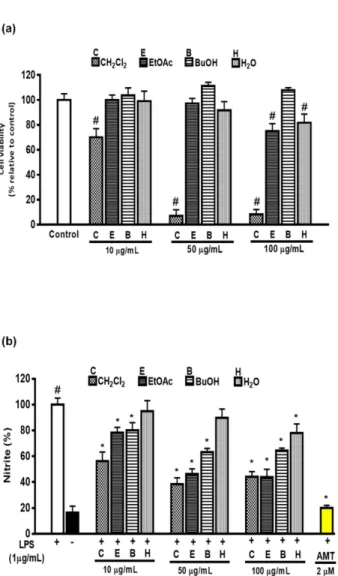
fraction inhibited LPS-stimulated NO production at 10, 50, and 100 µg/mL, with inhibition rates of 43.73%, 61.75%, and 55.93%, respectively. There was no significant difference in NO inhibition rate between concentrations of 50 and 100 µg/mL (Fig. 3). There was a slight increase in cell viability at 100 µg/mL compared to that at 50 µg/mL.

However, the difference between the two was not statisti- cally significant. In case of EtOAc fraction, tested con- centrations at 10, 50, and 100 µg/mL profoundly inhibited NO production, with average inhibition rates of 21.66%, 53.78%, and 56.15%, respectively (Fig. 3). Unexpectedly, concentration at 100 µg/mL did not show significant Fig. 2. Effects of MeOH extract on cell viability and LPS-

induced nitrite formation in RAW264.7 cells. Cell viability was measured by MTT assay.

Fig. 3. Effects of solvent soluble fractions of MeOH extract from Artemisia capillaris on cell viability (a) and LPS-induced nitrite formation (b) in RAW264.7 cells. Cells were pre-treated with different concentrations (10, 50 and 100 μg/mL) of CH

2

Cl

2

(C), EtOAc (E), BuOH (B), or H

2

O (H) fraction of MeOH extract from Artemisia capillaris followed by treatment with LPS (1 μg/

mL) and incubation for 18 h.

(5)

difference in NO suppression compared to concentration at 50 µg/mL. Such result might be due to cell toxicity at 100 µg/mL. Regarding n-BuOH fraction, at concentra- tions of 10, 50, and 100 µg/mL, it strongly decreased LPS-induced NO production at 20%, 37%, and 36%, respectively (Fig. 3). However, aqueous fraction of MeOH extract failed to potently attenuate LPS-triggered NO production at concentrations of 10, 50, or 100 µg/mL, with NO suppression rates of 5%, 10%, and 23%, respec- tively (Fig. 3). After treatment with aqueous fraction at concentrations of 10, 50, or 100 µg/mL, cell viabilities were 100%, 90%, and 20%, respectively (Fig. 3). As a positive control, AMT (2 µM) inhibited LPS-induced NO production by ~80%.

Protective Effects of Compounds Isolated from A.

capillaris against LPS-induced NO Production and Structure Activity Relationship − Bioactivity guided fractionation revealed that CH

2

Cl

2

, EtOAc, and n-BuOH fractions could strongly suppress LPS-induced NO accumu- lation. Therefore, systematic chromatographic techniques were used to isolate scopoletin, isoscopoletin, capillin, scoparone, and arcapillin from CH

2

Cl

2

fraction and scopolin, isoscopolin, quercetin 3-O-robinobioside (Q3R), isorhmanetin 3-O-robinobioside (IR3R), and quercetin 3- O-galactopyranosyl 7-O- α-L-rhamnoside (QGR) from n- BuOH fraction. Anti-inflammatory activities of isolated compounds from both fractions were further assessed based on their suppressive effects on inflammatory mediators released from macrophages upon exposure to LPS (1 µg/mL). As shown in Fig. 4, stimulation of cells

with LPS induced a dramatic increase in NO production from the basal level. However, pre-treatment with most of these compounds decreased inflammatory reactions by hampering NO release. Compound capillin possessed the most potent NO inhibitory effects even at low con- centrations of 0.062, 0.125, 0.25, 0.5 µM, with NO suppression rates of 20%, 23%, 65%, and 83.36%, respectively. Scopoletin also demonstrated NO inhibitory effects, with NO suppression rates of 5% and 35% at 50 and 100 µM, respectively. Although scopoletin at higher concentration (100 µM) showed promising NO inhibition effect, it failed to inhibit NO accumulation at lower concentrations (12.5 or 25 µM). Scopoletin at 100 µM displayed minute level of cell toxicity, although it was non-toxic at other concentrations (12.5 - 50 µM). On the other hand, isoscopoletin profoundly hindered NO release in a dose-dependent manner. NO inhibition rates by isoscopoletin at concentrations of 12.5, 25, 50, and 100 µM were 12%, 24%, 46%, 70%, respectively. Isosco- poletin at 100 µM showed minor cell toxicity, although it was non-toxic at concentrations of 12.5, 25, or 50 µM.

Although scopolin, isoscopolin, or scoparone was not toxic to RAW264.7 cells, they could not profoundly scavenge NO release at concentrations of 12.5 to 100 µM.

AMT, a positive control, inhibited NO accumulation by

~80%. Arcapillin isolated from CH

2

Cl

2

fraction significantly prevented NO release at 12.5 µM, with inhibition rate of 38%. At concentrations of 1.56, 3.12, 6.25 µM, NO inhibition rates were 18%, 23%, and 28%, respectively. It showed no cytotoxic effects at tested concentrations (1.56,

Fig. 4. Effects of capillin (a), scopoletin (b), isoscopoletin (c), scopolin (d), isoscopolin (e), or scoparone (f) isolated from Artemisia

capillaris on cell viability and LPS-induced NO production in RAW264.7 cells.

(6)

176 Natural Product Sciences

3.12, 6.25, 12.5 µM) (Fig. 5). Glucosides (Q3R, IR3R, QGR) demonstrated moderate inhibitory effects on LPS- activated NO accumulation at higher concentrations (25, 50, 100, 200 µM). However, these glucosides were cytotoxic at high concentrations (Fig. 5).

Effects of Compounds Isolated from A. capillaris on LPS-induced iNOS and COX-2 Expression in RAW264.7 Cells − Inflammatory markers such as iNOS and COX-2 play mighty roles in the progression of inflammation. To determine whether the inhibition of NO production in RAW264.7 cells was associated with down- regulation of iNOS protein expression, Western blot

analysis was performed. As illustrated in Fig. 6, iNOS and COX-2 expression was nearly undetectable in unstimulated cells. In contrast, iNOS and COX-2 band intensities were very high in LPS-treated cells with NO generation. Pretreatment with isoscopoletin or capillin effectively down-regulated iNOS and COX-2 protein expression in a dose response manner. Interestingly, such effect of capillin was more pronounced than that of isoscopoletin because capillin at lower concentrations (0.12 - 0.5 µM) showed apparent iNOS and COX-2 down- regulating effects.

Fig. 5. Effects of arcapillin (a), quercetin 3-O-robinobioside (Q3R) (b), isorhmanetin 3-O-robinobioside (IR3R) (c), or quercetin 3-O- galactopyranosyl 7- O-α-L-rhamnoside (QGR) (d) isolated from Artemisia capillaris on cell viability and LPS-induced NO production in RAW264.7 cells.

Fig. 6. Effects of capillin (a) or isoscopoletin (b) on the production of iNOS and COX-2 protein in RAW264.7 cells.

(7)

Discussion

Most inflammatory reactions are mediated by cytokines, chemokinesnitric, and interleukins.

12

These mediators from different sources can influence various reactions within the inflammatory process. Among these mediators, production of excess NO is widely accepted as the principal source of inflammatory reactions. Productions of iNOS and NO are positively associated with the patho- genesis of inflammatory and autoimmune diseases.

17

Transcriptional expression of iNOS can be induced by cytokines, microbial products, and radiation. The production and activity of iNOS can be induced in adipocytes by endotoxins and cytokines, leading to significant elevation of NO.

18

Over-expression of NO in obesity appears to contribute to impairment of muscle cell insulin sensitivity, β-cell dysfunction, and suppression of adipocyte differen- tiation.

19,20

In addition to iNOS, COX-2 is frequently produced during inflammatory reactions.

21

COX-2 expression is induced as pro-inflammatory mediator during an innate immune response.

22

Studies in animal models have shown that pharmacological inhibition or genetic deletions of COX-2 can lead to suppression of tumor growth.

23

Furthermore, inhibition of COX-2 could affect the production of inflammatory mediators.

24

Narcotic, steroidal, and non-steroidal anti-inflammatory drugs (NSAIDs) are currently treatment options against inflammation. However, these available drugs might have adverse effects, including hypertension due to analogy of steroidal drugs to the steroid hormones. Non-steroidal drugs have also posed adverse effects that include gastrointestinal bleeding and improper clotting of blood.

25

Therefore, the ultimate goal would be to obtain anti- inflammatory agents that are effective with minimal to no adverse effects even when they are administered over prolonged period. Plant derived natural products have proved to be the most reliable source of new therapeutic agents. These phytochemicals could serve as prototypes to develop more effective and less toxic medicines. The low toxicity of plant derived anti-inflammatories is attributed to biological compounds that are present in nature. Novel anti-inflammatory agents from plants have potential to have multiple targets as a phytoconstituent or a mixture.

As mixtures, several phytochemicals might be present and act on more than one target at a time which could result in faster and more efficient anti-inflammatory activity.

Hence, the role of medicinal plants in the treatment and management as well as possible prevention of inflamma- tion has attracted great attention.

Artemisia, a widespread and diverse genus in the

family of Asteraceae, comprises more than 500 species. It has been used traditionally used as anti-pyretic, anti- diabetic, anti-hypertensive, anti-hepatotoxic, anti-inflam- matory, eczema, jaundice, and anti-hemorrhoid. Owing to high number of species with ecological and economic importance, the genus Artemisia has been investigated extensively, focusing on its diverse biological activities.

26

However, anti-inflammatory therapeutic potential of Artemisia species, particularly A. capillaris extract, its fractions, or its anti-inflammatory responsible constituents, has not been explored yet. Therefore, the current study aimed to identify lead anti-inflammatory candidates from A. capillaris through bioguided extraction and fractio- nation. Bioactivity guided extraction revealed that MeOH extract significantly overturned the increased NO produc- tion mediated by LPS. In addition, CH

2

Cl

2

fractions strongly decreased LPS-stimulated NO production, with inhibition rates of 43.73% - 55.93%. However, such inhibition was closely related to the cytotoxic effect of CH

2

Cl

2

fraction. EtOAc fraction was found to be very pragmatic against NO generation. It profoundly inhibited NO release. In addition, n-BuOH fraction decreased LPS- activated NO secretion ina dose-dependent manner.

Interestingly, these obvious NO suppressive effects by n- BuOH fraction were not attributed to its cytotoxic aspects, but due to its protective potential based on cell viability data. Previous reports have also suggested anti-inflam- matory potential of A. capillaris. Ethanol extract of A.

capillaris has exerted anti-inflammatory effect by affecting mRNA expression levels of typical inflammatory cytokines (IL-6, IL1 β) and COX-2 in LPS-stimulated RAW264.7 cells. Additionally, this extract can inhibit NO production via downregulating iNOS transcription and expression levels of p38 and ERK proteins in LPS-stimulated RAW264.7 cells.

27

It has been reported that A. capillaris extract obtained by response surface methodology exerts marked anti-inammatory activity at cellular level.

28

Coumarins from A. capillaris and Angelica decursiva also exhibit anti-Alzheimer’s disease potential.

29

Moreover, tablets of A. capillaris have potential antiviral activity.

30

A.

iyawomogi and A. capillaris, referred to as ‘Hanjin’ and

‘Injin’, respectively, have been used in traditional medicinal

system in China, Korea, and Japan for treatment of

dieresis and inflammation related diseases. A. capillaris

extract can protect beta cells against cytokine-induced

beta-cell damage by suppressing NF-kappaB activation.

31

Infusions of buds, stems, and leaves of A. capillaris have

been used in TCM primarily as a choleric, anti-inflam-

matory, antipyretic, and diuretic agent for treating epidemic

hepatitis.

5

A. iyawomogi and A. capillaris have been used

(8)

178 Natural Product Sciences

in traditional medicinal system in China, Korea, and Japan for the treatment of dieresis and inflammation related diseases. It has been reported that 70% ethanol extract of aerial parts of A. capillaris shows potent inhibitory activity against 5-lipoxigenase-catalyzed leuko- triene production by ionophore-induced rat basophilic leukemia-1 cells.

15

Hong and Lee

12

have reported that ethyl acetate fraction of A. capillaris exhibits excellent protective effect by strengthening the antioxidant defense system, reducing the generation of reactive oxygen species, and damaging oxidative substances in the liver of high-fat diet induced obese mice. Chloroform extract of A. capillaris has anticarcinogenic activity against 7,12- dimethylbenzene anthracene (DMBA)-induced mouse epidermal carcinogenesis.

32

MeOH extract of A. maritime (L.) displays hepatoprotective activity against acetami- nophen and CCl

4

-induced hepatic damage.

33

Benli et al.

34

have shown that MeOH, chloroform, and acetone extracts of A. dracunculus display antimicrobial activity against nine bacterial and four yeast isolates. Another study has revealed that MeOH extract and chloroform fraction of A.

dracunculus can suppress platelet aggregation to laminin coated wells by 50% and 60%, respectively.

35

Extract of A. campestris (L.) can scavenge radicals generation and protected liver against CCl4-induced toxicity.

36

Anti-inflammatory activities of isolated compounds were assessed for their suppressive effects on inflammatory mediators released from macrophages upon exposure to LPS (1 µg/mL). Capillin particularly exhibited strong inhibition effect on NO release from RAW264.7 cells induced by LPS even at lower concentrations. Moreover, capillin was able to effectively defend RAW264.7 cells against LPS-stimulated NO without inducing cytotoxic effects at concentration up to 0.25 µM. Effects of polya- cetylene compounds such as capillin, capillene, capillinol, cis-dehydromatricaria ester, and transdehydromatricaria ester on Tribolium castaneum have been investigated.

Results showed that these crude essential oil derived polyacetylenes possessed fair repellent and fumigant activities.

37

Capillin and capillinol from A. capillaris have shown promising anti-diabetic effects.

38

Capillin, a com- ponent of the essential oil isolated from A. capillaris, has exhibited antimicrobial activity against Trichophyton mentagrophytes, Pyricularia oryzae, Candida albicans, Bacillus subtilis, E. coli, and Cochliobolus miyabeanus.

39

Capillin can potently inhibit growth of human leukemia HL-60 cells. Cytotoxic effects of capillin in cells were found to be associated with apoptosis. Capillin induced apoptosis in HL-60 cells via the mitochondrial apoptotic pathway which might be controlled through JNK

signaling.

40

In the present study, scopoletin exhibited NO inhibitory effects at higher concentration (100 µM), showing promising NO inhibition. In addition, scopoletin displayed minute cell toxicity at 100 µM. On the other hand, isoscopoletin profoundly blocked NO release in a dose-dependent manner. Interestingly, isoscopoletin also exhibited slight cell toxicity at 100 µM. In parallel, isoscopoletin was found to be more active than scopoletin to counteract NO release from RAW264.7 cells. Although scopolin, isoscopolin, or scoparone was not toxic to RAW264.7 cells, neither of them could profoundly scavenge NO release at tested concentrations (12.5 - 100 µM). Arcapillin significantly prevented NO release at higher does. At other concentrations, it moderately inhibited NO release. Flavonoid glycosides (Q3R, IR3R, QGR) demonstrated moderate inhibitory effects in response to LPS-activated NO accumulation at higher concentrations. However, they showed cell toxicity at such concentrations. Subsequently, the current study validated that flavonoids, coumarins, and polyacetylenes exhibited profound anti-inflammatory properties by blocking NO release from LPS-activated RAW264.7 cells.

Arcapillin has shown promising advanced glycation end product formation, showing IC

50

= 77.84 ± 1.07 μm com- pared to aminoguanidine, a positive control, with IC

50

= 932.66 ± 4.94. Isorhamnetin 3-O-robinobioside (IR3R) has been evaluated for its ability to induce apoptosis in human lymphoblastoid cells (TK6). The apoptosis was confirmed by DNA fragmentation and poly (ADP-ribose) polymerase (PARP) cleavage, indicating the release of caspase-3 level. Results indicated that the IR3R had great anti-proliferative effect on human lymphoblastoid (TK6) cells which might be due to their involvement in the apoptotic pathway.

41

Furthermore, IR3R can protect against lipid peroxidation induced by H

2

O

2

. Similarly, other reports have validated that flavonoids and a coumarin (6,7-dimethylesculetin) isolated from buds of A. capillaris possess significant antihepatotoxic activity by decreasing carbon tetrachloride-induced liver lesions both in vivo and in vitro.

42

Structure activity relationship in the present study revealed some interesting facts. Among tested compounds (scopoletin, isoscopoletin, scopolin, isoscopolin, and scoparone), both methoxy and OH groups played important role in hampering NO accumulation. The presence of methoxy group at C-6 and OH group at C-7 seemed to decrease the inhibitory potential of scopoletin.

However, alternation of methoxy and OH groups at

subsequent C-6 and C-7 positions evidently enhanced the

activity of isoscopoletin compared to scopoletin. Although

glycosylation significantly hindered the inhibitory potential

(9)

as noticed in the case of scopolin and isoscopolin and denied the role of hydorxy and glucose moiety substitution at either C-6 or C-7 positions toward NO inhibition. The presence of additional OCH

3

group in scoparone also diminished its activity. Hence, there was no significant NO inhibition by scoparone even at higher concentration.

Targeting inflammatory mediators has been a means of therapy for inflammatory conditions. Selective inhibition of the expression and activity of iNOS and COX-2 is the current medical intervention strategy for inflammatory conditions. It could result in the reduction of inflammatory response. Therefore, inhibition of iNOS and COX-2 would be ideal to relieve inflammation and possibly prevent disease. Inhibitors could play another role by quenching free radicals to attenuate chronic inflammation. Pretreatment with isoscopoletin or capillin markedly down-regulated iNOS and COX-2 expression in a dose response manner.

In particular, capillin was more effective than isoscopoletin because capillin at lower doses (0.12 - 0.5 µM) manifested apparent iNOS and COX-2 down-regulatory effects.

Taking together, results of the current investigation provided evidence for the first time that MeOH extract and CH

2

Cl

2,

EtOAc, n-BuOH fractions from A. capillaris and its derived mediators could strongly block inflammatory reactions in RAW264.7 macrophages. These effects might be by hampering NO signaling. Of particular interest, capillin from CH

2

Cl

2

fraction and isoscopoletin from n- BuOH fraction strongly blocked NO accumulation.

Furthermore, Western blotting analysis showed that NO suppression was likely associated with regulation of iNOS and COX-2 expression, indicating therapeutic potential of A. capillaris for the development of anti-inflammatory lead candidates. These molecules further down-regulated iNOS and COX-2 protein expressions known to play a vital role in the release of NO in response to LPS. Clearly, there is a tremendous need to explore therapeutic and preventive potential of A. capillaris with the aim to design new clinical treatment strategies for inflammation. The present investigation provides the first evidence of pharma- cological perspectives of A. capillaris against inflamma- tion. It might harbor lead anti-inflammatory candidates to prevent inflammation.

Acknowledgements

This research was supported by the Basic Science Research Program through the National Research Foun- dation of Korea (NRF), funded by the Ministry of Education (2012R1A6A1028677).

References

(1) Murakami, M.; Hirano, T. Front. Immunol. 2012, 3, 1-2.

(2) Sharma, J. N.; Al-Omran, A.; Parvathy, S. S. Inflammopharmacology 2007, 15, 252-259.

(3) Bognar, E.; Sarszegi, Z.; Szabo, A.; Debreceni, B.; Kalman, N.;

Tucsek, Z.; Sumegi, B.; Gallyas, F. Jr. PLoS One 2013, 8, e65355.

(4) Rhule, A.; Navarro, S.; Smith, J. R.; Shepherd, D. M. J.

Ethnopharmacol. 2006, 106, 121-128.

(5) Tang, W.; Eisenbrand, G. Chinese drugs of plant origin, chemistry, phamacology and use in traditional and modern medicine: Springer Verlag, New York, 1992, p 179.

(6) Hong, J. H.; Lee, J. W.; Park, J. H.; Lee, I. S. Biofactors 2007, 31, 43-53.

(7) Seo, K. S.; Yun, K. W. Korean J. Plant Res. 2008, 21, 292-298.

(8) Lee, C. J.; Kim, H. Y.; Kim, J. D.; Kim, C. H. J. Korean Orient.

Med. 2000, 21, 100-107.

(9) Choi, J. H.; Kim, D. W.; Yun, N.; Choi, J. S.; Islam, M. N.; Kim, Y.

S.; Lee, S. M. J. Nat. Prod. 2011, 74, 1055-1060.

(10) Seo, K. S.; Jeong, H. J.; Yun, K. W. J. Ecol. Field Biol. 2010, 33, 141-147.

(11) Cha, J. D.; Moon, S. E.; Kim, H. Y.; Cha, I. H.; Lee, K. Y. J. Food Sci. 2009, 74, 75-81.

(12) Hong, J. H.; Lee, I. S. Biofactors 2009, 35, 380-388.

(13) Okuno, I.; Uchida, K.; Kadowaki, M.; Akahori, A. Jpn. J.

Pharmacol. 1981, 31, 835-838.

(14) Jung, H. A.; Park, J. J.; Islam, M. N.; Jin, S. E.; Min, B. S.; Lee, J.

H.; Sohn, H. S.; Choi, J. S. Arch. Pharm. Res. 2012, 35, 1021-1035.

(15) Kwon, O. S.; Choi, J. S.; Islam, M. N.; Kim, Y. S.; Kim, H. P.

Arch. Pharm. Res. 2011, 34, 1561-1569.

(16) Nurul Islam, M.; Jung, H. A.; Sohn, H. S.; Kim, H. M.; Choi, J. S.

Arch. Pharm. Res. 2013, 36, 542-552.

(17) Pautz, A.; Art, J.; Hahn, S.; Nowag, S.; Voss, C.; Kleinert, H. Nitric Oxide 2010, 23, 75-93.

(18) Ribiere, C.; Jaubert, A. M.; Gaudiot, N.; Sabourault, D.; Marcus, M. L.; Boucher, J. L.; Denis-Henriot, D.; Giudicelli, Y. Biochem. Biophys.

Res. Commun. 1996, 222, 706-712.

(19) Mitrovic, B.; Ignarro, L. J.; Montestruque, S.; Smoll, A.; Merrill, J.

E. Neuroscience 1994, 61, 575-585.

(20) Kawachi, H.; Moriya, N. H.; Korai, T.; Tanaka, S. Y.; Watanabe, M.; Matsui, T.; Kawada, T.; Yano, H. Mol. Cell. Biochem. 2007, 300, 61- 67.

(21) Rayburn, E. R.; Ezell, S. J.; Zhang, R. Mol. Cell Pharmacol. 2009, 1, 29-43.

(22) Mulabagal, V.; Alexander-Lindo, R. L.; Dewitt, D. L.; Nair, M. G.

Evid. Based Complement. Alternat. Med. 2011, 11, 1-6.

(23) Yan, Y.; Li, J.; Ouyang, W.; Ma, Q.; Hu, Y.; Zhang, D.; Ding, J.;

Qu, Q.; Subbaramaiah, K.; Huang, C. J. Cell Sci. 2006, 119, 2985-2994.

(24) Turini, M. E.; DuBois, R. N. Annu. Rev. Med. 2002, 53, 35-57.

(25) Burk, D. R.; Cichacz, Z. A.; Daskalova, S. M. J. Med. Plant. Res.

2010, 4, 225-234.

(26) Valles, J.; Torrell, M.; Garnatje, T.; Garcia-Jacas, N.; Vilatersana, R.; Susanna, A. Plant Biol. 2003, 5, 274-284.

(27) Lim, H. K.; Cho, S. K.; Park, S.; Cho, M. J. Korean Soc. Appl.

Biol. Chem. 2010, 53, 275-282.

(28) Jang, M.; Jeong, S. W.; Kim, B. K.; Kim, J. C. BioMed. Res. Int.

2015, 2015, 872718.

(29) Ali, M. Y.; Jannat, S.; Jung, H. A.; Choi, R. J.; Roy, A.; Choi, J. S.

Asian Pac. J. Trop. Med. 2016, 9, 103-111.

(30) Han, J.; Zhao, Y. L.; Shan, L. M.; Huang, F. J.; Xiao, X. H. Chin. J.

Integr. Med. 2005, 11, 54-56.

(31) Kim, E. K.; Kwon, K. B.; Han, M. J.; Song, M. Y.; Lee, J. H.; Lv,

N.; Choi, K. B.; Ryu, D. G.; Kim, K. S.; Park, J. W.; Park, B. H. Int. J.

(10)

180 Natural Product Sciences

Mol. Med. 2007, 19, 535-540.

(32) Kim, Y. S.; Bahn, K. N.; Hah, C. K.; Gang, H. I.; Ha, Y. L. J. Food Sci. 2008, 73, 16-20.

(33) Janbaz, K. H.; Gilani, A. H. J. Ethnopharmacol. 1995, 47, 43-47.

(34) Benli, M.; Kaya, I.; Yigit, N. Cell Biochem. Funct. 2007, 25, 681- 686.

(35) Shahriyary, L.; Yazdanparast, R. J. Ethnopharmacol. 2007, 114, 194-198.

(36) Aniya, Y.; Shimabukuro, M.; Shimoji, M.; Kohatsu, M.; Gyamfi, M. A.; Miyagi, C.; Kunii, D.; Takayama, F.; Egashira, T. Biol. Pharm.

Bull. 2000, 23, 309-312.

(37) Zhang, Z.; Guo, S. S.; Zhang, W. J.; Geng, Z. F.; Liang, J. Y.; Du, S. S.; Wang, C. F.; Deng, Z. W. Ind. Crops Prod. 2017, 100, 132-137.

(38) Islam, M. N.; Choi, R. J.; Jung, H. A.; Oh, S. H.; Choi, J. S. Arch.

Pharm. Res. 2016, 39, 340-349.

(39) Tanaka, K. Seikagaku 1961, 33, 399-409.

(40) Masuda, Y.; Asada, K.; Satoh, R.; Takada, K.; Kitajima, J.

Phytomedicine 2015, 22, 545-552.

(41) Jihed, B.; Bhouri, W.; Ben Sghaier, M.; Bouhlel, I.; Kriffi, M.;

Skandrani, I.; Dijoux, F. M.; Ghedira, K.; Chekir-Ghedira, L. Nutr.

Cancer 2012, 64, 1095-1102.

(42) Kiso, Y.; Ogasawara, S.; Hirota, K.; Watanabe, N.; Oshima, Y.;

Konno, C.; Hikino, H. Planta Med. 1984, 50, 81-85.

Received March 9, 2018

Revised April 12, 2018

Accepted April 13, 2018

수치

Fig. 3. Effects of solvent soluble fractions of MeOH extract from Artemisia capillaris on cell viability (a) and LPS-induced nitrite formation (b) in RAW264.7 cells
Fig. 4. Effects of capillin (a), scopoletin (b), isoscopoletin (c), scopolin (d), isoscopolin (e), or scoparone (f) isolated from Artemisia capillaris on cell viability and LPS-induced NO production in RAW264.7 cells
Fig. 6. Effects of capillin (a) or isoscopoletin (b) on the production of iNOS and COX-2 protein in RAW264.7 cells.

참조

관련 문서

Anti-inflammatory effects between Ojeok-san Extract Powder group and Soft Extract groups in LPS induced inflammatory models (n=5, mean±SD, p: p value of ANOVA

Effect of Oenanthe javanica ethanol extract (OJE) on LPS-induced p-IκBα, IκBα, iNOS, and COX-2 proteins expression in RAW 264.7 cells.. After pretreatment with the

Effect of Zostera marina ethanolic extract (ZMEE) on LPS-induced iNOS, COX-2, and NF-κB p65 expression in LPS-induced RAW246.7 cells.. The levels of iNOS, COX-2 in the

Effects of Gagamtongsoon-San (GT) Extract on iNOS Gene Expression Ratio in LPS(Lipopolysaccharide)-Stimulated RAW264.7 cells.. The values represent mean

Inhibitory effect of methanol extract (A) and hot-water extract (B) from fruiting bodies of Dictyophora indusiata on LPS-induced nitrite production in RAW 264.7.. cell line

Effect of Oenanthe javanica ethanol extract (OJE) on LPS-induced p-IκBα, IκBα, iNOS, and COX-2 proteins expression in RAW 264.7 cells.. After pretreatment with the

Effect of Agrimoniae Herba exthanol extract on LPS- induced expression of inflammatory cytokines in RAW264.7 cells.. (B) Each band was analyzed per a GAPDH as

Methods : To measure out the cytotoxicity of LE, we performed the MTT assay. Aqueous extract from LE inhibited LPS-induced productions of inflammatory