• 검색 결과가 없습니다.

Rituximab-CHOP Induced Interstitial Pneumonitis in Patients with Disseminated Extranodal Marginal Zone B Cell Lymphoma

N/A
N/A
Protected

Academic year: 2022

Share "Rituximab-CHOP Induced Interstitial Pneumonitis in Patients with Disseminated Extranodal Marginal Zone B Cell Lymphoma"

Copied!
4
0
0

로드 중.... (전체 텍스트 보기)

전체 글

(1)

Yonsei Med J 49(1):155 - 158, 2008 DOI 10.3349/ymj.2008.49.1.155

Yonsei Med J Vol. 49, No. 1, 2008 A 69-year-old male was diagnosed in February 2004 with

stage IV extranodal marginal zone B cell lymphoma involving the mediastinal nodes, lung parenchyma and bone marrow with high LDH. Shortness of breath developed following the 5th course of Rituximab-CHOP chemotherapy (cyclophospha- mide, Vincristine, Doxorubicin, Prednisolone). Bronchoscopy guided transbronchial lung biopsy revealed interstitial thickening and type II pneumocyte activation, compatible with interstitial pneumonitis. After treatment with prednisolone a complete resolution of the dyspnea was observed. The patient was well on routine follow-up at the outpatient clinic, with no progression of lymphoma or interstitial pneumonitis.

Key Words: Interstitial pneumonitis, rituximab, lymphoma

INTRODUCTION

Rituximab, a chimeric anti-CD20 IgG1 mono- clonal antibody, is an effective treatment for B-cell low grade lymphomas. This includes extranodal marginal zone B cell lymphoma,

1-3

diffuse large B-cell lymphoma,

4

refractory idiopathic thrombo- cytopenic purpura,

5

and other autoimmune disorders.

6

The proposed mechanism of action for this depletion includes antibody-dependent cell-me- diated cytotoxicity, complement-dependent cyto- toxicity, and direct induction of apoptosis.

7

Interstitial pneumonitis and bronchiolitis obliterans with organizing pneumonia

8-10

have been recently reported when using rituximab alone or in combination with other medications.

We report a case of interstitial pneumonitis in a patient with disseminated extranodal marginal zone B cell lymphoma after the 5th cycle of rituximab and CHOP.

CASE REPORT

A 69-year-old male was diagnosed in February 2004 with stage IV extranodal marginal zone B cell lymphoma involving the mediastinal nodes, lung parenchyma and bone marrow.

Past medical history included one vessel disease, for which the patient underwent percutaneous coronary angioplasty; diabetes mellitus, and hypercholesterolemia. Medications included glim- epiride, aspirin, isosorbide dinitrate, nicoradil, and atorvastatin. None of these drugs had been taken since the diagnosis of non-Hodgkin’s lymphoma.

Following the 5th course of rituximab-CHOP chemotherapy the patient was admitted with neutropenic fever accompanied by generalized weakness and mucositis.

Empiric broad spectrum antibiotics were started along with granulocyte-colony stimulating factor.

Despite recovery of the neutrophil count, the shortness of breath was aggravated and arterial blood gas analysis revealed hypoxemia (PaO

2

= 55).

Gram stain and special stains of the sputum for

Rituximab-CHOP Induced Interstitial Pneumonitis in Patients with Disseminated Extranodal Marginal Zone B Cell Lymphoma

Kwang Min Kim,

1

Ho-Cheol Kim,

1,3

Kyung-Nyeo Jeon,

2,3

Hoon-Gu Kim,

1,3,4

Jung Hun Kang,

1,3,4

Jong Ryeal Hahm,

1,3

and Gyeong-Won Lee

1,3,4

1

Department of Internal Medicine, College of Medicine, Gyeongsang National University, Jinju;

2

Department of Diagnostic Radiology, College of Medicine, Gyeongsang National University, Jinju;

3

Gyeongsang Institute of Health Science, Jinju;

4
Gyeongnam Regional Cancer Center, Jinju, Korea.

Received July 20, 2006 Accepted October 2, 2006

Reprint address: requests to Dr. Gyeong-Won Lee, Division of Hematology-Oncology, Department of Internal Medicine, College of Medicine, Gyeongsang National University, Jinju 660-702, Korea.

Tel: 82-55-750-8066, Fax: 82-55-758-9122, E-mail: brightree@

lycos.co.kr

(2)

Kwang Min Kim, et al.

Yonsei Med J Vol. 49, No. 1, 2008

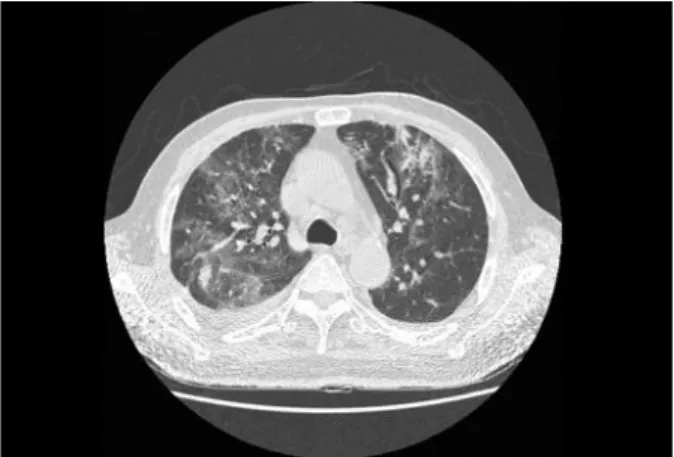
acid-fast bacilli, pneumocystis carinii, and fungi were negative. Routine cultures for bacteria, fungi and mycobacteria yielded no growth. A chest X-ray showed progressive infiltrates in both lung fields. A computed tomography (CT) scan of the lung revealed bilateral patchy ground-glass opacities, suggestive of new onset interstitial pneumonitis. CT also showed a reduced primary mass in the right middle lobe, consistent with the initial primary lesion (Fig. 1).

Extrathoracic echocardiogram showed normal left ventricular contractility with unaltered ejection fraction. Cardiac enzymes were also normal.

Ventilation perfusion scan showed no evidence of pulmonary artery embolism. Fiberoptic bronchos- copy revealed no evidence of endobronchial lesion. No malignant cells were found in the bronchoalveolar lavage fluid.

Gram stains, special analysis and cell cultures obtained from BAL and sputum following fiberoptic bronchoscopy were negative for bacteria, acid-fast bacilli, fungi and pneumocystis carinii.

Bronchoscopy guided transbronchial lung biopsy was performed, showing interstitial thickening and type II pneumocyte activation compatible with interstitial pneumonitis (Fig. 2).

The patient was treated with prednisolone, 1 mg/kg a day, for 2 weeks. The dyspnea and tachypnea gradually improved, in addition to blood oxygenation and chest X-ray. A subsequent CT scan following prednisolone treatment showed marked improvement of the multifocal patchy interstitial infiltration and ground glass opacities;

as well as a reduction in the primary lymphoma lesion.

After 42 days of hospitalization, the patient was discharged on a tapering prednisolone regimen.

He experienced complete resolution of dyspnea and dyspnea on exertion. He was well on routine follow-up at the outpatient clinic, with no lymphoma progression or interstitial pneumonitis.

DISCUSSION

The optimal therapeutic management for patients with non-gastric extranodal marginal zone B cell lymphoma has not yet been defined. For localized disease, local treatment (either radiotherapy or

surgery) will typically achieve excellent disease control.

11-13

When the disease is advanced or dis- seminated, several chemotherapeutic agents alone in combination are usually administered. These regimens include alkylating agents, anthracyclins, steroids, and purine analogs.

2,3,13

Anthracylines- based chemotherapy is typically recommended in patients with histological transformation or with high tumor mass (i.e. high LDH or a mass greater than 7 cm).

13

The use of rituximab alone or combination with cytotoxic chemotherapeutic agents is a new treat- ment breakthrough in disseminated or refractory disease. This is because extranodal marginal zone B cells typically express the CD20 antigen.

13,14

Adverse pulmonary reactions to rituximab occur as reversible events during the first infusion in 38% of patients. In addition, severe human

Fig. 1. Computed tomography of the chest, showing new bilateral patchy ground-glass opacities.

Fig. 2. Transbronchial lung biopsy, showing interstitial

thickening and type II pneumocyte activation (× 200,

hematoxylin and eosin).

(3)

Rituximab-CHOP Induced ILD in EMZBCL

Yonsei Med J Vol. 49, No. 1, 2008

antibody infusion reactions, generally occurring during the first 2 hours of the first infusion, can present with hypotension or angioedema. Pulmo- nary involvement manifests in the form of bronchospasm, hypoxia, infiltrates and even acute respiratory distress syndrome.

15

Late occurring pulmonary toxicities after the administration of rituximab have rarely been reported.

8-10,15-18

Mechanisms leading to rituximab-induced inter- stitial lung disease are not yet completely elucidated. However, dysregulated cellular cytoto- xicity may be related to a mechanism of delayed pulmonary toxicity.

17,19

Cytotoxic T lymphocytes (CTL) are believed to play an important role in long term anti-tumor effects after rituximab treatment.

17,19

Their activation (‘cross-priming’) appears to be induced by dendritic cells, which mature under the influence of cell-derived peptides resulting from rituximab-induced tumor destruction.

17,19

CTL activation may produce vascular and alveolar damage. Disturbed cellular cytotoxicity can also result from the interaction of rituximab with CD 20+ T-cells,

17,20-22

or by cross- reactivity between lung and tumoral antigens with possible generation of a self reactive clone

17

Pulmonary leukostasis is associated with activation of the complement system and changes in endothelial adhesivity induced by elevated cytokine levels. This leukostasis may also con- tribute to the dyspnea and bronchospasm often encountered in patients with high tumor burden after treatment with rituximab.

17,23,24

The emergence of pulmonary infiltrates in patients treated with rituximab and CHOP chemotherapy remains a difficult diagnostic problem. Many differential diagnoses need to be considered, including lymphoma progression, infection, cardiogenic edema, radiation pneumonitis, pulmonary hemorrhage, and allergies.

One of the major clinical challenges in these patients is ruling out opportunistic infection or lymphoma progression. The infectious etiologies of diffuse interstitial infiltrates in the lungs are multiple.

25

They include any Gram-negative or Gram-positive agents, fungi (Aspergillus, Candida), parasites (Pneumocystis carinii, Toxoplasma gondii), or viruses (Herpes simplex, Varicella zoster, Cytomegalovirus).

25

Non-invasive tests and studies such as chest

X-ray, CT scan, echocardiogram, pulmonary function tests, and arterial blood gas analysis can easily determine the pattern of pulmonary disease present. However, fiberoptic bronchoscopy with bronchoalveolar lavage and lung biopsy is usually necessary to eliminate infection or lymphoma progression. The exclusion of all known etiologic factors associated with pulmonary interstitial infiltrates is essential for diagnosing rituximab- induced interstitial pneumonitis.

We conclude that physicians should be aware of this rare, but possible complication of interstitial pneumonitis after combination rituximab-CHOP chemotherapy.

REFERENCES

1. Hiddemann W, Kneba M, Dreyling M, Schmitz N, Lengfelder E, Schmits R, et al. Frontline therapy with rituximab added to the combination of cyclopho- sphamide, doxorubicin, vincristine, and prednisone (CHOP) significantly improves the outcome for patients with advanced-stage follicular lymphoma compared with therapy with CHOP alone: results of a prospective randomized study of the German Low-Grade Lym- phoma Study Group. Blood 2005;106:3725-32.

2. Ahmed S, Kussick SJ, Siddiqui AK, Bhuiya TA, Khan A, Sarewitz S, et al. Bronchial-associated lymphoid tissue lymphoma: a clinical study of a rare disease. Eur J Cancer 2004;40:1320-6.

3. Conconi A, Martinelli G, Thieblemont C, Ferreri AJ, Devizzi L, Peccatori F, et al. Clinical activity of rituximab in extranodal marginal zone B-cell lym- phoma of MALT type. Blood 2003;102:2741-5.

4. Coiffier B. State-of-the-art therapeutics: diffuse large B-cell lymphoma. J Clin Oncol 2005;23:6387-93.

5. Braendstrup P, Bjerrum OW, Nielsen OJ, Jensen BA, Clausen NT, Hansen PB, et al. Rituximab chimeric anti-CD20 monoclonal antibody treatment for adult refractory idiopathic thrombocytopenic purpura. Am J Hematol 2005;78:275-80.

6. Higashida J, Wun T, Schmidt S, Naguwa SM, Tuscano JM. Safety and efficacy of rituximab in patients with rheumatoid arthritis refractory to disease modifying antirheumatic drugs and anti-tumor necrosis factor- alpha treatment. J Rheumatol 2005;32:2109-15.

7. Maloney DG, Smith B, Rose A. Rituximab: mechanism of action and resistance. Semin Oncol 2002;29(1 Suppl 2):2-9.

8. Kanelli S, Ansell SM, Habermann TM, Inwards DJ, Tuinstra N, Witzig TE. Rituximab toxicity in patients with peripheral blood malignant B-cell Lymphocytosis.

Leuk Lymphoma 2001;42:1329-37.

(4)

Kwang Min Kim, et al.

Yonsei Med J Vol. 49, No. 1, 2008

9. Burton C, Kaczmarski R, Jan-Mohamed R. Interstitial pneumonitis related to rituximab therapy. N Engl J Med 2003;348:2690-1.

10. Byrd JC, Peterson BL, Morrison VA, Park K, Jacobson R, Hoke E, et al. Randomized phase 2 study of fludarabine with concurrent versus sequential treatment with rituximab in symptomatic, untreated patients with B-cell chronic lymphocytic leukemia: results from Cancer and Leukemia Group B 9712 (CALGB 9712).

Blood 2003;101:6-14.

11. Tsang R, Gospodarowicz MK, Pintilie M, Bezjak A, Wells W, Hodgson DC, et al. Stage I and II MALT lymphoma: results of treatment with radiotherapy. Int J Radiat Oncol Biol Phys 2001;50:1258-64.

12. Schechter NR, Portlock CS, Yahalom J. Treatment of mucosa-asociated lymphoid tissue lymphoma of the stomach with radiation alone. J Clin Oncol 1998;16:

1916-21.

13. Thieblemont C. Clinical presentation and management of marginal zone lymphomas. Hematology Am Soc Hematol Educ Program 2005;307-13.

14. Soda R, Costanzo A, Cantonetti M, Orlandi A, Bianchi L, Chimenti S. Systemic therapy of primary cutaneous B-cell lymphoma, marginal zone type, with rituximab, a chimeric anti-CD20 monoclonal antibody. Acta Derm Venereol 2001;81:207-8.

15. Lee Y, Kyung SY, Choi SJ, Bang SM, Jeong SH, Shin DB, et al. Two cases of interstitial pneumonitis caused by rituximab therapy. Korean J Intern Med 2006;21:

183-6.

16. Hainsworth JD, Litchy S, Lamb MR, Rodriguez GI, Scroggin C Jr, Greco FA. First-line treatment with brief-duration chemotherapy plus rituximab in elderly patients with intermediate-grade non-Hodgkin's lymphoma: phase II trial. Clin Lymphoma 2003;4:36-42.

17. Alexandrescu DT, Dutcher JP, O'Boyle K, Albulak M, Oiseth S, Wiernik PH. Fatal intra-alveolar hemorrhage

after rituximab in a patient with non-Hodgkin lymphoma. Leuk Lymphoma 2004;45:2321-5.

18. Herishanu Y, Polliack A, Leider-Trejo L, Grieff Y, Metser U, Naparstek E Fatal interstitial pneumonitis related to rituximab-containing regimen. Clin Lymphoma Myeloma 2006;6:407-9.

19. Selenko N, Maidic O, Draxier S, Berer A, Jäger U, Knapp W, et al. CD20 antibody (C2B8)-induced apoptosis of lymphoma cells promotes phagocytosis by dendritic cells and cross-priming of CD8+ cytotoxic T cells. Leukemia 2001;5:1619-26.

20. Hultin LE, Hausner MA, Hultin PM, Giorgi JV. CD20 (pan-B cell) antigen is expressed at a low level on a subpopulation of human T lymphocytes. Cytometry 1993;14:196-204.

21. Algino KM, Thomason RW, King DE, Montiel MM, Craig FE. CD20 (pan-B cell antigen) expression on bone marrow-derived T cells. Am J Clin Pathol 1996;106:78- 81.

22. Warzynski MJ, Graham DM, Axtell RA, Zakem MH, Rotman RK. Low level CD20 expression on T cell malignancies. Cytometry 1994;18:88-92.

23. Jensen M, Winkler U, Manzke O, Diehl V, Engert A.

Rapid tumor lysis in a patient with B-cell chronic lymphocytic leukemia and lymphocytosis treated with an anti-CD20 monoclonal antibody (IDEC-C2B8, rituxi- mab). Ann Hematol 1998;77:89-91.

24. Byrd JC, Waselenko JK, Maneatis TJ, Murphy T, Ward FT, Monahan BP, et al. Rituximab therapy in hematologic malignancy patients with circulating blood tumor cells: association with increased infusion-related side effects and rapid blood tumor clearance. J Clin Oncol 1999;17:791-5.

25. Merad M, Le Cesne A, Baldeyrou P, Mesurolle B, Le

Chevalier T. Docetaxel and interstitial pulmonary

injury. Ann Oncol 1997;8:191-4.

수치

Fig. 1. Computed tomography of the chest, showing new bilateral patchy ground-glass opacities.

참조

관련 문서

B: HAZ (Heat Affected Zone; affected by heat generated during FSW ) C: TMAZ (Thermomechanically Affected Zone; contains material that interacts indirectly with

MC3T3-E1 cell morphorologies on the (a) CP-Ti surface and (b) nano-mesh surface for 20 min culturing time.. MC3T3-E1 cell morphorologies on the (a) CP-Ti surface and

(Saturated zone is the zone in which the voids in the soil and rocks are filled with water at a pressure greater than atmospheric pressure).. (Unsaturated zone is the zone

Compromised CD4+ CD25(high) regulatory T-cell function in patients with relap sing-remitting multiple sclerosis is correlated with a reduced frequency of

The combination treatment of PBA and 6-gingerol induced the cleavage of caspase-3, caspase-4, PARP, GRP78, p-eIF2α, and CHOP in DU145 cells and Western blot analysis for

6.5 Illustrating (a) possible sites for interstitial atoms in bcc lattice, and (b) the large distortion necessary to accommodate a carbon atom (1.54 Å diameter) compared

Post-surgical use of radioiodine (131I) in patients with papillary and follicular thyroid cancer and the issue of remnant ablation: a consensus

• Phase II clinical trials of PI3Kδ inhibitor (idelalisib) showed dramatic response in patients with previously treated indolent non-hodgkin’s