• 검색 결과가 없습니다.

I Transcaval TIPS in Patients with FailedRevision of Occluded Previous TIPS

N/A
N/A
Protected

Academic year: 2022

Share "I Transcaval TIPS in Patients with FailedRevision of Occluded Previous TIPS"

Copied!
6
0
0

로드 중.... (전체 텍스트 보기)

전체 글

(1)

Transcaval TIPS in Patients with Failed Revision of Occluded Previous TIPS

Objective: To determine the feasibility of transcaval transjugular intrahepatic portosystemic shunt (TIPS) in patients with occluded previous TIPS.

Materials and Methods: Between February 1996 and December 2000 we per- formed five transcaval TIPS procedures in four patients with recurrent gastric car- diac variceal bleeding. All four had occluded TIPS, which was between the hepat- ic and portal vein. The interval between initial TIPS placement and revisional pro- cedures with transcaval TIPS varied between three and 31 months; one patient underwent transcaval TIPS twice, with a 31-month interval. After revision of the occluded shunt failed, direct cavoportal puncture at the retrohepatic segment of the IVC was attempted.

Results: Transcaval TIPS placement was technically successful in all cases. In three, tractography revealed slight leakage of contrast materials into hepatic sub- capsular or subdiaphragmatic pericaval space. There was no evidence of propa- gation of extravasated contrast materials through the retroperitoneal space or spillage into the peritoneal space. After the tract was dilated by a bare stent, no patient experienced trans-stent bleeding and no serious procedure-related com- plications occurred. After successful shunt creation, variceal bleeding ceased in all patients.

Conclusion: Transcaval TIPS placement is an effective and safe alternative treatment in patients with occluded previous TIPS and no hepatic veins suitable for new TIPS.

t has been reported that transjugular intrahepatic portosystemic shunt (TIPS) is a useful procedure in the treatment of patients with uncon- trolled variceal hemorrhage or intractable abdominal ascites resulting from portal hypertension (1). It is an interventional procedure leading to decompres- sion of the splanchnic venous system in patients with portal hypertension by creating a low-resistance channel between an intrahepatic branch of the portal vein and a main hepatic vein. Although it has gained wide acceptance for the management of portal hypertension, a number of major problems such as an increased risk of hepatic en- cephalopathy and a high rate of shunt dysfunction have been associated with the tech- nique (2 8).

Shunt dysfunction is a consequence of shunt stenosis or occlusion, and can lead to recurrent bleeding or ascites. Thus, early detection and correction of shunt dysfunction may improve the secondary patency rate of TIPS. In most patients, TIPS revision is a safe and effective means of restoring shunt patency and achieving symptomatic relief.

In some cases, however, TIPS patency cannot be restored in the usual way, and a satis- factory outcome demands aggressive intervention. When standard shunt revision fails Chang Kyu Seong, MD

Yong Joo Kim, MD Tae Beom Shin, MD Hyo Yong Park, MD Tae Hun Kim, MD Duk Sik Kang, MD

Index terms : Hypertension, portal Interventional procedures,

complications Shunts, portosystemic

Korean J Radiol 2001;2:204-209 Received May 23, 2001; accepted after revision September 28, 2001.

All authors: Department of Radiology, Kyungpook National University School of Medicine

Address reprint requests to : Chang Kyu Seong, MD, Department of Radiology, Kyungpook National Univer- sity School of Medicine, 52 Samduk-dong 2 ga, Chung-gu, Daegu 700-412, Korea.

Telephone: (8253) 420-5390 Fax: (8253) 422-2677 e-mail: [email protected]

I

(2)

and the hepatic vein cannot be catheterized or is too small to create a new shunt, a direct shunt between the retrohep- atic inferior vena cava (IVC) and the portal vein can be safely performed. In this article, we report our experiences and evaluate the feasibility of transcaval TIPS in patients with failed standard shunt revision.

MATERIALS AND METHODS

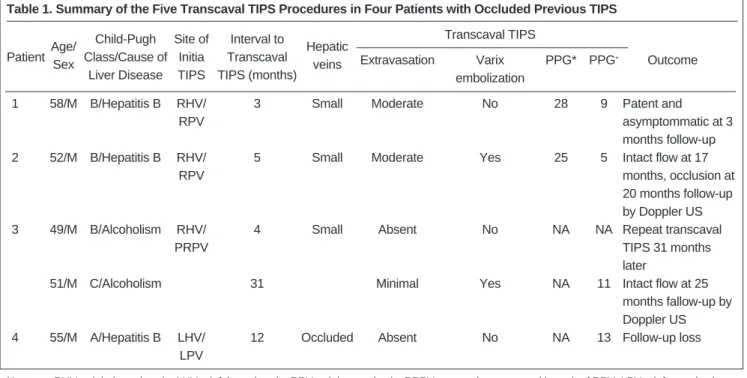
Between February 1996 and December 2000, 57 consec- utive patients with malfunctioning TIPS underwent revi- sion of previous TIPS (n=36) or new TIPS placement (n=21) for recurrent gastric cardiac variceal bleeding. Five transcaval TIPS procedures were subsequently performed in four patients, in all of whom TIPS between the hepatic and portal vein was occluded. In all cases, the indication for initial TIPS was recurrent bleeding from gastric cardiac varices. All patients, who were men aged 49 58 (mean, 53) years, were first referred to our department for revision of a previous shunt. The interval between initial TIPS place- ment and transcaval TIPS varied between three and 31 months, this latter period representing the interval be- tween two transcaval TIPS procedures performed in one patient. In all cases, portal hypertension was due to hepatic cirrhosis. Three patients had postnecrotic cirrhosis due to hepatitis B viral infection, and in one, cirrhosis due to alco- holic liver disease was present (Table 1). According to the

Childs-Pugh classification of hepatocellular disease, at the time of transcaval TIPS this was class A in one, class B in three, and class C in one.

All procedures were performed via the right internal jugular vein, accessed using the standard Seldinger tech- nique. A 9-F long vascular sheath (Cook Inc., Blooming- ton, U.S.A.) containing a 9-F dilator was advanced into the inferior vena cava, and using a 5-F multipurpose catheter and 0.035-inch hydrophilic guidewire (Terumo, Tokyo, Japan), previous TIPS were then accessed for recanaliza- tion. The shunts could not be catheterized, however. After failed attempts to negotiate a guidewire into the occluded lumen, stent puncture using a Colapinto transjugular portal venous access needle was attempted, but this also failed. In addition, there were no appropriate hepatic veins for new TIPS, and since it was thus impossible to catheterize the occluded shunt or hepatic veins for new TIPS creation, transcaval TIPS was attempted.

Direct cavoportal puncture from the intrahepatic seg- ment of the inferior vena cava to the portal vein using a Colapinto transjugular portal venous access needle was at- tempted. Using the previous TIPS stent as a target, the needle was advanced through the hepatic parenchyma into the portal vein under fluoroscopic guidance. After punctur- ing the vein, a guidewire was advanced through the needle and manipulated along it and into the splenic vein. The Colapinto needle was then withdrawn and a 5-F multipur-

Table 1. Summary of the Five Transcaval TIPS Procedures in Four Patients with Occluded Previous TIPS Age/ Child-Pugh Site of Interval to

Hepatic Transcaval TIPS

Patient

Sex Class/Cause of Initia Transcaval

veins Extravasation Varix PPG* PPG

+

Outcome

Liver Disease TIPS TIPS (months) embolization

1 58/M B/Hepatitis B RHV/ 3 Small Moderate No 28 9 Patent and

RPV asymptommatic at 3

months follow-up

2 52/M B/Hepatitis B RHV/ 5 Small Moderate Yes 25 5 Intact flow at 17

RPV months, occlusion at

20 months follow-up by Doppler US

3 49/M B/Alcoholism RHV/ 4 Small Absent No NA NA Repeat transcaval

PRPV TIPS 31 months

later

51/M C/Alcoholism 31 Minimal Yes NA 11 Intact flow at 25

months fallow-up by Doppler US

4 55/M A/Hepatitis B LHV/ 12 Occluded Absent No NA 13 Follow-up loss

LPV

Note. ─ : RHV = right hepatic vein, LHV = left hepatic vein, RPV = right portal vein, PRPV = posterior segmental branch of RPV, LPV = left portal vein PPG* = portal pressure gradient before procedure (mmHg)

PPG

+

= portal pressure gradient after procedure (mmHg)

NA = not available

(3)

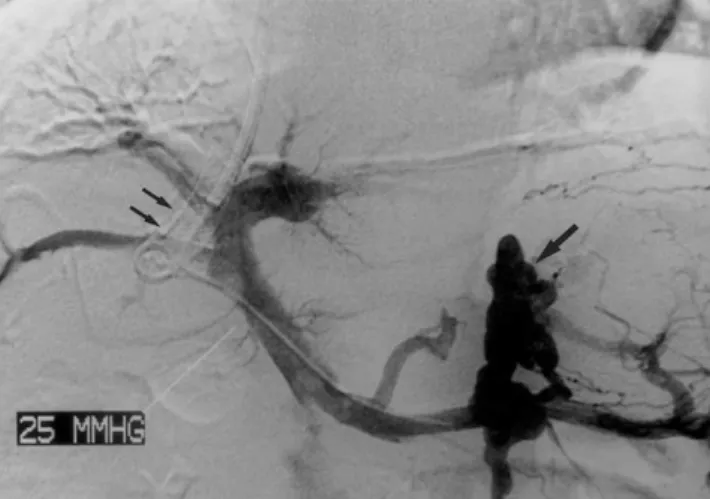
pose catheter was passed over the guidewire without di- latation of the parenchymal tract; venography from that position demonstrated large cardiac varices and occlusion of the previous TIPS (Fig. 1). Pressure measurements were obtained, and the portosystemic gradient thus determined.

The guidewire was replaced with an Amplatz extra-stiff wire (Cook Inc., Bloomington, U.S.A.), the 9-F sheath with its 9-F dilator was advanced into the portal vein, and the dilator was withdrawn. The sheath was then retracted over the wire from the portal vein to the IVC while simultane- ous contrast material injection through a side-arm adapter

was performed to confirm the parenchymal location of the tract prior to balloon dilatation (Fig. 2). After evaluating the puncture site, the parenchymal tract was dilated using an Ultrathin Diamond balloon catheter 10 mm in diameter (Medi-Tech/Boston Scientific, Watertown, Mass., U.S.A.) (Fig. 3), and a 10-mm-diameter Wallstent (Schneider USA, Minneapolis, Minn., U.S.A.) was deployed. The stent was then expanded using a 10-mm angioplasty balloon. A 5-F multipurpose catheter was readvanced into the splenic vein; venography from this position was performed and the portosystemic pressure gradient was remeasured.

Fig. 1. A 52-year-old man with postnecrotic liver cirrhosis and variceal bleeding. Portal venogram obtained through splenic vein injection before transcaval TIPS placement shows occluded pre- vious shunt, which was between the right hepatic and posterior segmental branch of the right portal vein (small arrows). Note fill- ing of prominent gastric cardiac varices with gastrorenal shunt (arrow).

Fig. 2. A 51-year-old man with alcoholic liver cirrhosis who under- went one standard TIPS and two parallel transcaval TIPS.

After transcaval portal vein puncture, contrast material injection through a side-arm adapter of a sheath, with simultaneous retrac- tion of the sheath over the wire, demonstrates slight spillage of contrast material (arrow).

Fig. 3. A 52-year-old man with postnecrotic liver cirrhosis and variceal bleeding. Radiograph demonstrates balloon dilatation of the parenchymal tract (small arrows). Note the extravasation of contrast materials into hepatic subcapsular or subdiaphragmatic pericaval space (arrow). Moderate extravasation of contrast ma- terials is apparent, and an opacified right bile duct is also seen.

Fig. 4. A 52-year-old man with postnecrotic liver cirrhosis and

variceal bleeding. Portal venogram obtained after transcaval stent

placement shows good flow through the stent without opacifica-

tion of gastric cardiac varices, which were embolized with stain-

less coils. Trans-stent extravasation of contrast material was not

apparent. The postprocedural portosystemic pressure gradient

was 5 mmHg.

(4)

The patients were discharged from hospital 1-2 weeks af- ter transcaval TIPS and were followed up at 3-month inter- vals. Doppler ultrasound (US) was performed 3-5 days af- ter TIPS insertion, and thereafter at 3-month intervals.

RESULTS

Transcaval TIPS was successful in all cases. In all pa- tients, 10-mm-diameter stents were positioned after bal- loon dilatation, and no immediate complications were ob- served. The portosystemic pressure gradient before tran- scaval TIPS placement was elevated, and direct portal venography demonstrated prominent gastric cardiac varices. After placement, the mean pressure gradient ranged from 5 to 13 mmHg. Although effective portal vein decompression was achieved, concomitant transcatheter coil embolization of varices was performed in two cases because portal venography demonstrated prominent filling of gastric cardiac varices (Fig. 4). After TIPS placement, bleeding stopped in all cases and during hospitalization did not recur. No patient developed encephalopathy.

In three of five cases, simultaneous contrast injection through a side-arm adapter while the sheath was retracted from the parenchymal tract demonstrated minimal or mod- erate extravasation of contrast material (Figs. 2, 3). This was, however, confined to hepatic subcapsular space or free space in the pericaval and subdiaphragmatic area, and it did not change shape. There was no evidence of propa- gation of extravasated contrast materials through the retroperitoneal space or spillage into the peritoneal space.

After tract dilatation by deploying a bare stent, no trans- stent bleeding occurred, and repeated shunt venography demonstrated good flow through the shunt and no further extravasation of contrast material (Fig. 4). No serious pro- cedure-related complications were observed, and blood pressure changed neither during nor after the procedures.

There was no evidence of internal bleeding after stent placement, and patients were discharged without incident one week later.

Using Doppler US, shunt patency was followed up in three patients. In two of these, shunts were patent 3 and 25 months after transcaval TIPS placement, respectively, and in the other, Doppler US detected shunt occlusion at 24 months follow-up. In that patient variceal bleeding re- curred 31 months after previous transcaval TIPS, and a new, parallel, transcaval TIPS was created (Fig. 2). The previous shunt was positioned through the right portal vein; the subsequent transcaval shunt was successfully po- sitioned through the portal vein near its bifurcation point.

Variceal bleeding in that patient resolved after new TIPS.

One patient died of progressive hepatic failure 20 months

after successful transcaval TIPS placement.

DISCUSSION

TIPS are functionally equivalent to small-bore portocav- al or mesocaval shunts. One of their disadvantages com- pared to surgically created portosystemic shunts is an in- creased risk of shunt failure (4 7), the most common cause of which is the development of pseudointimal hyperplasia (8). TIPS stenosis is most commonly located at the hepatic vein insertion site and is less frequently observed within the parenchymal tract (5, 9). Some investigators have spec- ulated that bile extravasation from adjacent transected bile ducts occurring during TIPS (a bile leak into the shunt) may stimulate thrombosis or accelerate the process of pseudointimal hyperplasia within the shunt track and the hepatic vein that results in TIPS stenosis or occlusion (10 12). LaBerge et al. (10) reported bile staining within shunts in several explant specimens, suggesting that an inflamma- tory response to bile may aggravate the hyperplastic re- sponse. In addition, technical error may also be a cause of some TIPS stenosis. Inadequate stent length overlap leav- ing a bare area of liver parenchyma has been shown to be a cause of shunt occlusion. Stent shortening can also occur over time, causing the metallic stent to recede into the parenchymal tract.

Primary one-year TIPS patency rates have been reported to be 25 66% (5, 13, 14). A two-year incidence of TIPS dysfunction of up to 90% was reported when invasive he- modynamic measurement was performed, though with careful sonographic follow-up and TIPS revision as needed, the secondary patency rate of TIPS is reported to be as high as 92% two years after placement (7).

TIPS revision generally involves angioplasty for stenosis after negotiating the shunt lumen, and more recently has involved the placement of additional stents (12). This al- lows not only the restoration of TIPS function, but may al- so modify the configuration of the shunt in a way that pre- vents future restenosis. Shunt occlusion is found in 13 16%

of all patients undergoing revision (5, 8, 15). The recanal-

ization of chronically occluded shunts is technically more

difficult than in cases involving a stenosed shunt. If a

guidewire can be advanced through the occluded lumen in-

to the portal vein, the occluded shunt can be recanalized

by angioplasty with or without coaxial placement of a new

stent. When primary guidewire passage through the oc-

cluded shunt fails, direct puncture of the lumen of the stent

may be attempted. If access to the shunt proves impossible,

the creation of an entirely new parallel shunt may be nec-

essary, though in some instances the catheterization of a

different hepatic vein may be difficult or impossible. As in

(5)

our cases, there may be no hepatic veins capable of sup- porting new TIPS. When the hepatic vein cannot be catheterized, portal vein puncture at the stump of the he- patic vein of the previous TIPS or the intrahepatic segment of the inferior vena cava itself can be attempted.

The concept of a direct portocaval shunt is not new.

Haskal et al. (16) described the creation of an intrahepatic portocaval shunt between the IVC and the right portal vein; in their cases the hepatic veins were inadequate be- cause of the cephalad location of the portal vein bifurca- tion relative to the hepatic veins. The procedure has also been described in a patient who lacked hepatic veins capa- ble of supporting TIPS, in one with Budd-Chiari syndrome, and in another with occluded previous TIPS (16 18). Other possible indications for transcaval portosystemic decom- pression include the need for a transfemoral approach in which the internal jugular veins or superior vena cava are thrombosed and the inferior right hepatic vein is inade- quate for TIPS.

Our cases are examples of portocaval shunt formation in patients with occluded previous TIPS resulting in or ac- companying unusable hepatic veins. Most stent stenoses occur at the hepatic venous end (8), and because small he- patic veins are more prone to stenosis, transcaval TIPS can be a solution where the hepatic vein is too small to create TIPS. It is also a means by which secondary or tertiary TIPS can be created, regardless of whether hepatic venous access is possible.

In TIPS, the puncture may on rare occasions enter the portal vein in an extrahepatic location, and if this is not recognized, balloon dilatation of the tract will result in por- tal vein laceration with significant intraperitoneal bleeding.

Under such circumstances, the use of a bare stent to create a shunt that extends into a portal vein segment not en- veloped by liver parenchyma can result in potentially fatal intra-abdominal hemorrhage, a complication that can be avoided by careful evaluation of the portal vein location prior to the procedure. The feasibility of direct portocaval shunt also depends on the existence of a safe route be- tween the IVC and the portal veins; such a route is provid- ed when the tract linking these vessels is completely intra- parenchymal, a location which must be confirmed. Using the same method as that employed in the evaluation of the anatomic relationship between the hepatic capsule and the portal vein segment, we evaluated the safety of the tract before stent deployment or tract dilatation. This involved pulling back a sheath or catheter over a safety wire and in- jecting contrast material through a side-arm adapter. In three cases in our series, tractography revealed slight leak- age of contrast materials into either hepatic subcapsular or subdiaphragmatic pericaval space. For an extended period,

however, the shape of the extravasated contrast materials was unchanged. Because there was no evidence of propa- gation of contrast materials through the retroperitoneal space, or spillage into peritoneal space, the tract was dilat- ed by deploying a bare stent. Although bridging may be safer with a covered stent than with a bare one, trans-stent bleeding did not occur in our cases; because the shunt exits the retrohepatic IVC at a site that is well invested by the fi- brous tissue of the retroperitoneum, such bleeding can be prevented (16).

The retrohepatic inferior vena cava has been measured in cadaveric studies; the average length in the craniocaudal dimension of the retrohepatic segment was found to be 6.7 (range, 3.5 10.9) cm (19, 20), and the vessel was totally en- closed by liver substance in 30% of cases (20). This en- closed hepatic substance had an average height of 3.2 cm and an average thickness of 0.7 cm, and in cases where the IVC was partially exposed, the average thickness of the nonenclosed IVC posterior wall was 1.0 cm. Those studies showed that because the tract is entirely intraparenchymal, ventral wall puncture of the inferior vena cava at this loca- tion is in most cases safe. In addition, the extravasation of contrast materials during the transcaval TIPS procedures in our series indicated that the retroperitoneal space sur- rounding the IVC may be confined and restricted, and in- vested by fibrous tissue. Although there was no bleeding through the porous mesh at the caval end of the stent in such cases, this hypothesis requires further anatomical in- vestigation.

McCowan et al. (21) reported a case of cardiac perfora- tion and tamponade during TIPS placement. The heart was, presumably, perforated by instrumentation during the initial phase of the procedure, at which point manipulation to gain suitable access to the hepatic vein was performed.

To prevent the occurrence of this unusual complication in transcaval TIPS, it is important that the cavoportal punc- ture is made at the extracardiac and retrohepatic segment of the IVC, and cephalad to the portal vein. For this pur- pose, the cephalad end of the occluded stent can be used as a reference marker.

The creation of a new shunt becomes increasingly diffi-

cult if a previous TIPS cannot be catheterized and there

are no hepatic veins capable of supporting a new TIPS. In

such instances, direct portocaval shunt creation permits

secondary or tertiary procedures. In our own experience, it

can be safely performed even if a small leak is found at

evaluation of the tract between the IVC and the portal

vein. The use of covered stents may improve the safety of

the transcaval approach to TIPS in the intrahepatic seg-

ment of the IVC and permit the extension of this concept

to the creation of a direct shunt between the extrahepatic

(6)

IVC and the main portal vein.

Although the number of patients in this study was limit- ed, the favorable results of shunt formation indicate that transcaval TIPS placement is an effective and safe alterna- tive treatment in patients with occluded previous TIPS and no hepatic veins suitable for new TIPS.

References

1. Zemel G, Katzen BT, Becker GJ, et al. Percutaneous transjugu- lar portosystemic shunt. JAMA 1991;266:390-393

2. Sanyal AJ, Freedman AM, Shiffman ML, Purdum PP 3rd, Luketic VA, Cheatham AK. Portosystemic encephalopathy after transjugular intrahepatic portosystemic shunt: results of a prospective controlled study. Hepatology 1994;20:46-55 3. Somberg KA, Riegler JL, LaBerge JM, et al. Hepatic en-

cephalopathy after transjugular intrahepatic portosystemic shunts: incidence and risk factors. Am J Gastroenterol 1995;

90:549-555

4. LaBerge JM, Ring EJ, Gordon RL, et al. Creation of transjugu- lar intrahepatic portosystemic shunt (TIPS) with the Wallstent endoprosthesis: results in 100 patients. Radiology 1993;

187:413-420

5. Haskal ZJ, Pentecost MJ, Soulen MC, Shlansky-Goldberg RD, Baum RA, Cope C. Transjugular intrahepatic portosystemic shunt stenosis and revision: early and midterm results. AJR 1994;163:439-444

6. Coldwell D, Ring E, Rees C, et al. Multicenter investigation of the role of transjugular intrahepatic portosystemic shunts in the management of portal hypertension. Radiology 1995;196:335- 340

7. Saxon RS, Ross PL, Mendel-Hartvig J, et al. Transjugular intra- hepatic portosystemic shunt patency and the importance of stenosis location in the development of recurrent symptoms.

Radiology 1998;207(3):683-693

8. Sterling KM, Darcy MD. Stenosis of transjugular intrahepatic portosystemic shunts: presentation and management. AJR 1997;168:239-244

9. Hausegger KA, Sternthal HM, Klein GE, Karaic R, Stauber R, Zenker G. Transjugular intrahepatic portosystemic shunt: angio-

graphic follow-up and secondary interventions. Radiology 1994;

191:177-181

10. LaBerge JM, Ferrell LD, Ring EJ, Gordon RL. Histopathologic study of stenotic and occluded transjugular intrahepatic por- tosystemic shunts. J Vasc Interv Radiol 1993;4:779-786 11. Saxon RR, Mendel-Hartvig J, Corless CL, et al. Bile duct injury

as a major cause of stenosis and occlusion in TIPS: comparative histologic analysis in humans and swine. J Vasc Interv Radiol 1996;7:487-497

12. Saxon RR, Timmermans H, Uchida BT, et al. Stent grafts for re- vision of TIPS stenoses and occlusions: A clinical pilot study. J Vasc Interv Radiol 1997;8:539-548

13. Martin M, Zajko AB, Orons PD, et al. Transjugular intrahepatic portosystemic shunt in the management of variceal bleeding: in- dications and clinical results. Surgery 1993;114:719-726 14. Lind CD, Malisch TW, Chong WK, et al. Incidence of shunt oc-

clusion or stenosis following transjugular intrahepatic portosys- temic shunt placement. Gastroenterology 1994;106:1277-1283 15. Nazarian GK, Ferral H, Castaneda-Zuniga WR, et al.

Development of stenoses in transjugular intrahepatic portosys- temic shunts. Radiology 1994;192:231-234

16. Haskal ZJ, Duszak R, Further EE. Transjugular intrahepatic transcaval portosystemic shunt: the gun-sight approach. J Vasc Interv Radiol 1996;7:139-142

17. Rogopoulos A, Gavelli A, Sakai H, McNamara M, Huguet C.

Transjugular intrahepatic portosystemic shunt for Budd-Chiari syndrome after failure of surgical shunting. Arch Surg 1995;

130:227-228

18. Soares GM, Murphy TP. Transcaval TIPS: Indications and anatomic considerations. J Vasc Interv Radiol 1999;10:1233- 1238

19. Chang RW, Shan-Quan S, Yen WW. An applied anatomical study of the retrohepatic segment of the inferior vena cava. J Anat 1989;164:41-47

20. Camargo AM, Teixeira GG, Ortale JR. Anatomy of the ostia ve- nae hepaticae and the retrohepatic segment of the inferior vena cava, Part 1. J Anat 1996;188:59-64

21. McCowan TC, Hummel MM, Schmucker T, Goertzen TC, Culp WC, Habbe TG. Cardiac perforation and tamponade during transjugular intrahepatic portosystemic shunt placement.

Cardiovasc Intervent Radiol 2000;23:298-311

수치

Table 1. Summary of the Five Transcaval TIPS Procedures in Four Patients with Occluded Previous TIPS Age/ Child-Pugh Site of  Interval to
Fig. 2. A 51-year-old man with alcoholic liver cirrhosis who under- under-went one standard TIPS and two parallel transcaval TIPS.

참조

관련 문서

According to the result of this study, to do effective nursing that improve health promoting behaviors of early-stage lung cancer patients, nurses should

The aim of this study was to provide a optimal drug therapy which secures effectiveness and safeness in elderly patients by analyzing polypharmacy and the

Abstract: This study was aimed to investigate the adhesion control standards of pain relieving patch (PRP) drugs and to survey it′s adverse effects on the skin of patients

Empirical results of this study indicate that the incremental explanatory power of earning is greater than that of cash flow in the mature stage of the

In this study, it is shows that the stream of CO 2 is more effective in the reduction of unreacted TEGDMA and the increase of surface microhardness than that of N 2

Objective: The purpose of this study was to analyze recent trend in incidence of basal cell carcinoma and squamous cell carcinoma in patients from the Gwangju City

The purpose of this study was to identify the frequency and related factors of advanced airway management for patients with cardiac arrest by the

Therefore, this paper is to recognize the common mistakes English learners make while using English articles and to provide helpful tips for those who teach