Korean J Radiol 2(1), March 2001 61
Characteristic Plain Radiographic and Intravenous Urographic Findings of
Bladder Calculi Formed over a Hair Nidus:
A Case Report
ladder calculi occur often in patients with urinary stasis and infection, and a foreign body in the bladder may serve as a nidus for stone formation.
Reports have shown that a multitude of foreign bodies are capable of act- ing as a center for bladder calculi, but a hair, introduced inadvertently into the bladder during catheterization, has rarely been reported as the cause of stone formation.
We present the characteristic plain radiographic and intravenous urographic (IVU) findings of calculus over a hair introduced during catheterization.
CASE REPORT
A 66-year-old man who had been quadriplegic for 40 years because of cervical ver- tebral injury during the Korean War was admitted for further evaluation of frequent urinary tract infection. Urinalysis revealed numerous bacteria and white blood cells.
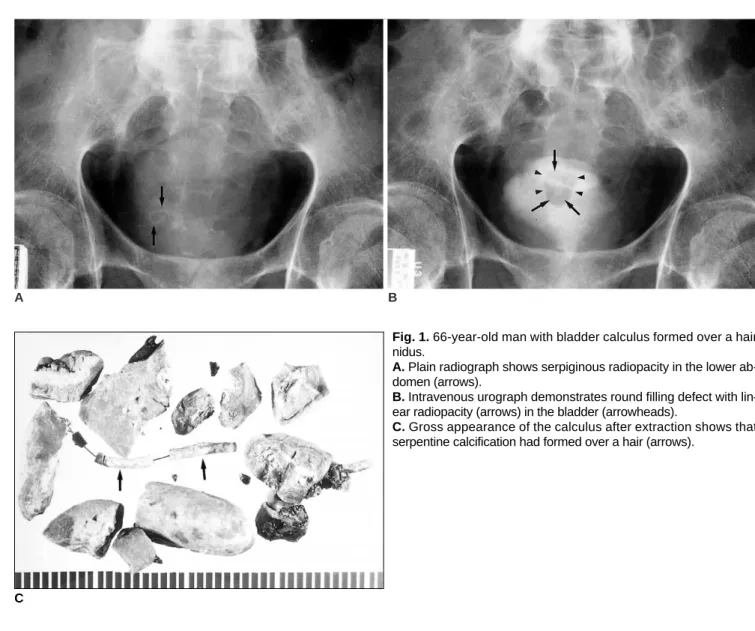
Plain radiography showed a linear, serpiginous calcification in the lower abdomen (Fig. 1A), and IVU demonstrated a round filling defect with linear radiopacity in the bladder, suggesting calculus (Fig. 1B).
Ultrasonic lithotripsy was performed, and using forceps, several stone fragments were removed. The results of analysis showed that they contained a mixture of calci- um oxalate, magnesium, ammonium and carbonate. The gross appearance of the stone after extraction demonstrated that calcification had formed over a hair (Fig. 1C).
DISCUSSION
For a variety of reasons, including immobilization hypercalciuria, urinary stasis, in- fection, and the introduction of a Foley catheter, patients with spinal cord injury are predisposed to calculi (1).
Calculus formation over a hair introduced into the bladder is a preventable compli- cation (2). Being a foreign material, hair in this location is an ideal site for crystalline precipitation, which may then be perpetuated by the reaction of urothelium with the Hak Jong Lee, MD
Seung Hyup Kim, MD
Index terms : Urolithiasis Bladder stone Hair
Radiography
Korean J Radiol 2001 ; 2 : 61-62 Received October 21, 2000; accepted after revision January 7, 2001.
All authors: Department of Radiology, Seoul National University College of Medicine, The Institute of Radiation Medicine, SNUMRC, and the Clinical Research Institute, Seoul National University Hospital
Address reprint requests to :
Seung Hyup Kim, MD, Department of Radiology, Seoul National University Hospital, 28, Yongon-dong, Chongro-gu, Seoul 110-744, Korea.
Telephone: (822)760-3259 Fax: (822)743-6385
e-mail: [email protected]
B
We present the characteristic plain radiographic and intravenous urographic (IVU) findings of calculus formed over a hair. A 66-year-old man who had been quadriplegic for 40 years because of vertebral injury was admitted for further evaluation of frequent urinary tract infection. Plain radiography showed a linear, serpiginous calcification in the lower abdomen, and IVU revealed a round filling defect with linear radiopacity in the bladder, suggesting calculus. The gross appearance of the stone after extraction demonstrated that calcification had formed over a hair.
extraneous material (3).
The absence of normal micturition in spinal cord injury patients exacerbates the problem because it prevents spon- taneous passage of small stone fragments. Some therefore undergo intermittent urethral catherization, and in some care centers it is routine practice to recommend periodic shaving of pubic hair in such patients (4).
In 1983, Amendola et al. reported that during a 12 - year period, plain radiographs of three of eight patients with bladder calculi formed over a hair nidus showed character- istic serpiginous, linear calculi (1). To the best of our knowledge, however, the IVU findings in patients with bladder calculi over a hair nidus have not been previously reported.
In our case, IVU revealed serpiginous radiopacity within the filling defect. Compared with the pathologic specimen, the serpiginous dense radiopacity seen at plain radiography and IVU revealed a calculus formed over a hair.
When plain radiographs or IVU in patients with a neuro- genic bladder show serpiginous radiopacity, the presence of bladder calculi formed over hair introduced into the bladder during catheterization may be suspected. An un- derstanding of this etiology may help prevent bladder cal- culus.
References
1. Amendola MA, Sonda LP, Diokno AC, Vidyasagar M. Bladder calculi complicating intermittent clean catheterization. AJR 1983;141:751-753
2. Solomon MH, Koff SA, Diokno AC. Bladder calculi complicat- ing intermittent catheterization. J Urol 1980; 124:140-141 3. Derry F, Nuseibeh I. Vesical calculi formed over a hair nidus. Br
J Urol 1997; 80(6):965
4. Vaidyanathan S, Bingley J, Soni BM, Krishnan KR. Hair as the nidus of a bladder stone in a traumatic paraplegic patient. Spinal Cord 1997; 35(8):558
Lee et al.
62 Korean J Radiol 2(1), March 2001
A B
Fig. 1. 66-year-old man with bladder calculus formed over a hair nidus.
A. Plain radiograph shows serpiginous radiopacity in the lower ab- domen (arrows).
B. Intravenous urograph demonstrates round filling defect with lin- ear radiopacity (arrows) in the bladder (arrowheads).
C. Gross appearance of the calculus after extraction shows that serpentine calcification had formed over a hair (arrows).
C