705
Open Access
Analysis of Potential Cost-Savings After Introduction of Drug-Eluting Balloon Angioplasty for In-Stent Restenosis or Small Vessel Disease
Kyungil Park, MD, Tae-Eun Kim, RN, Kyung-Woo Park, MD, Hyun-Jae Kang, MD, Bon-Kwon Koo, MD, and Hyo-Soo Kim, MD Cardiovascular Center, Department of Internal Medicine, Seoul National University College of Medicine, Seoul, Korea
ABSTRACT
Background and Objectives: The drug-eluting balloon (DEB) catheter system was developed to treat restenosis. Further- more, DEB angioplasty has been shown to reduce restenosis risk when compared to drug-eluting stents (DES) in patients with in-stent restenosis (ISR) or small vessel disease (SVD). In addition, DEB angioplasty reduces costs due to fewer revas- cularizations and reduced clopidogrel treatment length. The objective of this study was to predict the expected cost-savings when DEB is substituted for DES in patients with ISR or SVD. Subjects and Methods: The subjects included were patients treated by DES at Seoul National University Hospital from January 2006 to June 2009, with clinical data after percutaneous coronary intervention, were. A model was developed to allow the costs of DES and the calculated costs of DEB incurred by patients with ISR or SVD to be compared. The overall cost of DEB was calculated to be 1,256,150 won and the overall cost of DES was 2,102,500 won, and the cost of clopidogrel was 2,168 won. Expected repeat revascularizations within 12 months of DEB were calculated based on information provided by the Paclitaxel-Eluting PTCA-Balloon Catheter in Coronary Ar- tery (PEPCAD) I and II trials. Results: By substituting DEB for DES, total cost (including the cost of initial DEB treatment, the cost of repeat revascularization after DEB treatment, and the cost of clopidogrel treatment) was found to be 34% lower in ISR patients and 48% lower in SVD patients. Conclusion: DEB angioplasty will significantly reduce costs as compared to DES in ISR and in SVD patients. (Korean Circ J 2011;41:705-711)
KEY WORDS: Angioplasty, balloon; Coronary restenosis.
Received: November 24, 2010 Revision Received: February 8, 2011 Accepted: February 9, 2011
Correspondence: Hyo-Soo Kim, MD, Cardiovascular Center, Depart- ment of Internal Medicine, Seoul National University College of Medicine, 101 Daehak-ro, Jongno-gu, Seoul 110-744, Korea
Tel: 82-2-2072-2226, Fax: 82-2-766-8904 E-mail: [email protected]
• The authors have no financial conflicts of interest.
cc This is an Open Access article distributed under the terms of the Cre- ative Commons Attribution Non-Commercial License (http://creativecom- mons.org/licenses/by-nc/3.0) which permits unrestricted non-commer- cial use, distribution, and reproduction in any medium, provided the origi- nal work is properly cited.
Introduction
The introduction of coronary stents was one of the most remarkable clinical developments in the field of interven- tional cardiology, and although the long-term success of coronary stents is limited by in-stent restenosis (ISR), the in- cidence of ISR was reduced by 5-35% by the introduction of drug-eluting stents (DESs). But it still remains a significant challenge in ISR lesion and small vessel disease (SVD), and in-
creased expense for our health care system incurred by their high prices and by a high demand of DESs by physicians.1)
DESs are currently considered the best possible device for treating ISR,2)3) but the stent-in-stent approach introduces a metal component intraarterially, thus, reduces the vascular lumen. On the other hand, polymeric coatings on stents con- taining antiproliferative drugs can induce inflammation and thrombosis,4) and require long-lasting antiplatelet therapy to reduce late thrombotic complications.
Recently, non-stent-based local balloon delivery systems have been developed for the delivery of antiproliferative drugs. The concept behind this technology is that the rapid release of antiproliferative drugs into arterial tissue is more effective than their gradual release, as exemplified by DESs.5)6) Another benefit of drug-eluting balloon (DEB) based tech- nology is that it is potentially cheaper as balloon catheters are invariably cheaper than stents. Furthermore, a clinical trial demonstrated the efficacy of a balloon coated with a paclita- xel-iopromide mixture at inhibiting neointimal proliferation in coronary ISR patients.7) SVD patients are also at elevated
risk of needing repeat coronary procedures and also present the health care system with a substantial cost burden.8)9) How- ever, a clinical trial concluded that treatment of SVD with a DEB catheter was well tolerated by patients and that this me- thod may offer an alternative to DES implantation.10)
Furthermore, as compared to DESs, clopidogrel consump- tion would be significantly reduced by the use of DEBs,11) and reducing the duration of clopidogrel therapy might have cli- nical advantages in terms of safety, when there are concerns about bleeding or the need for surgical intervention.
Therefore, the use of DEBs may present an alternative tr- eatment option for patients with ISR in any type of coronary artery stent or SVD, although these findings need to be con- firmed by longer follow-up studies, and this might be parti- cularly true when there are clinical reasons for minimizing the duration of clopidogrel treatment or when the placement of further stents is not technically feasible.
Evaluations of the usefulness of a new device require a for- mal assessment of its cost implications, and no such assess- ment has yet been performed for the treatment of ISR or SVD with DEBs. In this study, we calculated the expected cost- saving associated with the use of DEBs versus DESs in pa- tients with ISR or SVD.
Subjects and Methods
Study population
This study was initiated by ourselves, and no third party was involved in the study design, conduct, or analysis. Pati- ents with SVD or ISR and had stable or unstable angina, and who were at least 18 years old, had a positive stress test, and scheduled to undergo PCI in a native coronary artery were considered eligible for this study. ISR was defined as stenosis of ≥50% of the arterial diameter at a stent site in vessels that were 3.0-5.0 mm in diameter with a lesion length of <25 mm in patients who underwent successful (<30% residual stenosis without complications) angioplasty using balloons (alone or in combination), ablative devices, or additional stents. SVD was defined as a lesion involving a de novo coronary artery with a vessel diameter of <2.8 mm. Consecutive patients that underwent DES implantation at Seoul National University Hospital from January 2006 to June 2009 were identified us- ing a cardiology database. Candidates were excluded if fol- low-up duration was less than 12 months. Finally, 585 pati- ents were included in the study (Fig. 1).
Study design
We evaluated potential cost-savings when all 585 study subjects with ISR (n=189) or SVD (n=396) that underwent DES were theoretically converted to DEB. We developed a model to compare the initial costs of DES and DEB for treat- ing ISR (ISR group) and SVD (SVD group) patients: 1) a
group was treated with a DES (DES group); and 2) a group was assumed to use DEB (length 17 to 30 mm, diameter 2.5 to 3.5 mm; SeQuent Please, B. Braun Melsungen) (DEB gr- oup) instead of DES. We also compared the overall long-term costs of DES and DEB group, respectively, for ISR and SVD group. We supposed the extra costs, except PCI, during ad- mission and follow-up costs between DES and DEB group would be identical. The number of devices used per patient between DES and DEB group was supposed to be the same.
All patients were assumed to be on a lifelong prescription of aspirin at ≥100 mg. Clopidogrel (75 mg/day) was adminis- tered for 6-12 months after DES, and was presumed to have been administered for 1 month after DEB. Clinical and angio- graphic follow-ups were performed at least 9 months after in- itial DES, as is performed routinely at our institution.
We evaluated the frequency of target-lesion revasculariza- tion (TLR) during the 12 months following DES. TLR was de- fined as revascularization of the target lesion in the presence of recurrent angina and/or angiographic findings at follow- up. Expected repeat revascularizations within 12 months of DEB group were calculated based on the findings of The Pa- clitaxel-Eluting PTCA-Balloon Catheter in Coronary Artery (PEPCAD) I and II trials. In the PEPCAD I trial, of 82 SVD patients with a single de novo lesion in a native small caliber coronary artery, restenosis occurred in 4 (4.9%) during the 12- month period following DEB.10) The PEPCAD II trial was a randomized controlled trial of 131 ISR patients treated by DEB or DES, and reported 12-month TLR rates of 6.3% for DEB and 15.4% for DES.7) In the present study, the costs of re- peat revascularizations and of clopidogrel therapy were com- pared for DEB and DES.
Cost of intervention
According to the Health Insurance Review & Assessment Service that the cost of DEB is 1,256,150 won, the cost of DES is 2,101,500 won and that the cost of clopidogrel is 2,168 won per tablet.
Angiographic analysis
Coronary angiograms were obtained in a routine manner.
All patients received intracoronary isosorbide dinitrate be- fore initial and postprocedural angiograms to achieve maxi- mal vasodilatation. Angiograms were analyzed by an inde- pendent angiographer using an automated edge-detection qu- antitative coronary angiography system (Quantcor QCA ver- sion 4.0., Pie Medical Imaging, the Netherlands). Angiogra- phic binary restenosis at follow-up was defined as ≥50% dia- meter narrowing within the stent and in the adjacent segment including the stent plus its edges (within 5 mm).
Statistical analysis
Data are expressed as means±SDs for continuous variables
and as numbers (%) for categorical variables, as appropriate.
Differences between the total cost for patients who underwent DES and the expected total cost for patients had they under- gone DEB were compared using the paired t-test for asymme- tric distributions, as determined using the Shapiro-Wilk test.
Differences between the cost of repeated PCI after DES and the expected cost of repeated PCI after DEB were compared using the non-parametric one sample test.
All statistical analyses were performed using SAS version 9.0 for Windows (SAS, Cary, NC, USA). Significance was ac- cepted for p<0.05.
Results
Baseline characteristics
A total of 1,146 patients, all patients were followed for 12 months, that underwent DES implantation from January 2006 to June 2009 were identified, but 561 were excluded for not meeting the inclusion criteria (ISR or SVD). Accordingly, 585 patients were enrolled in this study; 189 patients had ISR and 396 SVD.
In-stent restenosis group
Repeat revascularization for ISR was performed in the 189, 117 patients received a DES and 24 patients received a BMS at initial stent implantation, patients. Patients’ mean age was 64.91±9.72 years old, and 34.8% were women. Their baseline characteristics are summarized in Table 1. The pat- tern of ISR was predominantly focal. Mean duration of anti- platelet therapy with clopidogrel was 258.69±158.93 days.
Three patients died during follow-up, but no patient under- went coronary bypass grafting.
Small vessel disease group
The baseline clinical and angiographic characteristics of the 396 SVD patients are shown in Table 2. Mean patient age was 64.11±8.54 years old and 36.6% were women. Mean ves- sel diameter was 2.45±0.27 mm and lesions were predomin- antly of type C. Clopidogrel was prescribed for 202.50±
85.19 days. Of the 396 patients enrolled, 10 patients myocar- dial infarctions occurred after DES during follow-up and 3 patients died.
Initial treatment costs In-stent restenosis group
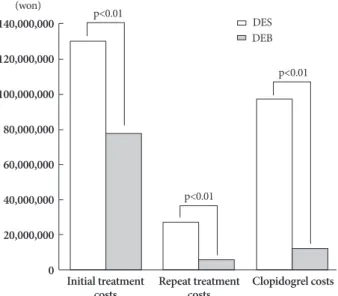
Of the 189 ISR patients, 62 received DES, 104 received a plain balloon, and 93 received a cutting balloon. An average of 0.33 stents/patient was implanted in the DES group. The cost was 2,102,500 won per number of DES at initial enroll- ment, therefore, the cost of 62 DES was 130,355,000 won (i.e., 62 DES×2,102,500 won per DES) in the DES group and
the cost of 62 DEB in the DEB group was 77,881,300 won (p<0.01) (Fig. 2).
The total medical cost of clopidogrel for the 189 ISR pa- tients treated by DES was 97,904,712 won, and for ISR pa- tients treated by DEB with a duration of clopidogrel therapy of 4 weeks, the total medical cost of clopidogrel would have been 12,292,560 won (97,904,712 won versus 12,292,560 won;
p<0.01) (Fig. 2).
Small vessel disease group
An average of 1.2 DESs per patient were implanted in the SVD group. The cost of DES group at initial treatment was KWR 1,023,735,290 won (i.e., 1.2×2,102,500 won per stent×
396 patients), whereas the cost of DEBs in this group was 596,671,250 won (p<0.01) (Fig. 3). Mean duration of clopido- grel antiplatelet therapy was 202.50±85.19 days for patients treated by DES, and clopidogrel cost for these patients was 459,616 won/patient. The total medical costs of clopidogrel for patients treated by DES and DEB were 181,856,176 and 25,755,840 won, respectively (p<0.01), and thus, the expected cost saving for antiplatelet therapy was 156,100,336 won.
Repeat revascularization treatment costs during follow-up
In-stent restenosis group
Restenosis occurred in 33 of 189 patients with ISR during follow-up. All lesions were treated by plain balloon dilatation, or cutting balloon dilatation. Additional DES was used, as re- quired, to optimize final angiographic results or to cover un- stented lesion regions (including edge dissection). Of these 33 patients, 13 received DES, 18 received a plain balloon, and 10 received a cutting balloon. The mean number of DESs used per patient for TLR during the 12-month follow-up was 0.4.
The cost of 13 DES was 27,319,500 won (i.e., 13 DES×
2,102,500 won per DES). For repeat PCI performed during follow-up, if DEB was used for initial treatment, we predicted repeat PCI rates after DEB of 6.3% during the subsequent 12 months based on PEPCAD II findings, which meant that 12 of 189 patients would need a repeat PCI. Therefore, the need- ed number of DEB was 4.8 after 12 months of follow-up in DEB group, and then the cost of 4.8 DEB was 5,938,163 won (i.e., 0.4 DEBs per patient×1,256,150 won per DEB×12 pa- tients). Accordingly, a cost saving of 22,865,878 won was predicted for repeat revascularization.
Small vessel disease group
Angiographically proven ISR was recorded in 24 of the 396 SVD patients at 12 months after DES implantation, a ISR in- cidence of 6.1%. Of these 24 patients, 8 received a DES, 13 re- ceived a plain balloon, and 8 received a cutting balloon. The number of devices used per patient was 1.21 and the mean
cost of used devices was 1,738,920 won per patient. An aver- age of 0.33 DESs were implanted in the 396 patients. How- ever, had DEB been used instead, using PEPCAD I findings, revascularization would have occurred in 4.9% with SVD at 12 month, that is, in 19 patients. We assumed that 0.33 DEB would be required by the 19 patients, which equated to a to- tal DEB number of 6.33. Accordingly, the costs of DES and DEB in SVD patients were 16,820,000 and 7,955,616 won, respectively (p=NS) (Fig. 3).
Cost-saving analysis
We defined “total cost” to be the sum of initial treatment DES or DEB cost, repeat revascularization cost, and clopidogrel th- erapy cost over 12 months of follow-up.
In-stent restenosis group
The expected total cost of DES treatment for 189 patients was 533,914,452 won and the total cost of DEB treatment was 354,769,296 won (p<0.001), and thus, the use of DEB led to an expected 1-year total cost savings of 179,145,156 won.
Small vessel disease group
Expected total costs of DES and DEB based treatments in Table 1. Continued
Characteristics N=189
Average stent diameter per patient (mm) 2.70±0.59 Stent type, n (%)
BMS 032 (16.8)
DES 157 (83.2)
Treatment, n (%) 033 (17.3)
Balloon angioplasty 017 (50.4)
Cutting balloon 012 (35.0)
Plain balloon 005 (15.4)
BMS 001 (1.6)
DES 015 (46.9)
Laboratory findings
Serum creatinine (mg/dL) 1.47±1.23
Echocardiographic parameters
LV-EF (%) 55.66±11.54
Clinical follow-up to 12 months
Duration of clopidogrel prescription (days) 258.69±158.93 Target lesion revascularization, n (%) 033 (17.3)
Death, n (%) 003 (1.8)
Myocardial infarction, n (%) 012 (6.1)
Stent thrombosis, n (%) 005 (2.6)
Data are expressed as number (%) or means±standard deviation.
SES: sirolimus-eluting stent, PES: paclitaxel-eluting stent, BMS:
bare-metal stent, LV-EF: left ventricular ejection fraction, LVEF:
left ventricular ejection fraction, DES: drug-eluting stent Table 1. Baseline characteristics of patients with in-stent restenosis
Characteristics N=189
Clinical variables
Age (years) 64.91±9.720
Female gender, n (%) 066 (34.8)
Clinical presentation, n (%)
Stable angina 134 (70.9)
Unstable angina 036 (19.1)
Acute myocardial infarction 005 (2.7)
Risk factors and comorbidities, n (%)
Hypertension 132 (69.6)
Diabetes mellitus 081 (42.9)
Smoking 079 (42.0)
Dyslipidemia 121 (64.0)
Chronic renal failure 023 (12.1)
Prior myocardial infarction 042 (22.4) Prior coronary artery bypass graft 027 (14.3) Location of target lesion (ISR), n (%)
Left anterior descending artery 091 (48.2)
Left circumflex artery 042 (22.0)
Right coronary artery 049 (25.7)
Left main 008 (4.2)
Restenosis pattern, n (%)
Type I A 004 (2.1)
Type I B 043 (22.5)
Type I C 049 (25.7)
Type I D 014 (7.3)
Type II 041 (21.5)
Type III 013 (6.8)
Type IV 009 (4.7)
Restenotic stent
SES, n (%) 118 (62.4)
Total stent length per patient (mm) 30.41±15.31 Average stent diameter per patient (mm) 3.02±0.33
PES, n (%) 071 (37.6)
Total stent length per patient (mm) 32.97±20.30 Average stent diameter per patient (mm) 3.07±0.35 Restenosis location, n (%)
Focal-gap 004 (2.3)
Focal-body 053 (28.2)
Focal-proximal edge 028 (14.9)
Focal-distal edge 017 (9.2)
Focal-multifocal 015 (8.0)
Diffuse-in stent 045 (23.6)
Diffuse-proliferative 014 (7.5)
Complete occlusion 010 (5.2)
Total stent length per patient (mm) 28.65±16.97
the SVD were 1,247,325,556 and 651,305,979 won, respective- ly, and thus, the expected total cost saving was 596,019,577 won, showing that conversion of the current PCI population from DES to DEB would result in a 48% saving in total costs.
Discussion
ISR remains a challenge despite the availability of DES.
Approximately 25 percent of patients treated with a bare-me- tal stent and about 10 percent of patients treated with a DES experience an overgrowth of vascular tissue and intrastent re- narrowing or ISR.12)13) Treating ISR with a DES is a complex procedure that adds another layer of metal, and thus, can cre- ate mechanical problems. Furthermore, polymeric matrixes containing embedded antiproliferative drugs on stents can lead to inflammation and thrombosis.4) For these reasons, DEB may offer a simpler alternative. The balloon is coated with the antimitotic drug paclitaxel to reduce restenosis and has the benefit of a matrix of paclitaxel and a hydrophilic spa- cer on its surface, which creates a large contact surface area between the lipophilic drug and the vessel wall and increases the bioavailability of the embedded drug and facilitates its rapid drug absorption by the vessel wall (PACCOCATH te- chnology).14) This use of a hydrophilic spacer allows the uni- form and complete administration of the drug after first bal- loon inflation. In addition, to avoiding the introduction of a second metal stent, DEBs also contain iopromide, the com- monly used contrast agent, to bind paclitaxel to the balloon.15) This meets concerns about the reactions of arteries to the polymers used to bind paclitaxel and other anti-restenosis medications to DESs. Furthermore, as compared to DES, DEB reduces the duration of clopidogrel administration.11)16)
The complex, vexing problem of restenosis after balloon angioplasty is influenced by a variety of clinical and anatomic factors. Vessel size is an important anatomic factor,17) and in fact, restenosis rate is inversely related to vessel diameter.18) It has been reported that angiographic and clinical outcomes after balloon angioplasty and elective stent placement are best in vessels slightly smaller than 3 mm,19) and regarding the treatment of stenotic coronary arteries with diameters be- low 3 mm, previous studies have demonstrated the superi- ority of implanting DES for restenosis reduction as compared to BMS implantation in SVD.20)21) Furthermore, data for DES in SVD shows the benefit of antiproliferative drug, however, DES introduces an another layer of metal to a small vessel, and Table 2. Baseline characteristics of patients with small vessel dis-
eases
Characteristics N=396
Clinical variables
Age (years) 64.11±8.54
Female gender, n (%) 145 (36.6)
Height (cm) 160.93±8.300
Weight (kg) 065.39±10.34
Clinical presentation, n (%)
Stable angina 163 (41.1)
Unstable angina 185 (46.6)
Acute myocardial infarction 33 (8.3) Risk factors and comorbidities, n (%)
Hypertension 287 (72.6)
Diabetes mellitus 137 (34.7)
Smoking 175 (44.2)
Dyslipidemia 193 (48.8)
Chronic renal failure 10 (2.6)
Prior myocardial infarction 28 (7.1) Prior cerebrovascular accident 23 (5.7) Prior percutaneous coronary intervention 042 (10.7) Prior coronary artery bypass graft 09 (2.3) Location of target lesion (SVD), n (%)
Left anterior descending artery 195 (49.2)
Left circumflex artery 118 (29.7)
Right coronary artery 074 (18.7)
Left main 10 (2.4)
Lesion type, n (%)
Type A 07 (1.8)
Type B1 088 (22.2)
Type B2 046 (11.5)
Type C 255 (64.5)
Total stent length per patient (mm) 032.48±15.75 Number of stents per patient 01.25±0.53 Average stent diameter per patient (mm) 02.45±0.27 Laboratory findings
Serum creatinine (mg/dL) 01.08±0.27
Total cholesterol (mg/dL) 174.63±41.27
LDL-cholesterol (mg/dL) 107.75±36.01
HDL-cholesterol (mg/dL) 042.43±10.43
TG (mg/dL) 147.93±84.34
Hematocrit (%) 39.50±5.35
hs-CRP (mg/dL) 00.51±2.21
Clinical follow-up to 12 months
Duration of clopidogrel prescription (days) 202.50±85.19 Target lesion revascularization, n (%) 24 (6.1)
Death, n (%) 00 (0.0)
Table 2. Continued
Characteristics N=396
Myocardial infarction, n (%) 6 (1.6)
Stent thrombosis, n (%) 3 (0.8)
Data are expressed as number (%) or means ± standard deviation.
LDL: low density lipoprotein, HDL: high density lipoprotein, TG:
triglyceride, Hs-CRP: highly sensitive C-reactive protein
thus, reduces available vascular lumen. Since none of the above-mentioned options for the percutaneous treatment of SVD seems to be universally recommendable, the DEB cathe- ter is to be considered an alternative. A previous study show- ed that DEB offers benefit as compared to DES in SVD.10) However, in the PICCOLETO study, DEB failed to show equ- ivalence to DES during PCI in SVD,22) but several aspects of this study were questionable. First, the balloon used (Dior; Eu- rocor, Bonn, Germany) was not based on PACCOCATH te- chnology, and the cohort was relatively small, and thus, the re- sults obtained did not allow clinical conclusions to be drawn.
Although results of initial DEB studies were good, inter- ventionalists are conservative in their views on potential ap- plications of DEBs in the coronary bed. This study suggested that DEB provided a viable alternative not only for treatment effect but also for cost saving. In the present study, we esti- mated the cost savings offered by DEB as compared to DES for the treatments of ISR and SVD. The principal finding of this study, based on economic analyses of results by substi- tuting DEB for DES and clinical trials of PEPAD I and II, is that will DEB reduce treatment cost. However, in the present study, we assumed that follow-up costs would be the same,
1,146 consecutive patients assessed for eligibility
561 excluded:
Not meeting inclusion criteria
Expected event number:
12 patients -TLR with DES
Expected event number:
19 patients -TLR with DES Conversion from DES to DEB Conversion from DES to DEB
Actual event number:
33 patients -TLR with DES
PCI with DES ISR group: 189
Actual event number:
24 patients -TLR with DES
PCI with DES SVD group: 396 585 patients:
• 189 patients assigned to ISR group
• 396 patients assigned to SVD group
PCI with DEB PCI with DEB
Fig. 1. Flow chart of study population of present study.
Fig. 2. Comparative cost analysis in patients with in-stent resteno- sis. DES: drug-eluting stent, DEB: drug-eluting balloon.
140,000,000 120,000,000 100,000,000 80,000,000 60,000,000 40,000,000 20,000,000
0 Initial treatment
costs Repeat treatment Clopidogrel costs costs
p<0.01 (won)
p<0.01
p<0.01
DES DEB
Fig. 3. Comparative cost analysis in patients with small vessel dis- ease. DES: drug-eluting stent, DEB: drug-eluting balloon.
120,000,000 100,000,000 80,000,000 60,000,000 40,000,000 20,000,000
0 Initial treatment
costs Repeat treatment Clopidogrel costs costs
p<0.01 (won)
p<0.01 p=NS
DES DEB
but the reduced requirement for repeat revascularization pro- cedures after DEB treatment would undoubtedly reduce fol- low-up costs and increase cost savings. We made the assump- tion that the number of DEB per patient was the same as the number of DES per patient because several DEBs could be required to treat a long lesion.
DEB seems to be helpful in the treatment of ISR or SVD, because it is potentially cheaper and reduces the duration of clopidogrel therapy, and thus, increases safety. Therefore, ISR and SVD may be proper indications for DEB.
Conclusion
In patients with ISR or SVD, the use of DEB may result in significant cost savings as compared to using DES. DEB will reduce the incidence of restenosis, and therefore, the costs as- sociated with subsequent re-intervention for coronary steno- ses, and it will reduce the costs of clopidogrel therapy. How- ever, more long-term data is needed to assess the safety and cost-effectiveness of DEB.
Study limitation
Our study has several limitations that should be consid- ered. The major limitation of this study was the introduction of selection bias. Second, the study does not include a DEB case group, and therefore, we adopted a repeated revasculariz- ation rate in-line with those determined by comparative cli- nical trials on the costs of DEB and DES treatments. As a re- sult, the cost difference between DEB and DES group can be changeable in practice. It is not really clear whether this un- certainty leads to cost savings being overestimated or under- estimated. And validation of present study model was not approved. Therefore potential value of our analysis was limit- ed. Third, the study is inherently limited by its retrospective, single centre nature. Fourth, the patients enrolled in this stu- dy all met the 12-months follow-up criterion, which may limit the generalizability of our results. Fifth, the long-term clinical outcomes after angioplasty with DEB in patients with ISR and SVD are not available yet. Therefore, it may be too early to discuss the cost-effectiveness of DEB compared to DES.
Acknowledgments
The authors would like to thank Nam-Beom Gim for his expert advice on statistics.
This study was supported by a grant from the Center of Ischemic Heart Disease (0412-CR02-0704-0001) sponsored by the Ministry of Health &
Welfare, the Republic of Korea.
REFERENCES
1) Stone GW, Ellis SG, Cannon L, et al. Comparison of a polymer-bas- ed paclitaxel-eluting stent with a bare metal stent in patients with com- plex coronary artery disease: a randomized controlled trial. JAMA 2005;294:1215-23.
2) Iofina E, Haager PK, Radke PW, et al. Sirolimus- and paclitaxel-elut- ing stents in comparison with balloon angioplasty for treatment of in- stent restenosis. Catheter Cardiovasc Interv 2005;64:28-34.
3) Kastrati A, Mehilli J, von Beckerath N, et al. Sirolimus-eluting stent or paclitaxel-eluting stent vs balloon angioplasty for prevention of recurrences in patients with coronary in-stent restenosis: a randomiz- ed controlled trial. JAMA 2005;293:165-71.
4) Virmani R, Guagliumi G, Farb A, et al. Localized hypersensitivity and late coronary thrombosis secondary to a sirolimus-eluting stent: sh- ould we be cautious? Circulation 2004;109:701-5.
5) Posa A, Hemetsberger R, Petnehazy O, et al. Attainment of local drug delivery with paclitaxel-eluting balloon in porcine coronary arteries.
Coron Artery Dis 2008;19:243-7.
6) Cremers B, Speck U, Kaufels N, et al. Drug-eluting balloon: very short-term exposure and overlapping. Thromb Haemost 2009;101:
201-6.
7) Unverdorben M, Vallbracht C, Cremers B, et al. Paclitaxel-coated balloon catheter versus paclitaxel-coated stent for the treatment of coronary in-stent restenosis. Circulation 2009;119:2986-94.
8) Hong SJ, Ahn TH, Kim MH, et al. Comparison of the predictors of cronary restenosis after drug-eluting stent implantation in diabetic and nondiabetic patients. Korean Circ J 2007;37:530-7.
9) Elezi S, Kastrati A, Neumann FJ, Hadamitzky M, Dirschinger J, Schömig A. Vessel size and long-term outcome after coronary stent placement. Circulation 1998;98:1875-80.
10) Unverdorben M, Kleber FX, Heuer H, et al. Treatment of small coro- nary arteries with a paclitaxel-coated balloon catheter. Clin Res Car- diol 2010;99:165-74.
11) Scheller B, Hehrlein C, Bocksch W, et al. Two year follow-up after tr- eatment of coronary in-stent restenosis with a paclitaxel-coated bal- loon catheter. Clin Res Cardiol 2008;97:773-81.
12) Bauters C, Hubert E, Prat A, et al. Predictors of restenosis after coro- nary stent implantation. J Am Coll Cardiol 1998;31:1291-8.
13) Novack V, Nguyen MC, Rooney M, et al. Effect of coronary target le- sion revascularization on late cardiac events after insertion of sirolim- us-eluting or bare metal stents. Am J Cardiol 2010;106:774-9.
14) Scheller B, Speck U, Abramjuk C, Bernhardt U, Böhm M, Nickenig G.
Paclitaxel balloon coating, a novel method for prevention and therapy of restenosis. Circulation 2004;110:810-4.
15) Scheller B, Speck U, Romeike B, et al. Contrast media as carriers for local drug delivery: successful inhibition of neointimal proliferation in the porcine coronary stent model. Eur Heart J 2003;24:1462-7.
16) Scheller B, Hehrlein C, Bocksch W, et al. Treatment of coronary in- stent restenosis with a paclitaxel-coated balloon catheter. N Engl J Med 2006;355:2113-24.
17) Lee CW, Park SJ. Predictive factors for restenosis after drug-eluting stent implantation. Korean Circ J 2007;37:97-102.
18) Kuntz RE, Safian RD, Carrozza JP, Fishman RF, Mansour M, Baim DS. The importance of acute luminal diameter in determining resteno- sis after coronary atherectomy or stenting. Circulation 1992;86:1827- 19) Savage MP, Fischman DL, Rake R, et al. Efficacy of coronary stenting 35.
versus balloon angioplasty in small coronary arteries: Stent Resteno- sis Study (STRESS) Investigators. J Am Coll Cardiol 1998;31:307-11.
20) Ardissino D, Cavallini C, Bramucci E, et al. Sirolimus-eluting vs un- coated stents for prevention of restenosis in small coronary arteries:
a randomized trial. JAMA 2004;292:2727-34.
21) Whang YJ, Kim HS, Kim KM, et al. The efficacy of drug eluting st- ents on restenosis reduction in small coronary arteries. Korean Circ J 2006;36:450-7.
22) Cortese B, Micheli A, Picchi A, Coppolaro A, et al. Paclitaxel-coated balloon versus drug-eluting stent during PCI of small coronary ves- sels, a prospective randomised clinical trial: the PICCOLETO Study.
Heart 2010;96:1291-6.