• 검색 결과가 없습니다.

A Thief Caught in the Act

N/A
N/A
Protected

Academic year: 2022

Share "A Thief Caught in the Act"

Copied!
2
0
0

로드 중.... (전체 텍스트 보기)

전체 글

(1)

51

Print ISSN 1738-5520 / On-line ISSN 1738-5555 Copyright © 2011 The Korean Society of Cardiology IMAGES IN CARDIOVASCULAR MEDICINE

DOI 10.4070/kcj.2011.41.1.51

Open Access

A Thief Caught in the Act

- Free Floating Venous Thrombus in the Right Heart Associated With Pulmonary Embolism - Seung-Pyo Lee, MD, Hyung-Kwan Kim, MD, Song-Yi Kim, MD, Il-Young Oh, MD,

Hyun-Jai Cho, MD, Yong-Jin Kim, MD and Dae-Won Sohn, MD

Department of Internal Medicine and Cardiovascular Center, Seoul National University College of Medicine, Seoul, Korea

Received: April 21, 2010 / Revision Received: May 10, 2010 / Accepted: May 31, 2010

Correspondence: Hyung-Kwan Kim, MD, Department of Internal Medicine and Cardiovascular Center, Seoul National University College of Medicine, 101 Daehak-ro, Jongno-gu, Seoul 110-744, Korea

Tel: 82-2-2072-0243, Fax: 82-2-2072-3757, E-mail: [email protected]

• The authors have no financial conflicts of interest.

cc
This is an Open Access article distributed under the terms of the Creative Commons Attribution Non-Commercial License (http://creativecommons.org/licens- es/by-nc/3.0) which permits unrestricted non-commercial use, distribution, and reproduction in any medium, provided the original work is properly cited.

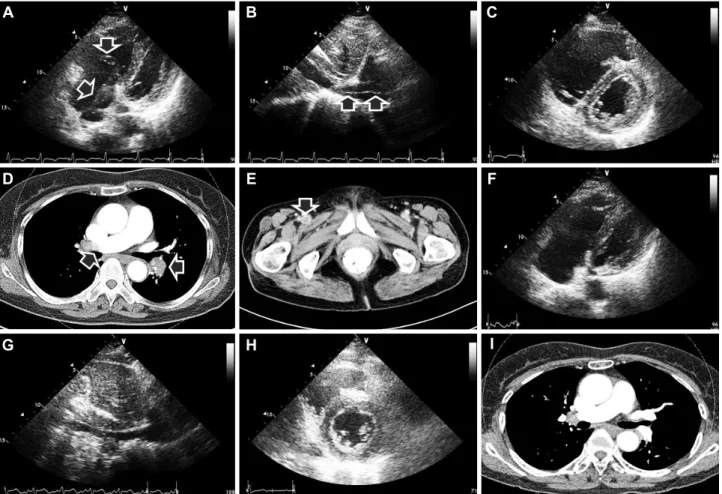
A 65-year-old, previous healthy woman was referred for evaluation of exertional dyspnea that had developed three days prior. Radical hysterectomy had been done for cervical cancer, followed by reoperation for wound dehiscence 12 days before referral. Lower extremity edema was observed solely on the right side. Transthoracic echocardiography re- vealed serpentine, free-floating thrombus, starting from the inferior vena cava and extending to the right ventricle (RV) at diastole and the dilated RV showed systolic dysfunction (Fig. 1A, B and C). Computed tomography (CT) showed near total obstruction of pulmonary arteries and deep vein throm- bosis of the right femoral vein (Fig. 1D and E). Administra- tion of intravenous heparin with close monitoring was se- lected as the initial treatment, rather than thrombolysis or surgical embolectomy. This was due to the patient’s stable vi- tal signs, and most importantly, a history of repeated surgical operation and serious wound dehiscence with ongoing infec- tive intraabdominal lymphocele. The thrombus disappeared 4 days later, though pulmonary hypertension remained (Fig.

1F and G). Oral anticoagulation treatment was started and the patient was markedly relieved of dyspnea 14 days later, with

significant improvement of RV function (Fig. 1H) and com- plete resolution of pulmonary thrombus as assessed 4 months later by CT (Fig. 1I).

Although the prognosis is more fatal for patients with pul- monary embolism that is associated with right heart throm- bus,

1)

the efficacy of different treatments, including the use of anticoagulants, thrombolytic therapy,

2)

or surgical embolec- tomy,

3)

remains controversial.

3)4)

In this case, given the patient’s stable vital signs and past medical history, radical thrombol- ysis or thrombectomy was not performed, and fortunately she had an uncomplicated recovery.

REFERENCES

1) Torbicki A, Galie N, Covezzoli A, et al. Right heart thrombi in pul- monary embolism: results from the International Cooperative Pul- monary Embolism Registry. J Am Coll Cardiol 2003;41:2245-51.

2) John SH, Jung GM, Choi HJ, et al. A case of huge right atrial throm- bi treated with thrombolytic agent. Korean Circ J 2004;34:328-32.

3) Rose PS, Punjabi NM, Pearse DB. Treatment of right heart thrombo- emboli. Chest 2002;121:806-14.

4) Kinney EL, Wright RJ. Efficacy of treatment of patients with echo-

cardiographically detected right-sided heart thrombi: a meta-analy-

sis. Am Heart J 1989;118:569-73.

(2)

52 Pulmonary Embolism With Visible Right Heart Thrombus

Fig. 1. Representative echocardiography and computed tomography images at initial presentation (A-E) and at follow-up (F-I). A and B: a large, serpentine, free-floating thrombus (arrows) was noted at the dilated right artium and ventricle (A) and also, inferior vena cava (B). C:

the right ventricle was dilated and compressed the left ventricle in to a typical D-shape. D, E and F: thrombus was demonstrated clearly at both pulmonary arteries (arrows) (D) and also at the right femoral vein (arrows) (E) on computed tomography, confirming the diagnosis of pul- monary thromboembolism with concomitant deep vein thrombosis. F and G: the free-floating thrombus had disappeared from the right heart (F) and also, the inferior vena cava (G) 4 days after continuous intravenous heparin. H: the right and left ventricle had recovered into a normal configuration 14 days after oral anticoagulation. I: thrombus at pulmonary arteries had disappeared after 4 months of oral anticoagulation.

A

D

G

B

E

H

C

F

I

수치

Fig. 1. Representative echocardiography and computed tomography images at initial presentation (A-E) and at follow-up (F-I)

참조

관련 문서

 The Dutch physicist Pieter Zeeman showed the spectral lines emitted by atoms in a magnetic field split into multiple energy levels...  With no magnetic field to align them,

Modern Physics for Scientists and Engineers International Edition,

However, all greetings are usually used to welcome people and wish them

Five days later, on 15 January 1975, the Portuguese government signed an agreement with the MPLA, FNLA and UNITA providing for Angola to receive its independence on 11

Usefulness of co-treatment with immunomodulators in patients with inflammatory bowel disease treated with scheduled infliximab maintenance therapy.. Oussalah A, Chevaux JB, Fay

Inclusion and Inclusiveness: Shared Vision of Youth for Local, National, and Global Village Inclusion at large stands for embracing populations with disabilities and

systemic circulation, in the right ventricle and oxygenated blood from the lungs, or pulmonary circulation, in the left ventricle, as in birds and mammals.. Two vessels,

The index is calculated with the latest 5-year auction data of 400 selected Classic, Modern, and Contemporary Chinese painting artists from major auction houses..