INTRODUCTION
Since the introduction of desensitization (DSZ) with rit- uximab (RTX; anti-CD20 monoclonal antibody; Rituxan
& MabThera, Roche, Switzerland), graft survival after ABO-incompatible (ABOi) living donor liver transplantation (LDLT) has been gradually improving. However, there is no standardized DSZ protocol for preventing graft injury.
The role of the isoagglutinin (IA) titer in liver transplan- tation (LT) is still not well defined, but the general belief is that a higher titer may result in a higher risk of rejection [1-3]. To reduce the IA titer, plasmapheresis is usually per- formed 1–2 weeks before ABOi LDLT. However, due to the lack of sufficient evidence for the role of plasmapheresis, it is unclear whether plasmapheresis is necessary for all patients undergoing ABOi LDLT. Several studies have re-
Successful ABO-incompatible living donor liver transplantation using splenectomy and intravenous immunoglobulin in high
isoagglutinin titer patients
Boram Lee, Jai Young Cho, Hae Won Lee, YoungRok Choi, Yoo-Seok Yoon, Ho-Seong Han
Department of Surgery, Seoul National University Bundang Hospital, Seoul National University College of Medicine, Seongnam, Korea
The role of the isoagglutinin (IA) titer in liver transplantation (LT) is still not well de- fined, but the general belief is that a higher titer may result in a higher risk of rejection in ABO-incompatible living donor LT. To reduce the IA titer by 1:16 or lower, plasmaphere- sis is usually performed before transplantation. However, there is no established proto- col for patients for whom plasmapheresis has failed before reaching the target IA titers.
Here, we report the cases of three patients who show high baseline IA titers and have failed plasmapheresis: no-response to plasmapheresis, allergic reaction associated with plasmapheresis, and anaphylactic reaction to platelet transfusion. For various rea- sons, after several plasmapheresis procedures, IA titers were not effectively reduced.
In these patients, splenectomy and intravenous immunoglobulin (0.8 g/kg, from the anhepatic phase to 2 days after transplantation) were carried. The protocol biopsy on postoperative day 7 showed no histologic evidence of meaningful acute rejection. The main aim of this work is to demonstrate that we can apply this protocol to patients who have high baseline IA titers and have failed plasmapheresis. Furthermore, this report is enhanced to promote to the transplant community this approach with this type of re- cipient.
Keywords: Liver transplantation; Plasmapheresis; Graft rejection; Splenectomy;
Immunoglobulins, intravenous
Received March 3, 2020 Revised April 21, 2020 Accepted April 22, 2020
Corresponding author: Jai Young Cho Department of Surgery, Seoul National University Bundang Hospital, 82 Gumi- ro 173beon-gil, Bundang-gu, Seongnam 13620, Korea
Tel: +82-31-787-7098 Fax: +82-31-787-4078 E-mail: [email protected]
© The Korean Society for Transplantation This is an Open Access article distributed under the terms of the Creative Commons Attribution Non-Commercial License (http://creativecommons.org/licenses/
by-nc/4.0/) which permits unrestricted non-commercial use, distribution, and reproduction in any medium, provided the original work is properly cited.
pISSN 2671-8790
eISSN 2671-8804
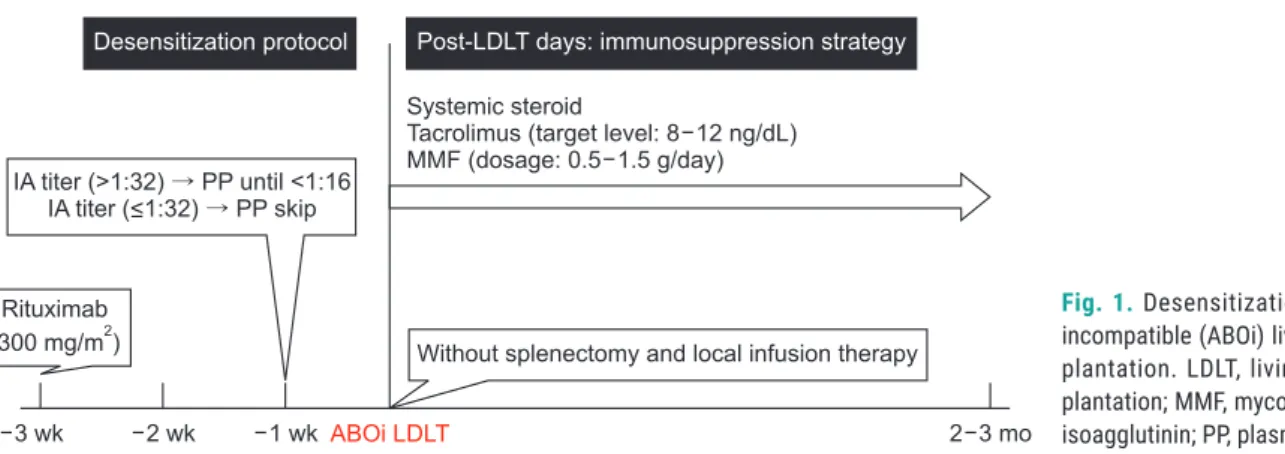
ported that sufficient DSZ for ABOi LDLT can be achieved using RTX alone [4-6]. In our center, if the baseline IA titer (≤1:32) is low, ABOi LDLT is carried out using conventional immunosuppression and RTX alone [4]. Otherwise, plas- mapheresis combined with RTX is used as protocol to reduce the IA titer by 1:16 or lower before transplantation (Fig. 1). Our patients undergo conventional plasmapher- esis (total plasma exchange), using freshly frozen blood type AB plasma or albumin. One session of plasmapher- esis is carried out 1–1.5 times at the predicted plasma volume every other day.
However, there is no established protocol for patients who have failed plasmapheresis before reaching target IA titers. The purpose of this case series is to show suc- cessful ABOi LDLT in patients who show high baseline IA titers and have failed plasmapheresis. The protocol of this retrospective cohort study was approved by the Institu- tional Review Board of Seoul National University Bundang Hospital, Seongnam, Korea, an academic hospital affili- ated with Seoul National University, College of Medicine (IRB No. B-2003-603-702). Informed consent was waived because of the retrospective nature of the study and the analysis used anonymous clinical data.
CASE REPORT Case 1
Non-response to plasmapheresis
The patient was a 47-year-old male (Rh+, O) with hep- atitis B induced liver cirrhosis (LC) and hepatocellular carcinoma (HCC). Due to HCC recurrent, he was referred to our department for LT (Child-Pugh Score and model for end-stage liver disease [MELD] score was B7 and 9). His 52-year-old brother (Rh+, A) was determined to be a ABOi living donor. Preoperative donor specific antibody (DSA) and cross-matching were negative. The patient received RTX (300 mg/m
2) 3 weeks before transplantation (per- centage of cluster of differentiation 19 [CD19] decreased from 18% to <1%). The initial titers of immunoglobulin G (IgG) and immunoglobulin M (IgM) were 1:256 and 1:64.
The patient underwent conventional plasmapheresis us- ing 5% albumin for whole replacement volume. After three plasmapheresis procedures, IA titers were not effectively reduced (IgG 1:256 and IgM 1:4). We decided to proceed with additional plasmapheresis procedures through mul- tidisciplinary discussions. However, despite two addition- al cycles of plasmapheresis, the IA titer did not decrease to the target value (IgG 1:256 and IgM 1:8). Splenectomy combined with intravenous immunoglobulin (IVIg; 0.8 g/
kg, from anhepatic phase to 2 days after transplantation) was done to reduce the possibility of rejection (Fig. 2).
LDLT was completed without complications. The protocol biopsy on postoperative day (POD) 7 showed no histo- logic evidence of acute rejection. The titers of IgG vs. IgM were 1:16 vs. 1:2 and 1:16 vs 1:1 at POD 7 and 30, respec- tively.
Case 2
Allergic reaction associated with plasmapheresis HIGHLIGHTS
• Plasmapheresis is usually performed before transplan- tation.
• Patients showed the high isoagglutinin titers even after plasmapheresis.
• The splenectomy and intravenous immunoglobulin were applied.
Systemic steroid
Tacrolimus (target level: 8 12 ng/dL) MMF (dosage: 0.5 1.5 g/day)
Without splenectomy and local infusion therapy
3 wk 2 wk 1 wk ABOi LDLT
Desensitization protocol Post-LDLT days: immunosuppression strategy
Rituximab (300 mg/m )2
IA titer (>1:32) PP until <1:16 IA titer (<1:32) PP skip
2 3 mo
Fig. 1. Desensitization protocol for ABO
incompatible (ABOi) living donor liver trans-
plantation. LDLT, living donor liver trans-
plantation; MMF, mycophenolate mofetil; IA,
isoagglutinin; PP, plasmapheresis.
The patient was a 58-year-old male (Rh+, O) with hep- atitis B induced LC and HCC. We decided to perform LT due to recurrent HCC (Child-Pugh Score and MELD score was B7 and 9). A possible living donor was his 54-year- old brother (Rh+, B). Preoperative DSA and cross-match- ing were negative. The percentage of CD 19 decreased from 37% to 1% after receiving RTX (300 mg/m
2) 3 weeks before transplantation. The initial titers of IgG and IgM were 1:512 and 1:64. An allergic reaction, such as itch- ing sensation and hypotension, occurred during the first plasmapheresis, and so the procedure was interrupted.
The cause was presumed to be the albumin used in the replacement fluid. To prevent the allergic reaction, the patient was administered with 100 mg of hydrocortisone and 4 mg of chlorpheniramine intravenously before start- ing the 2nd plasmapheresis. Fresh frozen plasma (FFP) was used as a replacement fluid. Despite the changes, it was discontinued due to an allergic reaction. Therefore, we decided to stop additional plasmapheresis. The final IgG and IgM titers before transplantation were 1:64 and 1:8. Splenectomy combined with IVIg was done. LDLT was completed without complications. The protocol biopsy on POD 7 were consistent with acute cellular rejection (ACR) of a mild degree (rejection activity index [RAI] score, 3).
Even if there was an ACR finding with a RAI score of 3, there was no sign of graft failure at the time, and rejection therapy was not performed. The titers of IgG vs. IgM were 1:4 vs. 1:1 and 1:2 vs. negative at POD 7 and 30, respec- tively.
Case 3
Anaphylactic reaction to platelet transfusion
The patient was a 64-year-old male (Rh+, O) with hepa- titis B induced LC and HCC who had a history of platelet transfusion-related anaphylaxis. He was readmitted for
LT due to HCC recurrence and deteriorating liver function (Child-Pugh Score and MELD score was B7 and 16). His 19-year-old son (Rh+, A) was determined to be a living donor. Preoperative DSA and cross-matching were neg- ative. The patient received RTX (300 mg/m
2) 3 weeks be- fore transplantation (percentage of CD19 decreased from 16% to <1%). The initial titers of IgG and IgM were 1:128 and 1:64. After the first cycle of plasmapheresis, IA titers were IgG 1:64 and IgM 1:32. Platelet count decreased from 37×10
3/µL to 23×10
3/µL. Because of previous al- lergic reactions, washed apheresis platelets were trans- fused. Fever, shivering and hypotension developed 1 hour after finishing the transfusion. The patient was managed with hydration and antipyretics. Even though the IgG titer did not reach the target value of 1:16, we decided not to perform any further plasmapheresis due to the burden of pancytopenia and coagulopathy that occurred after plas- mapheresis. Splenectomy and IVIg administration were performed. The patient was transfused with 23 units of red blood cells, 27 units of FFP, and three units of apher- esis platelet during surgery and no transfusion-related allergic reactions occurred. LDLT was completed without complications. The protocol biopsy on POD 7 showed no evidence of acute rejection. The titers of IgG vs. IgM were 1:4 vs. 1:1 and 1:2 vs. negative at POD 7 and 30, respec- tively.
DISCUSSION
As reflected in the remarkable improvement in survival outcomes, ABOi LDLT has become an effective treatment option for end-stage liver disease. However, an effective DSZ protocol is the Achilles’ heel of ABOi LDLT [7]. The
Systemic steroid
Tacrolimus (target level: 8 12 ng/dL) MMF (dosage: 0.5 1.5 g/day)
Splenectomoy 3 wk 2 wk 1 wk ABOi LDLT
Desensitization protocol Post-LDLT days: immunosuppression strategy
Rituximab (300 mg/m )2
2 3 mo IA titer (>1:32) PP until <1:16
If) fail
IVIg, 0.8 g/kg from anhepatic phase to 2 days after LT
Fig. 2. Desensitization protocol for patients