https://doi.org/10.5468/ogs.2017.60.1.100 pISSN 2287-8572 · eISSN 2287-8580
Introduction
Premenstrual syndrome (PMS) affects millions of women and is recognized as the most significant disorder among women [1]. Several days to 2 weeks before menses, a range of emo- tional, behavioral, and physical symptoms can occur. These symptoms known as PMS are decreased following the men- strual period [2]. Prevalence of PMS during the reproductive period has been reported to be between 70% to 90% [3].
The most common symptoms in PMS include abdominal bloating, breast tenderness, anxiety, crying spells, depression, fatigue, lack of energy, anger and irritability, changes in ap- petite, and varying degrees of edema [4]. Etiology of PMS
Effect of calcium on premenstrual syndrome:
A double-blind randomized clinical trial
Fatemeh Shobeiri
1, Fahimeh Ezzati Araste
1, Reihaneh Ebrahimi
1, Ensiyeh Jenabi
2, Mansour Nazari
31Maternal and Child Care Research Center, Hamadan University of Medical Sciences, Hamadan; 2Department of Midwifery, Tuyserkan Branch, Islamic Azad University, Tuyserkan; 3Department of Medical Entomology, School of Medicine, University of Medical Sciences, Hamadan, Iran
Objective
Premenstrual syndrome (PMS) affects millions of women and is known as the most important disorder among them. The very aim of the present study was to evaluate the effects of low dose calcium on severity of PMS.
Methods
This study can be considered as a double-blind randomized clinical trial. Female students of Hamadan University of Medical Sciences diagnosed with PMS in 2014 participated in the present study. Sixty-six female students diagnosed with PMS were involved in the experimental and control groups. The participants were randomly assigned into two groups to receive 500 mg of calcium daily or placebo for two months. Severity of PMS was detected by Daily Record of Severity of Problems, which was used to measure symptoms during one menstrual cycle before and two menstrual cycles after the intervention.
Results
No signifcant differences were observed in the mean scores of PMS symptoms between calcium and placebo groups before the treatment (P=0.74). However, signifcant differences were noticed between the two intervention groups in the first (P=0.01) and second menstrual cycles (P=0.001) after the intervention. The differences were significant in subgroups of anxiety, depression, emotional changes, water retention, and somatic changes in calcium group compared with placebo group in the menstrual cycle before the intervention and two menstrual cycles after the intervention and among menstrual cycles (0, cycle 1, cycle 2) in calcium group (P=0.01).
Conclusion
Overall, the results of the present study suggest that treatment with calcium supplements is an effective method for reducing mood disorders during PMS.
Keywords: Calcium; Premenstrual syndrome; Randomized clinical trial
Articles published in Obstet Gynecol Sci are open-access, distributed under the terms of the Creative Commons Attribution Non-Commercial License (http://creativecommons.
org/licenses/by-nc/3.0/) which permits unrestricted non-commercial use, distribution, and reproduction in any medium, provided the original work is properly cited.
Copyright © 2017 Korean Society of Obstetrics and Gynecology Received: 2016.6.28. Revised: 2016.9.3. Accepted: 2016.9.12.
Corresponding author: Ensiyeh Jenabi
Department of Midwifery, Tuyserkan Branch, Islamic Azad University, Tuyserkan, Iran
Tel: +98-081-34920253 Fax: +98-081-34925353 E-mail: [email protected]
http://orcid.org/0000-0002-4536-0814
still remains unknown; however, it is understood as a psycho- endocrine disorder. Involvement of sex steroids is supported by the relief of PMS symptoms with the suppression of ovula- tion; however, no strong evidence is provided to confirm that reproductive hormones are the sole cause of PMS [5].
A number of studies have suggested that administration of supplements including vitamin D and E, thiamin, and riboflavin is associated with decreased development of PMS [6-10]. Shamberger [11] revealed that levels of calcium and some trace elements in red blood cells were lower than nor- mal in women with PMS. Some studies have reported signifi- cant effect of 1,000 mg of calcium supplement on decrease of PMS [4,12,13]. The calcium effect on PMS is correlated to the production of serotonin and tryptophan metabolism [14].
With consideration of the mentioned findings, the present study examined the efficacy of 500 mg of calcium per day for two months on reduction of PMS symptoms among students of Hamadan University of Medical Sciences, in west of Iran.
Materials and methods
1. Study participants
The present double-blind randomized clinical trial was con- ducted from January 10 to March 18, 2014 among female students of Hamadan University of Medical Sciences in west of Iran. The study was registered in the www.irct.ir as IRCT 201309296888 after taking approval from the Research Eth- ics Committee of Hamadan University of Medical Sciences.
Written informed consent was received from all the par- ticipants. Inclusion criteria applied for all students were as follows: (1) no ongoing hormone therapy; having moderate to severe PMS specified based on Diagnostic and Statistical Manual of Mental Disorders, 4th edition criteria. This syn- drome was defined by the presence of at least 5 symptoms problematic enough to warrant treatment, one of which is a functionally impairing affective symptom and (2) no clinical history of major psychological problems. According to calcu- lations performed to determine the differences about 30%
and pain reduction according to 80% power scale and sig- nificance level 0.05, 33 patients in each group were required Which is justified the sample size of 66 subjects in this study.
2. Procedures and data collection
The eligible women were randomly assigned into two groups
using the balance block randomization method. To do so, four sheets of paper were prepared. “C” was written for calcium on two of the prepared sheets, and on the other two sheets,
“P” was written for placebo. The sheets were pooled, placed in a container, and randomly drawn one at a time for each patient without replacement until all 4 sheets were drawn.
The four sheets were then placed back into the container, and this action was repeated until the sample size was reached.
The allocations remained concealed during the study. For this purpose, random allocation was conducted and labeled by a pharmacologist, so that neither the students nor the distributer who evaluated the effect of the interventions was aware of the administered drugs until the data was analyzed, and the labels were decoded.
Calcium tablets of 500 mg daily were provided after lunch for two cycles. Participants in the placebo group received pla- cebo tablet of 500 mg (starch), which was identical to the cal- cium tablet. Both calcium and placebo tablets were packed in similar packages and were given to a person to be distributed, so that neither the distributer nor the students were aware of the package contents.
Severity of symptoms was determined based on Daily Re- cord of Severity of Problems scale in one menstrual cycle be- fore the intervention and two menstrual cycles after the inter- vention. Participants rated the severity of symptoms as 0 to 3 in their forms. While absence of the symptom was scored as 0, score of 1indicated mild symptoms, which did not interfere with daily activities such as education and work. Score of 2 represented moderate symptoms, which affected daily activi- ties to some extent. However, score of 3 was indicative of severe symptoms, which prevented the patient from daily ac- tivities. To simplify the comparisons between groups in terms of the effectiveness of calcium on reducing each of the symp- toms, the overall 30 symptoms of the menstrual diary were divided into 5 subgroups according to the Abraham’s classifi- cation system [8,15]. The effectiveness of each compound on the symptoms was then evaluated in detail. The subgroups were as follows: anxiety (stress, irritability, and anxiety); de- pression (depression and seclusion, social inactivity, crying, impatience, desire to stay at home, anger, forgetfulness, insomnia, and lack of concentration); emotional changes (cravings for sweets, palpitation, weakness, decreased energy, increased appetite, and fatigue); water retention (pain and breast tenderness, swelling of legs, abdominal bloating, pain, and discomfort); and somatic changes (feeling cold, nausea,
frequent urination, hot flashes, back pain, headaches, acne, oily skin, joint pain, and muscle pain).
3. Data analyses
Two groups’ severity of symptoms was compared with t-test.
Analysis of variance was applied to compare the values of menstrual cycles (0, cycle 1, cycle 2) in calcium and placebo groups. All the hypotheses were two-sided, and P-values <0.05 were considered to be statistically significant. SPSS ver. 16.0 (SPSS Inc., Chicago, IL, USA) was used for statistical analyses.
Results
From 66 involved participants, one in the calcium group and one in the placebo group did not return to complete the follow-up data. Hence, they were excluded from the study (Fig. 1). In the current study, the mean age of participants in the intervention and placebo groups was 21.09 and 20.81 years, respectively.
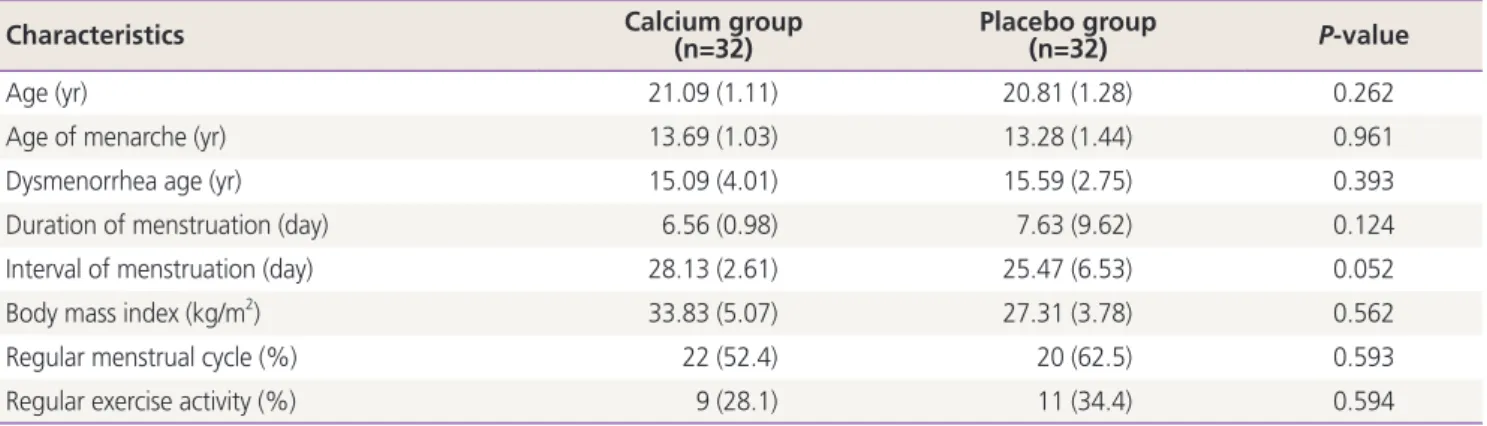
The two groups were similar in terms of the age of menarche, dysmenorrheal age, duration of menstruation, interval of menstruation, body mass index, regular menstrual cycle, and regular exercise activity (Table 1).
In Table 2, significant differences in the mean scores of PMS symptoms were not found between the intervention and placebo groups before treatment (P=0.74). However, sig- nificant difference was observed between two groups in the first menstrual cycle (P=0.01) and the second menstrual cycle (P=0.001) after the intervention and among menstrual cycles (0, cycle 1, cycle 2) in calcium group (P=0.01). The differences among menstrual cycles (0, cycle 1, cycle 2) in placebo group were not statistically significant (P=0.2).
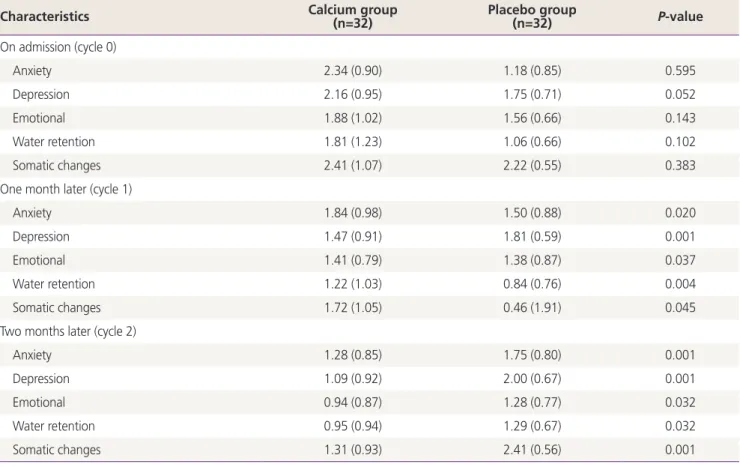
Comparisons of changes in the mean scores of PMS before and after the intervention in placebo and calcium groups are summarized in Table 3. The differences were significant in subgroups of depression, emotional changes, and somatic changes in calcium group compared with placebo group in the menstrual cycle before the intervention and in two men- strual cycles after the intervention. The comparisons were not significant between two groups in the subgroup of water retention in two menstrual cycles after the intervention. The side effect in two groups was not reported.
Fig. 1. Flowchart of progress through the trial.
200 Students assessed for screening
66 Students randomized
33 Allocated to calcium 33 Allocated to placebo
1 Lost to follow up
32 Included in analysis
1 Lost to follow up
32 Included in analysis 134 Excluded
88 Did not meet inclusion criteria 46 Decline to participate
Table 1. Baseline characteristics and clinical data of the study population
Characteristics Calcium group
(n=32) Placebo group
(n=32) P-value
Age (yr) 21.09 (1.11) 20.81 (1.28) 0.262
Age of menarche (yr) 13.69 (1.03) 13.28 (1.44) 0.961
Dysmenorrhea age (yr) 15.09 (4.01) 15.59 (2.75) 0.393
Duration of menstruation (day) 6.56 (0.98) 7.63 (9.62) 0.124
Interval of menstruation (day) 28.13 (2.61) 25.47 (6.53) 0.052
Body mass index (kg/m2) 33.83 (5.07) 27.31 (3.78) 0.562
Regular menstrual cycle (%) 22 (52.4) 20 (62.5) 0.593
Regular exercise activity (%) 9 (28.1) 11 (34.4) 0.594
Values are presented as mean (standard deviation).
Discussion
The findings of this study demonstrated significant effects of low dose calcium (500 mg) on reduction of PMS symptoms and among menstrual cycles (0, cycle 1, cycle 2). The obtained results corroborate those of previous studies regarding the positive effect of calcium supplementation on premenstrual symptoms (2, 4, 5, 12, 13). Ghanbari et al. [16] reported that comparison of the results obtained before and after interven- tion revealed that depression and sadness were significantly reduced in the women receiving calcium 1,000 mg/day (27%) in comparison with those receiving placebo (7%) (P<0.002).
These results were similar to those reported by Penland and Johnson [17]. The mentioned study revealed that calcium supplements alleviated concentration problems, and affective and behavioral variations related to PMS (P=0.01).
In another study conducted in this regard, intake of calcium (500 mg) plus vitamin D (200 mg) supplement modestly re- duced PMS symptoms, although the improvements did not exceed the placebo [2]. In a larger placebo-controlled study, calcium supplementation (1,200 mg/day) significantly reduced premenstrual depression, fatigue, edema, and pain in women with PMS [3].
In a review study conducted in 2015, numerous non-phar-
Table 2. Scores of premenstrual syndrome before and after the intervention in the two groups Calcium group
(n=32) Placebo group
(n=32) P-value
Before the intervention (cycle 0) 10.59 (2.74) 8.41 (1.70) 0.741
After the intervention (cycle 1) 7.66 (3.05) 7.44 (2.10) 0.012
After the intervention (cycle 2) 5.56 (2.98) 8.28 (1.80) 0.001
P-value 0.01 0.2 -
Table 3. Comparison of changes in mean premenstrual syndrome scores before and after the intervention in two groups
Characteristics Calcium group
(n=32) Placebo group
(n=32) P-value
On admission (cycle 0)
Anxiety 2.34 (0.90) 1.18 (0.85) 0.595
Depression 2.16 (0.95) 1.75 (0.71) 0.052
Emotional 1.88 (1.02) 1.56 (0.66) 0.143
Water retention 1.81 (1.23) 1.06 (0.66) 0.102
Somatic changes 2.41 (1.07) 2.22 (0.55) 0.383
One month later (cycle 1)
Anxiety 1.84 (0.98) 1.50 (0.88) 0.020
Depression 1.47 (0.91) 1.81 (0.59) 0.001
Emotional 1.41 (0.79) 1.38 (0.87) 0.037
Water retention 1.22 (1.03) 0.84 (0.76) 0.004
Somatic changes 1.72 (1.05) 0.46 (1.91) 0.045
Two months later (cycle 2)
Anxiety 1.28 (0.85) 1.75 (0.80) 0.001
Depression 1.09 (0.92) 2.00 (0.67) 0.001
Emotional 0.94 (0.87) 1.28 (0.77) 0.032
Water retention 0.95 (0.94) 1.29 (0.67) 0.032
Somatic changes 1.31 (0.93) 2.41 (0.56) 0.001
Values are presented as mean (standard deviation).
macologic treatments were utilized; however, efficacy was re- ported only for calcium supplements [5]. The other study was performed in 2016 that students in a group received com- bined vitamin B6 (40 mg) and calcium (500 mg) and in other group only vitamin B6 twice a day. The result showed that although the severity of symptoms decreased in both groups, this reduction was more significant in the combined calcium and vitamin B6 group [14].
Previous studies indicated that daily intake of 1,000 mg cal- cium reduced PMS symptoms [12,13,16]. The present study reported that daily intake of 500 mg calcium was effective in reducing PMS symptoms. Therefore, intake of lower doses of calcium can decrease PMS symptoms similar to the reduction occurring in 1,000 mg dose of calcium intake. Furthermore, daily intake of calcium for longer duration was caused that the symptoms more were relieved. Overall, the results of the mentioned studies suggest that treatment with calcium supplements is an effective technique for reducing mood dis- orders observed in PMS. Furthermore, calcium supplementa- tion is a cost-effective, beneficial, and effective treatment for reducing symptoms of PMS.
The main limitation of the present study was small sample size of the study groups. If the sample size was large enough, the differences between the trial groups would be indicated more clearly with less random error. In addition, the present study was conducted addressing a single group of adoles- cents; therefore, the results may not be generalizable to fe- males outside that age range.
Conflict of interest
No potential conflict of interest relevant to this article was reported.
References
1. Fathizadeh N, Ebrahimi E, Valiani M, Tavakoli N, Yar MH.
Evaluating the effect of magnesium and magnesium plus vitamin B6 supplement on the severity of premen- strual syndrome. Iran J Nurs Midwifery Res 2010;15(Sup- pl 1):401-5.
2. Khajehei M, Abdali K, Parsanezhad ME, Tabatabaee HR.
Effect of treatment with dydrogesterone or calcium plus
vitamin D on the severity of premenstrual syndrome. Int J Gynaecol Obstet 2009;105:158-61.
3. Thys-Jacobs S, Starkey P, Bernstein D, Tian J. Calcium carbonate and the premenstrual syndrome: effects on premenstrual and menstrual symptoms. Premen- strual Syndrome Study Group. Am J Obstet Gynecol 1998;179:444-52.
4. Ghanbari Z, Haghollahi F, Shariat M, Foroshani AR, Ashrafi M. Effects of calcium supplement therapy in women with premenstrual syndrome. Taiwan J Obstet Gynecol 2009;48:124-9.
5. Freeman EW. Therapeutic management of premenstrual syndrome. Expert Opin Pharmacother 2010;11:2879-89.
6. Chocano-Bedoya PO, Manson JE, Hankinson SE, John- son SR, Chasan-Taber L, Ronnenberg AG, et al. Intake of selected minerals and risk of premenstrual syndrome.
Am J Epidemiol 2013;177:1118-27.
7. Salamat S, Ismail KM, O’Brien S. Premenstrual syndrome.
Obstet Gynecol Reprod Med 2008;18:29-32.
8. Abraham GE. Nutritional factors in the etiology of the premenstrual tension syndromes. J Reprod Med 1983;28:446-64.
9. Shobeiri F, Jenabi E. The effects of vitamin E on muscular pain reduction in students affected by premenstrual syn- drome. Iran J Obstet Gynecol Infertil 2014;17:1-5.
10. Shobeiri F, Oshvandi K, Nazari M. Clinical effective- ness of vitamin E and vitamin B6 for improving pain severity in cyclic mastalgia. Iran J Nurs Midwifery Res 2015;20:723-7.
11. Shamberger RJ. Calcium, magnesium, and other ele- ments in the red blood cells and hair of normals and pa- tients with premenstrual syndrome. Biol Trace Elem Res 2003;94:123-9.
12. Akhlaghi F, Hamedi A, Javadi Z, Hosseinipoor F. Effects of calcium supplementation on premenstrual syndrome.
Razi J Med Sci 2004;10:669-75.
13. Kermani AZ, Taavoni S, Hosseini AF. Effect of combined calcium and vitamin E consumption on premenstrual syndrome. Iran J Nurs 2010;23:8-14.
14. Masoumi SZ, Ataollahi M, Oshvandi K. Effect of com- bined use of calcium and vitamin B6 on premenstrual syndrome symptoms: a randomized clinical trial. J Caring Sci 2016;5:67-73.
15. Ebrahimi E, Khayati Motlagh S, Nemati S, Tavakoli Z.
Effects of magnesium and vitamin b6 on the sever-
ity of premenstrual syndrome symptoms. J Caring Sci 2012;1:183-9.
16. Ghanbari Z, Manshavi FD, Jafarabadi M. The effect of three months regular aerobic exercise on premenstrual
syndrome. J Family Reprod Health 2008;2:167-71.
17. Penland JG, Johnson PE. Dietary calcium and manga- nese effects on menstrual cycle symptoms. Am J Obstet Gynecol 1993;168:1417-23.