Introduction
Cervical intraepithelial neoplasia (CIN) is caused by persistent infection with high-risk human papillomavirus (hrHPV) and is a precursor of cervical cancer [1]. Persistent infection with hrHPV is the direct cause of the vast majority of CINs and invasive cervical cancers [2]. Age, parity, smoking, sexual
Risk factors for type-specific persistence of high-risk human papillomavirus and residual/recurrent cervical intraepithelial neoplasia after surgical treatment
Yung-Taek Ouh, MD, PhD 1,2 , Hyun Woong Cho, MD 1 , Seong Min Kim, MD, PhD 3 , Kyung-Jin Min, MD, PhD 4 , Sang-Hoon Lee, MD, PhD 5 , Jae-Yun Song, MD, PhD 5 , Jae-Kwan Lee, MD, PhD 1 , Nak Woo Lee, MD, PhD 4 , Jin Hwa Hong, MD, PhD 1
Department of Obstetrics and Gynecology,
1Korea University Guro Hospital, Korea University College of Medicine, Seoul,
2Graduate School of Medicine, Kangwon National University, Chuncheon;
3Gynecologic Cancer Center, Department of Obstetrics and Gynecology, CHA University Ilsan Medical Center, Goyang; Department of Obstetrics and Gynecology,
4Korea University Ansan Hospital, Korea University College of Medicine, Ansan,
5
Korea University Anam Hospital, Korea University College of Medicine, Seoul, Korea
Objective
This study aimed to investigate the clinicopathologic risk factors for type-specific persistence of high-risk human papillomavirus (hrHPV) and residual/recurrent cervical intraepithelial neoplasia (CIN) after surgical treatment.
Methods
Patients with CIN-2/3 who underwent conization or loop electrosurgical excision procedure (LEEP) at Korea University Hospital were enrolled. All patients underwent hrHPV testing and genotyping before conization or LEEP followed by both hrHPV genotyping and cytology. The significance of associations between patient characteristics and persistence of infection were assessed by multivariate logistic regression analyses.
Results
Among 398 women with pathologically confirmed CIN-2/3, 154 (38.7%) patients showed hrHPV persistence after surgical treatment. In multivariate analysis, high preoperative hrHPV load (P<0.05; odds ratio [OR], 2.063), presence of CIN-2 at treatment (P<0.01; OR, 2.732), and multiple hrHPV infections (P<0.001; OR, 4.752) were associated with hrHPV persistence. HPV 53 was the most likely to persist after treatment (24/43, 55.8%). The risk of residual/recurrent CIN-2/3 was higher in persistent infection with HPV 16 than other types (P<0.05). Menopause (P<0.001; OR, 3.969), preoperative and postoperative hrHPV load (P<0.05; OR, 2.430; P<0.05; OR, 5.351), and infection with multiple hrHPV types (P<0.05; OR, 2.345) were significantly related to residual/recurrent CIN following surgical treatment.
Conclusion
HPV load before treatment and infection with multiple hrHPV types were predictors of postoperative hrHPV persistence. HPV 53 was the type most likely to persist, but HPV 16 was the type that was most closely associated with residual/recurrent CIN-2/3.
Keywords: Cervical intraepithelial neoplasia; Conization;
Human papillomavirus; HPV DNA tests
Received: 2020.02.24. Revised: 2020.03.29. Accepted: 2020.04.23.
Corresponding author: Jin Hwa Hong, MD, PhD
Department of Obstetrics and Gynecology, Korea University Guro Hospital, Korea University College of Medicine, 148 Gurodong-ro, Guro-gu, Seoul 08308, Korea
E-mail: [email protected] https://orcid.org/0000-0002-6905-5363
Articles published in Obstet Gynecol Sci are open-access, distributed under the terms of the Creative Commons Attribution Non-Commercial License (http://creativecommons.
org/licenses/by-nc/3.0/) which permits unrestricted non-commercial use, distribution, and reproduction in any medium, provided the original work is properly cited.
Copyright © 2020 Korean Society of Obstetrics and Gynecology https://doi.org/10.5468/ogs.20049
pISSN 2287-8572 · eISSN 2287-8580
behavior, and socioeconomic status have been reported as potential factors mediating persistent infection by hrHPV [3].
The standard treatment for CINs, especially high-grade lesions, is conization or the loop electrosurgical excision pro- cedure (LEEP) [4]. Even if the lesion is completely removed, these patients have a higher risk for recurrence of high-grade lesions compared to the general population [5]. Because of this potential risk, close monitoring after surgical treatment for CIN is standard practice. Screening for patients at risk of residual/recurrent high-grade lesions using combined testing for hrHPV with cytology has a negative predictive value of 99% [6,7]. Detection of HPV infection has been highlighted as an objective marker with high sensitivity in screening or follow-up, as there is less interobserver variability compared to cytology testing alone [8]. High-grade squamous intraepi- thelial lesions (HSILs) with hrHPV infection have been demon- strated to be highly predictive of invasive cervical cancer [7,9].
It is well established that persistent infection by HPV after conization is a precursor for relapse of CINs. Patients tested as HPV- after conization had a 6.5% risk of residual/recurrent high-grade lesions, while those tested as HPV+ had a 60.9%
risk [10]. Determining the characteristics and risk factors for HPV persistence after CIN treatment has implications for the early detection and treatment of high-grade lesions and cervical cancer, as well as for our understanding of the natu- ral history of HPV infection. Several studies have analyzed persistent infection by HPV and residual/recurrent CINs after conization or LEEP [3,11-14]. However, specific HPV geno- types have different natural histories, and individual phylo- genetic species have different carcinogenicities. In terms of HPV persistence, therefore, a detailed analysis of specific HPV genotypes can help expand our understanding of the nature of HPV infections [15].
In this study, we aimed to analyze genotype-specific persis- tence of HPV and persistence/recurrence of CIN after surgery in patients that underwent hrHPV genotyping before and after conization or LEEP.
Materials and methods
1. Study population and inclusion criteria
A flowchart of participant enrollment is provided in Fig. 1.
A retrospective analysis was performed on 1,029 patients who underwent conization or LEEP at Korea University Guro
Hospital and Anam Hospital between January 2014 and September 2018. We included patients for whom informa- tion on HPV genotypes before and after surgical treatment was available. Of these 1,029 patients, 504 were excluded because of preoperative negative hrHPV or lack of HPV data. The remaining 525 patients were documented to have hrHPV based on the Anyplex
TMII (Seegene, Seoul, Korea) HPV genotyping test before operation. Patients with histo- logically confirmed CIN of grade 2/3 through punch biopsy were included. Of the remaining 525 patients, 31 and 19 were excluded due to diagnosis of VAIN or CIN-1, and due to invasive cervical cancer respectively. Finally, of the remaining 475 patients, 77 were lost to follow-up for HPV DNA testing after conization or LEEP, resulting in a total enrollment of 398 patients for this study.
Conization was performed using the surgeon’s choice of cold-knife or Bovie blade after the application of Lugols’ io- dine solution to confirm previous cervical lesions. Hemostasis was then achieved with electric coagulation.
Postoperative follow-up was done between 3–6 months after surgical treatment, and follow-up visits occurred every 6–12 months thereafter. Patients underwent cervical inspec- tions, HPV DNA genotyping tests, and cervical cytology. Pa- panicolaou smears were interpreted by the Bethesda system and histologic diagnoses of excised specimens were based on the World Health Organization classification.
Fig. 1. Composition of enrolled patients’ population. LEEP, loop electrosurgical excision procedure; hrHPV, high risk human papil- lomavirus; VAIN, vaginal intraepithelial neoplasia; CIN, cervical intraepithelial neoplasia.
LEEP or conization (n=1,029)
HrHPV negative or no data (n=504)
VAIN (n=13) CIN 1 (n=18) Squamous cell carcinoma (n=14)
Adenocarcinoma (n=5) HrHPV positive (n=525)
CIN 2/3 (n=475)
No postoperative HrHPV (n=77)
CIN 2/3 (n=398)
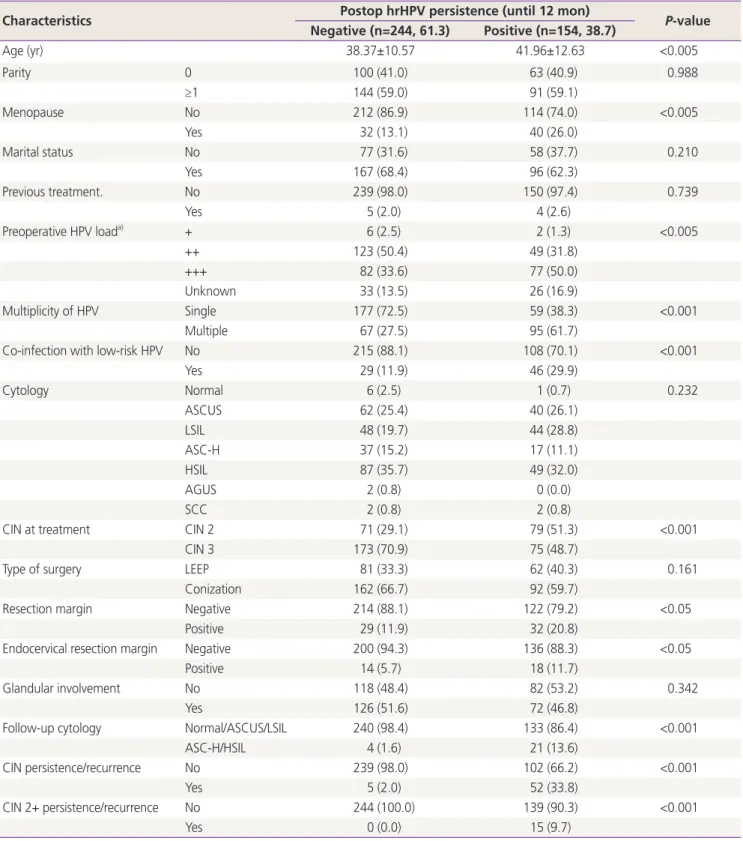
Table 1. Overview of patient characteristics based on the postoperative human papillomavirus (HPV) status
Characteristics Postop hrHPV persistence (until 12 mon)
P-value Negative (n=244, 61.3) Positive (n=154, 38.7)
Age (yr) 38.37±10.57 41.96±12.63 <0.005
Parity 0 100 (41.0) 63 (40.9) 0.988
≥1 144 (59.0) 91 (59.1)
Menopause No 212 (86.9) 114 (74.0) <0.005
Yes 32 (13.1) 40 (26.0)
Marital status No 77 (31.6) 58 (37.7) 0.210
Yes 167 (68.4) 96 (62.3)
Previous treatment. No 239 (98.0) 150 (97.4) 0.739
Yes 5 (2.0) 4 (2.6)
Preoperative HPV load
a)+ 6 (2.5) 2 (1.3) <0.005
++ 123 (50.4) 49 (31.8)
+++ 82 (33.6) 77 (50.0)
Unknown 33 (13.5) 26 (16.9)
Multiplicity of HPV Single 177 (72.5) 59 (38.3) <0.001
Multiple 67 (27.5) 95 (61.7)
Co-infection with low-risk HPV No 215 (88.1) 108 (70.1) <0.001
Yes 29 (11.9) 46 (29.9)
Cytology Normal 6 (2.5) 1 (0.7) 0.232
ASCUS 62 (25.4) 40 (26.1)
LSIL 48 (19.7) 44 (28.8)
ASC-H 37 (15.2) 17 (11.1)
HSIL 87 (35.7) 49 (32.0)
AGUS 2 (0.8) 0 (0.0)
SCC 2 (0.8) 2 (0.8)
CIN at treatment CIN 2 71 (29.1) 79 (51.3) <0.001
CIN 3 173 (70.9) 75 (48.7)
Type of surgery LEEP 81 (33.3) 62 (40.3) 0.161
Conization 162 (66.7) 92 (59.7)
Resection margin Negative 214 (88.1) 122 (79.2) <0.05
Positive 29 (11.9) 32 (20.8)
Endocervical resection margin Negative 200 (94.3) 136 (88.3) <0.05
Positive 14 (5.7) 18 (11.7)
Glandular involvement No 118 (48.4) 82 (53.2) 0.342
Yes 126 (51.6) 72 (46.8)
Follow-up cytology Normal/ASCUS/LSIL 240 (98.4) 133 (86.4) <0.001
ASC-H/HSIL 4 (1.6) 21 (13.6)
CIN persistence/recurrence No 239 (98.0) 102 (66.2) <0.001
Yes 5 (2.0) 52 (33.8)
CIN 2+ persistence/recurrence No 244 (100.0) 139 (90.3) <0.001
Yes 0 (0.0) 15 (9.7)
Values are presented as mean±standard deviation or number (%).
hrHPV, high-risk human papillomavirus; ASCUS, atypical squamous cells of undetermined significance; LSIL, low grade squamous intraepithelial lesion; ASC-H, atypical squamous cells, cannot exclude HSIL; HSIL, high grade squamous intraepithelial lesion; AGUS, atypical glandular cells of undetermined significance; SCC, squamous cell carcinoma; CIN, cervical intraepithelial neoplasia; LEEP, loop electrosurgical excision procedure.
a)
HPV viral copy number. +, <10
2; ++, 10
2–10
5; +++, >10
5.
2. Human papillomavirus (HPV) test with Anyplex™ II We extracted HPV DNA in accordance with the manufac- turer’s guidelines. Nucleic acids were extracted from 400 μL of sample using the MICROLAB STARlet automated purifica- tion system (Hamilton, Reno, NV, USA). HPV detection and genotyping were performed using an Anyplex II HPV28 and CFX96 real-time thermocycler (Bio-Rad, Hercules, CA, USA) according to the manufacturer’s instructions [16]. The Any- plex II HPV28 has been shown to perform comparably to the Roche Cobas 4800 HPV assay (Cobas) (Roche Molecular di-
agnostics, Branchburg, NJ, USA) and the HR Hybrid Capture 2 (Qiagen, Gaithersburg, MD, USA), which are accredited for cervical cancer screening and detection of hrHPV [16,17].
Furthermore, Anyplex II HPV28 is considered a reliable and validated test for detecting hrHPV genotypes [18].
3. Human papillomavirus (HPV) persistence and genotype-specific persistence
Persistent hrHPV infection was defined as the presence of hrHPV at the first follow-up visit after surgery regardless of
Table 2. Risk factors associated with high-risk human papillomavirus (hrHPV) persistence after surgical treatment
Characteristics Univariate Multivariate
OR 95% CI P-value OR 95% CI P-value
Age (yr) ≥50 2.553 1.406–4.636 <0.005 2.486 0.652–9.494 0.182
<50
Parity ≥1 0.811 0.512–1.284 0.372
0
Menopause Yes 2.577 1.355–4.899 <0.010 1.085 0.257–4.586 0.912
No
Marriage Yes 0.763 0.500–1.165 0.211
No
Previous treatment Yes 1.151 0.303–4.374 0.836
No
Preoperative HPV load
a)+++ 2.231 1.329–3.746 <0.010 2.063 1.139–3.737 <0.050
+-++
Multiplicity of HPV Multiple 4.402 2.713–7.144 <0.001 4.752 2.593–8.710 <0.001
Single
Co-infection with low risk HPV Yes 2.917 1.603–5.307 <0.001 1.584 0.750–3.344 0.228 No
Follow-up cytology ASC-H/HSIL/SCC 0.797 0.505–1.256 0.327
Normal/ASCUS/LSIL
CIN at treatment CIN 2 2.674 1.656–4.310 <0.001 2.732 1.451–5.128 <0.010
CIN 3
Type of surgery Conization 0.884 0.561–1.395 0.597
LEEP
Resection margin Positive 1.936 1.117–3.353 <0.05 1.319 0.558–3.121 0.528
Negative
Glandular involvement Yes 0.762 0.484–1.201 0.242
No
OR, odd ratio; CI, confidence interval; HPV, human papillomavirus; ASC-H, atypical squamous cells, cannot exclude HSIL; HSIL, high grade squamous intraepithelial lesion; SCC, squamous cell carcinoma; ASCUS, atypical squamous cells of undetermined significance; LSIL, low grade squamous intraepithelial lesion; CIN, cervical intraepithelial neoplasia; LEEP, loop electrosurgical excision procedure.
a)
HPV viral copy number. +, <10
2; ++, 10
2–10
5; +++, >10
5.
HPV type. HPV type-specific persistence was defined as the presence of the same HPV type before surgery and at the first follow-up visit after surgery. Multiple HPV infections in a patient were considered separate units when analyzing the HPV type-specific persistence rate. Patients who were HPV negative at the first follow-up visit, or had cleared all HPV types present before surgery, were defined as being clear of HPV infection.
4. Statistical analysis
The Chi Square (χ
2) and Fisher’s exact tests were used to eval- uate the significance of differences in variables between the HPV persistent group and the HPV non-persistent group. The risk for HPV persistence was modelled by logistic regression analysis and is presented as relative risks (odds ratios [ORs]) with 95% confidence intervals (CIs). Backward stepwise mul- tivariable logistic regression was applied to identify factors independently predictive of persistent/recurrent CIN1+ and CIN2+.
P-values (from 2-sided tests) less than 0.05 were considered significant. Data were analyzed using SPSS software (version 22.0; SPSS Inc., Chicago, IL, USA).
Results
A total of 398 patients who tested positive for hrHPV and underwent conization or LEEP met the inclusion criteria. The mean number of follow-up visits was 2.8 (range 1–7) and median follow-up period was 17.3 (range 4–48) months.
Overall, the prevalent hrHPV genotypes were HPV 16 (n=128, 32.2%), HPV 52 (n=80, 20.1%), HPV 58 (n=74, 18.6%), and HPV 53 (n=43, 10.8%). Two hundred thirty-six patients (59.3%) were infected by a single hrHPV type. Of the re- maining 162 patients infected with multiple types of hrHPV, 118 patients (29.6%) were infected with 2 hrHPV types, 32 patients (8.0%) were infected with 3 hrHPV types, and 12 patients (3.0%) were infected with more than 4 hrHPV types.
Persistent hrHPV infection after conization or LEEP was identified in 154 patients (38.7%) of the 398 patients en- rolled. Baseline characteristics of these patients are presented in Table 1. Mean age at diagnosis was 41.96±12.63 years in patients with hrHPV persistence compared to 38.37±10.57 years in those without hrHPV persistence (P<0.005). Initial re- sults from cervical cytology were not significantly associated with hrHPV persistence (P=0.232). Among patients who did not show hrHPV persistence, 25.4% had ASCUS and 37.3%
had ≥HSIL at initial cytology. However, in patients with hrHPV persistence, 26.1% had ASCUS and 32.8% had ≥HSIL. Re- sidual/recurrent CIN2+ occurred in 15 patients (9.7%) with hrHPV persistence, while it did not occur in those without persistent infection. Both patient groups (with and without persistent hrHPV infection) were similar in terms of previous treatment for CIN, type of surgery, glandular involvement, and socioeconomic status including parity and marital status.
Unadjusted and adjusted odds ratios for clinical factors se- lected for multivariable analysis are presented in Table 2. Age
≥50 years (OR, 2.553; 95% CI, 1.406–4.636; P<0.005) and post-menopausal status (OR, 2.577; 95% CI, 1.355–4.899;
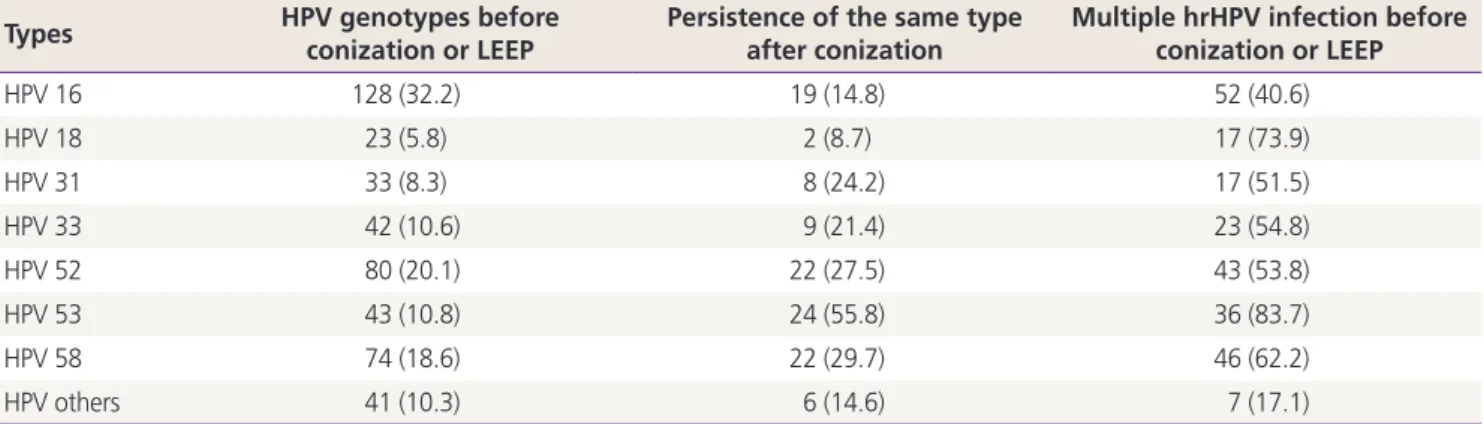
Table 3. Human papillomavirus (HPV) genotype-specific rate of persistence and multiple infection
a)Types HPV genotypes before
conization or LEEP
Persistence of the same type after conization
Multiple hrHPV infection before conization or LEEP
HPV 16 128 (32.2) 19 (14.8) 52 (40.6)
HPV 18 23 (5.8) 2 (8.7) 17 (73.9)
HPV 31 33 (8.3) 8 (24.2) 17 (51.5)
HPV 33 42 (10.6) 9 (21.4) 23 (54.8)
HPV 52 80 (20.1) 22 (27.5) 43 (53.8)
HPV 53 43 (10.8) 24 (55.8) 36 (83.7)
HPV 58 74 (18.6) 22 (29.7) 46 (62.2)
HPV others 41 (10.3) 6 (14.6) 7 (17.1)
Values are presented as number (%).
hrHPV, high-risk human papillomavirus; LEEP, loop electrosurgical excision procedure.
a)
Persistence of the same type after conization or LEEP was found in 120 of 398 (30.2%) patients.
P<0.01) were risk factors for hrHPV persistence in univariate analysis; however, these factors were not significant in multi- variate analysis (P=0.182 and P=0.912). HPV was more likely to persist in patients with CIN-2 than in patients with CIN- 3 (OR, 2.674; 95% CI, 1.451–5.128; P<0.01). HPV viral load at baseline was an independent predictor of persistence.
HPV with a viral copy number >10
5at baseline was associ- ated with an increased rate of persistence at 12 months (OR, 2.063; 95% CI, 1.139–3.737; P<0.05). Positive resection margin was not a significant risk factor for hrHPV persistence (OR, 1.319; 95% CI, 0.558–3.121; P<0.01), although it was associated with hrHPV persistence in univariate analysis (OR, 1.936; 95% CI, 1.117–3.353; P<0.05). Furthermore, there was no significant association between hrHPV persistence and socioeconomic status, history of previous treatment, co- infection with low risk HPV, or glandular involvement.
Type-specific persistence of hrHPV was found in 120 of the 398 patients (30.2%). Table 3 shows the rates and patterns
of HPV infection according to HPV genotype. HPV 16 was the most prevalent genotype (128/398, 32.2%), followed by HPV 52 and 58. Among 43 patients with HPV 53, 24 (55.8%) showed persistent infection with the same HPV genotype.
HPV 58 showed type-specific persistence after surgical treat- ment in 22 (29.7%) patients, while HPV 52 showed type- specific persistence in 27.5% (22/80) of patients. In contrast, HPV 16 and 18 showed relatively lower rates of type-specific persistence (19/128, 14.8%, and 2/23, 8.7%, respectively).
In addition, among 43 patients infected with HPV 53, 36 (83.7%) were co-infected with other hrHPVs, while 40.6%
(52/128) of those infected with HPV 16 were co-infected with other hrHPVs.
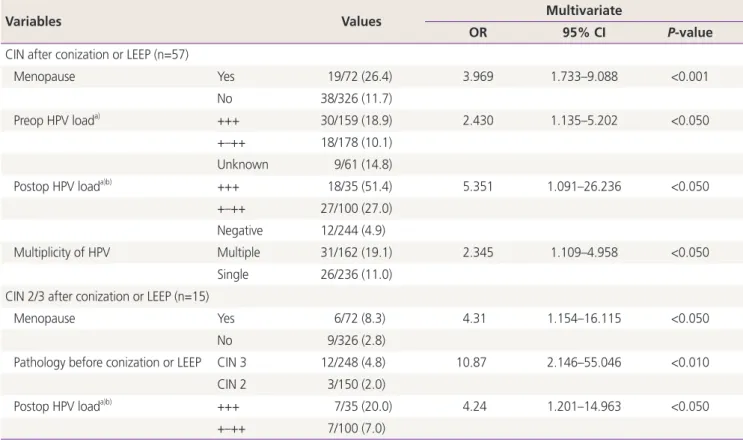
Fifty-seven patients (14.3%) showed residual/recurrent CIN during follow-up. Table 4 shows the risk factors for residual/recurrent CIN or CIN-2/3 after conization or LEEP.
Post-menopausal status (OR, 3.969; 95% CI, 1.733–9.088;
P<0.001) and infection with multiple hrHPV types (OR, 2.345;
Table 4. Logistic regression results for predicting the residual/recurrent cervical intraepithelial neoplasia (CIN) or CIN-2/3 after conization or loop electrosurgical excision procedure (LEEP) (n=57)
Variables Values Multivariate
OR 95% CI P-value
CIN after conization or LEEP (n=57)
Menopause Yes 19/72 (26.4) 3.969 1.733–9.088 <0.001
No 38/326 (11.7)
Preop HPV load
a)+++ 30/159 (18.9) 2.430 1.135–5.202 <0.050
+–++ 18/178 (10.1)
Unknown 9/61 (14.8)
Postop HPV load
a)b)+++ 18/35 (51.4) 5.351 1.091–26.236 <0.050
+–++ 27/100 (27.0)
Negative 12/244 (4.9)
Multiplicity of HPV Multiple 31/162 (19.1) 2.345 1.109–4.958 <0.050
Single 26/236 (11.0)
CIN 2/3 after conization or LEEP (n=15)
Menopause Yes 6/72 (8.3) 4.31 1.154–16.115 <0.050
No 9/326 (2.8)
Pathology before conization or LEEP CIN 3 12/248 (4.8) 10.87 2.146–55.046 <0.010
CIN 2 3/150 (2.0)
Postop HPV load
a)b)+++ 7/35 (20.0) 4.24 1.201–14.963 <0.050
+–++ 7/100 (7.0)
Values are presented as number (%).
HPV, human papillomavirus; LEEP, loop electrosurgical excision procedure; CI, confidence interval.
a)