MiR-24 Simultaneously Regulates Both Oxytocin and Vasopressin
Heon-Jin Lee*
Department of Microbiology and Immunology, Kyungpook National University, School of Dentistry, Daegu 41940, Korea Received August 9, 2018 /Revised August 21, 2018 /Accepted August 21, 2018
Oxytocin (Oxt) and vasopressin (Avp) are mainly synthesized in neuronal cells of the hypothalamus and are released from the posterior pituitary. The structure and sequences of Oxt and Avp genes im- ply that they are closely related and that they are the result of a duplication event during evolution.
A previous study suggested that a small regulatory microRNA (miRNA), miR-24, regulated Oxt after binding. However, it is not clear whether this miRNA can modulate Avp simultaneously. The aim of the present study was to investigate putative targeting miRNAs of Avp, including miR-24. Targeted candidate miRNA oligonucleotides were transfected into COS-7 cells to elucidate the binding activity of miRNAs and Avp using dual-luciferase assays. The luciferase assay showed that only miR-24 dis- played elevated binding activity with Avp as compared to a control and other candidate miRNAs.
Transfection with seed mutants of Avp and miR-24 inhibitors clearly showed that miR-24 can directly bind to the Avp gene. These results provide new insight into the regulatory mechanism of neuro- hypophysial hormones by a single miRNA.
Key words : Hypothalamus, miR-24, miRNA, neuropeptide, oxytocin, vasopressin
*Corresponding author
*Tel : +82-53-660-6832, Fax : +82-53-425-6025
*E-mail : [email protected]
This is an Open-Access article distributed under the terms of the Creative Commons Attribution Non-Commercial License (http://creativecommons.org/licenses/by-nc/3.0) which permits unrestricted non-commercial use, distribution, and reproduction in any medium, provided the original work is properly cited.
Journal of Life Science 2019 Vol. 29. No. 1. 118~122 DOI : https://doi.org/10.5352/JLS.2019.29.1.118
Introduction
MicroRNAs (miRNAs) are small (20-23 nucleotides in length), non-coding RNAs that have well-known regulatory functions. miRNAs usually have a repression function dur- ing formation of a double-stranded RNA duplex by binding to a target mRNA in the RNA-induced silencing complex (RISC), which triggers the inhibition of protein translation [1, 9, 10]. Nucleotides 2 to 8 of the 5‘ region of miRNAs are called the “seed” sequences that play an important role in the pairing with target transcripts, and are thus consid- ered to be critical for miRNA-mediated inhibition [8, 12].
The neuropeptide hormones oxytocin (Oxt) and vaso- pressin (arginine-vasopressin, Avp) are evolutionary related and produced from large magnocellular neurons of the su- praoptic and paraventricular hypothalamic nuclei that have axon projections to the posterior pituitary and form the ma- jor parts of the hypothalamo-neurohypophysial system (HNS) [2]. Oxt and Avp are traditionally recognized to play important roles in reproduction and osmoregulation, re-
spectively [5, 14]. In addition, Oxt and Avp mediate compli- cated brain activities such as stress modulation, aggressive behavior, and social recognition as neurotransmitters [4, 11].
Expression of the Oxt and Avp genes in the hypothalamus is tightly and specifically regulated; however, the mecha- nisms responsible for this regulation have not yet been eluci- dated [3, 15].
Our research group previously profiled the expression of miRNAs in the hypothalamus by RNA-sequencing (RNA- Seq), and the results suggested miR-24 as a novel regulator of Oxt [7]. Based on this finding, and the close sequence and functional relationship between Oxt and Avp, I hy- pothesized that miR-24 might also directly regulate Avp in the same manner.
Materials and Methods
Prediction of miRNAs targeting Avp
Avp-targeting candidate miRNAs were predicted using the RegRNA tool (available at http://regrna.mbc.nctu.edu.
tw/php/prediction.php).
Generation of DNA constructs
The complete murine Avp (GenBank accession no. NM_
009732.2) sequence was amplified by reverse transcription- polymerase chain reaction (PCR) from total RNA obtained from the adult mouse hypothalamus. The PCR product was - Note -
A
B
Fig. 1. Target prediction of vasopressin (Avp). (A) Schematic diagram of putative miRNA- binding sites within the Avp gene.
Boxes represents exons and the 3‘ or 5’ untranslated region (UTR). Predicted duplex form between miR-24 and the targeted Avp gene and the comparison of conserved targeting regions between the mouse and other species. The non-conserved regions are shown in red. (B) Sequences of wild-type (wt) Avp and the mir-24 binding site-mutated versions (Mut1, Mut2, and Mut3) developed for this study. Highlighted sequences represent mutated sequences that are located at the 5‘ end of the miR-24 seed region. Two mutant Avp versions located at the 5’ region of Avp and one mutant Avp located at the 3‘ region are shown.
cloned into the pSICHECK2 vector (Promega, Madison, WI, USA) downstream from the Renilla luciferase coding se- quence (pSICHECK2-Avp) for the luciferase assay. Three Avp mutants (Mut1–3) were generated using QuikChange Site-Directed Mutagenesis Kit (Agilent Technologies, Foster City, CA, USA) following the manufacturer’s instructions and the following primers: Mut1: 5'- AACACTACGCTCTC CGCTTGTTTCTTAAATTTGCTGGCCTTCTCCTCCGC-3‘
and 5’-GCGGAGGAGAAGGCCAGCAAATTTAAGAAACA AGCGGAGAGCGTAGTGTT-3‘; Mut2: 5’- CTCCGCTTGTTT CCCGGGCCCGCTGGCCTTCTCCT-3‘ and 5’- AGGAGAAG GCCAGCGGGCCCGGGAAACAAGCGGAG-3‘; Mut3: 5’- GGATTCTGCCAAGCCCCGGGTCTATTAAATTATCGCCC CCACGC-3‘ and 5’- GCGTGGGGGCGATAATTTAATAGA CCCGGGGCTTGGCAGAATCC-3’.
Luciferase activity assay
For the luciferase reporter assay, COS-7 cells (2×10⁵) were co-transfected in 24-well plates with 10-100 nM of miRNA oligo (Bioneer, Deajeon, Korea) and 800 ng of pSICHECK2- Avp (or mutated Avp) cDNA using Lipofectamine 2000 re- agent (Life Technologies, Carlsbad, CA, USA). In addition, the cells were transfected with 25 nM of an miR-24 inhibitor (antagomir-24, Exiqon, Vedbaek, Denmark) and non-specific
scrambled control siRNA (ON-TARGET plus Control Pool;
D-001810-10, Dharmacon, Lafayette, CO, USA) as an in- hibitor and negative control, respectively. Luciferase assays were performed 24 hr later with the Dual- Luciferase re- porter system (Promega, Madison, WI, USA) according to the manufacturer’s instructions. All experiments were per- formed in triplicate.
Statistical analysis
All data are presented as the means ± standard deviations.
Significant differences between groups were evaluated with the parametric two-tailed non-paired t-test. All analyses were performed using Origin 8.0 software (OriginLab, MA, USA), and p-values<0.05 were considered statistically sig- nificant.
Results and Discussion
Candidate Avp-targeting miRNAs were searched using the bioinformatics tool RegRNA [6], and six miRNAs (miR- 24, miR-328, miR133a, miR-16, miR-744, and miR423) that are expressed in the mouse hypothalamus were identified based on the previous RNA-seq profile (Fig. 1A) [7]. Accord- ing to the traditional miRNA-target mRNA binding hypoth-
Fig. 2. Binding activity of the Avp cDNA reporter gene in the presence of the miRNA oligos. COS-7 cells were co-transfected with both wild-type (wt) Avp cDNA containing the reporter gene and 25 nM of miRNA mimic oligos: miR-24, miR-233a, miR-16, miR-34c, miR-338-3p, miR744, miR-423, and miR-328. Renilla luciferase activity values were normalized to firefly luciferase activity values, and compared with the activity of cells transfected with the control vector (cDNA empty luciferase vector). Data represent the means from three independent transfections (error bars indicate standard deviations; *p<0.05 between the control vector- and miR-24-transfected groups).
esis, the 3‘ untranslated region (UTR) of a target mRNA is the major site for miRNA binding, including the RISC com- plex pairing region; however, in this study, the entire Avp sequence was analyzed given that several studies have sug- gested that miRNAs can bind to any region of their target transcripts [10, 13]. Interestingly, Avp was found to possess two miR-24 binding sites on both the 5‘ and 3’ ends. The 3‘ end of the Avp sequence is homologous to that of the Oxt sequence; therefore, Avp and Oxt share a putative bind- ing site for miR-24 at the 3’ UTR (Fig. 1A). Both the 5’ and 3’ UTRs of miR-24 binding sites are evolutionary conserved with those of other species. To evaluate the potential inter- action of miR-24 with Avp, the full cDNA sequence of Avp was cloned after co-transfection of the Renilla luciferase re- porter gene and dual-luciferase vector into COS-7 cells along with eight miRNA oligos (including two unrelated miRNAs).
Among them, only the cells transfected with miR-24 showed a significant decrease in Renilla luciferase activity compared with the control empty vector, whereas the other miRNAs did not result in any reduction (Fig. 2). This result suggested that miR-24 can directly bind to Avp by sequence-directed pairing.
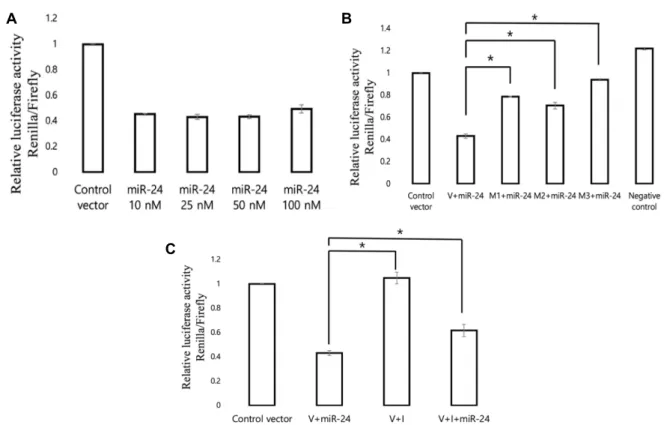
The effect of various concentrations of miR-24 oligos (10
to 100 nM) on Avp was also tested. The miR-24 oligos sus- tained the same effect at a concentration as low as 10 nM, with the highest inhibitory effect observed at 25 and 50 nM (Fig. 3A). To determine whether the miR-24 seed sequence is critical for the binding effect, the seed sequence-mutated artificial Avp targets (Mut1, Mut2, and Mut3) were also cloned into the dual-luciferase vector and the activity was examined along with that of the miR-24 oligos. When miR-24 was transfected with the seed mutants, the relative luciferase activity was significantly recovered compared to that of wild- type Avp (Fig. 2B). This finding suggests that the miR-24 seed sequence is critical for pairing with Avp. Among the Avp mutants, that with mutation at the 3‘ region of the Avp-binding site (Mut3) showed the strongest recovery ef- fect, suggesting that the miR-24 seed of the Oxt and Avp shared region is more pivotal than that of other regions. To confirm the miR-24 inhibitory effect on Avp, the cells were also transfected with an miR-24 inhibitor along with miR-24, which resulted in significant suppression of luciferase activ- ity inhibition (Fig. 3C). Taken together, these results suggest that the mouse Avp gene has two miR-24-binding sites and that miR-24 can directly bind to these sites to regulate the gene. Along with the previous data that miR-24 can modu-
A B
C
Fig. 3. Direct targeting of Avp by miR-24. (A) Dual-luciferase activity of the Avp cDNA reporter gene in the presence of various concentrations (10, 25, 50, and 100 nM) of miR-24 oligos. (B) Dual-luciferase for the miR-24 target site in Avp constructs (V) and Avp target mutants (M1, Mut1; M2, Mut2; M3, Mut3) illustrated in Fig. 1B. Non-specific scramble control siRNA with Avp reporter transfectants were used as negative controls. (C) Dual-luciferase activity of the Avp cDNA reporter gene (V) in the presence of miR-24, the miR-24 inhibitor (I), and both. All Renilla luciferase activity values were normalized to firefly luciferase activity values, and compared with cells transfected with the control vector (cDNA empty luciferase vector).
Luciferase activity was measured 24 hr post-transfection. Data represent the means from three independent transfections (error bars indicate standard deviations; *p<0.05 for between the two treatments).
late the mouse Oxt gene, the present results demonstrate that miR-24 can simultaneously regulate both Oxt and Avp, suggesting a novel regulatory mechanism for the HNS system. Further investigation is needed to determine pre- cisely how miR-24 controls neurohypophysial hormones and neurotransmitters in the different cells of the hypothalamus.
Acknowledgements
The author thanks Dr. Ji-Woong Choi for technical support. This research was supported by the Basic Science Research Program through the National Research Founda- tion of Korea (NRF), funded by the Korean Government (MSIT 2017R1A5A2015391, 2015R1D1A3A01019684, and 2018 R1D1A3B07043539).
References
1. Bartel, D. P. 2004. MicroRNAs: genomics, biogenesis, mech-
anism, and function. Cell 116, 281-297.
2. Brownstein, M., Russell, J. and Gainer, H. 1980. Synthesis, transport, and release of posterior pituitary hormones.
Science 207, 373-378.
3. Burbach, J., Luckman, S., Murphy, D. and Gainer, H. 2001.
Gene regulation in the magnocellular hypothalamo-neuro- hypophysial system. Physiol. Rev. 81, 1197-1267.
4. Caldwell, H. K., Lee, H. J., Macbeth, A. H. and Young, W.
S. 2008. Vasopressin: behavioral roles of an “original” neu- ropeptide. Prog. Neurobiol. 84, 1-24.
5. Caldwell, H. K. and Young, W. S. 2006. Oxytocin and Vasopressin: Genetics and Behavioral Implications, pp. 573- 607. In: Lim, R. (ed.), Neuroactive Proteins and Peptides.
Springer: New York, USA.
6. Chang, T. H., Huang, H. Y., Hsu, J. B. K., Weng, S. L., Horng, J. T. and Huang, H. D. 2013. An enhanced computational platform for investigating the roles of regulatory RNA and for identifying functional RNA motifs. BMC Bioinformatics 14, S4.
7. Choi, J. W., Kang, S. M., Lee, Y., Hong, S. H., Sanek, N.
A., Young, W. S. and Lee, H. J. 2013. MicroRNA profiling in the mouse hypothalamus reveals oxytocin-regulating
초록:바소프레신과 옥시토신을 동시에 조절 마이크로RNA, miR-24
이헌진*
(경북대학교 치과대학 구강미생물학교실)
옥시토신(Oxt)과 바소프레신(Avp)은 주로 시상하부의 신경세포에서 생성이 되어 뇌하수체 후엽에서 온 몸으로 분비된다. 유전자 구조와 염기서열 연구를 통해 옥시토신과 바소프레신이 진화적으로 발달되는 단계에서 유전자 가 염색체 내에 중복된 것으로 추정되어져 왔다. 이전 연구에서 작은 조절자로 알려진 마이크로RNA 중 하나인 miR-24가 옥시토신과 직접 결합한 후 조절할 수 있다는 사실을 본 연구실에서 발표한 바가 있지만, 바소프레신을 동시에 조절할 수 있는지는 확실치 않았다. 본 연구에서 바소프레신을 조절할 수 있는 후보 마이크로RNA를 생물 정보학적 방법으로 탐색하였다. 여러 후보 중 miR-24만이 바소프레신과 직접 결합할 수 있음을 형광 리포터 분석 과 바소프레신 결합부위의 돌연변이 cDNA 제작을 통해 밝혀내었다. 바소프레신의 miR-24 결합 필수 부위인
“seed” 부분을 돌연변이 시킨 바소프레신의 경우 miR-24와의 결합능이 현저히 떨어지고 miR-24의 저해제 역시 결합능을 감소시키는 것을 보아 miR-24가 바소프레신에 결합하여 조절할 수 있음을 명확히 할 수 있었다. 이러한 결과를 종합해 볼 때 단일 마이크로RNA가 두 주요한 뇌하수체 호르몬의 조절에 관여한다는 새로운 조절 기전을 제시하여 준다.
microRNA. J. Neurochem. 126, 331-337.
8. Kim, Y. K., Heo, I. and Kim, V. N. 2010. Modifications of small RNAs and their associated proteins. Cell 143, 703- 709.
9. Lee, H. J. 2014. Additional stories of microRNAs. Exp. Biol.
Med. 239, 1275-1279.
10. Lee, H. J. 2013. Exceptional stories of microRNAs. Exp. Biol.
Med. 238, 339-343.
11. Lee, H. J., Macbeth, A. H., Pagani, J. H. and Young, W. S.
2009. Oxytocin: the great facilitator of life. Prog. Neurobiol.
88, 127-151.
12. Lewis, B. P., Burge, C. B. and Bartel, D. P. 2005. Conserved seed pairing, often flanked by adenosines, indicates that
thousands of human genes are microRNA targets. Cell 120, 15-20.
13. Qin, W., Shi, Y., Zhao, B., Yao, C., Jin, L., Ma, J. and Jin, Y. 2010. miR-24 regulates apoptosis by targeting the open reading frame (ORF) region of FAF1 in cancer cells. PLoS One 5, e9429.
14. Stoop, R. 2012. Neuromodulation by Oxytocin and Vaso- pressin. Neuron 76, 142-159.
15. Young, W. S. and Gainer, H. 2003. Transgenesis and the study of expression, cellular targeting and function of oxy- tocin, vasopressin and their receptors. Neuroendocrinology 78, 185-203.