A Study of the Diversity and Profile for Extracellular Enzyme Production of Aerobically Cultured Bacteria in the Gut of Muraenesox cinereus
Yong-Jik Lee
1†, Do-Kyoung Oh
2†, Hye Won Kim
2, Gae-Won Nam
1, Jae Hak Sohn
2, Han-Seung Lee
2, Kee-Sun Shin
3* and Sang-Jae Lee
2*
1Department of Cosmetics, Seowon University, Chung-Ju 28674, Korea
2Major in Food Biotechnology and Research Center for Extremophiles & Marine Microbiology, Silla University, Busan 46958, Korea
3Industrial Bio-materials Research Center, Korea Research Institute of Bioscience and Biotechnology (KRIBB), Daejeon 34141, Korea Received January 26, 2019 /Revised February 24, 2019 /Accepted February 27, 2019
This research confirmed the diversity and characterization of gut microorganisms isolated from the intestinal organs of Muraenesox cinereus, collected on the Samcheonpo Coast and Seocheon Coast in South Korea. To isolate strains, Marine agar medium was basically used and cultivated at 37℃ and pH7 for several days aerobically. After single colony isolation, totally 49 pure single-colonies were iso- lated and phylogenetic analysis was carried out based on the result of 16S rRNA gene DNA sequenc- ing, indicating that isolated strains were divided into 3 phyla, 13 families, 15 genera, 34 species and 49 strains. Proteobacteria phylum, the main phyletic group, comprised 83.7% with 8 families, 8 genera and 26 species of Aeromonadaceae, Pseudoalteromonadaceae, Shewanellaceae, Enterobacteriaceae, Mor- ganellaceae, Moraxellaceae, Pseudomonadaceae, and Vibrionaceae. To confirm whether isolated strain can produce industrially useful enzyme or not, amylase, lipase, and protease enzyme assays were per- formed individually, showing that 39 strains possessed at least one enzyme activity. Especially the
Aeromonas sp. strains showed all enzyme activity tested. This result indicated that isolated strains haveshown the possibility of the industrial application. Therefore, this study has contributed for securing domestic genetic resources and the expansion of scientific knowledge of the gut microbial community in Muraenesox cinereus of South Korea.
Key words : Bacteria, diversity, extracellular enzyme, gut microorganism, Muraenesox cinereus
†Authors contributed equally.
*Corresponding author
*Tel : +82-51-999-5447, Fax : +82-51-999-5458
*E-mail : [email protected]
This is an Open-Access article distributed under the terms of the Creative Commons Attribution Non-Commercial License (http://creativecommons.org/licenses/by-nc/3.0) which permits unrestricted non-commercial use, distribution, and reproduction in any medium, provided the original work is properly cited.
Journal of Life Science 2019 Vol. 29. No. 2. 248~255 DOI : https://doi.org/10.5352/JLS.2019.29.2.248
서 론
마이크로바이옴(Microbiome)은 자연계에 존재하는 모든 미생물군집의 집합체 혹은 균총을 의미하며 동물의 장내에 존재하는 미생물 균총은 장내 마이크로바이옴(Gut micro- biome)이라 하여 최근 많은 연구를 통하여 매우 다양한 미생 물로 구성되며 영양학적, 생리학적, 및 병리학적으로 숙주의 대사활성에 관여하여 숙주의 건강 및 질병과의 연관성이 알려 지고 있다[1]. 이와 같이 장내미생물의 기능적 역할이 확인되 면서 최근 장내미생물에 대한 연구가 꾸준히 증가하고 있다.
최근 국립낙동강생물자원관에서는 어류인 빙어의 장내 마이 크로바이움을 분석하여 프로바이오틱스로 활용 가능한 유산 균이 많이 분포하고 있음을 확인하였으며, 붉은 멍게의 경우,
장에서 분리한 신종 미생물에서 새로운 항생물질이 발견되어 보고된 바 있다[13]. 이처럼 어류의 장내세균은 해당 숙주의 서식처 주변 환경 조건 및 먹이 등에 영향을 많이 받기 때문에 숙주마다 매우 다양한 장내미생물이 서식하며, 이는 해당 어 류의 생활사 연구의 중요한 지표가 되기도 하며 해양바이오소 재 응용분야의 중요한 한 부분인 극한환경미생물과 해양미생 물을 활용한 산업효소소재 개발을 위한 핵심적인 자원이 된다 [11].
작년 국내에서도 “나고야 의정서”의 발효에 따른 자국의
생물자원 확보가 중요한 이슈로 떠오르며 국립낙동강생물자
원관에서 유용 담수세균 254 균주를 발견함과 동시에 수입
의존도가 높은 국내 산업용 효소시장에 활용할 수 있는 효소
활성 평가 정보를 확보함으로써 국내 담수생물자원에 산업적
가치를 부여하고 국내 바이오산업 발전에 기여할 것으로 기대
되는 만큼, 본 연구에서는 국내 어류로부터 장내 미생물의 분
리 뿐만 아니라 전분가공용, 식품 및 세제 산업용 효소시장
등에 응용 가능한 효소 3 종(amylase, lipase, protease)의 활성
을 중심으로 분리된 미생물의 특성 탐색이 진행되었다. 이는
국내 미래 산업의 지향점이 무공해 고효율의 탄소 자원 절약
형 산업이라고 규정되면서, 생물 효소 시장이 미래 산업을 만
족시킬 수 있는 한 축을 담당하고 있으므로 유용한 산업용
효소 생산능을 가진 미생물 탐색은 국내 생물자원 가치를 제 고하고 생물공학 연구 기초 소재로 활용될 것으로 예상된다.
본 연구에 사용된 어류인 갯장어(Muraenesox cinereus)는 뱀 장어목(Anguilliformes) 갯장어과(Muraenesocidae)에 속하며 대한민국에서는 주로 서해안과 남해안에서 서식하는데 몸길 이는 보통 60~80 cm 정도 되지만 최대 2 m 까지 자라는 개체 도 존재한다. 갯장어의 등은 녹회색, 배는 은백색을 띠고 있으 며 날카로운 이빨로 작은 물고기나 갑각류, 두족류 따위를 잡 아 먹으며 양식은 불가능하다. 최근 해양유래생물로부터 장내 미생물 분리연구 사례는 무지개송어, 넙치, 볼락, 감성돔, 참 돔, 자리돔, 독가시치, 청어 및 불가사리 등이 사용되었음이 보고[2, 5, 6, 9, 12, 16-18]되었으나 갯장어를 해양생물로 사용 한 경우는 없었으며 따라서 해양에서 섭취한 작은 생물체와 같은 먹이들을 소화시키기 위해선 장내 미생물들이 다양한 분해 효소를 생산할 것으로 예상되어 남해안의 삼천포 및 서 해의 서천에서 잡은 갯장어로부터 장내미생물을 순수 분리 한 후, 분리된 미생물 균의 효소 생산능 분석을 실시하였다.
또한 auxin 생산 능력 등을 가진 미생물은 작물의 생육을 촉진 하는 기능을 함으로써 화학비료를 대체하는 미생물비료로 사 용 될 수 있기에 추가적으로 갯장어에서 분리된 장내 미생물 들의 auxin 생산능 분석도 실시하였다[8]. 본 연구를 통하여 국내 갯장어의 생물자원으로써의 가치를 제고하고 산업용 효 소 관련 생물공학 및 미생물비료 연구의 기본 생물소재로 활 용이 가능할 것으로 예상된다.
재료 및 방법
실험어 채취
본 실험에 사용된 시료어는 남해안 삼천포 연안 및 서해안 서천 연안에서 채집된 갯장어 5 마리씩을 사용하였으며 장내 미생물을 분리하기 위하여 채집한 갯장어의 내장은 분리하여 바로 얼음이 들어있는 아이스박스(4℃)에 보관 운송 하였다.
장내미생물 분리 및 배양
갯장어로부터 장내세균의 분리를 위해 내용물이 제거된 내장을 절단하여 멸균된 0.85% 생리식염수에 현탁하였다. 그 뒤 잘 현탁되도록 vortexing 해준 뒤 현탁액 1 ml를 넣고 10
-1~10
-4배로 단계희석 하였다. 그 뒤 일반 증식배지로 해양미 생물 전용배지인 Marine agar (BD, USA) 고체배지를 제작하 여 희석액을 도말 한 후, 37℃에서 호기적으로 장내 미생물을 배양하여 선택적으로 배지상에 나타나는 균의 크기, 모양, 색 깔 등 형태학적 모습을 관찰한 후 동일한 고체배지를 사용하 여 추가적으로 single colony isolation을 수행하였다. 순수분 리된 균주의 혼합배지에서의 생육 가능성을 확인하기 위하여, Nutrient agar (BD, USA), R2A agar (BD, USA), 및 Tryptic soy agar (BD, USA)에 평판 도말법을 이용하여 37℃에서 7
일간 정치 배양을 하였다.
16S rDNA 염기서열의 계통학적 분석
갯장어의 내장으로부터 호기적 조건에서 분리된 균주의 분 자생물학적 동정을 위해 Marine agar (BD, USA)에 각각의 분리된 균주의 colony가 배양된 상태의 agar plate를 ㈜바이오 팩트에 보내어 16S rDNA 염기서열의 분석을 의뢰하였다. 분 석된 16S rDNA 염기서열은 NCBI의 BLAST search program 과 ㈜천랩의 Ezbiocloud (https://www.ezbiocloud.net/)를 사용하여 가장 유사한 근연 균주를 확인하였다. 계통학적 분 석은 Clustal W 및 MEGA 6.0 프로그램을 이용하여 phyloge- netic tree를 작성하였다.
분해 효소 생산능 분석
분리된 균주의 세포외 분해 효소 amylase, lipase, protease 생산능 분석을 위하여 각각의 효소와 특이적으로 반응할 기질 성분이 포함된 고체평판 선별배지를 사용하였다. 먼저 amy- lase 생산능은 0.2% soluble starch (BD, USA)를, lipase 생산능 은 1% Tween 80 (Sigma, USA) 을, protease 생산능은 2%
skim milk (BD, USA)를 기질로 선택하여 Marine agar (BD, USA) 배지에 각각 첨가하여 제조하였으며 분리된 균주를 직 접 접종하여 37℃에서 7 일 배양한 후 저지원(Clear zone)의 직경으로 조사하였다. 분리된 균주의 효소활성 분해능 평가는 배양 후 나타나는 접종균 주위의 억제환의 크기(+++ : > 7 mm, ++ : 4~6 mm, + : 1~3 mm)로 나타내었다.
옥신(Auxin) 생산능 분석
분리된 균주의 auxin 생산능은 0.1% L-tryptophan이 첨가 된 Marine broth (BD, USA) 배지에 순수분리된 colony를 tooth-picking 한 후 37℃에서 5일 배양하여 Salkowski 시약 (35% HClO
450 ml + 0.5 M FeCl
31 ml) 800 ul을 배양 상등액 400 ul에 섞어준 후 어두운 곳에서 30 min 반응시켜 육안으로 확인하여 붉은 색깔 변화 정도에 따라 옥신 생성능 정도를 표시하였다(짙은 붉은색: +++; 일반 붉은색: ++; 옅은 붉은색:
+; 주황색: w; 무색: -).
결과 및 고찰
갯장어 호기적 장내세균 분리
남해안에 위치한 삼천포와 서해안에 위치한 서천에서 포획
한 갯장어를 대상으로 산업적 활용이 용이할 것으로 생각되는
호기적으로 생육 가능한 장내 미생물을 분리하고자 1차로
Marine agar 배지에 시료를 도말하여 배양한 후, 배양된 col-
ony의 모양, 색깔 등 형태학적 특징을 육안으로 구분이 가능한
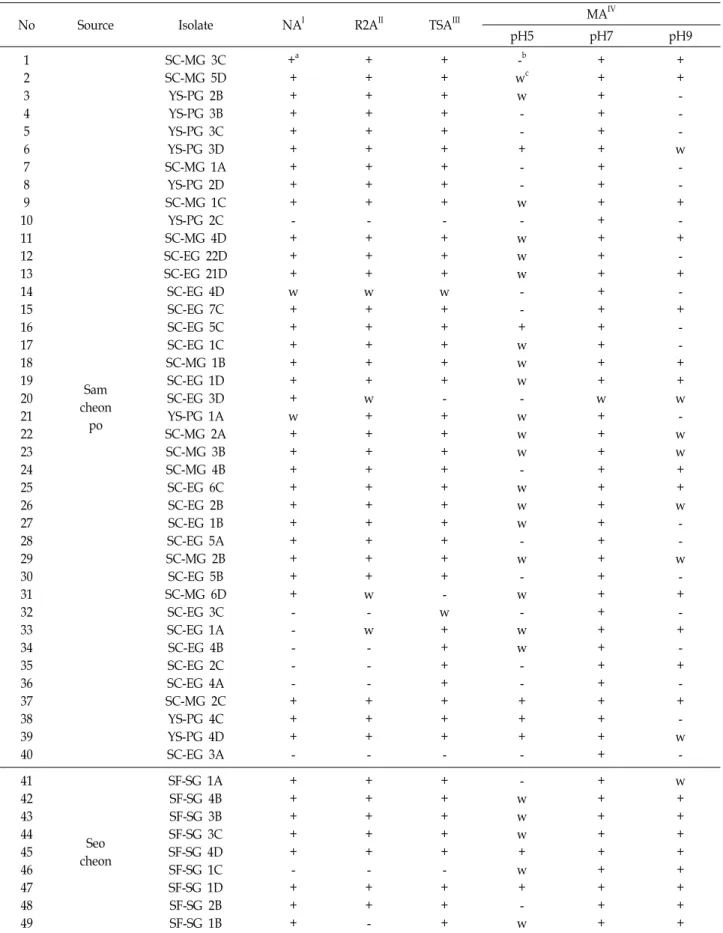
균주들을 2차로 단일 균주 분리를 수행하였다. 그 결과 Table
1에서 나타낸 것처럼 삼천포 갯장어에서는 40 균주, 서천 갯장
Table 1. Isolation and identification of aerobically cultured microorganisms isolated from the gut microbiomes of Muraenesox cinereus
No Source Isolate NAI R2AII TSAIII MAIV
pH5 pH7 pH9
1 2 3 4 5 6 7 8 9 10 11 12 13 14 15 16 17 18 19 20 21 22 23 24 25 26 27 28 29 30 31 32 33 34 35 36 37 38 39 40
Sam cheon
po
SC-MG 3C SC-MG 5D YS-PG 2B YS-PG 3B YS-PG 3C YS-PG 3D SC-MG 1A
YS-PG 2D SC-MG 1C YS-PG 2C SC-MG 4D SC-EG 22D SC-EG 21D SC-EG 4D SC-EG 7C SC-EG 5C SC-EG 1C SC-MG 1B SC-EG 1D SC-EG 3D YS-PG 1A SC-MG 2A SC-MG 3B SC-MG 4B SC-EG 6C SC-EG 2B SC-EG 1B SC-EG 5A SC-MG 2B SC-EG 5B SC-MG 6D
SC-EG 3C SC-EG 1A SC-EG 4B SC-EG 2C SC-EG 4A SC-MG 2C YS-PG 4C YS-PG 4D SC-EG 3A
+a + + + + + + + + - + + + w + + + + + + w + + + + + + + + + + - - - - - + + + -
+ + + + + + + + + - + + + w + + + + + w + + + + + + + + + + w - w
- - - + + + -
+ + + + + + + + + - + + + w + + + + + - + + + + + + + + + + - w + + + + + + + -
-b wc
w - - + - - w
- w w w - - + w w w - w w w - w w w - w
- w
- w w - - + + + -
+ + + + + + + + + + + + + + + + + + + w + + + + + + + + + + + + + + + + + + + +
+ + - - - w
- - + - + - + - + - - + + w - w w + + w - - w
- + - + - + - + - w
- 41
42 43 44 45 46 47 48 49
Seo cheon
SF-SG 1A SF-SG 4B SF-SG 3B SF-SG 3C SF-SG 4D SF-SG 1C SF-SG 1D SF-SG 2B SF-SG 1B
+ + + + + - + + +
+ + + + + - + + -
+ + + + + - + + +
- w w w + w + - w
+ + + + + + + + +
w + + + + + + + +
I: Nutrient agar, II: Reasoner’s 2A agar, III: Tryptic soy agar, IV: Marine agar, a: Well-growth, b: No growth, c: Weak growth.
Table 2. Isolation and identification of aerobically cultured microorganisms isolated from the gut microbiomes of Muraenesox cinereus
Phylum Class Order Family Genus Species Number
Actinobacteria Actinobacteria_c Micrococcales
Intrasporangiaceae Janibacter Janibacter hoylei 1 Micrococcaceae Micrococcus Micrococcus aloeverae 1 Micrococcus antarcticus 1
Firmicutes Bacilli Bacillales Bacillaceae Bacillus Bacillus nealsonii 1
Bacillus idriensis 1 Fictibacillus Fictibacillus phosphorivorans 1
Planococcaceae Kurthia Kurthia gibsonii 1
Lactobacillales Carnobacteriaceae Desemzia Desemzia incerta 1
Proteobacteria Gammaproteobacteria
Aeromonadales Aeromonadaceae Aeromonas
Aeromonas bivalvium 7
Aeromonas encheleia 1
Aeromonas media 1
Aeromonas popoffii 1
Aeromonas salmonicida subsp.
Salmonicida 1
Aeromonas veronii 2
Aeromonas rivipollensis 1
Haemophilus piscium 2
Alteromonadales
Pseudoalteromonadaceae Pseudoalteromonas Pseudoalteromonas undina 1
Shewanellaceae Shewanella
Shewanella upenei 1
Shewanella baltica 1
Shewanella indica 4
Shewanella xiamenensis 2 Shewanella seohaensis 2
Enterobacteriales
Enterobacteriaceae Citrobacter Citrobacter freundii 2
Morganellaceae Proteus
Proteus hauseri 1
Proteus alimentorum 1
Proteus vulgaris 1
Proteus terrae 1
Pseudomonadales
Moraxellaceae Psychrobacter
Psychrobacter pulmonis 1 Psychrobacter sanguinis 2 Psychrobacter phenylpyruvicus 1
Pseudomonadaceae Pseudomonas
Pseudomonas parafulva 1 Pseudomonas oleovorans subsp.
Oleovorans 1
Vibrionales Vibrionaceae Photobacterium Photobacterium damselae subsp.
Piscicida 1
Vibrio Vibrio diazotrophicus 1
어에서는 9 균주를 순수 분리하였다. 상대적으로 삼천포에서 포획한 갯장어에서 훨씬 많은 장내 호기적 미생물이 분리된 것은 포획된 갯장어의 먹이활동, 지역적 특징, 건강상태, 호기 적 미생물군집 차이, 배양방법 등의 여러 가지 원인의 가능성 이 있을 것으로 추측된다. 또한 주요성분이 무기염으로 이루 어진 Marine agar 배지는 해양미생물 배양에 유리한 배지이기 에 산업적 활용가능성을 확인하기 위하여 대량 배양 등에 많 이 활용되는 혼합 배지(Nutrient agar, R2A agar, Tryptic soy agar)에서의 분리 균주들의 생육 가능성을 확인한 결과 분리 균주 3 종을 제외한 모든 균주가 최소 1 종류 이상의 혼합 배지에서 생육이 가능한 것을 확인하였다. 이는 어류의 호기 성 장내 미생물세균의 탐색에 있어서 분리 배지의 구성성분이 어느 정도 영향을 미치는 것으로 생각되며, 본 연구 결과를 바탕으로 어류 호기성 장내 미생물 분리를 위한 최적 배지는
marine agar 배지로 나타났다.
16S rDNA 염기서열의 계통학적 분석
삼천포 및 서천 갯장어의 장내 미생물로부터 호기적으로 분리된 49 균주의 16S rDNA 염기서열을 바탕으로 NCBI Nucleotide BLAST program, Ezbiocloud를 사용하여 세균 동 정을 분석한 결과 크게 3 문, 8 목, 13 과, 15 속, 34 종으로 나타났으며(Table 2), 분리 균주와 근연 균주 및 상동성을 Table 3에 나타내었다. 또한 분리 동정된 장내 세균들 간의 유연관계를 확인하기 위하여 계통수를 작성하였다(Fig. 1).
Proteobacteria (Gamma- proteobacteria)가 83.7%로 가장 우
점도가 높았고, Actinobaceria 6.1%, Firmicutes 10.2%로 각각
나타났다. Proteobacteria 문은 Aeromonadaceae 39.0%,
Shewanellaceae 24.3%, Morganellaceae 9.8%, Moraxellaceae
Fig. 1. Neighbour-joining phylogenetic tree determined from the 16S rDNA sequences of bacteria from the gut of Muraene- sox cinereus. Bootstrap values calculated (from 1,000 rep- lications).
9.8%, Enterobacteriaceae 4.9%, Pseudomonadaceae 4.9%, Vibrionaceae 4.9%, Pseudoalteromonadaceae 2.4%로 구성되 었으며, 총 8 과로 9 속, 25 종이 분리되었다. 가장 많이 분리된 Aeromonadaceae 과는 Aeromonas sp.이 수중환경에서 많이 분리되며 유럽의 뱀장어에서도 분리된다는 것이 알려져 있기 에 갯장어의 장내 미생물 균총에서 가장 많이 분리된 것으로 예상되며[4], 해양유래 프로바이오틱 균주로 어류의 장에 서식 하며 성장률과 면역능 증가에 도움이 되는 것으로도 알려진 Moraxellaceae과 Psychrobacter속의 5 종이 확인되었다[19].
Actinobacteria 문 에서 3 속, 3 종이 분리되었으며 Firmicutes
문에서 4 속, 5 종이 분리되었다. 본 연구에서는 Bacteroides 문의 균주는 분리되지 않았으며 이전에 보고된 해수어 및 담 수어 장내 세균총에서 대부분이 Proteobacteria 문이 우점하였 다는 연구결과와 마찬가지로 갯장어에서도 Proteobacteria 문 이 우점하고 있는 것을 확인할 수 있었다 [3, 10, 12, 15]. 또한 Photobacterium 속, Vibrio 속과 같은 어류병원체 균주도 삼천 포 및 서천 갯장어에서 각각 1 균주씩 분리되었으며 이는 대부 분의 해산어 장내기관에서 분리되었다는 보고와 일치한다[3, 5, 12, 14]. 이런 병원체 균주는 먹이와 함께 체내로 들어와 장내에서 잠복했다가 숙주어의 면역력이 저하되면 기회감염 을 일으키는 것으로 사료된다. 이와 같은 결과는 장내미생물 은 생활환경, 방식 등 여러 요인에 따라 다양한 차이를 나타내 는 것을 알 수 있다.
분해 효소 및 옥신 생산능 분석
갯장어처럼 작은 해양 생물체를 먹이로 섭취하는 경우, 섭 취한 먹이들을 소화시키기 위해 소화기관내에 존재하는 장내 미생물들의 다양한 분해 효소 분비등과 같은 상호작용이 필요 할 것으로 예상되어 분리된 장내 미생물 균주들의 신규 분해 효소 탐색 자원 및 미생물비료로써의 산업적 응용가능성을 확인하기 위하여 세포외 분해 효소 생산능 및 옥신 생산능 분석을 실시하였다.
Table 3에 나타낸 것처럼 분리된 49 균주에서 10 균주를
제외한 모든 균주에서 한 가지 이상의 분해 효소 활성이 존재
하는 것을 확인하였으며, 두 가지 이상의 효소 활성을 가지는
20 균주 중 특히 세 가지 효소에 대하여 활성을 모두 가지고
있는 것으로 확인된 3 균주(과제기탁번호: NMC4-B106,
NMC4-B108, NMC4-B151)는 모두 Aeromonas sp. 인 것으로
확인하였다. 이는 거머리에서 분리된 Aeromonas veronii는 혈
액 분해, 영양분 공급 및 외부 박테리아의 생육저해능이 있을
것으로 보고 된 것처럼 이러한 기능이 다양하게 존재하는 분
해 효소의 도움에 의한 것으로 생각된다[7]. 또한 옥신 생산능
을 확인한 결과, 12 균주에서 생산능이 확인되었으며 특히
Proteus sp. 의 4 균주들의 생산능이 매우 높은 것을 알 수 있었으며 이는 식물생장을 촉진시킬 수 있는 미생물비료 연구에
활용할 수 있는 미생물 소재로써의 활용가치가 존재할 것으로
예상된다. 동물 유래의 장내 미생물은 매우 다양하며 배양조
건이 까다롭기 때문에 순수 분리에 한계가 있을 것을 생각되
지만 본 연구에서는 남해안 및 서해안에서 포획한 갯장어에서
분리된 장내 세균군의 일부분이라도 국내 생물 자원의 다양성
확보 차원에서 의미를 찾을 수 있을 것이며 갯장어의 장내세
균으로부터 분해 효소 탐색을 위한 신균주의 활용 가능성과
산업용 효소 관련 생물공학 및 미생물비료 연구의 기본 생물
소재로 활용이 가능할 것으로 예상된다. 또한 본 연구를 통하
여 분리한 모든 균주들은 한국생명공학연구원 미생물가치제
고사업단에 기탁하였다.
Table 3. Representative sequences of an aerobically isolated strains from the gut microbiomes of Muraenesox cinereus
No Isolate Name Closed strain Closed strain
number
Similarity (%)
Extracellular enzyme activity
Auxin Deposited number Amylase Lipase Protease
1 2 3 4 5 6 7 8 9 10 11 12 13 14 15 16 17 18 19 20 21 22 23 24 25 26 27 28 29 30 31 32 33 34 35 36 37 38 39 40
SC-MG 3C SC-MG 5D YS-PG 2B YS-PG 3B YS-PG 3C YS-PG 3D SC-MG 1A YS-PG 2D SC-MG 1C YS-PG 2C SC-MG 4D SC-EG 22D SC-EG 21D SC-EG 4D SC-EG 7C SC-EG 5C SC-EG 1C SC-MG 1B SC-EG 1D SC-EG 3D YS-PG 1A SC-MG 2A SC-MG 3B SC-MG 4B SC-EG 6C SC-EG 2B SC-EG 1B SC-EG 5A SC-MG 2B SC-EG 5B SC-MG 6D
SC-EG 3C SC-EG 1A SC-EG 4B SC-EG 2C SC-EG 4A SC-MG 2C YS-PG 4C YS-PG 4D SC-EG 3A
Aeromonas bivalvium Aeromonas bivalvium Aeromonas bivalvium Aeromonas bivalvium Aeromonas bivalvium Aeromonas bivalvium Aeromonas bivalvium Aeromonas encheleia Aeromonas popoffii Aeromonas veronii Aeromonas veronii Bacillus nealsonii Bacillus idriensis Desemzia incerta Fictibacillus phosphorivorans
Citrobacter freundii Citrobacter freundii Janibacter hoylei Micrococcus aloeverae Micrococcus antarcticus Psychrobacter pulmonis Psychrobacter sanguinis Psychrobacter sanguinis Psychrobacter phenylpyruvicus
Proteus terrae Proteus hauseri Proteus alimentorum
Proteus vulgaris Kurthia gibsonii Pseudomonas parafulva Pseudomonas oleovorans subsp. oleovorans
Shewanella upenei Shewanella indica Shewanella indica Shewanella indica Shewanella indica Shewanella xiamenensis
Shewanella seohaensis Shewanella seohaensis Photobacterium damselae subsp. piscicida
CECT 7113 CECT 7113 CECT 7113 CECT 7113 CECT 7113 CECT 7113 CECT 7113 LMG 16331 CIP 105493 CECT 4257 CECT 4257 DSM 15077 SMC 4352-2 DSM 20581
Ca7T DSM 30039 DSM 30039 DSM 21601
AE-6 T2 CECT 5989
13983 13983 NBRC 102152
N5/687 ATCC 700826
08MAS0041 ATCC 29905 NCIMB 9758 NBRC 16636 DSM 1045
20-23R KJW27 KJW27 KJW27 KJW27 S4 S7-3 S7-3 NCIMB 2058
100.00 100.00 100.00 100.00 100.00 100.00 100.00 100.00 100.00 100.00 100.00 98.15 99.05 98.94 98.94 99.07 99.07 100.00 99.04 100.00 99.78 100.00 100.00 99.86 99.34 99.93 98.74 100.00 100.00 98.53 100.00 99.07 98.41 98.94 99.07 98.68 100.00 100.00 100.00 99.08
+++
+++
+++
++
+++
+++
+++
+++
+++
+++
+++
- +++
- +++
- - - - + - - - - - - - - - - - - - - - - - - - -
+++
+ +++
+++
+++
+++
+++
+++
+++
+++
+++
- - - +++
- - +++
- - +++
+ + + - - +++
+++
- - +++
++
- ++
++
- +++
+++
+++
+++
+ ++
- - - - + - - ++
- - - - - - - +++
- - - - - - - - - - - - - - +++
- - - + - - -
- - - + - - + - - - - - - - - - - - +++
- ++
+ + - +++
+++
+++
+++
- - ++
- - - - - - - - -
NMC4-B106 NMC4-B108 NMC4-B149 NMC4-B150 NMC4-B152 NMC4-B155 NMC4-B98 NMC4-B154 NMC4-B104 NMC4-B151 NMC4-B107 NMC4-B126 NMC4-B125 NMC4-B128 NMC4-B123 NMC4-B121 NMC4-B118 NMC4-B100 NMC4-B124 NMC4-B127 NMC4-B148 NMC4-B99 NMC4-B101 NMC4-B103 NMC4-B122 NMC4-B115 NMC4-B114 NMC4-B113 NMC4-B101 NMC4-B117 NMC4-B109 NMC4-B120 NMC4-B110 NMC4-B116 NMC4-B119 NMC4-B112 NMC4-B105 NMC4-B153 NMC4-B156 NMC4-B120 41
42 43 44 45 46 47 48 49
SF-SG 1A SF-SG 4B SF-SG 3B SF-SG 3C SF-SG 4D SF-SG 1C SF-SG 1D SF-SG 2B SF-SG 1B
Aeromonas rivipollensis Aeromonas media
Aeromonas salmonicida subsp. salmonicida Haemophilus piscium Haemophilus piscium Pseudoalteromonas undina
Shewanella baltica Shewanella xiamenensis
Vibrio diazotrophicus
P2G1 CECT 4232 ATCC 33658
CIP 106116 CIP 106116 NCIMB 2128 NCTC 10735
S4 NBRC 103148
100.00 100.00 100.00 100.00 100.00 100.00 100.00 100.00 100.00
+++
+++
+++
+++
+++
++
- - +++
+++
+++
+++
+++
+++
+++
+++
+++
-
- - - - - - - - -
- - - - - - +++
- +
NMC4-B173 NMC4-B177 NMC4-B176 NMC4-B179 NMC4-B181 NMC4-B178 NMC4-B180 NMC4-B175 NMC4-B174
감사의 글
이 논문은 2018년도 정부(과기정통부)의 재원으로 한국연 구재단 바이오·의료기술개발사업(NRF-2013M3A9A5076603) 과 이공학 개인기초연구지원사업(NRF-2016R1D1A1B03936183) 의 지원을 받아 수행된 연구임.
References
1. Andoh, A. 2016. Physiological role of gut microbiota for maintaining human health. Digestion 93, 176-181.
2. Choi, G. G., Lee, O. H. and Lee, G. H. 2003. The diversity of heterotrophic bacteria isolated from intestine of starfish (Asterias amurensis) by analysis of 16S rDNA sequence. J.
Ecol. Environ. 26, 307-312.
3. Einar, R. G., Sigmund, S., Reider, M. B., Stale, R. and Ashild, K. 2006. Characterisation of the microbiota associated with intestine of Atlantic cod (Gadus morhua L.): The effect of fish meal, standard soybean meal and a bioprocessed soybean meal. Aquaculture 261, 829-841.
4. Esteve, C., Gutiérrez, M. C. and Ventosa, A. 1995. Aeromonas encheleia sp. nov., isolated from European eels. Int. J. Syst.
Bacteriol. 45, 462-466.
5. Hasen, G. H., Strom, E. and Olafsen, J. A. 1992. Effect of different holding regimens on the intestinal microflora of herring (Clupea harengus) larvae. Appl. Environ. Microbiol. 58, 461-470.
6. Huber, I. 2004. Phylogenetic analysis and in situ identi- fication of the intestinal microbial community of rainbow trout (Oncorhynchus mykiss, Walbaum). J. Appl. Microbiol. 96, 117-132.
7. Indergand, S. and Graf, J. 2000. Ingested blood contributes to the specificity of the symbiosis of Aeromonas veronii biovar sobria and Hirudo medicinalis, the medicinal leech. Appl.
Environ. Microbiol. 66, 4735-4741.
8. Jung, H. K., Kim, J. R., Woo, S. M. and Kim, S. D. 2006.
An auxin producing plant growth promoting rhizobacte- rium Bacillus subtilis AH 18 which has siderophore-produc- ing biocontrol activity. Kor. J. Microbiol. Biotechnol. 34, 94- 100.
9. Kim, A. R. and Kim, D. H. 2015. Diversity of cultured and uncultured bacteria in the gut of olive flounder Paralichthys olivaceus. Fish. Aquat. Sci. 48, 447-453.
10. Kim, D. H. and Kim, D. Y. 2013. Microbial diversity in the intestine of olive flounder (Paralichthys olivaceus). Aquacul- ture 414-415, 103-108.
11. Kim, M. S., Lee, S. J. and Heo, M. S. 2018. Research on the diversity of intestinal microbial communities of Red tilefish (Branchiostegus japonicus) by 16S rDNA sequence analysis.
J. Life Sci. 28, 361-368.
12. Kim, S. R., Jung, S. J. and Oh, M. J. 2007. Bacterial flora and antibiotics resistance of intestinal bacteria in the wild and cultured black rockfish Sebastes inermis. J. Fish Pathol.
20, 221-227.
13. Kim, Y. O., Nam, B. H., Kim, D. G., An, C. M., Lee, J. S.
and Kim, W. J. 2016. Novel microorganism having anti- bacterial activity and method for producing pseudane using same. Korea patent 10-2015-0056985.
14. Kim, Y. O., Nam, B. H., Kim, D. G., An, C. M., Lee, J. S.
and Kim, W. J. 2016. Novel microorganism having anti- bacterial activity and method for producing pseudane using same. Korea patent 10-2015-0056985.
15. Kristiansen, M., Merrifield, D. L., Gonzalez Vecino, J. L., Myklebust, R. and Ringo, E. 20l1. Evaluation of prebiotic and probiotic effects on the intestinal gut microbiota and histology of Atlantic salmon (Salmo salar L.). J. Aquac. Res.
Development 7, 1-9.
16. Muroga, K., Higashi, M. and Keioku, H. 1987. The isolation of intestinal microflora of farmed red seabream (Pagrus ma- jor) and black seabream (Acanthopagrus schlegeli) at larval and juvenile stages. Aquaculture 65, 79-88.
17. Nielsen, S., Walburn, J. W., Verges, A., Thomas, T. and Egan, S. 2017. Microbiome patterns across the gastrointestinal tract of the rabbitfish Siganus fuscescens. PeerJ 5, e3317.
18. Parris, D. J., Brooker, R. M., Morgan, M. A., Dixson, D. L.
and Swtewart, F. J. 2016. Whole gut microbiome composi- tion of damselfish and cardinalfish before and after settle- ment. PeerJ 4, e2412.
19. Sun, Y. Z., Yang, H. L., Ma, R. L., Zhang, C. X. and Lin, W. Y 2010. Effect of dietary administration of Psychrobacter sp. on the growth, feed utilization, digestive enzymes and immune responses of grouper Epinephelus coioides. Aquacult.
Nutr. 3, 733-740.
초록:갯장어(
Muraenesox cinereus) 장으로부터 호기적 조건에서 분리된 미생물의 다양성 및 세포외 효소 생산능 분석에 관한 연구
이용직
1†․오도경
2†․김혜원
2․남개원
1․손재학
2․이한승
2․신기선
3․이상재
2*
(1서원대학교 화장품학부, 2신라대학교 식품공학전공 & 해양극한미생물연구소, 3한국생명공학연구원 산업바이오
소재연구센터)