Investigation of Soybean Cyst Nematode Heterodera Glycines Type and Evaluation of Resistance on Soybean Varieties and Germplasms in Korea
Myung-Sik Kim*, Mi-Kyung Sung**, Min-Whan Kim**, Hyung-Jin Seo**, Dong-Geun Kim***, and Jong-Il Chung**†
*Department of Functional Crop, National Inst. of Crop Science, Rural Development Administration of Korea. 20, Jeompiljae-ro, Miryang-si, Gyeongsangnam-do, 627-803 Korea
**Department of Agronomy, Research Institute of Life Science, Gyeongsang National University, JinJu 660-701 Korea
***Institute for Natural Products Resesrch, Gyeongsangbuk-do Agricultural Research & Extension Service. Euiseong, Gyeongbuk 769-803 Korea
161
†Corresponding author: (Phone) +82-55-772-1872 (E-mail) [email protected]
<Received 28 January, 2013; Revised 8 April, 2013; Accepted 10 April, 2013>
ABSTRACT Soybean cyst nematode (Heterodera glycines Ichinohe) is one of the serious soybean [Glycine max (L.) Merr.] pests in major soybean producing countries. The objective of this study was to investigate of Heterodera glycines type using the five SCN infested soybean field soils and was to evaluate resistance to the soybean cyst nematode HG 2.5.7 type on soybean varieties and germplasms. The five SCN contaminated soil samples were collected from the three provinces on November 2011 in Korea, and eggs were cultured on early spring season in 2012. For the second study, a total fifty nine soybean varieties and germplasms were tested by infestation of HG type 2.5.7 in the greenhouse.
Soybean cyst nematode HG types were investigated from five locations, HG 2 (race 1) type at Donghae, HG 2.5 (race 1) type at Jeongseon and Hapcheon, HG type 2.5.7 (race 1 or 5) at Yeongwol, and HG 1.2.7 (race 5) type at Haenam locations in present study. No Korean soybean varieties and germplasms were observed with SCN resistant trait to the HG type 2.5.7.
Average SCN female index were calculated with 82.7% in 59 plant materials. Our results could be provided useful information to develop a SCN resistant cultivar in Korea.
Keywords : soybean, soybean cyst nematode (SCN), Heterodera glycines, HG type
Soybean
cyst nematode (Heterodera glycines Ichinohe) is a plant-parasitic nematode and estimated to be the most important soybean pathogen. Damage caused by soybean cyst nematode (SCN) was reported in northeastern Chinain 1899 (Liu et al., 1997), Korea in 1936 (Yokoo, 1936), and the first discovery of SCN in the USA was confirmed in North Carolina 1954 (Winstead et al., 1955). Yield losses caused by SCN can be as great as 30% by feeding plant nutrients (Donald et al., 2006) and average yield loss estimated was the 3.7 million metric tons annually in the United States from 2008 to 2010 (http://aes.missouri.edu/
delta/research/soyloss.stm). Also, SCN is a significant problem in the big soybean producing areas, in Brazil, Argentina, Columbia of South America, and in Asia.
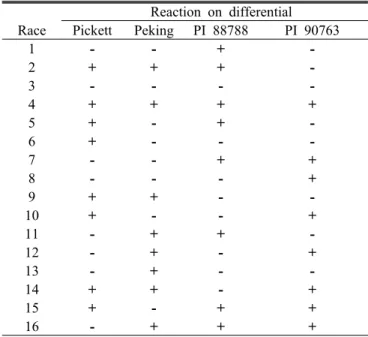
Crop rotation system with nonhost crops and planting of SCN resistant soybean cultivars (Niblack, 1999) have been suggested as effective management of soybean cyst nematode in infested soybean field. The classification system of SCN race was completed and 16 virulence phenotypes with four soybean differentials Pickett, Peking, PI 88788, and PI 90763 was possible (Niblack,1992; Riggs and Schmitt, 1988) (Table 1). The 14 SCN races among a total 16 soybean cyst nematode Heterodera glycines races reported by today worldwide, but race 12 and 16 have not been reported yet (Schmitt et al., 2004).
In Korea, existence of soybean cyst nematode first reported by Yokoo (1936). Choi and Choi (1983) conducted experiment about soybean parasitic nematodes from 71 soil samples.
In their study, 46 of 71 soybean fields were infested with SCN Heterodera glycines. The SCN races 1, 5, and 6 were identified in four different locations by Kim and Choi
Table 1. Full expansion of race classification for Heterodera glycines using the host differentials as described by Golden et al. (1970) and Riggs and Schmitt (1988).
Reaction on differential Race Pickett Peking PI 88788 PI 90763
1 - - + -
2 + + + -
3 - - - -
4 + + + +
5 + - + -
6 + - - -
7 - - + +
8 - - - +
9 + + - -
10 + - - +
11 - + + -
12 - + - +
13 - + - -
14 + + - +
15 + - + +
16 - + + +
+ = Number of females and cysts recovered was 10% or more of the number on Lee 74 cultivar.
- = Number of females and cysts recovered was less than 10% of the number on Lee 74 cultivar.
(1983). Choi et al. (1986, 1987) reported SCN races as 1, 3, 5 and 6 from collection of soil samples in Kyungpook, Chungpook, Cheonnam, Gyeonggi, Kangwon and Chungnam provinces. Kim et al. (1999) reported a SCN race 3, including SCN race 1, 5 and 6 at 21 locations of 8 provinces in Korea.
The classification scheme of soybean cyst nematode Heterodera glycines was modified with the additional four plant introductions, PI 437654, PI 209332, PI 89772 and PI 548316 including the previously used lines, PI 548402, PI 88788 and PI 90763 to accurate race determination more (Niblack et al., 2002). Currently, this SCN HG type classification scheme has being used in most of the soybean cyst nematode research areas in worldwide.
Classification of soybean cyst nematode HG type is one of the important biological elements to develop a SCN resistant soybean cultivar in soybean breeding programs.
After determination of soybean cyst nematode HG types, the soybean cyst nematode resistant cultivars are available to reduce yield losses in the SCN infested field.
Soybean germplasm can be used to develop a new
soybean cultivar in breeding programs. Not enough research papers, concerning the discovery of SCN resistance resources, have been published from the soybean germplasms in Korea. Park et al. (1969) performed SCN resistance test using 64 soybean varieties, unfortunately all of the recommended varieties observed with susceptible trait to the soybean cyst nematode in their studies. Additional SCN research using the 33 Korean soybean varieties in the SCN infested field was conducted by Park (1981). Kim and Choi (1983) also tested SCN resistant test with 16 soybean varieties by SCN race 5. It is need to find a strong SCN resistant resource to develop a SCN resistant soybean cultivar. The objectives of present study were investigation of soybean cyst nematode Heterodera glycines type and were evaluation of SCN resistance with soybean cultivars and germplasms in Korea.
MATERIALS & METHODS
Collection of SCN infested soils
The soybean cyst nematode infestations were observed in five soybean fields on summer season in 2011. The soil samples contained with SCN eggs were collected from five different locations overall three provinces, Gangwon-do, Gyeongsangnam-do, and Jeollanam-do on November 2011 in Korea. These soil samples were kept in the refrigerator with 4℃ temperature conditions until hatching the eggs for the further studies.
Investigation of SCN Heterodera glycines type Soybean cyst nematode populations were first reproduced to get the high density SCN populations from originally collected soil samples, and were cultured by a susceptible host soybean variety Lee 74 in one liter plastic beaker maintained with 27℃ temperature in a thermo-regulated water bath system on May 2012 in the greenhouse of the Gyeongsang National University as described by Arelli et al. (2000) and Niblack et al. (2002). The PVC tubes (16.5 cm length and 2.95 cm inside diameter) were filled with autoclaved sandy soil (soil: sand ratio 2:1) and packed into plastic crocks that were suspended over a water bath maintained at constant 27°C temperature condition. Each crock contained with 25 PVC tubes, and each tube was an
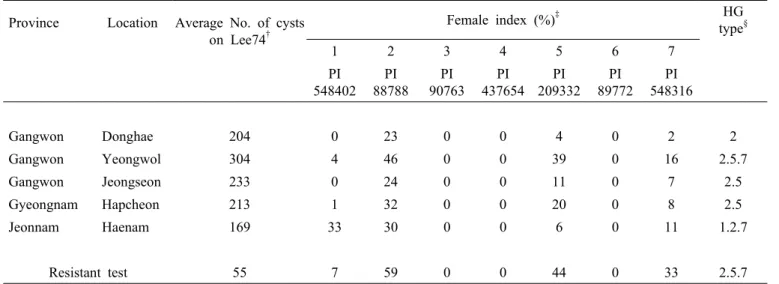
Table 2. Reactions of soybean cyst nematode to the SCN check varieties from the five SCN infested soil samples and resistant test in this study.
Province Location Average No. of cysts on Lee74†
Female index (%)‡ HG
type§
1 2 3 4 5 6 7
PI 548402
PI 88788
PI 90763
PI 437654
PI 209332
PI 89772
PI 548316
Gangwon Donghae 204 0 23 0 0 4 0 2 2
Gangwon Yeongwol 304 4 46 0 0 39 0 16 2.5.7
Gangwon Jeongseon 233 0 24 0 0 11 0 7 2.5
Gyeongnam Hapcheon 213 1 32 0 0 20 0 8 2.5
Jeonnam Haenam 169 33 30 0 0 6 0 11 1.2.7
Resistant test 55 7 59 0 0 44 0 33 2.5.7
†A standard susceptible variety Lee 74 was used with three replications in each SCN test.
‡A female index was calculated for each plant with the formula FI=100×(Number of cysts per plant /Average number of cysts on susceptible host Lee74) (Golden et al., 1970). Those cultivars with FI < 10 are considered resistant adapted from Schmitt and Shannon (1992). In this study, three soybean plants in individual indicator variety was tested to get the average number of females from SCN inoculation.
§Heterodera glycines type was determined depends on SCN cysts reproductions in each check variety.
experiment unit in this study. The soybean cyst nematode check varieties, Lee 74 (Caviness, 1975), PI 548402(Peking) (Brim and Ross, 1966), PI 88788 (Hartwig and Epps, 1978), PI 90763 (Hartwig and Young, 1990), PI 437654 (Anand, 1992a), PI 209332 (Anand, 1992b), PI 89772 (Nickell et al., 1994a) and PI 548316(Cloud) (Nickell et al., 1994b) were obtained from USDA-ARS Plant Germplasm Inspection Station, Beltsville, MD USA and used to conduct SCN bioassays with three plant replications per variety in the greenhouse. The HG type tests were initiated by germinating seeds of SCN check varieties in the sand soil plates for four days in the greenhouse. When roots reached approximately 3 cm in length, one seedling soybean plant was transplanted in each PVC tube that was previously infested with 2,000 eggs per plant as described by Kim et al. (2011). The SCN bioassays were completed with three plant replications to the seven indicator lines, including Lee 74 as a SCN susceptible control soybean plant (Niblack et al., 2002). The plant materials were grown under 16 hours day length and watered as needed in the greenhouse to investigate soybean cyst nematode Heterodera glycines types from the collection of five SCN
infested soil samples in Korea.
Evaluation of resistance to HG 2.5.7 type on soybean varieties and germplasms
A total of 59 soybean varieties or germplasms including seven SCN resistant and one susceptible check varieties were obtained from Gyeongsangnam-do Agricultural Research
& Extension services and Gyeongsang National University to perform the resistance test. Each soybean seed was planted into the plat pots filled with autoclaved sand soil, and grown for four days in the greenhouse. Three seedlings of the ten seeds, similar root growth sizes on individual plant materials, were transplanted into the pencil sized hole on the PVC tube after inoculation of 2,000 eggs per plant with previously identified with HG type 2.5.7 SCN isolate in this research.
Data collections on soybean cyst nematode
After thirty days from SCN egg inoculums, the female cysts were collected by gently soaking each tube in a bucket filled with water to loosen soil but to avoid dislodging cysts. Each root was placed on nested 850-mm
aperture over 250-mm aperture sieves and SCN females were dislodged from the roots with water spray. The separated female cysts were collected into the 50ml tube, and then counted the number of soybean cysts under a stereomicroscope. A female index was calculated for each plant with the follow formula, FI=100×(Number of cysts per plant /Average number of cysts on susceptible host Lee 74), as previously described by Golden et al. (1970).
RESULTS
Investigation of HG type
To investigate soybean cyst nematode HG (Heterodera glycines) type in Korea, soybean cyst nematode reproduction test was performed separately with individual SCN isolate which collected from five different locations in Korea. The number of soybean cyst nematode reproduced in a standard susceptible check variety Lee 74 was varied from 169 cysts for Haenam to 304 cysts for Yeongwol SCN infested soil samples (Table 2 and Figure 1). These results indicated that all of the soybean cyst nematodes were well reproduced as enough more than one hundred cysts on susceptible check variety Lee 74 as described by Niblack et al. (2002).
Average number of female cysts reproductions on Lee 74 was 204 cysts for Donghae SCN isolate, and female index estimated was 23% in PI 88788 check variety. As a this result, Donghae soybean field could be determined with HG type 2 SCN population since 10% of female index (FI) was a susceptible trait to the soybean cyst nematode (Riggs and Schmitt , 1988) (Table 1 and 2). In Yeongwol soil sample, 304 cysts reproduction was observed on Lee 74 and female index estimated was 46%, 39%, and 16% for PI 88788, PI 209332, and PI 548316, respectively. This result indicates Yeongwol soybean field infected with HG type 2.5.7. The other two SCN soil samples for Jeongseon and Hapcheon locations were determined with HG type 2.5 because more than 10% cysts reproductions were observed on PI 548402(Peking), PI 88788 and PI 548316 as considered with susceptible reactions comparing with a susceptible check variety Lee 74. Interestingly, PI 548402(Peking) resistant check variety was observed as a susceptible reaction from infestation of
Haenam SCN isolate, and determined with HG 1.2.7 type (Table 2).
From the above results, four different soybean cyst nematode Heterodera glycines types, HG 2 (race 1), HG 2.5 (race 1), HG 2.5.7 (race 1 or 5) and HG 1.2.7 (race 5) were determined from the five SCN infested soybean fields.
Evaluation of SCN resistance on soybean varieties and germplasms
A total 59 of soybean varieties or germplasms were used to evaluate their resistances to the soybean cyst nematode HG type 2.5.7 (race 1 or 5) by SCN bioassay in the greenhouse. Soybean cyst reproduction was observed with 55 cysts on a susceptible check Lee 74 (Table 2), and estimated with more than 10% cyst reproductions on soybean plant differentials, PI 88788, PI 209332 and PI 548316 comparing with susceptible check variety Lee 74.
This result indicated that SCN HG 2.5.7 type was inoculated into the present plant materials (Table 2). The lowest SCN cysts reproductions were observed with 22%
female index (FI) on Nampung variety. This female index level considered with moderately resistant (< 30%), and the highest SCN cysts reproductions were estimated with 122% on Jinnong 1 variety. The other 58 of the 59 plant materials determined with susceptible trait to the SCN HG type 2.5.7 (race 1 or 5), and average female index of 59 soybean varieties and germplasms were observed with 82.7% SCN reproductions in this study (Table 3).
DISCUSSION
Soybean cyst nematode Heterodera glycines (HG) type is one of the important factors for high yield productions in the SCN infested soybean fields. The first objective of this study was to investigate soybean cyst nematode Heterodera glycines type in Korea. Four SCN HG types were determined, HG 2 (race 1), HG 2.5 (race 1), HG 2.5.7 (race 1 or 5) and HG 1.2.7 (race 5) from five different locations (Table 2) in present studies. In Korea, three research papers were published about the distribution of soybean cyst nematode races by today. Kim and Choi (1983) reported the three SCN races, race 1 at Hwasun,
Table 3. The results of soybean cyst nematode reproductions on soybean varieties and germplasms by infestation of HG type 2.5.7 (continued).
Plant names RY† Development organization or country‡ FI§ Determination*
Galchae 2011 RDA 85 S
Gaechuk 1 2009 GNU 74 S
Gaechuk 2 2009 GNU 84 S
Geomeunbapmitkong 1996 Korean local variety 98 S
Gyeongsang #1 2008 Genomine(INC) 104 S
Gyeongsang #2 2008 GNU 87 S
Gyeongsang 3ho 2009 GNU 103 S
Gwanggyo 1987 RDA 78 S
Nampung 2010 RDA 22 MR
Namhaekong 1997 RDA 82 S
Nokwon 2007 RDA 101 S
Danyeopkong 1984 RDA 72 S
Daenchubamkong 1996 Korean local variety 113 S
Daepung 2003 RDA 72 S
Tokyukong 1983 RDA 64 S
Mallikong 1997 RDA 118 S
Mansu 2007 RDA 113 S
Moohankong 1997 RDA 102 S
Milang 2006 RDA 116 S
Milyangkong 1986 RDA 61 S
Bamkong 1985 Korean local variety 111 S
Baegunkong 1997 RDA 83 S
Baegcheon 1987 RDA 90 S
Bokwangkong 1997 RDA 64 S
Bosug 2004 RDA 104 S
Buchaekong 1989 Korean local variety 105 S
Bultae 2010 Korean local variety 77 S
Sang-won 2010 RDA 44 S
Saedanbaek 2012 RDA 113 S
Seomoktae 1985 Korean local variety 90 S
Socheong 2007 RDA 114 S
Socheong2 2010 RDA 99 S
Sohwang 2011 RDA 45 S
Songhakkong 1999 RDA 72 S
Subaktae 1992 Korean local variety 84 S
Shingi 2004 RDA 53 S
Shinhwa 2009 RDA 56 S
Ulsan 2010 Korean local variety 98 S
Table 3. The results of soybean cyst nematode reproductions on soybean varieties and germplasms by infestation of HG type 2.5.7 (continued).
Plant names RY† Development organization or country‡ FI§ Determination*
Wonkwang 2010 RDA 44 S
Wonhwang 2006 RDA 58 S
Jangbaekkong 1986 RDA 60 S
Jangwon 2001 RDA 90 S
Jonam 2007 RDA 75 S
Joyang 2012 RDA 78 S
Junjeori 1996 Korean local variety 85 S
Jinnong 1 2009 GNU 122 S
Jinnong 2ho 2010 GNU 97 S
Jinyang 2011 GNU 79 S
Chungdu1ho 2004 RDA 76 S
Cheongjakong 2001 RDA 76 S
Cheongja2ho 2004 RDA 115 S
Pungwon 2007 RDA 81 S
Happung55# NI** China 84 S
Whaumputkong 1997 RDA 93 S
Heuknong51# NI China 55 S
Heugmi 2010 RDA 81 S
Hinyutae 2010 Korean local variety 54 S
Huinkongnamulkong 1986 Korean local variety 62 S
CJ1ho 2009 CJ CheilJedang 62 S
†Registration years at Korea Seed & Variety Service.
‡RDA (Rural Development Administration), GNU (Gyeongsang National University)
§A female index (FI) was calculated for each plant with the formula, FI=100×(Number of cysts per plant /Average number of cysts on susceptible host Lee74)(Golden et al., 1970). Those cultivars with FI<10 are considered resistant, 10 to < 30 are considered moderately resistant, 30 to < 60 are considered moderately susceptible, and 60 or higher are considered susceptible adapted from Schmitt and Shannon (1992).
*Reaction of SCN cyst reproduction, ‘S’ indicated a susceptible trait and ‘MR’ indicated a moderately resistant trait.
**Not identified year.
race 5 at Yangsan and Suweon, and race 6 at Seonsan.
Choi et al. (1987) also identified SCN races including former three SCN races, race 1, race 5, race 6 and a new race 3 from the 21 soil samples which collected at Kangwon, Kyeonggi, and Chungnam Provinces. Twelve years late, SCN race 1, 3, 5 and 6 were found from eight different provinces in Korea by Kim et al. (1999). Niblack et al. (2002) recommended a new SCN Heterodera glycines type classification adding four additional indicator lines to better describe population and to expand the flexibility of the classification system compared with old
SCN race scheme (Golden et al. 1970: Riggs and Schmitt, 1988). Interestingly, PI 548402(Peking) was considered with a SCN resistant source to the SCN race 1, 3, 5 and 6 by today. These four SCN races have been determined with resistant trait in Korea, but a new HG type 1.2.7 was discovered from SCN infested soil samples at Haenam location in present study. This result indicated that a PI 548402(Peking) SCN resistances could be destroyed by SCN HG type 1.2.7 (race 5) in Korea (Table 2).
Germplasm screening is also one of the essential steps to find a useful genetic resource in plant breeding programs,
(a) (b)
Fig. 1. Soybean cyst nematodes were increased from the five different soil samples to conduct further SCN test in the greenhouse (A), and Heterodera glycines type test were performed on SCN check varieties as described by Arelli et al. (2000), Niblack et al. (2002) and Kim et al. (2011) in the thermo-regulated water bath system (B).
and could be used to make a mapping population and cultivar development. The second objective of this study was evaluation of resistance to the soybean cyst nematode HG type 2.5.7 (race 1 or 5) on soybean varieties and germplasms. Unfortunately, 58 of the 59 plant material used in this study were observed with a susceptible trait to the SCN HG type 2.5.7 (race 1 or 5), and average female index was estimated with 82.7% in our soybean varieties and germplasms. The female index was estimated as 22%
on Nampung, this SCN cyst reproduction ratio could be determined with moderately resistance. A cultivar Socheong was developed from a cross Milyang78×Peking, and registered as cultivar in 2006 by Rural Development Administration (RDA) of Korea. A PI 548402 (Peking) with a resistant trait on SCN HG type 2.5.7 (race 1 or 5) appeared a susceptible trait in this study and estimated as 114% female index in Socheong cultivar (Table 3). This result indicated Peking SCN resistant allele might be eliminated during the breeding processes by selection activities. Not many research papers have been published about SCN resistant screening on the soybean cultivars and germplasms in Korea. Park et al. (1969) conducted SCN resistant tests using the 64 soybean varieties including foreign germplasms by infestation. In their study, Baektae, Keumgang-sorip, and Southern-proripic were determined with a resistant trait. A Ulsan soybean plant material observed with medium resistant trait to the soybean cyst nematode, but it was estimated with SCN susceptible trait (female index=98%) in present study (Table 3). Park
(1981) identified a few SCN resistant Korean soybean varieties in their research. Kim and Choi (1983) conducted the experiment about the SCN resistant from 14 soybean varieties including two susceptible checks (Hill and Essex) and SCN resistant checks (PI 90763 and PI 548402). From their research, all of the plant materials were observed with SCN susceptible phenotypes except two resistant checks.
Especially, Geumgangdaelib soybean variety was observed a serious susceptible (female index=289%) trait to the SCN.
Growing the SCN resistant cultivars is one of the effective management ways to decrease soybean yield loses by SCN feeding activities in the soybean cyst nematode infested fields. Based on above investigations, PI 90763, PI 437654 and PI 89772 SCN resistant resources can be used to develop a SCN resistant soybean cultivar in Korea (Table 2). Not enough SCN resistant Korean soybean cultivars and germplasms were discovered by former research groups. A total 158 soybean cultivars were registered in Korea Seed & Variety Service (http://www.seed.go.kr/) from 1913 through 2010 year. Particularly, 74 of the 158 soybean cultivars (46.8%) were developed by cross within Korean soybean cultivars or local lines. The other registered soybean cultivars have been developed by pure line breeding or introduction breeding (http://www.seed.go.kr/protection/
situation/register_01.JSP). This statistical data indicates indirectly that although Korea is one of the important native places or areas of soybean, not enough Korean native germplasms have been used to find a very strong SCN resistant plant resource to fight against soybean cyst
nematode. Our results could be provided useful information to the soybean breeders to develop SCN resistant soybean cultivars in Korea.
ACKNOWLEDGEMENTS
This study was supported by Technology Development Program for Agriculture and Forestry, Ministry for Food, Agriculture, Forestry and Fisheries, Republic of Korea (Research number: 111097-03-1-SB010).
REFERENCES
Anand, S. C. 1992a. Registration of ‘Hartwig’ soybean. Crop Sci. 32 : 1069-1070.
Anand, S. C. 1992b. Registration of ‘Delsoy 4710’ soybean.
Crop Sci. 32 : 1294.
Arelli, P. R., D. A. Sleper, P. Yue, and J. A. Wilcox. 2000.
Soybean reaction to races 1 and 2 of Heterodera glycines.
Crop Sci. 40 : 824-826.
Brim, C. A. and J. P. Ross. 1966. Registration of ‘Pickett’
soybeans. Crop Sci. 6 : 305.
Caviness, C. E. 1975. Registration of of ‘Lee 74’ soybean.
Crop Sci. 15 : 100.
Choi, D. R., Y. B. Lee, and S. C. Han. 1987. Race distribution of the soybean cyst nematode (Heterodera glycines) in Korea. Korean J. Plant Prot. 26(4) : 203-207.
Choi, Y. E. and D. R. Choi. 1983. Survey on soybean parasitic nematodes. Korean J. Plant Prot. 22(4) : 251-261.
Choi, Y. E., D. G. Kim, and D. R. Choi. 1986. Selection of soybean cultivars resistant to soybean cyst nematode, Heterodera glycines. Korean J. Plant Prot. 25(1) : 53-61.
Donald, P. A., P. E. Pierson, S. K. St. Martin, P. R. Sellers, G. R. Noel, A. E. MacGuidwin, J. Faghihi, V. R. Ferris, C. R. Grau, D. J. Jardine, H. Melakeberhan, T. L. Niblack, W. C. Stienstra, G. L. Tylka, T. A. Wheeler, and D. S.
Wysong. 2006. Assessing Heterodera glycines-resistant and susceptible cultivar yield response. J. Nematol. 38 : 76-82.
Golden, A. M., J. M. Epps, R. D. Riggs, L. A. Duclos, J. A.
Fox, and R. L. Bernard. 1970. Terminology and identity of intraspecific forms of the soybean cyst nematode (Heterodera glycines). Plant Dis. Rep. 54 : 544-546.
Hartwig, E. E. and J. M. Epps. 1978. Registration of ‘Bedford’
soybean. Crop Sci. 18 : 915.
Hartwig, E. E. and L. D. Young. 1990. Registration of
‘Cordell’ soybean. Crop Sci. 30 : 231.
Kim, D. G. and Y. E. Choi. 1983. Studies on the resistance and races of soybean cyst nematode, Heterodera glycines, in soybean. Korean J. Plant Prot. 22(3) : 208-212.
Kim, D. G., J. K. Lee, and Y. K. Lee. 1999. Distribution of races of soybean cyst nematode in Korea. Korean J. Appl.
Entomol. 38(3) : 249-253.
Kim, M., D. L. Hyten, T. L. Niblack, and B. W. Diers. 2011.
Stacking resistance alleles from wild and domestic soybean sources improves soybean cyst nematode resistance. Crop Science 51 : 934-943.
Liu, X. Z., J. Q. Li, and D. S. Zhang. 1997. History and status of soybean cyst nematode in China. International Journal of Nematology. 7 : 18-25.
Niblack, T. L., The race concept. In: Riggs R. D., Wrather, J. A. (eds). 1992. Biology and management of the soybean cyst nematode. APS Press, St. Paul, Minn. pp. 73-86.
Niblack, T. L., ed. 1999. Soybean cyst nematode management guide. North-central soybean research program publication.
Columbia, MO: University of Missouri Printing Services.
Niblack, T. L., P. R. Arelli, G. R. Noel, C. H. Opperman, J.
H. Orf, D. P. Schmitt, J. G. Shannon, and G. L. Tylka.
2002. A revised classification scheme for genetically diverse populations of Heterodera glycines. J. Nematol. 34 : 279-288.
Nickell, C. D., G. R. Noel, R. L. Bernard, D. J. Thomas, and K. Frey. 1994a. Registration of soybean germplasm line
‘LN89-5699’ resistant to soybean cyst nematode. Crop Sci.
34 : 1133-1134.
Nickell, C. D., G. R. Noel, R. L. Bernard, D. J. Thomas, and J. Pracht. 1994b. Registration of soybean germplasm line
‘LN-5612’ moderately resistant to soybean cyst nematode.
Crop Sci. 34 : 1134.
Park, M. S. 1981. Studies on breeding for disease and insect resistant soybean variety. II. Resistance to soybean cyst nematode (Heterodera glycines I.) by soybean variety.
Korean Journal of Crop Sciences. 26(4) : 324-331.
Park, J. S., S. C. Han, and Y. B. Lee. 1969. Studies on the varietal resistance of the soybean to the cyst nematode, Heterodera glycines Ichinohe and its damage. Korean J.
Plant Prot. 7(3) : 21-25.
Riggs R. D. and D. P. Schmitt. 1988. Complete characterization of the race scheme for Heterodera glycines. Journal of Nematology. 20(3) : 392-395.
Schmitt, D. P. and G. Shannon. 1992. Differentiating soybean cyst nematode race and resistance response of soybean.
Crop Sci. 32 : 275-277.
Schmitt, D. P., J. A. Wrather, and R. D. Riggs. 2004. Biology and management of soybean cyst nematode. pp. 60-66.
Winstead, N. N., C. B. Skotland, and J. N. Sasser. 1955.
Soybean cyst nematode in North Carolina. Plant Dis. Rep.
39 : 9-11.
Yokoo, T. 1936. Host plants of Heterodera schachtii Schmidt and some instructions. Korea Agricultural Experiment Station Bulletin. 8 : 47-174.