Orthodontic Acrylic Resin의 중합조건 변화가 최대하중에 미치는 영향
이 규 선 동남보건대학 치기공과
The Effect of Changes in Polymerization Conditions of Orthodontic Acrylic Resin on Maximum Load
Lee, Gyu Sun
Department of Dental Technology, DongNam Health college
Purpose: In order to find out the impact of changes in polymerization conditions of orthodontic acrylic resin on
maximum load.
Methods: While maintaining mixing ratio 3:1 of polymer and monomer in spray-on way in the production
condition of polymerization temperature 25 or 37 for 10 minutes or 30 minutes of polymerization time by pressure 3kfg/ or 6kfg/ in the lab maintaining 25 of room temperature, the change in maximum load rise rate was tested by producing 5 acrylic resin specimens for orthodontics per group to meet the standards of 25 2
2 and using INSTRON with the 3rd bar 2mm in diameter and parallel support bending device of 15 0.1 as test equipment showing 30.00 /min of crosshead speed, 50 16 N/min of load ratio in the laboratory of 24 room temperature and as a result, the following results were obtained.
Results: 1. When increasing pressure from 3kfg/
to 6kfg/ , maximum load was lowered by -4.285%. 2. When increasing polymerization time from 10 minutes to 30 minutes, maximum load rose by 3.848%. 3. When increasing polymerization temperature from 27 to 37 , maximum load rose by 5.854%.
Conclusion: Considering the above test results that polymerization time and polymerization temperature when
polymerizing acrylic resin for orthodontics according to changes in working conditions had an impact on the rate of rise of maximum load values but the rate of rise was lowered when increasing pressure from 3kfg/ to 6kfg/ , we came to a conclusion that high pressure more than necessary does not affect the rate of rise of maximum load.
[Abstract]
*본 연구는 2012년도 동남보건대학 연구비 지원에 의해서 이루어진 논문임.
Key words :
maximum load, Orthodontic Acrylic Resin, Polymerization Conditions
Ⅰ. 서 론
일반적으로 acrylic resin은 중합방법에 따라 heat- activated resin, chemically -activated resin, light- activated resin으로 분류된다. 이들 중 active plate, functional appliance, retainer, splint 등의 치과교정 장치 제작에 주로 사용되는(Phillips, 1994) Chemically -activated resin은 self-curing resin, direct resin, cold curing resin, autopolymerizing resin으로 불리기 도 한다(Kim et al, 1995).
치과보철물 제작에 주로 사용되고 있는 acrylic resin은 polymethyl methacrylate(PMMA-중합체)와 개시제 (initiator)가 들어 있는 분말과 methyl methacrylate (MMA-단량체) 및 소량의 억제제(inhibitor)가 들어 있는 용액의 혼합에 의하여 중합반응이 일어난다.
이때 heat-activated resin은 열이 benzoyl peroxide 의 이중결합을 파괴하고, chemically -activated resin 은 단량체에 포함된 3차아민(accelerator)에 의하여 열을 가하지 않아도 benzoyl peroxide가 파괴되고 자유라디칼 을 형성함으로써 중합이 이루어진다.
Chemically -activated resin은 heat-activated resin 보다 중합수축량이 적어 장치의 적합성은 우수하나 중합률이 떨어지고 미반응 단량체의 비중이 높아지는 것 으로 알려져 있다(Fletcher et al, 1983; Kalipcilar et al, 1991).
Acrylic resin 중합반응시 약 25~50%의 미반응 단량 체가 치과보철물 안에 존재하게 되고 이 미반응 단량체의 약 10%가 장치 밖으로 유출된다는 보고도 있다 (Peutzfeldt, 1997).
이처럼 치과교정장치 제작용 acrylic resin의 중합률이 떨어지면 미반응 단량체의 작용으로 중합체의 기질이 산 화되므로 기계적 강도(Fletcher et al, 1983), 마모저항 (Wu, 1983)이 낮아지고, 산화에 따른 변색(Ferraane et al, 1983) 및 구강점막이나 위장관 등에 유해한 영향 (Weaver & Goebel, 1980)을 미치기도 한다.
또한 미반응 단량체의 증가는 탄성률이 떨어지고 기계 적 성질이 약해지며 기포가 발생한다(Beech, 1975;
이와 같이 chemically -activated resin이 heat- activated resin 보다 낮은 중합률에 따른 문제점들이 지 적되고 있어 이를 개선하고자 중합시 압력을 높여 기포의 크기를 줄여 굽힘강도를 향상시킨 보고서(Donovan et al, 1985)와 중합온도를 높여 단량체의 잔류 함량을 감소 시킨 보고서(Vallittu et al, 1998)도 있다.
최근 치과교정장치 제작에 사용되고 있는 장비의 개선 으로 우수한 pressure pot가 출시되고 있다. 따라서 예전 보다 더 높은 중합 압력을 가할 수 있는 장비의 개선이 chemically -activated resin의 단점을 얼마나 보완할 수 있는지 알아보고자 하였다.
본 연구에서 chemically -activated resin을 중합시킬 때 온도, 압력, 시간의 변화가 중합률과 어떤 상관관계가 있는지 비교 실험하였으며 다소의 지견이 있으므로 이를 보고한다.
Ⅱ. 연구 방법
1. 실험재료
실험 재료는 미국의 Lang Dental Manufacturing Co., Inc.에서 제조한 Ortho-Jet Pound Package Acrylic REF 1334 chemically -activated resin을 선택 하였으며 이 재료의 구성은 polymer는 polymethyl methacrylate “PMMA”이며 monomer는 methyl methacrylate “MMA”이다. 이 회사의 지침서에 따르면 orthodontic acrylic resin의 중합조건은 30psi의 압력하 에서 10분간 중합하도록 되어 있다.
2. 실험장비
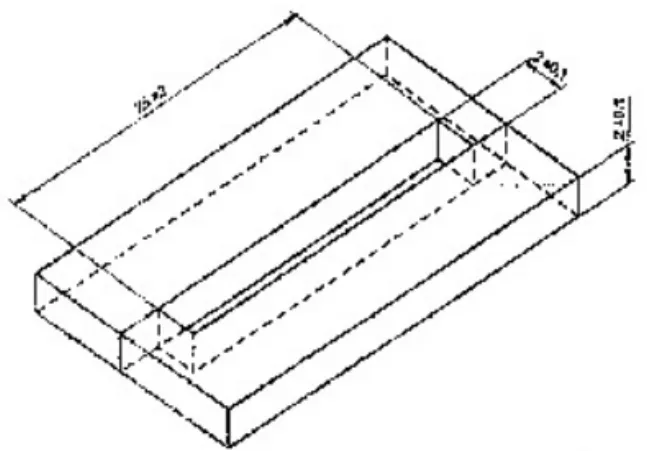
1) 주형Orthodontic acrylic resin 시편 제작을 위한 주형은
<Fig. 1>과 같이 25㎜×2㎜×2㎜의 규격으로 제작될 수 있도록 설계된 틀로서 3%의 폴리비닐스티어릴 에테르 왁 스 헥산 용액 분리제로 코팅한다.
2) 중합장치
Orthodontic acrylic resin 시편 제작을 위한 중합장치 는 독일 Vertex사의 제품으로 수조의 온도를 ±1℃로 유 지하며 압력을 6bar까지 올릴 수 있는 것을 사용하였다.
3) 마이크로미터
Orthodontic acrylic resin 시편의 규격을 측정하기 위 하여 정확도가 0.01㎜인 마이크로미터 측정기를 사용하 였다.
4) 만능 물성실험기
만능 물성실험기는 지속적인 크로스헤드 속도가 30.00㎜
/min이며 하중 비율이 50±16 N/min인 실험 설비로 표 점거리 15±0.1㎜의 평행 지지대 휨 장치(bending apparatus) 및 직경이 2㎜인 제3의 막대를 갖춘 INSTRON을 사용하 였다.
3. 시편 제작
Orthodontic acrylic resin의 중합조건(온도, 압력, 시 간) 변화가 물성에 미치는 영향을 알아보기 위하여, 실내 온도가 25℃를 유지하는 Lab에서 spray-on방법으로 polymer와 monomer의 혼합비를 3:1로 유지한 채, Fig. 1 과 같이 준비된 주형에 orthodontic acrylic resin 시료를 시편 제작조건에 따라 넘치도록 채운 후, 시편의 일률적 인 규격 유지를 위하여 즉시 여분의 재료는 얇은 수술용 칼을 이용하여 평면으로 조심스럽게 밀어내고, 중합한 후 주형에서 시편을 꺼내 flash를 제거하였다.
마지막으로 마이크로미터 측정기를 이용하여 시편을 측 정하고 규격보다 큰 부분은 800번 sand paper를 이용하 여 다듬었다.
시편 제작조건은 <Table 1>과 같이 중합수조 내의 압력 을 3㎏f/㎠ 또는 6㎏f/㎠, 중합시간을 10분 또는 30분, 그 리고 중합온도는 25℃ 또는 37℃로 변경하고 group당 5 개씩의 시편을 제작하였다.
Table 1. Production conditions of acrylic resin specimens Fig. 1. Specimen production mold for maximum load test
Group Temperature
(℃) Time
(min) Pressure
(㎏f/㎠) Resin Work Technique
Spray-on Polymer 3 : Monomer 1
A1 A2 A3 A4 B1 B2 B3 B4 25
37 25 37 25 37 25 37 10
30
10
30 3
6
실험 표본을 준비한지 24시간이 지난 후 0.01㎜의 정확 도를 가진 마이크로미터로 시편의 폭과 높이를 다시 측정 하였다.
실온 24℃의 실험실에서 지속적인 크로스헤드 속도가 30.00㎜/min이며, 하중 비율이 50±16N/min인 실험 설 비로 15±0.1㎜의 평행 지지대 휨 장치(bending apparatus) 및 직경이 2㎜인 제3의 막대를 갖춘 INSTRON을 사용하여 3점 굴곡실험을 하되 maximum load 값을 측정하였다.
Ⅲ. 결 과
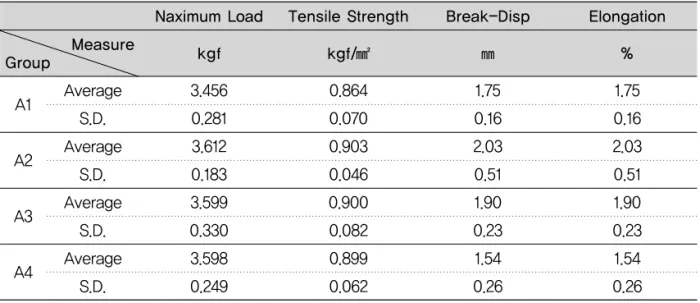
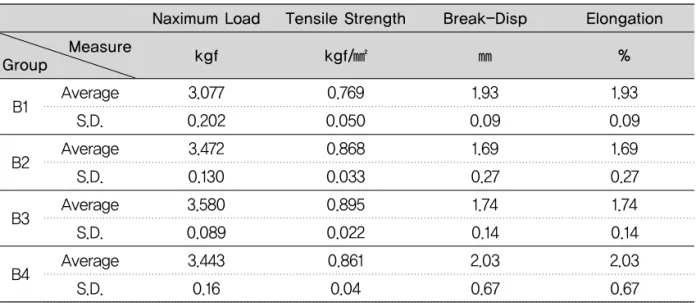
<Table 1>과 같은 시편 제작조건에 따라 준비된 group 당 5개씩의 시편을 INSTRON으로 실험한 결과 group A 는 <Table 2>, group B는 <Table 3>과 같은 maximum load 값을 얻었다.
즉 압력 3㎏f/㎠, 중합시간 10분, 물의 온도 25℃인 group A1의 maximum load 평균값은 3.456(S.D.
group A2의 maximum load 평균값은 3.612(S.D.
0.183), 압력 3㎏f/㎠, 중합시간 30분, 물의 온도 25℃인 group A3의 maximum load 평균값은 3.599(S.D.
0.330), 압력 3㎏f/㎠, 중합시간 30분, 물의 온도 37℃인 group A4의 maximum load 평균값은 3.598(S.D.
0.249), 압력 6㎏f/㎠, 중합시간 10분, 물의 온도 25℃인 group B1의 maximum load 평균값은 3.077(S.D.
0.202), 압력 6㎏f/㎠, 중합시간 10분, 물의 온도 37℃인 group B2의 maximum load 평균값은 3.472(S.D.
0.130), 압력 6㎏f/㎠, 중합시간 30분, 물의 온도 25℃인 group B3의 maximum load 평균값은 3.443(S.D.
0.089), 압력 6㎏f/㎠, 중합시간 30분, 물의 온도 37℃인 group B4의 maximum load 평균값은 3.580(S.D. 0.16) 이다.
이상의 실험 결과를 살펴보면 group A 보다 group B 의 maximum load 값이 떨어지는 것으로 나타났다.
그리고 group A와 group B의 시편들에 대한 maximum load 값에 대한 표준편차가 큰 것을 알 수 있다.
1.75 0.16 2.03 0.51 1.90 0.23 1.54 0.26 1.75
0.16 2.03 0.51 1.90 0.23 1.54 0.26 0.864
0.070 0.903 0.046 0.900 0.082 0.899 0.062 3.456
0.281 3.612 0.183 3.599 0.330 3.598 0.249 Average
S.D.
Average S.D.
Average S.D.
Average S.D.
A1
A2
A3
A4
Table 2. Maximum load of acrylic resin specimen group A
Elongation
%
㎜ kgf/㎟
Measure kgf Group
Break-Disp Tensile Strength
Naximum Load
따라서 group A와 B군 각각 5개씩의 시편에서 최대값 과 최소값을 제외한 후 group 간 maximum load 값을 2 차로 비교한 결과 압력 3㎏/㎠, 중합시간 10분, 물의 온도 25℃인 group A1의 maximum load 평균값은 3.493(S.D. 0.205), 압력 3㎏f/㎠, 중합시간 10분, 물의 온도 37℃인 group A2의 maximum load 평균값은 3.560(S.D. 0.103), 압력 3㎏f/㎠, 중합시간 30분, 물의 온도 25℃인 group A3의 maximum load 평균값은 3.488(S.D. 0.135), 압력 3㎏f/㎠, 중합시간 30분, 물의 온도 37℃인 group A4의 maximum load 평균값은
3.671(S.D. 0.041), 압력 6㎏f/㎠, 중합시간 10분, 물의 온도 25℃인 group B1의 maximum load 평균값은 3.103(S.D. 0.110), 압력 6㎏f/㎠, 중합시간 10분, 물의 온도 37℃인 group B2의 maximum load 평균값은 3.489(S.D. 0.073), 압력 6㎏f/㎠, 중합시간 30분, 물의 온도 25℃인 group B3의 maximum load 평균값은 3.428(S.D. 0.099), 압력 6㎏f/㎠, 중합시간 30분, 물의 온도 37℃인 group B4의 maximum load 평균값은 3.583(S.D. 0.04)이다(Table 4).
1.93 0.09 1.69 0.27 1.74 0.14 2.03 0.67 1.93
0.09 1.69 0.27 1.74 0.14 2.03 0.67 0.769
0.050 0.868 0.033 0.895 0.022 0.861 0.04 3.077
0.202 3.472 0.130 3.580 0.089 3.443 0.16 Average
S.D.
Average S.D.
Average S.D.
Average S.D.
B1
B2
B3
B4
Table 3. Maximum load of acrylic resin specimen group B
Elongation
%
㎜ kgf/㎟
Measure kgf Group
Break-Disp Tensile Strength
Naximum Load
1.61 1.95 1.57 1.71 0.21 1.29 2.35 2.31 1.98 0.60 1.61
1.95 1.57 1.71 0.21 1.29 2.35 2.31 1.98 0.60 0.829
0.929 0.862 0.873 0.051 0.878 0.873 0.920 0.890 0.026 3.314
3.717 3.447 3.493 0.205 3.513 3.490 3.678 3.560 0.103 1
2 3 Average
S.D.
1 2 3 Average
S.D.
A1
A2
Table 4. Maximum load of acrylic resin specimen group A, B
Elongation
%
㎜ kgf/㎟
Measure kgf Group
Break-Disp Tensile Strength
Naximum Load
이상의 결과를 살펴보면 group A 보다 group B의 maximum load 값이 현저하게 차이나는 것으로 나타났다.
그리고 group A와 B군 각각 5개씩의 시편에서 최대값 과 최소값을 제외한 후 maximum load 값에 대한 표준 편차는 크게 준 것을 알 수 있다.
이 실험 결과를 토대로 orthodontic acrylic resin 중합 시 압력을 3㎏f/㎠ 또는 6㎏f/㎠, 중합시간을 10분 또는 30분, 그리고 중합온도를 25℃ 또는 37℃로 변경한 경우 각각의 조건에 대한 maximum load의 상승률을 비교해 보면 다음과 같다.
1.95 1.84 1.80 1.86 0.08 1.82 1.61 1.46 1.63 0.18 1.89 1.82 1.96 1.89 0.07 1.48 1.43 1.71 1.54 0.15 1.22 2.26 2.00 1.83 0.54 1.79 1.62 1.81 1.74 0.10 1.95
1.84 1.80 1.86 0.08 1.82 1.61 1.46 1.63 0.18 1.89 1.82 1.96 1.89 0.07 1.48 1.43 1.71 1.54 0.15 1.22 2.26 2.00 1.83 0.54 1.79 1.62 1.81 1.74 0.10 0.847
0.910 0.859 0.872 0.033 0.921 0.926 0.906 0.918 0.010 0.807 0.754 0.767 0.776 0.028 0.893 0.866 0.859 0.873 0.018 0.835 0.852 0.884 0.857 0.025 0.887 0.894 0.907 0.896 0.01 3.387
3.641 3.436 3.488 0.135 3.684 3.705 3.625 3.671 0.041 3.226 3.015 3.069 3.103 0.110 3.572 3.462 3.434 3.489 0.073 3.340 3.409 3.535 3.428 0.099 3.548 3.575 3.627 3.583 0.04 1
2 3 Average
S.D.
1 2 3 Average
S.D.
1 2 3 Average
S.D.
1 2 3 Average
S.D.
1 2 3 Average
S.D.
1 2 3 Average
S.D.
A3
A4
B1
B2
B3
B4
Elongation
%
㎜ kgf/㎟
Measure kgf Group
Break-Disp Tensile Strength
Naximum Load
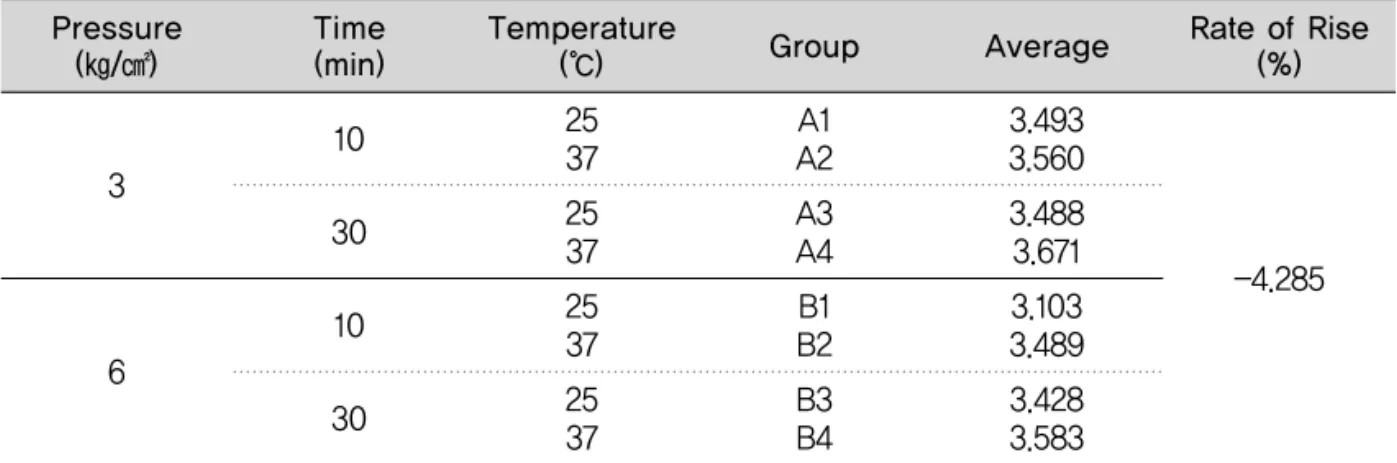
Orthodontic acrylic resin 중합 시 3㎏f/㎠일 때보다 6㎏f/㎠으로 압력을 높였을 때 maximum load는 - 4.285%로 오히려 더 낮아졌다(Table 5). 그러나 중합 시 간이 10분 보다 30분으로 늘어났을 때 maximum load는
3.848%로 상승했다(Table 6). 또한 중합 온도를 27℃ 보 다 37℃로 높였을 때에도 maximum load는 5.854%나 상승했다(Table 7).
Ⅳ. 고 찰
본 연구에서 시편 제작을 위하여 사용되어진 재료는 미
국의 Lang Dental Manufacturing Co., Inc.에서 제조 한 Ortho-Jet Pound Package Acrylic REF 1334 chemically -activated resin을 선택하였으며 이 재료의 Table 5. Rate of rise of maximum load according to the change in pressure when polymerizing acrylic resin
Rate of Rise Average (%)
Group Temperature
(℃) Pressure
(㎏/㎠)
Time (min)
-4.285 3.493
3.560 3.488 3.671 3.103 3.489 3.428 3.583 A1
A2 A3 A4 B1 B2 B3 B4 25
37 25 37 25 37 25 37 10
30
10
30 3
6
Table 6. Rate of rise of maximum load according to the change in time when polymerizing acrylic resin Rate of Rise Average (%)
Group Temperature
(℃) Time
(min)
Pressure (㎏f/㎠)
3.848 3.493
3.560 3.103 3.489 3.488 3.671 3.428 3.583 A1
A2 B1 B2 A3 A4 B3 B4 25
37 25 37 25 37 25 37 3
6
3
6 10
30
Table 7. Rate of rise of maximum load according to the change in temperature when polymerizing acrylic resin Rate of Rise Average (%)
Group Pressure
(㎏f/㎠) Temperature
(℃)
Time (min)
5.854 3.493
3.103 3.488 3.428 3.560 3.489 3.671 3.583 A1
B1 A3 B3 A2 B2 A4 B4 3
6 3 6 3 6 3 6 10
30
10
30 25
37
이며 monomer는 methyl methacrylate “MMA”이다.
Orthodontic acrylic resin 시편 제작을 위한 주형은 25㎜×2㎜×2㎜의 규격으로 제작될 수 있도록 설계된 틀 에 3%의 폴리비닐스티어릴 에테르 왁스 헥산 용액 분리 제로 코팅한 후 polymer 3 그리고 monomer 1의 비율로 쌓아 올리는 spray-on을 이용하여 orthodontic acrylic resin 시편을 제작하고 수조의 온도를 ±1℃로 유지하며 압력을 6bar까지 올릴 수 있는 독일 Vertex사의 중합장 치를 사용하여 압력은 3㎏f/㎠ 또는 6㎏f/㎠, 중합시간은 10분 또는 30분, 그리고 중합온도는 25℃ 또는 37℃로 변경하고 group A, B군 각각 5개씩의 시편을 제작하였다.
그리고 지속적인 크로스헤드 속도가 30.00㎜/min이며 하중 비율이 50±16 N/min인 실험 설비로 표점거리 15
±0.1㎜의 평행 지지대 휨 장치(bending apparatus) 및 직경이 2㎜인 제3의 막대를 갖춘 INSTRON을 이용하여 maximum load 값을 측정하고 상승률을 비교한 결과는 다음과 같다.
Orthodontic acrylic resin 중합 시 3㎏f/㎠일 때보다 6㎏f/㎠으로 압력을 높였을 때 maximum load는 - 4.285%로 오히려 더 낮아졌다. 그러나 중합 시간이 10분 보다 30분으로 늘어났을 때 maximum load는 3.848%
로 상승했다. 또한 중합 온도가 27℃ 보다 37℃로 높였을 때에도 maximum load는 5.854%나 상승했다.
유종욱 등(1999)은 압력을 가한 경우보다 압력을 가하 지 않은 경우가 중합률이 높았다고 하였다. 그러나 본 실 험에서는 3㎏f/㎠일 때보다 6㎏f/㎠으로 압력을 높였을 때 maximum load와 tensile strength는 오히려 더 낮 아졌다.
Acrylic resin 중합 시 압력의 증가는 기포의 감소로 중 합체의 밀도가 증가하므로 강도도 증가할 것이라고 하였 으나(Vallittu et al, 1998) 통계적으로 유의한 차이 없다 는 보고도 있다(Furnish et al, 1983)
이렇게 압력이 증가함에도 불구하고 maximum load가 낮아진 이유는 acrylic resin 중합 시 적당한 압력을 가하 는 경우 휘발성이 강한 monomer가 기화하는 것을 방지 하고 기포를 줄게 하지만, 과하게 높은 압력은 레진 표면 에 산소를 너무 많이 공급하므로 중합 반응이 제대로 이
Vallittu 등(1998)은 자가중합레진 중합 시 온도와 의치 상 중합체의 잔류 monomer 함량과의 관계를 조사한 결 과 온도상승은 잔류 monomer의 함량을 감소시킨다고 하였다.
Donovan 등(1985)은 자가중합레진 중합 시 압력을 가 하면 기포가 줄어들고 굽힘강도가 향상되지만 경도는 큰 차이가 없다고 하였다.
또한 Dogan 등(1995)은 중합 시간, 중합 온도 변화 시 중합 시간이 늘어나고 온도가 높아짐에 따라 잔류 monomer 함량은 줄고 인장강도는 증가한다고 하였다.
그리고 Ogawa 등(2000)은 자가중합레진을 23℃ 공기 중과 30℃ 수중에서 중합한 경우에는 굽힘강도의 차이가 없는 반면, 23℃ 공기 중에서 중합한 것보다 60~80℃ 수 중에서 중합한 경우의 굽힘강도는 2배나 증가한다고 하 였다.
이와 같이 orthodontic acrylic resin 중합 시 과도한 압력의 증가는 장치 표면에 과하게 산소를 공급하여 기계 적 성질을 낮출 우려가 있으나, 중합 시간을 늘리고 온도 를 높이는 방법으로 기계적 성질의 향상은 물론 monomer의 잔존함량을 줄이는데 도움이 되는 것과 같 이, 일정 수준의 압력 증가 역시 장치 내의 monomer 잔 존함량을 줄이는데 도움이 되므로(Undurwade &
Sidhaye, 1989) 간과 하여서는 안 될 것이라고 판단된다.
Ⅴ. 결 론
Orthodontic acrylic resin의 중합조건 변화가 최대하 중에 미치는 영향을 알아보기 위하여, 실내온도가 25℃를 유지하는 Lab에서 압력 3㎏f/㎠ 또는 6㎏f/㎠, 중합시간 10분 또는 30분, 중합온도 25℃ 또는 37℃로 변경하는 제작조건에서 spray-on방법으로 polymer와 monomer 의 혼합비를 3:1로 유지한 채, 25㎜×2㎜×2㎜의 규격에 맞도록 시편을 group당 5개씩 제작하고, 실온 24℃의 실 험실에서 크로스헤드 속도 30.00㎜/min, 하중 비율 50
±16 N/min인 실험 설비로 15±0.1㎜의 평행 지지대 휨 장치 및 직경이 2㎜인 제3의 막대를 갖춘 INSTRON을
사용하여 각각의 조건에 대한 maximum load 상승률 변 화를 실험한 결과 다음과 같은 결론을 얻었다.
1. 3㎏f/㎠일 때보다 6㎏f/㎠으로 압력을 높였을 때 maximum load는 -4.285% 낮아졌다.
2. 중합 시간이 10분 보다 30분으로 늘어났을 때 maximum load는 3.848% 상승했다.
3. 중합 온도가 27℃ 보다 37℃로 높였을 때 maximum load는 5.854% 상승했다.
이상의 실험 결과로 미루어 볼 때 작업조건 변경에 따른 치과 orthodontic acrylic resin 중합 시의 중합 시간과 중합 온도는 maximum load 값의 상승률에 영향을 미치 지만, 압력이 3㎏f/㎠일 때보다 6㎏f/㎠ 일 때 상승률이 낮아진 것으로 보아 필요 이상의 고압은 maximum load 상승률에 영향을 미치지 않는다는 결론에 도달하였다.
REFERENCES
Kim KN, Kim KH, Kim HI, Park YJ, Bae TS, Lim HN, Cho HW. Dental Materials. 1st Edition, Koonja Publishing, Inc, 159-90, 1995.
Yoo JW, Jang KT, Kim CC. A study on the degree of polymerization of autopolymerized resin for removable orthodontic appliance according to curing time and and curing method. J Korean Acad Pediatr Dent, 26⑵, 304, 1999.
Austin AT, Easker RK. Residual monomer levels in denture bases. Br Dent J., 153, 424, 1982.
Beech DR. Molecular weight distribution of denture base acrylics. J. Prosthet Dent. 3, 19-22, 1975.
Dogan A, Bek B, Cevik NN, Usanmaz A. The effect of preparation conditions of acrylic denture
monomer, mechanical properties and water absorption. J Dent, 23, 313-8, 1995.
Donovan TE, Hurst RG, Campagni WV. Physical properties of acrylic resin polymerized by four different techniques. J Prosthet Dent, 54, 522-4, 1985.
Ferraane JL, Moser JB, Greener EH. Color stability of unfilled Bis-GMA resins under UV exposure. AADR Progr & Abst, 62, 453, 1983.
Fletcher AM. Purnaveja S. Amin WM et al. The level of residual monomer in self curing denture base materials. Dent Res, 62⑵, 118~120, 1983.
Furnish GM, O’Toole TJ, von Fraunhofer JA. The polymerization of acrylic resin orthodontic prostheses. J Prosthet Dent, 49, 276-8, 1983.
Kalipcilar B. Karragaclioglu L. Hasanreisoglu U.
Evaluation of the level of residual monomer in acrylic denture base materials having different polymerization properties. Journal of oral rehabilitation, 18, 399-401, 1991.
Ogawa T, Tanaka M, Koyano K. Effect of water temperature during polymerization on strength of autopolymerizing resin. J Prosthet Dent, 84, 222-4, 2000.
Peutzfeldt A. Resin composites in dentistry: The monomer system. Eur J Oral Sci 105, 97-116, 1997.
Phillips M: Elements of dental materials. 5th ed, 100-116, 1994.
Undurwade, JH. Sidhaye, AB. Curing acrylic resin in a domestic pressure cooker: A study of residual monomer content. Quintessence International, 20⑵, 1989.
Vallittu PK, Ruyter IE, Buykuilmaz S. Effect of polymerization temperature and time on the
Vallittu PK. Unpolymerized surface layer of autopolymerizing polymethyl methacrylate resin. Oral Rehabil, 26, 208-212, 1999.
Weaver RE, Goebel WM. Reactions to acryli resin dental prostheses. J Prosthet Dent 43, 138- 142, 1980.
Wu W. Degree of cure and wear resistance of dental composites. J Dent Res, 62, 671, 1983.