Print ISSN: 1738-3110 / Online ISSN 2093-7717 JDS website: http://www.jds.or.kr/
http://dx.doi.org/10.15722/jds.19.3.202103.49
A Study on Competition Analysis in Retail Distribution Industry Using GIS in Seoul *
Byong-Kook YOO 1 , Soon-Hong KIM 2
Received: January 22, 2021. Revised: February 23, 2021. Accepted: March 05, 2021.
Abstract
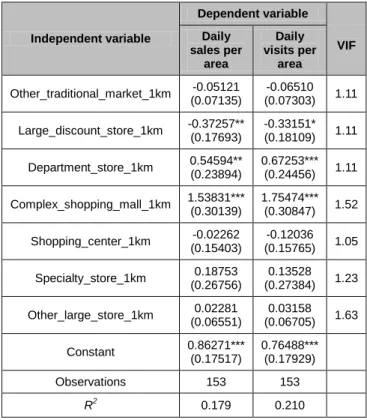
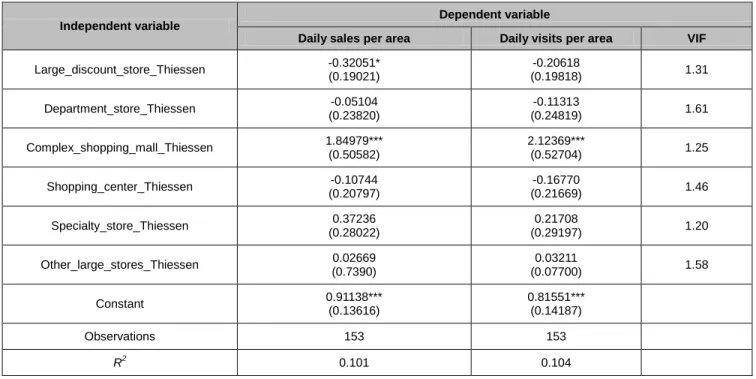
Purpose: This study aims to utilize geographic data to analyze how various retail formats of large-scale stores around the traditional market affect the performance of the traditional market in Seoul, Korea. Research design, data, and methodology: The two types of catchment areas were demarcated (circle of 1km radius and Thiessen polygon) for each traditional market, and the large-scale stores located within each catchment area were identified for 153 traditional markets in Seoul, Korea. Additionally, multiple regression analysis was utilized. Results: The results revealed that the influence on the performance of the traditional markets were different depending on the retail format of the large-scale stores. Large discount stores were found to have a negative effect on the sales and the visitors of traditional markets, whereas complex shopping malls and department stores had a positive effect on the traditional markets.
Conclusions: As a result of the differences in the retail format such as product categories and leisure functions, the impact of some large-scale stores on the traditional market may have a greater agglomeration effect than the consumer churn effect. Therefore, it is suggested that in the regulation of these large-scale stores, the differences in retail format should be considered for the future.
Keywords : Traditional Market, Large-Scale Stores, GIS Buffer and Overlay, Agglomeration Effect JEL Classification Code : L81, C81, R58
1. Introduction 12
There are various retail formats of retail stores located around a traditional market that can influence the market’s performance. Among the diverse retail stores, large discount stores and SSMs are the representative retailers that mainly influence the traditional market’s performance.
In recent years, instead of shrinking and reorganizing these
* This paper was supported by the Incheon National University Research Grant in 2016
1 First Author. Professor, Division of International Trade, Incheon National University, South Korea. Email: [email protected] 2 Corresponding Author, Professor, Division of International Trade,
Incheon National University, South Korea, Email: [email protected]
ⓒ Copyright: The Author(s)
This is an Open Access article distributed under the terms of the Creative Commons Attribution Non-Commercial License (http://Creativecommons.org/licenses/by-nc/4.0/) which permits unrestricted noncommercial use, distribution, and reproduction in any medium, provided the original work is properly cited.