• 검색 결과가 없습니다.

Development of Microsatellite Markers and their Use in Genetic Diversity and Population Analysis in Eleutherococcus senticosus

N/A
N/A
Protected

Academic year: 2021

Share "Development of Microsatellite Markers and their Use in Genetic Diversity and Population Analysis in Eleutherococcus senticosus"

Copied!
8
0
0

로드 중.... (전체 텍스트 보기)

전체 글

(1)

Introduction

Eleutherococcus senticosus, commonly known as “Siberian ginseng,” is distributed widely in northeast Asia, including in China, Japan, and Korea, where its shoots and roots have been used as traditional medicine. Various studies have searched for bioactive substances in this crop. Davydov and Krikorian (2000) reported on the use of E. senticosus as an adaptogen to relieve stress and fatigue. A crude E. senticosus extract has also been found to contain diverse bioactive compounds, such as phenolic compounds, polysaccharides, and lignans (Fang et al., 1985; Lee et al., 2004; Nishibe et al., 1990).

Molecular evaluation tools can provide information on genetic variation and population structure, which can then be applied to sustainable conservation and use strategies.

However, such tools are currently lacking for E. senticosus.

Therefore, it is necessary to identify polymorphisms at the molecular level in E. senticosus. Simple sequence repeats (SSRs, or microsatellites) are an effective molecular marker system by which to understand the genetic variation of germplasm with co-dominant, reproducible, polymorphic, and easily detectable characteristics (Ishii and McCouch, 2001). To use SSR markers in genetic studies, sequence information from regions flanking the SSR region is needed to design primer pairs. While extensive databases exist for many crops, the amount of useful data has been limited in E.

senticosus.

In a survey of the Web of Science (Institute of Scientific Information, Thomson Scientific) using the keywords

‘Eleutherococcus senticosus’ and ‘microsatellite,’ we found only one study (Kim and Chung, 2007) that isolated 239 new microsatellite-containing sequences. In this study, the distribution and variation in size of microsatellites within the DNA sequence of the E. senticosus genome were characterized.

Our goal was to develop new SSR markers to assess genetic

Development of Microsatellite Markers and their Use in Genetic Diversity and Population Analysis in Eleutherococcus senticosus

Kyung Jun Lee

1

, Yong-Jin An

2

, Jin-Kwan Ham

2

, Kyung-Ho Ma

1

, Jung-Ro Lee

1

, Yang-Hee Cho

1

and Gi-An Lee

1

*

1

National Agrobiodiversity Center, National Institute of Agricultural Sciences, RDA, Jeonju-Si 54874, Korea

2

Ginseng & Medicinal Herb Experiment Station, Chuncheon-si 24226, Korea

Abstract - Eleutherococcus senticosus (Siberian ginseng) is an important medicinal tree found in northeast Asia. In this study, we analyzed the genome-wide distribution of microsatellites in E. senticosus. By sequencing 711 clones from an SSR-enriched genomic DNA library, we obtained 12 polymorphic SSR markers, which also revealed successful amplicons in E. senticosus accessions. Using the developed SSR markers, we estimated genetic diversity and population structure among 131 E. senticosus accessions in Korea and China. The number of alleles ranged from 2 to 11, with an average of 7.4 alleles. The mean values of observed heterozygosity (H

O

) and expected heterozygosity (H

E

) were 0.59 and 0.56, respectively. The average polymorphism information content (PIC) was 0.51 in all 131 E. senticosus accessions. E.

senticosus accessions in Korea and China showed a close genetic similarity. Significantly low pairwise genetic divergence was observed between the two regions, suggesting a relatively narrow level of genetic basis among E. senticosus accessions.

Our results not only provide molecular tools for genetic studies in E. senticosus but are also helpful for conservation and E.

senticosus breeding programs.

Key words - Eleutherococcus senticosus, Genetic diversity, Population structure, SSR

*Corresponding author. E-mail : [email protected] Tel. +82-63-238-4873

ⓒ 2017 by The Plant Resources Society of Korea

Original Research Article

(2)

relationships among E. senticosus accessions in Korea and China. Our study not only provides a means of understanding the genetic relatedness and structure of E. senticosus accessions, but is also helpful for E. senticosus breeding and germplasm conservation.

Materials and Methods

Plant materials

The 131 E. senticosus accessions used in this study were obtained from the Korea Genebank Rural Development Administration. Of the 131 accessions, 97 were from Korea and 34 were from China. Leaf samples were randomly collected from the field. Genomic DNA was extracted from leaves using the modified CTAB method, and the final DNA concentration was adjusted to 20 ng/㎕ with a NanoDrop ND-1000 spectrometer (Wilmington, DE, USA).

Construction of an SSR motif-enriched library

A microsatellite-motif enrichment library was constructed using the modified biotin-streptavidin capture method with genomic DNA from E. senticosus (Ma et al., 2009). Briefly, genomic DNA was digested using six restriction enzymes, AluI, DraI, HaeIII, RsaI, EcoRV, and NruI. The digested DNA was size-fractionated on a 1.2% agarose gel and the fragments ranging from 300 bp to 1,500 bp were eluted from the gel. After adaptor ligation and PCR amplification, the DNA fragments were hybridized with a mixture of the following biotin-labeled SSR probes: (GA)

20

, (CA)

20

, (AT)

20

, (GC)

20

, (AGC)

15

, (GGC)

15

, (AAG)

15

, (AAC)

15

, and (AGG)

15

. The hybridized DNA fragments were captured with streptavidin- coated magnetic beads (Promega, Madison, WI, USA) and were cloned into the pGEM-T Easy vector (Promega). In total, 711 white colonies were randomly picked and sequenced in an ABI 3100 DNA sequencer (Applied Biosystems, Foster City, CA, USA), and SSR MANAGER was used to find SSR motifs and design primer pairs (Kim, 2004).

PCR amplification

The “M13 tail at its 5’ end” PCR method was used to measure the size of the PCR products (Schuelke, 2000). PCR amplification was carried out in a total volume of 20 ㎕

containing 2 ㎕ of genomic DNA (10 ng/㎕), 0.2 ㎕ of the specific primer (10 pmol/㎕), 0.4 ㎕ of M13 universal primer (10 pmol/ ㎕), 0.6 µl of normal reverse primer, 2.0 ㎕ of 10×

PCR buffer (Takara, Tokyo, Japan), 1.6 ㎕ of dNTPs (2.5 mM), and 0.2 ㎕ of Taq polymerase (5 unit/㎕; Takara). The conditions used for the PCR amplification were as follows:

94 ℃ (3 min), followed by 30–33 cycles at 94℃ (30 s), 50–5 5 ℃ (45 s), and 72℃ (45 s), then 15 cycles at 94℃ (30 s), 5 3℃ (45 s), and 72℃ (45 s), and a final extension at 72℃ for 20 min. PCR was carried out in PTC-220 thermocyclers (MJ Research, Waltham, MA, USA). The PCR products of three microsatellites were mixed together in a ratio of 6-FAM:

HEX:NED (fluorescent dyes) = 1:3:4, which was varied depending on the amplification intensity of the individual markers as determined on an ABI PRISM 3130xl Genetic Analyzer (Applied Biosystems). PCR products labeled with HEX and NED were added in higher amounts and those labeled with FAM were added in lower amounts because of the different signal intensities of the three fluorescent dyes.

The mixed PCR product (1.5 ㎕) was combined with 9.2 ㎕ of Hi-Di formamide and 0.3 ㎕ of an internal size standard, Genescan-500 ROX (6-carbon-X-rhodamine) as a molecular size standard (35–500 bp). The samples were denatured at 9 4 ℃ for 3 min and analyzed with an ABI PRISM 3130xl Genetic Analyzer (Applied Biosystems). The molecular weights, in base pairs, of the microsatellite products were estimated with Genescan software ver. 3.7 (Applied Bio- systems) using the local Southern method. Individual fragments were assigned as alleles of the appropriate microsatellite loci with Genotyper software ver. 3.7 (Applied Biosystems).

Analysis of genetic diversity

The total number of alleles, allele frequency, genetic

diversity, and polymorphism information content (PIC) per

individual SSR locus were calculated with PowerMarker

version 3.25 (Liu and Muse, 2005). An unweighted pair

group method with an arithmetic mean (UPGMA) dendrogram

was constructed to visualize the phylogenetic distribution of

accessions using MEGA version 5.03 software (Tamura et

al., 2007). Principal co-ordinate analysis (PCoA) in GenAlEx

6.5 was used to further examine the genetic relationships

among the detected populations on the basis of the SSR data

(3)

(Peakall and Smouse, 2012). STRUCTURE software (v 2.3.4) was used to detect possible subpopulations (K=1 to K=10) with a model allowing for admixture and correlated allele frequencies using a burn-in period of 50,000 and MCMC repeats of 50,000 followed by three iterations (Pritchard et al., 2000). The optimal number of populations corresponded to the highest peak in the ΔK graph and accessions with membership probabilities ≥ 70% were assigned to sub- populations (Evanno et al., 2005).

Results

Simple sequence repeats in the E. senticosus genome A total of 711 clones from an SSR-enriched genomic DNA library were sequenced, of which 47 clones (6.6%) were redundant. Of the 664 independent clones, 470 (70.8%) revealed

SSR motifs (Table 1). Di-nucleotide repeats (DNRs) were the most abundant, accounting for 64% of all SSRs (Table 1).

Tri-nucleotide repeats (TNRs), penta-nucleotide repeats (PNRs), and hexa-nucleotide repeats (HNRs) accounted for 35.3, 0.2, and 0.4% of all SSRs, respectively. Among the DNRs, TG/GT was the most abundant (39.2%), followed by AC/CA (25.9%) and AG/GA (20.6%). In contrast, AT/TA repeats were rather rare, only accounting for 2.7% of all DNRs. Of the TNRs, CAA/ACA/AAC was the most abundant (62.7%), followed by TTG/TGT/GTT (18.7%) and GAA/AGA/AAG (7.2%). GGGGA and GCACC and GGCGGA were the most abundant PNRs and HNRs, respectively. In addition, TG/GT was the most predominant motif overall, accounting for 25.1% of all SSRs.

Validation and polymorphism assessment of SSRs For the 470 unique SSR clones, we designed 190 primer pairs flanking SSR motifs; the others were incompatible with the primer design process. We finally acquired 12 polymorphic SSR markers in diverse E. senticosus accessions. The number of alleles for each SSR ranged from 2 to 13, with an average of 7.4 alleles per SSR (Table 2). To measure the infor- mativeness of these markers, the polymorphism information content (PIC) for each SSR locus was calculated. The PIC values varied from 0.22 to 0.77, with an average of 0.51 (Table 2). Based on the PIC value, GB-ES-146, GB-ES-175, and GB-ES-109 were the most informative, with values of 0.77, 0.75, and 0.73, respectively. The average number of effective alleles per SSR ranged from 1.29 to 5.03, with a mean of 2.77 alleles per SSR. The Shannon index ranged from 0.51 to 1.83, with an average of 1.14. The expected heterozygosity ranged from 0.23 for GB-ES-148 to 0.80 for GB-ES-146, with an average of 0.56. The observed hetero- zygosity varied from 0.15 for GB-ES-080 to 0.87 for GB-ES- 146, with a mean of 0.59.

Genetic structure and subdivision of E. senticosus between Korean and Chinese accessions

The number of alleles (Na) was 6.917 and 4.833 in Korean (KOR) and Chinese (CHN) accessions, respectively (Table 3). The Shannon indexes (I) of KOR and CHN were 1.138 and 1.030, respectively. The observed heterozygosity (Ho) Table. 1. Distribution of the major SSR motifs identified in E.

senticosus

Repeat unit Motif type No of clones Frequency (%)

Dimer AC/CA 78 16.6

TG/GT 118 25.1

AG/GA 62 13.2

TC/TC 35 7.4

AT/TA 8 1.7

Total 301 64.0

Trimer TTG/TGT/GTT 31 6.6

CAA/ACA/AAC 104 22.1

GGT/GTG/TGG 2 0.4

GAA/AGA/AAG 12 2.6

TTC/TCT/CTT 3 0.6

CCT/CTC/TCC 3 0.6

AGG/GAG/GGA 3 0.6

GCT/CTG/TGC 2 0.4

AGC/GCA/CAG 3 0.6

AAT/ATA/TAA 2 0.4

TGA/GAT/ATG 1 0.2

Total 166 35.3

Pentamer GGGGA 1 0.2

Total 1 0.2

Hexamer GCACCA 1 0.2

GGCGGA 1 0.2

  Total 2 0.4

(4)

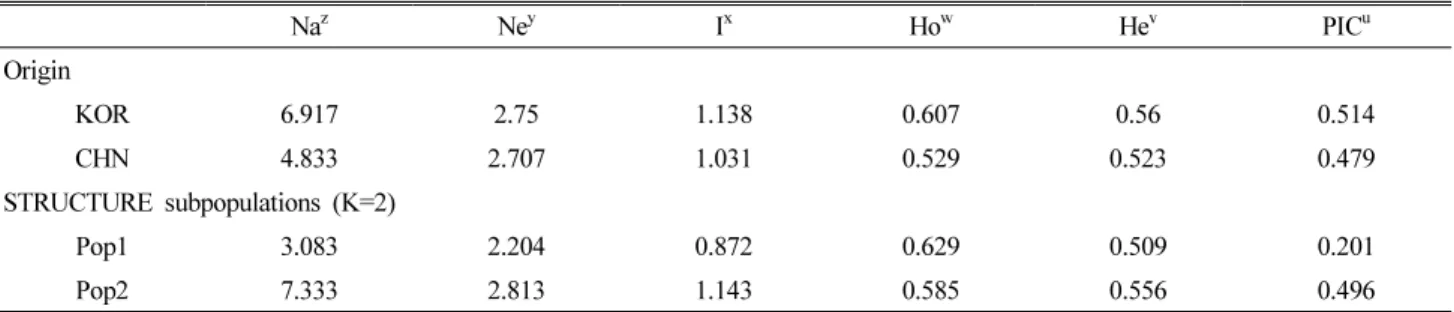
and expected heterozygosity (He) of KOR and CHN were 0.607 and 0.529 and 0.560 and 0.523, respectively. The PIC values of KOR and CHN were 0.514 and 0.479, respectively.

Between the two STRUCTURE subpopulations, all population

2 (Pop2) parameters were higher than those of population 1 (Pop1), except Ho. Analysis of molecular variance (AMOVA) showed that 1% of the observed variation was due to variation among populations (Table 4). Approximately 96% of the total Table 2. SSR markers assayed in the characterization of E. senticosus

Name R.motif Forward primer Reverse primer Na

z y

Ne

x

I

w

Ho

v

He PIC

u

GB-ES-025 (GT)13 GCAACTAAAGATGTTCAATCAA TAGAGCAGACAGAGTTTAGGGT 11 2.54 1.35 0.73 0.61 0.58 GB-ES-080 (AAC)4 GAGAAGAGGAATTTGAGTGAAG TTGTTGCTTCTGTTATTGTTGT 6 1.29 0.52 0.15 0.22 0.22 GB-ES-104 (TTC)9 GAGAGAGAAGGTAGAGATGGTG TCTTCTTTTACGTGGTGAAAAT 9 3.26 1.42 0.63 0.69 0.65 GB-ES-109 (GT)9,

(TC)13 AGAAGAGAAAAGAGAGTGTGGA GATAAGGTGAAGGGAGTGATAA 10 4.23 1.70 0.66 0.76 0.73 GB-ES-112 (TC)8 ATATAGGATAGGCATGACAAGG TCAATCGTAATGAAGACATGAT 2 1.40 0.46 0.18 0.28 0.24 GB-ES-133 (TGC)9 TGATGAACACTTGCATACAATA AAAGCTATGTTTCAGGGAAG 5 2.03 0.80 0.85 0.51 0.40 GB-ES-143 (GCA)6 GATGTGTTTGTGTTGGAAGTTA ATGGTATGAAAATGGAGTGATT 5 2.07 0.79 0.68 0.52 0.40 GB-ES-146 (TC)7,

(CA)16 TATATTTCAGGAAGAGGTATGC CCCATTTGATCTTATCTTCACT 13 5.03 1.83 0.87 0.80 0.77 GB-ES-148 (TC)19 ACTCTAATTGCTTCAACTCCAT GTCTTGTGTGTGATTCGTAAAG 4 1.31 0.51 0.21 0.23 0.22 GB-ES-161 (TG)13 CTTTCTGTTTGCTCACTCTGTA ATCTTTTCCAATTTCCTGACTA 9 3.28 1.51 0.68 0.70 0.66 GB-ES-175 (CT)13 TACCACATACTGCAGTCCTTTA TCAATAGAGTGGAAACATGAGA 11 4.61 1.80 0.76 0.78 0.75 GB-ES-181 (CA)11 AGTTGGCTACTAAACATTCCAT CTAATACCCAATAATGCCTAGC 4 2.25 0.95 0.65 0.56 0.47

Mean 7.4 2.77 1.14 0.59 0.56 0.51

z

Na, no. of alleles;

y

Ne, no. of effective alleles,

x

I, Shannon's information index,

w

Ho = observed heterozygosity,

v

He = expected heterozygosity;

u

PIC, polymorphism information content.

Table 3. Genetic diversity analyses of E. senticosus populations

  Na

z

Ne

y

I

x

Ho

w

He

v

PIC

u

Origin

KOR 6.917 2.75 1.138 0.607 0.56 0.514

CHN 4.833 2.707 1.031 0.529 0.523 0.479

STRUCTURE subpopulations (K=2)

Pop1 3.083 2.204 0.872 0.629 0.509 0.201

Pop2 7.333 2.813 1.143 0.585 0.556 0.496

z

Na, no. of alleles;

y

Ne, no. of effective alleles,

x

I, Shannon's information index,

w

Ho = observed heterozygosity,

v

He = expected heterozygosity;

u

PIC, polymorphism information content.

Table 4. Summary of analysis of molecular variance (AMOVA) results

Source df

z

SS

y

MS

x

Est. Var.

w

%

v

Fst

u

P value

Among Pops 1 8.645 8.645 0.050 1% 0.014 <0.01

Among Indiv 129 460.653 3.571 0.085 2%

Within Indiv 131 445.500 3.401 3.401 96%

Total 261 914.798   3.536 100%    

z
df, degrees of freedom,

y

SS, sum of squares,

x

MS, mean sum of squares,

w

Est. Var., estimate of variance,

v

%, percentage of total

variation;

u

Fst, genetic differentiation among populations.

(5)

genetic variance was explained by differences within individuals, with 2% of the variation being among individuals.

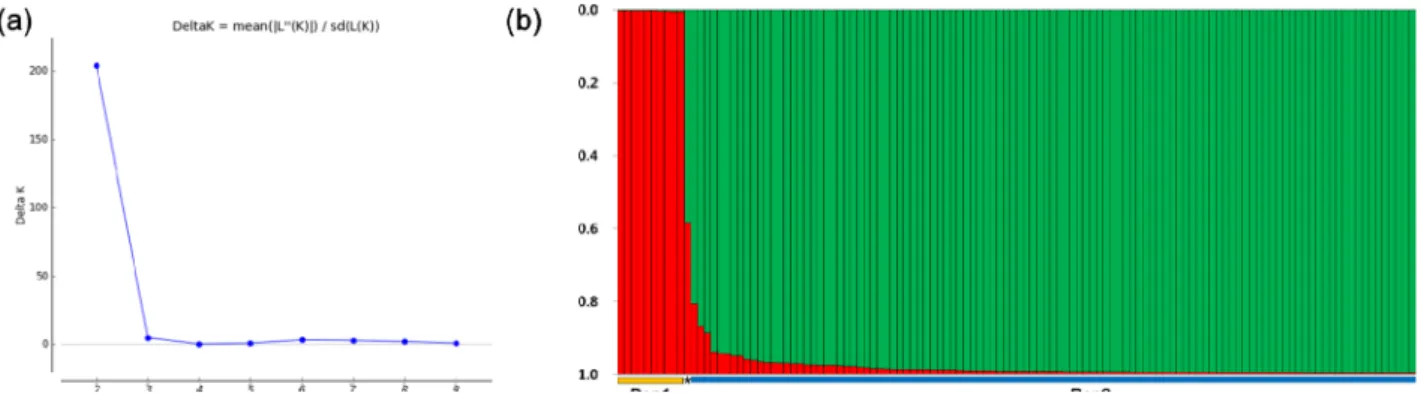
The inferred population structures are given in Fig 1. By comparing LnP(D) and Evanno’s ΔK values by increasing K from 1 to 10, we found that LnP(D) values increased with K, with the highest log likelihood score at K = 2, while the ΔK value was also the highest at K = 2 (Fig. 1a). No ΔK peak was evident at K > 3. This indicated that these 131 E. senticosus accessions fit into two genetic subpopulations. Pop1 had only 10 Korean accessions. Pop2 consisted of a total of 121 accessions, including 87 Korean accessions and 34 Chinese

accessions. Altogether, one admixture accession (with < 80%

of inferred ancestry from any one group), CWH0202, was identified in this population.

Cluster analysis using the unweighted pair group method with arithmetic mean (UPGMA) method detected two clusters (Fig. 2a.). Cluster 1 consisted of 15 accessions, including 12 Korean and 3 Chinese accessions. Cluster 2 was comprised of 85 Korean and 31 Chinese accessions. Upon labelling the accessions according to their inferred STUCTURE ancestry, we did not find exact matches between the results of UPGMA cluster and STRUCTURE analysis. However, the PCoA Fig. 1. Population genetic structures and relationships between 131 E. senticosus accessions (a) Values of ΔK, with its modal value detecting a true K of two groups (K = 2) (b) The two subgroups inferred from STRUCTURE analysis.

Fig. 2. Genetic grouping of 131 E. senticosus accessions (a) Clustering analysis using unweighted pair group method with arithmetic

mean (UPGMA) and (b) principal coordinate analysis. In both (a and b), the accessions have been color coded: red, Korean; blue,

Chinese.

(6)

results were consistent with the STRUCTURE results (Fig.

2b). In PCoA, the first two coordinates clearly divided the two STRUCTURE subpopulations.

Discussion

Genome-wide analysis of microsatellites is an efficient way to develop molecular markers for genetic and evolutionary studies and may provide a clue to understanding the possible roles of SSRs in genome organization and gene regulation (Ogutu et al., 2016). In this study, we analyzed the distribution of microsatellites with 2-6 bp motifs and provided 190 SSR markers for E. senticosus. Only 12 of these 190 SSRs (6.3%) produced polymorphic patterns among E. senticosus accessions.

This result is lower than that seen in other species, such as common buckwheat (26.7%) (Konishi et al., 2006), Humulus lupulus (41.7%) (Stajner et al., 2005), foxtail millet (9.8%) (Ali et al., 2016), and Acacia mangium (40.7%) (Butcher et al., 2000). The few SSR markers developed in this study are the first reported in E. senticosus.

The simple repeat unit of the most abundant SSRs varies among plant species. For example, di-nucleotide repeats represent the most abundant SSRs in the apple genome (Zhang et al., 2012), whereas tri-nucleotide repeats are the most prevalent type of SSRs in Arabidopsis, sorghum, rice, and soybean, and tetra-nucleotide repeats are the most prevalent in grapevine, poplar, and Coffea canephora (Cavagnaro et al., 2010; Ogutu et al., 2016). In this study, di-nucleotide repeats were found to be the most abundant, with a frequency of 64%

of the total SSRs identified in the E. senticosus genome. This finding is similar to that of a previous study, which isolated an abundance of di-nucleotide repeats (55.2%) in Acanthopanax senticosus. In addition, microsatellites in E. senticosus exhibited a TG/GT preference; this is different from previous findings in other species, which showed that AT-rich SSRs are predominant in dicots, such as Arabidopsis (Tamanna and Khan, 2005), apple (Zhang et al., 2012), soybean (Shultz et al., 2007), papaya (Lai et al., 2006), and cucumber (Cavagnaro et al., 2010).

In our study, the number of alleles (Na) of KOR and CHN accessions was 6.917 and 4.833, respectively (Table 3).

These values were lower than other reported studies such as

aspen demes (Populus tremula and P. tremuloides, Na=14.6, Zhang et al., 2015), and cranberry (Vaccinium macrocarpon and V. oxycoccos, Na=9.82, Zalapa et al., 2015). Although the number of alleles was strongly correlated with the number of accessions (Cui et al., 2010), it seemed that lower Na and genetic diversity in the KOR and CHN accessions of E.

senticosus was due to their clonal nature. Generally, clonal plants have been considered low in genetic diversity at the population and species level principally due to their clonal reproduction (Zalapa et al., 2015). Moreover, E. senticosus has also been grown vegetatively through rhizomes, with rare sexual reproduction resulting from infrequent flowering (Hong and Lee, 2015).

Korean populations had slightly higher PIC values than did Chinese populations in this study (Table 3). Wang et al.

(2016) reported that E. senticosus had a considerable level of genetic diversity and that more genetic diversity was found in E. senticosus populations from the Changbai Mountains than from northern China. Also, they suggested that the Korean Peninsula and the Bo Sea are potential routes of diffusion of E. senticosus into China, although they did not analyze Korean E. senticosus accessions. Our results agree with and support their suggestions. It seems that the major area in which E. senticosus originated in China is in the northeastern part of the country and that some sources diffused into China via the Korean peninsula. This hypothesis is also consistent with the results of the STRUCTURE analysis. The STRUCTURE analysis in this study identified two populations (K=2) given all accessions, with one exclusively from KOR (Pop1) and the other including all accessions from CHN and 87 accessions from KOR (Fig. 1). The pairwise Fst analysis revealed a low divergence between KOR and CHN accessions (0.014). We suggest that founder/bottleneck effects could account for the observed patterns of distribution. Thus, further analysis of the genetic diversity or variation among E. senticosus accessions is required because no other studies on this topic have been undertaken.

In summary, our study characterized the distribution of

microsatellites in the E. senticosus gemome. High micro-

satellite density was found in the genome, with di-nucleotides

being the most abundant SSRs. TG/GT-rich motifs are

dominant across all SSR repeat units, while AT/TA-rich

(7)

motifs are rare. This study provides important new SSR markers and reveals the population genetic structure of 131 E.

senticosus accessions collected from KOR and CHN. These results will be helpful for the evaluation of germplasm resources for breeding.

Acknowledgment

This work was carried out with the support of “Research Program for Agricultural Science & Technology Development (Project No. PJ012580)”, National Institute of Agricultural Sciences, Rural Development Administration, Republic of Korea.

References

Ali, A., Y.-M. Choi, D.Y. Hyun, S. Lee, S. Oh, H.-J. Park, Y.-H. Cho and M.C. Lee. 2016. EST-SSR based genetic diversity and population structure among Korean landraces of foxtail millet (Setaria italica L.). Korean J. Plant Res.

29:322-330.

Butcher, P.A., S. Decroocq, Y. Gray and G.F. Moran. 2000.

Development, inheritance and cross-species amplification of microsatellite markers from Acacia mangium. Theor. Appl.

Genet. 101:1282-1290.

Cavagnaro, P.F., D.A. Senalik, L.M. Yang, P.W. Simon, T.T.

Harkins, C.D. Kodira, S.W. Huang and Y.Q. Weng. 2010.

Genome-wide characterization of simple sequence repeats in cucumber (Cucumis sativus L.). BMC Genomics 11:569.

Cui H., K.T. Moe, J.W. Chung, Y.I. Cho, G.A. Lee and Y..J.

Park. 2010. Genetic diversity and population structure of rice accessions from South Asia using SSR markers. Korean J. Breed. Sci. 42:11-22.

Davydov, M. and A.D. Krikorian. 2000. Eleutherococcus senticosus (Rupr. & Maxim.) Maxim.(Araliaceae) as an adaptogen: a closer look. J. Ethnopharmacol. 72:345-393.

Evanno, G., S. Regnaut and J. Goudet. 2005. Detecting the number of clusters of individuals using the software STRUCTURE: a simulation study. Mol. Ecol. 14:2611-2620.

Fang, J.N., A. Proksch and H. Wagner. 1985. Immunologically active polysaccharides of Acanthopanax senticosus. Phyto- chemistry 24:2619-2622.

Hong, K.N. and J. W. Lee. 2015. Fine-scale spatial genetic and

clonal structure of Eleutherococcus senticosus populations in South Korea. Forest Sci. Technol. 11: 160-165.

Ishii, T., Y. Xu and S.R. McCouch. 2001. Nuclear-and chloroplast- microsatellite variation in A-genome species of rice. Genome 44:658-666.

Kim, J. and K.W. Chung. 2007. Isolation of new microsatellite- containing sequences in Acanthopanax senticosus. J. Plant Biol. 50:557-561.

Kim, K.Y. 2004. Developing one step program (SSR Manager) for rapid identification of clones with SSRs and primer designing. Department of Plant Science, MS. Thesis, Seoul National Univ., Korea.

Konishi, T., H. Iwata, K. Yashiro, Y. Tsumura, R. Ohsawa, Y.

Yasui and O. Ohnishi. 2006. Development and characterization of microsatellite markers for common buckwheat. Breed.

Sci. 56:277-285.

Lai, C.W.J., Q.Y. Yu, S.B. Hou, R.L. Skelton, M.R. Jones, K.L.T. Lewis, J. Murray, M. Eustice, P.Z. Guan, R.

Agbayani, P.H. Moore, R. Ming and G.G. Presting. 2006.

Analysis of papaya BAC end sequences reveals first insights into the organization of a fruit tree genome. Mol. Genet.

Genomics 276:1-12.

Lee, S., D. Son, J. Ryu, Y.S. Lee, S.H. Jung, J. Kang, S.Y. Lee, H.S. Kim and K.H. Shin. 2004. Anti-oxidant activities of Acanthopanax senticosus stems and their lignan components.

Arch. Pharm. Res. 27:106-110.

Liu, K.J. and S.V. Muse. 2005. PowerMarker: an integrated analysis environment for genetic marker analysis. Bio- informatics 21:2128-2129.

Ma, K.H., N.S. Kim, G.A. Lee, S.Y. Lee, J.K. Lee, J.Y. Yi, Y.J.

Park, T.S. Kim, J.G. Gwag and S.J. Kwon. 2009. Development of SSR markers for studies of diversity in the genus Fagopyrum. Theor. Appl. Genet. 119:1247-1254.

Nishibe, S., H. Kinoshita, H. Takeda and G. Okano. 1990.

Phenolic compounds from stem bark of Acanthopanax senticosus and their pharmacological effect in chronic swimming stressed rats. Chem. Pharm. Bull. 38:1763.

Ogutu, C., T. Fang, L. Yan, L. Wang, L.F. Huang, X.Y. Wang, B.Q. Ma, X.B. Deng, A. Owiti, A. Nyende and Y.P. Han.

2016. Characterization and utilization of microsatellites in the Coffea canephora genome to assess genetic association between wild species in Kenya and cultivated coffee. Tree Genet. Genomes. 12.

Peakall, R. and P.E. Smouse. 2012. GenAlEx 6.5: genetic

analysis in Excel. Population genetic software for teaching

(8)

and research-an update. Bioinformatics 28:2537-2539.

Pritchard, J.K., M. Stephens and P. Donnelly. 2000. Inference of population structure using multilocus genotype data.

Genetics 155:945-959.

Schuelke, M. 2000. An economic method for the fluorescent labeling of PCR fragments. Nature Biotechnol. 18:233-234.

Shultz, J.L., S. Kazi, R. Bashir, J.A. Afzal and D.A. Lightfoot.

2007. The development of BAC-end sequence-based micro- satellite markers and placement in the physical and genetic maps of soybean. Theor. Appl. Genet. 114:1081-1090.

Stajner, N., J. Jakse, P. Kozjak and B. Javornik. 2005. The isolation and characterisation of microsatellites in hop (Humulus lupulus L.). Plant Sci. 168:213-221.

Tamanna, A. and A.U. Khan. 2005. Mapping and analysis of Simple Sequence Repeats in the Arabidopsis thaliana Genome. Bioinformation 1:64-68.

Tamura, K., J. Dudley, M. Nei and S. Kumar. 2007. MEGA4:

Molecular evolutionary genetics analysis (MEGA) software version 4.0. Mol. Biol. Evol. 24:1596-1599.

Wang, S.H., L. Bao, T.M. Wang, H.F. Wang and J.P. Ge. 2016.

Contrasting genetic patterns between two coexisting Eleutherococcus species in northern China. Ecol. Evol.

6:3311-3324.

Zalapa, J.E., T.C. Bougie, T.A. Bougie, B.J. Schlautman, E.

Wiesman, A. Guzman, S. Steffan and T. Smith. 2015. Clonal diversity and genetic differentiation revealed by SSR markers in wild Vaccinium macrocarpon and Vaccinium oxycoccos. Ann. Appl. Biol. 166:196-207.

Zhang, C.Z., B. Vornam, K. Volmer, K. Prinz, F. Kleemann, L.

Kohler, A. Polle and R. Finkeldey. 2015. Genetic diversity in aspen and its relation to arthropod abundance. Front. Plant Sci. 5:806.

Zhang, Q., B.Q. Ma, H. Li, Y.S. Chang, Y.Y. Han, J. Li, G.C.

Wei, S. Zhao, M.A. Khan, Y. Zhou, C. Gu, X.Z. Zhang, Z.H.

Han, S.S. Korban, S.H. Li and Y.P. Han. 2012. Identification, characterization, and utilization of genome-wide simple sequence repeats to identify a QTL for acidity in apple. BMC Genomics 13:537.

(Received 27 March 2017 ; Revised 28 April 2017 ; Accepted 4 May 2017)

수치

Table 4. Summary of analysis of molecular variance (AMOVA) results
Fig. 2. Genetic grouping of 131  E. senticosus accessions (a) Clustering analysis using unweighted pair group method with arithmetic  mean (UPGMA) and (b) principal coordinate analysis

참조

관련 문서

This study was conducted to evaluate genetic diversity and population structure of 179 Korean rice varieties bred by the National Institute of Crop Science,

Genetic Diversity Analysis of Sogatella furcifera (Horváth) (Hemiptera: Delphacidae) by Using Novel

Several previous studies reported higher F ST values (0.15 Table 4. Analysis of molecular variance calculated based on the allelic distance matrix of F ST statistics

Assessment of genetic diversity and phylogenetic relationships of Korean native chicken breeds using microsatellite markers. Fathi M, El­Zarei M, Al­Homidan I,

YSO: Yeonsan Ogye, ARO: Animal Genetic Resources Research Center Ogye, CBO: Chungbuk Ogye, CNO: Chungnam Ogye, GBO: Gyengbuk Ogye, SUO: Seoul National

ABSTRACT: This study employed inter-simple-sequence repeat (ISSR) to assess genetic variation among 189 indi- viduals representing 10 populations (nine in Korea and one in Japan)

Genetic relationships among 11 peony species analyzed using 24 random RAPD primers showed highly reproducible, polymorphic RAPD fingerprints for discrimination of genetic

Genetic Diversity and Relationship Analysis of Taraxacum officinale Weber and Taraxacum coreanum Nakai Accessions Based on Inter-Simple Sequence