Kor. J. Hort. Sci. Technol. 31(3):337-343, 2013 DOI http://dx.doi.org/10.7235/hort.2013.12204
SRAP과 SSR 마커를 이용한 국내 육성 팔레놉시스 품종의 유전적 다양성 분석과 품종판별
박부희1*ㆍ박용진2ㆍ김미선1ㆍ이영란1ㆍ박필만1ㆍ이동수1ㆍ예병우1
1국립원예특작과학원 화훼과, 2공주대학교 산업과학대학 식물자원학과
Analysis of Genetic Diversity and Identification of Domestic Bred Phalaenopsis Varieties Using SRAP and SSR Markers
Pue Hee Park1*, Yong-Jin Park2, Mi Seon Kim1, Young Ran Lee1, Pil Man Park1, Dong Soo Lee1, and Byeong Woo Yae1
1Floriculture Research Division, National Institute of Horticultural & Herbal Science, Rural Development Administration, Suwon 441-440, Korea
2Department of Plant Resources, College of Industrial Science, Kongju National University, Yesan 340-702, Korea
Abstract. The aims of this study were to compare genetic distances among 14 Phalaenopsis varieties using simple sequence repeat (SSR) and sequence-related amplified polymorphism (SRAP) marker systems and to determine the discrimination using SSR. A total of 111 SSR primers and 30 SRAP combinations were initially screened. Twelve SSR primers and thirty SRAP combinations showed high polymorphism among the 14 Phalaenopsis varieties including domestic breeding varieties, conserved in National Institute of Horticultural
& Herbal Science (NIHHS). The amplified DNA fragments were separated by denaturing acrylamide gels and detected by silver staining method. A total of 474 polymorphic bands, including 55 by SSRs and 419 by SRAPs, were identified and used for genetic diversity analysis. Polymorphic bands were scored for calculating a simple matching coefficient of genetic similarity and cluster analysis with multi-variate statistical package (MVSP) 3.1. Fourteen Phalaenopsis varieties were classified into three major groups at similarity coefficient value of 0.683 and 0.66 using SRAP and SSR, respectively. Also we could discriminate these domestic breeding Palaenopsis varieties using only SSR 20 and SSR 22. The results indicate that SSR analysis is effective for discrimination among Phalaenopsis varieties and SRAP is useful for genetic diversity when there is no sequence information. These studied SSR and SRAP markers will be useful tools for genotype identification, germplasm conservation and genetic relationship study in Phalaenopsis.
Additional key words: discrimination, genotype, orchid, polymorphism, similarity
*Corresponding author: [email protected]
※ Received 6 November 2012; Revised 24 January 2013; Accepted 8 February 2013.
서 언
난은 생산액이 805억(’11년)으로 화훼류에서 비중이 높 은 작물이며, 2010년 약 2천만불 이상을 수출한 수출효자 작목이다. 대부분은 중국으로 수출하는 심비디움으로 중국 구정인 춘절에 맞추어 수출하고 있다. 하지만 종묘의 해외 의존도가 매우 높아 농가의 로열티 부담을 경감하기 위해 우수한 국산품종의 육성과 보급이 시급한 실정이다. 팔레놉 시스의 경우 대만이 국가주도적으로 산업을 육성하여 해마
다 100여 품종 이상의 신품종을 육성하고 있다. 국내 팔레놉 시스 육종은 1993년 국가기관 주도로 2002년 ‘Yellow Star’
육성을 시작으로 2011년까지 국립원예특작과학원에서 17 품종이 개발되었고, 경상남도농업기술원, 경기도농업기술 원 및 민간에서도 육종사업을 진행 중이다.
난 육종에 있어서 품종의 유전적 다양성 및 체계적 분류 가 중요한데 예전엔 난의 잎, 꽃, 벌브 등과 같은 형태적 형 질을 근거로 하는 방법을 이용하여 왔다. 하지만 이 같은 형 태적 형질은 유전적으로 가까운 품종들을 구별해 내기가 어
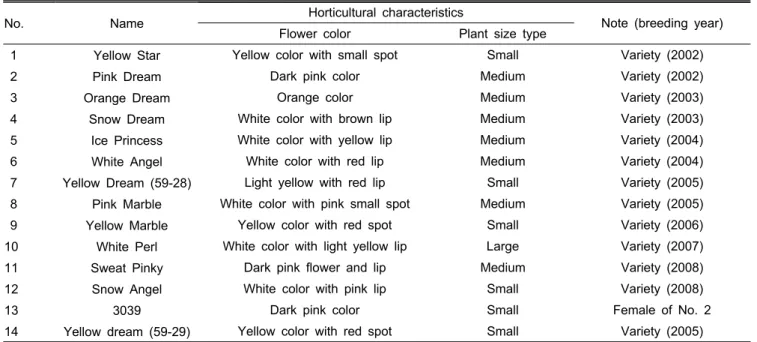
Table 1. List of 14 Phalaenopsis varieties used for SSR and SRAP analysis.
No. Name Horticultural characteristics
Note (breeding year) Flower color Plant size type
1 Yellow Star Yellow color with small spot Small Variety (2002)
2 Pink Dream Dark pink color Medium Variety (2002)
3 Orange Dream Orange color Medium Variety (2003)
4 Snow Dream White color with brown lip Medium Variety (2003)
5 Ice Princess White color with yellow lip Medium Variety (2004)
6 White Angel White color with red lip Medium Variety (2004)
7 Yellow Dream (59-28) Light yellow with red lip Small Variety (2005) 8 Pink Marble White color with pink small spot Medium Variety (2005)
9 Yellow Marble Yellow color with red spot Small Variety (2006)
10 White Perl White color with light yellow lip Large Variety (2007)
11 Sweat Pinky Dark pink flower and lip Medium Variety (2008)
12 Snow Angel White color with pink lip Small Variety (2008)
13 3039 Dark pink color Small Female of No. 2
14 Yellow dream (59-29) Yellow color with red spot Small Variety (2005)
렵고, 재배방법 및 환경의 영향을 많이 받는다. 그 이후 isozyme을 이용하는 방법(ObaraOkeyo and Kako, 1997) 이 보고되었으나 이는 isozyme의 수가 극히 제한적인 단점 이 있다. 최근 분자유전학적인 수준에서 random amplified polymorphic DNA(RAPD)(Choi et al., 2006; Goh et al., 2005; Niknejad et al., 2009; Obara-Okeyo and Kako, 1998;
Park et al., 2010), amplified fragment length polymorphism (AFLP)(Chang et al., 2009), simple sequence repeat(SSR) (Huang et al., 2010; Moe et al., 2010; Rodrigues and Kumar, 2009; Wang et al., 2009), cleavage amplified polymorphic sequence(CAPS)(Ok et al., 2004)와 같은 다양한 DNA marker 들을 이용하여 유전적 다양성을 분석하였다. RAPD의 경우 에는 다형성이 많고 비교적 쉬운 방법이지만 재현성이 낮은 단점이 있고, AFLP는 RAPD보다 재현성은 높지만 실험방 법이 다소 까다롭다. SSR의 경우에는 재현성도 높고 공우성 마커로서 안정성이 높지만, 팔레놉시스의 경우 알려진 SSR 마커가 그리 많지 않다. 최근 품종 보호가 강화되면서 원예 작물에 있어 국내 육성 품종의 보호측면에 품종판별의 수단 으로 SSR 마커를 많이 활용하고 있다(Jang et al., 2009;
Neto et al., 2008; Sun et al., 2009). 반면 sequence-related amplified polymorphism(SRAP)은 open reading frames(ORFs) 부분을 증폭하도록 디자인된 분자표지로서 exon을 이용해 먼저 forward primer가 디자인되고, intron과 promoter부분을 reverse primer가 증폭하여서 이들의 길이를 바탕으로 다 형성을 많이 획득할 수 있다. SRAP 마커는 처음 Brassica 작물에서 개발되었으며(Li and Quiros, 2001), 가지(Li et al., 2010), 파(Li et al., 2008), 완두(Esposito et al., 2007), 복숭
아(Ahmad et al., 2004), 국화(Zhang et al., 2011)등 다양한 작물에 이용되었지만, 난 특히 팔레놉시스 작물에서의 SRAP 표지 연구는 적용된 바가 거의 없는 실정이다(Cai et al., 2011; Ding et al., 2008; Lu et al., 2011).
팔레놉시스 속은 특성상 그 분포가 매우 광범위하고 다양 하여 다른 식물에 비해 분류에 대한 연구가 극히 미흡하다.
교잡을 통해 다양한 품종들을 육성하여 왔는데 오랜 시간을 통해 육성해 온 우리 국내 육성 품종의 분류에 대한 연구는 아직 보고된 바가 없다. 따라서 본 연구에서는 2002년부터 2009년까지 육성되어 품종 보호 등록이 완료된 국내 육성 품종 팔레놉시스 13품종과 그들의 양친으로 사용된 도입 품 종 1종의 유전자원을 대상으로 다형성과 재현성이 높은 SRAP 표지를 이용하여 이들의 유연관계 분석함으로써 유전적 다 양성을 평가하고 난 육종연구의 기초 자료로 활용하고자 하 였다. 또한 오랜 기간 동안 육성해 온 팔레놉시스를 구분할 수 있는 SSR 마커를 선별함으로써 국내 육성 품종 보호를 위한 뒷받침 자료로 사용하고자 수행하였다.
재료 및 방법
식물재료
본 연구에 사용한 재료는 농촌진흥청 국립원예특작과학 원 육성 품종인 팔레놉시스 13품종과 유전자원 1종류를 이 용하였다. 2002년부터 육성하기 시작하여 2009년까지 13품 종을 개발하였으며 이들의 양친 즉 교배 모・부본으로 사용 된 도입 유전자원도 함께 이용하였다(Table 1). 각 식물체는 국립원예특작과학원 팔레놉시스 육종온실에서 수태를 식재
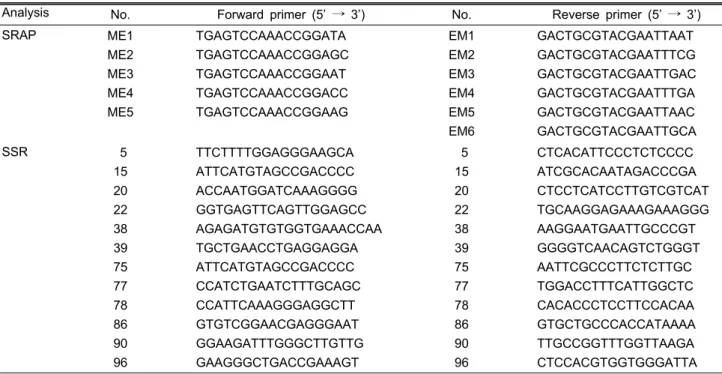
Table 2. Sequence information of the 11 SRAP primers and 12 SSR primers used this study.
Analysis No. Forward primer (5’ → 3’) No. Reverse primer (5’ → 3’)
SRAP ME1
ME2 ME3 ME4 ME5
TGAGTCCAAACCGGATA TGAGTCCAAACCGGAGC TGAGTCCAAACCGGAAT TGAGTCCAAACCGGACC TGAGTCCAAACCGGAAG
EM1 EM2 EM3 EM4 EM5 EM6
GACTGCGTACGAATTAAT GACTGCGTACGAATTTCG GACTGCGTACGAATTGAC GACTGCGTACGAATTTGA GACTGCGTACGAATTAAC GACTGCGTACGAATTGCA
SSR 5
15 20 22 38 39 75 77 78 86 90 96
TTCTTTTGGAGGGAAGCA ATTCATGTAGCCGACCCC ACCAATGGATCAAAGGGG GGTGAGTTCAGTTGGAGCC AGAGATGTGTGGTGAAACCAA TGCTGAACCTGAGGAGGA ATTCATGTAGCCGACCCC CCATCTGAATCTTTGCAGC CCATTCAAAGGGAGGCTT GTGTCGGAACGAGGGAAT GGAAGATTTGGGCTTGTTG GAAGGGCTGACCGAAAGT
5 15 20 22 38 39 75 77 78 86 90 96
CTCACATTCCCTCTCCCC ATCGCACAATAGACCCGA CTCCTCATCCTTGTCGTCAT TGCAAGGAGAAAGAAAGGG AAGGAATGAATTGCCCGT GGGGTCAACAGTCTGGGT AATTCGCCCTTCTCTTGC TGGACCTTTCATTGGCTC CACACCCTCCTTCCACAA GTGCTGCCCACCATAAAA TTGCCGGTTTGGTTAAGA CTCCACGTGGTGGGATTA
Table 3. The polymorphic bands generated by SSR and SRAP analysis.
Total polymorphic bands
Polymorphic bands by SSR
Polymorphic bands by SRAP
474 55 419
재료로 하여 겨울철 23-25°C 이상을 유지시키면서 재배하 였고, 자연 저온 감응 후 개화를 유도하였다.
DNA 추출
팔레놉시스 잎을 액체질소를 이용하여 마쇄하고 CTAB 방법 을 약간 변형하여 DNA를 추출하였다(Murray and Thompson, 1980). 추출한 DNA는 0.8%의 agarose gel 상에 전기영동하여 확인하였고 DNA 순도 및 정량은 NanoDrop spectrophotometer (Thermo Scientific, USA)로 정량한 후 10ng・μL-1의 농도로 희석하여 분석에 이용하였다.
SRAP 분석
SRAP 분석은 기존에 보고된 방법(Li and Quiros, 2001) 을 바탕으로 수행하였다. 즉 5개의 forward primer와 6개의 reverse primer를 조합하여 30개의 서로 다른 primer 조합을 만들어 이용하였다(Table 2). PCR 반응 조성액은 40ng의 template DNA, 10X Buffer(Genetbio, Korea), 5pmol의 primer, 200μM의 dNTP(Genetbio, Korea), 1mM MgCl2(Promega, USA)와 0.32units Taq DNA polymerase(Genetbio, Korea) 를 첨가하여, 반응액을 12.5μL로 조정하여 사용하였다. PCR 증폭반응은 thermal cycler(Applied Biosystems, USA)를 이 용하여 다음과 같은 프로그램으로 수행하였다. 94°C에서 10분 denaturation 후, 94°C에서 1분, 35°C에서 1분, 72°C에 서 1분을 5회 수행 후 다시 94°C에서 1분, 50°C에서 1분, 72°C에서 1분을 35회 반복 수행하였다. 마지막으로 72°C에
서 10분간 extension을 수행하였다. 증폭된 PCR 산물은 6%
polyacrylamide gel상에서 전기영동하여 silver staining 후 분석하였다.
SSR 분석
수집SSR 마커 111개 중에 다형성 있는 SSR Primer 12개 선별하여 PCR 하였다(Table 3). PCR 반응 조성액은 40ng의 template DNA, 10X Buffer(Genetbio, Korea), 5pmol의 primer, 200μM의 dNTP(Genetbio, Korea), 1mM MgCl2(Promega, USA)와 0.32units Taq DNA polymerase(Genetbio, Korea) 를 첨가하여, 반응액을 12.5μL로 조정하여 사용하였다. PCR 증폭반응은 thermal cycler(Applied Biosystems, USA)를 이 용하여 다음과 같은 프로그램으로 수행하였다. 94°C에서 10 분 denaturation 후, 94°C에서 30초, 59°C에서 30초, 72°C에 서 1분 30초를 30회 수행 후 마지막으로 72°C에서 10분간 extension을 수행하였다. 증폭된 PCR 산물은 6% polyacrylamide gel상에서 전기영동하여 silver staining 후 분석하였다 유연관계 분석
SRAP과 SSR 분석으로 다형성 분석으로 증폭된 밴드의 유
M 1 2 3 4 5 6 7 8 9 10 11 12 13 14
Fig. 1. SRAP band pattern produced by ‘ME3 × EM5’ primer in Phalaenopsis varieties. M, 100 bp DNA ladder. Marker size is 300 bp. Numbers refer to the listed in Table 1.
1 2 3 4 5 6 7 8 9 10 11 12 13 14 M
Fig. 2. SSR band pattern produced by SSR 20 primer in Phalaenopsis varieties. M, 100 bp DNA ladder. Marker size is 300 bp. Numbers refer to the listed in Table 1.
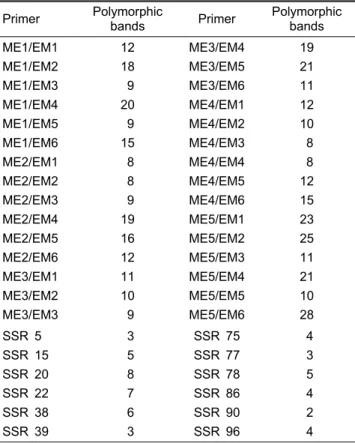
Table 4. The polymorphic bands generated by SRAP and SSR analysis.
Primer Polymorphic
bands Primer Polymorphic bands ME1/EM1
ME1/EM2 ME1/EM3 ME1/EM4 ME1/EM5 ME1/EM6 ME2/EM1 ME2/EM2 ME2/EM3 ME2/EM4 ME2/EM5 ME2/EM6 ME3/EM1 ME3/EM2 ME3/EM3
12 18 9 20 9 15 8 8 9 19 16 12 11 10 9
ME3/EM4 ME3/EM5 ME3/EM6 ME4/EM1 ME4/EM2 ME4/EM3 ME4/EM4 ME4/EM5 ME4/EM6 ME5/EM1 ME5/EM2 ME5/EM3 ME5/EM4 ME5/EM5 ME5/EM6
19 21 11 12 10 8 8 12 15 23 25 11 21 10 28 SSR 5
SSR 15 SSR 20 SSR 22 SSR 38 SSR 39
3 5 8 7 6 3
SSR 75 SSR 77 SSR 78 SSR 86 SSR 90 SSR 96
4 3 5 4 2 4
무에 따라 1과 0으로 기록하였고 MVSP(Multi-Variate Statical Package) ver 3.13(Kovach computing services) 통계 프로그 램을 이용하여 국내 육성 팔레놉시스 품종 간의 유연관계를 추정하였다. Simple matching coefficient에 의해 유전적 유 사도 값을 계산하고 이 값을 기초로 하여 비가중 평균결합 (UPGMA: unweighted pair-group method with arithmetic averages)법으로 집괴 분석하여 dendrogram을 작성하였다.
결과 및 고찰
SRAP과 SSR을 이용한 다형성 분석
본 연구에서는 30개 조합의 SRAP primer 조합(Table 2) 을 스크리닝한 결과 모든 조합에서 다형성이 나타나 팔레놉 시스 14품종들에게 적용하였다. Fig. 1은 ME3/EM5 primer를 이용한 PCR 증폭 양상을 나타낸 것이다. 팔레놉시스의 SRAP 분석에서 30조합의 primer로부터 총 419개의 다형성 밴드를 획득하였다. Primer당 최소 8개에서 최고 28개의 높 은 다형성을 획득할 수 있었으며 Primer당 평균 14개 정도 의 다형성을 보였다(Table 4). 다형성밴드의 분포 범위는 약 200bp에서 1kb로 다양하게 분포하였다(Fig. 1).
Obara-Okeyo and Kako(1998)는 15개의 RAPD primer 를 이용하여 총 132개의 다형성 밴드를 획득, 서양 심비디움
36품종의 유전적 다양성을 보고한 바 있고, Park et al.(2010) 은 RAPD와 Universal Rice Primer(URP)를 함께 보완하여 심비디움 유전자원에 대한 다양성을 분석한 바 있다. 심비 디움 유연관계 분석한 논문을 살펴보면 RAPD와 URP에서 각각 primer당 평균 9.9와 9.5개의 다형성 밴드를 획득하였 는데, 이는 많은 primer를 이용하여 다형성이 높은 primer만 선별하였고, 동양 심비디움과 서양 심비디움, 교잡종 등 심 비디움 속 내에서도 근연거리가 먼 식물재료를 이용하였기 때문이라고 보고하였다(Park et al., 2010). SRAP 을 적용한 타 작물과 비교해보면, 중국 재배삼의 SRAP 분석에서 primer 당 평균 21.75개의 밴드수를 확보하였다(Xu et al., 2010).
국내 육성 심비디움 품종의 경우 primer당 평균 7개의 다형 성을 보였고 총 196개의 다형성 밴드를 획득하였다(Park et al., 2011). 이렇듯 SRAP 표지의 경우 타 표지보다 다형성의 획득수가 많은 편이지만, 원연관계가 있는 다양한 종이 포 함된 유전자원이 아닌 국내 육성 품종을 대상으로 수행 했 을 때에는 다형성의 수가 적음을 알 수 있었다. 본 연구에서 도 다양한 유전자원이 아닌 모부본과 함께 육성된 품종들에 대해 분석한 것이어서 얻어낸 다형성 밴드수가 다소 작은 것으로 생각된다.
SSR분석의 경우에는 총 111개의 primer를 수집하여 먼
Fig. 3. Dendrogram of 14 Phalaenopsis varieties based on UPGMA generated by cluster analysis of genetic similarity using SRAP.
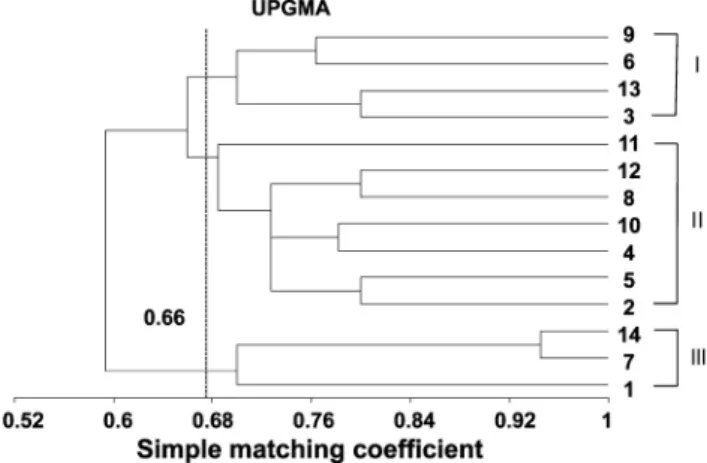
Fig. 4. Dendrogram of 14 Phalaenopsis varieties based on UPGMA generated by cluster analysis of genetic similarity using SSR.
저 polymorphism을 screening한 후 12개의 primer를 선별한 후에 14품종에 적용하였다. 수행의 결과로 총 55개의 다형 성 밴드를 획득했으며(Table 3), primer당 평균 5개의 밴드 를 나타낸 것이다(Table 4). SSR 마커의 경우 SRAP 보다는 밴드수가 적었지만, DNA 증폭이 일정한 편으로 균일하게 나왔고, 재현성도 높았다(Figs. 1 and 2).
SRAP과 SSR을 이용한 유연관계 분석
SRAP분석 결과로 얻어진 밴드들을 이용하여 UPGMA 분 석을 실시한 결과, 국내 육성 팔레놉시스 14품종에 대한 유전 적 거리는 유사도 지수 0.588-0.913 범위에 속하였다(Fig. 3).
유사도 지수 0.683에서 3개의 그룹으로 크게 구분이 되었다 (Fig. 3). 유사도 지수가 0.952로 가장 높은 것은 Phalaenopsis (P.) ‘Yellow Dream’으로 교배 모・부본이 같다. 1995년 P.
PN21-1과 P. ‘Golden Emperor’를 교배하여 1999-2002년 계통양성과 선발을 거쳐 2003년부터 2004년까지 특성검정 을 통하여 2005년에 등록된 품종이다(Kim et al., 2009). 7번 의 경우 육성한 품종으로 stripe가 진하고 꽃잎 가장자리가 주름이 조금 진 반면, 14번의 경우 stripe 발현이 조금 연한 계통이다. 같은 그룹에 속한 1번은 P. ‘Yellow Star’로 ‘Taipei gold’를 자가 수분하여 나온 품종인데, 모두 노란 꽃잎색을 가진 품종끼리 3번째 그룹에 포함되었다(Fig. 3). 또 다른 노 란색P. ‘Yellow Star’의 오렌지 계열의 P. ‘Orange Dream’
를 포함하여 유전자원 P. 3039, ‘Yellow Marble’ 3품종이 같이 grouping 되었다. 백색 꽃인 P. ‘Ice Princess’와 ‘White Pearl’이 유사도 지수가 0.838로 두 번째로 가까운 품종으로 분류되었다. 노란색과 백색 등 같은 색깔의 꽃잎이 같은 그 룹 내에 분류되기도 하지만 엽형, 병저항성 등 여러 원예적 형질이 존재하므로 화색만으로 근연관계를 연관짓기는 어
렵다. 이는 심비디움에서도 같은 결과를 나타냈으며, 화색 등 다양한 원예적 형질과의 연관성을 결정짓기 위해서는 자 세한 원예적 형질 조사가 뒷받침되어야 한다(Park et al., 2011). 이러한 SRAP 표지를 이용한 유전적 다양성 분석뿐 만 아니라, Xue et al.(2010)은 RAPD와 SRAP을 함께 이 용하여 Dendrobium에 적용하였는데, SRAP primer 10개를 이용하여 98개의 마커를 획득하였고 lingkage map을 작성 하는데 이용하였다.
SSR 분석결과로 얻어진 다형성 밴드는 SRAP의 419개에 비해 55개로 많지는 않았으나(Table 3), SRAP 분석의 결과 와 유사한 국내육성품종의 근연관계를 나타내었다(Fig. 4).
SRAP과 같이 III 그룹으로 나뉘는데, 유사도 지수는 0.66이 며, 그룹에 속한 품종들이 유사하였다. 단지 SRAP 분석에는 P. ‘White Angel’가 I 그룹에 속하였지만, SSR 분석에서는 II 그룹에 속하는 것으로 나타났다(Fig. 4). II 그룹 내에서 품 종간의 유사도도 SRAP과 차이가 있었다. Cynaracardunculus 16품종의 유전적 다양성을 알아보기 위한 SSR과 SRAP 비교 분석에서도 dendrogram상 약간의 차이를 보였다(Casadevall et al., 2011). 팔레놉시스 SSR 다형성 밴드의 수는 적지만 이 때문에 scoring이 편하고 SRAP 분석과 유사한 덴드로그 램 양상을 보여주었다. 하지만 해당 작물의 SSR 마커의 정 보가 없을 경우 SRAP을 적용하여 근연관계 분석을 수행할 수 있다. 개발된 SSR 마커의 정보가 존재할 시 공우성 마커 로서 재현성이 있고, 시간과 비용을 절약할 수 있는 SSR 마 커를 이용하는 것이 낫다(Casadevall et al., 2011).
SSR을 이용한 품종판별
선발된 6개의 SSR 프라이머를 이용하여 팔레놉시스 14 품종을 대상으로 SSR 분석한 결과 재현성 있고 품종 판별 용 마커로 이용할 수 있는 최소의 프라이머 2개를 선발하였
Table 5. Genotypes detected by 8 SSR markers among 14 Phalaenopsis varieties.
Marker 1 2 3 4 5 6 7 8 9 10 11 12 13 14
20-3 - + + + - - + - - - + - - +
20-4 + - - + + + - + + + + + + -
20-5 + - - - - - + + - + - - - +
20-6 + - - - - + - - - - - - - -
22-3 + - + - + + + - + + + - - +
22-4 + - - - + + - - + - + + - +
22-5 - + - + - - - + - - - - + -
22-6 - + - - + - - - - - - + - -
다(Table 5). 선발한 프라이머는 SSR 20번과 22번으로부터 찾은 다형성 마커의 수는 각각 8개, 7개이나 팔레놉시스 14 종의 품종판별로 가능한 마커는 20번 프라이머로부터 20-3 등 4개, 22번 프라이머로부터 22-3 등 4개이다(Tables 4 and 5).
Fig. 2는 SSR 20번 프라이머로 증폭한 팔레놉시스 품종 의 SSR band pattern을 나타낸 것이다. 약 300bp 크기의 마커인 20-3은 2번 3번, 4번, 7번, 11번에서만 증폭되었고, 20-6 마커는 1번과 6번 품종에서만 특이적으로 증폭되었 다(Fig. 2 and Table 5). 유사도 지수가 가장 높았던 7번과 14번은 SSR 22-4번 프라이머를 통해 구분할 수 있었다 (Table 5).
로열티를 줄이고자 국내 육종에 많은 연구가 진전되고 있 으며, 이와 더불어 점점 품종 보호의 중요성도 증대되고 있 다. 따라서 국내 품종 판별을 위한 마커 개발 연구도 진행되 고 있다(Cho et al., 2010; Seo et al., 2008; Sun et al., 2009).
팔레놉시스 육종에 있어서 변이를 창출하기 위한 방법으 로 전통적인 교배 육종 방법을 많이 이용하고 있으므로 교 배를 위해 쓰이는 양친재료에 대한 유전적 분류와 유전자원 의 다양성에 대한 연구는 매우 중요하다. 본 실험에서 국내 육성 팔레놉시스 14품종 간의 유전적 근연관계를 밝힘으로 써 이후 팔레놉시스 교배 육종에 이용할 양친의 선정이나 잡 종강세의 예측 등 유전 및 육종 연구에 유용한 기초 자료가 될 수 있을 것으로 기대된다. 또한 육성 품종들을 사용하여 여러가지 DNA 마커를 적용해봄으로써 향후 국내 육성 품 종들에 대한 보호 기술을 마련할 수 있을 것으로 생각된다.
초 록
본 연구의 목적은 SSR과 SRAP 마커 시스템을 이용하여 팔레놉시스 14품종 간 유전적 거리를 비교하고, SSR 마커 를 이용하여 품종 간 구분을 하기 위한 것이다. 전체적으로 111개의 SSR 프라이머와 30조합의 SRAP primer를 먼저
스크리닝하였다. 국립원예특작과학원에서 보존중인 국내 육 성품종을 포함한 14품종의 팔레놉시스에서 12개의 SSR 프 라이머와 30조합의 SRAP 프라이머에서 높은 다형성을 보 였다. 증폭된 DNA 단편들은 acrylamide gel에서 분리시킨 후 silver staining 방법으로 검출하였다. SSR 마커 55개와 SRAP 419개로, 총 474개의 마커를 획득하였으며 이를 유 전적 다양성 분석에 사용하였다. 다형성 밴드들은 MVSP 3.1 프로그램을 이용하여 유전적 유사도와 UPGMA clustering 분석을 위해 scoring 되었다. 14 팔레놉시스 품종은 SRAP 과 SSR 분석을 통해 각각 0.683과 0.66의 유사도 지수에서 3그룹으로 분류되었다. 또한 SSR 20번과 22번만으로도 이 들 육성 품종을 구분할 수 있었다. 이 결과는, SSR 분석은 팔레놉시스 품종간 구분에 효과적이고 SRAP은 염기서열의 정보가 없을 때 유전적 다양성 분석에 유용하다는 것을 보 여준다. 이번 연구된 SSR과 SRAP 마커들은 팔레놉시스의 유전자형 판별, 유전자원 보존, 유전적 근연관계를 분석하는 데 유용한 기술이 될 것이다.
추가 주요어 : 판별, 유전자형, 난, 다형성, 유사성 인용문헌
Ahmad, R., D. Potter, and S.M. Southwick. 2004. Genotyping of peach andnectarinecultivars with SSR and SRAP molecular markers. J. Amer. Soc. Hort. Sci. 129:204-210.
Cai, X., Z. Feng, X. Zhang, W. Xu, B. Hou, and X. Ding. 2011.
Genetic diversity and population structure of an endangered Orchid (Dendrobium loddigesii Rolfe) from China revealed by SRAP markers. Scientia Hort. 129:877-881.
Casadevall, R., E. Martin, and V. Cravero. 2011. Simple sequence repeat (SSR) vs. sequence-related amplified polymorphism (SRAP) markers for Cynara cardunculus characterization.
Spanish J. Agr. Res. 9:453-459.
Chang, Y.K., R.E. Veilleux, and M.J. Iqbal. 2009. Analysis of genetic variability among Phalaenopsis species and hybrids using amplified fragment length polymorphism. J. Amer. Soc.
Hort. Sci. 134:58-66.
Cho, K.H., S. Heo, H.R. Kim, J.H. Kim, I.S. Shin, S.E. Han, S.H. Kim, and D.H. Kim. 2010. Discrimination of Korean apple cultivars using combination of RAPD-SCAR Markers. Kor.
J. Hort. Sci. Technol. 28:828-835.
Choi, S.H., M.J. Kim, J.S. Lee, and K.H. Ryu. 2006. Genetic diversity and phylogenetic relationships among and within species of oriental cymbidiums based on RAPD analysis.
Scientia Hort.108:79-85.
Ding, G., D. Zhang, X. Ding, Q. Zhou, W. Zhang, and X. Li.
2008. Genetic variation and conservation of the endangered Chinese endemic herb Dendrobium officinale based on SRAP analysis. Plant Syst. Evol. 276:149-156.
Esposito, M.A., E.A. Martin, V.P. Cravero, and E. Cointry. 2007.
Characterization of pea accessions by SRAP’s markers. Scientia Hort. 113:329-335.
Goh, M.W.K., P.P. Kumar, S.H. Lim, and H.T.W. Tan. 2005.
Random amplified polymorphic DNA analysis of the moth orchids, Phalaenopsis (Epidendroideae: Orchidaceae). Euphytica 141:11-22.
Huang, Y., F. Li, and K. Chen. 2010. Analysis of diversity and relationships among Chinese orchid cultivars using EST-SSR markers. Biochem. Syst. Ecol. 38:93-102.
Jang, S., S. Park, K. Park, H. Song, Y. Cho, S. Jong, J. Kang, and H. Kim. 2009. Genetic diversity and identificaiton of Korean elit soybean cultivars based on SSR markers. Kor. J.
Crop Sci. 54:231-240.
Kim, M.S., Y.R. Lee, H.R. Cho, H.K. Rhee, J.H. Lim, S.K. Park, H.K. Shin, and I.J. Choi. 2009. New cultivar developed:
Breeding of small type and yellow colored Phalaenopsis
“Yellow Dream”. Kor. J. Breeding. Sci. 41:145-148.
Li, G. and C.F. Quiros. 2001. Sequence-related amplified polymorphism (SRAP), a new marker system based on a simple PCR reaction:
Its application to mapping and gene tagging in Brassica. Theor.
Appl. Genet.103:455-461.
Li, H., H. Chen, T. Zhuang, and J. Chen. 2010. Analysis of genetic variation in eggplant and related Solanum species using sequence-related amplified polymorphism markers. Scientia Hort. 125:19-24.
Li, H.Z., Y.P. Yin, C.Q. Zhnag, M. Zhang, and J.M. Li. 2008.
Comparison of characteristics of SRAP and SSR markers in genetic diversity analysis of cultivars in Allium fistulosum L.
Seed Sci. Technol. 36:423-434.
Lu, F.B., N. Yu, X.L. Zhao, J.X. Zhang, W.F. Xiao, W.Y. Li, R.Z.
Liu, J. Zhu, and C.C. Peng. 2011. Genetic diversity analysis of Phalaenopsis ‘Frigdaas Oxford’ using SRAP markers with reference to those genes responsible for variations in the pigmentation of petals and sepals. J. Hort. Sci. Biotech. 86:
486-492.
Moe, K.T., W. Zhao, H.S. Song, Y.H. Kim, J.W. Chung, Y.I.
Cho, P.H. Park, H.S. Park, S.C. Chae, and Y.J. Park. 2010.
Development of SSR markers to study diversity in the genus Cymbidium. Biochem. Syst. Ecol. 38:585-594.
Murray, M. and W. Thompson. 1980. Rapid isolation of high
molecular weight plant DNA. Nucleic. Acids. Res. 8:4321-4325.
Neto, F.D., D.H. Rodrigues, and I. Schuster. 2008. Identification of essentially derived soybean cultivars using microsatellite markers. Crop Breed. Appl. Biotechnol. 8:74-78.
Niknejad, A., M.A. Kadir, S.B. Kadzimin, N.A.P. Abdullah, and K. Sorkheh. 2009. Molecular characterization and phylogenetic relationships among and within species of Phalaenopsis (Epidendroideae: Orchidaceae) based on RAPD analysis. African J. Biotechnol. 8:5225-5240.
Obara-Okeyo, P. and S. Kako. 1998. Genetic diversity and identification of cymbidium cultivars as measured by random amplified polymorphic DNA (RAPD) markers. Euphytica 99:
95-101.
ObaraOkeyo, P. and S. Kako. 1997. In vitro and in vivo cha- racterization of Cymbidium cultivars by isozyme analysis. J.
Hort. Sci. 72:263-270.
Ok, S.H., J.U. Jeung, H.M. Kang, K.W. Jung, J.S. Lee, and J.S.
Shin. 2004. Development and utilization of sequence tagged site-polymerase chain reaction and cleaved amplified polymorphic sequence markers for classification of oriental cymbidium cultivars and variegates. J. Kor. Soc. Hort. Sci. 45:216-221.
Park, P.H., M.S. Kim, Y.R. Lee, P.M. Park, D.S. Lee, and B.W.
Yae. 2010. Analysis of Genetic relationship among cymbidium germplasms using RAPD and URP. Flower Res. J. 18:201-206.
Park, P.H., M.S. Kim, Y.R. Lee, P.M. Park, D.S. Lee, and B.W.
Yae. 2011. Analysis of genetic diversity in cymbidium varieties using SRAP. Kor. J. Breed. Sci. 43:331-337.
Rodrigues, K. and S. Kumar. 2009. Isolation and characterization of microsatellite loci in Phalaenopsis gigantea. Conserv.
Genet. 10:559-562.
Seo, K.I., K.Y. Jang, Y.B. Yoo, S.Y. Park, K.H. Kim, and W.S.
Kong. 2008. Differentiation among commercial strains of Pleurotus spp. based on DNA fingerprinting using universal rice primer (URP). Kor. Mycol. 36:130-137.
Sun, M., K. Choi, H. Kim, B. Song, S. Woo, C. Lee, S. Jong, and Y. Cho. 2009. Genetic diversity and discrimination of recently distributed rice varieties in Korea by SSR markers.
Kor. J. Breed Sci. 41:115-125.
Wang, H.Z., Z.X. Wu, J.J. Lu, N.N. Shi, Y. Zhao, Z.T. Zhang, and J.J. Liu. 2009. Molecular diversity and relationships among Cymbidium goeringii cultivars based on inter-simple sequence repeat (ISSR) markers. Genetica 136:391-399.
Xu, Y.H., H. Jin, Y. Kim, K. Bang, S. Cha, and L. Zhang. 2010.
Genetic diversity and genetic structures in ginseng landrace (cultivars) by SRAP analysis. Kor. J. Med. Crop Sci. 18:180-185.
Xue, D., S. Feng, H. Zhao, H. Jiang, B. Shen, N. She, J. Lu, J. Liu, and H. Wang. 2010. The linkage maps Dendrobium species based on RAPD and SRAP markers. J. Genet. Genomics 37:197-204.
Zhang, F., S. Chen, F. Chen, W. Fang, Y. Deng, Q. Chang, and P.
Liu. 2011. Genetic analysis and associated SRAP markers for flowering traits of chrysanthemum (Chrysanthemum morifolium).
Euphytica 177:15-24.