창이자의 항산화 활성 및 항균효과
신선우, 이정호1, 방극수2*
원광대학교 한의학전문대학원 한약자원개발학과, 1송호대학교 동의건강복지과, 2전북대학교 환경생명자원대학 한약자원학과
Antioxidant and Antimicrobial Activities of Xanthium sibiricum
Sun Woo Shin, Jeong Ho Lee1 and Bang Keuk Soo2*
Department of Herbal Resources, Professional Graduate School of Oriental Medicine, Wonkwang University, Iksan 570-749, Korea
1Department of Natural Health Management, Songho College, Hoengseong 225-801, Korea
2Department of Chinese Medicine Resource, Chonbuk National University, Iksan 570-752, Korea
Abstract - Xanthium sibiricum using extracts antioxidant activity and antimicrobial activity were analyzed and the following results were obtained. Antioxidant activity using DPPH as a VLC column fractionation experiments XS-5 (water fraction of Xanthium sibiricum) concentration in the 500 ㎍/ml to 87.53 percent in the highest antioxidant activity was found, VLC fractionation in XS-3-2 (eluted with chloroform/methanol 7~10%) concentration of 500 ㎍/ml, showed the antioxidant activity of 78.72%. The antioxidant activity measured by PCL XS-1 (n-hexane fraction of Xanthium sibiricum) XS-5 (water fraction of Xanthium sibiricum) and 13.32 nmol open column XS-3-2 (eluted with chloroform/methanol 7~10%) showed antioxidant activity with 14.34 nmol. The antimicrobial activity against Candida albicans XS-2 (methlene chloride fraction fo Xanthium sibiricum) is the concentration of 500 ㎍/disc 1 mm of the clean zone was formed. XS-3 (ethanol fraction fo Xanthium sibiricum) in the antioxidant activity using DPPH and PCL had higher antibacterial activity was low.
Key words - Antioxidant activity, Xanthium sibiricum, DPPH, Photochemiluminescence, Candida albicans
*교신저자(E-mail) :[email protected]
서 언
인체에 질병을 일으키는 여러 가지 원인 중 활성산소에 의하여 발생한 질병은 활성산소를 억제시켜 질병을 치료 하거나 예방한다. 일반적으로 활성산소를 억제시키는 항산 화제는 superoxide dismutase, catalase, glutathione reductase 등의 효소계열의 항산화제와 phenol성 화합물, flavone 유도체, ascorbic acid, carotenoids, glutathione 등의 천연 항산화제, butylated hydroxyanisole(BHA)와 butylated hydroxytoluene(BHT), PG(propyl gallate) 등 의합성 항산화제가 널리 알려져 있다(Shin et al., 2008).
합성항산화제인 BHA와 BHT는 항산화력은 강하지만 열에 대한 안정성이 낮고 병이원성과 독성이 있으며, 천연항산화 제인 tocopherol은 식물성유지에 사용했을 때 항산화력이 감소되는 단점이 있다(Lee et al., 2007; Choi et al., 2008;
Park, 2008). 자연계에 존재하는 식물은 자외선과 자연 산 화로부터 자신을 보호하기 위하여 polyphenol계의 항산화 물질을 함유하고 있으며, flavonoid류는 산화, 알러지, 암에 대한 활성이 있다(Wang et al., 1996; Van der Sluis et al., 1997; Kim et al., 2003). 천연식물은 인체에 부작용이 없어 천연식물을 이용한 항산화에 대한 연구가 활발하게 진행 되고 있다(Kwon et al., 2008; Han et al., 2007; Song et al., 2007).
자연계에서 존재하는 진균류 중 candida albicans는 효 모균 중 약 85-90%의 감염을 일으키고 인체에 면역력이 저하되면 기회성 감염으로 발생하기도 한다(Kim et al., 2007; Chun et al., 2004). Candida albicans는 정상조직 피부에 약 20%정도 존재하며, 여성은 질내벽을 감염시키는 경우가 대다수이며, 질염 중 약 20~25% 정도 발현한다(Kang et al., 2003).
창이자는 국화과에 속하는 1년생 초본식물인 도꼬마리 (Xanthium sibiricum)의 열매로 우리나라와 일본, 만주,
n-hexane XS-1
Plate 1. Extraction and fractions of Xanthium sibiricum.
중국, 대만, 필리핀 등의 아시아와 유럽, 북아메리카에서 분포되어 있다.창이자의 약리작용은 종양, 두통, 치통, 사지 경련, 피부소양, 비염, 해열, 비염, 류마티스성 관절염, 진통, 궤양성 피부병, 습진, 신경통, 이질균, 황색 포도상구균 등 에 효과가 있으며, xanthanol, isoxanthanol, tomentosin, xanthatin, xanthumanol, xanthumin, thiazinedione, xanthiozone, caffeic acid, β-sitosterol, xantostrumarin, isoxanthol, cholin, daucosterol, campesterol, tomesterol 등의 성분이 함유되어 있다(Kim et al., 2003). 본 연구에 서는 창이자 메탄올 추출물과 메탄올 추출물을 분획한 분 획물을 이용하여 항산화 활성과 항균활성을 측정하여 창이 자의 약리활성을 검토하였다.
재료 및 방법
실험재료
창이자는 대전시 동구 중동에 소재한 약재상에서 구입하 여 외부형태를 검정한 후 실험에 사용하였다. 창이자 500 g을 분쇄시켜 메탄올(2.5 L)에 넣고 상온에서 일주일 동안 침지시켜 3회 반복 추출하여 얻은 추출물을 Whatman No.
2 여과지로 감압농축 시켜 24.64 g(4.93%)을 얻었다. 창이 자 메탄올 추출물 20.0 g을 실리카겔(kieselgel 60, 230~
400 mesh, Aldrich Co.,) 20 g으로 coating 시켰다. Coating
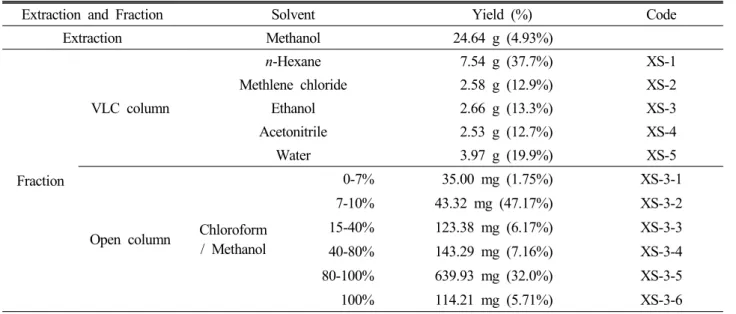
된 메탄올 추출물을 실리카겔 500 g 충진 된 glass column (90 × 600 mm)으로 n-hexane, methylene chloride, ethanol, acetonitrile, distiled water를 이용하여 VLC column chromaotography법으로 1차 분획하여 XS-1, 7.54 g(37.7%), XS-2, 2.58 g(12.9%), XS-3, 2.66 g(13.3%), XS-4, 2.53 g(12.7%), XS-5, 3.97 g(19.9%)를 얻었다. VLC column 으로 분리한 XS-3(2,00 mg)을 실리카겔(200.0 g)이 충진된 glass column(40 × 700 mm)에 chloroform과 methanol을 이용하여 open column chromatography법으로 2차 분획하 여 XS-3-1, 35.00 mg(1.75%), XS-3-2, 43.32 mg(47.17%), XS-3-3, 123.38 mg(6.1%), XS-3-4, 143.29 mg(7.16%), XS-3-5, 639.93 mg(32.00%), XS-3-6, 114.21 mg(5.71%) 을 얻었다(Plate 1, Table 1). 창이자 추출 및 VLC column (Vaccum Liquid Chromatography)과 open column에 사용된 시약은 Dae Jung(Korea)사의 GR급 시약을 사용하였으며, TLC(Thin Layer Chromatography)는 silica gel plate(0.25 mm, polygram sil N-HR/UV254, E. Merck), silica gel (kieselgel 60, 230~400 mesh) Aldrich Co.,를 사용하였다.
항산화 측정
1,1-diphenyl-2-picrylhydrazyl(DPPH)와 ascobic acid는 Sigma Chemical Co.,(St. Louis, MO, USA), UV-Spectrophotometer(Analytik Jena SPECORD 200.
Table 1. Extraction and fraction yield of Xanthium sibiricum
Extraction and Fraction Solvent Yield (%) Code
Extraction Methanol 24.64 g (4.93%)
Fraction
VLC column
n-Hexane 7.54 g (37.7%) XS-1
Methlene chloride 2.58 g (12.9%) XS-2
Ethanol 2.66 g (13.3%) XS-3
Acetonitrile 2.53 g (12.7%) XS-4
Water 3.97 g (19.9%) XS-5
Open column Chloroform / Methanol
0-7% 35.00 mg (1.75%) XS-3-1 7-10% 43.32 mg (47.17%) XS-3-2 15-40% 123.38 mg (6.17%) XS-3-3 40-80% 143.29 mg (7.16%) XS-3-4 80-100% 639.93 mg (32.0%) XS-3-5 100% 114.21 mg (5.71%) XS-3-6
Germany)을 사용하였으며, Brand-Willams(Williams et al., 2005)의 방법을 변형하여 자유 라디칼인 DPPH에 대한 전 자공여효과로 나타나는 시료의 환원력을 측정하였다. 유리 시험관에 메탄올과 증류수를 이용하여 1 mg/ml의 농도로 조제한 후 희석하여 사용하였다. 측정시료의 농도는 0.5~
100 ㎍/ml와 0.3 mM DPPH 용액을 첨가하여 30분 동안 반응시켜, UV-spectrophotometer를 이용하여 517 nm에서 흡광도를 측정하였다. 전자공여능은 시료를 첨가하지 않은 대조군의 흡광도를 50% 감소시키는데 필요한 시료의 양을 IC50(50% inhibition concentration)으로 나타내었다(Lee et al., 2011; Kim et al., 2008).
DPPH radical scavenging activity(%)
= [ 1- (
)] × 100
Asample은 시료와 반응한 30분 후의 흡광도이며, Acontrol은
대조군의 흡광도이다. 창이자의 항산화 활성을 ascobic acid 와 비교하였다(Qin et al., 2006).
Photochemiluminescence(PCL) 측정
Popov and Lewin(Popov and Lewin, 1999)의 방법으 로 항산화분석기를 이용하여 항산화 활성을 측정하였다.
Photochem(Analytik Jena AG, Jena Germany)와 PCL
분석은 지용성 kit(antioxidative capacity of the lipid soluble compounds), ACL(Analytik Jena AG, Jena Ger- many)를 사용하였다. 항산화 활성 측정 방법은 Regent 1(buffer solution), Regent 2(methanol), 500 ㎕ Regent 3(phosphosenstizer)과 10 ㎕ 시료를 혼합하여 측정하였다.
항산화력은 log phase의 평균값에 의해서 분석하였으며, calibration curve를 만들기 위한 표준물질은 trolox(nmol/g) 를 사용하였다.
항균활성 측정
Candida albicans 17485 KCTC균주는 한국 세포주 은행 에서 분양을 받아 사용하였으며, agar powder는 Samchum chemical Co.,(Korea), PDB(potato dextrose broth)는 Becton Dickinson Co.,(USA), paper disc는 Advantec (Japan)를 사용하였다.Plate에 107 CFU/ml 농도로 candida albicans 균주를 분주시킨 후, 시료가 점적된 filter paper disk(6.25 mm)를 이용하여 항균활성을 측정하였다. 시료의 농도는 500 ㎍/20 ㎕, 250 ㎍/20 ㎕, 100 ㎍/20 ㎕, 50 ㎍ /20㎕로 점적 시켰으며, 점적된 filter paper disk는 실온 에서 24시간 동안 용매를 휘발시켰다. Candida albicans가 접종된 고체배지에 시료가 점적된 filter paper disk를 올 려놓은 후, 30℃에서 48시간 배양시켜 filter paper disk 주위에 선명지대(clear zone)의 생성 유무와 선명지대의 크기(mm)로 항균력을 측정하였다(Lee et al., 2009).
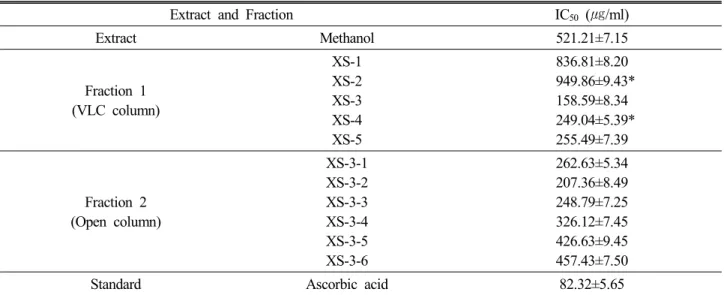
Table 2. DPPH radical scavenging activities of Xanthium sibiricum
Extract and Fraction IC50 (㎍/ml)
Extract Methanol 521.21±7.15
Fraction 1 (VLC column)
XS-1 XS-2 XS-3 XS-4 XS-5
836.81±8.20 949.86±9.43*
158.59±8.34 249.04±5.39*
255.49±7.39
Fraction 2 (Open column)
XS-3-1 XS-3-2 XS-3-3 XS-3-4 XS-3-5 XS-3-6
262.63±5.34 207.36±8.49 248.79±7.25 326.12±7.45 426.63±9.45 457.43±7.50
Standard Ascorbic acid 82.32±5.65
IC50: concentration of each samples for inhibition 50% of radical. Values are mean ± SD (n = 3) with out relative activity. *Different superscript letters in the same line show significant differences at *p < 0.05 by one-way ANOVA.
통계분석
실험결과는 평균값과 표준편차(mean ± SD)로 표시하였 고, 각 실험군 간의 통계학적 분석은 SPSS 12.0(SPSS Inc, Chicago IL, USA)을 사용하였다. 각 군 간의 측정치 비교는 one-way analysis of variance를 시행하였으며, 유의성은 신뢰구간 p < 0.05에서 의미를 부여하였다(Song et al., 2008).
결과 및 고찰
DPPH radical-scavening 활성측정
창이자 메탄올 추출물과 분획물의 DPPH 전자공여능을 측정하기 대조시약인 ascobic acid(IC50 = 82.32 ± 5.62 ㎍ /ml)와 비교하였다. 창이자 메탄올 추출물의 처리농도가 증가함에 따라 항산화 활성도 증가하였으며, IC50은 521.21
± 7.15 ㎍/ml로 나타났다. VLC column으로 1차 분획한 XS-3의 IC50은 158.59 ± 8.34 ㎍/ml으로 가장 강한 활성이 나타났으며, XS-4는 249.04 ± 5.3 ㎍/ml, XS-5는 255.49
± 7.3 ㎍/ml, XS-1는 836.81 ± 8.2 ㎍/ml, XS-2는 949.86 ± 9.4 ㎍/ml순으로 항산화 활성이 나타났다. 가장 우수한 항산화 활성이 나타난 XS-3을 chloroform과 me- thanol을 이용하여 open column으로 분리하였다. Open column으로 분리한 분획물의 XS-3-2에서 207.36 ± 8.4
㎍/ml에 가장 우수한 항산화 활성이 나타났으며, XS-3-3
에서 248.79 ± 7.25 ㎍/ml, XS-3-1에서 262.63 ± 5.34
㎍/ml, XS-3-4에서 326.12 ± 7.45 ㎍/ml 순으로 항산화 활성이 나타났다. VLC column으로 분획물 XS-2와 XS-4 분획물(p < 0.05)에서 통계적 유의성이 나타났다. 항산화 대조 시약으로 사용한 ascobic acid 보다 낮은 항산화력이 나타났 지만 창이자 추출물은 항산화 활성이 있는 것으로 판단된다.
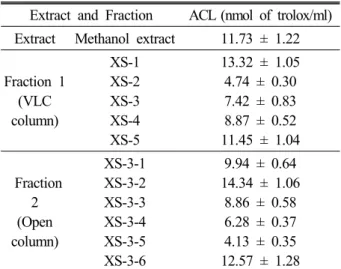
Photochemiluminescence(PCL)에 의한 항산화측정 PCL(Photochemiluminescence)를 이용한 항산화 활성 측정은 radical을 발생시키기 위하여 높은 온도가 필요하 지 않으며, 측정이 용이하고 실험결과가 비교적 정확하고, 짧은 시간에 nanomolar범위까지 측정할 수 있는 장점을 가지고 있다. PCL를 이용한 ACL측정은 10 ㎍에 들어있는 항산화 활성 농도를 nmol농도로 나타나는 방법으로 적은 시료의 값으로 효과적으로 항산화 활성 농도를 측정하는 방법이다. 지용성 성분의 활성의 측정은 trolox equivalents 로 표현되며, 항산화 활성을 측정하기 위하여 trolox를 이용 하여 검량을 실시한 후(r = 0.9926) 측정하였다. 창이자 메탄 올 추출물의 10 ㎍에 함유되어 있는 항산화 활성은 11.73 nmol로 나타났다. VLC column으로 분획한 XS-1에서 13.32
± 1.05 nmol, XS-5에서 11.45 ± 1.04 nmol, XS-4에서 8.87 ± 0.52 nmol, XS-3에서 7.42 ± 0.83 nmol, XS-2 에서 4.74 ± 0.30 nmol의 순으로 항산화 활성이 나타났다.
Open column으로 2차 분리한 XS-3-2에서 14.34 ±
Table 4. Antimicrobial activity of Xanthium sibiricum methanol extract on Candida albicans Extract and Fraction Concentration (㎍/disc)
0 500 250 100 50
Extract Methanol extract - + - - -
Fraction 1 (VLC column)
XS-1 XS-2 XS-3 XS-4 XS-5
- - - - -
- +++
- - ++
- + - - -
- - - - -
- - - - -
Fraction 2 (Open column)
XS-3-1 XS-3-2 XS-3-3 XS-3-4 XS-3-5 XS-3-6
- - - - - -
- +++
+++
- - -
- ++
++
- - -
- + + - - -
- - + - - - - : no inhibition zone, + : < 0.3 mm, ++ : < 0.5 mm, +++ : < 1 mm in dimeter.
Table 3. Antioxidant activity of Xanthiumsibiricum by Photochemiluminescence method
Extract and Fraction ACL (nmol of trolox/ml) Extract Methanol extract 11.73 ± 1.22 Fraction 1
(VLC column)
XS-1 XS-2 XS-3 XS-4 XS-5
13.32 ± 1.05 4.74 ± 0.30 7.42 ± 0.83 8.87 ± 0.52 11.45 ± 1.04 Fraction
2 (Open column)
XS-3-1 XS-3-2 XS-3-3 XS-3-4 XS-3-5 XS-3-6
9.94 ± 0.64 14.34 ± 1.06
8.86 ± 0.58 6.28 ± 0.37 4.13 ± 0.35 12.57 ± 1.28 ACL: Antioxidant activity of liquid soluble substance.
1.06 nmol, XS-3-6에서 12.57 ± 1.28 nmol, XS-3-1에서 9.94 ± 0.64 nmol, XS-3-3에서 8.86 ± 0.58 nmol 순 으로 항산화 활성이 나타났으며, XS-3-2에서는 가장 낮 은 활성을 보인 XS-3-5의 4.13 ± 0.35 nmol 보다 약 3 배의 항산화 활성이 나타났다(Table 3).
항균활성 측정
창이자 메탄올 추출물과 column chromaotography로 분리한 분획물을 이용하여 candida albicans에 대한 항균
활성을 측정하였다. 시료의 처리농도는 0, 50, 100, 250, 500
㎍/disc로 측정하였다. 메탄올 추출물의 처리농도가 500
㎍/disc에서 0.3 mm의 clean zone이 나타났다. VLC로 분리 한 XS-2와 XS-5의 500 ㎍/disc에서 각각 1mm와 0.5 mm의 clean zone이 형성되었다. Open column으로 분리한 분획물의 XS-3-2의 500 ㎍/disc에서 1mm, 250 ㎍/disc 에서 0.5 mm, 100 ㎍/disc에서 0.3 mm, XS-3-3의 500
㎍/disc에서 1 mm, 250 ㎍/disc에서 0.5 mm, 100 ㎍/disc 와 50 ㎍/disc에서 0.3 mm의 항균활성이 나타났다(Table 4). DPPH법에서 측정된 항산화력은 XS-3, XS-3-2이 가장 높게 나타났으며, PCL로 측정된 항산화력은 XS-1, XS-3 -2에서 가장 높은 항산화력이 나타났지만 candida albicans 의 항균활성의 경우 XS-2, XS-3-3에서 가장 높은 항균 력이 측정된 결과는 항균활성과 항산화 활성간의 효과에 대한 상관관계는 없는 것으로 판단된다(Table 4).
인체의 free radical은 생체내에서 유해한 활성산소종 (reactive oxygen species, ROS)을 생성시키며, DNA 분절 과 단백질의 불활성화 및 세포 생체막의 불포화지방산을 공격하여 과산화 반응을 일으켜 생체기능을 저하시키며, 산화시켜서 노화를 유발하고 류마티스성 관절염, 당뇨병, 심 장병, 동맥경화, 암 등과 같은 질환을 일으키게 된다. 활성 산소종은 피부의 항산화제 파괴, 지질 과산화 반응의 개시, 단백질의 산화, DNA의 산화, 콜라젠, 히아루론산 등의 사 슬을 절단하고 비정상적인 교차결합을 생성하여 주름생성, 멜라닌 저해 등을 일으켜 피부의 노화를 촉진시킨다. 따라서
생체내 항산화 방어시스템을 활성화시키거나 활성산소를 조절할 수 있다면 생체의 노화를 억제할 수 있을 것이다.
현재 사용되고 있는 합성 항산화제는 BHA, BHT 등과 천연 항산화제인 tocopherol 등은 경제성과 안정성, 활성효과가 우수하여 많이 사용되고 있으나 다량섭취하게 하면 간, 신장, 순환계 등에 악영향을 일으키게 된다(Kwon et al., 2008).
한약재 중 갈근, 갈화, 참취잎, 쑥갓잎, 머위잎 등이 항산화 활성이 있는 것으로 보고 되어 있다(Cho et al., 2001). DPPH 를 이용한 항산화 측정은 페놀의 함량에 비례하여 항산화력 을 측정한 흡광도이고 PCL(Photochemiluminescence)은 10 ㎍에 들어있는 항산화력을 trolox와 비교하여 측정한 값 으로 DPPH 항산화력 결과와 PCL 실험 결과가 일치하지 않을 수도 있는데 이러한 결과는 DPPH측정과 PCL측정 항 산화력을 측정하는 물질이 다르기 때문으로 판단된다.
정상 인체에 존재하는 candida albicans는 인체에 존재 하는 면역체계와 균에 대한 방어작용에 의하여 균의 증식과 활동이 억제되지만 인체의 면역력과 균에 대한 증식 억제력 이 저하되면 균이 증식하여 질병을 유발하게 된다. 여성 질염 중 candida albicans는 임신, 당뇨, 항암치료, 스테로이드, 항생제 등의 복용으로 인하여 발생하는 것으로 추정된다.
한약재를 이용한 candida albicans에 대한 항균 활성은 산 초나무, 귤나무, 황련 등이 보고되었다(Kim et al., 1997;
Kim et al., 2006). Nishibe 등의 연구결과에서 자몽 종자를 이용한 candida albicans에 대한 항균활성은 40 ㎕/disk의 농도 에서 9.0 mm clean zone형성되었다고 보고된 것과 같이 본 실험에서 측정된 항균활성 측정 결과와 유사성이 있는 것 으로 판단되지만 창이자 추출물의 항균활성은 자몽 종자 보다 낮은 것으로 나타났다(Nishibe et al., 1982; Lee et al., 2004).
적 요
창이자 추출물을 이용하여 항산화활성 및 항균활성을 측 정한 결과 다음과 같은 결론을 얻었다. DPPH를 이용한 항 산화 활성 실험결과 VLC column로 분획한 XS-5에서 처리 농도 500 ㎍/ml에서의 87.53%로 가장 우수한 항산화 활성 이 나타났으며, VLC로 분획한 XS-3-2의 처리농도 500 ㎍ /ml에서 78.72%의 항산화 활성이 나타났다. PCL법으로 측 정한 항산화 활성은 XS-1에서 13.32 nmol과 open column XS-3-2에서 14.34 nmol으로 항산화력을 나타났다. Candida
albicans에 대한 항균활성은 XS-2의 처리농도가 500 ㎍ /disc에서는 1 mm의 clean zone이 형성되었다. XS-3에서 DPPH와 PCL를 이용한 항산화 활성은 높았지만 항균활성은 낮게 나타났다. 창이자 추출물은 항산화 활성과 항균 활성은 상호 상관관계가 없는 것으로 판단된다.
인용문헌
Cho, S.Y., Y.B. Han and K.H. Shin. 2001. Screening for antioxidant activity of edible plant. J. Korean Soc. Food Sci.
Nutr. 30:133-137 (in Korean).
Choi, N.Y., J.W. Lee and H.S. Shin. 2008. Antioxidant activity and nitrite scavenging ability of olive leaf (Olea europaea L.) fractions. Korean J. Food. Sci. Technol, 40:257-264 (in Korean).
Chun, S.C., S.Y. Jee and S.K. Lee. 2004. The antimicrobial activity of Naesohwangryuntang and its composition oriental medicines. Korean J. Herbology 19:51-60 (in Korean).
Han, J.H., J.H. Kim, S.G. Kim, S.H. Jung, D.H. Kim, G.E. Kim and W.K. Whang. 2007. Anti- oxdative compounds from the aerial parts of Atractylodes macrocephala koidzumi, Yakhak Hoeji. 51:88-95 (in Korean).
Kang, D.G., C. Yun and H.S. Lee. 2003. Screening and comparison of antioxidant activity of solvent extracts of herbal medicines used in Korea J. Ethnopharmacol. 87:
231-236
Kim, E.S., J.M. Lee, C.H. Lee, J.H. Cho, J.B. Jang and K.S.
Lee. 2007. Antimicrobial effects of herbs for removing dampness and promoting urination against vaginal microbe.
J. Oriental Gynecology 20:001-015 (in Korean).
Kim, H.S., T.S. Yu, I.S. Lee, Y.W. Kim and S.H. Yeo. 2003.
Screening of the antimicrobial and antitumor activity of Xanthlum strumarlum L. extract. Korean J. Biotechnol. Bioeng.
18:55-61 (in Korean).
Kim, K.D., J.H. Min, J.E. Jo and M.K. Na. 2006. Studies on the antimicrobial effect of herbal extracts. J. Korean Soc. Cosmet.
23:75-83 (in Korean).
Kim, S.I and Y.S. Han. 1997. Isolation and identification of antimicrobial compound from sancho (Zanthoxylum Schini- folium). Korean J. Soc. Food Sci. 13:56-63 (in Korean).
Kim, Y.J., I.S. Jung, H.J. Song, E.Y Choi, I.S. Choi and Y.J.
Choi. 2008. Study of deep ground sea-like water on anti- oxidant activity and the immune response in RAW264.7 macrophages. J. Life. Sci. 329-335 (in Korean).
Kwon, J.W., E.J. Lee, Y.C. Kim, H.S. Lee and T.O. Kwon.
2008. Screening of antioxidant activity from medicinal plant extracts. Korean J. Pharmacogn. 39:155-163 (in Korean).
Lee, B.B., Y.M. Ha, S.H. Shin, K.M. Jea, S.R. Kim, J.S. Choi and I.S. Choi. 2009. Antimicrobial activity of test dentifrice product containing grapefruit seed extract and processed sulfur solution against oral pathogens. J. Life. Sci. 19:956- 962 (in Korean).
Lee, C.H., S.L. Shin, N.R. Kim and J.K. Hwang. 2011. Com- parison of antioxidant effects of different Korean pear species. Korean J. Plant Res. 24: 253-259.
Lee, Y.M., D.G. Kang, M.G. Kim, D.H. Choi and H.S. Lee.
2004. Isolation of antioxidants from the seeds of Xanthium Strumarium. Korean J. Oriental Physiology & Pathology 18:792-796 (in Korean).
Lee, Y.M., H.D. Shin and J.J. Lee. 2007. Antioxidative effect of chaenomelis fructus ethanol extract. Korean J. Food.
Preserv. 14:177-182 (in Korean).
Nishibe, S., K. Okabe, H. Tsukamoto, A. Sakunshima, S.
Hisada, H. Baba and T. Akisada. 1982. Studies on the chinese crude drug “Forsythiae Fructus” the structure and antibacterial activity of suspensaside isolated from Forsy- thiasuspense. Chem. Pharm. Bull. 39:4548-4553.
Park, B.J. 2008. Isolation of main component and antioxidant activities on the stem and root of rosa rugosa. Korean J. Plant Res. 21:402-407 (in Korean).
Popov, I. and G. Lewin. 1999. Antioxidative homeostasis charhctrization by means of chemiluminescent technique.
Methods Enzymol. 300:437-456.
Qin, L., T. Han, H. Li, Q. Zhang and H. Zheng. 2006. A new thiazinedione from Xanthium strumarium. Fitoterapia 77:
45-6.
Shin, Y.S., J.E. Lee, I.K. Yeon, H.W. Do, J.D. Cheung, C.K.
Kang, S.Y. Choi, S.J. Youn, J.G. Cho and D.J. Kwoen. 2008.
Antioxidant and antimicrobial effect with water and ethanol of oriental melon (Cucumismelo L.vrmakuwaMakino). J.
Korean Soc. Appl. Biol. Chem. 51:194-199 (in Korean).
Song, H.S., H.J. Moon, B.E. Park, B.S. Choi and D.J. Lee.
2007. Antioxidant activity and whitening activity of bamboo extracts. Yakhak Hoeji. 51:500-507 (in Korean).
Song, J.W., K.J. Min and C.G. Cha. 2008. Antioxidative and antitumor activity of extracts from Saussurea lappa. J. Env.
Heth. Sci. 34:55-61 (in Korean).
Van der Sluis, A., M. Dekker and W.M.F. Jongen. 1997. Flavonoid as bioactive components in apple products. Cancer Lett.
114:107-108.
Wang, H., G. Gao and R.L. Prior. 1996. Total antioxidant capacity of fruits. J. Agric. Food Chem. 44: 701-705.
Williams, B.W., B.S. Moon, Y.M. Park, N.H. Yoo, I. J. Ryoo, N.T. Chinh, I.D. Yoo and J.P. Kim. 2005. Structures and antioxidant activity of diketopiperazines isolated from the mushroom Sarcodon aspratus. Korean Soc. Appl. Biol.
Chem. 48:93-97.
(Received 23 July 2010 ; Revised 23 November 2010 ; Accepted 4 June 2012)