404
Copyright © 2021 The Korean Society of Fisheries and Aquatic Science pISSN:0374-8111, eISSN:2287-8815
서 론
패류는수천년전부터인류의주요식량자원으로이용되어 왔으며
,
양식기술의발달로인해굴,
진주담치,
가리비등다양 한종류가대량으로생산되어소비되고있다(Lee et al., 2007).
또한패류는서식생태특성상이동성이거의없고여과섭식방 법으로해수중의부유하는플랑크톤등을섭취하여생활한다
.
이과정에서유독성분을함유한와편모조류등을섭취하면서 패류체내에독을축적하게된다(Schantz et al., 1957, Hall et al., 1991).
패류의식품위해인자로는장염비브리오균,
패혈증 비브리오균,
노로바이러스, A
형간염바이러스등생물학적위해요소뿐만아니라자연독또한심각한문제가되고있다
(Park
et al., 2010; Kim et al., 2012).
패류에서검출되는자연독에는Alexandrium spp., Gymnodinium sp.
등의플랑크톤이생산하 는것으로중독시마비를유발하며치사율이높은신경성급 성독인마비성패류독소(paralytic shellfish poisoning, PSP)
가 있으며, Dinophysis spp.
및Prorocentrum spp.
에의해생산되 는것으로복통과설사를동반하는설사성패류독소(diarrhetic shellfish poisoning, DSP)
그리고Pseudonitzschia spp.
가생 산하는것으로신경계장애를유발하는기억상실성패류독소(amnestic shellfish poisoning, ASP)
등이알려져있다(Nogu- chi, 2003; Toyofuku, 2006; Kim et al., 2012; Lee et al., 2017).
그리고
1995
년네덜란드에서는아일랜드산(Killary Harbour, Ireland)
의진주담치를섭취한사람들중최소8
명에게서어지 러움증,
구토,
설사및위경련등의설사성패류독소와유사한 증상이확인되었고,
설사성패류독소의독화조류인Dinophy-
LC-MS/MS (Liquid Chromatography-Tandem Mass Spectrometry)를 이용한 패류 및 피낭류 중 아자스필산 분석법의 유효성 검증
조성래*·정상현·박큰바위
1·윤민철
1·김동욱
1·손광태
1·하광수
국립수산과학원 남동해수산연구소, 1국립수산과학원 식품위생가공과
Verification of Analytical Method of Azaspiracid Toxins in Shellfish and Tunicates by Liquid Chromatography-Tandem Mass Spectrometry
Sung Rae Cho*, Sang Hyeon Jeong, Kunbawui Park
1
, Minchul Yoon1
, Dong Wook Kim1
, Kwang Tae Son1
and Kwang Soo HaSoutheast Sea Fisheries Research Institute, National Institute of Fisheries Science, Tongyeong 53085, Korea
1Food Safety and Processing Research Division, National Institute of Fisheries Science, Busan 46083, Korea
Although, mouse bioassay for the monitoring of azaspiracids (AZAs) toxins in shellfish has been used previously, the reported method has low sensitivity and it is time-consuming. Recently, there is an interest in the quantitative analysis of AZAs using liquid chromatography-tandem mass spectrometry (LC-MS/MS). The purpose of this study is to verify the simultaneous analysis of AZAs in shellfish and tunicate in Korea using LC-MS/MS. To validate the method, linearity, limit of detection (LOD), limit of quantification (LOQ), precision, accuracy, and repeatability were determined. All standard compounds were analyzed within 7 min. The correlation coefficients (R
2) of the standard solution was higher than 0.9995 (within the range of 0.8-10.0 μg/L). The LODs and LOQs of AZAs in shellfish were 0.08-0.16 μg/kg and 0.23-0.50 μg/kg, respectively. The accuracy and precision of the method for determining AZAs in shellfish were 87.1-93.0% and 1.23-4.91%, respectively. Consequently, the verified LC-MS/MS method is suitable to analyze AZAs in shellfish and tunicates in Korea.
Keywords: Azaspiracid toxin, LC-MS/MS, Validation, Shellfish, Tunicate
*Corresponding author: Tel: +82. 55. 640. 4763 Fax: +82. 55. 641. 2036 E-mail address: [email protected]
This is an Open Access article distributed under the terms of the Creative Commons Attribution Non-Commercial Licens (http://creativecommons.org/licenses/by-nc/3.0/) which permits unrestricted non-commercial use, distribution, and reproduction in any medium, provided the original work is properly cited.
Received 24 June 2021; Revised 13 July 2021; Accepted 26 July 2021
저자 직위: 조성래(연구사), 정상현(연구사), 박큰바위(연구사), 윤민철(연구사), 김동욱(연구사), 손광태(연구관), 하광수(연구관)
https://doi.org/10.5657/KFAS.2021.0404
Korean J Fish Aquat Sci 54(4), 404-410, August 2021
sis acuta
가발견되어설사성패류독소로인한식중독인것으로 예측하였지만,
분석결과에따르면설사성패류독소의농도는 낮은것으로판명되었다.
이진주담치의추출물에서는설사성 패류독소와완전히다른신경독소가있는것으로밝혀졌고,
이 것은아자스필산(azaspiracids shellfish poisoning, AZP)
으로 명명되었다(Twiner et al., 2008).
그리고1997
년아일랜드에서 는아란모어섬(Arranmore Island, Ireland)
에서채취한진주담 치를섭취후20-24
명이중독된사례가보고되었고,
그이후이 탈리아,
프랑스등다른유럽여러나라에서아일랜드산진주담 치,
가리비등을수입하여중독사고가반복적으로발생한것으 로보고되었다(Twiner et al., 2008).
패류독화가일어난시점에 서해수시료로부터는독성이있는조류를확인할수없었으나,
최근에는Azanidium spinosum
등의와편모조류가원인생물이 라고밝혀졌다(Krock et al., 2009; McCarron et al., 2014; Kim et al., 2017).
또한,
아자스필산은1998
년에아일랜드산(Killary Harbour, Ireland)
진주담치로부터 분리되었으며, Azaspirac- id-1
으로명명되었지만(Satake et al., 1998; Krock et al., 2015),
이후연구가진행됨에따라2006
년에는Azaspiracid-1
의구조 가개정되어Azaspiracid-1, 2, 3
으로나뉘었다(Nicolaou et al., 2006; Krock et al., 2015). Azaspiracid (AZA)
는독특한구조적 특징인azaspiro ring
가있으며, 8-methyl azaspiracid (AZA-2)
와22-demethyl azaspiracid (AZA-3)
의두가지유사체및산 화형태의유사체인3-hydroxy-22 demethylazaspiracid (AZA- 4), 23-hydroxy-22-demethylazaspiracid (AZA-5)
도보고되었 다(Quilliam, 2003).
우리나라에서는설사성패류독의원인플 랑크톤인Dinophysis spp.
와Prorocentrum spp.
등이검출되고 있으며(Kim et al., 2008a; Kim et al., 2010; Lee et al., 2015),
연안산패류에서okadic acid, dinophysistoxins
등의독소검출 이보고되었다(Kim et al., 2008b; Lee et al., 2009; Ha et al.,
2018).
이에따라현재우리나라는이매패류에대한설사성패류독소중
okadic acid, dinophysistoxins
에대해서만기준이설 정되어있으며(KMFDS, 2020),
아자스필산에대한국내기준은정해져있지않다
. EU,
미국등에서는아자스필산으로인한식중독발병위험에대한지속적인관리를위해
Azaspiracid-1, 2, 3
을모두합한값이160 μg/kg
으로기준이설정되어 있다(European Commission, 2004; FDA, 2011).
현재우리나라에 서아자스필산에대한조사는기후변화에따른신종해양생물 독소의출현경향파악및외국과체결한위생협정의이행을위 하여이루어지고있다.
초기아자스필산분석법은
mouse
나rat
을이용한동물시험법 이일반적이었으나,
낮은민감도등의문제가지속적으로제기 되어왔다(Suzuki et al., 2005; Hess et al., 2009).
따라서최근에는
LC-MS/MS
를이용한분석법이개발되어사용되고있다(Quilliam, 2003; Suzuki et al., 2005; Lee et al., 2009).
본연구에서는미국
, EU
등의국가에서주로이용되고있는 아자스필산분석법에대한유효성을확인하고,
우리나라연안에서주로생산되는패류및피낭류분석의적합성을평가하고 자하였다
.
재료 및 방법
시약 및 표준독소
아자스필산 분석에 활용한 표준물질은
National Research Council (NRC; Halifax, Canada)
에서 구입한인증표준물질(certified reference material)
등급의Azaspiracid-1 (AZA-1), Azaspiracid-2 (AZA-2), Azaspiracid-3 (AZA-3)
를 사용하였 다.
그리고모든분석에는analytical
또는LC grade
에해당하는 시약을사용하였으며,
아자스필산추출용매는methanol (Mer- ck, Darmstadt, Germany)
을사용하였다.
이동상제조에사용된 시약은ammonium hydroxide (Sigma, St. Louis, MO, USA), formic acid (Fluka, Buchs, Germany), acetonitrile (Merck)
을 사용하였으며,
탈이온수는Milli-Q water purification system (Millipore, Bedford, MA, USA)
에서정제하여사용하였다. 시료 전처리 및 추출
시험에사용된패류시료를탈각한후패육을균질화하여시 료
2 g
을칭량하여50 mL
폴리프로필렌시험관에넣고, 90%
methanol 18 mL
를가하여혼합한후추출하였다.
추출한시료 는3,000 g
에서5
분간원심분리하였고,
분리된상등액을취한 후0.22 μm syringe filter (Millipore, Burlington, MA, USA)
로 여과하여분석에사용하였다.
LC-MS/MS 분석조건
아자스필산분석을위하여
Xevo TQ-S tandem quadrupole mass spectrometer (Waters, Milford, MA, USA)
와acquity UPLC H-class (Waters)
를 사용하였고, column
은acquity UPLC BEH C18 column (1.7 μm, 2.1 mm×100 mm; Waters)
을사용하였다.
이동상으로A
용액은각각50 mM formic acid
와2 mM ammonium formate
가되도록제조한수용액을사용 하였고, B
용액은A
용액과동일농도의formic acid
와ammo- nium formate
가함유된95% acetonitrile
용액을제조하여사용하였다
.
또한LC-MS/MS
를이용한아자스필산의질량분석은electrospray ionization (ESI)
법의positive ion mode
를사용하 였으며, multiple reaction monitoring (MRM)
조건으로분석하 였다(Table 1, Table 2).
분석법 검증
LC-MS/MS
를이용하여확립된아자스필산3
종동시분석법은
Codex Alimentarius Commission (2014)
가이드라인에따 라 직선성(linearity),
정밀성(precision),
정확성(recovery),
검 출한계(limit of detection, LOD),
정량한계(limit of quantita- tion, LOQ)
에대해유효성을검증하였다.
LC-MS/MS
를이용한아자스필산 분석법검증의직선성은아자스필산
3
종의인증표준물질을0.8-10.0 μg/L
의농도로희 석하여조제하였으며,
각각의농도범위에대한피크면적으로 검량선작성및검량선의상관계수(coefficient of correlation, r
2)
를구하였다.
또한,
검출한계및정량한계는표준용액을5
회 분석한검량선의기울기와y
절편값의표준편차를활용하여,
검 량선y
절편값의표준편차에3.3
배를곱하고기울기의평균값 으로나눈값을검출한계, 10
배를곱한값에기울기의평균값을 나눈값을정량한계로설정하였다.
시험방법의정확성과정밀성은패류시료
(
지중해담치)
에총3
종의아자스필산표준물질을1.0-4.0 μg/L
농도로조제후첨 가하여위와동일한방법으로추출한다음일내(intra-day)
및 일간(inter-day)
정밀성실험을1
일5
회및3
일5
회반복측정하 였다.
LC-MS/MS
를이용한아자스필산분석법이우리나라연안에서생산되는주요패류및피낭류품종의분석에적합한지확인 하기위해독이없는것으로확인된지중해담치
(Mussel Myti-
Table 2. LC-MS/MS parameter for the analysis of azaspiracid shellfish toxins
Parameter Condition
Column Acquity UPLC® BEH C18 (2.1 mm I.d.×50 mm, 1.7 μm)
Column temp. 40°C
Injection volume 2 μL
Time (min) Flow (mL/min) Mobile phase A (%) B (%)
Gradient initial 0.35 80 20
0.2 0.35 80 20
1.5 0.35 80 20
5.0 0.35 5 95
7.5 0.35 5 95
9.0 0.35 80 20
Ionization mode Electrospray ionization mode(positive) Desolvation
temp. 450°C
Capliary voltage 3 kV
Table 1. Mass spectrometry parameters for detection of azaspiracid shellfish toxins
Toxins1 Precursor ion
(m/z) Product ion
(m/z) Mode Cone (V)2 CE
(eV)3
AZA-1 842.5 824.5 ESI+ 40 40
AZA-2 856.5 820.5 ESI+ 40 40
AZA-3 828.5 810.5 ESI+ 40 40
1AZA-1; azaspiracid-1; AZA-2, azaspiracid-2; AZA-3, azaspirac- id-3. 2Cone (V), cone voltage in volts. 3CE (eV), collision energy in electron volts.
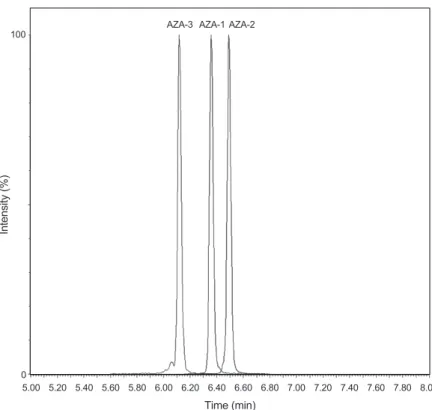
Fig. 1. LC-MS/MS chromatogram of standard solution of azaspiracid shellfish toxins. AZA, azaspiracid.
AZA-3
5.00 5.20 5.40 5.60 5.80 6.00 6.20 6.40 6.60 6.80 7.00 7.20 7.40 7.60 7.80 8.00
Time (min)
100
0
AZA-1 AZA-2
Intensity (%)
lus galloprovinciallis),
바지락(Short-necked clam Ruditapes philippinarum),
가리비(Scallop Argopecten irradians),
피조 개(Ark shell Scapharca broughtonii),
굴(Oyster Crassostrea gigas),
키조개(Comb pen shell Atrina pinnata),
개조개(Butter clam Saxidomus purpuratus)
등패류7
종과,
미더덕(Warty sea squirt Styela clava),
멍게(Sea squirt Halocynthia roretzi)
등피 낭류2
종의시료에3
종의아자스필산표준물질혼합용액을첨 가하여위와동일한방법으로추출하여회수율을측정하였다.
결과 및 고찰
분석법 유효성 시험결과
LC-MS/MS
를이용한아자스필산분석법을이용하여아자스필산
3
종의표준물질혼합용액을분석한결과7
분이내에모든 독소가분리되었으며,
주변에정량을방해하는peak
는검출되 지않았다(Fig. 1).
확립된시험방법의유효성검증을위하여표 준물질3
종을섞은혼합표준용액을0.8-10.0 μg/L
범위로단계 적으로희석하여직선성을검토하였다.
시험시오차범위를확 인하기위해5
회반복측정한결과,
아자스필산3
종표준물질의 상관계수(r
2)
는0.9995
이상으로Codex Alimentarius Commis- sion (2014)
가이드라인에서제안하는r
2≥0.98
이상의높은결 과값을나타내었다(Table 3).
AZA-1, 2, 3
의검출한계는각각0.16, 0.13
및0.08 μg/kg
이었 으며,
정량한계는각각0.50, 0.40
및0.23 μg/kg
로확인되었다(Table 3). Otero et al. (2019)
는LC-MS/MS
를이용하여패류 시료(
지중해담치)
에서AZA-1, 2, 3
을동시분석한결과, AZA- 1, 2, 3
의검출한계는0.30 μg/kg,
정량한계는0.90 μg/kg
수준 으로보고하였고, Yang et al. (2020)
은LC-MS/MS
를이용하 여CRM-Zero-Mus
에표준용액을첨가하여AZA-1, 2, 3
를분 석한결과, AZA-1, 2, 3
의정량한계는0.30-0.33 μg/kg
의범위 로본연구결과의검출한계및정량한계는만족할만한수준으 로확인되었다.
시험법의정확성
(accuracy)
과정밀성(precision)
은우리나라 주요생산패류중하나인지중해담치를대상으로하였고,
독 이없음을확인한후일내(intra-day)
및일간(inter-day)
반복하 여시험을실시하였다.
또한, 3
종의혼합표준용액을3
가지농도로첨가하여
1
일5
회및3
일간5
회반복측정한결과, AZA-1
의 일내정확성과 정밀성은각각87.5-89.4%
및3.41-4.91%
의범위를나타내었고
, AZA-2
의일내정확성과정밀성은각각88.8-93.0%
및2.34-4.34%
를나타내었다. AZA-3
의일내정 확성과정밀성은87.1-91.6%
및1.23-3.33%
의결과값을확인 하였다(Table 4).
또한,
일간정확성및정밀성은3
일간5
회반 복측정하였으며, AZA-1
의일간정확성과정밀성은각각83.0- 88.9%
및4.45-6.57%
를나타내었고, AZA-2
의일간정확성과 정밀성은각각86.7-90.2%
및4.92-6.06%
로확인되었다.
또한, AZA-3
의일간정확성과정밀성은85.5-88.4%
및2.72-4.18%
의결과를나타내었다
(Table 4). Codex Alimentarius Commis- sion (2014)
과AOAC (2013)
에서제시하는시험법검증가이 드라인의표준물질첨가에따른권장기준에따라,
정확성은10 μg/kg
에서60-115%,
정밀성은10 μg/kg
에서15%
보다낮은정 밀성을요구하고있다.
따라서본분석법은Codex
와AOAC
의 기준을만족하는것으로나타났으며,
따라서확립된시험법이 패류중아자스필산을분석하는데적합한방법임을확인할수 있었다.
분석법에 대한 시료 적용성 검토
본연구를통해확립된아자스필산분석법의적합성을확인 하기위하여국내에서생산되는대표적인패류및피낭류
9
종 에대한회수율을확인하였다.
시료에일정농도의혼합표준 용액을제조후첨가하여위와동일한방법으로추출한후5
회 반복측정하여시료에대한적합성을확인하였다.
패류7
종중 지중해담치에서 아자스필산의회수율은87.6-93.8%,
굴에서91.4-93.4%,
바지락에서76.4-92.1%,
피조개에서86.8-93.2%,
키조개에서91.1-96.0%,
개조개에서91.7-93.2%,
가리비에서 는93.0-94.6%
의범위를나타내었다(Table 5).
피낭류2
종중Table 4. Accuracy and precision of intra-day and inter-day for aza- spiracid shellfish toxins (n=5)
Toxins1 Spiked concentration
(μg/kg)
Intra-day Inter-day Accuracy
(%) RSD2
(%) Accuracy (%) RSD
(%)
AZA-1
4.0 87.5 3.88 83.0 6.33
2.0 88.9 3.41 86.3 6.57
1.0 89.4 4.91 88.9 4.45
AZA-2
4.0 89.6 4.34 86.7 4.92
2.0 93.0 2.34 90.2 6.06
1.0 88.8 3.68 86.8 5.86
AZA-3
4.0 87.1 1.84 85.5 2.75
2.0 86.5 1.23 87.0 2.72
1.0 91.6 3.33 88.4 4.18
1AZA-1, azaspiracid-1; AZA-2, azaspiracid-2; AZA-3, azaspirac- id-3. 2RSD, relative standard deviation.
Table 3. Linearity, limits of detection (LOD) and limits of quantita- tion (LOQ) of analysis for the azaspiracid shellfish toxins (n=5) Toxins1 Concentration
(μg/L) Linearity
(r2) LOD
(μg/kg) LOQ (μg/kg)
AZA-1 0.8-10.0 0.9999 0.16 0.50
AZA-2 0.8-10.0 0.9995 0.13 0.40
AZA-3 0.8-10.0 0.9998 0.08 0.23
1AZA-1, azaspiracid-1; AZA-2, azaspiracid-2; AZA-3, azaspi- racid-3.
멍게의회수율은
89.2-91.5%,
미더덕에서는87.8-94.5%
의범 위로확인되었다(Table 6).
본실험결과는Codex Alimentarius Commission (2014)
가이드라인의권장기준을만족하였다.
하 지만바지락에서AZA-2
의값이76.4%
로다른시료에비해다 소낮은회수율을나타내었다. Garcia-Altares et al. (2013)
은 지중해담치,
굴,
대합조개(clam),
성게(sea urchin)
를대상으로LC-MS/MS
를이용해AZA-1
을분석한결과92.5-117.3%
이 었고, Yang et al. (2020)
은진주담치,
굴,
대합조개에대상으로LC-MS/MS
를이용하여AZA-1, 2, 3
을분석한결과, AZA-1
에 서78.8-102%, AZA-2
에서78.1-94.5%, AZA-3
의값이66.2- 104%
로본연구결과와유사하였다.
따라서본실험결과는전 체적으로패류및피낭류총9
개시료의회수율은76.4-94.9%
로매우양호한수준으로확인되었다
.
최근각종패류독이세계여러지역으로확산되는사례가보 고되고있으며
,
우리나라연안의아열대화로인해신종유독플 랑크톤의검출도지속적으로보고되고있다.
따라서국내패류 의위생학적안전성확보를위해서아자스필산에대한적극적인 모니터링이요구된다.
본연구에서사용한
LC-MS/MS
를이용한아자스필산분석법은국제적인유효성기준을만족하는것으로확인되었으며
,
우리나라에서생산되는주요패류및피낭류에서아자스필산을 분석하는데적합한것으로평가되었다.
사 사
이논문은국립수산과학원수산과학연구사업수출패류생산 해역및수산물위생조사
(R2021060)
의지원으로수행된연구 이며연구비지원에감사드립니다.
References
AOAC (The Association of Official Agricultureal Chemists).
2013. Guidelines for dietary supplements and botanicals.
Appendix K, 8-9. In: Official methods of analysis. AOAC, Gaithersburg, MS, U.S.A.
Codex Alimentarius Commission. 2014. Principle for the estab- lishment of Codex methods of analysis. In: Procedural man- ual, twenty-first edition. FAO/WHO, Rome, Italy, 63-73.
European Commission. 2004. Regulation (EC) No 853/2004 of the European parliament and of the council of 29 April 2004 laying down specific hygiene of foodstuffs. Off J Eur Com- mun L139, 99-100.
FDA (Food and Drug Administration). 2011. National shellfish sanitation program guide for control of molluscan shell- fish 2011 revision. Retrieved from http://www.fda.gov/
Food/GuidanceRegulation/FederalStateFoodPrograms/
ucm2006754.htm on Jun 22, 2021.
Garcia-Altares M, Diogene J and Iglesia de la P. 2013. The implementation of liquid chromatography tandem mass spectrometry for the official control of lipophilic toxins in seafood:Single-laboratory validation under four chromato- graphic conditions. J Chromatogr A 1275, 48-60. https://doi.
org/10.1016/j.chroma.2012.12.021.
Ha KS, Lee KJ, Jeong YJ, Mok JS, Kim PH, Kim YK, Lee HJ, Kim DW and Son KT. 2018. Evaluation of sanitary safety for shellfish in Hansan·Geojeman, Korea. J Food Hyg Saf 33, 404-411. https://doi.org/10.13103/JFHS.2018.33.5.404.
Hall S. 1991. Natural toxins. In: Microbiology of marine food products. Ward DR and Hackney CR, eds. Van Nostrand Reinhold, New York, NY, U.S.A., 301-330.
Hess P, Butter T, Petersen A, Silke J and McMahon T. 2009.
Table 5. Recovery of azaspiracid toxins in shellfish (n=5)
Toxins1Original conc.
(μg/kg) Spiked
conc.
(μg/kg)
Mussel Oyster Short neck
clam Ark shell Comb pen
shell Butter clam Scallop Recovery
(%) RSD2
(%) Recovery (%) RSD
(%) Recovery (%) RSD
(%) Recovery (%) RSD
(%) Recovery (%) RSD
(%) Recovery (%) RSD
(%) Recovery (%) RSD
(%) AZA-1 ND3 2.0 89.9 5.74 92.8 2.96 80.2 5.62 86.8 4.67 91.1 5.12 93.2 3.72 93.0 2.94 AZA-2 ND 2.0 93.8 4.67 91.4 3.51 76.4 4.92 88.7 3.68 94.9 4.47 91.7 2.39 94.6 2.19 AZA-3 ND 2.0 87.6 3.83 93.4 2.08 92.1 3.54 93.2 1.88 96.0 3.43 92.5 3.10 93.3 1.11
1AZA-1, azaspiracid-1; AZA-2, azaspiracid-2; AZA-3, azaspiracid-3. 2RSD, relative standard deviation. 3ND, not detected.
Table 6. Recovery of azaspiracid toxins in tunicates (n=5) Toxins1 Original conc.
(μg/kg) Spiked concentration
(μg/kg) Sea squirt Warty sea squirt
Recovery (%) RSD2 (%) Recovery (%) RSD (%)
AZA-1 ND3 2.0 91.5 3.97 87.8 3.08
AZA-2 ND 2.0 90.9 4.78 88.6 3.85
AZA-3 ND 2.0 89.2 1.29 94.5 1.97
1AZA-1, azaspiracid-1; AZA-2, azaspiracid-2; AZA-3, azaspiracid-3. 2RSD, relative standard deviation. 3ND, not detected.
Performance of the EU-harmonised mouse bioassay for lipophilic toxins for the detection of azaspiracids in natu- rally contaminated mussel Mytilus edulis hepatopancreas tissue homogenates characterized by liquid chromatograpy coupled to tandem mass spectrometry. Toxicon 53, 713-722.
https://doi.org/10.1016/j.toxicon.2009.02.015.
Kim SU, Yuk DH, Park YA, Kim JA, Park AS and Kim YC.
2012. Analysis of diarrhetic shellfish poisoning toxins by liquid chromatograpy-electrospray ionization mass spec- trometry. Korean J Food Sci Technol 44, 390-392. https://
doi.org/10.9721/KJFST.2012.44.4.390.
Kim S, Kang YG, Kim HS, Yih W, Coats DW and Park MG.
2008a. Growth and grazing responses of the mixotrophic dinoflagellate Dinophysis acuminata as functions of light intensity and prey concentration. Aquat Microb Ecol 51, 301-310. https://doi.org/10.3354/ame01203.
Kim JH, Lee KJ, Suzuki T, Kang YS, Kim PH, Song KC and Lee TS. 2010. Seasonal variability of lipophilic shellfish toxins in bivalves and water, and abundance of Dinophysis spp. in Jinhae Bay, Korea. J Shellfish Res 29, 1061-1067.
https://doi.org/10.2983/035.029.0408.
Kim JH, Suzuki T, Lee KJ, Kim PH, Kamiyama T and Lee TS.
2008b. The first detection of okadaic acid and its deriva- tives in Korean bivalves by liquid chromatography-mass spectrometry. Fish Sci 74, 433-438. https://doi.org/10.1111/
j.1444-2906.2008.01541.x.
Kim JH, Tillmann U, Adams NG, Krock B, Stutts WL, Deeds JR, Han MS and Trainer VL. 2017. Identification of Azanid-
ium species and a new azaspiracid from Azanidium popo- rum in Puget sound, Washington state, USA. Harmful Algae
68, 152-167. http://doi.org/10.1016/j.hal.2017.08.004.KMFDS (Korea Ministry of Food and Drug Safety). 2020. Ko- rea food code. Retrieved from https://www.foodsafetykorea.
go.kr/foodcode/01_03.jsp?idx=12 on Jan 11, 2021.
Krock B, Tillmann U, John U and Cembella AD. 2009. Char- acterization of azaspiracids in plankton size-fractions and isolation of an azaspiracid-producing dinoflagellate from the North Sea. Harmful Algae 8, 254-263. https://doi.
org/10.1016/j.hal.2008.06.003.
Krock B, Tillmann U, Potvin E, Jeong HJ, Drebing W, Kilcoyne J, AI-Jorani A, Twiner MJ, Gothel Q and Kock M. 2015.
Structure elucidation and in vitro toxicity of new azaspirac- ids isolated from the marine dinoflagellate Azanidinium po-
porum. Mar Drugs 13, 6687-6702. https://doi.org/10.3390/
md13116687.
Lee KJ, Kwon SJ, Jung YJ, Son KT, Ha KS, Mok JS and Kim JH. 2017. Comparison of analytical methods for the detec- tion of paralytic shellfish toxins. Korean J Fish Aquat Sci 50, 669-674. https://doi.org/10.5657/KFAS.2017.0669.
Lee KJ, Suzuki T, Kim PH, Oh EG, Song KC and Kim JH.
2009. Establishment of a method for the analysis of diar- rhetic shellfish poisoning by liquid chromatography-tandem
mass spectrometry. Korean J Food Sci Technol 41, 458-463.
Lee JS, Yun SM, Jang JH, Shin IS and Lee JO. 2007. Detec- tion of diarrhetic shellfish poison by LC-MS/MS. J Korean Soc Food Sci Nutr 36, 926-931. https://doi.org/10.3746/
jkfn.2007.36.7.926.
Lee S, Hwang BS, Kim HS, Yih W, Jeong EJ and Rho JR. 2015.
A new diol ester derivative of dinophysistoxin-1 from cul- tures of Prorocentrum lima collected in South Korea. Bull Korean Chem Soc 36, 395-398. https://doi.org/10.1002/
bkcs.10031.
McCarron P, Giddings SD, Reeves KL, Hess P and Quilliam MA. 2014. A mussel Mytilus edulis tissue certified reference material for the marine biotoxins azaspiracids. Anal Bioanal Chem 407, 2985-2996. https://doi.org/10.1007/s00216-014- 8250-5.
Nicolaou KC, Frederick MO, Petrovic G, Cole KP and Loizidou EZ. 2006. Total synthesis and confirmation of revised struc- tures of azaspiracid-2 and azaspiracid-3. Angew Chem Int Ed 45, 2609-2615. http://doi.org/10.1002/anie.200600295.
Noguchi T. 2003. Marine toxins. Nippon Suisan Gakkaishi 69, 895-909. https://doi.org/10.2331/suisan.69.895.
Otero P, Miguens N, Rodriguez I and Botana LM. 2019. LC- MS/MS analysis of the emerging toxin pinnatoxin-G and high levels of esterified oa group toxins in Galician com- mercial mussels. Toxins 11, 394. https://doi.org/10.3390/
toxims11070394.
Park K, Jo MR, Kwon JY, Son KT, Lee DS and Lee HJ. 2010.
Evaluation of the bacteriological safety of the shellfish- growing area in Gangjinman, Korea. Korean J Fish Aquat Sci 43, 614-622. http://doi.org/10.5657/kfas.2010.43.6.614.
Quilliam MA. 2003. Chemical methods for lipophilic shellfish toxins. In: Manual on harmful marine microalgae. Hal- legraeff GM, Anderson DM and Cembella AD, eds. Monog- raohs on oceanographic methodology, Paris, Italy, 211-246.
Satake M, Ofuji K, Naoki H, James KJ, Furey A, McMahon T, Silke J and Yasumoto T. 1998. Azaspiracid, a new marine toxin having unique spiro ring assemblies, isolated from Irish mussels, Mytilus edulis. J Am Chem Soc 120, 9967- 9968. https://doi.org/10.1021/ja981413r.
Schantz EJ, Mold JD, Stranger DW, Shavel J, Riel FJ, Bowden JP, Lynch JM, Wyler RS, Reigel B and Sommer H. 1957.
Paralytic shellfish poison. A procedure for the isolation and purification of the poison form toxic clams and mus- sel tissues. J Am Chem Soc 79, 5230-5235. https://doi.
org/10.1021/ja01576a044.
Suzuki T, Jin T, Shirota Y, Mitsuya T, Okumura Y and Kami- yama T. 2005. Quantification of lipophilic toxins associated with diarrhetic shellfish poisoning in Japanese bivalves by liquid chromatography-mass spectrometry and comparison with mouse bioassay. Fish Sci 71, 1370-1378. https://doi.
org/10.1111/j.1444-2906.2005.01104.x.
Toyofuku H. 2006. Joint FAO/WHO/IOC activities to provide
scientific advice on marine biotoxins (research report). Mar Pol Bull 52, 1735-1745. https://doi.org/10.1016/j.marpol- bul.2006.07.007.
Twiner MJ, Rehmann N, Hess P and Doucette GJ. 2008. Azaspi- racid shellfish poisoning: a review on the chemistry, ecology, and toxicology with an emphasis on human health impacts.
Mar Drugs 6, 39-72. https://doi.org/10.3390/md6020039.
Yang L, Shigh A, Lankford SK, Stuart J, Rice D, Wu WH and Hungerford JM. 2020. A rapid method for the detection of diarrhetic shellfish toxins and azaspiracid shellfish toxins in Washington state shellfish by liquid chromatography tan- dem mass spectrometry. J AOAC Int 103, 792-799. https://
doi.org/10.1093/jaoacint/qsaa009.