Introduction
The reported incidence of medial plica of the knee found dur
ing arthroscopy varies from 22% to almost 80%
1,2). The healthy medial plica has smooth elastic properties and slides freely over the femoral condyle with knee movement. However, a pathologi
cal medial plica can develop when inflammation and fibrosis oc
cur. Patients suffer anterior knee pain more often on the medial aspect
35). The pain is often made worse through activities involv
ing flexion of the knee and may be associated with symptom of knee clicking or locking
6). Often there is a history of injury or
reparative sporting activity
47).
The diagnosis of symptomatic medial plica is challenging, as the medial plica is a common incidental finding
8)and the symptoms experienced by the patient with a pathological medial knee plica are indistinguishable on clinical examination to other patholo
gies of the knee including torn menisci, inflammation, and os
teochondral defects
9). Similarly, the management of pathological medial plica is controversial
10), with beneficial effects reported for both nonsurgical
11,12)and surgical treatment
13). Nonsurgical management uses analgesia and antiinflammatory medications along with physiotherapy. However, when this has not improved the patient’s symptoms, surgical arthroscopic intervention may be employed. At arthroscopy the pathological medial plica may be excised or divided, with studies advocating complete excision to be a superior treatment
7). Surgical intervention is not without its risks as a patient is subject to the inherent dangers of surgery in
cluding anaesthetic risks and thromboembolic events, combined with the possibility of the surgery not improving symptoms
14)or causing local complications such as haemarthrosis and swelling, increasing the patient’s morbidity
1517).
A previous metaanalysis performed for all types of knee plica
Arthroscopic Excision of Medial Knee Plica: A Meta
Analysis of Outcomes
Adam Daniel Gerrard, MRCS 1 and Charalambos P. Charalambous, FRCS 1,2
1
Department of Orthopaedics, Blackpool Victoria Hospital, Blackpool;
2School of Medicine, University of Central Lancashire, Preston, UK
Purpose: A metaanalysis was performed to assess the outcomes following surgical intervention for medial knee plica.
Materials and Methods: A literature search of Medline, EMBASE, CINAHL and Cochrane CENTRAL was performed using relevant key words. The primary outcome was patientreported postoperative scores of “good” and “excellent”. Metaanalyses were performed using a random effects model.
Results: The literature search identified 731 articles. After removing duplicates and those not meeting the inclusion criteria, 12 articles reporting on a total of 643 knees were included for analysis, and of these, 7 articles including 235 knees were used for metaanalysis. The overall rate of good and excellent outcomes following surgery was estimated at 84.2% (95% confidence interval [CI], 72.8–91.4). In those cases that had nonsurgical therapy prior to surgery, the rate of good and excellent outcomes of surgery was estimated at 76.1% (95% CI, 60.1–87).
Conclusions: Arthroscopic surgical management of symptomatic medial knee plica results in favourable outcomes. Our results suggest that arthroscopic surgical excision should be considered as a treatment modality in patients with pathological medial plica disease of the knee either as a firstline treatment or when symptoms have not responded to nonsurgical interventions.
Level of Evidence: IV
Keywords: Knee, Plica, Medial, Arthroscopy, Excision pISSN 2234-0726 · eISSN 2234-2451
Knee Surgery & Related Research
Received February 13, 2018; Revised April 19, 2018;
Accepted August 1, 2018
Correspondence to: Charalambos P. Charalambous, FRCS
Department of Trauma and Orthopaedics, Blackpool Teaching Hospitals NHS Trust, Whinney Heys Rd, Blackpool FY3 8NR, UK
Tel: +441253955983, Fax: +441253953530 Email: [email protected]
356
This is an Open Access article distributed under the terms of the Creative Commons Attribution NonCommercial License (http://creativecommons.org/licenses/bync/4.0/) which permits unrestricted noncommercial use, distribution, and reproduction in any medium, provided the original work is properly cited.
Copyright © 2018 KOREAN KNEE SOCIETY www.jksrr.org
and including children found arthroscopic resection resulted in patients being asymptomatic in 64% of cases and 26% only ex
periencing intermittent symptoms
18). We hypothesise that within adult patients with only pathological medial plica, arthroscopic excision will yield similar positive postoperative outcomes. This will give surgeons, patients, and health care commissioners infor
mation to guide best care.
Materials and Methods
A literature search of MEDLINE (1946 to present), EMBASE (1974 to present), CINAHL (1961 to present), and Cochrane CENTRAL (1988 to present) databases was conducted using any combination of the key words, “plica” and “knee” in December 2016 for articles published in English with no publication year limit.
The study inclusion criteria were as follows: studies includ
ing patients over the age of 15 years, published in the English language, reporting cases having arthroscopic intervention in medial plica disease with no other coexisting knee pathology, and reporting outcomes per knee rather than per patient. Studies that reported their outcomes as excellent, good, fair, or poor were included. Randomised control trials and retrospective and pro
spective study designs were included, with case series of less than ten patients and case reports excluded.
The title and abstract of the articles were reviewed by both authors against the inclusion criteria. Where no decision about inclusion could be made from the publication title and abstract alone, the full texts were reviewed by the first author. The lists of references for all included articles were searched for any further articles for inclusion not identified in the database search.
An electronic standardised proforma for data extraction was created and utilized. The first author performed data collection, and where there was uncertainty, this was checked by the second author. Where articles included other types of pathology or other types of plica, the data for patients with only medial plica were included.
The Preferred Reporting Items for Systematic Review and MetaAnalyses (PRISMA) methodology was used
19). The articles were appraised using the methodological index for nonrandom
ized studies
20). 1. Statistical Analysis
The primary outcome was patientreported postoperative scores of “good” and “excellent”. Metaanalyses were performed using randomeffects model
20), 95% confidence intervals (CIs)
were calculated, and the heterogeneity was assessed using tau
2, I
2, Q, and pvalues. Funnel plots were created, with no formal asym
metrical tests performed. Data were analyzed with CMA ver. 2 (Biostat, Englewood, NJ, USA).
Results
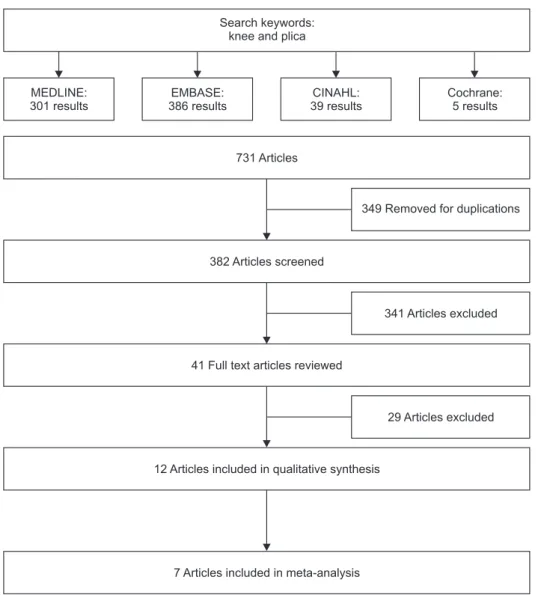
The search of the databases produced 731 results. Duplicated articles were removed, and the remaining articles were assessed.
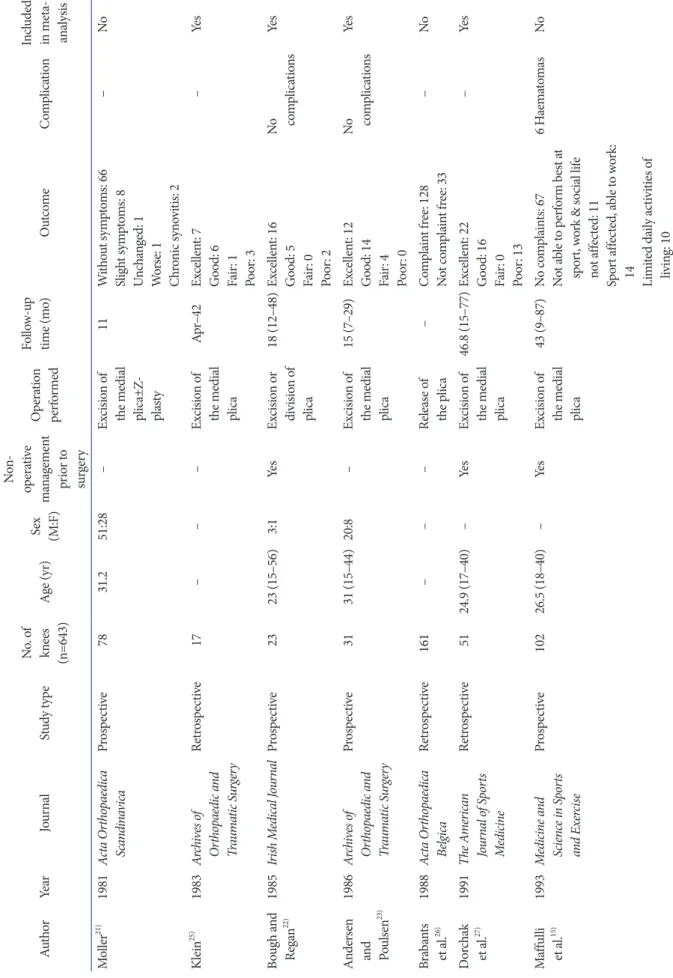
Those of no relevance were eliminated, leaving 41 articles whose full texts were examined (Fig. 1). Twelve articles were identified that reported outcomes of arthroscopic medial plica excision (Table 1). In the study by Yilmaz et al.
16), one patient was under the age of 15 years, and the outcomes of that single case were re
moved from analysis. These studies reported a total of 643 knees which had arthroscopic surgery for symptomatic medial plica.
Followup ranged between four and 87 months, with the mean age across the studies of between 25 years and 45 years. Six stud
ies were prospective in their design
15,16,2124)and six were retro
spective
17,2529).
In five of these 12 studies, all participants had undergone a course of physiotherapy and conservative management prior to arthroscopic surgery
1517,2227). One contained patients whose symptoms persisted despite prior operations
21)whilst six did not state what measures had been tried prearthroscopic surgi
cal intervention
2326,28,29). Of these 12 studies, three reported no complications from arthroscopic management of medial knee plicae
25,22,28), two reported cases of effusion within the knee joint postoperatively with all settling without further operative in
tervention
16,17). One study reported four cases of haemarthrosis which required aspiration at one week
28). Of these 12 studies, one described their improvement in outcomes in terms of presence or change in symptoms
21), one with regards to presence or absence of knee complaints
26), one in terms of influence upon daily activi
ties
15), and one in terms of satisfaction
24). Two studies used mean functional Lysholm scores pre and postoperatively. Both of these found improvements with surgery. Yilmaz et al.
16)reported a mean preoperative scores of 38.5 and a mean postoperative score of 82. Uysal et al.
17)reported a mean preoperative scores of 67.19±8.05 and a mean postoperative score of 90.57±9.80. A third study by Guney et al.
29)used Western Ontario and McMas
ter Universities Osteoarthritis Index (WOMAC) scores and pub
lished mean preoperative and postoperative scores of 1.4±0.7/1.3
(0–3.04) and 0.2±0.5/0 (0–2.42), respectively, again showing an
improvement with surgery. In the studies by Maffulli et al.
15)and
Uysal et al.
17), the included cases had undergone a course of phys
iotherapy and conservative management prior to arthroscopic surgery.
Seven studies including 235 knees reported their outcomes as either excellent, good, fair, or poor
16,22,23,25,2729)and were thus used for metaanalysis (Table 1). Of these, 3 studies reported cases that had undergone a course of physiotherapy and conservative man
agement prior to arthroscopic surgery
16,22,27), and a further meta
analysis was performed for these studies in isolation. Metaanaly
sis of all seven included studies showed that arthroscopic excision of medial knee plica resulted in favorable outcomes in most cases (Fig. 2). An outcome of good or excellent was seen in 84.2% (95%
CI, 72.8–91.4) of knees following arthroscopic resection of patho
logical medial plica (21 knees; heterogeneity: tau
2=0.52; I
2=64.7%;
Q=17; df=6; p=0.009). Funnel plot visual analysis did not show an obvious small study effect. Metaanalysis of the three studies where the participants had nonsurgical interventions prior to arthroscopic surgery showed that arthroscopic excision of medial
knee plica resulted in favorable outcomes in most cases; an out
come of good or excellent was seen in 76.1% (95% CI, 60.1–87) following arthroscopic resection of pathological medial plica (Fig.
3) (heterogeneity: tau
2=0.22; I
2=50.2%; Q=4; df=2; p=0.134).
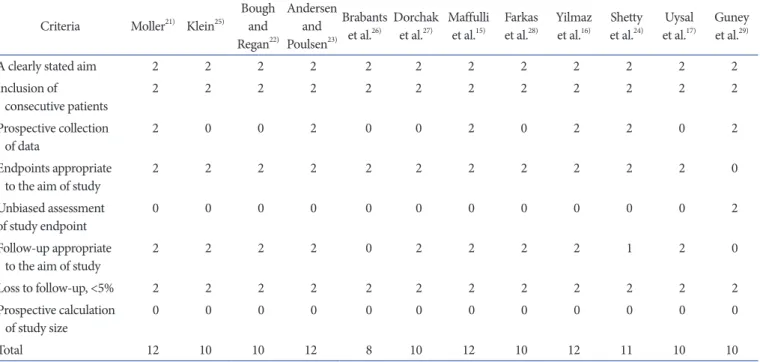
Critical appraisal of the included studies using MINORS cri
teria
20)are summarised in Table 2. A clearly stated aim could be observed in all. Unbiased assessment of outcomes was not seen in any of the studies, as they did not use independent evaluators to assess the postoperative outcomes.
Discussion
The results of this metaanalysis demonstrate that arthroscopic excision of symptomatic medial knee plica leads to favourable clinical outcomes in most cases. Hence, based on our results, we recommend that arthroscopic excision of symptomatic medial knee plica is considered as a treatment modality in those patients
Search keywords:
knee and plica
MEDLINE:
301 results
EMBASE:
386 results
CINAHL:
39 results
Cochrane:
5 results
731 Articles
382 Articles screened
41 Full text articles reviewed
12 Articles included in qualitative synthesis
7 Articles included in meta-analysis
349 Removed for duplications
341 Articles excluded
29 Articles excluded
Fig. 1. Study flow diagram.
Ta bl e 1. Summ ar y o f S tud y D em og ra phics, O ut co m es, a nd C om plic at io ns Aut hor Ye ar Jo ur na l St ud y t yp e N o. o f kn ees (n=643) Ag e (y r) Sex (M:F)
No n op era tiv e m an ag em en t pr io r t o su rge ry
O pera tio n pe rfo rm ed
Fo llo w up tim e (m o) O ut com e Co m plic at io n In clude d in m et a ana lys is M ol ler
21)1981 Ac ta O rtho pae di ca Sca nd ina vi ca Pr os pec tiv e 78 31.2 51:28 – Ex cisio n o f th e m edi al plic a±Z pla sty
11 W ith ou t sy m pt om s: 66 Slig ht sy m pt om s: 8 Un ch ange d: 1 W or se: 1 Chr onic sy no vi tis: 2
– No Klein
25)1983 Ar ch ive s o f O rtho pae di c a nd Tr aum at ic Sur ge ry
Re tro sp ec tiv e 17 – – – Ex cisio n o f th e m edi al plic a
Ap r–42 Ex ce llen t: 7 G oo d: 6 Fa ir: 1 Po or : 3
– Ye s Bo ug h a nd Rega n
22)1985 Iri sh M edi ca l J our na l Pr os pec tiv e 23 23 (15–56) 3:1 Ye s Ex cisio n o r di vi sio n o f plic a
18 (12–48) Ex ce llen t: 16 G oo d: 5 Fa ir: 0 Po or : 2
No com plic at io ns Ye s An der sen an d Po ul se n
23)1986 Ar ch ive s o f O rtho pae di c a nd Tr aum at ic Sur ge ry
Pr os pec tiv e 31 31 (15–44) 20:8 – Ex cisio n o f th e m edi al plic a
15 (7–29) Ex ce llen t: 12 G oo d: 14 Fa ir: 4 Po or : 0
No com plic at io ns Ye s Bra ba nts et a l.
26)1988 Ac ta O rtho pae di ca Bel gic a Re tro sp ec tiv e 161 – – – Re lea se o f th e p lic a – Co m pl ain t f re e: 128 N ot co m pl ain t f re e: 33 – No D orc ha k et a l.
27)1991 Th e A m er ica n Jo ur na l o f S po rts M edi cin e
Re tro sp ec tiv e 51 24.9 (17–40) – Ye s Ex cisio n o f th e m edi al plic a
46.8 (15–77) Ex ce llen t: 22 G oo d: 16 Fa ir: 0 Po or : 13
– Ye s M af fu lli et a l.
15)1993 M ed ici ne a nd Sci en ce i n S po rts an d E xer cis e
Pr os pec tiv e 102 26.5 (18–40) – Ye s Ex cisio n o f th e m edi al plic a
43 (9–87) N o co m pl ain ts: 67 N ot a ble t o p er fo rm b es t a t sp or t, w or k & s oci al lif e no t a ffe ct ed: 11 Sp or t a ffe ct ed , a ble t o w or k:
14 Limi te d d ail y ac tiv ities o f liv in g: 10
6 H ae ma to mas No
Ta bl e 1. C ont inu ed Aut hor Ye ar Jo ur na l St ud y t yp e N o. o f kn ees (n=643) Ag e (y r) Sex (M:F)
No n op era tiv e m an ag em en t pr io r t o su rge ry
O pera tio n pe rfo rm ed
Fo llo w up tim e (m o) O ut com e Co m plic at io n In clude d in m et a ana lys is Fa rka s et a l.
28)1997 Ac ta Ch iru rg ica H ung ar ica Re tro sp ec tiv e 14 23.6 (15–43) 1:1 – Ex cisio n o f th e m edi al plic a
18 (7–35) Ex ce llen t: 4 G oo d: 9 Fa ir: 0 Po or : 1
No com plic at io ns Ye s Yi lm az et a l.
16)2005 Int er nat io na l O rth op ae di cs RCT b et we en dif fer en t p lic a exicio ns
23 45.1 1:2 Ye s Ex cisio n o f th e m edi al plic a
30 (24–36) Ex ce llen t: 5 G oo d: 10 Fa ir: 2 Po or : 6
20/23 S elf res ol vin g ef fu sio ns
Ye s Sh et ty et a l.
24)2007 Jo ur na l o f K ne e Sur ge ry Pr os pec tiv e 44 45 (15–65) – – Res ec tio n o f th e p lic a 3 Sa tisfac to ry : 39 Un sa tisfac to ry : 5 – No U ys al et a l.
17)2008 Int er nat io na l O rth op ae di cs Re tro sp ec tiv e 23 42.4 (23–60) 14:8 Ye s Plic a r es ec te d wi th p un ch an d t hen sh av ed
21 (13–24) Al l p at ien ts r ega in ed f ul l ra ng e o f m ov em en t Av era ge L ys ho lm k ne e s ca le sco re: pr eo pera tiv e, 67.19±8.05, pos to pera tiv e, 90.57±9.80
2/23 S elf res ol vin g ef fu sio ns
No G un ey et a l.
29)2010 Kn ee S ur ger y, S po rts Tr au m atol og y, Ar th ro scop y
Re tro sp ec tiv e 76 37.2 (15–61) 44:32 – Ex cisio n o f th e m edi al plic a
6 Ex ce llen t: 72 G oo d: 2 Fa ir: 2 Po or : 0 M ea n W O MA C s co re: pr eo pera tiv e, 1.4±0.7/1.3
(0–3.04) pos to pera tiv e, 0.2±0.5/0 (0–2.42)
– Ye s Va lues a re p res en te d a s m ea n (ra ng e). RCT : ra ndo mize d co nt ro lle d t ria l, W O MA C: W es ter n On ta rio a nd M cM as ter U ni ver sit ies O ste oa rthr iti s I ndex.
that fail initial nonsurgical management. Five of our included studies looked at patients who had a course of physiotherapy and conservative management prior to arthroscopic surgery.
One of these
15)showed that 67 of 102 cases had no postsurgery complaints with regards to functional activities, whilst another study
17)reported an improvement in the mean Lysholm knee score from 67.19±8.05 prior to surgery to 90.57±9.80 postsurgery.
Metaanalysis of three further studies which reported their out
comes as excellent, good, fair, or poor showed that arthroscopic excision of medial knee plica resulted in a good or excellent out
come in an estimated 76.1% (95% CI, 60.1–87) of cases.
Synovial plica of the knee was first described by Mayeda in 1918. It is thought that a plica is a remnant strand of mesenchy
mal tissue persisting from the embryonic development of the
0.765 0.839 0.913 0.974 0.652 0.929 0.745 0.842 Study name
Klein
Andersen and Poulse Bough and Regan Guney et al.
Yilmaz et al.
Farkas et al.
Dorchak et al.
25)
23) 22) 29) 16) 28) 27)
Lower limit Event
rate
0.514 0.666 0.711 0.901 0.443 0.630 0.609 0.728
Event rate and 95% CI
0.00 1.00
Upper limit 0.909 0.931 0.978 0.993 0.816 0.990 0.846 0.914
0.50 0.50
1.00 Meta-analysis
Fig. 2. Metaanalysis of outcomes rated as good and excellent following arthroscopic excision of medial knee plica. CI: confi
dence interval.
0.913 0.652 0.745 0.761 Study name
Bough and Regan Yilmaz et al.
Dorchak et al.
22) 16)
27)