• 검색 결과가 없습니다.

A Study on Absorption Properties of the EM Wave Absorber Using TiO<sub>2</sub> in W-band

N/A
N/A
Protected

Academic year: 2021

Share "A Study on Absorption Properties of the EM Wave Absorber Using TiO<sub>2</sub> in W-band"

Copied!
5
0
0

로드 중.... (전체 텍스트 보기)

전체 글

(1)

Vol.34, No.2 pp. 111~115, 2010 (ISSN-1598-5725)

A Study on Absorption Properties of the EM Wave Absorber Using TiO

2

in W-band

Chang-Mook Choi†․Kwang-Soob Ko*

*,Department of Navigation & Shiphandling, Korea Naval Academy, Jinhae 645-797, Korea

Abstract : In this paper, the electromagnetic (EM) wave absorbers using TiO2 as a dielectric material with chlorinated polyethylene (CPE) were investigated in W-band radio frequencies. We compared the relative permittivity with reflectionless curve and the absorption properties of samples containing 40 wt.%, 50 wt.%, 60 wt.%, 70 wt.%, and 80 wt.% TiO2. It is possible to realize a complex relative permittivity satisfying the reflectionless condition by choosing composition ratio of TiO2. The optimized composition ratio of TiO2 for the maximum absorption property is about 70 wt.%. As a result, we have confirmed the realization of an EM wave absorber with a high absorption property in W-band radio frequencies.

Key words : Absorption property, Complex relative permittivity, Material property, Reflectionless condition, TiO2..

†Corresponding Author : Chang-Mook Choi, [email protected], 010-4846-1864

* [email protected], 055)542-0565

1. Introduction

Millimeter waves offer a solution to the increasing demand for frequency allocation due to low-frequency band saturation and the requirement for higher data rates.

Moreover, a high directivity can be obtained by the small antennas which are associated with small-sized circuits. For these reasons, the extensive research on the applications of millimeter waves has been done. In particular, research on applications in W-band is progressing rapidly (Russell., 1997;

Brooker, 2005). The electromagnetic (EM) wave absorbers are effective for prevention of electromagnetic interference possibly caused by high degree of usage of electromagnetic waves. Therefore, researchers have confirmed the realization of a sheet-type absorber with a high absorption property at these frequency ranges (Soh and Hashimoto, 2001).

As is well known, EM wave absorbers can be broadly divided into two types from the viewpoint of material. One is a wave absorber using a dielectric material and the other is a magnetic wave absorber using a ferrite material (Kotsuka and Yamazaki, 2000).

In general, Carbon and titanium dioxide as a dielectric material, and Permalloy as a magnetic material are useful materials for EM wave absorption in W-band, and absorption properties of EM wave absorbers using Carbon or Permalloy have been investigated (Choi, 2007; Kim, 2007).

But, absorption properties of samples in composition ratio of

TiO

2

have not been reported yet.

In this research, we investigated EM wave absorbers using TiO

2

as a dielectric material with chlorinated polyethylene (CPE) as a binder. First of all, we fabricated sheet-type EM wave absorbers containing 40 wt.%, 50 wt.%, 60 wt.%, 70 wt.%, and 80 wt.% TiO

2

. These material properties were calculated using S-parameters and analyzed along with reflectionless condition. The optimized composition ratio of TiO

2

as a dielectric material has been estimated for high absorption property under reflectionless condition. We have confirmed the realization of an EM wave absorber containing TiO

2

in W-band.

2. Preparation and measurement of samples

2.1 Preparation of samples

In this research, we fabricated some samples in different composition ratio of TiO

2

and CPE. TiO

2

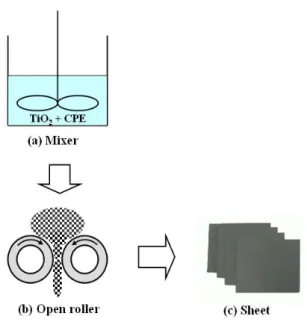
was mixed with the binder of CPE, and a sheet-type absorber was fabricated by using an open roller as shown in Fig. 1. The open roller's surface temperature was maintained at 70 ˚C during sample preparation because the surface temperature affects the EM wave properties of sheet-type absorbers (Moon, 2003). To investigate the effect of the composition ratio of the material, we fabricated samples containing 40 wt.%, 50 wt.%, 60 wt.%, 70 wt.%, and 80wt.% TiO

2

.

The dimensions of the sample to measure the complex

(2)

relative permittivity were 2.54 × 1.27 × 1.5 mm and 2.54 × 1.27 × 3 mm.

Fig. 1 Manufacturing process of an EM wave absorber

2.2 Measurement for reflection coefficient

The measurement equipment in this research is used for the reflection measurement. It includes an ANRITSU ME 78080A broadband vector network analyzer, rectangular waveguide, sample holder, and short circuit. Figures 2 and 3 are diagrams of the measurement setup used for measuring the reflection coefficient and the sample holder for rectangular waveguide, respectively. The reflection coefficient of the sample can be obtained from S

11

after critical calibration.

3. Results and discussion

3.1 A comparison of the relative permittivity of the samples

The relative permittivity of the samples is calculated using S-parameters of a network analyzer by using ℓ-2ℓ method (Naito, 1987). Figure 4 shows plots of measured complex relative permittivity ( ε

r

= ε

r'

j

ε

r''

) at different frequencies, together with the first-order, second-order and third-order curves among the reflectionless curves obtained by solving eq.(1)

1 2 )

tanh(

1 r =

r

j d
ε

λ π

ε (1)

where ε

r

, d , and λ are the relative permittivity, the

sample thickness, and the wavelength, respectively (Hashimoto, 1997).

Fig. 2 Measurement setup for the reflection coefficient

Fig. 3 Sample holder for rectangular waveguide

If a material is used for the measured complex relative permittivity exists on the reflectionless curve, an ideal EM wave absorber can be obtained. From comparison in Fig. 4, it is found that the complex relative permittivity of the samples approaches to the reflectionless curve from 40 wt.% to 70 wt.% and gets away from 80 wt.% of TiO

2

by impedance matching. From above result, we know that the complex relative permittivity of the sample containing 70 wt.% of TiO

2

crosses the reflectionless curves. Therefore, the sample containing 70 wt.% of TiO

2

is suitable for developing an excellent EM wave absorber.

Fig. 4 Measured result of relative permittivity

(3)

3.2 A comparison of the SEM micrographs of the samples

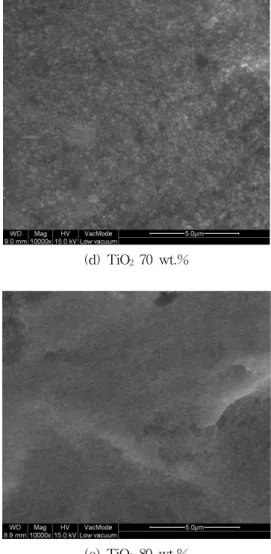
The SEM micrographs of samples are presented in Fig. 5, and show that all TiO

2

particles were mixed with the binder and that the number air holes decreased with increasing composition ratio of TiO

2

.

(a) TiO

2

40 wt.%

(b) TiO

2

50 wt.%

(c) TiO

2

60 wt.%

(d) TiO

2

70 wt.%

(e) TiO

2

80 wt.%

Fig. 5 Sem micrographs of samples containing various composition ratio of TiO

2

3.3 A comparison of the absorption properties of the samples

Fig. 6 Reflection coefficient as a function of frequency for samples with a composition of TiO2:CPE=40:60 wt.%

in several thickness

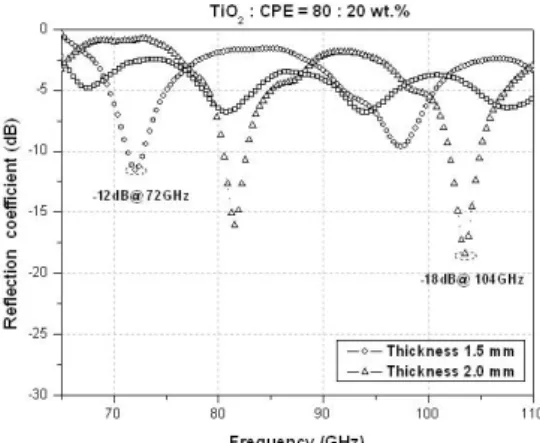
Figures 6-10 plot the reflection coefficients against

frequency. The thicknesses of the samples shown in Figures

are 1.5 mm and 2.0 mm. The absorption property has a

(4)

tendency to increase from 40 wt.% to 70 wt.% and decrease from 70 wt.% to 80 wt.% TiO

2

. In Fig. 9, the maximum values of absorption properties of 1.5 mm and 2.0 mm thick samples are 30 dB at 87 GHz and 29 dB at 92 GHz, respectively. As a result, the absorption property of the sample containing TiO

2

: CPE = 70 : 30 wt.% has a maximum value in frequency range of 65-110 GHz.

Fig. 7 Reflection coefficient as a function of frequency for samples with a composition of TiO2:CPE=50:50 wt.%

in several thickness

Fig. 8 Reflection coefficient as a function of frequency for samples with a composition of TiO2:CPE=60:40 wt.%

in several thickness

Fig. 9 Reflection coefficient as a function of frequency for samples with a composition of TiO2:CPE=70:30 wt.%

in several thickness

Fig. 10 Reflection coefficient as a function of frequency for samples with a composition of TiO2:CPE=80:20 wt.%

in several thickness

4. Conclusion

In this paper, we investigated EM wave absorbers using TiO

2

as a dielectric material. Material properties of the samples were calculated from S-parameters and analyzed under reflectionless condition. It is found that the relative permittivity of the sample containing 70 wt.% of TiO

2

goes across the reflectionless curves. Therefore, the sample containing 70 wt.% of TiO

2

is suitable for developing an excellent EM wave absorber. The absorption properties of the samples were measured by using a vector network analyzer. The absorption property has a tendency to increase from 40 wt.% to 70 wt.% and decrease from 70 wt.% to 80 wt.% of TiO

2

. 1.5 mm and 2.0 mm thick samples containing 70 wt.% of TiO

2

have a maximum absorption value 30 dB at 87 GHz and 29 dB at 92 GHz, respectively. As a result, the absorption property of the sample containing TiO

2

: CPE = 70 : 30 wt.% has a maximum value in W-band radio frequencies.

References

[1] Brooker, G. M., Birch, D., and Solms, J.(2005), “W-Band Airborne Interrupted Frequency Modulated CW Imaging Radar,” IEEE Trans. Aero. Elec. Sys., vol.41, no.3, p.955-971.

[2] Brooker, G. M., Scheding, S., Bishop, M. V., and Hennessy, R. C.(2005), “Development and Application of Millimeter Wave Radar Sensors for Underground Mining," IEEE Sensors J., vol.5, no.6, pp. 1270-1280.

[3] Choi, C. M., Kim, D. I., and Li, R.(2007), “A Study on

the Absorption Properties of EM Wave Absorbers Using

Carbon," J. Korean Phys. Soc., vol.41, no.2, pp. 470-473.

(5)

[4] Choi, C. M., Kim, D. I., Je, S. H., and Choi, Y. S.(2007),

“Study on Electromagnetic Wave Absorber for the Collision-avoidance Radar," Current Applied Physics, vol.7, no.5, pp. 586-589.

[5] Hashimoto, O(1997), Introduction to Wave Absorber, Tokyo, Morikita Shuppan, p. 29.

[6] Kim, D. I., Choi, C. M., Li, R., and Lee, D. H.(2007), “A Study on Electromagnetic Wave Absorber for W-Band Radars Using Permalloy," IEICE Trans. Comm., vol.E90-B, no.8, pp. 2138-2142.

[7] Kotsuka, Y. and Yamazaki, H.(2000), “Fundamental Investigation on a Weakly Magnetized Ferrite Absorber," IEEE Trans. Electromag. Compat., vol.42, no.2, pp. 116-124.

[8] Moon, S. H., Shin, S. J., Song, J. M., Kim, D. I., and Kim, K. M. (2003), “Development of composite Ba ferrite EM wave absorbers for GHz frequency,” J. Korea Electromag. Engin. Soc., vol. 14, no. 12, pp. 1329-1334.

[9] Naito, Y. (1987), Electromagnetic Wave Absorbers, Tokyo, New Ohm, p. 80.

[10] Russell, M. E., Crain, A., Curran, A., Campbell, R. A., Drubin, C. A., and Miccioli, W. F.(1997),

“Millimeter-Wave Radar Sensor for Automotive Intelligent Cruise Control(ICC)," IEEE Trans. Microw.

Theory Tech., vol.45, no.12, pp. 2444-2453.

[11] Soh, T., Hashimoto, O. (2001), “A Study on Millimeter-Wave Absorber Coating for V Band and W Band,” Trans. IEICE, vol. J84-B, no.8, pp. 1523-1528.

Received 5 January 2010

Revised 19 March 2010

Accepted 22 March 2010

수치

Fig. 2 Measurement  setup  for  the  reflection  coefficient
Fig. 6 Reflection  coefficient  as  a  function  of  frequency  for  samples  with  a  composition  of  TiO2:CPE=40:60  wt.%
Fig. 7 Reflection  coefficient  as  a  function  of  frequency  for  samples  with  a  composition  of  TiO2:CPE=50:50  wt.%

참조

관련 문서