Journal of Navigation and Port Research International Edition Vol.35, No.9 pp. 717~720, 2011 (ISSN-1598-5725)
DOI : http://dx.doi.org/10.5394/KINPR.2011.35.9.717
- 717 -
Development of EM Wave Absorber for Hi-pass System Using Amorphous Metal Powder
†Dong Il Kim, Gun Suk Yoo*, Dong Soo Choi*
* Department of Radio Sciences & Engineering, Korea Maritime University, Busan, Korea
Abstract : In this paper, we designed and fabricated the Electromagnetic(EM) wave absorber for an Electronic Toll Collection(ETC or Hi-pass) system by using Amorphous metal powder and CPE. The material properties and the absorption properties of the samples containing 50 wt.%, 60 wt.%, 70 wt.%, and 80 wt.% of Amorphous. Moreover, the EM wave absorption abilities were simulated for the different thicknesses of the EM absorbers by adopting the measured permittivity and permeability, and then the EM wave absorber was fabricated based on the simulated design values. As a result, the EM wave absorber with the composition of Amorphous metal powder : CPE = 50 : 50 wt.% with the thickness of 2.6 mm has excellent absorption ability more than 40 dB at 5.8 GHz.
Key words : EM Material property, CPE, Amorphous metal powder, EM wave absorber, absorption ability.
†Corresponding author, [email protected] 051)410-4314 * [email protected] 051)410-4932
[email protected] 051)410-4932
1. Introduction
With the rapid advancements in the electronics industry and the radio communication technology, mankind might enjoy his abundant life. On the other hand, serious social problems such as electromagnetic interference (EMI) and electromagnetic susceptibility (EMS), have arisen due to the increased applications of electromagnetic waves (Dong Il Kim, 1996). Therefore, the countermeasures against electro- magnetic wave problems are important subjects ( Dae-Hun Kim et al, 2006). These problems can be solved through the use of EM wave absorbers. EM wave absorbers are well known to use three kinds of loss, conductive loss, dielectric loss, and magnetic loss (Dong-Han Choi et al, 2003).
Metropolis is faced with serious traffic jam as the extension of society and development of economy on the increase of traffic density. The Intelligent Transport System (ITS) for the solution of these problems is the service of various forms combining the hardware such as road building, traffic, communication technology, and the software. Especially, ETC system is possible to realize an ITS. ETC system is non-stop auto collection system through an application of Dedicated Short Range wireless Communication (DSRC), which uses microwave of the 5.8 GHz. In this system, the waves reflected, diffracted or shadowed by the canopy, booth, and road surface may reduce the coverage area of the system. These problems can be solved by using the EM wave absorber (K. Haneda et al, 2004).
In this paper, we fabricated the EM wave absorbers for ETC system using Amorphous magnetic material inter- mixed with chlorinated polyethylene (CPE), and their impedances were measured. The complex relative permittivity () and permeability () were calculated by the measured data. The EM wave absorption abilities are simulated according to the thicknesses of the EM wave absorbers, and the EM wave absorber was manufactured based on the simulated design values.
2. Design of EM wave absorber
For an EM wave absorber made of a conductor-backed single layer type as shown in Fig. 1, the Return Loss (RL) can be obtained from the equivalent circuit as follows (T.
Soh et al, 2001 and David M. Pozer, 2005) :
(1) where, is the input impedance normalized by the free-space wave impedance .
(2) The normalized input impedance is expressed as eq.
(2) (O.Hashimoto, 1997). Where is the wavelength, d is the thickness of the sample, is the complex relative
Development of EM Wave Absorber for Hi-pass System Using Amorphous Metal Powder
- 718 - permittivity, and is the complex relative permeability.
The matching condition for incidence of the electromagnetic wave is given by (Chang-Mook Choi et al, 2006).
. (3)
Therefore, if the eq. (3) is solved the relationship between the material property and the sample thickness can be simulated. Further, it is possible to use equation (1) for confirmation of the absorption abilities (Chang-Mook Choi et al, 2006).
Fig. 1 EM wave absorber in 1 layed type.
3. Preparation and Measurements of Samples
3-1 Preparation of Samples
In this research, we used amorphous as the starting material for preparing sheet-type EM wave absorbers. The manufacturing process of absorber is shown in Fig. 2. The material was mixed with the binder of CPE, and a sheet-type absorber was fabricated by using an open roller as shown in Fig. 2(b). The open roller's surface temperature was maintained as 70℃ during sample preparation because the surface temperature affects the absorption properties of sheet-type absorbers (Dong Il Kim et al, 2003). To investigate the effect of the composition ratios of the material, we manufactured samples containing 50%, 60%, 70%, and 80% volume fraction of the Amorphous metal powder.
Fig. 2 Manufacturing process of the EM wave absorber.
3-2 Measurement method
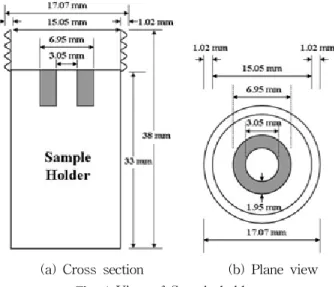
For the investigation of the EM wave absorption properties of the samples, the prepared sheet-type absorbers were punched into a toroidal shape with an inner diameter of 3.05 mm and an outer diameter of 6.95 mm.
The absorption properties of the samples were investigated with the Vector Network Analyzer of the Model HP 8753D.
Figures 3 and 4 are diagrams of the measurement system used for the reflection coefficient and the sample holder, respectively.
Fig. 3 Measurement System for Reflection Coefficient.
(a) Cross section (b) Plane view Fig. 4 View of Sample holder.
3-3 Measurements of Samples
The material properties of the samples are calculated from the S-parameters measured by using the
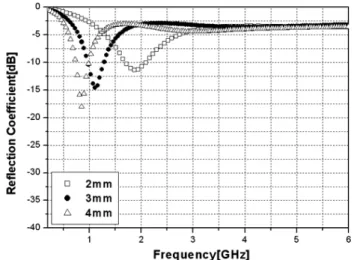
method (Y. Naito, 1987). We carried out the EM wave absorber design with the samples containing 50 wt.%, 60 wt.%, 70 wt.% and 80 wt.% of Amorphous. Figures 5, 6, 7, and 8 show reflection coefficients as a function of frequency for the samples containing difference composition ratios of materials. In Fig. 5, it is shown that the predictable optimum composition ratio of the Amorphous is 50 wt.% at 5.8 GHz.
Dong Il Kim, Gun Suk Yoo, Dong Soo Choi
- 719 - Fig. 5 Reflection coefficients of samples (Amorphous : CPE
= 50 : 50 wt.%).
Fig. 6 Reflection coefficients of samples (Amorphous : CPE
= 60 : 40 wt.%).
Fig. 7 Reflection coefficients of samples (Amorphous : CPE
= 70 : 30 wt.%).
Fig. 8 Reflection coefficients of samples (Amorphous : CPE
= 80 : 20 wt.%).
4. Simulation and Measured Results
The material constants of these samples are calculated from the S-parameters for the samples using the
method. We simulated absorption ability of EM wave absorber using calculated material constants by MATLAB program. Absorption abilities of EM wave absorbers were simulated using the material constants by changing the thickness without changing the composition ratios. Figures 9 and 10 show the results. In Fig. 9 shows the absorption ability more than 15 dB with thickness 2.5 mm at 60 wt.%
composition ratio. However, at the composition ratio of 50 wt.%, the absorption ability more than 30 dB was obtained the and thickness was 2.6 mm, which was the best results and, satisfies the target of this research.
From the simulation results, the optimized composition ratio of Amorphous was found by 50 wt.%. The fabricated EM wave absorber by obeying the simulated results has 40 dB absorption ability at 5.8 GHz as was shown in Fig. 10.
Fig. 9 Simulation result.
Development of EM Wave Absorber for Hi-pass System Using Amorphous Metal Powder
- 720 - Fig. 10 Comparison of simulated and measured results
(Thichness : 2.6 mm).
5. Conclusion
The ETC system is widely used for high speed transportation and comfortable driving environment. The ETC system is non-stop auto collection system through an application of the DSRC, which uses the microwave of 5.8 GHz band. In this system, the EM waves can be reflected, diffracted or shadowed by the canopy, booth, road surface and these waves cause errors in the system. EM wave absorber can solve these problems by eliminating unnecessary EM wave.
In this paper, we investigated the EM wave absorber for ETC system using Amorphous metal powder with CPE as binder. The material constants were calculated from the measured S-parameters. The absorption ability of the samples was also measured by the network analyzer and the absorption abilities of each sample were compared. The optimized composition ratio of the absorbing material was Amorphous : CPE = 50 : 50 wt.%, and the absorption ability of the EM wave absorber with thickness of 2.6 mm was more than 40 dB at 5.8 GHz. Since the fabricated EM wave absorber is very thin and the absorption ability is excellent, the developed EM wave absorber can be applied to ETC system.
Acknowledgment
This work was supported by the program of the Academic Research & Development from Korea Sanhak Foundation.
References
[1] Choi, D. H., Kim, D. I., and Song J. M., (2003), J.
Korean Phys. Soc. 42, 799.
[2] Choi, C. M., Kim D. I., Rui Li, Ko, K. S., (2006),
"Development of the Electromagnetic Wave Absorber for 94 GHz Radar Sensors Using Permalloy", Inter. J.
KIMICS, vol.4, no.3, pp.114-117.
[3] David M. Pozer(2005), Microwave Engineering - 3rd ed., J. Wiley & Sons.
[4] Haneda K., Takada J., Iwata T., Wakinaka Y., and Kunishima T. (2004), "Experimental Determination of Propagation Paths for the ETC System - Equipment Development and Field Test", Trans. IEICE, vol.
E87-A, no. 11, pp. 3008-3015.
[5] Hashimoto O. (1997), Introduction to Wave Absorber, Tokyo : Morikita Shuppan.
[6] Kim, D. I., (1996), Michiharu Takahashi, Hiroki Anzai, and Sang Yup Jun, IEEE Trans. Electromag. Compat.
38, 173.
[7] Kim, D. H., Kim, D. I., Choi, C. M., and Son J. Y., (2006), Internat. J. Navig. Port Res. 30, 161.
[8] Kim, D. I., Kim, S. J., and Song, J. M., (2003), J.
Korean Phys. Soc. 43, 269.
[9] Naito Y. (1987), Electromagnetic Wave Absorbers, New Ohm, Tokyo, Chap. 2, p. 73.
[10] Soh T., Hashmoto O. (2001), Trans. IEICE J84-B, 1523.
Received 9 November 2011 Revised 22 December 2011 Accepted 22 December 2011