• 검색 결과가 없습니다.

A Round-Robin Analysis of Temperature and Residual Stresses in Dissimilar Metal Weld

N/A
N/A
Protected

Academic year: 2021

Share "A Round-Robin Analysis of Temperature and Residual Stresses in Dissimilar Metal Weld"

Copied!
3
0
0

로드 중.... (전체 텍스트 보기)

전체 글

(1)

이종금속용접부 온도 및 잔류응력의 라운드로빈 해석

송민섭

․ 강선예

*

․ 박준수

*

․ 손갑헌

*

A Round-Robin Analysis of

Temperature and Residual Stresses in Dissimilar Metal Weld

Min-sup Song, Sun-ye Kang, June-soo Park, and Gap-heon Sohn

Key Words: Weld residual stress(용접잔류응력), Thermal elasto-plastic analysis(열탄소성해석), PWSCC(일차수응력부식균열), Dissimilar metal weld(이종금속용접부), Nickel-based Alloy 82/182(니켈기합금 82/182)

Abstract

DMWs are common feature of the PWR in the welded connections between carbon steel and stainless steel piping. The nickel-based weld metal, Alloy 82/182, is used for welding the dissimilar metals and is known to be susceptible to PWSCC. A round-robin program has been implemented to benchmark the numerical simulation of the transient temperature and weld residual stresses in the DMWs. To solve the round-robin problem related to Pressurizer Safety & Relief nozzle, the thermal elasto-plastic analysis is performed in the DMW by using the FEM. The welding includes both the DMW of the nozzle to safe-end and the SMW of the safe-end and piping. Major results of the analyses are discussed: The axial and circumferential residual stresses are found to be -88MPa(225MPa) and -38MPa(293MPa) on the inner surface of the DMW; where the values in parenthesis are the residual stresses after the DMW. Thermo-mechanical interaction by the SMW has a significant effect on the residual stress fields in the DMW.

책임저자, 한국전력기술(주) 기계설계처

E-mail : [email protected]

TEL : (042)868-4262 FAX : (042)863-4682

* 한국전력기술(주) 기계설계처

1. 서 론

최근 원전배관 이종금속용접부의 일차수응력부 식균열(PWSCC)이 문제가 되면서 용접부 잔류응 력에 대한 연구가 국내외적으로 활발히 진행되고 있다[1-3]. 본 논문은 2007 ~ 2008년 국내에서 수 행된 ‘용접부 온도 및 잔류응력 시뮬레이션 기법 개발 Round-Robin 해석 (Safety & Relief Nozzle) 프로그램에 의한 것이며 [4,5] 국내 한 원전의 가 압기 안전/방출노즐 이종금속용접부에 대한 온도 및 잔류응력에 대한 유한요소법 해석 결과를 제 시하고 있다.

2. 용접 열전달 및 역학 해석

가압기 안전 /방출노즐 이종금속용접을 수치적 으로 모사하기 위한 노즐의 물리적 형상과 제원 은 Round Robin 프로그램에 따른 문제정의를 기 초로 하였으며[4,5], 용접 열해석 및 역학해석을 위한 유한요소모델은 범용코드인 ANSYS를 사용 하였다[6]. 열전달해석시 PLANE 55를 역학해석 시 PLANE 182 요소를 사용하였다.(Fig. 1 참조)

용접부의 열전달 해석은 인코넬 용가제(Alloy 82/182)를 적용한 노즐과 안전단 사이의 이종금속 용접부와 안전단과 배관 사이의 스테인리스강 용 가재 (ER-316L)를 적용한 동종용접부 순으로 이루 어지며, 비드 용착 순서는 노즐 및 배관의 내면 에서 시작하여 외면에서 끝난다 . 용접비드 입열 모델은 체적열유속과 표면열유속을 복합적으로 적용하였다 . 비드 입열시간은 용접부 노드의 평

대한기계학회 2008년도 추계학술대회 논문집

85

(2)

균온도가 용융온도 이상이 될 때까지 가열하였으 며, 냉각시간은 층간온도(Interpass temperature) 이하가 될 때까지로 하였다 . 표면의 열손실 경계 조건은 자연대류로 가정하였으며, 용융비드의 초 기온도는 용융점보다 200℃ 높게 설정하였다.

용접부 열전달 해석결과를 열하중 입력으로 하 여 열탄소성 역학해석을 수행하였다 . 역학해석 시 경계조건은 이종용접부 및 동종용접부의 경우 모두 노즐 끝단에서 축방향만을 고정했다 .

3. 용접잔류응력 평가

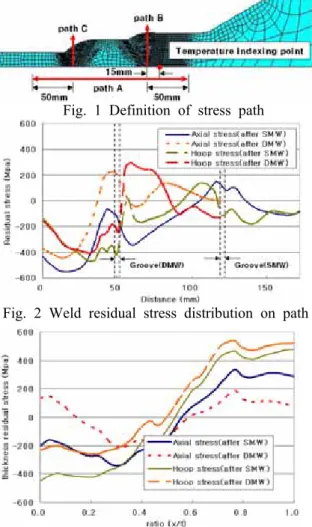
Fig. 1에 정의된 Path A에 해당하는 용접부 내 부표면에 존재하는 용접잔류응력 예측결과를 Fig.

2에 도시하였다. 여기서, 이종금속용접부 축방향 인장잔류응력의 최대값은 이종금속 용접 후에 225 MPa, 동종용접 후에 -88 MPa로 나타났으며, 원주방향 인장잔류응력의 최대값은 역시 이종금 속 용접 후에 293 MPa, 동종용접 후에 -38 MPa 으로 나타나 동종용접부 용접에 의해 이종금속용 접부의 잔류응력이 각각 313 MPa, 331 MPa 만큼 감소한 것으로 나타났다.

Fig. 1에 정의된 이종금속용접부 중심선(Path B)에서의 용접잔류응력을 Fig. 3에 도시하였다.

노즐의 원주방향 잔류응력은 두께 전반에 걸쳐 감소현상을 보였으며, 축방향 잔류응력의 경우에 는 내면에서는 감소하나 외면에서는 증가하는 경 향을 보였다. Fig. 1에 정의된 동종금속용접부 중 심선 (Path C)에서는 인장잔류응력 최대값이 축방 향은 113 MPa, 원주방향은 356 MPa을 나타냈다.

4. 결 론

본 논문연구에서 안전/방출노즐 이종금속용접 부 용접역학 해석의 주요 결론은 다음과 같다.

1) 이종금속용접부 내면에서 축방향 및 원주방 향 잔류응력은 동종용접 후 225MPa에서 -88MPa, 293MPa에서 -38MPa으로 동종용접의 영향에 의해 313MPa, 331MPa 각각 감소한 것으로 나타났다.

2) 동종용접 후 이종금속용접부 중심에서 두께 방향으로의 최대잔류응력은 축방향의 경우 x/t=0.77 위치에서 337MPa, 원주방향의 경우 x/t=1.0 위치에서 479MPa 로 나타났다.

Fig. 1 Definition of stress path

Fig. 2 Weld residual stress distribution on path A

Fig. 3 Weld residual stress distribution on path B

3) 한편, 이종금속용접부 중심선(Path B)에서 축방향 잔류응력은 동종용접에 의한 영향으로 인 해 x/t=0.5를 기점으로 해서 이종금속용접부 잔류 응력이 내면쪽에서는 감소, 외면쪽에서는 반대로 증가하는 것으로 관찰되었다 .

4) 이종금속용접부의 잔류응력이 감소하는 경 향은 동종용접부 용접이 진행되는 동안 열적 및 구조적인 상호작용에 기인하는 것으로 판단된다.

위의 이종금속용접부 용접역학해석 결론에 대 하여 향후 3차원 용접해석을 통해 추가적으로 확 인 및 검증할 예정이다.

참고문헌

(1) EPRI, 2007, "Advanced FEA Evaluation of Growth of Postulated Circumferential PWSCC

86

(3)

Flaws in Pressurizer Nozzle Dissimilar Metal Welds (MRP-216)"

(2) S. Fricke, E. Keim, J. Schmidt, 2006,

"Numerical weld modeling - a method for calculating weld-induced residual stress", Nuclear Engineering and Design, pp. 139~150.

(3) David W. Wu, Raymond K. Yee, 2005,

"Structural and Thermal Analyses of Pressure Vessel Bottom Head with Penetration Holes", Proceedings of ASME PVP Conference 2005, PVP2005-71084, pp.1~7.

(4) 고려대학교, 2007, “용접부 온도 및 잔류응력 Simulation 기법 개발 Round robin 해석 (Safety

& Relief Nozzle)"

(5) 고려대학교, 2008, “용접부 온도 및 잔류응력 예측 Simulation 개발을 위한 Round robin 해석 - Phase II"

(6) ANSYS User's Manual Ver.10.

87

수치

Fig. 1에 정의된 Path A에 해당하는 용접부 내 부표면에 존재하는 용접잔류응력 예측결과를 Fig.  2에  도시하였다.  여기서,  이종금속용접부  축방향  인장잔류응력의  최대값은  이종금속  용접  후에  225 MPa, 동종용접 후에 -88 MPa로 나타났으며,  원주방향  인장잔류응력의  최대값은  역시  이종금 속 용접  후에  293 MPa, 동종용접 후에 -38 MPa 으로 나타나 동종용접부 용접에 의해 이종금속용 접부의 잔류응력이 각

참조

관련 문서

This study was performed to investigate the effect of ultrasonic nano crystal surface modification (UNSM) on residual stress mitigation after Weld Inlay repair for butt

This paper aimed to understand the residual stress in the dissimilar metal welds of nuclear power plant. Two kinds of residual stress were considered, which caused by

Process Development of Laser Cladding for Weld Inlay Repair of Dissimilar Metal Weld in Reactor Vessel In/Outlet Nozzles Hong Seok Cho*,†, Kwang Woon Jung*, Min Hwan Mo*, Ki Hyun

This work is concerned with the analysis of stress corrosion cracking(SCC) behavior of Alloy 600 nozzle penetration mock-up according to a residual stress induced by a dissimilar

First, finite element analyses are carried out to calculate residual stresses at the inside of nozzle considering only dissimilar metal welding.. Subsequently, residual

Key Words: Dissimilar Metal Weld (이종금속 용접부), Fracture toughness (파괴인성), Tensile Property (인장 물성), Inconel 82/182

First, detailed finite element stress analyses were performed to predict the stress distribution of the dissimilar metal butt weld in which the hydrostatic

Finite element analysis was carried out in order to simulate the butt welding of dissimilar metal plate, and the calculated weld residual stress distribution was compared