• 검색 결과가 없습니다.

Design Re-engineering of the Lower Support Structure of the APR1400 Reactor Internals

N/A
N/A
Protected

Academic year: 2021

Share "Design Re-engineering of the Lower Support Structure of the APR1400 Reactor Internals"

Copied!
7
0
0

로드 중.... (전체 텍스트 보기)

전체 글

(1)

Design Re-engineering of the Lower Support Structure of the APR1400 Reactor Internals

Nguyen Anh Tung, Ihn Namgung

*

KINGS (KEPCO INTERNAL NUCLEAR GRADUATE SCHOOL)

Abstract : This paper aims to evaluate the conservatism in the design of APR1400 (Advanced Pressurized water Reactor 1400 designed by KHNP) reactor internals component, the LSS (Lower Support Structure).

Re-engineering of the LSS is done based on the system design condition data and applicable ASME code that was used for the original APR1400 design. Systems engineering approach is applied to design the LSS of APR1400 without refering APR1400 LSS dimensional parameters and tries to verify important design parameters of APR1400 LSS as well as the validity of the re-engineering design process as independent verification method of reactor component design. Systems engineering approach applied in this study following V-model approach. The re-engineered LSS design showed more than enough conservatism for static loading case. The maximum deflection of LSS is under 1mm (calculated value is 0.25mm) from 4000 mm diameter of LSS. Hence the deflection can be ignored in other reactor internals for structural integrity assessment.

Especially the effect of LSS deflection on fuel assembly can be minimized and which is one of the main requirements of LSS design. It also showed that the maximum stress intensity is 2.36MPa for the allowable stress intensity of 60.1 MPa. The stress resulted from the static load is also very small compared to the maximum allowable stress intensity, hence there is more than enough conservatism in the LSS design.

Key Words : Re-engineering, Nucelar Component Design, APR1400 NPP, Lower Support Structure

Received: November 11, 2016 / Revised: May 22, 2017 / Accepted: June 5, 2017

* Corresponding Author : Ihn Namgung, [email protected]

This is an Open-Access article distributed under the terms of the Creative Commons Attribution Non-Commercial

License(http://creativecommons.org/licenses/by-nc/3.0) which permits unrestricted non-commercial use, distribution,

and reproduction in any medium, provided the original work is properly cited.

(2)

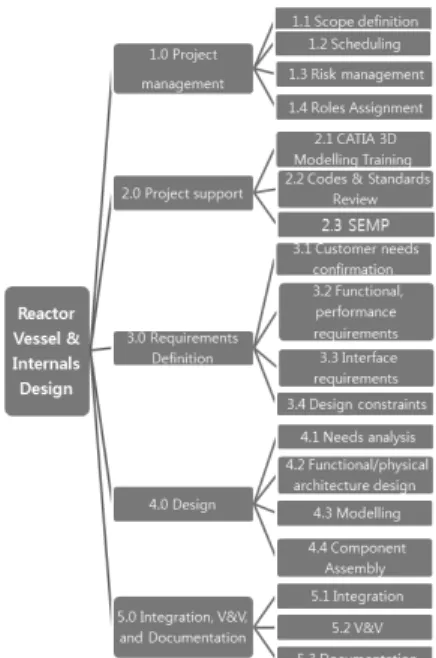
[Figure 1] Work breakdown structure

1. Introduction and Process Planning

1.1 Introduction

This paper is aimed at re-engineering one of the APR1400 Reactor Lower Internals com- ponents, i.e. the LSS, based on ASME codes.

The purpose of the paper is to do re-engineering design by rules process based on Systems Engineering approach, to investigate the amount of conservatism in the design of LSS of APR1400 Reactor Internals, and to compare the paper result with the real APR1400 design.

1.2 Scope of the paper

The objective of this paper is to do re- engineering design of the LSS that satisfies the conditions and technical requirements within the system. The design shall be consistent with other components that interfaces and interacts with.

The final design is determined after meeting the following requirements:

• Dimensional consistency and compatibility with other components.

• Structural deformation requirements.

In order to carry out given project scope, the following works are covered:

• Review of available documents

• ASME code based calculation

• Consistency check between Reactor Internals components

• Finalize the 3D model

• Static structural analysis of LSS

1.3 Work breakdown structure

The work breakdown structure defines the work required for each activities and clearly

divide scopes and division of responsibilities.

Figure 1 shows LSS re-engineering design activities.

2. Re-engineering of Lss Based on System Engineering Approach

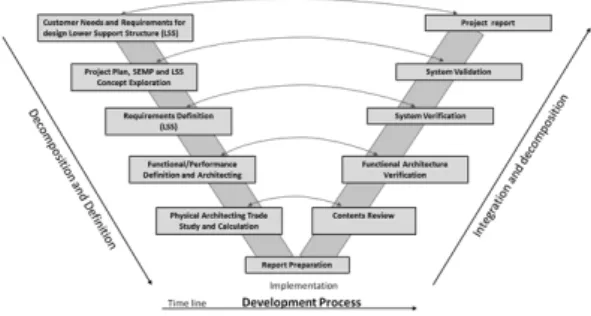
2.1 System Engineering V-model of Re-engineering Design Activities of LSS

The V-model is used in the project execution

because it ensures a maximum transparency

for all project participants. It is a systematic

approach defined by Systems Engineering to

understand the project requirements and it maps

these requirements to process definitions. The

V-model also performs reviews on multiple

levels by tracing all requirements throughout

the entire project life cycle so as to ensure

clear and unambiguous implementation of

requirements. Figure 2 demonstrates the

V-Model developed for LSS re-engineering

design project. [1][2]

(3)

[Figure 2] The V-model of LSS re-engineering design activities

2.2 Risk analysis of the LSS re-engineering design project

In order to keep project risks on LSS re-engineering design be reduced to minimum, there is still some challenges during project execution. Those risks include the following:

• Data unavailability

• Compatibility issues with other reactor lower internal components

• Inappropriate allocation of resource and time

• Delay of the project due to other interfacing design projects running in parallel

Figure 3 shows risk analysis process.

[Figure 3] Risk management process

3. Modelling and Calculation Process of the Lss

3.1 Introduction to LSS component

The LSS is a component of reactor internals

installed at the lower part of reactor vessel.

The LSS supports the weight of the reactor core, mechanical assembly load and flow drag force on core and transmits the load to core support barrel. The LSS is composed of grid of beams structure to support heavy load and at the same time minimize flow resistance.

The main component of LSS consists of a cylinder, main support beams, secondary support beams, cross support beams. The lower flange of the core support barrel supports, secures and positions the LSS, and is attached to the LSS by means of flexural weld connection.

The LSS provides support for the core by means of support beams that transmit the load to the core support barrel lower flange. The insert pins on the top face of LSS beams provide mating surface to he the lower ends of the fuel assembly and provide exact installation of fuel assembly at desired location.

3.2 Methodology

In order to design the LSS, there are number of important design parameters that need to be considered. These are structural stiffness and geometrical compatibility with fuel assembly.

The structural stiffness is defined the allowable stress intensity limits, and the geometrical compatibility is defined by deflection of LSS.

The allowable stress intensity limit is determined by material used to construct LSS and the values are defined in ASME. The material of the LSS according to SAR is Type 304 SA-182 18Cr-8Ni austenitic steel. The allowable stress intensity limit in this case is 60.1 MPa. [3]

Geometrical compatibility with fuel assembly

is assessed in term of LS S deformation and

fuel assembly relocation due to LSS deformation.

(4)

[Figure 4] Forces acting on LSS

<Table 1> Forces acting on LSS

Loading Symbol Magnitude (N)

Hold-down

spring force Fspring 12,205,639 Core Shroud Wcore_shroud 209,405.5 Fuel Assembly Wfuel_assembly 1,546,429.8

LSS WLSS 167,371.4

Flow drag

force Fdrag_force 471,511.5

The fuel assemblies define the distance between the beams of the LSS and the pins located on these beams, with their thickness and location.

Fuel assembly must remain upright position and do not contact with neighboring fuel as- semblies. The LSS deflection need to be controlled so that the top edges of the fuel assemblies do not contact with each other when the LSS is deformed. This requirements resulted in maximum LSS deformation limit.

3.3 Assumptions

For the re-engineering design of LSS, followings are assumed and limited in the analysis for the verification purpose. The analysis was limited for design loading case, and the scope of study was limited to static analysis. Dynamic analysis due to operational load such as pump pulsation, load follow operation, pipe break load and seismis loads are not considered as these analysis requires another full scope of analysis. Hence the loading were limited to pressure, temperature and mechanical load (weight and assembly load).

3.4 Calculation

The LSS was modeled based on system operation data given in SAR. [4] The calculation in this section will verify that the thickness of the LSS cylinder satisfies Article NG-3000, part NG-3133.6 “Cylinders Under Axial Com- pression”. [5]

3.4.1 NG-3133.6 “Cylinders Under Axial Com- pression” requirement

According to NG-3133.6, the maximum allowable compressive stress to be used to determine the limit for design stress shall be the lesser of either (a) or (b), where:

(a) is the Sm value of material at design temperature given in Tables 2A, 2B and 4, Section II, Part D, Subpart 1. [3]

(b) is the factor B determined using applicable chart in Section II, Part D, Subpart 3. [3]

3.4.2 Design longitudinal compressive stress The design compressive stress acting on the LSS cylinder is obtained considering the reaction force of the CSB (Core Support Barrel). The reaction force is calculated and described as below, see [6]. The free-body diagram is shown in Figure 4 and summary of laods is given in Table 1.

F

CSB_reaction

=F

spring

+W

core_shroud

+W

fuel_assembly

+W

LSS

-

F

drag_force

(5)

[Figure 5] Deflection examination of the LSS

[Figure 6] Collision check of fuel assemblies

[Figure 7] Close up view at position 1 (from above figure) - Most deformed position

Then the CSB reaction force is calculated to be:

F

CSB_reaction

=2,672,259 N The area of the LSS cylinder is:

A

L S S

=π(r

o2

-r

i2

)=π(1985

2

-1892

2

)

=1,132,735.8 mm

2

Then the resulting compressive stress in the support ring of LSS is:

σ

design

=F

CSB_reaction

/A

LSS

=2.36 MPa

3.4.3 Verification of support beams thickness and height

The support beams thickness is designed fit with the fuel insert pins, and the value is 45 mm. The height of the beams is designed as structural support and does not have any SAR requirement to follow. However, the support structure shall ensure that, after loads are applied on the LSS, fuel assemblies will not make contact due to deformation of the LSS.

To verify the parameters in the support beams, CATIA analysis was conducted to check if the fuel assemblies touch each other after LSS deformation shown in Figure 5.

This condition can be checked by investigating the deformed shape of LSS top surface. The result is used to check if the fuel assemblies collide at top nozzle outer boundary. The vertical line shown in Figure 6 represent fuel assembly center line. The upper horizontal line, white

line, indicates undeformed top surface of LSS.

The lower “horizontal” line is actually the deformation curve as shown in Figure 7. The square dots are the positions of various Fuel Insert pins. From left to right, the deformation at these pins location are approximately 0 mm, 0.063 mm, 0.136 mm, 0.198 mm, 0.234 mm, 0.249 mm, 0.234 mm, 0.198 mm, 0.136 mm, 0.063 mm and 0 mm respectively. The vertical lines representing the outside boundary of neighboring fuel assemblies are drawn in pairs.

The clearance between fuel assemblies is

5.2832 mm. Hence at the top of fuel assembly,

this clearance shall not be closed. Taking the

(6)

[Figure 8] Clearance check at the top of fuel assemblies

[Figure 9] Isometric view of the conceptual design

[Figure 10] Cross-section of the conceptual design

fuel assembly height of 4530 mm, the contact is determined graphically.

With the maximum bending deformation of 0.249 mm, the clearance at the fuel top position is 5.2784 mm as shown in Figure 8.

Since un-deformed clearance is 5.2832 mm, the change of clearance is 0.0048 mm. This is well below the fuel assemblies clearance requirements.

The result shows that even at the most deformed surface of the LSS, fuel assemblies do not make any contact with each other.

Therefore the parameters of the support structures are proven adequate.

3.5 Design re-engineering result

From the design limits defined in ASME codes

and consistency requirements, the conceptual design was developed using CATIA modelling.

Figures 9 and 10 show the modelling of the LSS. The total compressive stress acting on the LSS is approximately 2.36 MPa, which is within the design limit (60.1 MPa). The allowable deflection is examined by deflection analysis.

Clearance between fuel assemblies changes 0.0048 mm. This small deformation of LSS is mainly due to requirement of fuel thermal hydarulic requirements which is muchj more stringent requirements to prevent local heat up of reactor core.

4. Conclusions

The calculated maximum stress intensity value of 2.36 MPa is much smaller than the maximum allowable compressive stress of value 60.1 MPa. This indicates that the strength of LSS is much greater that structurally required for static loading condition. Hence the thickness of the LSS cylinder satisfies NG-3133.6.

The investigation of deflection of LSS top surface showed maximum value of 0.249 mm due to bending. This bending caused maximum of 0.0048 mm reduction of clearance at the top of fuel assemblies. This is to meet the stringent requirement of maintaining gap between fuel assemblies. Henc the deformation shall be very small so that Fuel Assembly shall stay within designated location for all loading conditions.

This stringent requirement resulted in very rigid support structure.

The re-engineered LSS beam height is verified

to be adequate, based on total deflection of the

LSS under loading condition and was investigated

by CATIA FEM analysis.

(7)

Acknowledgements

This work was supported by the 2016 Research fund of the KEPCO International Nuclear Graduate School (KINGS), Republic of Korea. The authors would like to express appreciation toward KINGS.

References

1. Alexander Kossiakoff et.al, Systems Engineering Principles and Practice, 2

nd

ed. 2010.

2. INCOSE Manual on System Engineering, 2012 Edition.

3. ASME Boiler and Pressure Vessel Code

2010 Ed., Section II, Part D Properties, pp.

304-306, American Society of Mechanical Engineers.

4. Korea Hydro & Nuclear Power Co., Ltd, 2014. “APR1400 design control document tier 2 - chapter 3 design of structures, systems, components, and equipment”, US NRC.

5. ASME Boiler and Pressure Vessel Code 2015 Ed., Section III, Subsection NG.

Article NG-3000 Design, pp. 30~34, American Society of Mechanical Engineers.

6. Ihn Namgung, Conceptual Design of PWR600

Reactor Pressure Vessel Mechanical Design,

KINGS textbook, 2015.

수치

Figure  1  shows  LSS  re-engineering  design  activities.
Figure  3  shows  risk  analysis  process.

참조

관련 문서

To this end, prior studies of the type of value, design paradigm and design value were considered, and three types of design value (practical value,

The design method for the optimization of FRP leaf spring is proposed by applying design method of experiment in order to improve the characteristics of

Evaluating the impact of a facilitated learning community approach to professional development on teacher practice and student achievement.. Engineering by

The characteristic change according to the main design parameters of the magnetic gear can be confirmed, and the difference in loss and efficiency according

이상해결책과 물리적 모순의 정의(defining ideal final result(IFR) and physical contradiction). – 3.1

1 John Owen, Justification by Faith Alone, in The Works of John Owen, ed. John Bolt, trans. Scott Clark, &#34;Do This and Live: Christ's Active Obedience as the

○ In the future, the goals of Korea’s international agricultural development cooperation projects should be connected with SDGs, and it is important to

Design is applied to create better convenience and beneficial values through a variety of design methodology in relevant industry, and new service