만성 및 급성 염증 모델에서 강황추출물의 효과
⁃연구노트⁃
Senthilkumar Anandakumar1․Joshua Allan Joseph1†․Bharathi Bethapudi1 Amit Agarwal1․정은봉2
1네츄럴리메디 연구소
2세광에스티코퍼레이션
Anti-inflammatory Effects of Turmeric (Curcuma longa L.) Extract on Acute and Chronic Inflammation Models
Senthilkumar Anandakumar1, Joshua Allan Joseph1†, Bharathi Bethapudi1, Amit Agarwal1, and Eun-Bong Jung2
1R&D Centre, Natural Remedies, Bangalore-560 100, India
2Sekwang S.T Corporation, Seoul 153-803, Korea
ABSTRACT Anti-inflammatory effects of turmeric (Curcuma longa L.) rich in polysaccharides, as well as free of curcuminoids and turmerones were investigated in acute and chronic inflammatory models. Activity against the acute phase of inflammation was evaluated in carrageenan-induced paw edema and xylene-induced ear edema models. The results showed that turmeric extract significantly decreased paw edema volume in the first and third hours after carra- geenan injection (P≤0.05). Turmeric extract at all dose levels also significantly inhibited xylene-induced ear edema formation (P≤0.05). Activity against chronic inflammation was also evaluated in cotton pellet-induced granuloma model.
Turmeric extract significantly (P≤0.05) decreased the weight of granuloma tissue on cotton pellets in a dose-dependent manner when compared to the vehicle control. Thus, the findings of the study suggest that turmeric extract in effective against both acute and chronic inflammation.
Key words: Curcuma longa L., anti-inflammation, xylene-induced ear edema, carrageenan-induced paw edema, cotton-induced granuloma
Received 19 December 2013; Accepted 16 January 2014
†Corresponding author.
E-mail: [email protected], Phone: +91-80-40209824
서 론
관절의 연골조직이 파괴되는 관절염은 류마티스성관절염 과 퇴행성관절염으로 대별되며 그중에서 퇴행성관절염은 전 세계 65세 이상의 인구에서 약 50% 이상의 발병률이 나 타날 정도로 가장 흔한 질환 중의 하나이다(1). 흔히 퇴행성 관절질환이라 불리는 골관절염은 인류가 겪고 있는 만성질 환의 대표적 질환으로 관절 연골의 퇴화가 특징이며 손상된 연골수복과 연골하 골조직의 재구성 또한 동반된다. 또한 골관절염은 흔히 비염증 반응으로 알려져 있지만, 병의 진행 시 중증도의 염증 반응이 일어난다(2). 염증은 복잡한 병리 생리학적인 과정으로 여러 가지 형태의 감염이나 생체 내 대사산물 중 자극성 물질에 대한 생체 방어기전의 발현이라 고 할 수 있다(3). 기존의 항염증제는 크게 스테로이드성과 비스테로이드성 항염증제로 구분되며, 염증 반응의 주요 증 상인 발열, 발적, 동통, 부종 등의 치료를 위하여 비스테로이 드성 항염증제를 많이 사용하는데, 특히 골관절염 치료에
쓰이는 비스테로이드성 항염증제의 작용 기전은 cyclo- oxygenase(COX)를 억제하는 것으로 알려졌다(4).
강황은 생강과(Zingiberaceae)의 강황속(Curcuma)으로 분류되는 다년생 식물로서, 학자들에 따라 30~70여종의 독 립종이 존재한다고 밝혀지고 있지만 정확한 종의 수는 알려 지지 않고 있으며 대부분 외관상 형태는 비슷하다(5). 강황 의 재배는 인도 대륙이 원산지고, 중국의 남부, 동남아시아 및 일본의 오키나와, 한반도의 중남부 지역 등으로 주로 열 대와 아열대 지역에서 자생하거나 기후 조건에 맞는 특정 지역에서 재배되고 있다. 특히 강황은 세계시장의 약 94%가 인도 대륙에서 재배하거나 생산되고 있으며, 인도에서는 기 원전 2500년에서 1500년까지 아리아계 민족이 강황을 재 배하여 약재와 염료 등에 사용하여 왔다(6).
강황의 주요성분은 탄수화물(69.4%), curcuminoids, 정 유성분과 단백질로 구성되어 있으며 curcuminoids는 cur- cumin, diferuloylmethane, mono-dexmethoxy curcu- min과 bisdesmethoxycurcumin으로 구성되어 있다(7). 그 중 curcumin이 강황 속의 curcuminoids의 약 90%를 차지 하고 있으며(8), 대부분의 강황을 이용한 연구는 curcumin 중심으로 한 연구이며, 일부 강황 유래의 정유성분과 비극성
Curcuma Longa L. rhizomes
Water extract Concentrate
Spray dry
Mixed with 1% curcuma oil Turmeric extract
Extracted with water, 4 times Filtrated
Fig. 1. Processing flow chart of turmeric extract.
물질을 이용한 약리적 효능과 항산화, 항암, 항염증 등의 효 과에 대한 연구가 대부분이다(9-11). 강황 유래의 수용성 성분을 이용한 연구는 단지 강황의 curcuminoids가 없는 물분획 성분을 이용한 항당뇨와 항암 효과와 관련하여 연구 되었으며 이는 강황의 식이섬유 성분이나 단백질에서 기인 된 것으로 보고되고 있다(12). 그러나 강황의 주요성분 중 하나인 다당체를 이용한 항염증에 대한 연구는 미약한 실정 이다.
다양한 천연물에서 유래된 다당체 성분들이 항염증과 면 역 활성을 나타내는 것으로 보고되고 있다. de Paulo Pereira 등(13)은 Azadirachta indica 씨앗 외피를 이용하여 in vivo 실험에서 항염증 효과가 있는 것으로 보고하였으며, Viola odorata L.과 Malva pusilla Smith에서 추출한 수용성 다당 체 성분들이 항염증 효과가 있는 것으로 나타나 다당체들이 염증의 발현이나 삼출물 발생을 억제하는 것으로 보고되고 있다(14). Caesalpinia ferrea의 콩깍지에서 추출한 다당체 는 carrageenan에 의한 항부종 작용 실험 결과에서 효과가 있는 것으로 나타났으며 혈관이나 세포내의 염증을 억제하 는 것으로 보고되었다(15). 또한 강황 유래의 다당체추출물 을 이용한 in vitro 실험에서도 항염증 효과가 있는 것으로 보고되었다(16). 따라서 본 연구에서는 curcuminoids를 포 함하지 않은 강황 유래의 다당체추출물을 이용하여 λ-car- rageenan과 xylene으로 유발한 급성염증에 대한 항염 활성 과 cotton pellet 육아종 실험을 통하여 만성염증에 대한 항염 활성을 알아보고자 하였다.
재료 및 방법
시약
Diclofenac sodium(Ankur Drugs and Pharma, Mum- bai, India)와 dexamethasone(Cadila Healthcare, Gujarat, India), xylene(Ranbaxy Fine Chemicals, Gujarat, India) 와 λ-carrageenan(Sigma-Aldrich Co., St. Louis, MO, USA)을 이용하였다.
실험동물
실험에 사용된 동물은 흰쥐(albino Wistar rats, 150~
180 g)와 생쥐(Swiss albino mice, 25~30 g)를 Natural Remedies R&D center 중앙 동물실험실(Bangalore, India) 에서 사육하였다. 실험동물은 온도 25±2°C, 상대습도 30~
70%, 조명시간 12시간 조건 하에 일반사료(M/s Amrut Laboratory Animal Feeds, Bangalore, India)와 UV로 살 균한 물을 충분히 공급하였다. 모든 동물 실험은 Institutional Animal Ethics Committee(IAEC)의 기준에 의하여 실시하 였다.
강황추출물이 제조
본 실험에 사용된 강황추출물은 Chandrasekaran 등(16)
의 방법대로 Fig. 1과 같이 제조하였다. 인도 뱅갈로르 지역 에서 수확한 강황을 이용하여 제조한 강황 열수추출물에 강 황 유래의 오일을 혼합하여 제조하였으며 비율은 열수추출 물과 오일이 99:1(w/w)로 하였다(16).
Carrageenan에 의한 족부종 실험에 의한 급성염증 효과 생리식염수에 1%의 농도로 λ-carrageenan을 용해하여 0.1 mL를 흰쥐의 오른쪽 뒷발 발바닥 중심부 피하에 주사하 여 부종을 유발하였다(17). 실험군(n=6)의 강황추출물 투여 량은 각각 22.5, 45 및 90 mg/kg을 경구투여 하였으며, 대 조군(n=6)은 10 mL/kg의 정제수를 경구투여 하였고, 약물 투여군(n=6)은 diclofenac sodium(10 mg/kg)을 경구투여 하였다. 모든 투여물질은 λ-carrageenan을 주사 전 60분 에 경구투여 하였다. 부종을 유발시키고 0, 1, 2, 3 및 4시간 에 plethysmometer(PanLab, Barcelona, Spain)를 이용하 여 발의 용적을 측정하였다.
Xylene에 의한 귀부종 실험에 의한 급성염증 효과 Atta와 Alkofahi의 방법(18)에 준하여 실험하였으며 수 컷 생쥐(albino Swiss mice)를 각각 대조군(물 10 mL/kg), 약물투여군(50 mg/kg), 투여량을 달리한 실험군(강황추출 물 31.5, 63 및 126 mg/kg)의 5군(n=6)으로 나누고 xylene 을 처리하기 1시간 전에 각각의 투여물질을 경구투여 하였 다. Xylene(50 μL)을 오른쪽 귀의 앞면과 뒷면에 도포하여 급성염증을 유발하고 왼쪽 귀는 대조군으로 하였다. Xylene 을 처리한 4시간 후 실험동물을 희생시켰으며 양쪽 귀에서 직경 6 mm로 적출하여 중량을 측정하고 양쪽 귀의 중량을 측정한 평균값의 차를 이용하여 염증 정도를 측정하였으며 염증의 저해활성은 대조군과 비교하여 계산하였다.
염증 억제율(%)=[{(Rc-Lc)-(Rt-Lt)}/Rc-Lc]×100 Rc: 대조군의 오른쪽 귀 중량
Lc: 대조군의 왼쪽 귀 중량
Rt: 실험군 및 양성대조군의 오른쪽 귀 중량
0 10 20 30 40 50 60 70 80 90 100
0 1 2 3 4
Time (hours)
Increase percentage of edema (%) . Control (water; 10 mL/kg)
Diclofenac sodium (10 mg/kg) Turmeric extract
(22.5 mg/kg)
Turmeric extract (45 mg/kg) Turmeric extract
(90 mg/kg)
*
*
*
*
*
*
*
* *
*
*
*
*
*
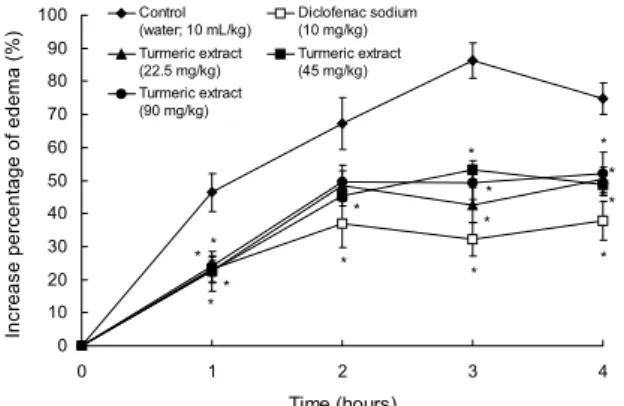
Fig. 2. Effect of turmeric extract on carrageenan induced rat paw edema. Values represent mean±SE; n=6. *P≤0.05 vs. control.
Table 1. Inhibition rate of xylene-induced ear edema by turmeric extract
Treatment Inhibition rate (%) Control (water 10 mL/kg)
Diclofenac sodium (50 mg/kg) Turmeric extract (31.5 mg/kg) Turmeric extract (63 mg/kg) Turmeric extract (126 mg/kg)
- 78.13 68.75 62.50 59.38 Lt: 실험군 및 양성대조군의 왼쪽 귀 중량
Cotton pellet 육아종 실험에 의한 만성염증 효과 흰쥐를 5개 군(n=6)으로 나누고 마취하여 살균된 cotton pellet 10 mg을 액와부와 대퇴부안쪽을 절개하여 피하조직 에 삽입하였다. 약물투여군은 dexamethasone(0.5 mg/kg), 대조군은 물(10 mL/kg), 실험군은 강황추출물을 3가지의 농도(22.5, 45.0 및 90 mg/kg)로 cotton pellet을 삽입한 날부터 일주일간 1일 1회 경구투여 하였다. 8일째 되는 날 모든 실험동물을 희생시켜 cotton pellet을 수집하여 cot- ton pellet에서 육아종 조직을 모아 무게를 달고 60°C에서 24시간 동안 건조시키고 무게를 측정하였다. 육아종의 무게 는 최초의 cotton pellet 중량의 차로 계산하였다(19).
통계처리
자료의 통계처리는 SPSS 12.0(SPSS Inc., Chicago, IL, USA)을 이용하여 ANOVA 검정과 post-hoc Dunnet's test 로 하여 평균값 간의 유의수준 P≤0.05에서 유의성을 검정 하였다.
결과 및 고찰
Carrageenan에 의한 족부종 실험을 통한 항염증 효과 1% Carrageenan에 의한 시간에 따른 부종 증가율은 Fig. 2에 나타내었다. Carrageenan 염증 유발 모델은 천연 물을 이용한 급성염증에 대한 효과를 확인하기 위하여 널리 사용된다. Carrageenan을 주사한 후 3시간이 경과하였을 때 가장 큰 부종 증가율을 보였으며 이는 carrageenan을 이용하여 급성염증에 대한 항염증 효과를 실험한 다른 연구 결과와 비슷한 경향을 보였다(20,21).
Carrageenan은 Chondrus crispu 해조류에서 추출한 sulfated polygalactose로서 kappa(κ)와 lambda(λ)의 2가 지 분획으로 구성되며 이 중에서 염증 유발에 유효한 분획은 lambda(λ) 분획으로 보고되었다(22). λ-Carrageenan에 의한 염증 시 histamine, kinins, serotonin, prostaglandin
E 등이 나타나며, λ-carrageenan에 의한 염증 초기 반응에 는 histamine 및 serotonin 등에 의한 충혈을 일으키고 이후 bradykinin에 의해 지속적인 부종을 수반하는 염증 반응이 일어난다고 하였다(23). 특히 흰쥐 족 부위에 λ-carra- geenan에 의하여 유발한 염증 모델은 급성 관절염 모델로 서 그 의미를 두어 골관절염에 따른 부종 억제 작용을 확인 하고자 할 때 사용된다(24). λ-Carrageenan으로 염증이 유 발된 흰쥐 족부에서 COX-2가 발현되며, 선택적 COX-2 억 제제를 사용하여 염증을 억제할 수 있고 COX-1의 발현은 증가되지 않는다고 알려져, λ-carrageenan으로 유발한 급 성 관절염 모델에서 부종 억제 효과가 나타나면 COX-2 억 제 기전으로 항염 효과를 나타낸다고 보고하였다(25).
Diclofenac sodium 투여군은 모두 대조군에 비하여 유의 적으로 부종 증가율이 낮았다. 실험군인 강황추출물을 경구 투여 하였을 때 45 mg/kg의 농도에서는 diclofenac so- dium과 같이 섭취 후 대조군에 비하여 유의적으로 부종 증 가율이 낮았으나(P≤0.05), 다른 농도에서는 2시간 이후 부 종 증가율이 유의적으로 낮아지는 것으로 나타났다(P≤ 0.05). 하지만 carrageenan을 주사한 이후 4시간까지 부종 을 측정한 결과 부종 증가율이 낮아지는 경향을 보였다.
Yegnanarayan 등(26)은 추출용매의 극성별로 추출한 강황 추출물을 복강 내 투여하고 2시간이 경과하였을 때 높은 부 종 증가율을 나타내고 4시간이 경과하였을 때 다시 감소하 는 것과 유사한 결과를 보였다. 강황추출물을 경구투여 하였 을 때 부종 증가율이 억제되는 것으로 보아 항염 효과가 있 는 것으로 사료된다.
Xylene에 의한 귀부종 실험에 의한 급성염증 효과 Xylene에 의한 귀부종 실험은 급성염증에 대한 항염효능 평가법으로 널리 이용되는 방법이며 비스테로이드성 항염 증 약물(non-steroidal anti inflammatory drugs, NSAIDs) 의 일종인 diclofenac은 항염 실험에서 가장 흔히 사용되는 약물이다. Xylene 도포 후 정상군에 비하여 대조군에서 현 저한 절대적 및 상대적 귀 중량의 증가가 관찰되었으며, 정 상 부위와 유발 부위의 중량 차이 역시 정상군에 비하여 현 저히 증가되는 것으로 관찰되었다. 이러한 귀 중량의 증가는 전형적인 마우스를 이용한 xylene에 의해 유발된 급성염증 실험모델에서 나타나는 전형적인 현상으로 알려져 있다 (27). 강황추출물의 급성염증에 대한 저해 활성은 정상 귀와 xylene 도포 귀의 중량 차 및 염증 억제율을 Table 1과 Fig.
Table 2. Effect of turmeric extract on cotton pellet-induced granuloma in albino Wistar rats Treatment Weight of cotton pellet (mg)
Weight of granuloma1) (mg)
Wet Dry
Control (water 10 mL/kg) Dexamethasone (0.5 mg/kg) Turmeric extract (22.5 mg/kg) Turmeric extract (45 mg/kg) Turmeric extract (90 mg/kg)
190.04±5.61 93.88±2.30* 166.88±2.60* 166.08±1.36* 148.83±4.05*
43.00±1.77 20.63±0.59* 37.46±0.54* 36.79±0.72* 34.58±0.66*
33.00 10.63 27.46 26.79 24.58 Values are expressed as mean±SE; n=6.
*P≤0.05 vs. control.
1)Weight of granuloma is difference of dry cotton pellet weight and initial cotton pellet weight.
0.00 1.00 2.00 3.00 4.00 5.00 6.00 7.00
Control (water; 10
mL/kg)
Diclofenac (50 mg/kg)
Turmeric extract (31.5 mg/kg)
Turmeric extract (63 mg/kg)
Turmeric extract (126 mg/kg) Treatment group
Mean ear weight difference (mg)
*
* *
*
Fig. 3. Effect of turmeric extract on xylene induced ear edema in mice. Values represent mean±SE; n=6. *P≤0.05 vs. control.
3에 나타내었다. Xylene 도포한 오른쪽 귀와 도포하지 않은 왼쪽 귀의 중량 차이를 비교하여 염증 유발의 억제 활성을 확인하였을 때 강황추출물과 약물투여군에서 양쪽 귀의 중 량 차가 대조군과 비교하여 유의적으로 낮은 값을 나타내었 다(P≤0.05). 또한 귀 염증의 억제율은 대조군과 비교하였을 때 약물투여군과 농도별 강황추출물 투여군(31.5, 63.0 및 126 mg/kg)에서 각각 78.13%, 68.75%, 62.5% 및 59.38%
로 나타났다.
Cotton pellet 육아종 실험에 의한 만성염증 효과 염증은 급성 및 만성으로 통증을 나타내며, 조직손상을 일으키는 등의 복합적인 증상이 있다. 급성 염증질환은 혈관 의 확장, 혈관투과성인자, 호중성백혈구의 활성화 등에 의하 여 나타나며(28), 만성 염증질환은 섬유아세포의 분화와 삼 출물과 단핵구의 침투, 육아종의 분화에 의하여 나타나는 것으로 알려져 있다(29). 염증 부위에 모세혈관의 신생세포 의 증식과 더불어 결합조직의 기질이 형성되는 만성염증을 증식형 염증이라 한다(28). 이러한 염증질환을 위한 치료제 는 대부분 합성에 의해 만들어지며 이들은 다양한 부작용을 나타내는 것으로 알려져 있다. 또한 합성 염증치료제는 각성 효과도 있어 천연물 유래의 항염증에 대한 유용성분을 찾기 위한 연구가 계속되고 있다(30).
Cotton pellet 육아종낭법은 만성염증에서 나타날 수 있 는 삼출물 및 염증의 분화 정도를 확인할 수 있는 실험법으 로 널리 사용된다(31). 강황추출물의 만성염증에 대한 항염
활성을 알아보기 위하여 cotton pellet 육아종낭법을 적용 하였다. 대조군, 농도별 강황추출물 투여군 그리고 약물투여 군의 cotton pellet 중량의 평균값을 건조 전후로 Table 2에 나타내었다. 대조군의 경우 cotton pellet의 건조 전 중량이 190.04±5.61 mg으로 강황추출물(22.5 mg/kg, 45 mg/kg, 90 mg/kg)과 약물투여군(dexamethasone 0.5 mg/kg)의 166.88±2.60, 166.08±1.36, 148.83±4.05 및 93.88±2.30 mg보다 유의적으로 높았다(P≤0.05). 또한 대조군의 cot- ton pellet의 건조 후 중량은 43.00±1.77 mg으로 강황추출 물(22.5 mg/kg, 45 mg/kg, 90 mg/kg)과 약물투여군의 37.46±0.54, 36.79±0.72, 34.58±0.66 및 20.63±0.59 mg보다 유의적으로 중량이 더 나가는 것으로 나타났다(P≤ 0.05). Cotton pellet의 건조 후 무게와 최초 cotton pellet 의 중량 차를 이용하여 육아종의 분화 정도를 확인하였을 때 대조군의 경우 가장 큰 차이를 나타내어 육아종의 분화가 더 많이 일어난 것으로 사료된다. Cotton pellet 육아종 실험 에서 수집한 cotton pellet의 중량은 삼출물과 관련이 있으 며 건조한 cotton pellet의 중량은 염증의 분화 정도와 관련 이 있는 것으로 알려져 있고 삼출물과 염증의 분화 정도는 중량과 비례한다고 보고하였다(32). 따라서 강황추출물 및 약물투여군의 cotton pellet의 건조 전후 중량이 대조군과 비교하여 유의적으로 적은 것으로 보아 삼출물이 적게 발생 하고 육아종 조직이 적게 분화된 것으로 판단된다. 강황 유 래의 curcuminoids가 없는 강황추출물을 경구투여 하였을 때 급성염증에 대한 항염 효과뿐만 아니라 만성염증에 대한 항염 효과가 있음을 보여준다.
요 약
본 연구에서는 강황 유래의 curcuminoids가 없는 다당체를 이용하여 급성 및 만성 염증 모델에서의 항염증 효과를 검증 하고자 하였다. 급성염증에 대한 효과를 알아보기 위하여 carrageenan에 의한 족부종 유발과 xylene에 의한 귀부종 유발을 일으킨 모델을 이용하여 수행하였다. Carrageenan 에 의한 족부종 유발 실험에서 강황추출물과 관절염 치료제 로 알려진 diclofenac sodium을 처리하였을 때는 부종의 증가도가 낮은 것으로 나타났다(P≤0.05). 또한 다른 급성염 증 모델인 xylene application 마우스 모델에서도 대조군에
비하여 diclofenac sodium과 강황추출물(31.5, 63, 126 mg/kg)을 농도별로 경구투여 하였을 때 염증 억제율이 각각 78.13%, 68.75%, 62.50% 및 59.38%로 나타나 염증 억제 율이 높은 것으로 나타났다(P≤0.05). 만성염증에 대한 효과 를 알아보기 위한 cotton pellet 육아종 실험에서는 대조군 과 비교하여 삼출물과 염증 육아종이 적게 발생된 것으로 나타났다(P≤0.05). 따라서 강황 유래의 다당체를 경구투여 하였을 때 만성 및 급성 염증에 대한 저해활성이 있는 것으 로 나타나 항염증 소재로서 개발 가능성이 있음을 제시하였 다.
REFERENCES
1. Metcalf MH, Larson RV, Bonica JJ. 2001. Painful disorders of the knee and thigh. In Bonica's Management of Pain.
3rd ed. Lippincott Williams & Wilkins, Philadelphia, PA, USA. p 1593-1613.
2. Gordon GV, Villanueva T, Schumacher HR, Gohel V. 1984.
Autopsy study correlating degree of osteoarthritis synovitis and evidence of articular calcification. J Rheumatol 11: 681- 686.
3. Yoo TM, Yi SY, Chung SY, Seung SA, Rheu HM, Lee EB, Yang JS. 1998. Studies on the anti-inflammatory effects of natural products. Korean J Appl Pharmacol 6: 269-275.
4. Cashman JN. 1996. The mechanisms of action of NSAIDs in analgesia. Drugs 52: 13-23.
5. Jung SH, Chang KS, Ko KH. 2004. Physiological effects of curcumin extracted by supercritical fluid from turmeric (Curcuma longa L.). Korean J Food Sci Technol 36: 317- 320.
6. Sung KC. 2011. A study on the pharmaceutical & chemical characteristics and analysis of natural curcumin extract. J Korean Oil Chemists' Soc 28: 393-401.
7. European Medicines Agency. 2009. Committee on herbal medicinal products; assessment report on Curcuma longa L. rhizoma. http://www.ema.europa.eu/docs/en_GB/docu- ment_library/Herbal_-_HMPC_assessment_report/2010/
02/WC500070700.pdf.
8. Ruby AJ, Kuttan G, Babu KD, Rajasekharan KN, Kuttan R. 1995. Anti-tumour and antioxidant activity of natural curcuminoids. Cancer Lett 94: 79-83.
9. Negi PS, Jayaprakasha GK, Jagan Mohan Rao L, Sakariah KK. 1999. Antibacterial activity of turmeric oil: a byproduct from curcumin manufacture. J Agric Food Chem 47: 4297- 4300.
10. Jayaprakasha GK, Jena BS, Negi PS, Sakariah KK. 2002.
Evaluation of antioxidant activities and antimutagenicity of turmeric oil: a byproduct from curcumin production. Z Naturforsch C 57: 828-835.
11. Liju VB, Jeena K, Kuttan R. 2011. An evaluation of anti- oxidant, anti-inflammatory, and antiociceptive activities of essential oil from Curcuma longa L. Indian J Pharmacol 43: 526-531.
12. Deshpande SS, Ingle AD, Maru GB. 1998. Chemopreventive efficacy of curcumin-free aqueous turmeric extract in 7,12- dimethylbenz[a]anthracene-induced rat mammary tumori- genesis. Cancer Lett 123: 35-40.
13. de Paulo Pereira L, da Silva KES, da Silva RO, Assreuy AMS, Pereira MG. 2012. Anti inflammatory polysaccharides of Azadirachta indica seed tegument. Rev Bras de Farma-
cogn 22: 617-622.
14. Drozdova IL, Bubenchikov RA. 2005. Composition and anti inflammatory activity of polysaccharides complexes ex- tracted from sweet violet and low mallow. Pharm Chem J 39: 197-200.
15. Pereira Lde P, da Silva RO, Bringel PH, da Silva KE, Assreuy AM, Pereira MG. 2012. Polysaccharide fractions of Caesalpinia ferrea pods: potential anti-inflammatory usage. J Ethnopharmacol 139: 642-648.
16. Chandrasekaran CV, Sundarajan K, Edwin JR, Gururaja GM, Mundkinajeddu D, Agarwal A. 2013. Immune-stimulatory and anti-inflammatory activities of Curcuma longa extract and its polysaccharide fraction. Pharmacognosy Res 5: 71- 79.
17. Winter CA, Risley EA, Nuss GW. 1962. Carrageenin-in- duced edema in hind paw of the rat as an assay for anti inflammatory drugs. Proc Soc Exp Biol Med 111: 544-547.
18. Atta AH, Alkofahi A. 1998. Anti-nociceptive and anti-in- flammatory effects of some Jordanian medicinal plant extracts. J Ethnopharmacol 60: 117-124.
19. D'Arcy PF, Howard EM, Muggleton PW, Townsend SB.
1960. The anti-inflammatory action of griseofulvin in ex- perimental animals. J Pharm Pharmacol 12: 659-665.
20. Galhena PB, Samarakoon SR, Thabrew MI, Weerasinghe GA, Thammitiyagodage MG, Ratnasooriya WD, Tennekoon KH. 2012. Anti-inflammatory activity is a possible mecha- nism by which the polyherbal formulation comprised of Nigella sativa (seeds), Hemidesmus indicus (root), and Smilax glabra (rhizome) mediates its antihepatocarcinogenic effects. Evid Based Complement Alternat Med 2012: 108626.
21. Ghildiyal S, Gautam MK, Joshi VK, Goel RK. 2012.
Pharmacological evaluation of extracts of Hedychium spica- tum (Ham-ex-Smith) rhizome. Anc Sci Life 31: 117-122.
22. Cho YS, Kim ND, Kim SA. 1978. Effects of concurrent administration of aspirin and prednisolone on the anti-in- flammatory and antipyretic activities in rats. Yakhak Hoeji 22: 128-137.
23. Costa B, Colleoni M, Conti S, Parolaro D, Franke C, Trovato AE, Giagnoni G. 2004. Oral anti-inflammatory activity of cannabidiol, an non-psychoactive constituent of cannabis, in acute carrageenan-induced inflammation in the rat paw.
Naunyn Schmiedebergs Arch Pharmacol 369: 294-299.
24. Lee YS, Park JY, Lim HJ. 2004. Peripheral analgesic effects of NSAIDs and expressions of cyclooxygenase-1 and cyclo- oxygenase-2 in acute arthritic model in rats. Korean J Anesthesiol 47: 862-869.
25. Seibert K, Zhang Y, Leahy K, Hauser S, Masferrer J, Perkins W, Lee L, Isakson P. 1994. Pharmacological and bio- chemical demonstration of the role of cyclooxygenase 2 in inflammation and pain. Proc Natl Acad Sci USA 91: 12013- 12017.
26. Yegnanarayan R, Saraf AP, Balwani JH. 1976. Comparison of anti-inflammatory activity of various extracts of Curcuma longa (Linn). Indian J Med Res 64: 601-608.
27. Jung BG, Jeon KO, Cho DH, Park MY, Choi HY, Kim JD. 2006. Anti-inflammatory effect of Haepyoejin-tang plus antler water extract in xylene-application mouse ear acute inflammation model. Korean J Oriental Physiology &
Pathology 20: 985-991.
28. Eddouks M, Chattopadhyay D, Zeggwagh NA. 2012. Animal models as tools to investigate antidiabetic and anti-in- flammatory plants. Evid Based Complement Alternat Med 2012: 142087.
29. Gupta M, Mazumder UK, Kumar RS, Kumar TS. 2003.
Studies on anti inflammatory, analgesic and antipyretic properties of methanol extract of Caesalpinia bonducella leaves in experimental animal models. Iran J Pharmacol
& Ther 2: 30-34.
30. Beg S, Swain S, Hasan H, Barkat MA, Hussain MS. 2011.
Systematic review of herbals as potential anti-inflammatory agents: recent advances, current clinical status and future
perspectives. Pharmacogn Rev 5: 120-137.
31. Gupta M, Mazumder UK, Gomathi P, Selvan VT. 2006.
Anti-inflammatory evaluation of leaves of Plumeria acumi- nate. BMC Complement Altern Med 6: 36.
32. Shewale VD, Deshmukh TA, Patil LS, Patil VR. 2012. Anti- inflammatory activity of Delonix regia (Boj. Ex. Hook). Adv Pharmacol Sci 2012: 789713.