*Corresponding author:
Phone. +82-42-867-8835, +82-42-821-5734 Fax. +82-42-624-4068, +82-42-821-8888 E-mail. [email protected],
[email protected] Received: September 5, 2017 Revised: September 22, 2017 Accepted: September 26, 2017
Ⓒ 2017 The Korean Society of Weed Science and The Turfgrass Society of Korea.
This is an Open Access article distributed under the terms of the Creative Com- mons Attribution Non-Commercial License (http:
OPEN ACCESS
Research Article
부식산 함유 액상비료 시비에 따른 크리핑 벤트그래스의 생육과 품질 변화
김영선1,2, 이태순1, 조성현1*, 이긍주2*
1
효성오앤비(주),
2충남대학교 원예학과
Growth and Quality Changes of Creeping Bentgrass by Application of Liquid Fertilizer Containing Humic Acid
Young-Sun Kim
1,2, Tae-Soon Lee
1, Sung-Hyun Cho
1*and Geung-Joo Lee
2*1
Hyosung O&B Co. Ltd., Daejeon 34054, Korea
2
Department of Horticultural Science, Chungnam National University, Daejeon 34134, Korea
Abstract
This study was conducted to evaluate the effect of liquid fertilizer containing humic acid (LFHA) on changes of creeping bentgrass quality and growth. Treatments were designed as follows; control fertilizer (CF), HA-1 (CF+1 ml m
-2LFHA), HA-2 (CF+2 ml m
-2LFHA), and HA-3 (CF+4 ml m
-2LFHA). As compared with CF, soil chemical properties and chlorophyll content of clipping of LFHA treatments were not significantly different. Visual quality in both of HA-2 and HA-3 treatments was higher than that of CF treatment from September to November, and clipping yield on October 27. Shoot density, root length, and the content of nitrogen, phosphorus or potassium were increased by application of LFHA.
The clipping yield was positively correlated with phosphorus content, potassium content or shoot density. Similarly, LFHA level was proportionate to clipping yield of creeping bentgrass, and N, P, K contents in the leaf tissue. These results generally demonstrated that the application of LFHA improved the growth and quality of creeping bentgrass by increase of N content or P in leaf tissue.
Keywords: Creeping bentgrass, Growth and quality of turfgrass, Liquid Fertilizer Containing Humic Acid (LFHA), Shoot density
서 론
capacity; CEC) 및 미생물 활성도 등을 개선하여 식물의 지상부와 지하부의 생육, 종자발아, 유묘 활착 등을 촉진하 는 것으로 알려져 있다(Hamza and Suggars, 2001). 토양의 물리화학적 특성뿐 아니라 식물의 생리학적 과정에서 영향을 미치는(Cacco and Dell’Agnola, 1984) 부식물질은 처리농도에 따라 식물의 생육을 촉진하거나 저해하여 식 물호르몬 처리와 유사한 특성을 보였으나 부식물질 중에서 식물호르몬은 확인되지 않았다(Cacco and Dell’Agnola, 1984). 부식물질 중 수용성 물질인 부식산은 식물의 지하부 생육과 양분 흡수 및 생육이 증가하는 것으로 알려져 있어 기능성 비료의 원료로 이용되고 있다(Jannin et al., 2012). El-Ghamry et al. (2009)는 아미노산을 부식산과 함 께 처리할 경우에 양분 이용율이 증가하고, 병해 발생이 감소하여 작물의 생육이 건전해지므로 농자재 사용을 줄 일 수 있다고 보고하였다.
Zhnag and Ervin (2004) 은 부식산을 처리한 크리핑 벤트그래스(Agrostis palustris Huds.)에서 잔디품질, 지하부 생육, 엽록소지수 및 건조 스트레스에 대한 저항성 등이 증가한다고 보고하였다. 크리핑 벤트그래스에서 수용성 부식산의 처리는 잔디의 뿌리생육이 발달하여 토양유기물이용과 양분 흡수 및 수분흡수가 증가함으로써 광합성, 잔디생육, 잔디품질 등이 향상된다(Liu and Cooper, 2000; Hunter and Anders, 2004; Van Dyke et al., 2009). 이 외에 도 부식산 처리는 잔디의 내건성이 증가하며(Hunter and Anders, 2004), 특히 식물호르몬이 함유된 부식물질인 해 조추출물과 혼합하여 처리하는 경우 잔디생육과 품질 및 내건성 등에서 상승효과가 나타났다(Zhnag and Ervin, 2004).
국내의 잔디재배에서 부식산에 대한 연구는 입상이나 분말의 부식산을 이용하여 모래와 혼합하였을 때, 모래상 토의 이화학적 특성 변화(Kim et al., 2010)와 이들 토양에서의 잔디생육 및 잔디품질의 변화에 대한 연구가 진행되 어 왔다(Kweon et al., 2005; Lee et al., 2013; Kim, 2015). 그러나, 토양에 처리된 부식산은 토양개량제의 특성 상 쉽 게 분해되지 않는 휴민으로 되어 있어 수용성 부식산 함량은 매우 적다(Lee et al., 2017). 최근 수용성 부식산을 함 유한 다양한 기능성 비료들이 골프장에서 이용되고 있으나 기능성 비료 중 부식산의 함량 및 시비량에 대한 연구 나 부식산 처리에 의한 잔디의 생육 및 품질의 변화에 대한 연구가 부족한 실정이다.
따라서 본 연구는 부식산과 복합비료가 혼합하여 액상으로 제형화된 부식산 함유 액비를 크리핑 벤트그래스에 시비하였을 때, 잔디의 생육과 품질에 미치는 영향에 대해 조사하고자 수행되었다.
재료 및 방법
시험기간 및 공시재료
본 연구는 2014년 7월부터 2014년 11월까지 5개월 동안 대전광역시 소재의 사이언스대덕 골프클럽 퍼팅그린에 서 수행되었다. 공시잔디는 1997년 파종되어 약 17년간 관리된 크리핑 벤트그래스 ‘Penncross’ 품종을 이용하였 다. 시험 포장의 토양은 USGA 규격에 적합한 모래와 코코피트가 각각 95%와 5%씩 부피로 혼합된 모래로 조성되 어 있었고, 상토층의 깊이는 약 30 cm였다. 시험 전 토양은 pH와 EC가 각각 7.2와 0.21 dS m
-1로 잔디재배가 가능한 토양이었다(Table 1). 잔디 생육에 필요한 양분을 공급하기 위해 공시비료는 복합비료(compound fertilizer:
N-P
2O
5-K
2O=18-2-18, ( 주)솔그린, 대전, 한국)와 부식산 함유 액비(liquid fertilizer containing humic acid (LFHA):
N-P
2O
5-K
2O-Cu-Zn=5-2-4-0.05-0.05, 효성오앤비(주), 충남, 한국)를 사용하였다. 부식산 함유 액비(LFHA)는 갈탄
에서 추출한 부식산(5% 부식산)원료가 40% 함유되어 있었고, 비료의 종류는 제4종 복합비료였다.
처리구 설정
처리구는 비료의 종류 및 시비량에 따라 대조구[control fertilizer (CF); N-P
2O
5-K
2O=18-2-18], LFHA 를 1,000배 희석한 처리구1 (HA-1; CF+LFHA), 500배 희석한 처리구2 (HA-2; CF+2LFHA) 및 250배 희석한 처리구3 (HA-3;
CF+4LFHA) 으로 구분하였다.
실험 포장의 실험구 단위는 1 m
2(1m×1m) 크기로 전체 포장은 12 m
2였고, 실험구 배치는 난괴법(3반복)으로 배 치하였다. 공시비료 중 복합비료는 2014년 7월 4일과 8월 4일에 질소순성분량 기준으로 2.0 g N ai. m
-2씩, 9월 4일과 10 월 7일 및 11월 4일에 3.0 g N ai. m
-2씩 각각 2회와 3회씩 총 5회 시비하였다. LFHA는 2014년 7월 4일, 7월 16일, 7 월 25일, 8월 11일, 8월 26일, 9월 10일, 9월 25일, 10월 7일, 10월 22일, 11월 16일에 HA-1 (1.0 ml m
-2LFHA), HA-2 (2.0 ml m
-2LFHA) 및 HA-3 (4.0 ml m
-2LFHA) 를 1,000 ml의 수돗물에 희석하여 총 10회 관주시비(희석액 1,000 ml m
-2) 하였다. 시험기간 중 예초 관리는 자주식 그린모어(GM262B-AC9, SIBAURA, Tokyo, Japan)로 주 2-3회 4.0 mm 높이로 실시하였다. 시험 기간 중 통기 작업은 9월 4일과 10월 6일 2회 실시하였고, 배토는 7월 30일, 8월 11일, 9월 4 일, 10월 6일에 2-3 mm 두께로 총 4회 수행하였다. 병충해 방제를 위해 살균제인 프로피코나졸(propiconazole) 유제 (2 회, 8월 20일, 9월 20일)와 테부코나졸(tebuconazole) 유제(1회, 9월 30일)를, 살충제인 페니트로치온(fenitrothion) 유제(1회, 9월 10일)와 클로르피리포스메틸(chlorpyrifos-methyl) 유제(1회, 9월 30일)를 각각 살포하였다.
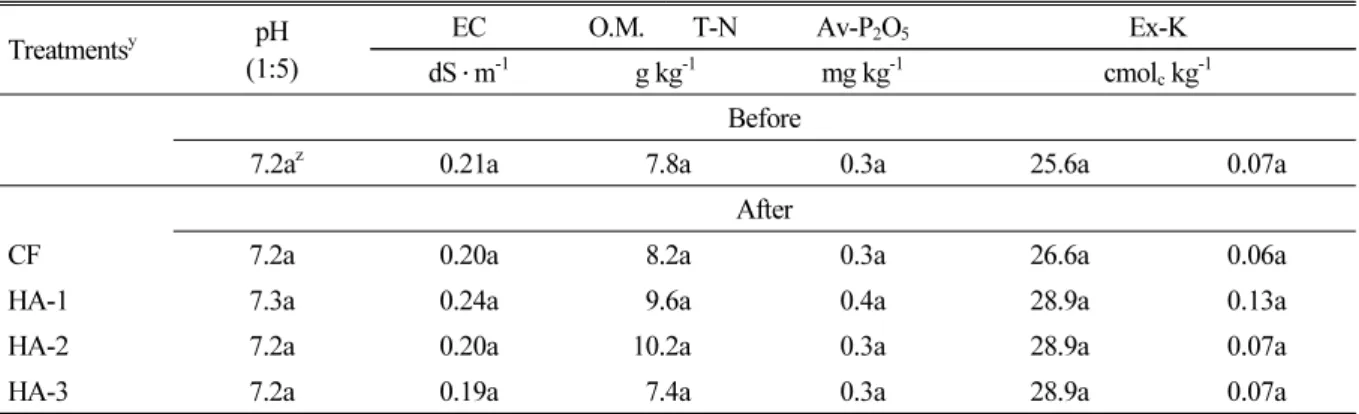
Table 1. Chemical properties of soil in the experimental plot.
Treatmentsy pH (1:5)
EC O.M. T-N Av-P2O5 Ex-K
dS․ m-1 g kg-1 mg kg-1 cmolc kg-1
Before
7.2az 0.21a 7.8a 0.3a 25.6a 0.07a
After
CF 7.2a 0.20a 8.2a 0.3a 26.6a 0.06a
HA-1 7.3a 0.24a 9.6a 0.4a 28.9a 0.13a
HA-2 7.2a 0.20a 10.2a 0.3a 28.9a 0.07a
HA-3 7.2a 0.19a 7.4a 0.3a 28.9a 0.07a
yTreatments were follows. CF: control fertilizer; HA-1: CF+1 ml m-2 liquid fertilizer containing humic aicd (LFHA); HA-2:
CF+2 ml m-2 LFHA; HA-3: CF+4 ml m-2 LFHA. CF was applied at 2.0 g N ai m-2 rate on July 4 and August 4, and at 3.0 g N ai m-2 rate on September 4 and October 7, respectively. Three LFHA treatments were implemented on July 4, July 16, July 25, August 11, August 26, September 10, September 25, October 7, October 22, and November 16.
zMeans with same letters within column are not significantly different by Duncan’s multiple range test at P=0.05 level.
생육 조사 및 분석 방법
잔디 생육 조사는 처리구별 잔디의 가시적 품질(visual quality), 엽록소 함량, 뿌리 길이 및 예지물 등을 조사하였
다. 잔디의 가시적 품질은 National Turfgrass Evaluation Program (NTEP)에서 제시한 방법에 준하여 7월 4일, 7월
16 일, 7월 25일, 8월 11일, 8월 26일, 9월 10일, 9월 25일, 10월 7일, 10월 22일, 10월 30일, 11월 16일, 11월 27일에 총
12 회 조사하였다(1=worst, 9=best and 6=acceptable). 잔디의 생육을 평가하기 위해 7월 25일, 8월 29일, 9월 30일,
10 월 31일에 잔디예지물을 총 5회 조사하였고, 이 때 채취된 시료를 이용하여 엽록소 함량을 분석하였다. 잔디예
정은 잔디시료 0.1 g 를 10 ml DMSO (dimethysulfoxide)로 냉암소에서 48 시간 추출하여 UV-spectrophotometer (X-MA 1200, Human, 서울, 한국)를 사용하여 645 nm와 663 nm에서 흡광도를 측정하고, 아래와 같은 식으로 엽록 소 a와 b 및 총 엽록소 함량을 계산하였다(Arnon, 1949).
Chlorophyll a=12.7 A
663-2.69A
645Chlorophyll b=22.9 A
645-4.68A
663Total Chlorophyll (a+b)=20.21 A
645+8.02A
663잔디의 뿌리길이는 제작한 코어(지름 4 cm, 깊이 15 cm)를 이용하여 8월 11일과 10월 22일 2회 조사하였고, 잔디 밀도는 제작한 밀도측정용 코어(1 cm×1 cm)를 이용하여 9월 10일과 11월 27일 2회 조사하였다.
포장시험에서 공시비료 처리에 의한 토양의 변화를 조사하기 위해 시험 전(7월 4일)과 시험 종료 후(11월 27일) 총 2회 실시하였다. 토양시료는 자체 제작된 토양시료채취용 코어(지름 2 cm, 깊이 10 cm)를 이용하여 각 처리구별 4 개씩 토양시료를 채취하였고, 분석을 위해 음지에서 풍건하였다. 분석 항목은 pH, 전기전도도(electrical conductivity; EC), 유기물(organic matter; O.M) 함량, 전질소(total nitrogen; T-N), 유효 인산(available phosphate;
Av-P
2O
5) 및 치환성 칼륨(exchangeable potassium; Ex-K) 등 이었고, 분석 방법은 토양 화학 분석법(NIAST, 1998) 에 준하여 실시하였다. pH와 EC는 1:5법으로, O.M은 Tyurin법으로, T-N은 Kjeldahl 증류법으로, Av-P
2O
5는 Bray No.1 법으로, 치환성 칼륨은 1N-NH
4OAc 침출법으로 각각 분석하였다.
식물체 분석은 잔디예지물을 마지막으로 채취한 시료(10월 31일 시료)를 분석시료로 이용하였다. 분석 영양소 는 잔디 생육의 주요 구성성분인 질소, 인 및 칼륨 등을 포함하였다. 잔디 식물체 분석은 식물체 분석법(NIAST, 1998) 에 준하여 실시하였고, 질소는 Kjeldahl 증류법으로, 인은 UV-spectrophotometer (X-MA 1200, Human, 서울, 한국)를 이용하여 바나도몰리브덴산법으로, 칼륨은 염광광도계(flame photometer; PFP7, JENWAY, Staffordshire, UK) 를 이용하여 각각 분석하였다.
통계처리는 SPSS 12.1.1을 이용하여 Duncan 다중검정을 통해 처리구간 평균값의 유의차를 검정하였다.
결과 및 고찰
토양의 무기 성분 함량
시험 전과 후의 토양의 화학적 특성은 pH, EC, 질소, 유기물, 유효인산 및 치환성 칼륨에서 시험 전과 후의 차이 는 나타나지 않았고, 시험 종료 후 처리구별 토양화학성의 변화는 통계적으로 유의차를 보이지 않아 부식산 함유 액비(LFHA)의 시비에 따른 토양의 변화는 나타나지 않았다(Table 1). Choi et al. (2011)의 결과에서도 부식산 함유 퇴비의 시비 시 토양의 이화학성 변화에 영향을 미치지 않았다고 보고된 바와 같이 본 연구의 결과와 유사하였다.
이들 결과를 종합할 때, LFHA의 시비는 질소, 인산, 칼륨 등의 처리량이 적고, 희석하여 처리되어 골프코스의 토양 이화학성 변화에 영향을 미치지 않은 것으로 판단된다.
잔디 품질 및 생육 조사
LFHA 시비 후 잔디의 가시적 품질은 크리핑 벤트그래스의 생육 시기 및 환경의 변화에 따라 변화하였다(Table 2).
7 월과 8월에는 LFHA처리구에서 대조구(CF)와 비슷하여 통계적 유의차를 나타내지 않았고, 9월, 10월 및 11월에
는 HA-2처리구와 HA-3처리구에서 대조구(CF)보다 잔디의 가시적 품질이 높아 통계적 유의차를 나타내었다. 이 는 수용성 부식산의 처리가 뿌리의 생육발달로 수분과 양분의 흡수가 증가하여 크리핑 벤트그래스의 품질 및 생육 이 증가한다는 Liu and Cooper (2000)의 결과와 유사하였다.
LFHA 시비 후 잔디 밀도 및 뿌리 길이의 변화는 Table 3과 같다. 9월 10일과 11월 27일 조사에서 잔디 밀도는 20.7-23.3 ea cm
-2와 19.9-23.0 ea cm
-2의 범위로 조사되었고, 11월 27일 조사에서 HA-2와 HA-3는 CF보다 높았다.
Kim et al. (2012) 은 잔디의 줄기 밀도는 잔디 뿌리 생육이 증가하여 잔디의 질소 이용이 개선되어 잔디품질이 향상 된다고 보고하였다.
또한 잔디 뿌리 길이의 변화는 8월 11일과 10월 22일에 각각 5.1-5.2 cm와 6.9-7.8 cm의 범위로 조사되었다 (Table 3). 8 월 11일 조사에서 LFHA처리구의 잔디 뿌리 길이는 CF와 통계적 유의차를 나타내지 않았고, 10월 22일 조사에서는 HA-1처리구에서 CF보다 13.0% 증가하였으나 통계적 유의차를 나타내었다. LFHA처리구들의 잔디 뿌리 길이는 통계적 유의차를 나타내지 않아 LFHA처리량에 따른 뿌리길이의 변화는 확인 할 수 없었다. 이는 부 식산 처리에 의해 토양미생물의 활성이 증가하고(Kim et al., 2017), 토양미생물이 식물생장촉진물질을 분비하여 식물의 뿌리발생 및 생장에 유익한 효과를 나타내기 때문으로 판단된다(Hartwigsen, and Evans, 2000; Arancon et al., 2006).
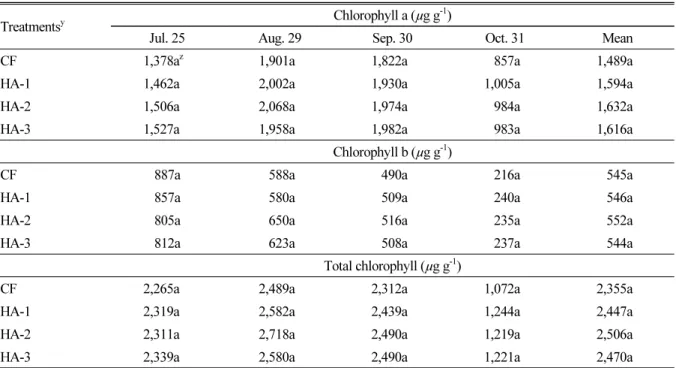
LFHA 처리에 따른 잔디의 엽록소 a, 엽록소 b 및 총 엽록소 함량을 조사하였다(Table 4). LFHA처리구의 엽록소
Table 2. Visual quality of creeping bentgrass by application of liquid fertilizer containing humic acid.
Treatmentsy Visual quality (1: low - 9: high)
Jul. Aug. Sep. Oct. Nov. Mean
CF 7.06az 6.88a 6.90b 7.16c 6.90c 7.02a
HA-1 7.17a 6.88a 7.00a 7.19b 6.98bc 7.08a
HA-2 7.16a 6.85a 6.94ab 7.20ab 7.06ab 7.06a
HA-3 6.99a 6.90a 6.98a 7.23a 7.15a 7.05a
yTreatments were follows. CF: control fertilizer; HA-1: CF+1 ml m-2 liquid fertilizer containing humic aicd (LFHA); HA-2:
CF+2 ml m-2 LFHA; HA-3: CF+4 ml m-2 LFHA. CF was applied at 2.0 g N ai m-2 rate on July 4 and August 4, and at 3.0 g N ai m-2 rate on September 4 and October 7, respectively. Three LFHA treatments were implemented on July 4, July 16, July 25, August 11, August 26, September 10, September 25, October 7, October 22, and November 16.
zMeans with same letters within column are not significantly different by Duncan’s multiple range test at P=0.05 level.
Table 3. The shoot density and root length of creeping bentgrass by application of liquid fertilizer containing humic acid.
Treatmentsy Shoot density (ea cm-2) Root length (cm)
Sep. 10 Nov. 27 Aug. 11 Oct. 22
CF 20.7az 19.9b 5.1a 6.9b
HA-1 20.7a 20.8ab 5.1a 7.8a
HA-2 23.3a 22.9a 5.2a 7.3ab
HA-3 22.4a 22.4a 5.1a 7.3ab
yTreatments were follows. CF: control fertilizer; HA-1: CF+1 ml m-2 liquid fertilizer containing humic aicd (LFHA); HA-2:
CF+2 ml m-2 LFHA; HA-3: CF+4 ml m-2 LFHA. CF was applied at 2.0 g N ai m-2 rate on July 4 and August 4, and at 3.0 g N
a, 엽록소 b 및 총 엽록소 함량은 7월 25일, 8월 29일, 9월 30일 및 10월 31일 조사에서 높은 경향을 보였으나 처리구 별 차이를 나타내지 않았다. Zhnag and Ervin (2004)은 크리핑 벤트그래스(Agrostis palustris Huds.)에서 부식산을 처리할 경우 잔디의 엽록소함량이 증가한다고 하였으나 본 연구에서는 잔디의 엽록소함량에 미치는 영향이 나타 나지 않아 추후 보완시험을 통해 확인이 필요하였다. 포장시험은 시험과정에서 다양한 환경요인과 잔디관리과정 에서 영향을 받기 때문에 환경요인을 다소 조정할 수 있는 포트시험과 다른 결과를 나타내기도 한다(Kim et al, 2016).
Table 4. Chlorophyll content in leaves of creeping bentgrass by application of liquid fertilizer containing humic acid.
Treatmentsy Chlorophyll a (µg g-1)
Jul. 25 Aug. 29 Sep. 30 Oct. 31 Mean
CF 1,378az 1,901a 1,822a 857a 1,489a
HA-1 1,462a 2,002a 1,930a 1,005a 1,594a
HA-2 1,506a 2,068a 1,974a 984a 1,632a
HA-3 1,527a 1,958a 1,982a 983a 1,616a
Chlorophyll b (µg g-1)
CF 887a 588a 490a 216a 545a
HA-1 857a 580a 509a 240a 546a
HA-2 805a 650a 516a 235a 552a
HA-3 812a 623a 508a 237a 544a
Total chlorophyll (µg g-1)
CF 2,265a 2,489a 2,312a 1,072a 2,355a
HA-1 2,319a 2,582a 2,439a 1,244a 2,447a
HA-2 2,311a 2,718a 2,490a 1,219a 2,506a
HA-3 2,339a 2,580a 2,490a 1,221a 2,470a
yTreatments were follows. CF: control fertilizer; HA-1: CF+1 ml m-2 liquid fertilizer containing humic aicd (LFHA); HA-2:
CF+2 ml m-2 LFHA; HA-3: CF+4 ml m-2 LFHA. CF was applied at 2.0 g N ai m-2 rate on July 4 and August 4, and at 3.0 g N ai m-2 rate on September 4 and October 7, respectively. Three LFHA treatments were implemented on July 4, July 16, July 25, August 11, August 26, September 10, September 25, October 7, October 22, and November 16.
zMeans with same letters within column are not significantly different by Duncan’s multiple range test at P=0.05 level.
LFHA 처리에 따른 잔디 생육량을 조사하기 위해 잔디예지물량을 조사한 결과, 1.62-2.59 g m
-2으로 조사되었다 (Table 5). 7 월 25일, 8월 29일 및 9월 30일 조사에서는 잔디 처리구별 차이를 나타내지 않았으나 10월 31일 조사와 총 예지물량은 HA-2와 HA-3에서 대조구보다 증가하였다. 이러한 결과는 부식산의 처리가 고추, 토마토 및 라이그 래스 생육과 생장에 기여한다는 연구들과 유사한 결과를 나타내었다(Asenjo et al., 2000; Türkmen et al., 2003; Kim et al., 2017). 식물의 생육에 미치는 부식산의 작용기작에 대해 정확히 알려지지는 않았으나 세포막투과성, 산소 섭 취량, 호흡과 광합성, 인산염 흡수 및 뿌리 신장에 대한 연구와 관련이 있을 것으로 몇몇 연구자들에 의해 제안되었 다(Vaughan, 1974; Cacco and Dell’Agnolla, 1984; Russo and Berlyn, 1990).
LFHA 처리 후 잔디 중 함유된 무기 성분 함량 조사 결과, 질소, 인 및 칼륨은 각각 2.15-2.68%, 0.10-0.18% 및
2.18-2.96% 의 범위를 나타내었다(Table 6). 질소와 칼륨은 CF보다 LFHA처리구에서 증가하였다. Kim et al. (2007)
은 토마토에서 부식산을 처리할 경우 작물의 양분 흡수 및 이용율이 증가하여 토마토 잎 중 질소함량 및 칼륨함량
이 증가한다고 보고하였다.
Table 5. Dry weight of clipping of creeping betngrass by application of liquid fertilizer containing humic acid.
Treatmensy Dry weight of clipping (g m-2)
Jul. 25 Aug. 29 Sep. 30 Oct. 31 Total
CF 0.40az 0.50a 0.46a 0.26b 1.62b
HA-1 0.55a 0.54a 0.80a 0.38b 2.27ab
HA-2 0.56a 0.61a 0.83a 0.50ab 2.50ab
HA-3 0.50a 0.69a 0.68a 0.72a 2.59a
yTreatments were follows. CF: control fertilizer; HA-1: CF+1 ml m-2 liquid fertilizer containing humic aicd (LFHA); HA-2:
CF+2 ml m-2 LFHA; HA-3: CF+4 ml m-2 LFHA. CF was applied at 2.0 g N ai m-2 rate on July 4 and August 4, and at 3.0 g N ai m-2 rate on September 4 and October 7, respectively. Three LFHA treatments were implemented on July 4, July 16, July 25, August 11, August 26, September 10, September 25, October 7, October 22, and November 16.
zMeans with same letters within column are not significantly different by Duncan’s multiple range test at P=0.05 level.
Table 6. The nutrient content in creeping bentgrass leaf tissue after application of liquid fertilizer containing humic acid.
Treatmentsy Nutrient content (%)
N P K
CF 2.15bz 0.10b 2.18b
HA-1 2.52a 0.17a 2.85a
HA-2 2.50a 0.16a 2.96a
HA-3 2.68a 0.18a 2.86a
yTreatments were follows. CF: control fertilizer; HA-1: CF+1 ml m-2 liquid fertilizer containing humic aicd (LFHA); HA-2:
CF+2 ml m-2 LFHA; HA-3: CF+4 ml m-2 LFHA. CF was applied at 2.0 g N ai m-2 rate on July 4 and August 4, and at 3.0 g N ai m-2 rate on September 4 and October 7, respectively. Three LFHA treatments were implemented on July 4, July 16, July 25, August 11, August 26, September 10, September 25, October 7, October 22, and November 16.
zMeans with same letters within column are not significantly different by Duncan’s multiple range test at P=0.05 level.
Table 7. Pearson correlation coefficients among growth parameters observed from the application of humic acid fertilizer to creeping bentgrass.
Growth
parametersz VQ SD RL TCh DWc N P K LFHA
VQ 1.0000** 0.0377 0.1522 0.4206 0.0744 0.4039 0.1798 -0.0425 0.1758
SD 1.0000** 0.0910 0.2651 0.7361** 0.3110 0.6487* 0.6387* 0.6133*
RL 1.0000** 0.2814 0.5075 0.1370 0.4183 0.4237 0.1035
TCh 1.0000** 0.3100 0.2976 0.2872 0.3692 0.4468
DWc 1.0000** 0.4388 0.7069** 0.5616* 0.5954*
N 1.0000** 0.7841** 0.4786 0.6805*
P 1.0000** 0.7598** 0.7441**
K 1.0000** 0.5288
LFHA 1.0000**
zGrowth parameters were follows. VQ: Visual quality; SD (ea cm-2): shoot density; RL (cm): root length; TCh (µg g-1): total
-2
LFHA 처리에 의한 잔디의 생육과 품질에 미치는 영향을 평가하기 위해 조사 항목 별 상관성을 조사하였다 (Table 7). 잔디예지물(건물중)은 잔디 밀도, 잔디 중 인산함량 및 칼리함량과 정의 상관성(P<0.05)을, 인산 함량은 잔디예지물, 질소함량과 정의 상관성(P<0.01)을 나타내었다. LFHA 처리량 별 잔디의 생육 인자별 상관성을 조사 한 결과, 잔디 밀도, 잔디예지물, 질소함량 및 인산함량이 정의 상관성(P<0.05)을 나타내었다. 부식산의 처리는 고 추나 토마토의 생육과 생장 및 생산량을 증가시킨다고 보고된 바 있어 본 연구의 결과와 유사한 결과를 확인하였 다(Kim et al., 2007; Kim et al., 2017). 이는 부식산의 처리가 잔디의 질소와 인산의 흡수를 증가시킴으로써 잔디예 지물과 잔디 밀도가 증가하는 것을 확인하였다. 본 연구에서는 부식산의 처리에 의한 잔디의 지하부 생육에 대한 결과는 확인 할 수 없었으나 추후 이를 확인하기 위한 보완시험이 필요하였다.
요 약
본 연구는 부식산 함유 액비(LFHA)의 시비에 따른 잔디의 생육과 품질의 변화를 평가하기 위해 수행하였다. 처 리구는 대조구(CF), HA-1 (CF+1 ml m
-2LFHA), HA-2 (CF+2 ml m
-2LFHA), and HA-3 (CF+4 ml m
-2LFHA) 로 구 분되었다. LFHA 처리 전후에 토양화학성은 차이를 나타내지 않았다. LFHA처리구와 대조구를 비교하였을 때, HA-2 처리구와 HA-3처리구의 잔디 품질은 9월, 10월 및 11월 조사에서 높았고, 잔디예지물은 10월 27일 조사에서 증가하였다. 줄기 밀도, 뿌리 길이, 잎조직 내 질소, 인산 및 칼륨의 함량은 LFHA처리구에서 증가하였다. 잔디예지 물은 잎 조직 내 인산 및 칼리함량이나 줄기 밀도와 정의 상관성을 보였고, 부식산 함유 액비는 잔디 밀도, 잔디예 지물 및 잎조직 내 질소 및 인산함량과 각각 정의 상관성을 나타내었다. 이 결과들을 종합해 볼 때, 크리핑 벤트그 래스에서 부식산 함유 액비의 시비는 잔디의 잎 조직 중 질소와 인산의 흡수가 증가하여 잔디예지물과 밀도가 증 가하는 것을 확인 할 수 있었다.
주요어: 크리핑 벤트그래스, 잔디의 생육 및 품질, 부식산 함유 액비, 줄기 밀도
ACKNOWLEDGEMENTS
This research was financially supported by the Ministry of Trade, Industry, and Energy (MOTIE), Korea, under the
“Regional Specialized Industry Development Program (Project No. R0005312)” supervised by the Korea Institute for Advancement of Technology (KIAT).
REFERENCES
Arancon, N.Q., Edwards, C.A., Lee, S. and Byrne, R. 2006. Effects of humic acids from vermicomposts on plant growth. Europe. J. Soil Biol. 42:65-69.
Arnon, D.I. 1949. Copper enzymes in isolated chloroplasts polyphenoloxidase in Beta vulgaris. Plant Physiol.
24(1):1-15.
Asenjo, M.C.G., Gonzalez, J.L. and Maldonado, J.M. 2000. Influence of humic extracts on germination and growth ryegrass. Commun. Soil Sci. Plant. Anal., 31:101-114
Cacco, G. and Dell’Agnola, G. 1984. Plant growth regulalor activity of soluble humic complexes. Can. J. Soil Sci.
64:225-228.
Choi, H.S., Li, X., Kim, W.S. and Lee, Y. 2011. Effects of nutrient source on soil physical, chemical, and microbial properties in an organic pear orchard. Kor. J. Environ. Agric. 30(1):16-23. (In Korean)
El-Ghamry, A.M., El-Hai, K.M.A. and Ghoneem, K.M. 2009. Amino and humic acids promote growth, yield and disease resistance of faba bean cultivated in clayey soil. Aust. J. Basic. Appl. Sci. 3(2):731-739.
Hamza B. and Suggars A. 2001. Biostimulants: Myths and Realities. Turfgrass Trends 10(8):6-10 MacCarthy, P., Malcolm, R.L., Clapp, C.E. and Bloom, P.R. 1985. An introduction to soil humic substances. pp 1-12. In:
MacCarthy et al. (Eds.) Humic substances in soil and crop sciences, selected reading, Soil Sci. Soc. of Am., Madison, WI, USA.
Hartwigsen, J.A. and Evans, M.R. 2000. Humic acid seed substrate treatments promote seedling root development.
HortScience 35:1231-1233.
Hunter, A. and Anders, A. 2004. The influence of humic acid on turfgrass growth and development of creeping bentgrass. Acta Hortic. 661:257-264.
Jannin, L., Arkoun, M., Ourry, A., Laîné, P, Goux, D., et al. 2012. Microarray analysis of humic acid effects on Brassica napus growth: Involvement of N, C and S metabolisms. Plant Soil 359:297-319.
Kim, H.G., Seo, D.C., Cheong, Y.H., Kang, C.S., Sohn, B.K., et al., 2007. Effects of different humic acids on growth and fruit quality of tomato plant. Kor. J. Environ. Agric. 26(4):313-318.
Kim, K.N. 2015. Comparison of underground root growth characteristic of major cool-season grasses according to establishment stages in sports turf designed by the USGA soil system. Kor. J. Hort. Sci. Techonol. 33(2):166-176.
(In Korean)
Kim, M.J., Shim, C.K., Kim, Y.K., Park, J.H., Han, E.J. et al. 2017. Effect of the concentration of humic acid on growth and yield of organically cultivated hot-pepper. J. Kor. Resour. Rec. Assoc. 25(1):67-78. (In Korean)
Kim, Y.S., Ham, S.K., Lee, J.P. and Hwang, Y.S. 2012. The growth effects of creeping bentgrass by application of liquid fertilizer with saponin and liquid fertilizer with amino acid. Asian J. Turfgrass Sci. 26(1):54-59. (In Korean) Kim, Y.S., Ham, S.K. and Lim, H.J. 2010. Change of soil physicochemical properties by mixed ratio of 4 types of soil
amendments used in golf course. Kor. Turfgrass Sci. 24(2):205-210. (In Korean)
Kim, Y.S., Lee, C.E., Ham, S.K. and Lee. G.J. 2016. Growth of creeping bentgrass by application of compound fertilizer containing microbes. Weed Turf. Sci. 5(1):42-50. (In Korean)
Kweon, D.Y., Lee, J.H., Lee, D.I. and Joo, Y.K. 2005. Turfgrass establishment of USGA putting greens related with soil physical properties. Kor. Turfgrass Sci. 19(2):95-102. (In Korean)
Lee, S.B., Kim, Y.S., Ham, S.K., Lim, H.J., Choi, Y.C. et al. 2013. Effect of soldier fly castes mixed soil on change of soil properties in root zone and growth of zoysiagrass. Weed Turf. Sci. 2(3):298-305. (In Korean)
Lee, T.S., Cho, S.H., Jeong, J.Y., An, J.Y., Lee, J.J., et al. 2017. Composting of livestock manure blending humic acid powder and influence on growth of lettuce by its application. J. Kor. Org. Res. Rec. Ass. 25(2):5-14. (In Korean) Liu, C. and Cooper, R.J. 2000. Humic substances influence creeping bentgrass growth. Golf Course Management
67(8):49-53.
Liu, C. and Cooper, R.J. 2002. Humic acid application does not improve salt tolerance of hydoponically grown creeping bentgrass. J. Amer. Soc. Hort. Sci. 127(2):219-223.
Liu, C, Cooper, R.J. and Bowman D.C. 1998. Humic acid application affects photosynthesis, root development, and
Russo, R.O. and Berlyn, G.P. 1990. The use of organic biostimulants to help low input sustainable agriculture. J. Sust.
Agric. 1:19-42.
Türkmen, Ö., Dursun, A., Turan, M. and Erdinç, C. 2003. Calcium and humic acid affect seed germination, growth, and nutrient content of tomato (Lycopersiocon esculentum L.) seedling under saline soil conditions. Acta. Agri.
Scandinavica 54:168-174.
Van Dyke, A., Johnson, P.G. and Grossl, P.R. 2009. Influence of humic acid on water retention and nutrient acquisition in simulated golf putting greens. Soil Use. Manage. 25(3):255-261.
Vaughan, D. 1974. Possible mechanism for humic acid action on cell elongation in root segments of Pisum sativum under aseptic conditions. Soil Biol. Biochem. 6:241-247.
Zhang, X., Ervin, E.H. and Schmit, R.E. 2003. Physiological effects of liquid applications of a seaweed extract and a humic acid on creeping bentgrass. J. Amer. Soc. Hort. Sct. 128(4):492-496.
Zhang, X. and Ervin, E.H. 2004. Cytokinin-containing seaweed and humic acid extracts associated with creeping bentgrass leaf cytokinins and drought resistance. Crop Sci. 44:1737-1745.