• 검색 결과가 없습니다.

Coronary artery vasospasm after atrial septal defect surgery

N/A
N/A
Protected

Academic year: 2021

Share "Coronary artery vasospasm after atrial septal defect surgery"

Copied!
5
0
0

로드 중.... (전체 텍스트 보기)

전체 글

(1)

Yeungnam Univ J Med 2014;31(2):122-126

Coronary artery vasospasm after atrial septal defect surgery

Jin Won Yoon

1

, Young Soo Lee

1

, Dong Keun Kim

1

, Young Hoon Choi

1

, Dong-Ju Kim

1

, Jae Jin Lee

2

, Hyo Seung Ahn

1

, Wook Hyun Cho

1

1

Division of Cardiology, Department of Internal Medicine and

2

Thoracic and Cardiovascular Surgery, Sahmyook Medical Center, Seoul, Korea

Coronary vasospasm is one of the fatal complications that may occur in patients undergoing open heart surgery. To date, however, there are not many cases in this series and no definite pathophysiology has been documented. We experienced a case of coronary artery vasospasm after atrial septal defect (ASD) surgery and then successfully treated it with both transbrachial intra-aortic balloon pump and percutaneous cardiopulmonary support. Only several hours after ASD surgery, the patient exhibited the cardiovascular col- lapse, the ST-segment elevation, followed by ventricular fibrillation and normal coronary angiography findings. It is important to make a differential diagnosis of coronary artery vasospasm in patients presenting with ST-segment elevation who had no notable coronary artery diseases. This case indicates that clinicians should be aware of the possibility that the coronary artery vasospasm may also occur in patients undergoing ASD surgery.

Keywords: Arterial heart septal defects; Cardiovascular diseases; Cardiopulmonary resuscitation;

Surgical procedures operative

Received: September 2, 2013, Revised: October 10, 2013, Accepted: October 15, 2013

Corresponding Author: Wook Hyun Cho, Division of Cardio- logy, Department of Internal Medicine, Sahmyook Medical Center, 82 Mangu-ro, Dongdaemun-gu, Seoul 130-711, Korea Tel: +82-2-2210-3507, Fax: +82-2-2212-2673

E-mail: [email protected]

INTRODUCTION

Coronary artery vasospasm is a sudden onset of intense vasoconstriction of the epicardial coronary artery and it causes occlusion or near occlusion. In addition, although it is a common cause of variant angina, it may be involved in other coronary syndromes [1]. It was first described in 1959 by Prinzmetal et al. According to these authors, angina attacks occurred at rest and were associated with ST-segment elevation, rather than ST-segment depression, on the electrocardiography (ECG) [2].

It occurs as a result of the interaction between the 2 components:

(1) the overactivity of coronary artery to vasoconstrictors because of its abnormalities that are localized or diffuse and (2) the induction of vasospasm at the site of overactive coronary artery segment with the stimulation by vasoconstrictors [1].

The proposed mechanisms of coronary artery vasospasm include (1) endothelial dysfunction, (2) the primary overactivity of vascular smooth muscle cells and (3) other factors.

Presumably, there might be no significant correlation between common cardiovascular risk factors and coronary artery vasospasm, but the smoking is an exception. It has been reported that active smokers account for up to 75% of total patients with variant angina [3]. Still, however, little is known about the reason that smokers are vulnerable to coronary artery vasospasm. In addition, it has also been reported that excessive alcohol consumption is also associated with variant angina [4]. But, this has not been supported by epidemiological studies. Furthermore, it is known that individuals who con- sume or abuse other substances ( e.g. , cocaine, amphetamines, marijuana, 5-fluorouracil, capecitabine or sumatriptan) are also vulnerable to coronary artery vasospasm [5-8].

To date, it has also been reported that coronary vasospasm

mainly occurs after coronary artery bypass grafting surgery

[9,10]. But there are almost no cases of vasospasm after repair

operation of atrial septal defect (ASD). To our knowledge,

only 2 cases of coronary vasospasm after ASD surgery have

(2)

Fig. 1. Preoperative echocardiography. A 65-year-old male had a known ASD (secundum type; 2 defects; Qp/Qs=2.0; pulmonary arterial pressure=53/24 mmHg) and a persistent presence of dyspnea on exertion (New York Heart Association class II of IV).

(A) The enlargement of RV and both atria, (B) Two defects of secundum type ASD on the color doppler (arrow). ASD, atrial septal defect; RV, right ventricle; LV, left ventricle; RA, right atrium; LA, left atrium.

Fig. 2. Rhythm strip of lead II on the monitor. On admission 2 days, the patient successfully under- went ASD closure and left atrial appendage obliteration. (A) Sinus rhythm with horizontal ST-seg- ments, (B) New elevation of ST-segment, (C) The final conversion of widened QRS rhythm to the ventrilcular fibrillation. ASD, atrial septal defect; HR, heart rate; S

P

O

2

, oxygen saturation;

PVC, premature ventricular contraction; ABP, ambulatory blood pressure; NBP, non-invasive blood pressure; CVP, central venous pressure; RESP, respiratory rate.

been described in the literature [11]. Both the intra-aortic balloon pump (IABP) and the percutaneous cardiopulmonary support (PCPS) are performed to resuscitate patients with coronary vasospasm and cardiogenic shock who underwent open heart surgery [12,13]. We experienced a case of coro- nary artery vasospasm after ASD surgery and then successfully treated it with both transbrachial IABP and PCPS. Here, we report our case with a review of literatures.

CASE

A 65-year-old male had a known ASD (secundum type;

2 defects; Qp/Qs=2.0; pulmonary arterial pressure=53/24 mmHg) and a persistent presence of dyspnea on exertion (New York Heart Association class II of IV). The patient was admitted to our hospital for surgical management (Fig. 1).

Prior to the outpatient visit, the patient had been taking oral medications for atrial fibrillation (AF), hypertension, heart failure, and diabetes mellitus. The patient had undergone coronary angiography 2 years before, thus showing normal

findings. In addition, the patient had also undergone subtotal gastrectomy due to stomach cancer 2 years before. But the patient had no notable findings on family or social history.

On admission 2 days, the patient successfully underwent

ASD closure and left atrial appendage obliteration. Imme-

(3)

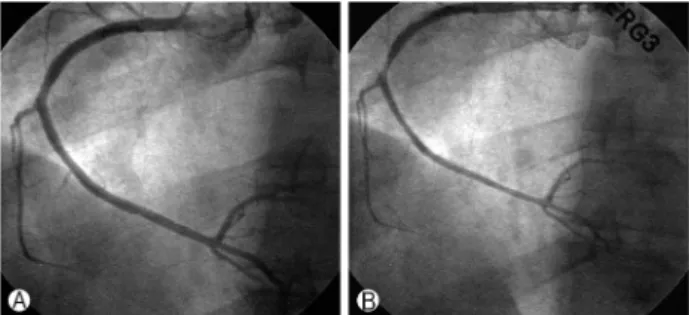
Fig. 3. Coronary angiography on postoperative 1 month. (A) Normal finding of the right coronary artery. (B) Diffuse spasm of the right coronary artery on ergonovine provocation test.

diately after surgery, the AF converted to sinus rhythm, his vital signs were stabilized (Fig. 2A). Five hours after the opera- tion, the ST-segment became progressively elevated (Fig. 2B), QRS was widened and the ventricular fibrillation (VF) was finally developed (Fig. 2C). We performed cardiopulmonary resuscitation. Several minutes later, the patient achieved return of spontaneous circulation but maintained low blood pressure (BP). Then, the patient underwent echocardiography, thus presenting with an ejection fraction of 20% and the left ventri- cular global hypokinesia. With the intravenous injection of epinephrine, the systolic BP was increased to more than 90 mm Hg and then dropped. This phenomenon was repeated for more than 20 minutes. We performed the PCPS via the right femoral artery and the left femoral vein. Following resuscitation, the ST elevation was normalized.

Four hours after resuscitation, although the patient main- tained a full dose of inotropics such as dobutamine, dopamine, norepinephrine, and epinephrine, the mean BP dropped to less than 60 mmHg. The bedside IABP was therefore attem- pted via the left femoral artery. But this trial failed due to the tortuosity of the left femoral artery.

For IABP insertion and coronary angiography, the patient was transferred to an angiography room. The IABP was succe- ssfully inserted via the left brachial artery. The patient under- went coronary angiography via the right brachial artery, thus showing no notable findings.

On the next day of operation, vital signs were stabilized.

Then, the patient was weaned from PCPS and IABP. This was followed by tapering out of inotropics. The patient under- went follow-up echocardiography after the discontinuation of inotropics, thus achieving a normalization of the ejection frac- tion and the left ventricular global hypokinesia. The patient

was transferred to a general ward and then discharged from us after achieving a recovery of the status. On outpatient echo- cardiography, the right ventricle was decreased in size from 4.87 cm a month preoperatively to 2.63 cm. At a month follow-up after discharge, a coronary vasospasm test revealed a diffuse vasoconstriction in the right coronary artery (Fig. 3)

DISCUSSION

To date, most cases of coronary vasospasm after open heart surgery have been reported predominantly in patients under- going coronary artery bypass grafting. The first case in this series was reported by Pichard et al. in 1980 [14]. As noted earlier, however, only 2 cases of coronary vasospasm after ASD surgery have been described in the literature [11].

Recently, the incidence of coronary vasospasm has been decreased in western countries probably because calcium- channel blockers have been widely used for chest pain or hypertension. Moreover, it can be attributed to the fact that clinicians perform coronary vasospasm provocation tests less than they previously used to [15]. Still, however, the prevalence of coronary vasospasm remains high and provocation tests are commonly performed in Japan and Korea [16,17].

The common clinical presentations of cardiac ischemia due to coronary spasm include chest pain and ST-segment changes on the ECG. Despite the similar characteristics to stable angina, chest pain is often characterized by a more severe, prolonged course. Moreover, it is also accompanied by cold sweat, nausea or vomiting, and sometimes by syncope. But clinicians should be aware that cardiac ischemia due to coronary vasospasm is not often accompanied by the above symptoms [18].

During episodes of coronary artery spasm, the ECG changes are characterized by the ST-segment elevation and/or the T-wave peaking due to the total or subtotal coronary occlusion [19]. In addition, the negative U-wave may also appear at the onset or near the end of coronary vasospasm [20].

It is also noteworthy that there is a correlation between the ST-segment elevation and subsequent VF [21]. According to Sanna et al. there was a sequence of sudden ST-segment elevation followed by VF and asystole in a 68-year-old man.

After achieving a recovery of the symptoms, the patient under-

went coronary angiography. This showed that the minimal

atherosclerosis was solely present. In addition, the patient also

underwent intracoronary ergonovine test. This showed that

(4)

there was a diffuse vasospasm associated with ST-segment elevation and it was completely reverted by the intracoronary administration of nitroglycerin [22].

Circulatory collapse due to vasospasm may be fatal to patients [23]. Clinicians should therefore consider the possibi- lity of vasospasm in patients who had alterations in ECG rhythm and hemodynamic profile after open heart surgery [12]. The possible etiologic factors of coronary vasospasm include elevated catecholamine levels, the use of catechola- mines such as dopamine during surgery, discontinuation of preoperative use of β-blockers or calcium channel blockers during surgery, intraoperative occurrence of vascular injury, alkalosis due to hyperventilation, the release of platelet-derived vasospastic factors ( e.g. , thromboxane A2), autonomic nervous stimulation, hypomagnesemia, hypothermia, and irritation from chest tube [24].

In the current case, only several hours after ASD surgery, the patient exhibited the cardiovascular collapse, the ST-seg- ment elevation, followed by VF, and normal coronary angio- graphy findings.

In association with this case, it is important to make a differential diagnosis of coronary artery vasospasm in patients presenting with ST-segment elevation who had no notable coronary artery diseases. Differential diagnoses include stress-induced cardiomyopathy, cardiac syndrome X, myocar- ditis, and cocaine abuse.

Based on a patient history, only stress-induced cardiomyo- pathy might postoperatively cause cardiac arrest. It is often characterized by the ECG abnormalities, such as the anterior ST-segment elevations and/or T-wave inversion and the abnor- malities of the regional wall motion involving the apex and/or middle segment of the left ventricle. This is typically accom- panied by a recovery of the normal left ventricular functions during the acute episodes within 1 to 4 weeks after the onset of stress-induced cardiomyopathy [25].

In this case, the ST-segment elevation was seen on the one of inferior leads. This was followed by the complete normali- zation of the global hypokinesia with severe systolic dysfunc- tion of the left ventricle on the next day of the event. More- over, a coronary artery vasospasm test with intracoronary ergonovine was also performed at a month follow-up after discharge. This revealed a diffuse vasoconstriction in the right coronary artery. These findings led to the speculation that the cardiac arrest occurred as a result of the coronary artery

vasospasm in this case. In addition, this case is the coronary artery vasospasm after ASD surgery irrespective of whether the coronary vessel was surgically operated, which may be of particular interest to clinicians.

Moreover, we performed the transbrachial IABP rather than the transfemoral one because of the tortuosity of the femoral artery. The transbrachial approach alternative to femoral access has been proposed for patients with associated severe aortoiliac and femoral disease or vascular prosthesis for aortofemoral bypass who require IABP insertion [13]. In association with this, Onorati et al. reported that the trans- brachial IABP with a 7.5-F catheter is as safe and effective as the transfemoral method in patients with unavailable femoral arteries [26].

In conclusion, this case indicates that clinicians should be aware of the possibility that the coronary artery vasospasm may also occur in patients undergoing ASD surgery.

REFERENCES

1. Lanza GA, Careri G, Crea F. Mechanisms of coronary artery spasm. Circulation 2011;124:1774-82.

2. Prinzmetal M, Kennamer R, Merliss R, Wada T, Bor N.

Angina pectoris. I. a variant form of angina pectoris; prelimi- nary report. Am J Med 1959;27:375-88.

3. Sugiishi M, Takatsu F. Cigarette smoking is a major risk factor for coronary spasm. Circulation 1993;87:76-9.

4. Fernandez D, Rosenthal JE, Cohen LS, Hammond G, Wolfson S. Alcohol-induced Prinzmetal variant angina. Am J Cardiol 1973;32:238-9.

5. El Menyar AA. Drug-induced myocardial infarction secon- dary to coronary artery spasm in teenagers and young adults.

J Postgrad Med 2006;52:51-6.

6. Bathina JD, Yusuf SW. 5-Fluorouracil-induced coronary vaso- spasm. J Cardiovasc Med (Hagerstown) 2010;11:281-4.

7. Sestito A, Sgueglia GA, Pozzo C, Cassano A, Barone C, Crea F, et al. Coronary artery spasm induced by capecitabine. J Cardiovasc Med (Hagerstown) 2006;7:136-8.

8. Wasson S, Jayam VK. Coronary vasospasm and myocardial infarction induced by oral sumatriptan. Clin Neuropharmacol 2004;27:198-200.

9. Mohammed AA, Yang A, Shao K, Disabatino A, Blackwell R, Banbury M, et al. Patients with left main coronary artery vasospasm inadvertently undergoing coronary artery bypass grafting surgery. J Am Coll Cardiol 2013;61:899-900.

10. Lorusso R, Crudeli E, Lucà F, De Cicco G, Vizzardi E, D’Aloia A, et al. Refractory spasm of coronary arteries and grafted conduits after isolated coronary artery bypass surgery. Ann Thorac Surg 2012;93:545-51.

11. Yokoyama M, Yamada T, Nakahara H, Oshima N, Tanabe

(5)

S, Irie Y, et al. Two cases of perioperative coronary vasospasm following ASD closure and OMC. Kyobu Geka 1990;43:891-4.

12. Min HK, Lee YT, Kim WS, Kim SW. The role of percuta- neous cardiopulmonary support in the treatment of native coronary spasm after coronary artery bypass grafting. Heart Surg Forum 2010;13:E126-8.

13. Rubino AS, Onorati F, Serraino F, Renzulli A. Safety and efficacy of transbrachial intra-aortic balloon pumping with the use of 7-Fr catheters in patients undergoing coronary by- pass surgery. Interact Cardiovasc Thorac Surg 2009;9:135-7.

14. Pichard AD, Ambrose J, Mindich B, Midwall J, Gorlin R, Litwak RS, et al. Coronary artery spasm and perioperative cardiac arrest. J Thorac Cardiovasc Surg 1980;80:249-54.

15. Hamilton KK, Pepine CJ. A renaissance of provocative testing for coronary spasm? J Am Coll Cardiol 2000;35:1857-9.

16. Yasue H, Sasayama S, Kikuchi K, Okumura K, Matsubara T, Miwa K, et al. The study on the role of coronary spasm in ischemic heart disease. In: Annual report of the research on cardiovascular diseases. Osaka: National Cardiovascular Center; 2000. p. 96-7.

17. Song JK, Park SW, Kang DH, Hong MK, Kim JJ, Lee CW, et al. Safety and clinical impact of ergonovine stress echo- cardiography for diagnosis of coronary vasospasm. J Am Coll Cardiol 2000;35:1850-6.

18. Yasue H, Touyama M, Shimamoto M, Kato H, Tanaka S.

Role of autonomic nervous system in the pathogenesis of Prinzmetal’s variant form of angina. Circulation 1974;50:

534-9.

19. Nakamura M, Takeshita A, Nose Y. Clinical characteristics associated with myocardial infarction, arrhythmias, and sud-

den death in patients with vasospastic angina. Circulation 1987;75:1110-6.

20. Lablanche JM, Fourrier JL, Gommeaux A, Mariotti R, Ber- trand ME. Value of negative U waves in coronary artery spasm. Arch Mal Coeur Vaiss 1990;83:199-203.

21. Noda T, Shimizu W, Taguchi A, Satomi K, Suyama K, Kurita T, et al. ST-segment elevation and ventricular fibrillation with- out coronary spasm by intracoronary injection of acetylcho- line and/or ergonovine maleate in patients with Brugada synd- rome. J Am Coll Cardiol 2002;40:1841-7.

22. Sanna T, Lanza GA, Niccoli G, La Torre G, Cosentino N, Crea F. Coronary artery vasospasm causing ventricular fibrilla- tion - an external loop recording. Resuscitation 2009;80:393-4.

23. Green MS, Gomes S. Intraoperative coronary artery vaso- spasm: a twist in the tale! Middle East J Anesthesiol 2011;

21:299-304.

24. Baek JH, Han SS, Lee DH. Native coronary artery and grafted artery spasm just after coronary artery bypass grafting: a case report. J Korean Med Sci 2010;25:641-3.

25. Sharkey SW, Lesser JR, Menon M, Parpart M, Maron MS, Maron BJ. Spectrum and significance of electrocardiographic patterns, troponin levels, and thrombolysis in myocardial in- farction frame count in patients with stress (tako-tsubo) car- diomyopathy and comparison to those in patients with ST-el- evation anterior wall myocardial infarction. Am J Cardiol 2008;101:1723-8.

26. Onorati F, Impiombato B, Ferraro A, Comi MC, Spaccarotella C, Indolfi C, et al. Transbrachial intraaortic balloon pumping in severe peripheral atherosclerosis. Ann Thorac Surg 2007;

84:264-6.

수치

Fig. 2. Rhythm strip of lead II on the monitor. On admission 2 days, the patient successfully  under- went ASD closure and left atrial appendage obliteration
Fig. 3. Coronary angiography on postoperative 1 month. (A)  Normal finding of the right coronary artery

참조

관련 문서

Intractable Coronary Spasm Requiring Percutaneous Coronary Intervention after Coronary Artery Bypass Grafting in a Patient with Moyamoya Disease.. Hyeon A Kim, M.D., Young Su

Changes in jugular bulb oxygen saturation during off-pump coronary artery bypass graft surgery Ji Young Kim.. Department

Total arterial revascula- rization using Y-composite graft for isolated left main coronary artery disease. Coronary artery bypass grafting using the gastroepiploic

Off-pump coronary artery bypass grafting provides complete revascularization with reduced myocardial injury, transfusion requirements, and length of stay: a

Compared with conventional coronary artery bypass graft (CABG), off-pump coronary artery bypass (OPCAB) has ad- vantages for performing transfusion-free surgery,

Management was coronary artery bypass grafting to the left anterior descending artery and obtuse marginal arteries, closure of the left main coronary artery

After percutaneous intervention to the right coronary artery, off-pump coronary artery bypass grafting for the left coronary territory was done using a right ITA

The ongoing PRECOMBAT (PREmiere of COMparison of Bypass Surgery and Angioplasty Using Sirolimus-Eluting Stents in Patients With Unprotected Left Main Coronary Artery Disease)