책임저자:정태은, 대구광역시 남구 대명동 317-1, 영남대학교 의과대학 흉부외과학교실 Tel: (053) 620-3884, Fax: (053) 626-8660, E-mail: [email protected] * 이 논문은 2005년도 재단법인 천마의학연구재단 지원에 의하여 이루어 졌음
소아 개심술에서 Histidine-Tryptophan-Ketoglutarate 용액과 냉혈심정지액의 심근보호 효과*
정태은⋅이동협⋅한승세
영남대학교 의과대학 흉부외과학교실Myocardial Protective Effect of Histidine-Tryptophan-Ketoglutarate Solution and Cold Blood Cardioplegic Solution in Pediatric Cardiac Surgery
Tae Eun Jung, Dong Hyup Lee, Sung Sae Han
Department of Thoracic and Cardiovascular Surgery, College of Medicine, Yeungnam University, Daegu, Korea
-Abstract-
Background: There is limited data on comparisons between the effect of histidine- tryptophan-ketoglutarate (HTK) solution and cold blood cardioplegic (CBC) solution in pediatric cardiac surgery. The purpose of this study was to compare the myocardial protective effect of HTK solution and CBC solution in patients undergoing pediatric cardiac surgery.
Materials and Methods: We selected 49 patients with ventricular septal defect and atrial septal defect. HTK solution was used in 21 patients and CBC solution was used in 28 patents. HTK solution was given as a single dose, whereas CBC solution was used in the usual multi-dose method. The incidence of EKG change and concentration of Troponin T and CK-MB were compared for the evaluation of myocardial damage.
1)Results: There were no significant differences in the incidence of ST, T segment change by EKG and serial cardiac enzyme levels between two groups.
Conclusion: These results suggested that the myocardial protective effect of HTK solution
was similar to CBC solution in simple pediatric cardiac surgery.
서 론
개심술을 시행함에 있어 허혈과 재관류에 따르는 심근손상을 줄이기 위해 다양한 종류의 심근보호법들이 사용되고 있다. 특히 심정지액 의 사용은 매우 중요한 부분을 차지하고 있으 며 그 종류도 다양하다.
1-3)Melose 등
4)이 심정 지액의 원리를 소개한 후 심정지액의 성분에 관한 다양한 연구가 이루어져 왔다. 심정지액 은 구성성분이나 적용방법 등에 따라 다양하게 구분될 수 있다. 크게 세포외 전해질 농도를 기 초로 하고 고 칼륨을 함유한 것과 세포내 전해 질에 기초한 것으로 나눌 수 있는데 histidine- tryptophan-ketoglutarate (HTK)용액은 세포내 전 해질의 농도에 기초한 심정지액으로 Bretschneider 등
3)에 의해 제안되었으며 이식 장기의 보존액 으로도 사용된다.
5)HTK용액 중 histidine은 완 충작용을 하고, tryptophan은 세포막을 안정화 시키고 ketoglutarate는 재관류시 에너지원으로 ATP를 공급하는 기전으로 심근을 보호하는 작용을 한다.
6)소아에 있어서 HTK용액의 효과에 대한 연 구는 많지 않다. 소아의 개심술에 있어 심근 손상을 줄이기 위한 HTK용액의 효과를 보편 적으로 사용되는 냉혈심정지액과 비교하였다.
대상 및 방법
2001년 9월부터 2004년 9월까지 영남대학교 의과대학 흉부외과학교실에서 개심술을 시행한 심실중격결손 및 심방중격결손 환자 49명(HTK
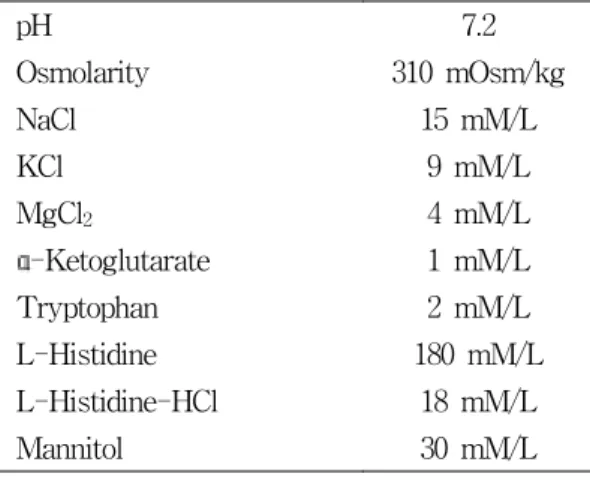
용액군: 21명, 냉혈심정지액군: 28명)을 대상으 로 하였다. HTK용액의 성분은 Table 1과 같 다.
냉혈심정지액은 통상적으로 사용되는 결절 성심정지액을 혈액과 1:4로 혼합하여 사용하였 으며 HTK용액은 상품화된 Custodiol
®을 사용 하였다. 심정지액은 두 군 모두 전향적으로 주 입하였는데 HTK용액군은 30 ml/kg를 1회 주 입하였으며 냉혈심정지액은 초 회 30 ml/kg를 주입 후 30분마다 20 ml/kg를 반복 투여하였 다.
심전도상의 변화는 수술 직후 및 술 후 1일 까지 심전도 변화를 조사하여 ST분절이 기준 점보다 1 mm 이상 하강하였거나 2 mm 이상 상승한 경우 그리고 T파 역위가 있는 경우 의 의가 있는 것으로 하였다. 심근 효소의 변화는 수술 직후 및 술 후 1, 2, 3, 4, 5일의 혈중 Troponin-T와 수술 직후 및 술 후 1, 2, 3일의 CK-MB의 농도를 측정하여 두 군간 비교를 하였다.
Table 1. Composition of HTK solution
pH 7.2
Osmolarity 310 mOsm/kg
NaCl 15 mM/L
KCl 9 mM/L
MgCl
24 mM/L
α-Ketoglutarate 1 mM/L
Tryptophan 2 mM/L
L-Histidine 180 mM/L L-Histidine-HCl 18 mM/L
Mannitol 30 mM/L
Key Words: Cardioplegic solution, Myocardial protection, Congenital heart surgery
계적 처리는 SPSS 12.0을 이용하여 Chi-square test, t-test 및 Mann-Whitney test를 시행하 였으며 유의 수준은 p 값이 0.05 이하인 경우 로 하였다.
결 과
간에 유의한 차이는 없었다. 총 체외순환과 대 동맥차단시간은 HTK용액군이 94.6 ± 32.9분과 47.1 ± 23.8분이었으며 냉혈심정지액군이 92.9
± 31.5분과 48.9 ± 27.8분으로 두 군 간에 유의 한 차이는 없었다(Table 2). 심정지액의 투여 회 수는 HTK용액군은 1회였으며 냉혈심정지
Table 2. Patient profile
CBC group (28 cases)
HTK group
(21 cases) p value
Age 3.9±2.6 4.8±3.8 NS
Sex (M/F) 15/13 13/8
Weight (kg) 16.2±11.7 15.8± 8.5 NS
Diagnosis ASD VSD
9 19
6 15
TBT 92.9±31.5 94.6±32.9 NS
ACC time (min) 48.9±27.8 47.1±23.8 NS
Cardioplegic solution
infusion time (min) 1.7±0.8 1 CBC; cold blood cardioplegia, HTK; histidine-tryptophan-ketoglutarate,
ASD; atrial septal defect, VSD; ventricular septal defect, TBT; total bypass time, ACC; aortic cross clamp time, NS; not significant
Fig. 1. Comparison of postoperative serum Troponin T level. CBC; cold blood
cardioplegia, HTK; histidine-tryptophan-ketoglutarate
액군은 1.7 ± 0.8회였다. 전 예에서 심폐기이탈 에는 문제가 없었으며 술 후 호흡기이탈에서도 특별히 문제가 된 예는 없었다.
술 후 일시적인 ST 분절변화 혹은 T파 역 위가 HTK용액군이 4례, 냉혈심정지액군이 5 례가 있었으나 발생빈도에 있어 유의한 차이는 없었다.
수술 직후와 술 후 1, 2, 3, 4, 5일의 Troponin-T 는 HTK용액군이 0.73 ± 0.18, 0.46 ± 0.11, 0.38 ± 0.11, 0.39 ± 0.13, 0.14 ± 0.09, 0.13 ± 0.09였으며 냉혈심정지액군이 0.63 ± 0.15, 0.38
± 0.14, 0.41 ± 0.13, 0.43 ± 0.12, 0.19 ± 0.11, 0.09 ± 0.06으로 두 군 간에 유의한 차이가 없 었다(Fig. 1). 수술 직후, 술 후 1, 2, 3일의 CK-MB의 농도는 HTK용액군이 11.5 ± 2.1, 5.3 ± 1.9, 2.7 ± 1.6, 1.8 ± 1.8이었고 냉혈심정 지액군이 10.4 ± 2.6, 5.2 ± 1.4, 4.3 ± 1.4, 2.4
± 1.8로 두 군 간에 유의한 차이를 보이지 않 았다(Fig. 2).
고 찰
심정지액은 심장의 이완기 심정지를 유도하 고 허혈 기간 동안 심근세포의 대사를 줄여 세 포내 에너지를 유지하도록 한다.
7)심정지액의 종류는 매우 다양할 뿐만 아니라 투여방법도 여러 가지가 있다. 심정지액의 구성성분에 혈 액의 첨가 유무에 따라 혈성 혹은 비혈성으로 나눌 수도 있으며 칼륨의 농도도 종류 마다 다 를 수 있다. 심정지용액의 성분에 따른 다양한 결과들이 보고되고 있는데 주로 세포외액의 성 분에 기초한 것이 주로 사용되고 있다. 초기에 는 칼륨의 농도에 관한 연구가 주로 이루어 졌 으며 이후 심정지액에 마그네슘, 아미노산 그 리고 각종 약제 등의 첨가에 관한 연구가 많이 발표되었다.
8-10)HTK용액의 장점으로 histidine은 anaerobic glycolysis의 효과를 향상시키는 완충작용을 하고 tryptophan은 세포막을 안정화시키고 ketoglutarate는 Krebs 사이클의 매개물과 nicotinamide adenine dinucleotide의 전구물질 로의 역할을 한다.
3)통상적으로 많이 사용되는 혈액성분을 가진 냉혈심정지액은 산소운반능 력, 완충작용 그리고 항산화효과 등의 장점 등 Fig. 2. Comparison of postoperative serum CK-MB fraction level. CBC; cold blood
cardioplegia, HTK; histidine-tryptophan-ketoglutarate
우 그 효과가 있다고 알려져 있다.
11, 12)또한 Amark 등
13)은 신생아의 수술에서 혈성심정지 액이 결정성심정지액 보다 심근보호효과가 우 수하다고 하였으며 Caputo 등
14)도 소아 심실 중격결손 수술에서 결정성심정지액보다 혈성심 정지액의 심근보호효과가 우수하다고 하였다.
그러나 Menasche 등
15)은 혈성심정지액은 활성 화된 백혈구로 인해 허혈-재관류시 심기능의 회복에 제한을 가져올 수 있다고 하였다. 일반 적으로 혈성심정지액의 장점으로 적혈구의 산 소함유로 인해 관류기간 동안 더 많은 산소공 급이 장점으로 생각될 수 있으나 제품화된 HTK용액에도 산소가 0.6%함유되어 있어 저온 의 심정지 기간 동안 심장의 산소 요구량을 충 족시킬 수 있다.
Garcia와 Oliveras
16)는 허혈기간 중 심정지 액의 반복 투여가 심근 손상을 증가 시킬 수 있으며 이는 재관류시 심근기능회복에 장애가 될 수 있다고 하였다. 통상 냉혈심정지액은 20
∼30분마다 투여함으로 인해 수술의 중단을 초 래할 수 있고 혈성심정지액을 사용할 경우 혈 액으로 인한 수술시야에 지장을 초래할 수 있 다. 반면 HTK용액의 장점으로 단 1회 투여로 보다 장시간 심근 보호가 가능하다고 하였는데 Stapenhorst
17)는 약 2시간에서 3시간까지 심근 허혈의 기간 후에도 별 무리 없이 심근기능이 회복 되었다고 하였다. 또한 Sakada 등
18)에 의 하면 성인의 승모판막 수술에서 1회 주입으로 2시간까지는 재 주입 없이 수술을 진행하여 냉 혈심정지액 보다 HTK용액이 우수함을 보고하 였다. 따라서 HTK용액의 사용은 심정지액의 재 투여로 인한 수술진행의 제한이나 시야의 방해 없이 지속적으로 시행할 수 있는 장점을
성인에 있어 HTK용액은 투여 초기에는 정 수압으로 100 mmHg의 압력으로 투여하여 심 정지가 일어나면 심근 부종의 예방을 위하여 40∼50 mmHg로 투여하는 것이 권장되나 적 정한 압력의 조절하에 심폐기를 이용하여 투여 할 수도 있다. 본원의 경우 심폐기를 이용하여 약 4∼5분간에 걸쳐 지속적으로 투여하였다.
투여한 HTK용액은 우심방 절개 후 관상동 맥동을 통해 제거하거나 체외순환시스템으로 섞이게 할 수 있다. HTK용액의 전량이 체외 순환 시스템으로 섞이는 경우 발생할 수 있는 문제로 평균압력이 낮아질 수 있는데 이는 순 환 시스템에 칼슘의 투여로 보완이 가능하다.
또한 HTK용액이 체외순환 시스템으로 섞임으 로 인해 혈희석 효과를 나타낼 수 있는데 만일 체외순환 중 소변량이 많은 경우 별문제가 되 지 않으며 또한 혈액여과로 충분히 보완할 수 있다. 본원에서는 대부분의 경우 혈액여과를 실행하였다.
Sakata 등
18)에 의하면 대동맥차단 제거 후 정상심장박동의 자발회복이 HTK용액군이 냉 혈심정지액을 사용한 군에 비하여 회복율이 높 은 것으로 보고하고 있으나 본원의 경우 대동 맥차단 제거 후 정상심장박동의 회복을 기다리 다가 제세동을 하는 시간이 일정치 않아 이를 배제하였다. 수술 후 ST, T 분절의 이상 등의 심전도변화는 HTK용액군이 4예 냉혈심정지액 군이 5예로 유의한 차이는 없었다.
수술 후 조사한 Troponin T의 변화를 보면
두 군 모두 수술 직 후 가장 높은 수치를 보이
고 점차 감소하다가 3일째 재상승 하다가 다시
감소하였는데 두 군 간에 유의한 차이는 없었
다. CK-MB의 농도는 수술 직후 최고치를 보
이다가 감소하였는데 두 군 간에 유의한 차이 는 없었다. 이러한 결과는 Lee 등
19)및 Lee와 Kim
20)이 발표한 결과와 비슷하였다.
요 약
심실중격결손이나 심방중격결손과 같이 대 동맥 차단시간이 길지 않은 질환에 있어서는 HTK용액의 심근보호효과가 냉혈심정지액과 비 슷한 효과를 가짐을 알 수 있었다. 따라서 한 번 투여로 2∼3시간의 수술이 가능한 장점을 가진 HTK용액을 소아에서도 유용하게 사용할 수 있을 것으로 생각되며 향후 복잡심기형과 같은 긴 대동맥차단이 요구되는 소아환자의 안 정성에 대해서는 더 많은 연구가 필요할 것으 로 생각된다.
참 고 문 헌
1. Guyton RA. Warm blood cardioplegia: benefits and risks. Ann Thorac Surg 1993 May;55(5):
1071-2.
2. Fremes SE, Li RK, Weisel RD, Mickle DA, Furukawa RD, Tumiati LC. The limits of cardiac preservation with University of Wisconsin solution. Ann Thorac Surg 1991 Oct;52(4):1021-5.
3. Bretschneider HJ. Myocardial protection.
Thorac Cardiovasc Surg 1980 Oct;28(5):295- 302.
4. Melrose DG, Dreyer B, Bentall HH, Baker JB.
Elective cardiac arrest. Lancet 1955 Jul 2;269 (6879):21-2.
5. van Gulik TM, Reinders ME, Nio R, Frederiks WM, Bosma A, Klopper PJ. Preservation of canine liver grafts using HTK solution.
Transplantation 1994 Jan;57(2):167-71.
6. Careaga G, Salazar D, Tellez S, Sanchez O, Borrayo G, Arguero R. Clinical impact of histidine-ketoglutarate-tryptophan(HTK) cardioplegic solution on the perioperative period in open heart surgery. Arch Med Res 2001 Jul-Aug;32(4):296-9.
7. Sunderdiek U, Feindt P, Gams E. Aortocoronary bypass grafting: a comparison of HTK cardioplegia vs. intermittent aortic cross- clamping. Eur J Cardiothorac Surg 2000 Oct;
18(4):393-9.
8. Effler DB, Groves LK, Sones FM Jr, Knight HF Jr, Kolff WJ. Elective cardiac arrest; an adjunct to open-heart surgery. J Thorac Surg 1957 Oct;34(4):500-8.
9. Bretschneider HJ, Hubner G, Knoll D, Lohr B, Nordbeck H, Spieckermann PG. Myocardial resistance and tolerance to ischemia: physio- logical and biochemical basis. J Cardiovasc Surg (Torino) 1975 May-Jun;16(3):241-60.
10. Gay WA Jr, Ebert PA. Functional, metabolic, and morphologic effects of potassium-induced cardioplegia. Surgery 1973 Aug;74(2):284-90.
11. Bull C, Cooper J, Stark J. Cardioplegic protection of the child's heart. J Thorac Cardiovasc Surg 1984 Aug;88(2):287-93.
12. Hammon JW Jr. Myocardial protection in the immature heart. Ann Thorac Surg 1995 Sep;
60(3):839-42.
13. Amark K, Berggren H, Bjork K, Ekroth A, Ekroth R, Nilsson K et al. Blood cardioplegia provides superior protection in infant cardiac surgery. Ann Thorac Surg 2005 Sep;80(3):
989-94.
14. Caputo M, Modi P, Imura H, Pawade A, Parry AJ, Suleiman MS et al. Cold blood versus cold crystalloid cardioplegia for repair of ventricular septal defect in pediatric heart surgery: a randomized controlled trial. Ann
15. Menasche P. New strategies in myocardial preservation. Curr Opin Cardiol 1997 Nov;12 (6):504-14.
16. Garcia-Dorado D, Oliveras J. Myocardial oedema:
a preventable cause of reperfusion injury?
Cardiovasc Res 1993 Sep;27(9):1555-63.
17. Stapenhorst K. Prolonged safe ischemic cardiac arrest using hypothermic Bretschneider cardioplegia combined with topical cardiac cooling. Clinical experience with cardiac arrest of up to 180 minutes in a few borderline cases. Thorac Cardiovasc Surg 1981 Oct;29(5):
272-4.
18. Sakata J, Morishita K, Ito T, Koshino T,
between histidine-tryptophan-ketoglutarate solution and cold blood cardioplegic solution in mitral valve replacement. J Card Surg 1998 Jan;13(1):43-7.
19. Lee DH, Park NH, Keun DY, Choi SY, Lee KS, Yoo YS. Comparison of myocardial protective effect between the cold blood cardioplegia and histidine-tryptophan-ketoglutarate solution. Korean J Thorac Cardiovasc Surg 2004;37:735-41.
20. Lee C, Kim YJ. A prospective clinical trial of histidine-tryptophan-ketoglutarate solution in congenital heart surgery. Korean J Thorac Cardiovasc Surg 2003;36:483-8.