Print ISSN: 2288-4637 / Online ISSN 2288-4645 doi:10.13106/jafeb.2021.vol8.no8.0625
The Role of Equity and Justice in Mediating the
Relationship Between Performance Appraisal and Employee Performance: Evidence from Lebanon
Denis USHAKOV 1
Received: April 30, 2021 Revised: July 08, 2021 Accepted: July 15, 2021
Abstract
The performance appraisal system is defined as general satisfaction with the performance appraisal system. It is used to assess employees’
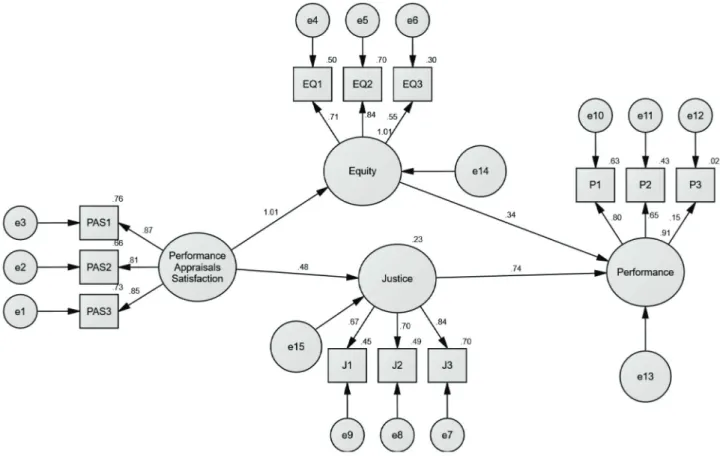
attitudes towards the fairness of the appraisal system, as well as their satisfaction with their knowledge of the appraisal system. This study aims to investigate the relationship between performance appraisal satisfaction and employee performance with equity as a mediator of this relation. There is limited research that studied the mediating effect of performance appraisal on the relationship between organizational justice and work performance. The research implemented the quantitative methodology throughout distributing questionnaires using google forms for data collection. Only 181 respondents out of 221 respondents answered the questionnaires. The data had been analyzed using the AMOS tool for performing structural equation modeling (SEM) analysis to validate the mediating relationship of equity and justice on the relationship between performance appraisals satisfaction and employees’ performance. The results indicated that achieving organizational fairness and equity in the workplace can be done by the implementation of performance appraisal satisfaction, which can lead to higher productivity in the workplace, whichin turn will enhance the organization’s image among its competitors.
Keywords: Justice, Equity, Performance Appraisals Satisfaction, Employees Performance JEL Classification Code: O15, O31, J53
feedback and motivate themselves accordingly to improve performance. Performance evaluation methods often involve feedback sessions, work-performance processes, self- assessments, and employee performance requirements. The purposes of the annual performance evaluation process are to promote communication and provide useful feedback about job performance, to facilitate better working relationships, to provide a historical record of performance, and to contribute to professional development.
Distributive justice is conceptualized as the fairness associated with decision outcomes and the distribution of resources.Distributive justice refers to the perceived fairness of an actual appraisal rating.For performance appraisal, distributive justice focuses on the perceived fairness of the appraisal rating or outcome received in relation to the actual work performed. Abuhashesh et al. (2019) described two types of distributive justice are internal and external equity.
This research aims to study the relationship between performance appraisal satisfaction and employee performance with equity as a mediator of this relation. It aims to fill a research gap; to analyze the mediating effect
1