Min Ok Song 140
INTRODUCTION
Since Song and Kim(1989) and Song & Kim(1996a, b) initiated taxonomic studies of Korean monogononts and bdelloids, respectively, 31 monogononts and 70 bdelloids have been reported from Korea so far(Song and Kim 1989;
Song 1999, 2014; Song and Jin 2000; Song and Kim 2000;
Song and Min 2015). In the present study, we investigated rotifers collected from various terrestrial habitats and identi
fied five species and one subspecies belonging to four gen
era in three families of monogonont and bdelloid rotifers, all of which are new to the Korean fauna. As a consequence of our findings, the number of Korean bdelloid records is brought to 75 taxa, of which 54 at the species and 21 at the subspecies level. As for monogononts, the number of Kore
an records is led to 32 taxa, of which 28 at the species and 4 at the subspecies level.
These 6 new Korean records include two rotifers with poorly known distributions. A. cuneata has been reported only from New Zealand, Australia and North America after
its description from South Africa, and B. stylata has been recorded only from Europe and North America before the present study.
Here diagnostic characteristics and illustrations are pro
vided for each Korean new record. The taxonomy and dis
tribution of each rotifer are discussed as well.
MATERIALS AND METHODS
For the present taxonomic study on Korean rotifers, spe
cimens collected from various terrestrial habitats such as mosses, lichens and mushrooms on tree trunks were investi
gated. Samples were collected from four locations in Korea from July 4 to Oct. 25, 2014. The detailed habitat informa
tion and sampling date of each locality are listed in Table 1.
The bdelloids were extracted from soil, mosses and mush
rooms according to a previously described method(Song 2014). All of the rotifers were examined and identified in the active state under a light microscope with a magnifica
tion of ×400 to ×600. The photography and motion re
cords of living specimens were performed using an Infinity 2 digital camera(Lumenera Corporation, ON, Canada). The photographs and computergrabbed images of motion re
* Corresponding author: Min Ok Song, Tel. 0336402310,
Fax. 0336402867, Email. [email protected], [email protected]
ⓒ2015. Korean Society of Environmental Biology.
New Records of One Monogonont and 5 Bdelloid Rotifers from Korea
Min Ok Song*
Department of Biology, Gangneung-Wonju National University, Gangwon-do 201-702, Korea Abstract - The rotifers collected from various terrestrial habitats such as mosses, lichens and mushrooms on tree trunks at four different locations in Korea were investigated. Five species and one subspecies belonging to four genera in three families of monogonont and bdelloid rotifers were identified: Adineta cuneata Milne, 1916, Macrotrachela insolita De Koning, 1947, Macrotrachela musculosa Milne, 1886, Macrotrachela nana nana(Bryce, 1912), Mniobia bredensis De Koning, 1947 and Bryceella stylata(Milne, 1886). All these rotifers are new to Korea, and A. cuneata, M.
bredensis and B. stylata are new to Asia as well. Here diagnostic characteristics and illustrations are provided for each Korean new record.
Key words: rotifera, new records, terrestrial habitats, Korea, taxonomy
Korean J. Environ. Biol. 33(2) : 140~147(2015) http://dx.doi.org/10.11626/KJEB.2015.33.2.140
cords were used for illustrations. Measurements were made by using Photoshop CS3. The specimens were killed with head, foot, and toes extended, by using the boiling water fixation method(Pennak 1978) instead of narcotization. The method of Stemberger(1979) was used for preparation of permanent mounts.
The classification scheme is based on Melone and Ricci (1995) for bdelloids, and De Smet(1997) as well as Nogra
dy and Pourriot(1995) for a monogonont. Iakovenko et al.
(2013) was referred to for the scheme of measurements of philodinid rotifers.
RESULTS AND DISCUSSION Phylum Rotifera Cuvier,1817 윤형동물문 Class Eurotatoria De Ridder,1957 진윤충강 Subclass Bdelloidea Hudson,1884 질형아강 Order Philodinida Melone &Ricci,1995 선윤충목 Family Philodinidae Ehrenberg,1838 선윤충과 Genus Macrotrachela Milne,1886 큰관윤충속 1. Macrotrachela insolita De Koning,1947(Fig.1)
별난큰관윤충(신칭)
Macrotrachela insolita De Koning, 1947, p. 200, Pl. 8, Figs.
33ae; Donner, 1965, pp. 131134, Figs. 97hi, 98.
Material examined: 4 specimens, Taebacksi, Gangwondo (mushrooms and mosses on a tree trunk), Aug. 17, 2014.
Diagnosis: Corona as wide as or slightly wider than cingu
lum pad. Upper lip arched, bilobed medially and slightly lower than trochal discs. Pharyngeal tube shorter than tro
phi length. Spurs conical, with sharppointed ends, highly divergent; interspace much narrower than spur base width.
Teeth 2+1/1+2.
Measurements: Corona width 42μm. Collar width(cingu
lum pad width) 40μm. Greatest trunk width(in feeding) 74 μm. Trophi length 18μm.
Remarks: The present species is very close to M. habita.
Despite the many records, the distinction of M. insolita from M. habita is not clear(Donner 1965). The most prominent difference between M. insolita and M. habita is the ratio of corona width to cingulum pad width(collar width). In M.
insolita, corona is a little bit wider or as wide as cingulum pad, while in M. habita, corona is much wider than cingul
Table 1. List of sampling localities
Locality GPS coordinates Sampling date Habitat Species
1. Saryeoni forest, Jocheoneup,
Jejusi 33˚25′20.9″N,
126˚37′29.0″E July 4, 2014 Mushrooms on a tree trunk Mniobia bredensis 2. Taebacksi, Gangwondo 37˚10′21.1″N,
128˚59′28.7″E August 17, 2014 Mushrooms and mosses on
a tree trunk Macrotrachela insolita, M. musculosa 3. A mountain in Jeonganmyun,
Gongjusi, Chungcheongnamdo 36˚36′30.86″N,
127˚7′12.42″E Sep. 20, 2014 Lichens and mosses Macrotrachela nana nana 4. Gariwangsan, Jeongseongun,
Gangwondo 37˚28′14.1″N,
128˚33′39.1″E Oct. 25, 2014 Wet mosses Adineta cuneata,
Bryceella stylata
Fig. 1. Macrotrachela insolita De Koning, 1947: A, feeding, dorsal view; B, creeping, dorsal view(scale bars: A, B=50μm).
A B
um pad. Donner(1970) recorded some specimens with over
lapping characteristics as M. habitainsolita in his report of the Spanish rotifers.
The Korean specimens were identified as M. insolita be
cause their coronas were as wide as or slightly wider than cingulum pads.
In their study on the fine morphology of the bdelloid tro
phi using scanning electron microscopy, Melone et al.(1998) showed that these two species have a difference in the num
bers of uncus teeth of proximal group, major teeth and dis
tal group.
Further genetic studies might be necessary with these two species to make it clear whether these are distinctly separate species or not.
The present species has been reported from many Eu
ropean countries, the Arctic, the Antarctic, Australia, New Zealand and Taiwan before the present study(Donner 1965;
Shiel and Green 1996; Ho 2005). The wide distribution of this species suggests that it is presumably cosmopolitan.
Habitat: The specimens were collected from mushrooms and mosses on a tree trunk at Taebacksi, Gangwondo.
World Distribution: Presumably cosmopolitan.
Deposition: National Institute of Biological Resources (NIBR)(KOSPGR0000276140, KOSPIV0000219229, KOSPIV0000219231).
Identifier: Min Ok Song.
2. Macrotrachela musculosa Milne,1886(Fig.2) 억센큰관윤충(신칭)
Macrotrachela musculosa Milne, 1886, pp. 138139, Pl. II, Fig. 7; Montet, 1915, pp. 287288, Pl. 10, Figs. 16ad;
Donner, 1965, p. 146, Figs. 95hj; Donner, 1970b, p. 526, Figs. 8ab; Donner, 1980, pp. 136137, Fig. 4.
Callidina musculosa: Janson, 1893, pp. 6465, pl. 4, Figs.
5253.
Material examined: 2 specimens, Taebaeksi, Gangwondo (mushroons and mosses on a tree trunk), Aug. 17, 2014.
Diagnosis: Upper lip bilobed medially and lower than tro
chal discs; a depression between two lobes narrower than each lobe’s width, and slightly convex or with a tiny pro
jection medially. Corona wider than cingulum pad. Sulcus narrower than pedicel width.
Measurements: Corona width 50~51μm. Collar width
(cingulum pad width) 43~44μm. Greatest trunk width(in feeding) 69~73μm. Trophi length 18μm.
Remarks: The general morphology of the Korean speci
mens conforms to the original description well except that foot and spurs are not granulated. There is a very tiny pro
jection on the median depression between two lobes of the upper lip in the Korean specimens. In Asia, this species was reported from Tibet by Gong(1983)(reviewed in Zhuge et al. 1998).
Habitat: The specimens were isolated from mushrooms and mosses on a tree trunk at Taebacksi, Gangwondo.
World Distribution: Cosmopolitan(Segers 2007) [Updated version of Segers(2007) is available from FADA website].
Deposition: NIBR(KOSPGR0000276139, KOSPIV00002 19220, KOSPIV0000219221).
Identifier: Min Ok Song.
Fig. 2. Macrotrachela musculosa Milne, 1886: A, B, feeding, dor
sal view(scale bars: A, B=50μm).
A
B
3. Macrotrachela nana nana(Bryce,1912)(Fig.3) 왜소큰관윤충(신칭)
Callidina nana Bryce, 1912, pp. 367368, Pl. 12, Fig. 2.
Macrotrachela nana: Dobers, 1915, p. 80, Fig. 11; Burger, 1948, pp. 125126, Figs. 11, 12.
Macrotrachela nana nana: Donner, 1965, p. 162, Figs. 120 ae.
Material examined: 3 specimens, Jeonganmyeon, Gong
jusi, Chungcheongnamdo(lichens and mosses), Sep. 20, 2014.
Diagnosis: Corona slightly wider than cingulum pad and slightly higher than upper lip. Upper lip arched and with a bellshaped median lobe. Sulcus narrow and about a third of pedicel width. Teeth 2/2. Foot with 4 pseudosegments.
Spurs conical and with pointed ends; interspace much nar
rower than spur base width.
Measurements: Total body length(in creeping) 280μm.
Corona width 36μm. Collar width(cingulum pad width) 31 μm. Greatest trunk width(in creeping) 47μm. Spur length 7 μm.
Remarks: The morphology of the Korean specimens con
forms to the original description well in those of upper lip, spurs and dental formula, while they differ from the origi
nal specimens in the morphology of corona and foot. The corona of the Korean specimen is wider than cingulum pad, while it is rather narrower than cingulum pad in the original specimen. As for the number of pseudosegments of foot, Bryce described that the original specimen had 3 even thou
gh the illustration showed it had four. The foot of the Kore
an specimens has 4 pseudosegments, and the illustration in Donner(1965) showed 4 pseudosegments as well. In Asia, this species was reported from Taiwan by Ho(2005). The wide distribution of this species suggests that it is presum
ably cosmopolitan(Segers 2007).
Habitat: Specimens were isolated from lichens and mosses collected from Jeonganmyeon, Gongjusi, Chungcheong
namdo.
World Distribution: Probably cosmopolitan.
Deposition: NIBR(KOSPGR0000276142, KOSPIV00002 19239, KOSPIV0000219240).
Identifier: Min Ok Song.
Genus Mniobia Bryce,1910 흡반윤충속 4. Mniobia bredensis De Koning,1947(Fig.4)
리본장식흡반윤충
Mniobia bredensis De Koning, 1947, p. 205, Pl. 9, Fig. 43a
e; Donner, 1950, pp. 318320, Abb. 16; Donner, 1965, pp.
247248, Fig. 182; Donner, 1970, p. 527, Abb. 9ab.
Material examined: 1 specimen, Saryeoni Forest, Jocheon
eup, Jejusi(mushrooms on tree trunk), July 4, 2014.
Diagnosis: Corona slightly narrower than cingulum pad.
Upper lip rather flat; middle part of upper lip swollen like Fig. 3. Macrotrachela nana nana(Bryce, 1912): A, creeping head and neck, ventral view; B, feeding head and neck, dorso
lateral view; C, D, feeding head and neck, dorsal view; E, foot, spurs and toes, ventral view; F, rump, foot and spurs, lateral view(scale bars: A, B, D, F =20μm; C =50μm;
E=10μm).
A
D B
E C
F
an animal’s head, and with two triangular projections ante
riorly. Pharyngeal tube as long as trophi length. Teeth 4/4.
Body highly granulated; granulated ridges on rump like a threelobed leaf.
Measurements: Total body length(in creeping) 288μm.
Corona width 41μm. Collar width(cingulum pad width) 44 μm. Greatest trunk width(in feeding) 53μm. Trophi length 25.5μm. Spur length 7μm.
Remarks: The present species has been reported from New Zealand(Shiel and Green 1996), Turkey(Kaya et al. 2009), Hungary(Schöll and Devetter 2013), The Arctic(Kaya et al. 2010), and Canada(Bateman and Davis 1980) before the
present study. This is the first record from Asia.
Habitat: The specimen was isolated from mushrooms on a tree trunk at Saryeoni Forest, Jocheoneup, Jejusi.
World Distribution: New Zealand, Turkey, Hungary, the Arctic, Canada and Korea.
Deposition: NIBR(KOSPIV0000206150).
Identifier: Min Ok Song.
Order Adinetida Melone &Ricci,1995 납작머리윤충목 Family Adinetidae Hudson and Gosse,1886
납작머리윤충과
Genus Adineta Hudson and Gosse,1886 납작머리윤충속 Fig. 4. Mniobia bredensis De Koning, 1947: A, B, feeding head
and neck, dorsal view; C, rump, foot and spurs, dorsal view; D, feeding, dorsal view(scale bars: AC=20μm;
D=50μm).
A
B
D
C
Fig. 5. Adineta cuneata Milne, 1916: A, head, neck and trunk, ven
tral view; B, head and neck, ventral view; C, rump, foot and spurs, ventral view; D, creeping, ventral view(scale bars: A, C, D=50μm; B=20μm).
A
D
B
C
5. Adineta cuneata Milne,1916(Fig.5)
가는발목납작머리윤충(신칭)
Adineta cuneata Milne, 1916, pp. 179180, pl. 14, Figs. 22, 22a; Burger, 1948, p. 132; Donner, 1965, p. 273, Figs.
197ij.
Material examined: 3 specimens, Gariwangsan, Jeong
seongun, Gangwondo(wet mosses), Oct. 25, 2014.
Diagnosis: Rostrum with a short auriclelike lamella lat
erally and without sensillae. Rake apparatus with 5 sharp claws. Pseudosegment bearing spurs round and with promi
nent constriction anteriorly. Spurs short, small, conical, and pointing rather laterally.
Measurements: Total body length(in creeping) 324μm.
Head width 48μm. Rostrum width 23μm. Greatest trunk width(in creeping) 78μm. Spur length 4.5μm.
Remarks: Since this species has been reported only from New Zealand(Shiel and Green 1996), Australia(Shiel and Koste 1985) and North America(Burger 1948) after its des
cription from South Africa by Milne(1916), the present study is the first Asian record of it.
Habitat: The specimens were isolated from wet mosses col
lected from Gariwangsan, Jeongseongun, Gangwondo.
World Distribution: New Zealand, Australia, North Amer
ica, South Africa and Korea.
Deposition: NIBR(KOSPGR0000276144, KOSPIV00002 19243).
Identifier: Min Ok Song.
Subclass Monogononta Plate,1889 단소아강 Order Ploima Hudson and Gosse,1886 유영목 Family Proalidae Harring and Myers,1924
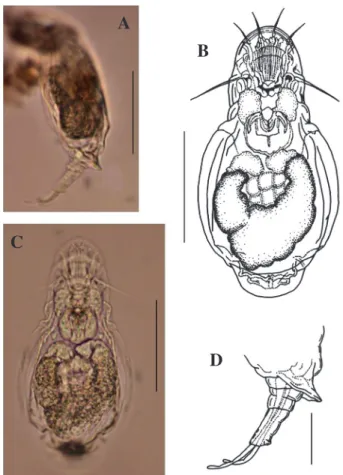
Genus Bryceella Remane,1929 브라이스윤충속(신칭) 6. Bryceella stylata(Milne,1886)(Fig.6)
관절발가락브라이스윤충(신칭)
Stephanops stylatus Milne, 1886, pp. 143145, pl. 2, Figs. 3, 4, 9; Steiner, 1913, pp. 293294, Figs. 5, 1315.
Bryceella stylata: De Smet, 1996, pp. 810, Figs. 15, pl. 1, Figs. 15; Wilts et al., 2009, pp. 161175, Figs. 15.
Material examined: 3 specimens, Gariwangsan, Jeong
seongun, Gangwondo(wet mosses), Oct. 25, 2014.
Diagnosis: Head distinctly offset by neckfolds. Two long and straight styli on each side of head; with lightrefracting
bodies at their bases. Modified malleate trophi. Trunk oval, without pseudosegments and ending with a broad and round tail. Toes longer than terminal foot pseudosegment, with three articulating joints, and slightly curved inwardly. Rami with teeth on inner margins.
Measurements: Total body length 159μm. Foot length 28 μm. Greatest body width 65μm. Toe length 21μm.
Remarks: This species has been reported from Europe and North America(De Smet 1996) since its description from Scotland by Milne(1886). The present study is the first Asian record of it.
Habitat: The specimens were isolated from wet mosses col
lected from Gariwangsan, Jeongseongun, Gangwondo.
World Distribution: Europe, North America and Korea.
Deposition: NIBR(KOSPGR0000276143, KOSPIV00002 19241).
Identifier: Min Ok Song.
Fig. 6. Bryceella stylata(Milne, 1886): A, lateral view; B, C, dor
sal view; D, foot and toes, lateral view(scale bars: AC=50 μm; D=20μm).
A
B
C
D
ACKNOWLEDGEMENT
This work was supported by a grant from the National Institute of Biological Resources(NIBR), funded by the Ministry of Environment(MOE) of the Republic of Korea (NIBR No. 201402001).
REFERENCES
Bateman LE and CC Davis. 1980. The Rotifera of Hummock
Hollow Formations in a Poor(Mesotrophic) Fen in New
foundland. Int. Revue d. ges. Hydrobiol. u. Hydrol. 65:127
Bryce D. 1912. On three new species of Callidina. J. Quekett 153.
Microsc. Club ser. 2:365370.
Burger A. 1948. Studies on the moss dwelling bdelloids(Roti
fera) of eastern Massachusetts. Trans. Am. Microsc. Soc.
67:111142.
De Koning P. 1947. Nieuwe Bdelloide Rotatorien. Biol. Jaarb.
(Dodonaea) 14:184205.
De Smet WH. 1996. Rotifera. Volume 4: The Proalidae(Mono
gononta). Guides to the identification of the microinverte
brates of the continental waters of the world. SPB Academ
ic Publishing. 102 pp.
De Smet WH. 1997. Rotifera Volume 5: The Dicranophoridae (Monogononta). Guides to the identification of the micro
invertebrates of the continental waters of the world. SPB Academic Publishing. 325 pp.
Dobers E. 1915. Über die Biologie der Bdelloidea. Internat.
Rev. d. ges. Hydrob. u. Hydrol. Suppl. zu Bd. 7:1128.
Donner J. 1950. Rotatorien der Humusböden. Hüllen und Ge
häuse bei bdelloiden Rädertieren, besonders bei Bodenbe
wohnern. Österr. Zool. Zeitscr. Wien 2:287335.
Donner J. 1965. Ordnung Bdelloidea(Rotatoria, Rädertiere).
Bestimmungsbücher zur Bodenfauna Europas. Akademie
Verl., Berlin. 297 pp.
Donner J. 1970. Rotatorien aus einigen Böden und Moosen Spaniens und seiner Inseln. Rev. Écol. Biol. Sol. T. 7:501
Donner J. 1980. Einige neue Forschungen über bdelloide Ro532.
tatorien, besonders in Böden. Rev. Écol. Biol. Sol. 17:125
143.
Ho JW. 2005. A taxonomic study of bdelloid rotifers(Rotifera, Bdelloidea) in Taiwan. MS Thesis, National Hsinchu Uni
versity of Education. pp. 75.
Iakovenko NS, E Kašparová, M Plewka and K Janko. 2013.
Otostephanos(Rotifera, Bdelloidea, Habrotrochidae) with the description of two new species. Syst. Biodivers. 11:477
494.
Janson O. 1893. Versuch einer Übersicht über die Rotatorien
Familie der Philodinaeen. Abhandl. des naturwiss. Ver. zu Bremen 12:185.
Kaya M, EA Herniou, TG Barraclough and D Fontaneto. 2009.
A faunistic survey of bdelloid rotifers in Turkey. Zool.
Middle East 48:114116.
Kaya M, WH De Smet and D Fontaneto. 2010. Survey of moss
dwelling bdelloid rotifers from middle Arctic Spitsbergen (Svalbard). Polar Biol. 33:833842.
Melone G and C Ricci. 1995. Rotatory apparatus in Bdelloids.
Hydrobiologia 313/314:9198.
Melone G, C Ricci and H Segers. 1998. The trophi of Bdel
loidea(Rotifera): a comparative study across the class. Can.
J. Zool. 76:17551765.
Milne W. 1886. On the defectiveness of the eyespot as a means of generic distinction in the Philodinidae, with a descrip
tion of two other Rotifera. Proc. phil. Soc. Glasg. 17:134
145.
Milne W. 1916. On the bdelloid Rotifera of South Africa. J.
Quekett Microsc. Club ser. 2:4783, 149184.
Montet G. 1915. Contribution à l’étude des Rotateurs du bassin du Léman. Rev. Suisse Zool. 23:251360.
Nogrady T and R Pourriot. 1995. Rotifera Volume 3: The Not
ommatidae and the Scaridiidae. Guides to the identification of the microinvertebrates of the continental waters of the world. SPB Academic Publishing. pp. 229.
Pennak RW. 1978. Freshwater Invertebrates of the United States. 2nd ed. John Wiley and Sons Inc., New York. 803 Schöll K and M Devetter. 2013. Soil rotifers new to Hungary pp.
from the Gemenc floodplain(DunaDráva National Park, Hungary). Turk. J. Zool. 37:406412.
Segers H. 2007. Annotated checklist of the rotifers(Phylum Rotifera), with notes on nomenclature, taxonomy and dis
tribution. Zootaxa 1564:1104.
Shiel RJ and JD Green. 1996. Rotifera recorded from New Zealand, 18591995, with comments on zoogeography.
New Zeal. J. Zool. 23:193209.
Shiel RJ and W Koste. 1985. New species and new records of Rotifera(Aschelminthes) from Australian waters. T. Roy.
Soc. South Aust. 109:115.
Song MO. 1999. Systematic study on Korean bdelloid Rotifera Ph.D. Thesis. Department of Molecular Biology Seoul Na
tional University. Seoul, Korea. pp. 200.
Song MO. 2014. Eight new records of monogonont and bdel
loid rotifers from Korea. J. Species Res. 3:5362.
Song MO and DH Jin. 2000. Rotifer fauna of natal streams of chum salmon(Oshipcheon). J. Fish. Sci. Tech. 3:7177.
Song MO and HS Kim. 1989. Monogonont rotifers(Mono
gononta: Rotifera) inhabiting several lowland swamps in Kyongsangnamdo, Korea. Korean J. Syst. Zool. 5:139
Song MO and W Kim. 1996a. Taxonomic study on the digo157.
nont rotifers of Korea. Korean J. Syst. Zool. 12:5359.
Song MO and W Kim. 1996b. Taxonomic study on the digon
ont rotifers of Korea: six new records of philodinid rotifers.
Korean J. Syst. Zool. 12:349358.
Song MO and W Kim. 2000. Bdelloid rotifers from Korea. Hy
drobiologia 439:91101.
Song MO and GS Min. 2015. A new species and ten new re
cords of bdelloid rotifers from Korea. Zootaxa 3964:211
Steiner G. 1913. Ein Beitrag zur Kenntnis der Rotatorien und 227.
Gastrotrichenfauna der Schweiz. Rev. Suisse Zool. 21:285
Stemberger RS. 1979. A Guide to Rotifers of the Laurentian 298.
Great Lakes. US Environmental Protection Agency, Cin
cinnati, Ohio. 185 pp.
Wilts EF, WH Ahlrichs and P Martínez Arbizub. 2009. The somatic musculature of Bryceella stylata(Milne, 1886) (Rotifera: Proalidae) as revealed by confocal laser scan
ning microscopy with additional new data on its trophi and overall morphology. Zool. Anz. 248:161175.
Zhuge Y, X Huang and W Koste. 1998. Rotifera recorded from China, 18931997, with remarks on their composition and distribution. Int. Rev. Hydrobiol. 3:217232.
Received: 18 May 2015 Revised: 8 June 2015 Revision accepted: 9 June 2015