• 검색 결과가 없습니다.

Eight Newly Recorded Species of the Subfamilies Pteromalinae and Miscogastrinae (Hymenoptera: Pteromalidae) from South Korea

N/A
N/A
Protected

Academic year: 2021

Share "Eight Newly Recorded Species of the Subfamilies Pteromalinae and Miscogastrinae (Hymenoptera: Pteromalidae) from South Korea"

Copied!
10
0
0

로드 중.... (전체 텍스트 보기)

전체 글

(1)

Short communication KOREAN JOURNAL OF APPLIED ENTOMOLOGY

한국응용곤충학회지 ⓒ The Korean Society of Applied Entomology

Korean J. Appl. Entomol. 55(2): 161-170 (2016) pISSN 1225-0171, eISSN 2287-545X

DOI: http://dx.doi.org/10.5656/KSAE.2016.03.0.002

Eight Newly Recorded Species of the Subfamilies Pteromalinae and Miscogastrinae (Hymenoptera: Pteromalidae) from South Korea

E.V. Tselikh, Guk Hyang Ko 1 , Gwan Suck Lee 2 , Hae Cheol Park 2 and Jong Wook Lee 1 *

Russian Academy of Sciences, Zoological Institute, Universitetskaya Emb., St. Petersburg 199034, Russia

1

Department of Life-Sciences, Yeungnam University, 280 Daehak-Ro, Gyeongsan, Gyeongbuk-do 38541, Korea

2

National Academy of Agricultural Science, 166 Nongsaengmyeong-ro, Iseo-myeon, Wanju-gun, Jeollabuk-do 55365, Korea

한국산 금좀벌아과와 가시금좀벌아과(벌목: 금좀벌과)의 8미기록종 보고

Ekaterina Vladimirovna Tselikhㆍ고국향 1 ㆍ이관석 2 ㆍ박해철 2 ㆍ이종욱 1 *

러시아 과학 아카데미, 동물학 연구소, 1영남대학교 생명과학과 동물계통학연구실, 2농촌진흥청 국립농업과학원
ABSTRACT: Four species (Diglochis sylvicola (Walker), Lariophagus obtusus Kamijo, Mokrzeckia lazoensis Tselikh, Paracarotomus cephalotes Ashmead) of the Pteromalinae and four species (Lamprotatus duplicatus (Kamijo), L. hikosanus (Kamijo), Stictomischus momoii Kamijo, S. scaposus Thomson) of the Miscogastrinae are recorded for the first time for the fauna of South Korea. Among them, Diglochis Förster, Paracarotomus Ashmead, and Stictomischus Thomson are newly recorded from South Korea. Additionally, a key to the South Korean genera of Pteromalinae and Miscogastrinae and photos of diagnostic characteristics are provided.

Key words: Chalcidoidea, first record, Diglochis, Paracarotomus, Stictomischus

초 록 : 한국산 금좀벌아과의 4종 Diglochis sylvicola (Walker), Lariophagus obtusus Kamijo, Mokrzeckia lazoensis Tselikh, Paracarotomus cephalotes Ashmead과 가시금좀벌아과 아과의 4종 Lamprotatus duplicatus (Kamijo), L. hikosanus (Kamijo), Stictomischus momoii Kamijo, S.

scaposus Thomson을 처음 보고한다. 이 중 3속 Diglochis Förster, Paracarotomus Ashmead, Stictomischus Thomson 은 한국에 처음 보고되는 속이다. 본 논문에서는 한국산 금좀벌아과와 가시금좀벌아과의 속 검색표와 진단 형질의 사진을 제공하였다.

검색어: 금좀벌과, 미기록종, Diglochis, Paracarotomus, Stictomischus

*Corresponding author: [email protected]

Received January 25 2016; Revised March 2 2016 Accepted March 13 2016

The family Pteromalidae is one of the numerous and economically important groups of parasitoids, but our knowledge of this group in South Korea is limited. To date, only 39 species of 27 genera belonging to five subfamilies have been recorded from this region (Chang, Youn, 1983; Chang et al., 1994; Cho et al., 2014; Chun et al., 1993; Kamijo, Grissell, 1982;

Kamijo, 1983; Mitroiu, 2011; Paik, 1978, 1994; Peck, 1963;

Ryoo et al., 1990; Rueda, 1997; Shin et al., 2000; Sureshan, 2003;

Sureshan, Narendran, 2001, 2003; Thompson, 1958; Tselikh,

2011).

This study is based on the material from the Applied

Entomology Division, Department of Agricultural Biology,

National Academy of Agricultural Science (NAAS) and

Yeungnam University, Gyeongsan, South Korea (YNU). As a

result of this works, three genera (Diglochis Förster,

Paracarotomus Ashmead, Stictomischus Thomson) and eight

species (Diglochis sylvicola (Walker), Lariophagus obtusus

Kamijo, Mokrzeckia lazoensis Tselikh, Paracarotomus cephalotes

Ashmead, Lamprotatus duplicatus (Kamijo), L. hikosanus

(Kamijo), Stictomischus momoii Kamijo, S. scaposus Thomson)

are recorded for the first time in South Korea. Therefore, 35

(2)

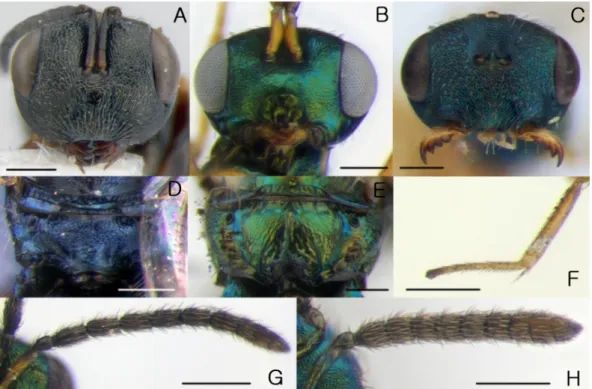
Fig. 1. Head in frontal view. (A) Pteromalinae, (B) Miscogastrinae, (C) Mokrzeckia lazoensis. Propodeum. (D) Lariophagus obtusus, (E) Lamprotatus hikosanus. Hind tibia. (F) Lariophagus distinguendus. Antenna. (G) Stictomischus momoii, (H) Stictomischus scaposus. Scale bars: 0.5 mm for all.

species of 27 genera in Pteromalinae and 9 species of 6 genera in Miscogastrinae are recorded from South Korea.

Materials and Methods

The present study is based on examination of the material from collections of the Applied Entomology Division, Department of Agricultural Biology, National Academy of Agricultural Science, South Korea (NAAS) and Yeungnam University, Gyeongsan, South Korea (YNU). Morphological terminology, including sculpture and wing venation nomenclature, follows that of Gibson (1997) and Graham (1969). The following abbreviations are used for morphology: POL - posterior ocellar line, minimum distance between posterior ocelli; OOL - ocell- ocular line, minimum distance between posterior ocellus and compound eye. The following abbreviations are used for type:

TD - type depository; TL - type locality; TS - type species; The Natural History Museum, London, England (BMNH); Hokkaido University, Japan (EIHU); Zoological Museum of the Lund University, Sweden (LUZN); Naturhistorisches Museum, Vienna, Austria (NHMV); Queensland Museum, Brisbane, Australia

(QMB); South Australian Museum, Adelaide, South Australia (SAMA); United States Museum of Natural History, Washington D.C., United States of America (USNM); Zoological Institute, St.

Petersburg, Russia (ZISP); Zoologische Staatssammlung München, Munich, Germany (ZSMM). Finally, the following abbreviations are used for geographical territories: CB - Chungcheongbuk-do; CN - Chungcheongnam-do; GB - Gyeongsangbuk-do; GG - Gyeonggi-do; GN - Gyeongsangnam- do; GW - Gangwon-do; JN - Jeollanam-do.

Systematic accounts

A key to the genera of South Korean Pteromalinae and Miscogastrinae (modified from Bouček, Rasplus, 1991)

1. Notauli incomplete, not traceable in posterior quarter of mesoscutum. Margin of clypeus with symmetric teeth or without teeth (Fig. 1A). ··· Pteromalinae …… 2 - Notauli complete, reaching transscutal groove. Margin of

clypeus with distinctly asymmetric teeth (Fig. 1B). ···

··· Miscogastrinae …… 5

(3)

2. Head much wider than pronotum in dorsal view; gena with strong lamina in posterior part. Mesosoma high and compact.

Mid coxae with transverse carina in anterior part. Gaster on distinct petiole. ··· Paracarotomus Ashmead - Head less wider than pronotum in dorsal view; gena without

strong lamina in posterior part. Mesosoma less high and compact. Mid coxae without transverse carina in anterior part. Gaster sessile, petiole transverse. ··· 3 3. Postmarginal vein only about as long as or even shorter than

stigmal vein. Antenna clavate and stout, inserted below centre of face. - Eyes with distinctly pilosity. Marginal and postmarginal vein with thin bristles. Propodeum with coarse irregular reticulation in posterior part. ···

··· Diglochis Forster - Postmarginal vein longer than stigmal vein. Antennae not

clavate and not stout, inserted above or in centre of face.

Eyes without distinctly pilosity. ··· 4 4. Hind corners of propodeum prominent and sharp. Propodeum

often with punctate nucha. Lower face swollen. Margin of first tergite prodused. ··· Lariophagus Crawford - Hind corners of propodeum not prominent and not sharp.

Propodeum without nucha, it hind margin deep arcuately excised. Lower face not swollen. Margin of first tergite not prodused. - Flagellar segment with two rows dense sensilla.

Pronotum short and carinate. ··· Mokrzeckia Mokrzecki 5. Fore wing almost completely pilose, speculum reduced to

narrow bare line along basal fold or to bare isolated oval area below parastigma or absent; stigma without bilobed lower margin. ··· Stictomischus Thomson - Fore wing incompletely pilose, with large speculum, stigma

with bilobed lower margin. ··· Lamprotatus Westwood

Family Pteromalidae Dalman, 1820 금좀벌과 Subfamily Pteromalinae Dalman, 1820 금좀벌아과

Genus Diglochis Förster, 1856 큰입금좀벌속(신칭) Diglochis Förster, 1856: 65; TS: Pteromalus complanatus Ratzeburg, by monotypy.

Diagnosis. Eyes with long and conspicuous pilosity.

Antennal strongly clavate. Outer marginal fringe on fore wing present. Propodeum posteriorly with coarse irregular alveolation.

Gaster subcircular (Bouček, Rasplus, 1991).

1. Diglochis sylvicola (Walker, 1835) 등에살이큰입금좀벌 ( 신칭) (Fig. 2A)

Pteromalus sylvicola Walker, 1835: 481; lectotype designated by Graham (1956: 260), female; TL: Sweden, Unknown; TD:

BMNH.

Pteromalus complanatus Ratzeburg, 1844: 197; holotype, female; TL: Berlin, Germany; type lost. Possible synonym of Anogmus vala (Walker) by Graham, M.W.R. de V. (1969: 632);

synonym of Diglochis sylvicola (Walker) by Graham, M.W.R.

de V. (1969: 783)

Dirhicnus complanatus (Ratzeburg, 1844); new combination for Pteromalus complanatus Ratzeburg by Kurdjumov, N.V.

(1913: 16)

Diglochis hybomitri Dzhanokmen, 1979: 248-251; holotype, female; TL: Tyumenskaya Oblast, Russia; TD: ZISP; synonym of Diglochis sylvicola (Walker) by Dzhanokmen, K.A. (2005:

51)

Material examined. [NAAS] South Korea: 1 female, GG, Ansan-si, Sihwaho Lake <Host: reed>, 3.VII.2001, H.C. Park.

Distribution. Western and Eastern Europe, Transcaucasus, Russia, Iran, Kazakhstan, South Korea, Japan.

Biology. The primary parasitoid of many species of Tabanidae (Diptera) (Stubbs, 1998: 76; Noyes, 2016), also reared from lepidopteran Stilpnotia salicis (Linnaeus) (Lymantriidae) (Noyes, 2016) and Panolis flammea (Denis, Schiffermülle) (Noctuidae) (Noyes, 2016).

Remarks. This species differs from all species of Diglochis Förster in having a dark metallic green body with coppery lustre, with yellowish-brown scape and legs (Dzhanokmen, 1978).

Genus Lariophagus Crawford, 1909 그물등자루금좀벌속 ( 신칭)

Lariophagus Crawford, 1909: 52; TS: Lariophagus texanus Crawford, 1909, by monotypy.

Uriellomyia Girault, 1915: 319; TS: Uriellomyia resoluta

Girault, 1915, original designation; Synonym of Lariophagus

Crawford by Bouček, Z. (1988: 414)

(4)

Fig. 2. Habitus in lateral view. (A) Diglochis sylvicola, (B) Lariophagus distinguendus, (C) Lariophagus obtusus, (D) Mokrzeckia lazoensis, (E) Paracarotomus cephalotes, (F) Lamprotatus duplicatus. Scale bars: 1 mm for all.

Diagnosis. Propodeum with plicae remote from spiracles with a distinct, reticulate nucha. Most funicular segments quadrate or oblong. Lower face swollen; clypeal margin emarginate.

Fore wing immaculate. Margin of first tergite produced (Bouček, Rasplus, 1991).

2. Lariophagus distinguendus (Förster, 1841) 바구미살이금 좀벌 (Figs 1F, 2B)

Pteromalus distinguendus Förster, 1841: 17; syntype, male;

TL: Unknown; TD: NHMV.

Pteromalus calamis Walker, 1849: 207; lectotype, male;

TL: Madeira, Portugal; TD: BMNH; synonym of Lariophagus distinguendus (Förster) by Graham, M.W.R. de V. (1969: 824- 825)

Pteromalus oryzinus Rondani, 1877: 195; TL: Italy; type lost; synonym of Lariophagus distinguendus (Förster) by Delucchi, V. (1955: 174)

Meraporus utibilis Tucker, 1910: 341-343; holotype, female;

(5)

TL: Texas, United States of America; TD: USNM; synonym of Lariophagus distinguendus (Förster) by Gahan, A.B. (1921:

239)

Uriellomyia resoluta Girault, 1915: 319; syntypes, female;

TL: Australia-Queensland; TD: QMB; synonym of Lariophagus distinguendus (Förster) by Bouček, Z. (1988: 415)

Nasonia miltoni Girault, 1929: 320; holotype, female; TL:

South Australia; TD: SAMA; synonym of Lariophagus distinguendus (Förster) by Bouček, Z. (1988: 415)

Material examined. [NAAS] South Korea: 1 female, GW, Hongchon-gun, 10.IX.1993, J.Y. Chio.

Distribution. Western and Eastern Europe, North Africa, Russia, Turkey, Israel, Kazakhstan, China, Thailand, South Korea, Japan, India, Sri Lanka, North and South America, Australia, New Zealand.

Biology. The primary parasitoid of many insects of Anobiidae, Bostrychidae, Bruchidae, Curculionidae, Dryophthoridae, Ptinidae, Tenebrionidae (Coleoptera) and Cecidomyiidae (Diptera). Secondary parasitoid of hymenopterous insects of family Braconidae, Ichneumonidae and Pteromalidae (Noyes, 2016).

Remarks. This species differs from all species of Lariophagus in having a hind tibia with one spur, combined length of pedicel and flagellum longer than breadth of the head, eye height 1.5× larger than malar space, head in dorsal view 1.7-1.8× broader than length, apical margin of fore wing without cilia, marginal vein shorter than postmarginal vein (Kamijo, 1981).

3. Lariophagus obtusus Kamijo, 1981 그물등자루금좀벌(신 칭) (Figs 1D, 2C)

Lariophagus obtusus Kamijo, 1981: 84-85; holotype, female;

TL: Hokkaido, Japan; TD: EIHU.

Material examined. [NAAS] South Korea: 1 female, JN, Gwangju-si, 15.VI.1994, J.Y. Chio.

Distribution. Russian Far East, South Korea, Japan.

Biology. The primary parasitoid of Ptinus japonicus Reitter (Coleoptera, Ptinidae) (Kamijo, 1981; Noyes, 2016).

Remarks. This species is similar to L. kuwayamai (Kamijo), but differs in having the anterior margin of clypeus without

fovea, POL less than 1.5× OOL, nucha occupying at most 0.4×

the length of the propodeum, pronotal collar 0.2-0.3× as long as the mesoscutum (Kamijo, 1981).

Genus Mokrzeckia Mokrzecki, 1934 고치금좀벌속(신칭) Mokrzeckia Mokrzecki, 1934: 143; TS: Pteromalus pini Hartig, 1838, by monotypy.

Beierina Delucchi, 1958: 271; TS: Pteromalus pini Hartig, 1838, original designation; synonym of Mokrzeckia Mokrzecki by Bouček, Z. (1961: 74)

Diagnosis. Fore wing with marginal vein 1.5 to 2.0 × as long as the stigmal vein. Anterior margin of clypeus with two curved lobes, between which there is a narrow incision. Propodeum with deeply arcuately excised hind margin, thin and narrowly upturned; median area reticulate. Each flagellar segment generally with two rows of dense sensilla. Hind tibia with two apical spurs (Bouček, Rasplus, 1991; Tselikh, 2012).

4. Mokrzeckia lazoensis Tselikh, 2012 태백고치금좀벌(신 칭) (Figs 1C, 2D)

Mokrzeckia lazoensis Tselikh, 2012: 293, 295-296; holotype, female; TL: Primor'skiy Terr., Russia; TD: ZISP.

Material examined. [NAAS] South Korea: 1 female, GW, Mt. Taebaek, Temp. Yuil-sa, 20.VI-11.VII.1999, D.S. Gu.

Distribution. Russian Far East, South Korea.

Biology. Unknown.

Remarks. This species is similar to M. orientalis Subba Rao, but differs in that head is 1.3-1.4× as broad as mesoscutum, lower margin of clypeus is wider than its upper margin, scape 4.0-5.0 × as long as pedicel, pedicel 1.3-1.5 × as long as broad, metasoma green with golden reflections, distance between the lower margin of clypeus of male 3.1× larger than distance between toruli and median ocellus (Tselikh, 2012).

5. Mokrzeckia pini (Hartig, 1838) 고치금좀벌

Pteromalus pini Hartig, 1838: 253; lectotype, female; TL:

Germany; TD: ZSMM.

Pteromalus halidayanus Ratzeburg, 1848: 207; type lost;

TL: Germany; synonym of Mokrzeckia pini (Hartig) by

Kurdjumov, N.V. (1913: 23); Graham, M.W.R. de V. (1969:

(6)

478-479); Tselikh, E.V. (2012: 292)

Mokrzeckia halidayana (Ratzeburg, 1848: 1-24); new combina- tion for Pteromalus halidayanus Ratzeburg by Kurdjumov, N.V. (1913: 23)

Schizonotus pailloti Ferrière, Faure, 1925: 229; holotype, female; TL: France; TD: BMNH; synonym of Beierina pini (Hartig) by Delucchi, V. (1958: 271)

Mokrzeckia pini (Hartig); new combination for Pteromalus pini Hartig by Mokrzecki, A. (1934: 143); compared with Mokrzeckia picta Yang, Yao by Yang, Z.Q.; Yao, Y.X.; Cao, L.M. (2015: 47, 230)

Beierina pini (Hartig, 1838); new combination for Pteromalus pini Hartig by Delucchi, V. (1958: 271)

Material examined. Unexamined.

Korean records. South Pyongan (Kamijo, 1983: 302).

Distribution. North Korea, Japan.

Biology. Unknown.

Remarks. This species recorded from North Korea by Kamijo (1983), but unexamined from South Korea.

Genus Paracarotomus Ashmead, 1894 꽃등에살이금좀벌 속(신칭)

Paracarotomus Ashmead, 1894: 335; Paracaratomus cephalotes Ashmead, by monotypy.

Stirogenium Dzhanokmen, 1984: 152; Stirogenium asiaticum Dzhanokmen, original designation and monotypy; synonym of Paracarotomus Ashmead by Dzhanokmen, K.A., Grissell, E.E. (2003: 536-537)

Diagnosis. Head very large; gena posteriorly with strong lamina. Mesosoma high and compact. Mid coxae in frontal part with horizontal shelf which is anteriorly delimited by cross- carina. Petiole slender and fully as long as the steep propodeum.

Gaster high at base, compressed laterally behind middle (Bouček, Rasplus, 1991).

6. Paracarotomus cephalotes Ashmead, 1894 꽃등에살이금 좀벌(신칭) (Figs 1A, 2E)

Paracarotomus cephalotes Ashmead, 1894: 336; holotype, male; TL: Morgantown, United States of America; TD: USNM.

Stirogenium asiaticum Dzhanokmen, 1984: 152-153; holotype,

female; TL: Tselinograd Obl., Kazakhstan; TD: ZISP; synonym of Paracarotomus cephalotes Ashmead by Dzhanokmen, K.A., Grissell, E.E. (2003: 537)

Material examined. [NAAS] South Korea: 1 Male, JN, Gwangyang-si, Jinwol-myeon, Singu-ri, 26.V.2005, J.D. Yeo.

Distribution. Western and Eastern Europe, Transcaucasus, Russia, Iran, Kazakhstan, South Korea, India, Sri Lanka, South Africa, America, Australia.

Biology. The primary parasitoid of Syrphidae (Diptera) (Noyes, 2016).

Remarks. This species has a head in dorsal view about 2.4×

broader than long, gena with strong lamina, propodeum at least 0.5× as long as scutellum, marginal vein 2.4-3.2× longer than stigmal vein and postmarginal vein about 2.0× longer than stigmal vein (Dzhanokmen, 1985).

Subfamily Miscogastrinae Walker, 1833 가시금좀벌아과 ( 신칭)

Genus Lamprotatus, Westwood, 1833 가시금좀벌속(신칭) Lamprotatus Westwood, 1833: 121; TS: Lamprotatus splendens Westwood, by monotypy.

Skeloceras Delucchi, 1953: 216; TS: Skeloceras seiunctum Delucchi, original designation; subgenus Lamprotatus Westwood by Bouček, Z. (1991: 203)

Octofuniculus Liao, 1982: 358-359, 369; TS: Octofuniculus chagyabensis Liao, original designation and monotypy; synonym of Skeloceras Delucchi by Huang, Da-Wei (1990: 289)

Diagnosis. Frenal area of scutellum bearing coarse longitudinal rugae, shiny, only on sides sometimes with slight reticulation. Forewing with large speculum and basal cell bare;

stigma with bilobed lower margin. Body length often 3-4 mm.

Flagellum with 6-7 funicular segments and 2-3 segmented clava (Bouček, Rasplus, 1991).

7. Lamprotatus cariniferum (Kamijo, 1960) 가시금좀벌 Skeloceras cariniferum Kamijo, 1960: 40; holotype, female;

TL: Hokkaido, Japan; TD: EIHU.

Material examined. Unexamined.

(7)

Korean records. Ryang-gang (Kamijo, 1983: 305).

Distribution. North Korea, Japan.

Biology. Unknown.

Remarks. This species has been recorded from North Korea by Kamijo (1983), but is unexamined from South Korea.

8. Lamprotatus duplicatus (Kamijo, 1960) 광택다리가시금 좀벌 (신칭)(Figs 2F, 3D)

Skeloceras duplicatum Kamijo, 1960: 37; holotype, female;

TL: Hokkaido, Japan; TD: EIHU.

Material examined. [NAAS] South Korea: 1 female, GW, MT. Taebaek, Temp. Yuil, 20.VI-11.VII.1999, D.S. Gu.

[YNU] South Korea: 1 female, CB, Mt. Sobaek, Namchun, 18.

VII.1994. W. Y. Chio; 1 female, CN, Buyeo-gun, Gyuam- myeon, 14-25.V.2005, J.W. Lee; 1 female, GB, Chilgok-gun, Dongmyeong-myeon, Hakmyeong-ri, Gasansanseong, N36°

02'11.74" E128°34'18.17", 9-22.V.2015, J.W. Lee; 1 female, GB, Cheongdo-gun, Gakbuk-myeon, Mt. Biseul, 24.V. -8.VI.

2015, J.W. Lee; 1 female, GN, Changnyeong-gun, Yueo-myeon, Daedae-ri, Upo Wetland, 3.VII.2015, Tselikh, G.H. Ko.

Distribution. Russian Far East, South Korea, Japan.

Biology. Unknown.

Remarks. This species is similar to L. hikosanus (Kamijo) and L. cariniferum (Kamijo), but differs from both species in having a bare costal cell of hind wing, subrectangular stigma of fore wing, a shorter antennal clava, subquadrate petiole and all femora metallic green (Kamijo, 1960).

9. Lamprotatus hikosanus (Kamijo, 1960) 비슬가시금좀벌 ( 신칭) (Figs 1E, 3A)

Skeloceras hikosanus Kamijo, 1960: 38; holotype, female;

TL: Kyushu, Japan; TD: EIHU.

Material examined. [NAAS] South Korea: 1 female, GW, Chuncheon-si, Balsan 2-ri, <Host: Fine tree>, 8.X.1998, H.C.

Park. [YNU] South Korea: 1 female, CN, Buyeo-gun, Gyuam- myeon, 14-25.V.2005, J.W. Lee; 1 female, GB, Cheongdo-gun, Gakbuk-myeon, Mt. Biseul, 10-24.V.2015, J.W. Lee; 3 female;

GB, Chilgok-gun, Dongmyeong-myeon, Hakmyeong-ri, Gasansanseong, N36°02'11.74" E128°34'18.17", 9-22.V.2015, J.W. Lee; 1 female; GB, Gyeongsan-si, Daehak-ro 280, Yeungnam

Univ., N 35°49'30" E 128°45'39", 4.V.2015, J.W. Lee; 1 female, JN, Jangseong-gun, Bukha-myeon, Sajabong, N 36°24'14.1"

E126°52'12.9", 21.VI.2005, K.B. Kim.

Distribution. South Korea, Japan.

Biology. Unknown.

Remarks. This species is very similar to L. cariniferum (Kamijo), but it is very distinct differs from its by the transwerse petiole with sharp anterior margin, flagellum as long as mesosoma, a shorter first claval segment, irregular median carina of propodeum and metallic green fore femora (Kamijo, 1960).

Genus Stictomischus Thomson, 1876 큰무늬가시금좀벌속 ( 신칭)

Stictomischus Thomson, 1876: 278; TS: Stictomischus scaposus Thomson, by subsequent designation of Ashmead W.H. (1904: 278).

Diagnosis. Petiole of gaster reticulate, at most slightly transverse and usually as long as or longer than broad. Stigma of fore wing large or moderately large. Prepectus with vertical carina or, if rarely this indistinct then fore wing with isolated bare area below parastigma (Bouček, Rasplus, 1991).

10. Stictomischus momoii Kamijo, 1960 큰무늬가시금좀벌 ( 신칭) (Figs 1G, 3B, E)

Stictomischus momoii Kamijo, 1960: 32; holotype, female;

TL: Hokkaido, Japan; TD: EIHU.

Material examined. [NAAS] South Korea: 1 female, GW, MT. Taebaek, Temp. Yuil, 20.VI-11.VII.1999, D.S. Gu.

Distribution. Russian Far East, South Korea, Japan.

Biology. Unknown.

Remarks. Stictomischus momoii Kamijo is similar to S.

japonicus Kamijo, but differs from this species in having an antennal scape less elongated, numerous and irregularly sensillae of funicular segments, basal part of costal cell of fore wing with numerous hairs (Kamijo, 1960).

11. Stictomischus scaposus Thomson, 1876 굴파리살이가 시금좀벌(신칭) (Figs 1H, 3C)

Stictomischus scaposus Thomson, 1876: 235; lectotype,

female; TL: Smaland, Sweden; TD: LUZN.

(8)

Fig. 3. Habitus in lateral view. (A) Lamprotatus hikosanus, (B) Stictomischus momoii, (C) Stictomischus scaposus. Fore wing. (D) Lamprotatus duplicatus, (E) Stictomischus momoii. Scale bars: 1 mm for all.

Material examined. [YNU] South Korea: 1 female, GB, Mungyeong-si, Gaeun-eup, Wanjang-ri, Mt. sogli, N 36°40'59", E 127°57'07", 21.V.-16.VI.2013, J. K. Choi.

Distribution. Western and Eastern Europe, South Korea.

Biology. Reared in England as a parasite of Phytobia (=Dizygomyza) hilarella (Zett.) (Diptera: Agromyzidae) (Noyes, 2016).

Remarks. This species is similar to S. marginatus Kamijo, but can be distinguished by the shape of the petiole and by the scape, which is much longer than the combined length of the first and second funicle segments (Kamijo, 1960).

Acknowledgements

This work was supported by a grant from the National institute of Biological Resources (NIBR), funded by the Ministry of Environment (MOE) of the Republic of Korea (NIBR 201601203), the Russian Foundation for Basic Research (projects No. 13-04-00026 and 15-29-02466) and the Russian state research project No. 01201351189.

Literature Cited

Ashmead, W.H., 1894. Descriptions of new parasitic Hymenoptera.

Trans. Am. Ent. Soc. Vil. 21, 335.

Ashmead, W.H., 1904. Classification of the chalcid flies of the su- perfamily Chalcidoidea, with descriptions of new species in the Carnegie Museum, collected in South America by Herbert H.

Smith. Mem. Carnegie Mus. 1, 225-551.

(9)

Bouček, Z., 1961. Beiträge zur Kenntnis der Pteromaliden-fauna von Mitteleuropa, mit Beshreibungen neuer Arten und Gattungen (Hymenoptera). Sb. Ent. Odd. Nár. Mus. Praze. 34, 55-95.

Bou ček, Z., 1988. Australasian Chalcidoidea (Hymenoptera). A bi- osystematic revision of genera of fourteen families, with a re- classification of species. 832pp. CAB International, Wallingford, Oxon, U.K., Cambrian News Ltd; Aberystwyth, Wales.

Bou ček, Z., 1991. Four new genera of European Pteromalidae (Hymenoptera), with some taxonomic changes. Boll. Zool. Agr.

Bach., Milano. 22, 195-206.

Bou ček, Z., Rasplus J.Y., 1991. Illustrated key to West-Palaearctic genera of Pteromalidae (Hymenoptera: Chalcidoidea). Paris:

Instit. Natl. Rech. Agronomique. 140.

Chang, Y.D., Lee, J.Y., Youn, Y.N., 1994. Primary parasitoids and hyperparasitoids of the soybean aphid, Aphis glycines (Homoptera:

Aphididae). Korean J. Appl. Entomol. 33, 51-55.

Chang, Y.D., Youn, Y.N., 1983. A study on the biology of primary parasites of cowpea aphid, Aphis craccivora Koch (Aphididae, Homoptera) and its hyperparasites. Korean J. Plant. Prot. 22, 237-243.

Cho, B.K., Kim, I.K., Yoon, C.S., Kim, H.G., Cheong, S.W., 2014.

First Record on the Exotic Parasitoids Anisopteromalus apiovorus Rasplus (Hymenoptera: Pteromalidae) in Korea. J. Environ. Sci.

Int. 2, 1463-1468.

Chun, Y.S., Ryoo, M.I., Shin, S.S., 1993. Effects of host on the life history or parasitoids, Anisopteromalus calandrae and Lariophagus distinguendus (Pteromalidae, Hymenoptera). Korean J. Entomol.

23, 253-259.

Crawford, J.C., 1909. New Chalcidoidea. (Hymenoptera). Proc.

Entomol. Soc. Wash. 11, 52.

Delucchi, V., 1953. Neue chalcidier aus der subfamilie der Lamprotatinae (Pteromalidae). Mitt. Schweiz. Entomol. Ges. 26, 216.

Delucchi, V., 1955. Notes sur les ptéromalides. Mém. Soc. R. Ent.

Belge. 27, 171-175.

Delucchi, V., 1958. Pteromalus pini Hartig (1838): specie tipo di Beierina gen. nov. (Hym., Chalcidoidea). Entomophaga 3, 271.

Dzhanokmen, K.A., 1978. Hymenoptera III. Chalcidoidea 5.

Pteromalidae. Opredeliteli Nasekomykh Evropeyskoy Chasti SSR 3, 57-228.

Dzhanokmen, K.A., 1979. Pteromalid roda Diglochis Förster (Hymenoptera, Chalcidoidea, Pteromalidae) - paraziti slepney v Armenii i drugich rayonach SSSR. Doklady Akad. Nauk. Arm.

SSR 68, 248-251.

Dzhanokmen, K.A., 1984. A new genus of the family Pteromalidae (Hymenoptera) from the Asian part of the USSR. Zoologicheskiy Zhurnal 64, 152.

Dzhanokmen, K.A., 1985. Pteromalids related to the arthropod eggs. Zoologicheskiy Zhurnal 64, 302-304.

Dzhanokmen, K.A., 2005. Synoptic list of the Pteromalidae

(Hymenoptera, Chalcidoidea) from Kazakhstan and middle Asia. Tethys Entomological Res. 11, 47-70.

Dzhanokmen, K.A., Grissell, E.E., 2003. Nomenclatural changes in Pteromalidae, with description of the first new world species of Ormocerus Walker (Hymenoptera: Chalcidoidea). Proc. Entomol.

Soc. Wash. 105, 535-541.

Ferrière, C., Faure, J.C., 1925. Contribution à l'étude des chalci- diens parasites de l'Apanteles glomeratus L. Annales du Service des Epiphyties 11, 229.

Förster, A., 1841. Beiträge zur monographie der Pteromalinen Nees 1 Heft, 17.

Förster, A., 1856. Hymenopterologische Studien. 2. Chalcidiae und Proctotrupii. 65.

Gahan, A.B., 1921. On the identity of several species of Chalcidoidea (Hymenoptera). Proc. Entomol. Soc. Wash. 22, 235-243.

Gibson, G.A.P., Huber, J.T., Woolley, J.B., 1997. Annotated keys to the genera of Nearctic Chalcidoidea (Hymenoptera), 794pp National Research Council Research Press, Ottawa, Canada.

Girault, A.A., 1915. Australian Hymenoptera Chalcidoidea VI.

Sulement. Mem. Queensl. Mus. 3, 319.

Girault, A.A., 1929. Notes on, and descriptions of, chalcid wasps in South Australian Museum. Concluding paper. Trans. Roy. Soc.

S. Aust. 53, 320.

Graham, M.W.R. de V., 1956. A revision of the Walker types of Pteromalidae (Hym., Chalcidoidea). Part 2 (including descrip- tions of new genera and species). Entomologist's Monthly Magazine 92, 260.

Graham, M.W.R. de V., 1969. The Pteromalidae of north-western Europe (Hymenoptera, Chalcidoidea). Bull. Br. Mus. Nat. Hist.

(Ent.). Sulement 16, 686.

Hartig, T., 1838. Uber den Raupenfrass im Koniglichen Charlotten- burger Forste unfern Berlin, wahrend des Sommers 1837.

Jahresberichte über die Fortschritte der Forstwissenschaft und Forstlichen Naturkundede im Jahre 1836 und 1837 nebst Original-Abhandlungen aus dem Gebiete und Cameralisten 1, 253.

Huang, D.W., 1990. On the Chinese species of the genus Skeloceras Delucchi (Hymenoptera: Pteromalidae: Miscogasterinae). Sino- zoologica 7, 289-295.

Kamijo, K., 1960. Descriptions of a new genus and ten new species of Lamprotatinae (Hymenoptera, Pteromalidae). Insecta Matsumurana 23, 37.

Kamijo, K., 1981. Two new species of Lariophagus (Hymenoptera, Pteromalidae) from Japan, with a note on a known species.

Kontyû 49, 84-85.

Kamijo, K., 1983. Pteromalidae (Hymenoptera) from Korea, with description of four new species. Annas. Hist. nat. Mus. Natn.

Hung. 75, 306.

Kamijo, K., Grissell, E.E., 1982. Species of Trichomalopsis Crawford

(Hymenoptera, Pteromalidae) from rice paddy, with descriptions

(10)

of two new species. Kontyû 50, 81.

Kurdjumov, N.V., 1913. Notes on Pteromalidae (Hymenoptera, Chalcidoidea). Russkoe Entomologicheskoe Obozrenie 13, 1-24.

Liao, Ding-xi, 1982. Hymenoptera: Chalcidoidea. Insects of Xizang 2, 358-359.

Mitroiu, M.D., 2011. New Pireninae (Hymenoptera: Pteromalidae) from south-east Asia. Zootaxa 3065, 1-13.

Mokrzecki, A., 1934. Die in de Forstschädlingen lebenden Parasiten des I und 2. Grades aus der Grue der Chalcidoidea. Polskie Pismo Entomologiczne 12, 143.

Noyes, J.S., 2016. Universal Chalcidoidea Database, Natural History Museum London. Available from: http://www.nhm.ac.uk/entomology/

chalcidoids/index.html (Accessed 1 Feb. 2016)

Paik, J.C., 1978. A list of Chalcidoidea, Hymenoptera from Korea.

Korean J. Plant. Prot. 17, 167-185.

Paik, J.C., 1994. Hymenopteran parasitoids of Korea (1), pter- omalid hyperparasitoids on aphid. Korean J. Appl. Entomol. 33, 257-262.

Peck, O., 1963. A catalogue of the Nearctic Chalcidoidea (Insecta;

Hymenoptera). Canadian Entomologist (Supplement) 30, 691.

Ratzeburg, J.T.C., 1844. Die Ichneumonen der Forstinsekten in en- tomologischer und forstlicher Beziehung 1, 197.

Ratzeburg, J.T.C., 1848. Die Ichneumonen der Forstinsekten in en- tomologischer und forstlicher Beziehung 2, 207.

Rondani, C., 1877. Vesparia parassita non vel minus cognita ob- servata et descripta. Bullettino della Società Entomologica Italiana 9, 195.

Rueda, L.M., Roh, P.U., Ryu, J.L., 1997. Pupal parasitoids (Hymenoptera: Pteromalidae) of filth flies (Diptera: Muscidae, Calliphoridae) breeding in refuse and poultry and livestock man- ure in South Korea. J. Med. Entomol. 34, 82-85.

Ryoo, M.I., Cho, H.W., Kim, Y.B., 1990. Ecological successions of arthropod communities in stored rough rice, polished rice and brown rice. Korean J. Appl. Entomol. 29, 31-42.

Shin, E.H., Lee, H.I., Lee, W.K., Kim, C.L., Lee, J.S., 2000.

Distribution and relative abundance of fly pupal parasitoids asso- ciated with accumulations of domestic animal manure in Korea.

Korean J. Appl. Entomol. 30, 51-56.

Stubbs, A., 1998. Diglochis sylvicola (Walker) (Hymenoptera, Pteromalidae) reared from the pupa of Tabanus cordiger Meigen (Diptera, Tabanidae). Dipterists' Dig. (Second Series) 5, 76.

Sureshan, P.M., Narendran, T.C., 2001. On the Indian species of Trichomalopsis Crawford (Hymenoptera: Chalcidoidea: Pteromalidae).

J. Bombay Natr. His. Soc. 98, 398.

Sureshan, P.M., Narendran, T.C., 2003. A checklist of Pteromalidae (Hymenoptera: Chalcidoidea) from the Indian subcontinent.

Zoos' Print J. 18, 1108.

Sureshan, P.M., 2003. Pteromalinae (Pteromalidae: Chalcidoidea:

Hymenoptera) of Indian subcontinent. Rec. Zool. Surv. India, Occasional Paper 205, 97.

Thompson, W.R., 1958. A catalogue of the parasites and predators of insect pests. Section 2. Host parasite catalogue. Commonwealth Agricultural Bureaux, Commonwealth Institute of Biological Control, Ottawa, Ontario, Canada. Part 5, 602-603.

Thomson, C.G., 1876. Hymenopteren Scandinaviae. Tom. IV.

Pteromalus (Svederus). 4, 220-234.

Thomson, C.G., 1878. Hymenoptera Scandinaviae 5. Pteromalus (Svederus) continuatio, 149.

Tselikh, E.V., 2011. New records of the chalcid wasps of the family Pteromalidae (Hymenoptera: Chalcidoidea) from the Russian far east. Far East. Entomologist. 237, 10.

Tselikh, E.V., 2012. Review of species of the genus Mokrzeckia Mokrezecki, 1934 (Hymenoptera: Pteromalidae) from the Russian far east. Zoosystematica Rossica 21, 293, 295-296.

Tucker, E.S., 1910. New parasites of the genus Meraporus. Canadian Entomologist 42, 341-343.

Walker, F., 1835. Monographia Chalciditum. (Continued.) Entomological Magazine 2, 481.

Walker, F., 1849. Notes on Chalcidites, and descriptions of various new species. Ann. Mag. Nat. Hist. 3, 207.

Westwood, J.O., 1833. On the probable number of insect species in the creation; together with descriptions of several minute Hymenoptera. Mag. Nat. Hist. 6, 121.

Yang, Z.Q., Yao, Y.X., Cao, L.M., 2015. Chalcidoidea parasitizing

forest defoliators (Hymenoptera). 296pp Science Press, Beijing,

China (ISBN 978-7-03-043647-4).

수치

Fig. 1.  Head in frontal view. (A) Pteromalinae, (B) Miscogastrinae, (C) Mokrzeckia lazoensis
Fig. 2.  Habitus in lateral view. (A) Diglochis sylvicola, (B) Lariophagus distinguendus, (C) Lariophagus obtusus, (D) Mokrzeckia lazoensis, (E)  Paracarotomus cephalotes, (F) Lamprotatus duplicatus
Fig. 3.  Habitus in lateral view. (A) Lamprotatus hikosanus, (B) Stictomischus momoii, (C) Stictomischus scaposus

참조

관련 문서

The family Echinasteridae of the order Spinulosida contains eight accepted genera, of which the majority of species are found in genera Echinaster and Henricia.. The

sp., and two species new to Korea, Theridion serpatusum Guan and Zhu, 1993 and Lathys annulata Bösenberg and Strand, 1906, and reported these species with habitus

According to van Achterberg (1985), Centistes was divided into four subgenera: Centistes Haliday, 1835, Syrrhizus Förster, 1862, Ancylocentrus Förster, 1862, and

This species has a unique wing pattern on forewing, divided into three longitudinal areas: the anterior third white, with 1/3 length of yellowish brown line basally,

During our studies on Dryinidae, both above of the genera of Conganteoninae and two species, Conganteon nepalense Olmi, 1984 and Fiorianteon junonium Olmi, 1984, were

The genus Pseudalelimma belonging to the subfamily Hermininae of the family Noctuidae was established by Inoue, based on the type species, Pseudalelimma miwai Inoue, 1965,

This subfamily comprises four genera: Kuzinellus Wainstein, Paraseiulus Muma, Galendromus Muma, and Typhlodromus Scheuten.. Key words: Key, List, Typhlodrominae,

Marine planktonic dinoflagellates of the order Dinophysiales (Dinophyta) from coasts of the tropical Mexican Pacific, including two new species of the