http://dx.doi.org/10.6107/JKHA.2014.25.4.125 eISSN 2234-2257
Participation in Common Activities and Satisfaction with Common Space - In a Tentative Framework of Housing Adjustment for Swedish Cohousing Residents -
공동활동참여도와 공동생활공간만족도의 효과
- 스웨덴 코하우징 거주자의 잠정적 주거조절 틀 속에서 -
최정신* 조재순** 서귀숙***
Choi, Jungshin Cho, Jaesoon Suh, Kueesook
Abstract
The purpose of this study was to find the role of participation in common activities and satisfaction with common space in a tentative housing adjustment framework for Swedish cohousing residents, applying the housing adjustment behavior model of Morris and Winter (1978, 1996). The data used for this research were a subset of data Choi and Paulsson (2011) surveyed from 12 Swedish cohousing units. Number of 216 cases whose age was 40 and over were selected and analyzed with Pearson correlations and hierarchical linear regressions by SPSS. The regression analyses included four main concepts as endogenous variables, which were participation in common activities, satisfaction with common space, overall life satisfaction, and intention to move out. The results showed that participation in common activities raised satisfaction with common space and overall life satisfaction but reduced intention to move out.
Meanwhile, satisfaction with common space diminished intention to move out but did not impact overall life satisfaction.
When overall life satisfaction was added to the final regression model, the direct impacts of security reasons, participation in common activities, and satisfaction with common space on intention to move out disappeared. It may be concluded that participation in common activities and satisfaction with common space acted as intervening variables in the tentative cohousing adjustment framework. Even though this study leaves further research on specifying the framework, it may be noteworthy as a first attempt that explains the flow of main concepts. This study may broaden the possibility of empirical studies to develop an analytical path model of housing adjustment for cohousing residents.
Keywords : Cohousing, Housing Adjustment, Intention to Move out, Participation in Common Activities, Overall Life
Keywords :Satisfaction, Reasons to Move, Satisfaction with Common Space
주 요 어 : 코하우징, 주거조절, 주거이동의사, 공동활동참여, 전반적인 생활만족도, 이동이유, 공동생활공간만족도
I. INTRODUCTION
Over the last half a century, South Korea has changed rapidly, developing from an agricultural to industrial and then to an information society. Due to the pressed economic development and high residential mobility, low fertility rate and fast aging population as well as diminishing sense of community have become major social issues.
As of 2010, more than 7.1 million baby boomers who were born in between 1955 and 1963 and led industrial development started to retire. Retirement can be a time when people start thinking about making changes to where they live (Russell, 2000). More than half of Korean baby boomers have intention to move after retirement (Kim, Lee & Yoon, 2010; Im & Baek, 2011). Housing alternatives for active aging are sought for in order to strengthen a sense of community and to meet changing housing needs as well as physical, financial, and emotional needs. Because of changes in family values and labor market, aged parent(s) can not depend on domestic support and care (Jung et al., 2010;
Kim & Kim, 2012). Cohousing as housing alternatives has been drawing greater attention in Korea since pioneer Choi and her colleague (Housing Study Group, 2000) introduced the concept nearly 15 years ago.
***정회원(주저자), 가톨릭대학교 소비자·주거학전공 교수
***정회원(교신저자), 한국교원대학교 가정교육과 교수
***정회원, 숭실대학교 건축학부 실내건축전공 교수
Corresponding Author: Jaesoon Cho, Dept. of Home Economics Education, Korea National University of Education, 250 TaeseongTabyeon-ro, Gangnae-meyon, Heungdeok-gu, Cheongju-si, Chungbuk, 363-791 Korea. Email: [email protected]
This work was supported by the KNUE Research Fund 2014. This is a revised paper that was presented at the ENHR Conference in June 2012.
Cohousing is an intentional community based on active participation in common activities by its residents.
Previous studies (Brenton, 2011; Choi, 2003, 2005; Choi
& Paulsson, 2006, 2011; Choi & Strid, 2011; Durrett, 2009; Glass, 2009; Meltzer, 2011; Williams, 2006; etc.) consistently report that cohousing promotes common activities and offers a way to build and strengthen a sense of neighborhood and community. Typical design features to maximize shared open spaces and common facilities encourage social interaction. The personal characteristics of cohousing residents are related to choosing cohousing and proactively predispose them to social interaction. Mutual support and security are identified as a driving reason to move into cohousing (Glass, 2009;
Glass & Vander Plaats, 2013). However, the results of previous empirical studies have been. mostly based on descriptive analyses and discovered only part of research concepts such as reasons to move into cohousing, participation in common activities, satisfaction with common space, overall life satisfaction, and intention to move out. Further research is required to connect the pieces of previous findings to show the whole picture of housing adjustment process for cohousing residents and explore the role of participation in common activities and satisfaction with common space in full flowing framework controlling the influence of other variables.
This research attempts to find the role of participation in common activities and satisfaction with common space in a tentative housing adjustment framework for Swedish cohousing residents based on previous descriptive findings. The housing adjustment behavior model of Morris and Winter (1978, 1996) will be adapted to the tentative research framework. The results might contribute to developing an empirical research model of cohousing adjustment behavior.
The research questions are: 1) How often do the cohousing residents participate in common activities and what are the general variables and mobility reasons related to participation in common activities? 2) Do participation in common activities and satisfaction with common space act as intervening variables in hierarchical linear regression analyses of participation in common activities, satisfaction with common space, overall life satisfaction, and intention to move out through tentative housing adjustment process?
II. LITERATURE REVIEW
Cohousing is an intentional community not only to
share common activities and facilities in common space but also to maintain personal life in individual dwellings (Brenton, 2011; Choi & Paulsson, 2011; Choi & Strid, 2011; Durrett, 2009; Glass, 2009; Glass & Vander Plaats, 2013; Meltzer, 2011; Russell, 2000; Vestbro, 2000; Williams, 2006; etc.). The design features of cohousing encourage social interaction by maximizing shared open spaces and common facilities. Cohousing promotes common activities among its residents by reducing daily chores. Participation in common activities enables frequent interaction, empowering its residents with a sense of community security and mutual support crucial for aging better together.
Modern types of cohousing as a self-work model instead of a previous service-model have been initiated in Denmark and Sweden in 1970’s (Choi, 2013a; Vestbro, 2000). Now it has disseminated to North America, Oceania, and other European countries. In Korea, a couple of small-sized cohousing among families with a child started to form communities such as Sohaengju and Mindlre in urban and rural areas since Housing study group (2000) published a book, “Cohousing in the world”, to migrate the concept of cohousing as housing alternatives nearly 15 years ago. Current situation encourages digging and burgeoning of housing issues on plus 40 cohousing or age-mixed cohousing, aimed to broaden the housing alternatives for the baby boomers.
Empirical studies on Scandinavian cohousing owe a debt to the two pioneer housing researchers, Choi and Paulsson. Their nationwide survey was the first time to collect data from senior cohousing respondents to uncover the life of cohousing residents in Denmark and Sweden, 2000. Their study has received worldwide attention and has been frequently referred by cohousing academic society. They carried out second nationwide survey with a revised questionnaire to both senior cohousing and age-mixed cohousing in Sweden, 2010.
Thereafter, many empirical cohousing studies have drawn numerous findings from their survey data (Choi, 2003, 2005, 2012, 2013a, 2013b; Choi & Cho 2006;
Choi & Paullson, 2006, 2011; Choi & Strid, 2011). The
studies have mainly grasped the general description of
whom the residents are, what kind of housing conditions
they live in, what motivated them to choose current
cohousing (as reasons to move), how often they
participate in what kind of common activities (called
participation in common activities), how they evaluate
their common space and overall life in cohousing (as
satisfaction with common space and overall life
satisfaction), and if they have thought of moving out (called intention to move). Some comparison studies were also performed to show the differences in two or three of the above concepts by country (Choi, 2005, 2013b), gender (Choi & Cho, 2006), or cohousing type (Choi, 2013a) through bivariate analyses. These previous research offer a bed to develop a whole figure that connects the pieces from the results and then to build an empirical model. The main concepts mentioned in previous cohousing studies are assumed to have a logical stream from condition (indicates what they are doing) to satisfaction (represents how they think about the condition) and then to intention to adjust (get out of here to overcome dissatisfaction, if any). This study attempts to put those main concepts together and look at the role of participation in common activities and satisfaction with common space in full path contexts.
The housing adjustment behavior model of Morris and Winter (1978, 1996) is a well-known theory explaining why people move with a flow chart or path process. It starts with the influence of housing deficits, which is a gap between actual housing situations and normative housing conditions, and flows to housing satisfaction, and then to intention to move or actual residential mobility.
General characteristics of residents act as constraints that facilitate or restrain the development of each stage.
Satisfaction, located between deficits and intention to move, plays a role of an intervening variable that delivers the impact of the former stage, deficits, to the next stage, intention to move. In an empirical model, satisfaction generally represents housing satisfaction but sometimes extends to satisfaction with neighborhood, community, or life in general.
This research integrates the pieces from the findings of previous cohousing studies into the housing adjustment behavior model of Morris and Winter (1978, 1996) and explores the role of participation in common activities and satisfaction with common space in a tentative path context of cohousing adjustment framework. In the flow, satisfaction with common space and overall life satisfaction are tentatively located between participation in common activities and intention to move out. Satisfaction with common space lies prior to overall life satisfaction.
III. METHODS
This research used a subset of data Choi and Paulsson (2011) surveyed from 12 cohousing units (4 of the +40 cohousing and 8 of the mixed-age cohousing)
in 5 cities of Sweden by post mail, 2010. For this research, 216 cases whose age was 40 and over were selected from the full data set of 242. The detailed information on sampling and data collection was shown by Choi and Paulsson (2011) and Choi (2013a).
The variables selected for this study were 10 general characteristics of respondents (6 individual, 4 housing), 4 motivation (personal, housing, environmental, and security reasons) to choose current cohousing with 3 to 6 items of 4-point Likert-scale from 1 ‘no, not at all’
to 4 ‘yes, to a high extent’, the participating level of 7 common activities with 6 point Likert-scale from 1
‘never’ to 6 ‘every day’, common space satisfaction with 6 items and overall life satisfaction with 5 items of 5-point Likert-scale, and thoughts of moving out from current house as intention to move with a single question of 3-point Likert-scale from 1 ‘never’ to 3
‘quite a lot’. Values of intention to move were reversely recoded for the expected direction of impacts to be consistent with ones of participation and satisfaction.
Therefore, the variable was switched to intention not to move or intention to stay.
The data were examined through descriptive analyses with frequencies and percentage, bivariate analyses with Pearson correlation (among general characteristics, participation in common activities, reasons of moving into the cohousing, and satisfaction with common space), and hierarchical multiple linear regression analyses of all four endogenous variables such as participation in common activities, satisfaction with common space, overall life satisfaction, and intention to move out by SPSS ver.12.
IV. RESULTS
1. General Characteristics of the Respondents
<Table 1> shows the general characteristics of 6
socio-demographic and 4 housing variables of 216
respondents. The ages of the respondents appeared that
over two fifths (43.5%) were in their 60’s, one fifth
(22.7%) in their 70’s, and about the same (20.4%) in
their 50’s. There were over two times more female
respondents (69.4%) than males (30.6%). Nearly seven
out of ten (69.4%) completed college or university level of
education. The main occupations were academic professionals
(37.0%) and civil servant, official, employee with long
professional education (30.6%). Nearly two thirds (64.8%)
were single and almost all (86.2%) were quite healthy
(51.9%) or all right (34.3%). A few (13.9%) were not
all right and none was bad in health condition.
As housing characteristics, there were more residents of +40 cohousing (58.8%) than mixed-age cohousing (41.2%). The difference could be enhanced by the age control in this research because the original data indicated 52.5% and 47.5%, respectively. Half of the respondents (50.9%) were dwellers of two-room plus kitchen, one fifth (21.8%) resided in 3-room plus kitchen, and one quarter lived in 1-room plus kitchen (13.0%) or 4-room plus kitchen (12.5%). Individual dwelling size widely varied from 30 m
2to 143 m
2with an average of 61.1 m
2. The duration of residence was also diverse from
under 4 years to over 10 years with a mean of 9.6 years.
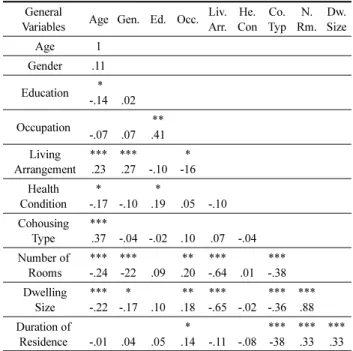
Among 15 Pearson correlations between 6 socio- demographic variables (upper part of <Table 2>), 7 correlation coefficients were significant, and such correlations were age with education, living arrangement, and health condition, gender with living arrangement, education with occupation and health condition, and occupation with living arrangement. The aged were more likely to live alone or be unhealthy, and single residents were more likely to be aged, female, or nonacademic professionals. The higher educated were more likely to have an academic career or be healthy.
Four housing variables were significantly correlated not only with each other (right side of lower part of
<Table 2>) but also with some of socio-demographic ones such as age, gender, occupation, and living arrangement (left side of lower part of <Table 2>). The aged, female, single residents or academic professionals were more likely to live in a smaller size or smaller number of rooms of individual dwelling rather than in a larger one. Plus 40 cohousing than mixed-age cohousing was more likely to be associated with aged residents, smaller dwelling size, smaller number of rooms, or shorter duration of residence. Longer residing residents were more likely to live in age-mixed cohousing, bigger size of dwelling or higher number of rooms. Dwelling size will be
Table 1. General Characteristics of the Respondents (N=216)Variables f %
Age
40~49 years old 15 6.9
50~59 44 20.4
60~69 94 43.5
70~79 49 22.7
80 and over years old 14 6.5
Gender Male 66 30.6
Female 150 69.4
Education
Elementary or Junior high school 24 11.1
Senior high school 42 19.4
College/university 150 69.4
Occupation
Workers 29 13.4
Civil servant/official/employee w/o
long professional education 13 6.0 Civil servant/official/employee w/
long professional education 66 30.6
Academic 80 37.0
Leader/owner of a business 14 6.5
Others 14 6.5
Living Arrangement
Single 140 64.8
Cohabitant 76 35.2
Health Condition
Not all right 30 13.9
All right 74 34.3
Quite all right 112 51.9
Cohousing Type
+40 cohousing 127 58.8
Mixed-age cohousing 89 41.2
Number of Rooms
1R+K 28 13.0
2R+K 110 50.9
3R+K 47 21.8
4R+K 27 12.5
5R+K and more 4 1.9
Dwelling Size (average=61.1 m2)
30~49 m2 60 27.8
50~59 m2 60 27.8
60~69 m2 36 16.7
70~143 m2 60 27.8
Duration of Residence (average=9.6 years)
Under 4 years 76 35.2
4~10 years 61 28.2
Over 10 years 79 36.6
Table 2. Correlation Coefficients between General Variables General
Variables Age Gen. Ed. Occ. Liv.
Arr.
He.
Con Co.
Typ N.
Rm.
Dw.
Size
Age 1
Gender .11 Education *
-.14 .02 Occupation
-.07 .07
**
.41 Living
Arrangement
***
.23
***
.27 -.10
* -16 Health
Condition
* -.17 -.10
*
.19 .05 -.10 Cohousing
Type
***
.37 -.04 -.02 .10 .07 -.04 Number of
Rooms
***
-.24
***
-22 .09
**
.20
***
-.64 .01
***
-.38 Dwelling
Size
***
-.22
* -.17 .10
**
.18
***
-.65 -.02
***
-.36
***
.88 Duration of
Residence -.01 .04 .05
*
.14 -.11 -.08
***
-38
***
.33
***
.33
***p< .001, **p< .01, *p< .05
Dummy variables: Gender (1=Female, 0=male), Occupation (1=Academic, 0=others), Living Arrangement (1=Single, 0=cohabitant), Cohousing Type (1=+40, 0=mixed-age)
excluded in the regression analyses because of its strong correlation with number of rooms (R
2= .88).
2. Participation in Common Activities
1) Frequencies of participation in common activities The 7 common activities were investigated to know how often respondents participate in each common activity with 6-point Likert-scale, from 1 ‘never’ to 6
‘every day’ (<Table 3>). The most frequently participating common activity was common meals (5.06 out of 6.00), followed by common coffee meeting (4.05 out of 6.00) and steering committee and inhabitants meeting (3.65).
Almost all (88.9%) had common meals once or a few times a week (66.7%) or daily (22.2%). Half of respondents had common coffee meeting once or a few times a week (31.0%) or every day (19.0%), while one fifth (19.9%) had rarely (8.8%) or never (11.1%).
More people participated, but less frequently in steering committee and inhabitants meeting than in common coffee meeting. Average frequencies to take part in other activities such as common exercise, common hobby, or common gardening were relatively low (2.85, 2.81, 2.75, respectively), which indicated less than once or a few times in 3 months. Matter of taking part in these relatively low-participating common activities seemed to separate inactive (48.6, 46.3, 44.5%, respectively) and active frequent participants (25.4, 14.8, 7.9%, respectively).
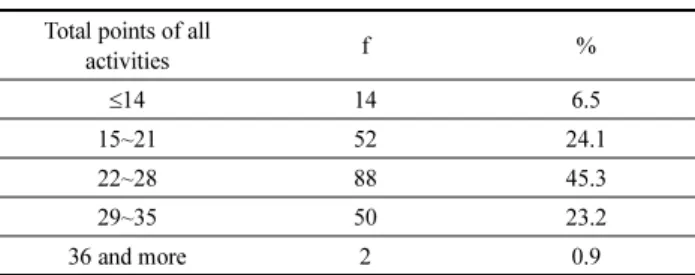
The sum of 7 participation in common activities ranged from 7 to 37 points (theoretically 7 to 42) with total average of 24.18 (equals to 3.45 in a 6-point scale), which represented that the 7 common activities were taken part in once or a few times in one to three months in average (<Table 4>). Forty-five percent of respondents belonged to this average group. Meanwhile, one fourth (24.1%) were more active and 30.6% were less active than the average group.
2) General characteristics and participation in common activities
The characteristics of active participants in common activities were revealed from correlation analyses of participation in common activities with general characteristics (<Table 5>).
Some socio-demographic variables such as age, living arrangement, and health condition were positively associated with the total frequencies of participation and with the frequencies of participation in two to five common activities. The higher aged, single residents, or healthier were the more frequently taking part in common activities on the whole. They were the major active participants in common activities. Gender, education, and occupation will be excluded in the regression analyses because of their insignificant correlation with participation in common activities.
The correlation between housing variables and participation in common activities was higher in degree and bigger in number than that between socio-demographic variables and participation in common activities. Three housing variables were negatively correlated to frequencies of participation in common activities. The residents of smaller number of rooms or smaller size of dwelling, or shorter residing residents were the ones who participated in almost all common activities. Residents of +40 cohousing were more likely to take part in common coffee meetings or common gardening along with overall common activities compared to those of age-mixed cohousing. These associations of housing characteristics with participation
Table 3. The Frequencies of Participation in Common ActivitiesCommon Activity Never
Once or a few times a year
Once or a few times
3 ms
Once or a few times a month
Once or a few times a week
Every day Mean
Common
Activity f % f % f % f % f % f %
Steering Committee/
Inhabitants Meetings
5 2.3 17 7.9 53 24.5 114 52.8 27 12.5 0 0 3.65
Common
Meals 2 0.9 1 0.5 3 1.4 18 8.3 144 66.7 48 22.2 5.06 Common
Coffee Meetings
24 11.1 19 8.8 29 13.4 36 16.7 67 31.0 41 19.0 4.05
Common Hobby Activities
57 26.4 43 19.9 36 16.7 48 22.2 29 13.4 3 1.4 2.81
Common
Exercise 75 34.7 30 13.9 26 12.0 32 14.8 43 19.9 10 4.6 2.85 Common
Gardening 44 20.4 52 24.1 53 24.5 50 23.1 14 6.5 3 1.4 2.75 Other
Common Activities
48 22.2 33 15.3 34 15.7 76 35.2 21 9.7 4 1.9 3.00
Table 4. Total Frequency of Common Activity Participation (N=216) Total points of all
activities f %
≤14 14 6.5
15~21 52 24.1
22~28 88 45.3
29~35 50 23.2
36 and more 2 0.9
in common activities might reflect the association of housing variables with socio-demographic characteristics shown in <Table 2>.
3) Reasons of moving into current cohousing and participation in common activities
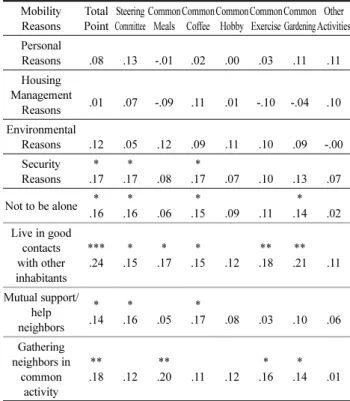
Each of the four main reasons (personal, housing management, environmental, and security) why the respondents chose to move into current cohousing unit was measured by 3 to 6 related items with 4-point Likert-scale, from 1 ‘not at all’ to 4 ‘yes, to a high extent’.
Upper part of <Table 6> showed that only security reason out of four mobility reasons was significantly positively correlated to participation in common activities on the whole besides steering committee and inhabitants meeting and common coffee meeting. The more the respondents chose current cohousing because of security reasons such as ‘not to be alone’, ‘to live in good contacts with other inhabitants’, ‘to give or have mutual support and help from neighbors’, or ‘to be together with neighbors in common activities’, the more frequently they participated in various common activities.
3. Participation in Common Activities, Satisfaction and Intention to Stay
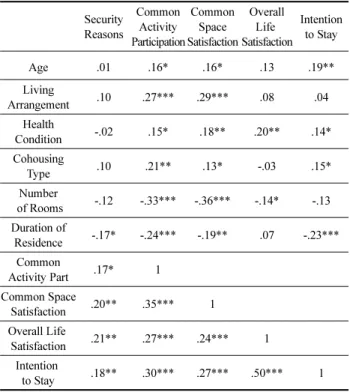
Pearson correlation coefficients were examined to check
the multicollinearity among four endogenous variables and six general variables as exogenous variables. In every case, the magnitude of correlation coefficients was under 0.5 (<Table 7>). The correlated directions of the four endogenous variables were positive except the one with number of rooms and duration of residence. The security reasons significantly related to only one exogenous variable, duration of residence.
<Table 8> showed series-results of hierarchical linear regressions of four endogenous variables with controlling the general variables as exogenous variables. In the multiple linear regressions for participation in common activities (part 1 of <Table 8>), security reasons insignificantly increased common activity participation. It needs to be watched with caution because the significance level (p= .06) was slightly out of p< .05 in this sample.
Health condition among control variables was the only significant variable in the regressions of participation in common activities.
Security reason and participation in common activities directly impacted satisfaction with common space when general variables were controlled (part 2 of <Table 8>).
The influence of participation in common activities was more powerful than security reasons. Among general variables, health condition positively and number of rooms negatively influenced satisfaction with common
Table 5. Correlation Coefficients between General Characteristicsand Participation in Common Activities General
Characteristics Total Point
Steering Committee
Common Meals
Common Coffee
Common Hobby
Common Exercise
Common Gardening
Other Activities
Age *
.17
* .14
**
.20 .12 .02
*
.16 .07 .10 Gender
.11 .04 .01 .03 .07
*
.17 -.00 .10 Education .01 .05 .04 -.01 .01 -.00 .00 -.02 Occupation
.11 -.00 .03 .06
*
.15 .08 .04 .08 Living
Arrangement
***
.27
***
.26 .11
* .16
* .14
***
.22
***
.23 .11 Health
Condition
*
.15 .05 .10 .01
* .17
***
.25 .05 -.00 Cohousing
Type
**
.21 .12 .07
**
.19 .05 -.12
***
.24 .12 Number
of Rooms
***
-.33
***
-.29
***
-.23
**
-.21
* -.15
***
-.28
***
-.25 -.11 Dwelling
Size
***
-.35
***
-.27
**
-.21
**
-.21
**
-.20
***
-.28
***
-.30 -.10 Duration
of Residence
***
-.24
***
-.26 -.00
***
-.22
* -.16 -.11
***
-.27 -.02
***p< .001, **p< .01, * p< .05
Dummy variables: Gender (1=Female, 0=male), Occupation (1=Academic, 0=others), Living Arrangement (1=Single, 0=cohabitant), Cohousing Type (1=+40, 0=mixed-age)
Table 6. Correlation Coefficients between Mobility Reasons and Participation in Common Activities
Mobility Reasons
Total Point
Steering Committee
Common Meals
Common Coffee
Common Hobby
Common Exercise
Common Gardening
Other Activities Personal
Reasons .08 .13 -.01 .02 .00 .03 .11 .11
Housing Management
Reasons .01 .07 -.09 .11 .01 -.10 -.04 .10 Environmental
Reasons .12 .05 .12 .09 .11 .10 .09 -.00
Security Reasons
* .17
* .17 .08
*
.17 .07 .10 .13 .07 Not to be alone *
.16
* .16 .06
*
.15 .09 .11
* .14 .02 Live in good
contacts with other inhabitants
***
.24
* .15
* .17
* .15 .12
**
.18
**
.21 .11
Mutual support/
help neighbors
* .14
* .16 .05
*
.17 .08 .03 .10 .06 Gathering
neighbors in common
activity
**
.18 .12
**
.20 .11 .12
* .16
* .14 .01
***p< .001, **p< .01, * p< .05
space. The most satisfied residents with common space were healthier in a smaller number of rooms, actively participated in common activities, and sought security in cohousing community.
From the multiple linear regressions of overall life satisfaction (part 3 of <Table 8>), impacts of security reason and participation in common activities were continuously effective on overall life satisfaction when general variables were controlled. Health condition and duration of residing periods positively influenced overall life satisfaction. However, satisfaction with common space appeared insignificant when general variables, security reasons, and participation in common activities were controlled. It is assumed that overall life satisfaction might be directly influenced by participation in common activities rather than satisfaction with common space.
In the last multiple linear regressions on intention to stay (part 4 of <Table 8>), impacts of security reasons and participation in common activities continued on intention to stay when general variables were controlled.
However, security reasons became insignificant when participation in common activities was added. When overall life satisfaction was finally added in the last regression of intention to stay, then both the participation in common activities and satisfaction with common space also appeared insignificant. It may possibly indicate that overall life satisfaction indirectly carries the impact of all three endogenous variables whose significance disappeared in the regression. Duration of residence and age among general variables positively influenced intention to stay.
The aged who lived in long periods with higher life satisfaction was less likely intending to move out.
Table 7. Correlation Coefficients among Participation in Common Activities, Satisfaction and Intention to Stay
Security Reasons
Common Activity Participation
Common Space Satisfaction
Overall Life Satisfaction
Intention to Stay
Age .01 .16* .16* .13 .19**
Living
Arrangement .10 .27*** .29*** .08 .04
Health
Condition -.02 .15* .18** .20** .14*
Cohousing
Type .10 .21** .13* -.03 .15*
Number
of Rooms -.12 -.33*** -.36*** -.14* -.13 Duration of
Residence -.17* -.24*** -.19** .07 -.23***
Common
Activity Part .17* 1 Common Space
Satisfaction .20** .35*** 1 Overall Life
Satisfaction .21** .27*** .24*** 1 Intention
to Stay .18** .30*** .27*** .50*** 1
***p< .001, **p< .01, * p< .05
Dummy variables: Gender (1=Female, 0=male), Occupation (1=Academic, 0=others), Living Arrangement (1=Single, 0=cohabitant), Cohousing Type (1=+40, 0=mixed-age)
Table 8. Coefficients of Linear Regressions of Four Endogenous Variables Variables
(1) Participation in Common Activities
(2) Satisfaction with
Common Space
(3) Overall Life Satisfaction
(4) Intention to stay
β β β β β β β β β β β β β β
Age .10 .10 .13 .13 .11 .16* .17* .15* .14 .23** .23** .21** .20** .13*
Living Arrangement .16 .15 .13 .12 .09 -.05 -.06 -.10 -.11 -.05 -.06 -.10 -.11 .06
Health Condition .17** .17** .21*** .21*** .18** .23*** .24*** .20** .18** .16* .16* .12 .10 .01
Cohousing Type .07 .06 -.04 -.04 -.05 -.11 -.12 -.13 -.13 -.03 -.03 -.04 -.04 .02
Number of Rooms -.14 -.13 -.23* -.22* -.20* -.22* -.21* -.18 -.16 -.05 -.04 -.01 .02 .09
Duration of Residence -.14 -.12 -.10 -.07 -.05 .11 .14 .16* .17* -.23** -.20** -.18* -.17* .25***
Security Reasons .12 .15* .13* .23*** .20** .19** .15* .13 .11 .02
Common Activity Participat. .19** .22** .20** .21** .18** .09
Common Space Satisfaction .10 .14* .10
Overall Life Satisfaction .46***
R2 .17 .19 .19 .21 .24 .11 .15 .19 .20 .12 .14 .18 .19 .36
Adjusted R2 .15 .16 .17 .19 .21 .08 .13 .16 .17 .09 .11 .15 .16 .33
F 7.33 6.86 8.22 8.04 8.24 4.09 5.40 6.21 5.74 4.68 4.87 5.56 5.45 11.73
***p< .001, **p< .01, *p< .05
Dummy variables: Gender (1=Female, 0=male), Occupation (1=Academic, 0=others), Living Arrangement (1=Single, 0=cohabitant), Cohousing Type (1=+40, 0=mixed-age)
There was a rough consequent cause and effect among four endogenous variables. The frequent participants in common activities were more likely to be satisfied with common space, and then to have higher overall life satisfaction. Finally, the higher satisfied with overall life had less intention to move out. The significant chain connecting satisfaction with common space to overall life satisfaction was not found in the regression.
Among the control variables, health condition significantly influenced all four endogenous variables, number of rooms significantly influenced two satisfaction variables, and duration of residence and age affected overall life satisfaction and intention to stay. The healthier was more likely to participate in common activities. Healthy residents in smaller number of rooms who moved in with security reasons and actively participated in common activities were satisfied with common space.
Their overall life satisfaction was also higher. Age positively but duration of residence negatively influenced intention to stay when the effects of other variables were controlled.
V. CONCLUSIONS
Active participation in common activities is a key to a vigorous cohousing life. This research attempts to search the role of participation in common activities and satisfaction with common space in a tentative housing adjustment framework for Swedish cohousing, applying the housing adjustment behavior model of Morris and Winter (1978, 1996). Based on a tentative housing adjustment process, the regression analyses include four main concepts as endogenous variables, which are participation in common activities, satisfaction with common space, overall life satisfaction, and intention to move out.
The cohousing residents took part in various common activities as expected. The most frequently participating common activity was common meals, followed by common coffee meetings and by steering committee and inhabitants meetings. There were individual differences in frequencies of participation in common activities.
Only the security reason, among 4 reasons to choose the current cohousing, was significantly related to the participating level of common activities. Impacts of participation in common activities and satisfaction with common space were shown by series of hierarchical linear regression analyses of overall life satisfaction and
intention to stay with the general variables controlled.
The results of this research support the general belief that cohousing is a living arrangement that reinforces a sense of community stability and mutual support through common activity participation. Participation in common activities raises not only satisfaction with common space and overall life satisfaction, but also intention to stay in the cohousing even when effects of other variables were controlled in multiple linear regressions. It could be tentatively concluded that there would be an intervening role of both satisfaction with common space and overall life satisfaction between participation in common activities and intention to move out and a similar role of participation in common activities among security reasons, satisfaction with common space and overall life satisfaction, and intention to move or stay. The results support that a pass flows roughly from participation in common activities to intention to move or stay through satisfaction with common space and overall life satisfaction. It seems that satisfaction with common space than overall life satisfaction is a better fit to the path process of the housing adjustment model by Morris & Winter (1978, 1996). Our future research plans to test this idea in a modified model excluding overall life satisfaction.
Further studies are required to explore the precise role of security reasons to participation in common activities and also the role of satisfaction with common space to overall life satisfaction. Further research may replace actual frequencies of participation in common activities with subjective evaluation of frequencies and contents of participating common activities. The considerable impact of general characteristics like health condition under controlling other variables might also be worthwhile to deeply look into, in order to develop the cohousing adjustment model. Issues might be raised concerning which is a cause and which is an effect between participation in common activities and satisfaction with common space, whose relationship might be suspected to be recursive.
Even though this study leaves further research to specify a tentative framework, it may be noteworthy as a first attempt to articulate the concepts revealed by previous empirical cohousing research. Also this study suggests some pass flow of main concepts to broaden the possibility of developing an analytical or theoretical model of housing adjustment for cohousing residents.
Lastly, it may give insight of housing alternatives for
emerging Korean baby boomers.
REFERENCES
1. Brenton, M. (2011). Cohousing: Supportive local networks in old age. In S. Bunker, C. Coates, M. Field, & J. How (Eds.), Cohousing in Britain (pp. 115-124). London, England: Diggers & Dreamers Publications.
2. Choi, J. (2003). Moving motivation of senior cohousing inhabitants in Scandinavian countries. Journal of the Architectural Institute of Korea. Planning and Design, 19(2), 129-138.
3. Choi, J. (2005). Comparison of life satisfaction between the residents of Danish and Swedish senior cohousing projects.
Journal of the Korean Housing Association, 16(6), 149- 161.
4. Choi, J. (2012). Evaluation of physical environment design in Swedish cohousing projects. Journal of the Scandinavian Society of Korea, 13, 115-150.
5. Choi, J. (2013a). Why do people move to cohousing communities in Sweden? Are there any significant differences between the +40 cohousing and the mixed-age cohousing? Architectural Research, 15(2), 77-86.
6. Choi, J. (2013b). Difference of move to Swedish senior cohousing by longitudinal analysis; focus on differences between the years of 2001 and 2010. Journal of Korean Home management Association, 31(3), 81-92.
7. Choi, J., & Cho, J. (2006). Differences between male and female in moving motivation and life satisfaction of senior cohousing residents in Scandinavia. Journal of the Korean Home Management Association, 24(1), 117-128.
8. Choi, J., & Paulsson, J. (2006). Planning and Implementation of Scandinavian Senior Cohousing Projects. Seoul, Korea:
Jipmundang.
9. Choi, J., & Paulsson, J. (2011). Evaluation of common activity and life in Swedish cohousing unit. International Journal of Human Ecology, 12(2), 133-146.
10. Choi, J., & Strid, M. (2011). Why do people move to cohousing communities in Sweden? Proceedings of IAP International Network Symposium, 1-10.
11. Durrett, C. (2009). The Senior Cohousing handbook: A Community Approach to Independent Living, 2nd ed.
Gabriola Island, BC, Canada: New Society Publishers.
12. Glass, A.P. (2009). Aging in a community of mutual support: The emergence of an elder intentional cohousing
community in the United States. Journal of Housing for the Elderly, 23(4), 283-303.
13. Glass, A.P. & Vander Plaats, R.S. (2013). A conceptual model for aging better together intentionally. Journal of Aging Studies, 27, 428-442.
14. Housing Study Group (2000). Cohousing in the World.
Seoul, Korea: Kyomoonsa.
15. Im, G., & Baek, S. (2011). A study on residential mobility of baby boomers in Korea. Proceedings of 2011 Annual Conference of Korean Association for Housing Policy Studies. 1-10.
16. Jung, K., Lee, S.,, Lee, Y., Kim, S., Seonwoo, D., Oh, Y., Kim, K., Pak, B., Yoo, H., & Lee, U. (2010). Baby Boomers’ Demographic Profiles and Welfare Needs.
(KIHASA Research Report 2010-30-18). The Korea Institute for Health and Social Affairs.
17. Kim, C., & Kim, T. (2012). Characteristics Analyses of Housing Demands for Baby Boom Generation. (Korea Housing Institute 2012-5). Korea Housing Institute.
18. Kim, H., Lee, Y., & Yoon, H. (2010). The study on housing characteristics preferred by baby boomers after retirement:
Focusing on apartment’s residents of Gangnam region in Seoul. Journal of the Korean Housing Association, 21(5), 83-92.
19. Meltzer, G. (2011). Close relationship: Learning from the cohousing model. In S. Bunker, C. Coates, M. Field, & J.
How (Eds.), Cohousing in Britain (pp. 43-58). London, England: Diggers & Dreamers Publications.
20. Morris, E.W. & Winter, M (1978). Housing, Family, and Society. New York, NY, U.S.A.: John Wiley & Sons.
21. Morris, E.W. & Winter, M (1996). Housing, Family, and Society. Revised ed. Unpublished manuscripts.
22. Russell, L. (2000). Housing Options for Older People.
London, England: Age Concern.
23. Vestbro, D.U. (2000). From collective housing to cohousing:
A summary of research. Journal of Architectural and Planning Research, 17(2), 164-177.
24. Williams, J. (2006). Designing neighborhoods for social interaction: The case of cohousing. Journal of Urban Design, 10(2), 195-227.
접수일(2014. 5. 29) 수정일(1차: 2014. 6. 30, 2차: 2014. 8. 3) 게재확정일자(2014. 8. 8)