Effects of Continuous Application of CO
2on
Fruit Quality Attributes and Shelf Life during Cold Storage in Cherry Tomato
Adanech Melaku Taye, Shimeles Tilahun, Do Su Park, Mu Hong Seo, and Cheon Soon Jeong*
Department of Horticulture, Kangwon National University, Chuncheon 24341, Korea
*Corresponding author: [email protected]
‘Unicon’ cherry tomato (
Solanum lycopersicum
) is one of the most highly perishable horticultural crops due to its high water content and respiration rate. This study was carried out to assess the effect of continuous application of CO2 (control [air], 3%, and 5%) on the quality and shelf life of cherry tomato fruits stored at 10°C and 85 ± 5% relative humidity (RH) at two maturity stages (pink and red). Continuous application of CO2 did not affect the soluble solids content (SSC) or titratable acidity (TA) of the fruit at either maturity stage during storage.However, there was a significant difference among treatments in terms of flesh firmness, cell wall thickness, pectin content, vitamin C content, skin color, lycopene content, weight loss, ethylene production rate, respiration rate, and acetaldehyde and ethanol production. Fruits treated with 5% CO2 maintained their high quality with regards to vitamin C, skin color (
a
*), lycopene content, weight loss, physiological parameters (ethylene production rate, respiration rate, and volatile compounds), flesh firmness, cell wall thickness, and pectin content at both maturity stages compared with 3% CO2 treatment and the control. Continuous application of CO2 (5%) reduced the ethylene production rate and the production of volatile compounds during storage. Therefore, cherry tomato ‘Unicon’ fruit can be stored for two weeks without losing fruit quality at both maturity stages under continuous application of 5% CO2 as a postharvest treatment.The work was supported by the Korea Institute of Planning and Evaluation for Technology in Food, Agriculture, Forestry, and Fisheries (IPET) through the Agri-Bioindustry Technology Development Program, funded by the Ministry of Agriculture, Food, and Rural Affairs (MAFRA) (314086-3) and by a 2015 Research Grant from Kangwon National University (No.
520150123).
HORTICULTURAL SCIENCE and TECHNOLOGY 35(3):300-313, 2017
URL: http://www.kjhst.org pISSN : 1226-8763 eISSN : 2465-8588
This is an Open-Access article distributed under the terms of the Creative Commons Attribution NonCommercial License which permits unrestricted non-commercial use, distribution, and reproduction in any medium, provided the original work is properly cited.
Copyrightⓒ2017 Korean Society for Horticultural Science.
OPEN ACCESS Received:
Revised:
Accepted:
September 1, 2016 March 20, 2017 March 24, 2017
Abstract
Additional key words: cell wall thickness, maturity stage, perishable, postharvest, volatile compounds
Introduction
Tomatoesareconsumedbroadlythroughouttheworld
,
andtheirconsumptionhasrecentlybeenshown tohavehealthbenefitsduetotheirhighphytonutrientcontents(
LevyandSharoni,
2004;
Hsuetal.,
2008).
Postharvestrecommendationsindicatethattomatoes
,
includingcherrytomatoes,
shouldbestoredat10°
C orhighertoavoidchillinginjury(
JimenezandCantwell,
1996andRobertsetal.,
2002)
andthateven10°
C maybeharmfultotomatoflavor(
Mauletal.,
2000).
Oneofthemostcharacteristicphytonutrientsin tomatoislycopene,
acarotenoidwithahighcapacityforreducingtheriskofchronicdiseasesthat represents-
80%
ofthetotalcarotenoidcontentsintomatofruit(
Raoetal.,
1998).
Lycopeneaccountsforthereddeningoftomatoesduetothedifferentiationofchloroplastsintochromoplasts
(
Egeaetal.,
2011).
Hence,
thiscarotenoid isfundamentalforthenutritionalqualityandcommercialvalueofthisfruit(
Dumasetal.,
2003).
ThestorabilityofapplescanbeincreasedbytreatingfruitswithhighconcentrationsofCO2forashortperiodoftime
.
Burg andBurg(
1967and1969)
foundthatCO2functionsasacompetitiveinhibitorofethyleneaction.
Beyer(
1979)
reportedthat suchanactionisrelatedtoethylenemetabolism;
CO2canaffectthismetabolismbyinhibitingethyleneoxidation.
Theactivity ofCO2indelayingtheagingrateisassociatedwithreducedrespiratorymovementandahindranceofthesuccinicoxidase complex,
particularlysuccinicdehydrogenase(
Ransonetal.,
1960andShipwayandBramlage,
1973).
Inadditiontoits respiration-
blockingactivity,
CO2athighlevelsdiminishesethyleneevolutioninfruits,
suchasapple,
pears,
andtomato(
Bramlage,
etal.,
1977;
Buescher,
1979;
Looney,
1975;
MarcellinandChaves,
1983andWangandMellenthin,
1975).
According toFarber(
1991),
theoptimumconditionsformodifiedatmospherepackaging(
MAP)
storageoffruitsandvegetablesare3-
8%
CO2 and2-
5%
O2.
Duetothelowstorabilityofcherrytomatofruit
,
manystudieshavefocusedondesigningvariouspracticalapproachesfor extendingthestorageperiod,
includingcontrolledatmosphere(
CA)
storage.
Short-
termexposureoftomatofruitto80%
CO2 stimulatestheethylenebiosyntheticpathwayduetotheinhibitionoftheripeningprocess(
Hirofumietal.,
1998).
Treatmentwith 60%
CO2for24hrreducedethyleneproductionintomatofruit,
butitsharplyincreasedimmediatelyaftertheCO2treatment.
Surfaceblemishes,
increasedsoftening,
andunevenripeningwerealsoobservedinfruitsafterremovalfromelevatedCO2 levels(
Kuboetal.,
1990andMorris,
1977).
However,
nostudieshaveinvestigatedtheeffectsofcontinuousapplicationofCO2 atlowtemperatureonfruitqualityattributesandshelflifeincherrytomato
.
Maintainingfruitqualityandaddingcommercial valuewillbenefitbothproducersandconsumers.
Tomatofruitisperishable,
chillingsensitive,
andeasilyaffectedbynumerous fungaldiseases(
Hoeberichtsetal.,
2002).
Inaddition,
tomatofruithasashortshelflifeduetoitshighwatercontent,
andits climactericnatureleadstoethyleneproductionandahighrespirationrateafterharvest.
Therefore,
inthecurrentstudy,
we examinedtheeffectsofcontinuousapplicationofCO2onfruitqualityattributesandshelflifeincherrytomato
.
Materials and Methods
Plant Material and TreatmentsCherrytomato
(Solanum lycopersicum) ‘
Unicon’
fruitswereharvestedatthepinkandredmaturitystagesfromacommercial farminKangwonProvince,
RepublicofKoreaonOctober15,
2015.
ThefruitswereimmediatelytransportedtothePostharvest QualityManagementLaboratory,
DepartmentofHorticulture,
KangwonNationalUniversityinanair-
ventilatedautomobile within30minofharvest.
Uponarrival,
defect-
freefruitsofuniformcolorweresorted,
washedwithcoldwater,
andair-
driedfor 6hrs.
Thesortedfruitwerecarefullytransferredto0.
75Lplasticcontainers(
16fruitspercontainer)
forCO2treatment.
The treatmentswereconductedusingacontinuousapplicationofCO2(
control[
untreated,
air],
3%,
and5% )
withtwomaturitystages offruit(
pinkandred)
inacompletelyrandomizeddesign(
CRD).
CO2wastakenfromagascylinderusingasyringeand immediatelyinjectedintothecontainer,
andtherequiredpercentageofCO2wasconfirmedusingahandheldPBIDansensor gasanalyzer(
CheckMate9900,
Ringsted,
Denmark).
Thetreatedfruitswerestoredat10°
Cand85±
5%
RH.
Evaluationswere madeoncherrytomatofruitstoredinanevaluationroom,
anddatawerecollectedfromeachtreatmentat2-
dayintervals.
Weight Loss, Flesh Firmness, Surface Color, Titratable Acidity, Soluble Solids Content, Ethylene Production Rate, and Respiration Rate
Weightlosswasdeterminedbymeasuringthefreshweightoffruitandcomparingthevaluetotheinitialfreshweight
.
Fresh weightwasmeasuredeverytwodaysfor15d,
andweightlosswascalculatedbysubtractingfreshweightsfromtheinitial weightofthefruit.
FleshfirmnesswasmeasuredusingaRheometer(
modelcompact-
100II,
Meschede,
Germany)
witha maximumforceof10kganda3mmdiameterroundstainlesssteelprobewithaflattip.
Surfacecolor(a*
value)
wasmeasured onfruitsmarkedalongtheirequatorregions,
withthreereadingstakenusingaChromameter(
modelCR-
400,
MinoltaCo.,
Tokyo,
Japan).
Cherrytomatojuicewasanalyzedforsolublesolidscontent(
SSC)
usingarefractometer(
Model-
AtagoInc.,
Tokyo,
Japan);
theresultswereexpressedin°
Brix.
Titratableacidity(
TA)
wasanalyzedusingaDL22FoodandBeverage Analyzer(
MettlerToledoLtd.,
Zurich,
Switzerland).
Dilutedjuice(
1mLofjuice:
19mLofwater)
wastitratedwith0.
1Nsodium hydroxideandtheresultswereexpressedasmg·
100g-1ofcitricacid.
TheethyleneproductionratewasmeasuredusingaGC-
2010Shimadzu(
ShimadzuCorporation,
Tokyo,
Japan)
fittedwithaBP20waxcolumn(
30m×
0.
25mm×
0.
25µm)
andaflame ionizationdetector(
FID).
Thedetectorandinjectorwereoperatedat127°
Candtheovenwassetat50°
C.
Thecarriergas(
N)
flow ratewas0.
67mL·
s-1(
Parketal.,
2000).
TherespirationratewasmeasuredwithaPBIDan-
sensor(
CheckMate9900,
Ringsted,
Denmark).
Vitamin C and Lycopene Content, Ethanol and Acetaldehyde Production
VitaminCwasanalyzedusinghighperformanceliquidchromatography
(
HPLC) (
model:
WatersAssociates,
Milford,
MA,
USA)
througha717plusautosamplerusingaZORBAXEclipseXDB-
C18analyticalcolumn(
4.
6cm×
250mm×
5μm,
Agilent Co.,
Torrance,
USA),
aWaters600controllerpump,
andaWaters486tunableabsorbancedetectorat265nm.
Themobilephase was1:
9and100%
MeOH:
0.
1MKH2PO4,
andtheflowratewas1.
0mL·
min-1(
LiandChen,
2001).
Frozenfruittissue(
1g)
was mixedwith10mLof5
%
metaphosphoricacidandhomogenizedusingaT25Ultra-
Turrax(
IKAKorea.
Ltd.,
Seoul,
Republic ofKorea)
untilcombined.
Themixturewascentrifugedat20,
000rpmfor10minutesat4°
Candfilteredthrougha0.
45μmfilter membrane.
Thesample(
1mL)
wasanalyzedbyHPLCwiththreereplicates(
Kimetal.,
2011).
Thelycopenecontentofthefruit wasanalyzedasdescribed,
withslightmodifications(
Fishetal.,
2002).
Frozenfruitwasgroundwithamortarandpestle,
and1 ggroundsamplewashomogenizedwith1mLdistilledwaterusingaT25Ultra-
Turraxstainlesssteelblender(
IKAKorea.
Ltd.,
Seoul,
RepublicofKorea).
Tubescontaininghomogenizedsampleswerecoveredwithaluminumfoilandplacedoniceand combinedwith20mLofhexane-
ethanol-
acetone(
2:
1:
1),
followedbygentleshaking.
Thesampleswerecentrifugedat 15,
000rpmfor20min,
followedbytheadditionof3mLdistilledwaterpervial.
Thesampleswereagitatedfor2min,
incubated atambienttemperatureforafewmin,
andreadusingaspectrophotometer(
ThermoFisherScientific,
Madison,
WI,
USA)
at503 nm.
Hexanewasusedasablank.
Ethanolandacetaldehydeweremeasuredusingthesameprocedureusedtomeasurethe ethyleneproductionrate.
Cell wall Thickness and Water-soluble Pectin
Cellwallthicknesswasmeasuredunderascanningelectronmicroscope
(
SEM,
Supra55VP,
CarlZeiss,
Germany)
as describedbyIslametal. (
2016).
WatersolublepectinwasanalyzedbasedontheprotocolofBlumenkrantzandAsoe-
Hansen(
1973).
Statistical Analysis
Significancetestswereconductedbyanalysisofvariance
(
ANOVA)
usingSASVersion9software(
SASInstitute,
Cary,
NC,
USA)
andExcel2010(
MicrosoftCo.,
WA,
USA).
Meancomparisonsweremadeusingleastsignificancedifference(
LSD)
at5%
probability.
Result and Discussion
Weightlossleadstoquantitativecroplosses
,
aswellasareductioninqualityduetoshrivelingandwilting,
softeningoftissue,
andalossofcrispness(
Kader,
1986).
Wedetectedasignificant( p <
0.
05)
differenceincherrytomatofruitqualityamong treatmentsatbothmaturitystages(
Fig. 1AandB).
Thehighestweightlosswasfoundinthecontrol,
followedby3%
CO2 treatment,
whiletheleastweightlosswasobservedinfruitsafter5daysof5%
CO2treatmentatthepinkmaturitystage.
However,
therewasnodifferencebetween3%
CO2and5%
CO2treatmentsuntilday13,
afterwhichweightlossincreased significantlyinfruitstreatedwith3%
CO2.
Thecontrolfruitsatbothmaturitystagesshowedmoreweightlossthanthetreated fruitsduetohigherrespirationratesandethyleneproduction(
Fig. 3CandD, 4AandB), whichinturnresultedinwaterlossor shrinkageofthefruitsurface.
Theseresultsindicatethatthecontinuousapplicationof5%
CO2reducesweightlossintomato fruitduetoreducedethyleneproductionandrespirationduringcoldstorage.
Therewassignificantdifference
( p <
0.
05)
infleshfirmnessamongtreatmentsatbothmaturitystages(
Fig. 1CandD). Fruits treatedwith5%
CO2weremuchfirmerthanthosetreatedwith3%
CO2andthecontrolatbothmaturitystagesduringtheentire storageperiod(
Fig. 1CandD). Attheredmaturitystage,
untreatedfruitwerethesoftest,
followedbyfruitsunder3%
CO2 treatmentandthoseunder5%
CO2treatment.
Atthepinkmaturitystage,
however,
therewasnosignificantdifferencebetween fruitstreatedwith3%
CO2anduntreatedfruitsthroughoutthestorageperiod.
Atbothmaturitystages,
fruitstreatedwith5%
CO2maintainedfirmnessthroughoutthestorageperiod.
Similarly,
PorrittandMeheriuk(
1977)
reportedthattreatmentwith20-
30%
CO2at0
°
Cfortwoweeksreducedthesofteningof‘
Newton’
applefruitwithoutinducingCO2injury.
Inthecurrentstudy,
5%
CO2-
treatedfruitswerefirmerthanthosetreatedwith3%
CO2andthecontrol.
Atthepinkmaturitystage,
fleshfirmnesswas reducedfrom9.
80Nto5.
48Nand7.
85Nincontroland5%
CO2-
treatedfruits,
respectively.
ThehigherthelevelofCO2 treatment,
thefirmerthefleshandthehigherthecellwallthickness.
Treatmentwith10to20%
CO2for10-
14daysreducedthe degradationoffleshfirmnessin‘
GoldenDelicious’
applefruit(
Lauetal.,
1977).
Asthestorageperiodincreases,
thethicknessof thefruitcellwalldecreases,
alongwithcellwallbreakage(
KashmireandKader,
1978).
Continuousapplicationof
CO2treatmentsignificantly
( p <
0.
05)
affectedthesurfacecolorchangeoftomatofruitduringcold storage(
Fig. 2AandB).
Fruitcolorpeakedearlierinuntreatedfruitsthanintreatedfruits.
After11days,
thecolorvaluesof controlfruitsandfruitstreatedwith3%
CO2weresignificantlylowerthanthoseof5%
CO2-
treatedfruits.
ContinuousCO2 applicationdelayedthecolorchangeatthepinkmaturitystage.
ThisresultissupportedbythefindingofSozzietal
. (
1999)
that redcolordevelopedslowlyintomatofruitatthebreakerstageasaresultofCO2treatment
.
Aharonietal. (
1989)
andMitcham(
1997)
alsoreportedthathighCO2concentrationssignificantlyreducedchlorophylldegradationingreenvegetablescompared withtheuntreatedcontrol.
Similarly,
thefruitsmaintainedtheirredcolorattheendofstorage.
Colordevelopmentincherry tomatoesatthepinkstagebeganonday3and5under3%
and5%
CO2treatment,
respectively.
Bycontrast,
colordevelopment inuntreatedfruitbeganonday5andreacheditspeakonday7.
However,
under3%
CO2treatment,
colordevelopmentbeganearlierthaninuntreatedfruitandincreasedslowlyuntilitreachedaclimactericpeakonday11
.
Similarly,
attheredmaturity stage,
fruitunder5%
CO2treatmentmaintainedbettercolorthanfruitundercontroland3%
CO2treatmentthroughoutthe storageperiod(
Fig. 2B).
Therewasnosignificantdifference
( p <
0.
05)
intitratableacidityamongtreatmentsatbothmaturitystages,
althoughthe acidityvaluesofthefruitsdecreasedwithincreasingstorage(
Fig. 2CandD).
Riquelmeetal. (
1994)
reportedthatstoring strawberriesunderlowO2andhighCO2concentrationsdidnotaffecttitratableacidity.
Similarly,
Biale(
1960)
reportedthat treatmentwith60%
CO2hadnoeffectontitratableacidityin‘
Valencia’
orangefruit,
whereasstorageunderhighCO2levels increasedtheorganicacidcontentsinlemon.
Atthepinkmaturitystage,
wedetectedadecreaseinaciditylevelsfromday3to day7inthecontrolgroup,
whichsubsequentlybecamesimilartothoseoftheothertreatments.
Therewasreductioninacidity Fig. 1. Effect of continuous application of CO2 on weight loss and flesh firmness in ‘Unicon’ cherry tomato fruit at two maturitystages stored at 10°C for up to 15 days. A and C=pink and B and D=red maturity stages. Vertical bars represent mean +/- SE (n=5) when larger than the symbols.
Weight loss (%)Weight loss (%)
0 0.5 1 1.5 2 2.5 3 3.5
0 2 4 6 8 10 12
0 1 3 5 7 9 11 13 15 0 1 3 5 7 9 11 13 15
A
C
B
D
Storage time (days) Storage time (days)
Control 3% CO2
5% CO2
levelfrom0
.
89mg·
100g-1to0.
59mg·
100g-1inuntreatedfruit,
from0.
89mg·
100g-1to0.
57mg·
100g-1infruitstreatedwith3%
CO2,
andfrom0.
89mg·
100g-1to0.
65mg·
100g-1infruitstreatedwith5%
CO2.
Thisresultisinagreementwiththefindingsof CouveyandOlsen(
1977).
Nosignificantdifference
( p <
0.
05)
wasobservedbetweentreatmentswithregardtosolublesolidscontent(
SSC)
atboth maturitystages(Fig. 3AandB).
RyallandPentez(
1982)
reportedthatSSCwasnotaffectedbyCO2levelorlong-
termapplication ofCO2.
However,
SSClevelsshowedadecreasingtrendonthelastdayatbothmaturitystages,
whichmightbeassociatedwith utilizationofSSCduringrespiration
.
AnalysisofvarianceoftheeffectsofcontinuousapplicationofCO2onethyleneproductionrevealedasignificantdifference
( p <
0.
05)
amongtreatmentsatbothmaturitystages (Fig. 3CandD).
Theethyleneproductionratewaslowerinfruitstreatedwith 5%
CO2fromthebeginningoftheexperiment,
followedby3%
CO2treatment,
comparedtountreatedfruitsatbothmaturity Fig. 2. Effect of continuous application of CO2 on surface color (a* value) and titratable acidity in ‘Unicon’ cherry tomato fruit attwo maturity stages stored at 10°C for up to 15 days. A and C=pink and B and D=red maturity stages. Vertical bars represent mean +/- SE (n = 9 for surface color and n = 5 for titratable acidity) when larger than the symbols.
Surface color (Hunter a*)Titiratable acidity (mg · 100g-1 )
-5 0 5 10 15 20
0 0.2 0.4 0.6 0.8 1 1.2
0 1 3 5 7 9 11 13 15 0 1 3 5 7 9 11 13 15
A
C
B
D
Storage time (days) Storage time (days)
Control 3% CO2
5% CO2
stages
.
TheseobservationsaresimilartothoseofBurgandBurg(
1967),
whodetectedinhibitedethyleneproductionunderCO2 treatmentduetoitscompetitiveaction,
whichinturnhelpsregulateethylenebiosynthesisduringstorage.
Eventhoughall treatedfruitsatbothmaturitystagesexhibitedpeakethyleneproductiononthesameday,
5%
CO2-
treatedfruitsproducedthe lowestethylenelevels,
whichdeclineddrastically.
Indeed,
areducedO2uptakerateduringhighCO2treatment,
accompaniedby inhibitedethyleneproduction,
wasfoundtoextendtheshelflifeoftomatofruit(
Kuboetal.,
1985).
Atthepinkmaturitystage,
bothcontroland3%
CO2-
treatedfruithadahighethyleneproductionrateuntilday5,
followedbyaslightdecrease.
Asimilar trendwasobservedattheredmaturitystageaswell.
Therespirationratewaslowerunder5%
CO2treatmentcomparedwith3%
CO2andthecontrolthroughouttheentirestorageperiod,
regardlessoffruitmaturity(
Fig. 4AandB).
Therespirationrate reacheditspeakonday1inalltreatments.
Eventhoughtherespirationratedecreasedafterday1underalltreatments,
therateof reductionwashigherundercontroland3%
CO2treatmentsthanunder5%
CO2treatmentthroughouttheexperimentalperiod.
Fig. 3. Effect of continuous application of CO2 on soluble solids content (SSC) and ethylene production rate in ‘Unicon’ cherry tomato fruit at two maturity stages stored at 10°C for up to 15 days. A and C=pink and B and D=red maturity stages. Vertical bars represent mean +/- SE (n=5 for SSC and n=3 for ethylene production rate) when larger than the symbols.Ethylene production (μL · kg-1· hr-1) 0 1 2 3 4 5 6 0 1 2 3 4 5 6
0 1 3 5 7 9 11 13 15 0 1 3 5 7 9 11 13 15
Storage time (days) Storage time (days)
Control 3% CO2
5% CO2
Soluble Solids content (°Brix)
A
C
B
D
ThisresultisinagreementwiththefindingsofKader
(
1986),
whodetectedreducedrespirationratesduetoelevatedCO2 concentrations,
whichisresponsibleforchangesintheactivitiesofvariousenzymesthathastenfruitripeningandsenescence.
Therewasasignificantdifference( p <
0.
05)
invitaminCcontentamongtreatmentsatbothmaturitystages(
Fig. 5AandB).
Continuousapplicationof5
%
CO2delayedthedecreaseinvitaminCcontentfor7daysatthepinkmaturitystage.
Thevitamin Ccontentsoffruitsunder3%
CO2andcontroltreatmentwerehigherthanthoseof5%
CO2-
treatedfruitsonday1atthepink maturitystage.
Subsequently,
vitaminClevelsdecreasedinboth3%
CO2-
treatedandcontrolfruitsattheendofstorageatboth maturitystages.
Thisresultindicatesthatasfruitripeningadvances,
organicacidcontentsdecline.
Similarly,
Islametal. (
1996)
detectedincreasedascorbicacidcontentsintomatofruitwithincreasingmaturity,
withhighconcentrationsofvitaminCfound atthepinkmaturitystage,
followedbyaslightdecreasewhenthefruitsreachedtheredmaturitystage.
AsshowninFig. 5B,
vitaminCcontentsweremaintainedunder5%
CO2treatmentcomparedwiththecontroland3%
CO2treatmentthroughoutthe storageperiod.
Attheendofstorage,
thehighestvitaminCcontent(
31.
78mg·
100g-1and30.
06mg·
100g-1atbothmaturity stages,
respectively)
wasfoundinfruittreatedwith5%
CO2.
Atbothmaturitystages,
vitaminClevelsremainedstableinfruit treatedwith5%
CO2comparedto3%
CO2andthecontrolthroughoutthestorageperiod.
Theseresultsindicatethattherateof vitaminClosswaslowerinthe5%
CO2-
treatedgroupthaninthe3%
CO2-
treatedandcontrolgroupsatbothmaturitystages throughouttheentirestorageperiod(
Fig. 5AandB).
VitaminCisgenerallyconsideredtobeagoodindicatorofnutritional qualityduringtheprocessingandstorageoffruits;
ifvitaminClevelsarewellmaintained,
theotherfruitqualityparametersare alsowellmaintained(
Uddinetal.,
2002).
Therewassignificantdifference
( p <
0.
05)
inlycopenebiosynthesisand/
orcontentamongtreatmentsatbothmaturitystages (Fig. 5CandD).
Atthepinkmaturitystage,
thelycopenecontentsatharvestweresimilarforalltreatmentsbutincreasedover timeuntilreachingapeakonday7(
24.
96mg·
kg-1)
andday11(
23.
68mg·
kg-1)
aftercontroland3%
CO2treatment,
respectively.
Similarly,
in5%
CO2-
treatedfruitatthepinkmaturitystage,
lycopenecontentsincreasedfrom6.
65mg·
kg-1onday1to20.
65 mg·
kg-1onday15(
Fig. 5C).
Attheredmaturitystage,
nosignificantchangeinlycopenecontentwasobservedunderany Fig. 4. Effect of continuous application of CO2 on respiration rate in ‘Unicon’ cherry tomato fruit at two maturity stages stored at10°C for up to 15 days. A=pink and B=red maturity stages. Vertical bars represent mean +/- SE (n=3) when larger than the symbols.
0 1 3 5 7 9 11 13 15 0 1 3 5 7 9 11 13 15
A B
Storage time (days) Storage time (days)
Control 3% CO2
5% CO2
Respiration rate (mg · kg-1 · hr-1 ) 0 0.2 0.4 0.6 0.8 1 1.2 1.4
treatmentuntilday11ofstorage
.
Thelycopenecontentstronglydecreasedfrom28.
31mg·
kg-1onday11to8.
65mg·
kg-1onday 15andfrom28.
31mg·
kg-1onday11to9.
72mg·
kg-1onday15incontroland3%
CO2-
treatedfruit,
respectively,
whereasthe lycopenecontentunder5%
CO2treatmentdecreasedonlyslightlyduringthisperiod,
from30.
11mg·
kg-1onday11to20.
88 mg·
kg-1onday15.
Untreatedfruitshowedanimmediatedeclineatbothpinkandredstages.
Therefore,
treatmentwithhigh levelsofCO2
(
5%)
delayedtheformationoflycopeneand/
ormaintainedthelycopenecontentattheendofthestorageperiod.
Similarly,
Sozzietal. (
1999)
reportedadelayintotalcarotenoidandlycopenebiosynthesisunderelevatedCO2levels.
Volatilecompounds
,
suchasacetaldehydeandethanol,
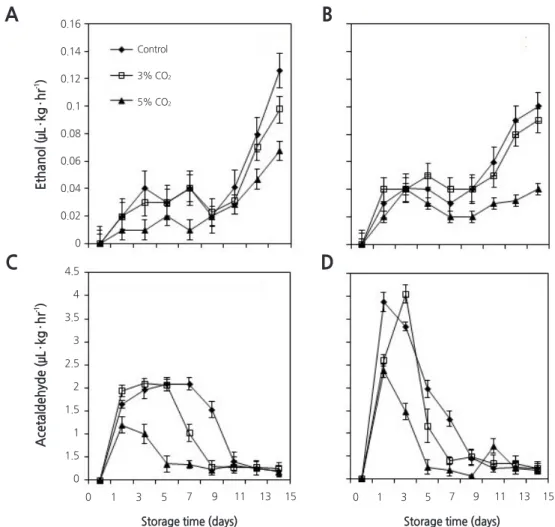
wereaffectedbythecontinuousapplicationofCO2atbothmaturity stages.
Wedetectedverylowlevelsofethanolformationincherrytomatofruitduringcoldstorageunderalltreatments regardlessoffruitmaturity(
Fig. 6AandB).
Afterday9,
ethanollevelsinfruitsinthecontrolgroupwerelowerthanthoseof fruitstreatedwith3%
and5%
CO2atthepinkmaturitystage.
Acetaldehydeformationwasaffectedbythecontinuousapplication Fig. 5. Effect of continuous application of CO2 on vitamin C and lycopene contents in ‘Unicon’ cherry tomato fruit at two maturity stages stored at 10°C for up to 15 days. A=pink and B=red maturity stages. Vertical bars represent mean +/- SE (n=3) when larger than the symbols.Lycopene content (mg · kg-1) 0 10 20 30 40 50 60
0 1 3 5 7 9 11 13 15 0 1 3 5 7 9 11 13 15
A
C
B
D
Storage time (days) Storage time (days)
Control 3% CO2
5% CO2
Vitamin C (mg · 100g-1 )
0 5 10 15 20 30 40
25 35
ofCO2(Fig. 6CandD)
.
Therateofacetaldehydeformationwaslowuntilday1foralltreatmentsatbothmaturitystages,
after whichthelevelsofthiscompoundinthecontroland3%
CO2treatmentgroupsincreaseduptoday5andthendecreasedslowly atthepinkmaturitystage.
Bycontrast,
attheredmaturitystage,
acetaldehydelevelsincontroland3%
CO2-
treatedfruits decreasedafterday3.
Irrespectiveoffruitmaturity,
acetaldehydeformationdecreasedafterafewdaysunderalltreatments.
Theseresultsindicatethatfruitripeningleadstotheincreasedproductionofvolatiles,
suchasethanolandacetaldehyde,
infruits storedforlongperiodsoftimewithoutanti-
agingpostharvesttreatment.
Indeed,
JanesandFrenkel(
1978)
andNanosetal. (
1992)
found thatfruitssuchaspearandstrawberryproduceethanolandacetaldehydewhentheyareallowedtoripen.
Therewassignificantdifference
( p <
0.
05)
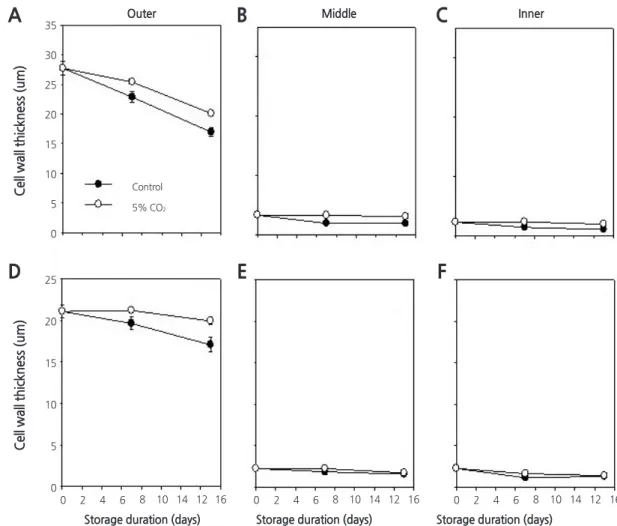
incellwallthicknessamongtreatmentsatbothmaturitystages(
Fig. 9A, B, C, D, E, andF). Cellwallthicknessdecreasedwithincreasingstorageatbothmaturitystages,
exceptforfruitstreatedwithCO2.
Atboth maturitystages,
wedetectedrapiddegradationofcellwallthickness(
outer,
middle,
andinner)
inthecontrol,
followedby3%
CO2treatment,
throughoutthestorageperiod.
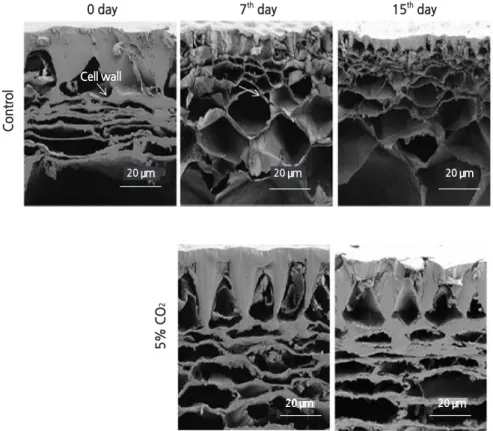
Fruitstreatedwith5%
CO2appearedmorecompactthantheotherfruitsatboth maturitystages(
Fig. 7and8).
Theseresultsareinagreementwiththefindingthat5%
CO2treatmentaffectstheactivitiesof enzymes,
suchaspolygalacturonase(
PG)
andpectinmethylesterase(
PME),
whichareresponsibleforfruitsofteningduring storage(
GoulaoandOliveira,
2008).
Fig. 6. Effect of continuous application of CO2 on ethanol and acetaldehyde production in ‘Unicon’ cherry tomato fruit at two maturity stages stored at 10°C for up to 15 days. A and C=pink and B and D=red maturity stages. Vertical bars represent mean +/- SE (n=3) when larger than the symbols.
Acetaldehyde (μL · kg · hr-1 )Ethanol (μL · kg · hr-1 )
0 1 3 5 7 9 11 13 15 0 1 3 5 7 9 11 13 15
A
C
B
D
Storage time (days) Storage time (days)
Control 3% CO2
5% CO2
0 1 1.5 2 1.5 2.5 3 4 3.5 4.5 0 0.04 0.02 0.08
0.06 0.1 0.12 0.16 0.14
Fig. 7. Effect of continuous application of CO2 on cell wall thickness in ‘Unicon’ cherry tomato fruit at the pink maturity stage.
0 day 7th day 15th day
Cell wall
20 μm 20 μm
20 μm
20 μm
20 μm
Fig. 8. Effect of continuous application of CO2 on cell wall thickness in ‘Unicon’ cherry tomato fruit at the red maturity stage.
Control 5% CO2
0 day 7th day 15th day
20 μm 20 μm
20 μm
20 μm
20 μm
Control 5% CO2
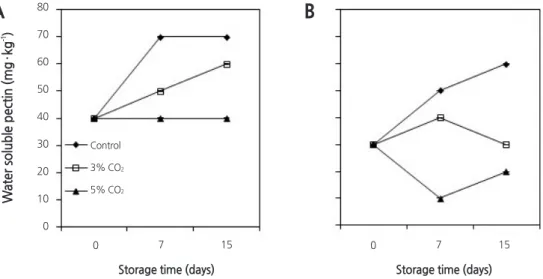
ThecontinuousapplicationofCO2significantly
(p <
0.
05)
affectedwater-
solublepectincontentsatbothmaturitystages(Fig. 10A andB). Water-
solublepectinlevelsincreasedmorerapidlyincontrolfruitthaninCO2-
treatedfruitatbothmaturitystages.
At thepinkmaturitystage,
water-
solublepectinlevelsincreasedfrom40mg·
kg-1to70mg·
kg-1andfrom40mg·
kg-1to60mg·
kg-1 incontroland3%
CO2-
treatedfruits,
respectively.
However,
5%
CO2treatmentreducedtherateofsolubilizationofpectinat bothmaturitystagescomparedwiththecontroland3%
CO2treatments.
TreatingfruitswithhighCO2levelsdelayedtheonset oftheclimactericriseandprolongedtomatofruitripening,
resultingindelayedfruitsoftening.
Thisresultisinagreementwith thefindingofWillsetal. (
1981)
thatelevatedCO2levelsreducethebreakdownofpecticsubstancesresponsibleformaintaining afirmtextureinfruitforalongperiodoftime.
Basedontheoverallresults
,
weconcludedthat‘
Unicon’
cherrytomatofruitcanbestoredfor15daysat10°
Cundercontinuous applicationof5
%
CO2,
comparedto3%
CO2andcontrolfruits.
Toobtainthebestsurfacecolorquality,
alongwithanacceptable textureandothertomatoqualityparameters,
werecommendthecontinuousapplicationof5
%
CO2asapostharvesttreatment duringstorage..
Fig. 9. Effect of continuous application of CO2 on cell wall thickness in the outer (A, D), middle (B, E), and inner (C, F) cortex in
‘Unicon’ cherry tomato fruit at the pink (A, B, C) and red (D, E, F) maturity stages stored at 10°C for up to 15 days. Vertical bars represent mean +/- SE (n=3) when larger than the symbols.
Cell wall thickness (um)Cell wall thickness (um)
0 2 4 6 8 10 14 12 16 0 2 4 6 8 10 14 12 16 0 2 4 6 8 10 14 12 16 Storage duration (days) Storage duration (days) Storage duration (days)
Outer Middle Inner
Control 5% CO2
0 10
5 20
15 25 30 35
0 10
5 20
15 25
A
D
C
F B
E
Literature Cited
Aharoni N, Reuveni A, Dvir O (1989) Modified atmospheres in film packages delays senescence and decay of green vegetables and herbs. Acta Hortic 258:255-262
Beyer JR, Elmo M (1979) Ethylene metabolism during leaf abscission in cotton. Plant Physiol 64: 971-974. No. 0032-0889
Biale JB (1960) Respiration of Fruits. In Handbook Der Plantephysiologie. Encyclopedia of Plant Physiology (J. Wolf (ed)), springer- Verleg. Berlin, pp 536-592
Blumankrantz N, Asboe-Hanson G (1973) New method for quantitative determination of uronic acid. Anal Biochem 54:484-489.
doi:10.1016/0003-2697(73)90377-1
Bramlage W, Bareford PH, Blanpied GD, Dewey DH, Taylor S, Porrtrm SW, Lougheed EC, Smith WH, Mcnicholas FS (1977) Carbon dioxide treatments for "Mc Intosh" apples before control atmosphere storage. J Am Soc Hortic Sci 10:658-662
Buescher RW (1979) Influence of carbon dioxide on postharvest ripening and deterioration of tomatoes. J Am Soc Hortic Sci 104:545- 547
Burg SP, Burg EA (1967) Molecular requirements for the biological activity of ethylene, Plant Physiol 42:144-152. Doi:10.1104/
pp.42.1.144
Burg SP, Burg EA (1969) Interactions of ethylene, oxygen, and carbon dioxide in the control of fruit ripening. Qual Plant Mater Veg 3:185-200. doi:10.1007/BF01101152
Couvey M, Olsen K (1977) Commercial use of a pre storage carbon dioxide treatment to retain quality in golden delicious apples in proceeding of the second national controlled atmosphere research conference. At Michigan State University. USA. 5-7 April Dumas Y, Dadomo M, Lucca GD, Grolier P (2003) Effects of environmental factors and agricultural techniques on antioxidant content
of tomatoes. J Sci Food Agric 83:369-382. doi:10.1002/jsfa.1370
Egea I, Bian W, Barsan C, Jaunean A, Peach JC, Latche A, Li Z, Chervin C (2011) Chloroplast to chromoplast transition in tomato fruits:
spectral confocal microscopy analysis of carotenoids and chlorophylls in isolated plastids and time-lapse recording on intact live tissue. Ann Bot 108(2):291-297. doi:10:1093/aob/mcr140
Farber JM (1991) Microbiological aspects of modified atmosphere packaging technology review. J Food Prot 54(1):58-70.
doi:10.4315/0362-028X-54.1.58
Goulao LF, Oliveira CM (2008) Cell wall modifications during fruit ripening: when a fruit is not the fruit. Trends Food Sci Technol 19:4- 25. doi:10.1016/j.tifs.2007.07.002
Hirofumi T, Tsuchida H, Mizuno M, Matsui N (1998) Influence of short term treatment with high CO2 and N2 on Ethylene biosynthesis in tomato fruit. Hort Science 33(1):103-104
Hoeberichts FA, Van Der Plas LHW, Woltering EJ (2002) Ethylene perception is required for the expression of tomato ripening-related genes and associated physiological changes even at advanced stages of ripening. Postharvest Biol Technol 26:125-133. doi:10.10 16/S0925-5214(02)00012-1
Hsu YM, Lai CH, Chang CY, Fan CT, Chen CT (2008) Characterizing the lipid lowering effects and antioxidant mechanisms of tomato paste. Biosci Biotech Bioch. 72:677-685. doi:10.1271/bbb.70402
Fig. 10. Effect of continuous application of CO2 on water soluble pectin in ‘Unicon’ cherry tomato fruit at two maturity stages stored at 10°C for up to 15 days. A=pink and B=red maturity stages. Vertical bars represent mean +/- SE (n=3) when larger than the symbols.
Water soluble pectin (mg · kg-1)
0 7 15 0 7 15
A B
Storage time (days) Storage time (days)
Control 3% CO2
5% CO2
0 20 10 40 30 50 60 80
70
Islam MS, Matsui T, Yoshida Y (1996) Effect of carbon dioxide enrichment on Physiochemical and enzymatic changes in tomato fruits at various stages of maturity. Sci Hortic 65(2-3):137-149. doi:10.1016/0304-4238(95)00867-5
Islam MZ, Mele MK, Baek JP, Kang HM (2016) Cherry tomato qualities affected by foliar spraying with boron and calcium. Hortic Environ Biotechnol 57:46-52. doi: 10.1007/s13580-016-0097-6
Janes HW, Frenkel C (1978) Promotion of softening processes in pear by acetaldehyde, independent of ethylene action. J Am Soc Hortic Sci 103:397-400
Jimenez ME, Cantwell M (1996) Studies on the cherry tomato storage and quality evaluations. Tulare county, vegetable research reports, The University of California Cooperative Extension, Tulare County
Kader AA (1986) Biochemical and physiological basis for effects of controlled and modified atmospheres on fruits and vegetables.
Food Technol 40(5):99-104
Kashmire RF, Kader AA (1978) Handling tomatoes at wholesale and retail: A guide for better quality and greater profits. University of California Davis, California. Outlook 5(3): 5-12
Kubo Y, Inaba A, Nakamura R (1985) Effects of high CO2 on respiration in various horticultural crops. J. Japan J Soc Hortic Sci 58:731- 736. doi:10.2503/jjshs.58.731
Kubo Y, Inaba A, Nakamura R (1990) Respiration and C2H4 production in various harvested crops held in CO2-enriched atmospheres. J Amer Soc Hortic Sci 115(6):975-978
Lau D, Donald RAM, Looney NE (1977) Response of British Colombia-grown Golden Delicious apples to a pre-storage high CO2
treatment. In proceeding of the second national controlled atmosphere research conference. At Michigan State University.
5-7April. USA, pp 175-181
Levy J, Sharoni Y (2004) The functions of tomato lycopene and its role in human health. The journal of the American botanical council.
Herbal Gram 62:49-56
Looney NE (1975) Control of ripening in "Mc Intosh" apples II. Effect on growth regulators and CO2 on fruit ripening, storage behavior and shelf life. J Amer Soc Hortic Sci 100:332-336
Marcellin P, Chaves AR (1983) Effects of intermittent high CO2 treatment on storage life of avocado fruits in relation to respiration and ethylene production. Acta Hortic 138:17
Maul F, Sargent SA, Sims CA, Baldwin EA, Balaban MO, Huber DJ (2000) Tomato flavor and aroma quality as affected by storage temperature. J Food Sci 65:1228-1237. doi:10.1111/j.1365-2621.tb10270.x
Mitcham EJ, Zhou S, Kader AA (1997) Potential of CA for postharvest insect control in fresh horticultural perishables: An update. Proc.
Seventh Intl. Controlled Atmosphere Res Conf 1:78-90
Morris LL, Kader AA (1977) Physiological disorders of certain vegetables in relation to modified atmospheres. In proceeding of the second national controlled atmosphere Research conference. At Michigan State University. USA
Nanos GD, Romani RJ, Kader AA (1992) Metabolic and other responses of ‘Bartlett’ pear fruit and suspension cultured ‘passe crassane’
pear fruit cells held in 0.25% O2. J Amer Soc Hortic Sci 177:934-940
Park KW, Kang HM, Kim CH (2000) Comparison of storability on film sources and storage temperature for fresh Japanese mint in MA storage. J Bio-Environ Cont 9:40-46
Porrit SW, Meheriuk MN (1977) Effects of CO2 Treatment on storage behavior of apples and pears. In proceeding of the second national controlled atmosphere research conference. At Michigan State University. USA. 5-7 April
Ranson SL, Walker DA, Clarke ID (1960) Effects of CO2 on mitochondrial enzymes from Ricinus. Biochem J 76(2):216-221.
doi:10.1042/bj0760216
Rao AV, Wassen Z, Agarwall S (1998) Lycopene content of tomatoes and tomato products and their contribution to dietary lycopene.
Food Res Int 31(10):737-741. doi: 10.1016/S0963-9969(99)00053-8
Riquelme F, Pretel MT, Martinez G, Serrano M, Amoros A, Romajoro F (1994) Packaging of fruits and vegetables: recent results in food packaging and preservation. (M. Mathlouithi (Eds.)), Blackie Academic and Professional. London, pp 141-158. doi:10.1007/978- 1-4615-2173-0_8
Roberts PK, Sargent SA, Fox AJ (2002) Effect of storage temperature on ripening and postharvest quality of grape and mini-pear tomatoes. Proc Fla State Hortic Soc 115:80-84. No: N-02285
Ryall AL, Pentez WT (1982) Handling, transportation and storage of fruits and vegetables. Second Edition. Avi Publishing Company Inc, pp 461-518
Shipway MR, Bramlage WJ (1973) Effects of carbon dioxide on activity of apple mitochondria. Plant Physiol 51:1095-1098
Sozzi GO, Trinchero GD, Fraschina AA (1999) Controlled atmosphere storage of tomato fruit: low oxygen or elevated carbon dioxide levels alter galactosidase activity and inhibit exogenous ethylene action. J Sci Food Agric 79:1065-1070
Uddin MS, Hawlader MNA, Ding L, Mujumdar AS (2002) Degradation of ascorbic acid in guava during storage. J Food Eng 51:21-26.
doi:10.1016/j.proche.2014.05.008
Wang CY, Mellenthin WM (1975) Effect of short term high CO2 treatment on storage of "d'anjou" pear. J Amer Soc Hortic Sci 100:492-495
Wills RBH, Mc Glasson WB, Graham D, Lee TH, Hall EG (1981) Post harvest: An introduction to the physiology and handling of fruit and vegetables. AVI publishing, Westport, pp 163