© Copyright
Keimyung University School of Medicine 2015 계명의대학술지 제34권 2호 141
Keimyung Med J
Vol. 34, No. 2, December, 2015
Department of Thoracic and Cardiovascular Surgery, Kyungpook National University School of Medicine, Kyungpook National University Hospital, Daegu, Korea
Thoracic outlet syndrome (TOS) is a condition related to compression of neurovascular structures within the thoracic outlet. Several surgical approaches are used to treat TOS, and the selection of the approach depends on the type of TOS. Our patient was diagnosed with vascular TOS and resection of the first rib was performed using the infraclavicular approach. The patient did not experience any perioperative complications, and there was no sign of recurrence at the 1-year follow-up. The infraclavicular approach is a suitable method for first rib resection in patients with vascular TOS.
Key Words: First rib resection, Surgery, Thoracic outlet syndrome
Introduction
Thoracic outlet syndrome (TOS) consists of compression of subclavian vessels and brachial plexus at the superior aperture of the chest. They have been known as the etiologies of compression such as scalenus anticus, costoclavicular, hyperabduction, cervical rib, or first rib syndromes. The first rib seems to be a common denominator against which most compressive factors operate. Several approaches are available for the first rib resection including transaxillary, supraclavicular, paraclavicular and infraclavicular approaches [1,2].
The infraclavicular approach is often considered optimal in the treatment of vascular TOS, although the transaxillary approach is traditionally considered as the most common method for first rib resection [3]. We report a case of vascular TOS treated with the first rib resection through the infraclavicular approach in a 26-year-old woman.
Received: September 8, 2015 Revised: October 6, 2015 Accepted: October 12, 2015
Corresponding Author: Deok Heon Lee, M.D., Department of Thoracic and Cardiovascular Surgery, Kyungpook National University School of Medicine, 130 Dongdeok-ro, Jung-gu, Daegu 41944, Korea Tel: +82-53-200-6589
E-mail: [email protected]
• The authors report no conflict of interest in this work.
Jong Uk Lee, M.D., Deok Heon Lee, M.D.
First Rib Resection Using Infraclavicular Approach for Treatment of
Vascular Thoracic Outlet Syndrome
142
계명의대학술지 제34권 2호 2015
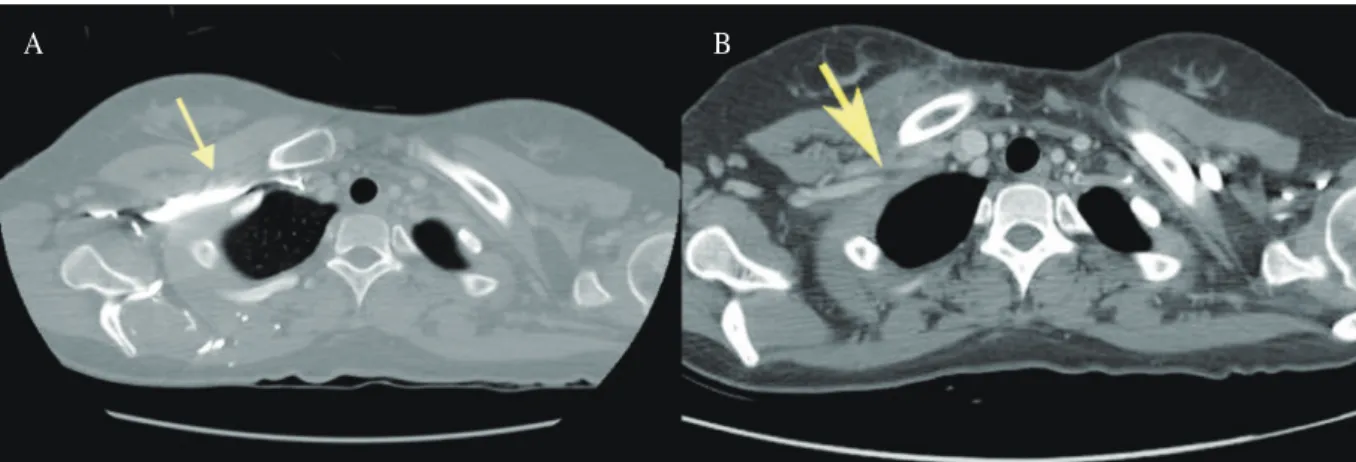
Fig. 1. (A) Preoperative chest computed tomography (CT) scan reveals compression of the right subclavian artery and vein between the clavicle and first rib (arrow). (B) Post operative chest CT scan reveals decompression of the right subclavian artery and vein between the clavicle and second rib in one year after the first rib resection.
A B
Case Report
A 26-year-old woman visited the hospital with intermittent pain and tingling sensation in the right shoulder, arm, and hand for 6 months, with no history of trauma or vigorous exercise. The symptoms were more frequent and aggravated for 2 months prior to the visit. The patient presented with an aching discomfort accompanied by a feeling of heaviness, swelling, and blue discoloration of the hand. Upon physical examination, the right radial artery pulse strength was found to be markedly decreased on the hyperabduction test. There was no evidence of neurogenic TOS in the electrodiagnostic testing such as electromyogram and nerve conduction velocity. A chest computed tomography scan revealed extrinsic compression of the right subclavian artery and vein between the clavicle and first rib, accompanied by prominent small collateral vessels (Fig. 1A). Doppler ultrasonography was performed to exclude the possibility of Paget- Schroetter syndrome. There was no evidence of thrombosis in the right subclavian vein and the severe occlusion of right subclavian artery was
found in hyperabduction of the right shoulder. We diagnosed the patient with vascular TOS and recommended physiotherapy as first-line treatment for relieving symptoms as well as anticoagulants to prevent thrombus formation.
The symptoms remained unchanged in spite of physiotherapy for 2 months. Finally, we decided to undergo surgical treatment for relief from symptoms. The surgery was performed using the infraclavicular approach. A 7 cm incision was made directly under the right clavicle. The subclavius muscle and costoclavi-cular ligament were resected, and then the first rib and costochondral junction were split after identifying the subclavian vein. The insertion of anterior scalene muscle upon the first rib was divided. The subclavian artery and brachial plexus were carefully exposed. Finally, the first rib was resected from the costo-chondral junction to point under subclavian artery. The subclavian artery and vein decompression was accomplished by performing removal of focal fibrous tissue around the vein and resecting the two-thirds of the anterior portion of the first rib (Fig. 2).
In the immediate postoperative period, the
143
First Rib Resection for Treatment of Vascular Thoracic Outlet Syndrome
patient reported improvement in her symptoms. At the 1-month and 1-year follow-ups, the patient did not have any symptoms and reported satisfaction with the treatment; no other abnormalities were found on physical examination, which included the hyperabduction test. In addition, the patient did not show any tendency for recurrence over a 1-year period. One year follow-up chest computed tomography scan revealed decompression of the right subclavian artery and vein between the clavicle and the second rib (Fig. 1B).
Discussion
TOS is a broad term referring to an array of s i g n s a n d s y m p t o m s t h a t a r e c a u s e d b y compression of neurovascular structures within the constricted space of the thoracic outlet, the area just above the first rib and behind the clavicle. The aim of TOS treatment is decompression of the costoclavicular junction. For successful prevention and treatment of pain due to TOS, both non- operative and operative approaches are available.
Non-operative management typically involves strategies to reduce and redistribute pressure and
traction with physical therapy. Surgical procedures are divided into 3 main groups: (1) soft-tissue procedures (scaleneus release and neurolysis); (2) cervical rib excision; and (3) excision of the first thoracic rib. Symptoms related to TOS are clinically challenging and depend on the specific type of TOS to a great extent. The specific type of TOS is c o r r e c t l y d i a g n o s e d f o r d e t e r m i n i n g t h e appropriate surgical approach [3,4].
There are several surgical approaches for first rib resection. Traditionally, transaxillary first rib resection is the most common method. A major advantage of this method is that it offers an excellent exposure of the anterior portion of the first rib, which is the area of pathology, and also excellent cosmesis. It is technically challenging, however, and complications, which can include hemopneumothorax and long thoracic nerve injury, are not trivial. Other modified methods have been attempted. Various combinations of supraclavicular, paraclavicular, and infraclavicular first rib resection, sternal disarticulation with first rib resection, medial claviculectomy, and thoracoscopic first rib resection can be performed to treat TOS [5,6].
Because of anatomical differences, the subclavian vein re-enters the chest more anteriorly, Fig. 2. (A) The first rib was resected using infraclavicular approach (arrow: costochondral junction, arrow head:
distal portion of the first rib). (B) After resection of the anterior portion of the first rib, the costoclavicular junction space is sufficient for decompression of the subclavian vein. (C) Two-thirds of the anterior portion of the first rib was resected.
A B C
144
계명의대학술지 제34권 2호 2015
passing adjacent to the junction of the clavicle and first rib, which is further reinforced by the subclavius muscle and tendon. The infraclavicular approach is considered optimal in the treatment of vascular TOS. This approach has several advantages as follows: (1) direct access to the vein within the costoclavicular space, (2) focused approach for minimizing exposure of brachial plexus and subclavian artery, (3) preservation of supraclavicular and axillary venous collateral pathways, and (4) ability to access the central veins u s i n g t r a n s m a n u b r i a l e x t e n s i o n f o r v e i n reconstruction [7].
Resection of the first rib can be performed using various surgical approaches, and each of these methods has advantages and disadvantages.
The type of TOS and anatomical characteristics of the patient are considered for selection of the surgical method. In our case, the infraclavicular approach was chosen for decompressing the vein and artery at the costoclavicular junction because the patient was diagnosed with vascular TOS and had prominent collateral vessels around the axillary vein. The infraclavicular approach, which has many advantages, is a useful option for treating vascular TOS, and here, we report our good results.
References
1. Shields TW, Locicero Iii J, Reed CE. General Thoracic Surgery. Philadelphia: Wolters Kluwer/Lippincott Williams Wilkins; 2009.
2. Urschel HC, Kourlis H. Thoracic outlet syndrome: a 50-year experience at Baylor University Medical Center. Proc (Bayl Univ Med Cent) 2007;20:125-35.
3. Povlsen B, Belzberg A, Hansson T, Dorsi M. Treatment for thoracic outlet syndrome. Cochrane Database Syst Rev 2010:CD007218.
4. Urschel HC, Jr., Patel AN. Surgery remains the most effective treatment for Paget-Schroetter syndrome: 50 years’ experience. Ann Thorac Surg 2008;86:254-60;
discussion 260.
5. Illig KA, Doyle AJ. A comprehensive review of Paget- Schroetter syndrome. J Vasc Surg 2010;51:1538-47.
6. Kim DJ, Kang CH, Kim YT, Kim JH. Video-assisted first rib resection. Korean J Thorac Cardiovasc Surg 2007;40:463-6.
7. Molina JE. A new surgical approach to the innominate and subclavian vein. J Vasc Surg 1998;27:576-81.