http://dx.doi.org/10.11625/KJOA.2016.24.4.735 ISSN 2287-819X (Online)
Analysis of Antibacterial, Antioxidant, and In Vitro Methane Mitigation Activities of Fermented
Scutellaria baicalensis Georgi Extract *
1)
Marbun, Tabita Dameria
**․Song, Jaeyong
**․Lee, Kihwan
**․Kim, Su Yeon
**․ Kang, Juhui
**․Lee, Sang Moo
**․Choi, Young Min
**․Cho, Sangbuem
***․
Bae, Guiseck
****․Chang, Moon Baek
****․Kim, Eun Joong
*****발효 황금 뿌리 추출물의 항균, 항산화 효과 및 메탄가스 저감 효과
In Vitro
Tabita Dameria Marbun․송재용․이기환․김수연․강주희․
이상무․최영민․조상범․배귀석․장문백․김은중
This study was conducted to investigate the antibacterial, antioxidant, and in vitro greenhouse gas mitigation activities of fermented Scutellaria baicalensis Georgi extract. Seven starter cultures were used, comprising four of lactic acid bacteria and three of Saccharomyces cerevisiae. Ten grams of S. baicalensis Georgi powder was diluted in 90 mL autoclaved MRS broth. Each seed culture was inoculated with 3-10% (v/v) S. baicalensis Georgi MRS broth and incubated at 30℃ for 48 h. Among the starter cultures used, only Lactobacillus plantarum EJ43 could withstand the fermentation conditions. This fermentation broth was dried and extracted with ethanol to assess its antibacterial, antioxidant, and in vitro methane mitigation activities. The extract of S. baicalensis Georgi fermented by L.
*****
This work was supported by Korea Institute of Planning and Evaluation for Technology in Food, Agriculture, Forestry and Fisheries (IPET) through Agri-Bio Industry Technology Development Program, funded by Ministry of Agriculture, Food and Rural Affairs (MAFRA) (312030-4). The authors also acknowledge microorganisms provided by MK-Bioscience Co. Ltd (Suwon, South Korea).
*****
Department of Animal Science, Kyungpook National University, Sangju 37224, South Korea
*****
CALSNBT Co. Ltd., 501, Building C 131, Gasan digital 1-ro, Guemcheon-gu, Seoul 08506, South Korea
*****Department of Animal Science and Technology, Chung-Ang University, Anseong, 17546, South Korea
*****
Corresponding author, Department of Animal Science, Kyungpook National University, Sangju 37224, South Korea ([email protected])
plantarum EJ43 (SBLp) showed higher antibacterial activity (bigger clear zone) compared to the unfermented S. baicalensis Georgi extract (SB0). SBLp also presented 1.2 folds higher antioxidant activity than SB0. During in vitro rumen fermentation, SBLp showed reduction in methane production compared to SB0 or the control. In conclusion, fermentation by L. plantarum EJ43 may enhance antibacterial and antioxidant activities of S. baicalensis Georgi and decrease enteric methane production.
Key words : antioxidant activity, fermentation, Lactobacillus plantarum, methane, Scutellaria baicalensis Georgi
Ⅰ. Introduction
Antibiotics have been used in the livestock industry not only to treat various diseases but also to improve animal productivity (Landers et al., 2012). However, overuse of antibiotics has caused numerous problems, particularly for public health, such as microbial resistance in animal products and outbreak of multidrug resistant pathogenic microorganisms. Because of these problems, the use of antibiotics has been banned, except in the treatment of diseases (Mathew et al., 2007). Numerous studies have been conducted to develop natural products that may substitute the use of antibiotics (Cowan, 1999).
Plant extract has been considered as a potential natural antibiotic alternative (Cowan, 1999).
Scutellaria baicalensis Georgi is one of the medicinal herbs used in ancient and modern China and other Asian countries (Gao et al., 1999). It has flavonoid compounds, including baicalein, baicalin, oroxylin A, wogonin, and norwogonin, which have broad biological activities. Several reports have described their strong antibacterial, antiviral, antifungal, anti-inflammatory, and notably antioxidant activities (Gao et al., 2001; Gao et al., 1999; Guo et al., 2011).
Fermentation is a biological process driven by microorganisms, and it may alter the biological, chemical, and physical characteristics of a plant. Various factors determine the effectiveness of the fermentation process, and starter culture strain is one of them. The effectiveness of the factor can vary depending on the purpose of fermentation. The present study analyzed the antibacterial and antioxidant activities of S. baicalensis Georgi and reduction in enteric methane production in the rumen.
Methane is produced during rumen fermentation, because it can consume the hydrogen
produced during degradation of feed and prevent its accumulation, to maintain the pH of the
rumen microorganism niche (Morgavi et al., 2010). However, methane production is also
regarded as energy loss in the context of whole body metabolic status (Johnson and Johnson, 1995). As rumen methane emission was identified as one of the factors contributing to global warming by enhancing the greenhouse effect, many studies have been conducted to identify, quantify, and inhibit methanogens and methanogenesis through methane mitigation schemes (Martin et al., 2010). The present study investigated the effect of different starter cultures on the effectiveness of S. baicalensis Georgi fermentation, to select the most appropriate starter culture, and evaluated the improvement in biological activities of S. baicalensis Georgi extract after fermentation.
Ⅱ. Materials and Methods
1. Microorganisms, fermentation, and extraction conditions
A total of seven starter strains (four lactic acid bacteria and three Saccharomyces cerevisiae), namely Lactobacillus brevis SB35, L. brevis SB36, Lactobacillus plantarum EJ40, and L.
plantarum EJ43 and Saccharomyces cerevisiae EJ44, EJ47, and EJ50, were used for the fermentation of S. baicalensis root material. These microorganisms were chosen because they are frequently in demand in the animal industry for various purposes, such as silage preparation and/or in feed additives as probiotics. All strains were kindly donated by the MK-Bioscience Co.
Ltd (Suwon, South Korea). Prior to the main experiments, all microorganisms were maintained in MRS broth (Difco, Maryland, USA) and incubated at 30℃ with agitation (150 rpm) for 24 h.
S. baicalensis was purchased from a medicinal plant market (Kyungdong market) in Seoul, South Korea and was ground to 2 mm size by a cutter miller (HR2860, Phillips, South Korea).
Ten grams of ground S. baicalensis was added to 90 mL MRS broth in a 250 mL Erlenmeyer flask and autoclaved at 121℃ for 15 min. After cooling to room temperature, the mixture was inoculated with 3% (v/v) seed cultures and incubated at 30℃ for 48 h. Cell growth was measured by viable cell count at the end of incubation. Culture broth was dried at 60℃ for about 24 h. The dried culture powder was ground using a mortar and pestle, and 20 mL of 99.9% ethanol (Samchun Chemical, Pyeongtaek, South Korea) was added to 2 g of the powder.
Extraction was performed at 30℃ and 150 rpm agitation for 24 h. The extract was filtered
through a filter paper (Whatman No. 1, Whatman International Ltd., Maidstone, UK), and the
solvent in the filtrate was evaporated using a rotary evaporator (N-110, EYELA, Japan). The
concentrated extract was redissolved in 2 mL ethanol and stored at -20℃.
2. Viable cell count
To evaluate the suitability of the starter culture strains for the fermentation of S. baicalensis, the cell growth in starter cultures was estimated by viable cell count analysis. After 48 h incubation, the culture broth was serially diluted with 0.85% (w/v) NaCl solution (Daejung Chemical & Metal Co. Ltd., Siheung, South Korea), and the diluted broths were spread on MRS plate medium. The number of colonies that appeared on the plate after 24 h of incubation at 3 0℃ was counted. The cell growth was represented as log10 colony forming units (CFU)/mL, by logarithmic transformation.
3. Antibacterial and antioxidant activity tests
Antibacterial activity of the extract was determined using the agar well diffusion method. For pathogenic bacteria, Staphylococcus aureus (wild type), Listeria monocytogenes KACC0550, Salmonella gallinarum ATCC9184, and Mannheimia haemolytica (wild type) were used, and they were grown in Luria-Bertani (LB) broth (Difco, Maryland, USA) at 37℃ in a shaking incubator for 24 h. A culture broth aliquot (0.1 mL) was added to sterilized 0.8% agar (Difco, Maryland, USA) solution, which was maintained at 50℃ to prevent solidification, and the suspension was immediately poured onto LB plate and cooled. An extract aliquot (30 µL) was dropped onto a sterilized paper disk (8 mm diameter, Advanctec, Japan), which was placed on the LB plate after ethanol was allowed to evaporate from it for 30 min. The assay plate was incubated at 37℃, and the diameter of the clear zone around the disk was measured.
Antioxidant activity was examined using DPPH (2,2-di (4-tert-octylphenyl)-1-picrylhydrazyl, Sigma, USA) to measure the free radical scavenging activity. Diluted extract (0.5 mL) was mixed with 2.0 mL of DPPH solution (0.2 M in ethyl alcohol) and incubated at room temperature for 15 min. Following this, 2.5 mL distilled water was added to the mixture, and its optical density was measured at 525 nm using a spectrophotometer (Optizen, South Korea).
Antioxidant activity was expressed as EC50, the concentration of extract showing 50% free radical scavenging activity, where lower EC50 values refer to better antioxidant activity.
4. Thin layer chromatography (TLC)-DPPH screening assay
A compound in the extract, relevant to antioxidant activity, was further monitored using TLC,
based on the method by Masoko and Eloff (2007). The TLC plate used was aluminum-back
TLC silica gel F254 plate (Fisher Scientific, South Korea). It was developed under three elution systems: ethyl acetate/methanol/water (EMW, 40:5:4.5, for polar/neutral), chloroform/ethyl acetate/
formic acid (CEF, 5:4:1, for intermediate polarity/acidic), and benzene/ethanol/ammonium hy- droxide (BEA, 90:10:1, for non-polar/basic). After development, the plate was dried under a fume hood, and the chromatogram was sprayed with 0.2% DPPH solution (w/v, in methanol).
5. In vitro fermentation characteristics
In vitro rumen fermentation was conducted according to the method by Johnson (1966), with three experimental treatments: 1) control (CON) with no extract added, 2) 10 µL supplement- ation with the extract of unfermented S. baicalensis root (SB0), and 3) 10 µL supplementation with the extract of S. baicalensis root fermented with L. plantarum EJ43 (SBLp). Ground orchard grass hay (0.5 g) was placed in a culture bottle and 50 mL of rumen inoculum, mixture of McDougal’s buffer (1948) and filtered rumen fluid (1:9), was added to it. The rumen contents were obtained from a local slaughterhouse, immediately transferred to our laboratory in a thermal flask, and filtered through eight layers of muslin in a CO
2enriched environment. After 10 µL S. baicalensis Georgi extract was added to the mixture, the bottle was capped and incubated at 39℃, in triplicates. Gas production was measured at 3, 6, 9, 12, and 24 h using a glass syringe (Sercrim Labtech Co. Ltd., South Korea). The produced gas was collected in an aluminum bag to determine the concentration of methane and carbon dioxide.
At the end of the incubation, all bottles were opened and stored in an ice-filled container to stop microbial fermentation. Supernatant was collected, by transferring the bottle contents to a nylon bag (R510, Ankom Technology, USA), for pH measurement and then centrifuged (5 min at 10,000 rpm, 1730MR, Labogene, South Korea) and stored at -20℃ for further analysis. Dry matter digestibility (DMD) was measured at 0 and 24 h, using a nylon bag to transfer any residues from the incubation bottle, which was washed with tap water until the water ran clear.
Volatile fatty acid (VFA) concentration was determined according to the method by Erwin et al.
(1961). A 1 mL aliquot of sample pre-treated with 0.2 mL of 25% metaphosphoric acid (Wako, Japan) was injected into the gas chromatograph (450-GC, Bruker Inc., Germany). VFA standard solution (Sigma Aldrich, USA) and BR-Wax fame (BR87503, Germany) column were used.
Injector and detector (flame ionized detector) were aligned to 250℃, whereas oven temperature
was 100℃. Ammonia-N was analyzed according to the method by Chaney and Marbach (1962).
6. Statistical analysis
The results of in vitro fermentation study were analyzed using the general linear model of SPSS 19 software (IBM Corporation), with the effect of supplementation as the main effect in the model. Further differences between means were subjected to Duncan’s multiple range test, and significant effect of treatment were declared at P < 0.05, with tendencies at 0.05 < P < 0.10.
Ⅲ. Results and Discussion
1. Cell viability
The bacterial growth in the MRS medium containing S. baicalensis Georgi (10%, w/v) was screened. Viability was only observed in S. baicalensis fermented with L. plantarum EJ43, with cell counts being approximately 107 CFU/mL. Therefore, in this experiment, it was concluded that L. plantarum EJ43 could ferment S. baicalensis Georgi root, and further extraction was performed only with this culture.
2. Antibacterial activity
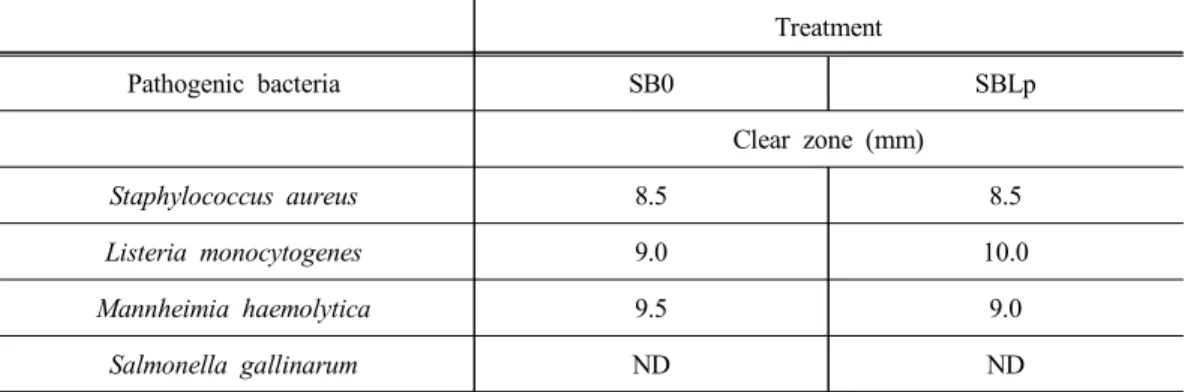
The result of antibacterial assay is presented in Table 1. The extract of S. baicalensis fermented with L. plantarum EJ43 was examined, because only this treatment allowed for cell viability. This extract showed antibacterial activity against S. aureus, L. monocytogenes, and M.
haemolytica, but not against S. gallinarum. Mukherjee and Ramesh (2015) reported that L.
plantarum strongly inhibits S. aureus through inhibitory substances, such as bacteriocins. S.
baicalensis was also reported to possess antibacterial activity against S. aureus. In this study, it is uncertain whether the antibacterial activity of S. baicalensis was improved by fermentation with L. plantarum EJ43, because the activities of control and treatments were not different.
The highest antibacterial activity was observed against L. monocytogenes, a pathogenic
bacterium related to food contamination. Grazing animals are usually infected by ingesting this
microorganism from contaminated vegetation and soil. Listeria contamination in silage resulted in
latent infection, reported in some herds or flocks, and only a few animals showed clinical
manifestation (Nightingale et al., 2004). In ruminants, listeriosis causes septicemia, abortion, and
latent infection. Listeria may be shed for more than 1 month, via the vagina and milk. Recently,
lactic acid producing bacteria have been used as potential biological agents against L.
monocytogenes in contaminated food. This anti-Listeria action of the bacteria has been ascribed to lactic acid and bacteriocin production (Wilson et al., 2005). Bacteriocins are bacterial proteinaceous toxins that display bactericidal activity against similar or closely related bacteria.
The anti-Listeria bacteriocin works by dissipating both proton motive force and membrane potential (Bruno and Montville, 1993).
The antioxidant activity is shown in Fig. 1. The extract of S. baicalensis fermented by L.
plantarum EJ43 (SBLp) showed 1.2 folds lower EC50 than the control (SB0).
Fig. 1. Antioxidant activity of ethanol extracts of Scutellaria baicalensis (SB0) and S.
baicalensis fermented by Lactobacillus plantarum EJ43 (SBLp).
Table 1. Antibacterial activity of the extracts of Scutellaria baicalensis root, with or without fermentation with Lactobacillus plantarum EJ43
Treatment
Pathogenic bacteria SB0 SBLp
Clear zone (mm)
Staphylococcus aureus 8.5 8.5
Listeria monocytogenes 9.0 10.0
Mannheimia haemolytica 9.5 9.0
Salmonella gallinarum ND ND
ND, Not detected; SB0, supplemented with the extract of Scutellaria baicalensis root; SBLp, supplemented with the extract of S. baicalensis root fermented by Lactobacillus plantarum EJ43.
3. TLC-DPPH assay
In this study, three different elution systems were applied to separate a compound in the extract relevant to antioxidant activity. To identify the constituent related to the antioxidant activity, TLC plate was stained with DPPH solution. No new spots were detected in EMW system (data not shown), delayed migration of spot was observed in CEF elution system (Fig.
2A), whereas distinct new spots were detected in BEA elution system (Fig. 2B). As a result, it was found that TLC-DPPH with CEF and BEA could be used for the detection of newly synthesized and/or newly altered compounds, and fermentation with L. plantarum EJ43 could change unknown compounds in S. baicalensis that may have potential to antioxidant activity.
(A) (B)
Fig. 2. Antioxidant component developed on a thin layer chromatography plate using elution solvent composed of chloroform/ethyl acetate/formic acid (5:4:1) [A] and ben- zene/ethanol/ammonium hydroxide (90:10:1) [B]. In [A] and [B], the developed chromatogram was treated with 0.2% 2,2-di (4-tert-octylphenyl)-1-picrylhydrazyl solution, and bright spots represent the components that have antioxidant activity.
SB0 indicates Scutellaria baicalensis extract, whereas SBLp indicates the extract of S. baicalensis fermented by Lactobacillus plantarum EJ43.
4. In vitro fermentation parameters
The effects of S. baicalensis extract on pH, ammonia-N concentration, and DMD in vitro are
presented in Table 2. The ruminal pH was close to neutral at the end of 24 h incubation; hence,
no detrimental effect on rumen microorganisms is expected in vitro. The tests for ammonia-N
concentration showed somewhat different results. S. baicalensis fermented by L. plantarum EJ43 extract showed the highest production of ammonia-N among all the treatments, with a value of 26.23 mg/100 mL (P < 0.05). DMD showed significant difference among treatments (P < 0.05).
Total VFA production numerically decreased when the extract of S. baicalensis was supple- mented, although there was no statistical difference among the treatments (Table 2). This result did not match with that of DMD, which was highest for SB0. The reason for such differences remains unclear.
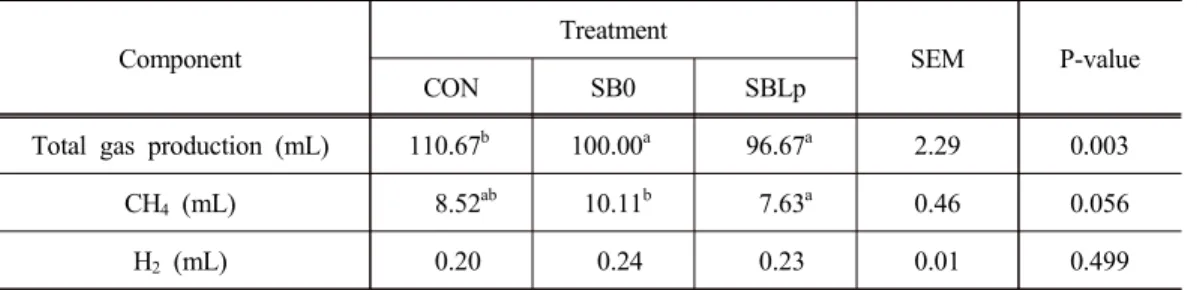
The total gas production by SB0 and SBLp was lower than that by CON (Table 3). However, SBLp also lowered methane production, indicating that the extract of this particular plant after fermentation may be used for methane control in the diet of ruminants, although further studies are warranted.
Table 2. Effect of fermented Scutellaria baicalensis root extract on rumen fermentation characteristics in vitro
Characteristic
Treatment
SEM P-value
CON SB0 SBLp
pH 6.77 6.75 6.78 0.01 0.554
Ammonia-N (mg/100 mL) 22.48b 12.67a 26.23c 2.04 0.001
Dry matter digestibility (%) 60.75a 65.12b 60.68a 0.78 0.001
Volatile fatty acids (VFA) (mM)
Acetate 48.25 46.52 45.97 0.79 0.535
Propionate 14.17 13.85 13.36 0.29 0.583
Isobutyrate 1.00 0.86 0.84 0.03 0.105
Butyrate 12.54b 10.39a 10.61a 0.38 0.051
Isovalerate 2.17 1.92 1.94 0.07 0.291
Valerate 1.33 1.21 1.20 0.04 0.351
Total VFA 79.46 74.75 73.91 1.59 0.353
A:P ratio 3.41 3.36 3.44 0.02 0.470
CON, treatment with no supplement; SB0, supplemented with the extract of S. baicalensis root; SBLp, supple- mented with the extract of S. baicalensis root fermented by Lactobacillus plantarum EJ43
A:P ratio, acetate:propionate ratio SEM = standard error of the mean
a, b, c
Different superscripted letters in the same row indicate significant difference (P < 0.05).
Methanogenesis in the rumen utilizes hydrogen and carbon dioxide produced during carbohydrate fermentation, which leads to the formation of VFAs. Formate formed during acetate production may be involved in methanogenesis, even though it is usually directly degraded into hydrogen and carbon dioxide (Hungate et al., 1970). VFAs, the end product of rumen ferment- ation, show a positive correlation with bacterial growth (Hungate et al., 1971). In terms of hydrogen transaction, acetate and butyrate production are considered hydrogen production reac- tions, whereas propionate production is considered a hydrogen consuming reaction (Martin et al., 2010; Moss et al., 2000). It is difficult to estimate such a relationship in our study, as the results of VFA and gas production did not reflect each other. Nevertheless, the extract of fermented S.
baicalensis root showed antibacterial and antioxidant effects and reduced methane production in vitro. Therefore, it may be suggested that this extract can be potentially developed as an alternative feed additive, to replace antibiotics in animal industry. Further research is necessary to identify the compound observed during the TLC analysis, and in vivo experiments are required to examine the efficacy of the extract.
Table 3. Effect of fermented Scutellaria baicalensis root extract on gas production and methane mitigation in vitro
Component
Treatment
SEM P-value
CON SB0 SBLp
Total gas production (mL) 110.67b 100.00a 96.67a 2.29 0.003
CH4 (mL) 8.52ab 10.11b 7.63a 0.46 0.056
H2 (mL) 0.20 0.24 0.23 0.01 0.499
CON, treatment with no supplement; SB0, supplemented with the extract of S. baicalensis root; SBLp, supple- mented with the extract of S. baicalensis root fermented by Lactobacillus plantarum EJ43; SEM=standard error of the mean
a, b, c
Different superscripted letters in the same row indicate significant difference (P < 0.05).
Ⅳ. Conclusions
In this study, only L. plantarum EJ43 showed viable cell activity during fermentation of S.
baicalensis Georgi root. Extract from this fermentation showed potential antibacterial activity
against pathogenic bacteria. It also showed higher antioxidant activity compared to the extract of
unfermented S. baicalensis Georgi. The reason may be changes in the antioxidant compounds, as
deduced from TLC assay. During in vitro rumen fermentation, addition of fermented S.
baicalensis Georgi significantly reduced methane production, compared to that on addition of unfermented S. baicalensis Georgi and control. Further studies are warranted to identify unknown antioxidant compounds in the extract of fermented S. baicalensis, and in vivo evaluation is necessary to confirm the effects of S. baicalensis extract.
[Submitted, July. 8, 2016 ; Revised, September. 20, 2016 ; Accepted, September. 26, 2016]
References
![Fig. 2. Antioxidant component developed on a thin layer chromatography plate using elution solvent composed of chloroform/ethyl acetate/formic acid (5:4:1) [A] and ben-zene/ethanol/ammonium hydroxide (90:10:1) [B]](https://thumb-ap.123doks.com/thumbv2/123dokinfo/5529474.462480/8.807.278.542.430.672/antioxidant-component-developed-chromatography-composed-chloroform-ammonium-hydroxide.webp)